PERCEPTION NISHA HARIYANI


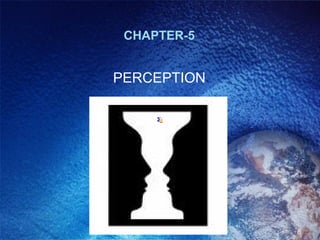
PERCEPTION CHAPTER-5
Objectives of The Chapter To understand Meaning of Perception  Sensation Vs Perception Sub processes  of Perception Perceptual Selectivity Factors influencing Perception Perceptual Organization Social Perception Impression Management Linkage between Perception and Individual decision-making
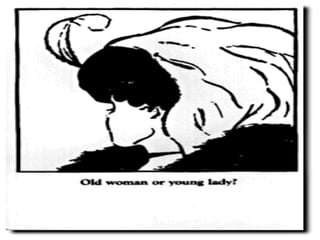
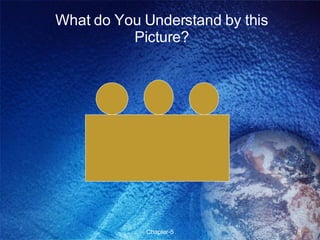
What do You Understand by this Picture?
Meaning of Perception Perception may be defined as the process by which an individual selects, organizes and interprets stimuli into a meaningful and coherent picture of the environment in which he lives.
Sensation Vs Perception Sensation deals with the basic behavior of an individual, caused by his physiological functions. Perception is the process by which an individual selects, organizes and interprets stimuli into a meaningful and coherent picture of the environment in which he lives.
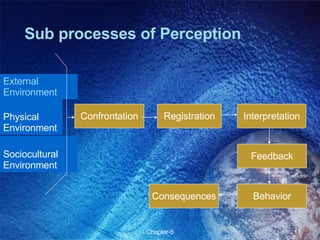
Sub processes of Perception External  Environment  Confrontation Consequences Behavior Feedback Interpretation Registration Sociocultural Environment Physical Environment
Perceptual Selectivity Though people are exposed to several stimuli , they tend to select only a few at a given point of time, this is perceptual selectivity. Subliminal Perception  : when the stimuli is so subtle that an individual may not even be conscious that he is exposed to some stimulus.
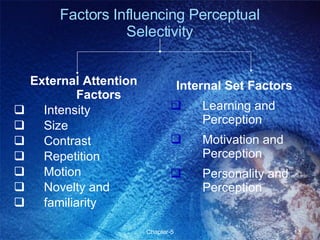
Factors Influencing Perceptual Selectivity External Attention Factors Intensity Size Contrast Repetition Motion Novelty and familiarity Internal Set Factors Learning and Perception Motivation and Perception Personality and Perception
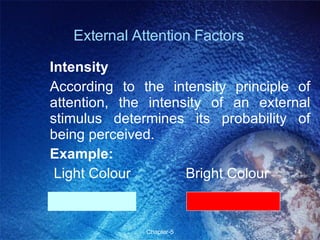
External Attention Factors Intensity According to the intensity principle of attention, the intensity of an external stimulus determines its probability of being perceived. Example: Light Colour    Bright Colour
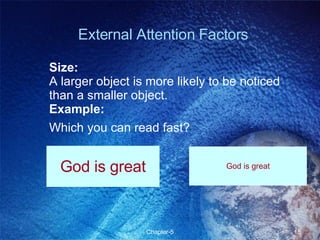
Size: A larger object is more likely to be noticed than a smaller object. Example:  Which you can read fast? God is great God is great External Attention Factors
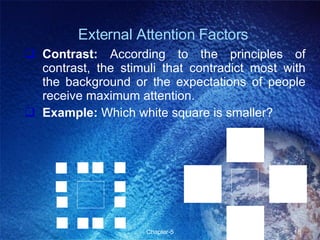
Contrast:  According to the principles of contrast, the stimuli that contradict most with the background or the expectations of people receive maximum attention. Example:  Which white square is smaller? External Attention Factors
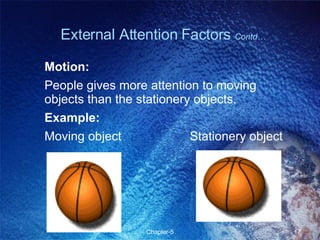
Motion: People gives more attention to moving objects than the stationery objects. Example: Moving object   Stationery object External Attention Factors  Contd…
Repetition The more number of times a stimulus is repeated, the more it is likely to be noticed Novelty and Familiarity: New objects in a familiar situation or familiar  objects in a new situation draw the perceiver’s attention. External Attention Factors  Contd…
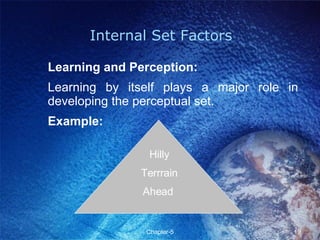
Internal Set Factors Learning and Perception: Learning by itself plays a major role in developing the perceptual set. Example: Hilly Terrrain Ahead
Motivation and  Perception: The primary motives: Hunger and Thirst  The secondary motives: The need for power, The need for affiliation and The need for achievement Personality and Perception :  Personality of a person influence perception
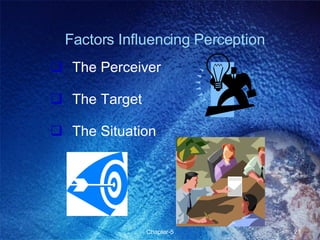
Factors Influencing Perception The Perceiver The Target The Situation
Emphasizes on the subsequent activities that take place in the perceptual Process after a stimulus is received. Perceptual Organization
Forms of Perceptual Organization Figure-ground Perceptual Grouping Closure Continuity Proximity Similarity Perceptual Constancy Perceptual Context Perceptual Defense
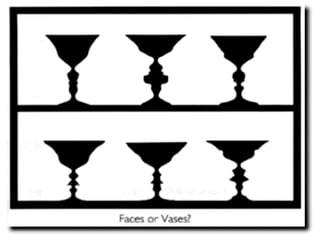
Perceptual Organization Figure-ground: In perceiving stimuli or phenomena, the tendency is to keep certain phenomena in focus and other phenomena in background.
An individual tends to group several stimuli together into a recognizable pattern. Various forms Closure Continuity Proximity  Similarity Perceptual Grouping
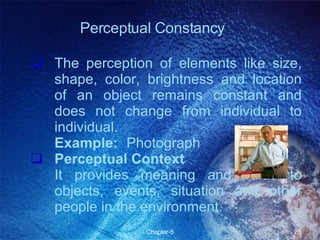
The perception of elements like size, shape, color, brightness and location of an object remains constant and does not change from individual to individual. Example:   Photograph Perceptual Context It provides meaning and value to objects, events, situation and other people in the environment.  Perceptual Constancy
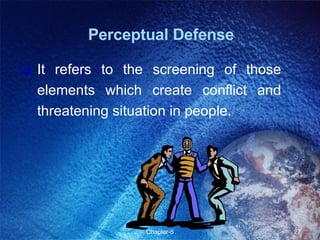
It refers to the screening of those elements which create conflict and threatening situation in people. Perceptual Defense
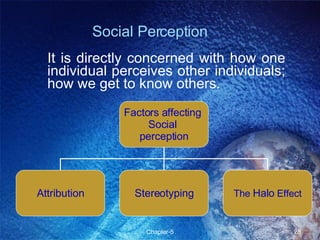
Social Perception It is directly concerned with how one individual perceives other individuals; how we get to know others. Factors affecting  Social  perception Attribution Stereotyping The  Halo  Effect
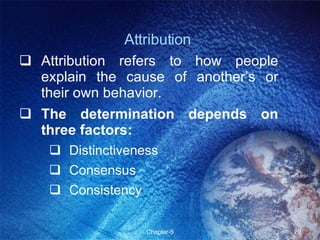
Attribution Attribution refers to how people explain the cause of another’s or their own behavior. The determination depends on three factors: Distinctiveness Consensus Consistency
Stereotyping  It is the tendency to perceive another person as belonging to a single class or category Halo effect The person is perceived on the basis of one trait or event.
Impression Management It is referred to as “ self presentation ” It is the process by which people try to manage or control the perceptions formed by other people about themselves.
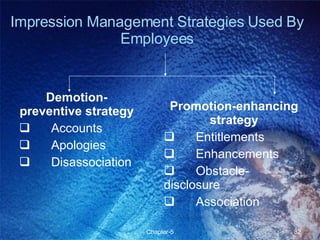
Impression Management Strategies Used By Employees Demotion-preventive strategy Accounts Apologies Disassociation Promotion-enhancing strategy Entitlements Enhancements Obstacle-disclosure Association
It is used when employees want to minimize their responsibilities for negative outcome Accounts Apologies Disassociation Demotion-Preventive Strategy
It is used when  employees want to maximize their responsibility for a positive outcome or improve their image Entitlements  Enhancements Obstacle-disclosure Association Promotion-Enhancing Strategy :
Linkage Between Perception and Individual Decision-making Perception has a crucial role in individual decision-making in organizations, by affecting both the decision  as well as the quality of the decision. The decision taken by an individual is a complex process involving the intake of data, screening procession and interpreting and evaluating of data, based on the perceptions of the individual.
Summary of The Chapter Meaning of Perception  Sensation Vs perception Sub processes  of perception Perceptual selectivity Factors influencing perception Perceptual organization Social Perception Impression management Linkage between perception  and individual decision-Making

Perception

  • 1.
  • 2.
  • 3.
  • 4.
  • 5.
  • 6.
  • 7.
    Objectives of TheChapter To understand Meaning of Perception Sensation Vs Perception Sub processes of Perception Perceptual Selectivity Factors influencing Perception Perceptual Organization Social Perception Impression Management Linkage between Perception and Individual decision-making
  • 8.
    What do YouUnderstand by this Picture?
  • 9.
    Meaning of PerceptionPerception may be defined as the process by which an individual selects, organizes and interprets stimuli into a meaningful and coherent picture of the environment in which he lives.
  • 10.
    Sensation Vs PerceptionSensation deals with the basic behavior of an individual, caused by his physiological functions. Perception is the process by which an individual selects, organizes and interprets stimuli into a meaningful and coherent picture of the environment in which he lives.
  • 11.
    Sub processes ofPerception External Environment Confrontation Consequences Behavior Feedback Interpretation Registration Sociocultural Environment Physical Environment
  • 12.
    Perceptual Selectivity Thoughpeople are exposed to several stimuli , they tend to select only a few at a given point of time, this is perceptual selectivity. Subliminal Perception : when the stimuli is so subtle that an individual may not even be conscious that he is exposed to some stimulus.
  • 13.
    Factors Influencing PerceptualSelectivity External Attention Factors Intensity Size Contrast Repetition Motion Novelty and familiarity Internal Set Factors Learning and Perception Motivation and Perception Personality and Perception
  • 14.
    External Attention FactorsIntensity According to the intensity principle of attention, the intensity of an external stimulus determines its probability of being perceived. Example: Light Colour Bright Colour
  • 15.
    Size: A largerobject is more likely to be noticed than a smaller object. Example: Which you can read fast? God is great God is great External Attention Factors
  • 16.
    Contrast: Accordingto the principles of contrast, the stimuli that contradict most with the background or the expectations of people receive maximum attention. Example: Which white square is smaller? External Attention Factors
  • 17.
    Motion: People givesmore attention to moving objects than the stationery objects. Example: Moving object Stationery object External Attention Factors Contd…
  • 18.
    Repetition The morenumber of times a stimulus is repeated, the more it is likely to be noticed Novelty and Familiarity: New objects in a familiar situation or familiar objects in a new situation draw the perceiver’s attention. External Attention Factors Contd…
  • 19.
    Internal Set FactorsLearning and Perception: Learning by itself plays a major role in developing the perceptual set. Example: Hilly Terrrain Ahead
  • 20.
    Motivation and Perception: The primary motives: Hunger and Thirst The secondary motives: The need for power, The need for affiliation and The need for achievement Personality and Perception : Personality of a person influence perception
  • 21.
    Factors Influencing PerceptionThe Perceiver The Target The Situation
  • 22.
    Emphasizes on thesubsequent activities that take place in the perceptual Process after a stimulus is received. Perceptual Organization
  • 23.
    Forms of PerceptualOrganization Figure-ground Perceptual Grouping Closure Continuity Proximity Similarity Perceptual Constancy Perceptual Context Perceptual Defense
  • 24.
    Perceptual Organization Figure-ground:In perceiving stimuli or phenomena, the tendency is to keep certain phenomena in focus and other phenomena in background.
  • 25.
    An individual tendsto group several stimuli together into a recognizable pattern. Various forms Closure Continuity Proximity Similarity Perceptual Grouping
  • 26.
    The perception ofelements like size, shape, color, brightness and location of an object remains constant and does not change from individual to individual. Example: Photograph Perceptual Context It provides meaning and value to objects, events, situation and other people in the environment. Perceptual Constancy
  • 27.
    It refers tothe screening of those elements which create conflict and threatening situation in people. Perceptual Defense
  • 28.
    Social Perception Itis directly concerned with how one individual perceives other individuals; how we get to know others. Factors affecting Social perception Attribution Stereotyping The Halo Effect
  • 29.
    Attribution Attribution refersto how people explain the cause of another’s or their own behavior. The determination depends on three factors: Distinctiveness Consensus Consistency
  • 30.
    Stereotyping Itis the tendency to perceive another person as belonging to a single class or category Halo effect The person is perceived on the basis of one trait or event.
  • 31.
    Impression Management Itis referred to as “ self presentation ” It is the process by which people try to manage or control the perceptions formed by other people about themselves.
  • 32.
    Impression Management StrategiesUsed By Employees Demotion-preventive strategy Accounts Apologies Disassociation Promotion-enhancing strategy Entitlements Enhancements Obstacle-disclosure Association
  • 33.
    It is usedwhen employees want to minimize their responsibilities for negative outcome Accounts Apologies Disassociation Demotion-Preventive Strategy
  • 34.
    It is usedwhen employees want to maximize their responsibility for a positive outcome or improve their image Entitlements Enhancements Obstacle-disclosure Association Promotion-Enhancing Strategy :
  • 35.
    Linkage Between Perceptionand Individual Decision-making Perception has a crucial role in individual decision-making in organizations, by affecting both the decision as well as the quality of the decision. The decision taken by an individual is a complex process involving the intake of data, screening procession and interpreting and evaluating of data, based on the perceptions of the individual.
  • 36.
    Summary of TheChapter Meaning of Perception Sensation Vs perception Sub processes of perception Perceptual selectivity Factors influencing perception Perceptual organization Social Perception Impression management Linkage between perception and individual decision-Making