CONFLICT RESOLUTION
MADE BY:- MOHIT KUMAR RAI
INTRODUCTION
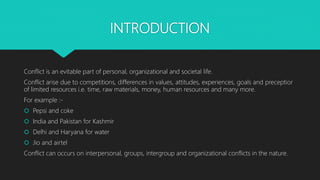
Conflict is an evitable part of personal, organizational and societal life.
Conflict arise due to competitions, differences in values, attitudes, experiences, goals and preceptior
of limited resources i.e. time, raw materials, money, human resources and many more.
For example :-
 Pepsi and coke
 India and Pakistan for Kashmir
 Delhi and Haryana for water
 Jio and airtel
Conflict can occurs on interpersonal, groups, intergroup and organizational conflicts in the nature.
“Perfect organizational health is not
from freedom from conflict. On the
contrary, if properly handled, conflicts
can lead to more effective and
appropriate adjustments”
Professor Kelly (1970)
Conflict as a process where one party
perceives that another party adversely
affected or has tried to affect adversely
something that the first party values
Conflict : Functional or Dysfunctional
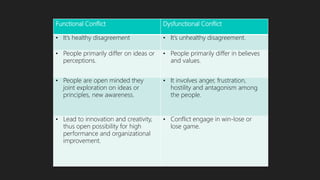
Functional Conflict Dysfunctional Conflict
• It’s healthy disagreement • It’s unhealthy disagreement.
• People primarily differ on ideas or
perceptions.
• People primarily differ in believes
and values.
• People are open minded they
joint exploration on ideas or
principles, new awareness.
• It involves anger, frustration,
hostility and antagonism among
the people.
• Lead to innovation and creativity,
thus open possibility for high
performance and organizational
improvement.
• Conflict engage in win-lose or
lose game.
Managers find it difficult to identify whether
a conflict is functional or dysfunctional
So, what to do?
DL NELSON and JC Quick (2000) suggest using
following questions to diagnose as to whether a
conflict is functional and dysfunctional:
• Are the parties to conflict hostile to each other?
• Is the outcome likely to be negative one for the
organizational?
• Do the potential losses of the parties exceed
any potential gains?
• Is energy diverted from goal accomplishment?
Another situation when you as a manger
would like to stimulate conflict is when group
is in the process of groupthink and is not
willing to examine various alternatives and its
creativity has gone down.
Conflict: TYPES AND FORMS
HAIMAN CONFLICT MODEL
INTRINSIC EXTRINSIC
Conflict has rational, ideational or
intellectual contents.
Conflict has psychological and
emotional
Resolving requires analytical
approach and skills.
Resolving requires social tact
and diplomacy.
COSER
REALISTIC NON-REALISTIC
Conflict have rational,
task or goal oriented,
confrontation
Conflict are related to
projected frustrations
and emotions
Guetzko and Gyr
Substantive conflict
• Task related conflicts
Affective conflict
• Socio-emotional or interpersonal relations issues
Morton and Deutsch suggested
Resources
Preferences and
Nuissances
Values
Beliefs
Nature of
relationship
between
parties
Deutsch proposed six types of conflict
 Veridical Conflict
 Contingent Conflict
 Displaced Conflict
 Misattributed Conflict
 Latent Conflict
 False Conflict
Robbins (2001)
Task Conflict
Relationship
Conflict
Process
Conflict
Level of Conflict in an Organization
Inter-organizational Conflict
Inter- Group Conflict
Inter-Personal Conflict
Inter-Role Conflict
Personal Role
Conflict
SOURCES OF CONFLICT
Pareek has proposed seven main sources of
conflict
CONFLICT PROCESS
LATENT
CONFLICT
PERCEIVE
CONFLICT
FELT
CONFLICT
AFTERMATH
CONFLICT
MANIFEST
CONFLICT
LOIS PONDY
DONELSON FORSYTH
ESCALATION
DE-ESCALATION
RESOLUTION
ROUTINE
GROUP
INTERACTION
DISAGREEMENT
CONFRONTATI
N
STYLES OF CONFLICT MANAGEMENT
 FIVE CONFLICT MANAGEMENT STYLES
 CONTINGENCY APPROACH TO CONFLICT MANAGEMENT
 PAREEK’S MODEL OF CONFLICT MANAGEMENT
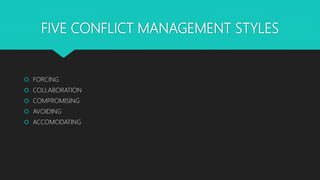
FIVE CONFLICT MANAGEMENT STYLES
 FORCING
 COLLABORATION
 COMPROMISING
 AVOIDING
 ACCOMODATING
CONTINGENCY APPROACH TO CONFLICT
MANAGEMENT
PAREEK’S MODEL OF CONFLICT
MANAGEMENT

Conflict resolution

  • 1.
  • 2.
    INTRODUCTION Conflict is anevitable part of personal, organizational and societal life. Conflict arise due to competitions, differences in values, attitudes, experiences, goals and preceptior of limited resources i.e. time, raw materials, money, human resources and many more. For example :-  Pepsi and coke  India and Pakistan for Kashmir  Delhi and Haryana for water  Jio and airtel Conflict can occurs on interpersonal, groups, intergroup and organizational conflicts in the nature.
  • 3.
    “Perfect organizational healthis not from freedom from conflict. On the contrary, if properly handled, conflicts can lead to more effective and appropriate adjustments” Professor Kelly (1970)
  • 4.
    Conflict as aprocess where one party perceives that another party adversely affected or has tried to affect adversely something that the first party values
  • 5.
    Conflict : Functionalor Dysfunctional
  • 6.
    Functional Conflict DysfunctionalConflict • It’s healthy disagreement • It’s unhealthy disagreement. • People primarily differ on ideas or perceptions. • People primarily differ in believes and values. • People are open minded they joint exploration on ideas or principles, new awareness. • It involves anger, frustration, hostility and antagonism among the people. • Lead to innovation and creativity, thus open possibility for high performance and organizational improvement. • Conflict engage in win-lose or lose game.
  • 7.
    Managers find itdifficult to identify whether a conflict is functional or dysfunctional So, what to do?
  • 8.
    DL NELSON andJC Quick (2000) suggest using following questions to diagnose as to whether a conflict is functional and dysfunctional: • Are the parties to conflict hostile to each other? • Is the outcome likely to be negative one for the organizational? • Do the potential losses of the parties exceed any potential gains? • Is energy diverted from goal accomplishment?
  • 9.
    Another situation whenyou as a manger would like to stimulate conflict is when group is in the process of groupthink and is not willing to examine various alternatives and its creativity has gone down.
  • 10.
  • 11.
    HAIMAN CONFLICT MODEL INTRINSICEXTRINSIC Conflict has rational, ideational or intellectual contents. Conflict has psychological and emotional Resolving requires analytical approach and skills. Resolving requires social tact and diplomacy.
  • 12.
    COSER REALISTIC NON-REALISTIC Conflict haverational, task or goal oriented, confrontation Conflict are related to projected frustrations and emotions
  • 13.
    Guetzko and Gyr Substantiveconflict • Task related conflicts Affective conflict • Socio-emotional or interpersonal relations issues
  • 14.
    Morton and Deutschsuggested Resources Preferences and Nuissances Values Beliefs Nature of relationship between parties
  • 15.
    Deutsch proposed sixtypes of conflict  Veridical Conflict  Contingent Conflict  Displaced Conflict  Misattributed Conflict  Latent Conflict  False Conflict
  • 16.
  • 17.
    Level of Conflictin an Organization Inter-organizational Conflict Inter- Group Conflict Inter-Personal Conflict Inter-Role Conflict Personal Role Conflict
  • 18.
  • 19.
    Pareek has proposedseven main sources of conflict
  • 20.
  • 21.
  • 22.
  • 23.
    STYLES OF CONFLICTMANAGEMENT  FIVE CONFLICT MANAGEMENT STYLES  CONTINGENCY APPROACH TO CONFLICT MANAGEMENT  PAREEK’S MODEL OF CONFLICT MANAGEMENT
  • 24.
    FIVE CONFLICT MANAGEMENTSTYLES  FORCING  COLLABORATION  COMPROMISING  AVOIDING  ACCOMODATING
  • 25.
    CONTINGENCY APPROACH TOCONFLICT MANAGEMENT
  • 26.
    PAREEK’S MODEL OFCONFLICT MANAGEMENT