Conflict and Negotiation in the Workplace McGraw-Hill/Irwin McShane/Von Glinow OB 5e Copyright © 2010 by The McGraw-Hill Companies, Inc. All rights reserved.
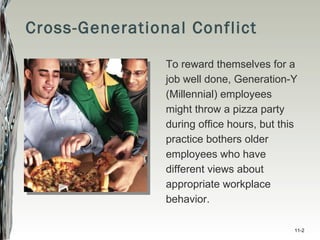
Cross-Generational Conflict To reward themselves for a job well done, Generation-Y (Millennial) employees might throw a pizza party during office hours, but this practice bothers older employees who have different views about appropriate workplace behavior. 11-
Conflict Defined The process in which one party perceives that its interests are being opposed or negatively affected by another party 11-
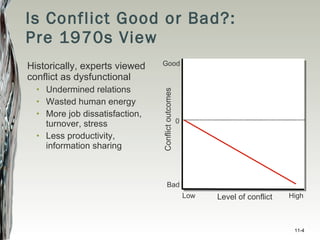
Is Conflict Good or Bad?: Pre 1970s View Historically, experts viewed conflict as dysfunctional Undermined relations Wasted human energy More job dissatisfaction, turnover, stress Less productivity, information sharing 11- Level of conflict Conflict outcomes Bad Good Low High 0
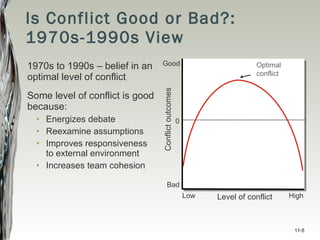
Is Conflict Good or Bad?: 1970s-1990s View 1970s to 1990s – belief in an optimal level of conflict Some level of conflict is good because: Energizes debate Reexamine assumptions Improves responsiveness to external environment Increases team cohesion 11- Level of conflict Conflict outcomes Bad Good Low High 0 Optimal conflict
Is Conflict Good or Bad?: Emerging View Two types of conflict Constructive conflict --  Conflict is aimed at issue, not parties Relationship conflict --  Conflict is aimed at undermining the other party 11-
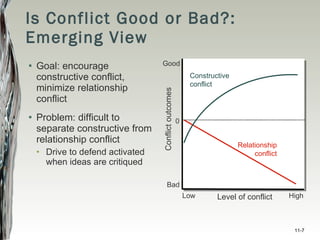
Is Conflict Good or Bad?: Emerging View Goal: encourage constructive conflict, minimize relationship conflict Problem: difficult to separate constructive from relationship conflict Drive to defend activated when ideas are critiqued Constructive conflict Relationship conflict 11- Level of conflict Conflict outcomes Bad Good Low High 0
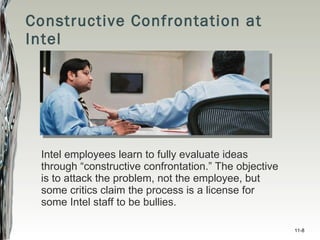
Constructive Confrontation at Intel Intel employees learn to fully evaluate ideas through “constructive confrontation.” The objective is to attack the problem, not the employee, but some critics claim the process is a license for some Intel staff to be bullies. 11-
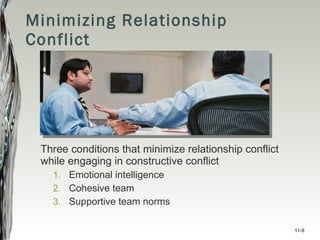
Minimizing Relationship Conflict Three conditions that minimize relationship conflict while engaging in constructive conflict Emotional intelligence Cohesive team Supportive team norms 11-
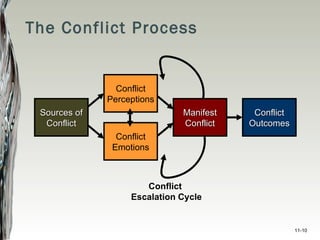
The Conflict Process Sources of Conflict Conflict  Escalation Cycle 11- Manifest Conflict Conflict Outcomes Conflict Perceptions Conflict Emotions
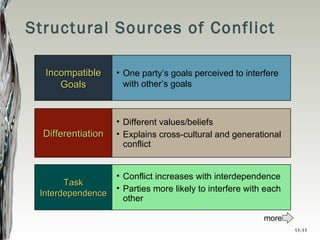
Structural Sources of Conflict Differentiation Task Interdependence Different values/beliefs Explains cross-cultural and generational conflict Conflict increases with interdependence Parties more likely to interfere with each other  Incompatible Goals One party’s goals perceived to interfere with other’s goals 11- more
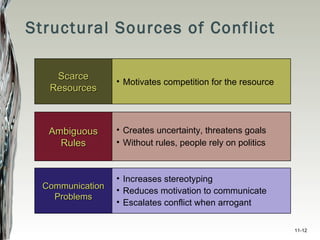
Structural Sources of Conflict Ambiguous Rules Communication Problems Creates uncertainty, threatens goals Without rules, people rely on politics  Increases stereotyping  Reduces motivation to communicate Escalates conflict when arrogant Scarce Resources Motivates competition for the resource 11-
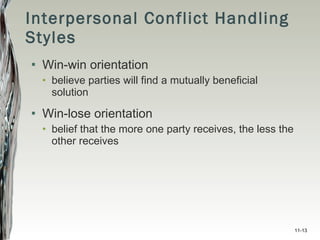
Interpersonal Conflict Handling Styles Win-win orientation believe parties will find a mutually beneficial solution Win-lose orientation belief that the more one party receives, the less the other receives 11-
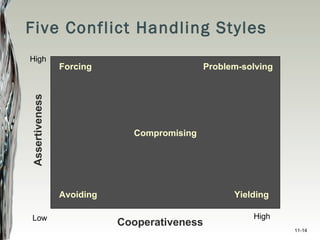
Five Conflict Handling Styles Assertiveness Cooperativeness Forcing Problem-solving Compromising Avoiding Yielding High Low High 11-
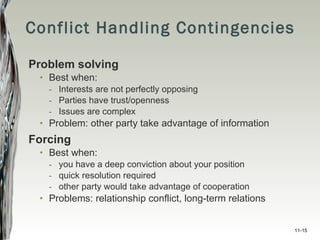
Conflict Handling Contingencies Problem solving Best when: Interests are not perfectly opposing Parties have trust/openness Issues are complex Problem: other party take advantage of information Forcing Best when: you have a deep conviction about your position quick resolution required other party would take advantage of cooperation Problems: relationship conflict, long-term relations 11-
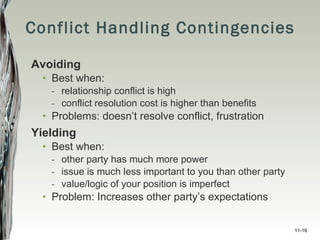
Conflict Handling Contingencies Avoiding Best when: relationship conflict is high conflict resolution cost is higher than benefits Problems: doesn’t resolve conflict, frustration Yielding Best when: other party has much more power issue is much less important to you than other party value/logic of your position is imperfect Problem: Increases other party’s expectations 11-
Conflict Handling Contingencies Compromising Best when… Parties have equal power Quick solution is required Parties lack trust/openness Problem:  Sub-optimal solution where mutual gains are possible 11-
Structural Approaches to Conflict Resolution Emphasizing superordinate goals Emphasize common objective rather than conflicting sub-goals Reduces goal incompatibility and differentiation Reducing differentiation Remove sources of different values and beliefs e.g. Move employees around to different jobs 11-
Structural Approaches to Conflict Resolution (con’t) Improving communication/understanding Employees understand and appreciate each other’s views through communication Relates to contact hypothesis Two warnings: Apply communication/understanding after reducing differentiation A Western strategy that may conflict with values/traditions in other cultures  11-
Structural Approaches to Conflict Resolution (con’t) Reduce Task Interdependence Dividing shared resources Combine tasks Use buffers Increase Resources Duplicate resources Clarify Rules and Procedures Clarify resource distribution Change interdependence 11-
Resolving Conflict Through Negotiation Negotiation -- attempting to resolve divergent goals by redefining terms of interdependence Which conflict handling style is best in negotiation? Begin cautiously with problem-solving style Shift to a win-lose style when Mutual gains situation isn’t apparent Other part won’t reciprocate info sharing 11-
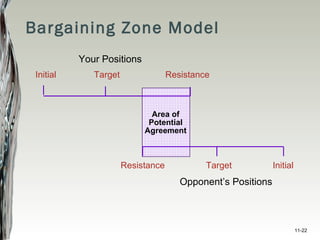
Bargaining Zone Model Your Positions Opponent’s Positions Area of Potential Agreement 11- Initial Target Initial Target Resistance Resistance
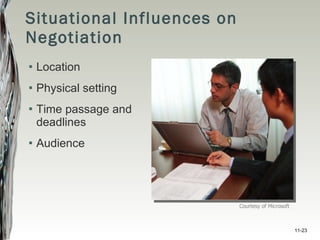
Situational Influences on Negotiation Location Physical setting Time passage and deadlines Audience Courtesy of Microsoft 11-
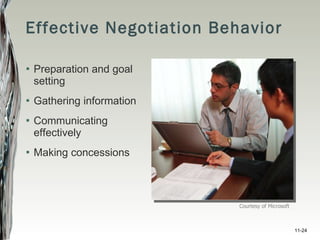
Effective Negotiation Behavior Preparation and goal setting Gathering information Communicating effectively Making concessions Courtesy of Microsoft 11-
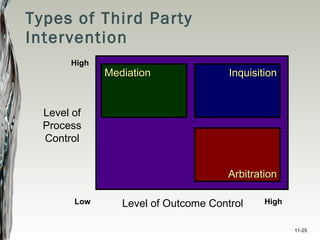
Types of Third Party Intervention Mediation Arbitration Inquisition Level of Process Control Level of Outcome Control High High Low 11-
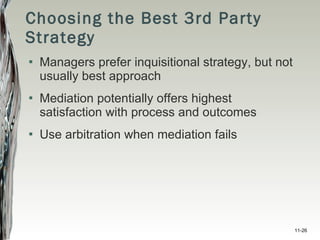
Choosing the Best 3rd Party Strategy Managers prefer inquisitional strategy, but not usually best approach Mediation potentially offers highest satisfaction with process and outcomes Use arbitration when mediation fails 11-
Conflict and Negotiation in the Workplace 11- McGraw-Hill/Irwin McShane/Von Glinow OB 5e Copyright © 2010 by The McGraw-Hill Companies, Inc. All rights reserved.

Conflict Resolution

  • 1.
    Conflict and Negotiationin the Workplace McGraw-Hill/Irwin McShane/Von Glinow OB 5e Copyright © 2010 by The McGraw-Hill Companies, Inc. All rights reserved.
  • 2.
    Cross-Generational Conflict Toreward themselves for a job well done, Generation-Y (Millennial) employees might throw a pizza party during office hours, but this practice bothers older employees who have different views about appropriate workplace behavior. 11-
  • 3.
    Conflict Defined Theprocess in which one party perceives that its interests are being opposed or negatively affected by another party 11-
  • 4.
    Is Conflict Goodor Bad?: Pre 1970s View Historically, experts viewed conflict as dysfunctional Undermined relations Wasted human energy More job dissatisfaction, turnover, stress Less productivity, information sharing 11- Level of conflict Conflict outcomes Bad Good Low High 0
  • 5.
    Is Conflict Goodor Bad?: 1970s-1990s View 1970s to 1990s – belief in an optimal level of conflict Some level of conflict is good because: Energizes debate Reexamine assumptions Improves responsiveness to external environment Increases team cohesion 11- Level of conflict Conflict outcomes Bad Good Low High 0 Optimal conflict
  • 6.
    Is Conflict Goodor Bad?: Emerging View Two types of conflict Constructive conflict -- Conflict is aimed at issue, not parties Relationship conflict -- Conflict is aimed at undermining the other party 11-
  • 7.
    Is Conflict Goodor Bad?: Emerging View Goal: encourage constructive conflict, minimize relationship conflict Problem: difficult to separate constructive from relationship conflict Drive to defend activated when ideas are critiqued Constructive conflict Relationship conflict 11- Level of conflict Conflict outcomes Bad Good Low High 0
  • 8.
    Constructive Confrontation atIntel Intel employees learn to fully evaluate ideas through “constructive confrontation.” The objective is to attack the problem, not the employee, but some critics claim the process is a license for some Intel staff to be bullies. 11-
  • 9.
    Minimizing Relationship ConflictThree conditions that minimize relationship conflict while engaging in constructive conflict Emotional intelligence Cohesive team Supportive team norms 11-
  • 10.
    The Conflict ProcessSources of Conflict Conflict Escalation Cycle 11- Manifest Conflict Conflict Outcomes Conflict Perceptions Conflict Emotions
  • 11.
    Structural Sources ofConflict Differentiation Task Interdependence Different values/beliefs Explains cross-cultural and generational conflict Conflict increases with interdependence Parties more likely to interfere with each other Incompatible Goals One party’s goals perceived to interfere with other’s goals 11- more
  • 12.
    Structural Sources ofConflict Ambiguous Rules Communication Problems Creates uncertainty, threatens goals Without rules, people rely on politics Increases stereotyping Reduces motivation to communicate Escalates conflict when arrogant Scarce Resources Motivates competition for the resource 11-
  • 13.
    Interpersonal Conflict HandlingStyles Win-win orientation believe parties will find a mutually beneficial solution Win-lose orientation belief that the more one party receives, the less the other receives 11-
  • 14.
    Five Conflict HandlingStyles Assertiveness Cooperativeness Forcing Problem-solving Compromising Avoiding Yielding High Low High 11-
  • 15.
    Conflict Handling ContingenciesProblem solving Best when: Interests are not perfectly opposing Parties have trust/openness Issues are complex Problem: other party take advantage of information Forcing Best when: you have a deep conviction about your position quick resolution required other party would take advantage of cooperation Problems: relationship conflict, long-term relations 11-
  • 16.
    Conflict Handling ContingenciesAvoiding Best when: relationship conflict is high conflict resolution cost is higher than benefits Problems: doesn’t resolve conflict, frustration Yielding Best when: other party has much more power issue is much less important to you than other party value/logic of your position is imperfect Problem: Increases other party’s expectations 11-
  • 17.
    Conflict Handling ContingenciesCompromising Best when… Parties have equal power Quick solution is required Parties lack trust/openness Problem: Sub-optimal solution where mutual gains are possible 11-
  • 18.
    Structural Approaches toConflict Resolution Emphasizing superordinate goals Emphasize common objective rather than conflicting sub-goals Reduces goal incompatibility and differentiation Reducing differentiation Remove sources of different values and beliefs e.g. Move employees around to different jobs 11-
  • 19.
    Structural Approaches toConflict Resolution (con’t) Improving communication/understanding Employees understand and appreciate each other’s views through communication Relates to contact hypothesis Two warnings: Apply communication/understanding after reducing differentiation A Western strategy that may conflict with values/traditions in other cultures 11-
  • 20.
    Structural Approaches toConflict Resolution (con’t) Reduce Task Interdependence Dividing shared resources Combine tasks Use buffers Increase Resources Duplicate resources Clarify Rules and Procedures Clarify resource distribution Change interdependence 11-
  • 21.
    Resolving Conflict ThroughNegotiation Negotiation -- attempting to resolve divergent goals by redefining terms of interdependence Which conflict handling style is best in negotiation? Begin cautiously with problem-solving style Shift to a win-lose style when Mutual gains situation isn’t apparent Other part won’t reciprocate info sharing 11-
  • 22.
    Bargaining Zone ModelYour Positions Opponent’s Positions Area of Potential Agreement 11- Initial Target Initial Target Resistance Resistance
  • 23.
    Situational Influences onNegotiation Location Physical setting Time passage and deadlines Audience Courtesy of Microsoft 11-
  • 24.
    Effective Negotiation BehaviorPreparation and goal setting Gathering information Communicating effectively Making concessions Courtesy of Microsoft 11-
  • 25.
    Types of ThirdParty Intervention Mediation Arbitration Inquisition Level of Process Control Level of Outcome Control High High Low 11-
  • 26.
    Choosing the Best3rd Party Strategy Managers prefer inquisitional strategy, but not usually best approach Mediation potentially offers highest satisfaction with process and outcomes Use arbitration when mediation fails 11-
  • 27.
    Conflict and Negotiationin the Workplace 11- McGraw-Hill/Irwin McShane/Von Glinow OB 5e Copyright © 2010 by The McGraw-Hill Companies, Inc. All rights reserved.