Biogeochemical Cycles
Water
Nitrogen
Carbon Dioxide
Phosphorus
Sulfur
By Laiba Sarwar
Biogeochemical Cycle :
• Chemical elements are required by life from the living and
nonliving parts of the environment.
• These elements cycle in either a gas cycle or a sedimentary
cycle
• In a gas cycle elements move through the atmosphere.
• Main reservoirs are the atmosphere and the ocean.
• Sedimentary cycle elements move from land to water to
sediment.
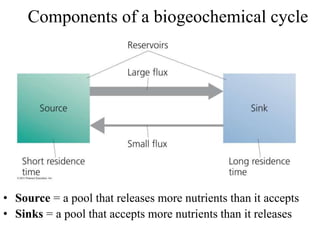
Components of a biogeochemical cycle
• Source = a pool that releases more nutrients than it accepts
• Sinks = a pool that accepts more nutrients than it releases
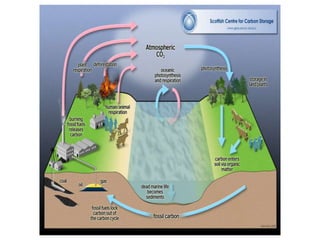
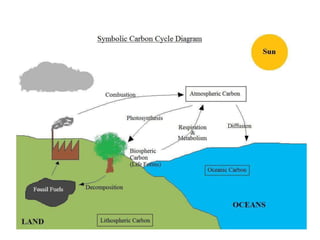
Carbon Cycle
Sediment storage of carbon
• Decomposition returns carbon to the sediment
– The largest reservoir of carbon
– May be trapped for hundreds of millions of years
• Aquatic organisms die and settle in the sediment
– Older layers are buried deeply and undergo high
pressure
– Ultimately, it may be converted into fossil fuels
• Oceans are the second largest reservoir of carbon
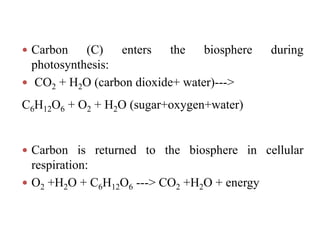
 Carbon (C) enters the biosphere during
photosynthesis:
 CO2 + H2O (carbon dioxide+ water)--->
C6H12O6 + O2 + H2O (sugar+oxygen+water)
 Carbon is returned to the biosphere in cellular
respiration:
 O2 +H2O + C6H12O6 ---> CO2 +H2O + energy
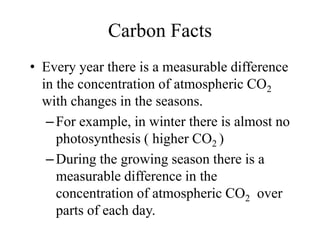
Carbon Facts
• Every year there is a measurable difference
in the concentration of atmospheric CO2
with changes in the seasons.
–For example, in winter there is almost no
photosynthesis ( higher CO2 )
–During the growing season there is a
measurable difference in the
concentration of atmospheric CO2 over
parts of each day.
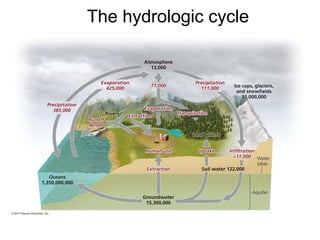
The Hydrologic cycle
• Water is essential for biochemical reactions
–It is involved in nearly every environmental
system
• Hydrologic cycle = summarizes how liquid,
gaseous and solid water flows through the
environment
–Oceans are the main reservoir
•Evaporation = water moves from aquatic
and land systems into the atmosphere
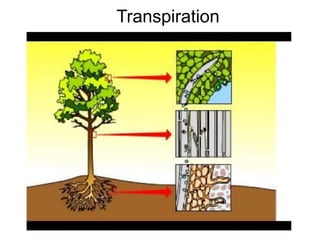
•Transpiration = release of water vapor by
plants
•Precipitation, runoff, and surface water =
water returns to Earth as rain or snow and
flows into streams, oceans, etc.
Evaporation
•The process by which liquid water is
transformed into a gaseous state
•Evaporation into a gas ceases when the gas
reaches saturation
•The molecules that escape the condensed stage have
above-average energies.
•Those left behind have below-average energies
•Manifested by a decrease in the temperature of the
condensed phase.
Evaporation
• Energy breaks bonds that hold molecules together
• Net evaporation occurs when the rate of
evaporation exceeds the rate of condensation
• Removes heat from the environment:
Net Cooling
Primary mechanism for surface-to-atmosphere water
transport
Evaporation v. Precipitation
• About equal on a global scale
• Evaporation more prevalent over the oceans than
precipitation
• Over land, precipitation exceeds evaporation
• Most water evaporated from the oceans falls back into
the ocean as precipitation
• 10% of water evaporated from the ocean is transported
over land and falls as precipitation
• Once evaporated, a water molecule spends ~ 10 days
airborne
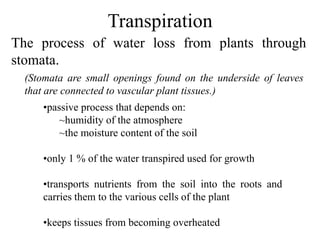
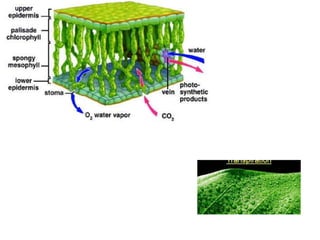
The process of water loss from plants through
stomata.
•passive process that depends on:
~humidity of the atmosphere
~the moisture content of the soil
•only 1 % of the water transpired used for growth
•transports nutrients from the soil into the roots and
carries them to the various cells of the plant
•keeps tissues from becoming overheated
(Stomata are small openings found on the underside of leaves
that are connected to vascular plant tissues.)
Transpiration
Transpiration
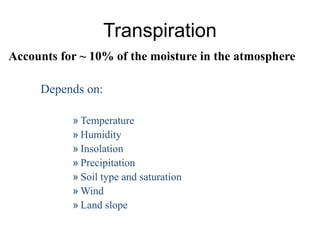
Accounts for ~ 10% of the moisture in the atmosphere
Depends on:
» Temperature
» Humidity
» Insolation
» Precipitation
» Soil type and saturation
» Wind
» Land slope
Transpiration
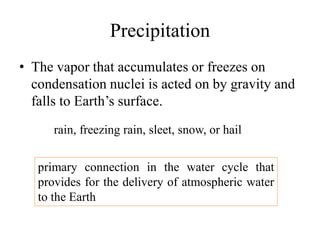
Precipitation
• The vapor that accumulates or freezes on
condensation nuclei is acted on by gravity and
falls to Earth’s surface.
rain, freezing rain, sleet, snow, or hail
primary connection in the water cycle that
provides for the delivery of atmospheric water
to the Earth
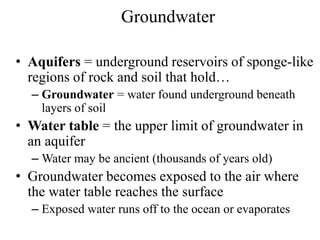
Groundwater
• Aquifers = underground reservoirs of sponge-like
regions of rock and soil that hold…
– Groundwater = water found underground beneath
layers of soil
• Water table = the upper limit of groundwater in
an aquifer
– Water may be ancient (thousands of years old)
• Groundwater becomes exposed to the air where
the water table reaches the surface
– Exposed water runs off to the ocean or evaporates
The hydrologic cycle
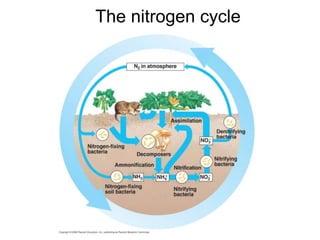
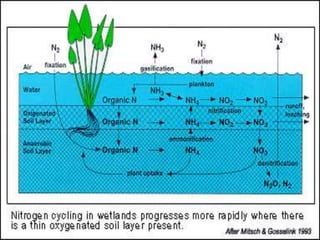
The Nitrogen Cycle
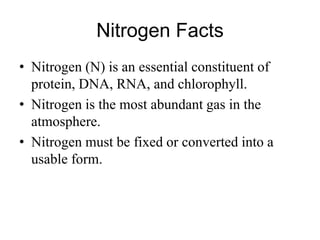
Nitrogen Facts
• Nitrogen (N) is an essential constituent of
protein, DNA, RNA, and chlorophyll.
• Nitrogen is the most abundant gas in the
atmosphere.
• Nitrogen must be fixed or converted into a
usable form.
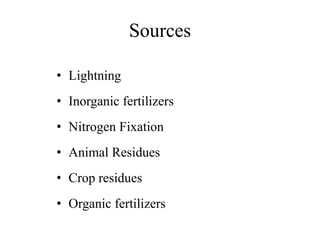
Sources
• Lightning
• Inorganic fertilizers
• Nitrogen Fixation
• Animal Residues
• Crop residues
• Organic fertilizers
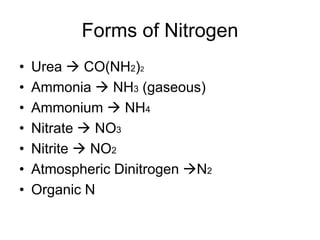
Forms of Nitrogen
• Urea  CO(NH2)2
• Ammonia  NH3 (gaseous)
• Ammonium  NH4
• Nitrate  NO3
• Nitrite  NO2
• Atmospheric Dinitrogen N2
• Organic N
• Nitrogen comprises 78% of our atmosphere
– It is contained in proteins, DNA and RNA
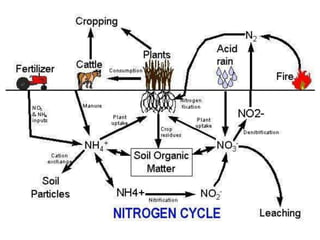
• Nitrogen cycle = describes the routes that
nitrogen atoms take through the environment
– Nitrogen gas cannot be used by organisms
• Nitrogen fixation = lightning or nitrogen-fixing
bacteria combine (fix) nitrogen with hydrogen
– To form ammonium
– Which can be used
by plants
Nitrification and Denitrification
• Nitrification = bacteria convert ammonium ions first
into nitrite ions then into nitrate ions
– Plants can take up these ions
• Animals obtain nitrogen by eating plants or other
animals
• Decomposers get it from dead and decaying plants or
other animals
– Releasing ammonium ions to nitrifying bacteria
• Denitrifying bacteria = convert nitrates in soil or
water to gaseous nitrogen
– Releasing it back into the atmosphere
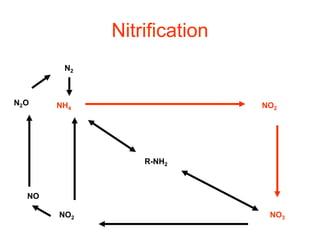
Nitrification
R-NH2
NH4 NO2
NO3NO2
NO
N2O
N2
Nitrification
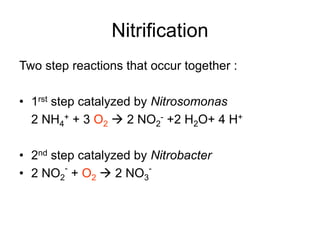
Two step reactions that occur together :
• 1rst step catalyzed by Nitrosomonas
2 NH4
+ + 3 O2  2 NO2
- +2 H2O+ 4 H+
• 2nd step catalyzed by Nitrobacter
• 2 NO2
-
+ O2  2 NO3
-
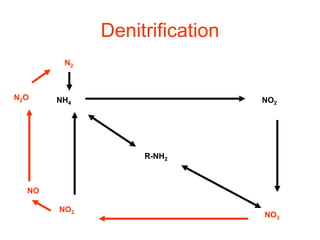
Denitrification
R-NH2
NH4 NO2
NO3
NO2
NO
N2O
N2
Denitrification
• Removes a limiting nutrient from the
environment
• 4NO3
-
+ C6H12O6 2N2 + 6 H20
• Inhibited by O2
• Not inhibited by ammonia
• Microbial reaction
• Nitrate is the terminal electron acceptor
The nitrogen cycle
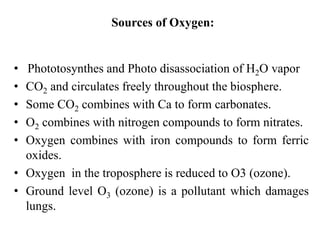
Sources of Oxygen:
• Phototosynthes and Photo disassociation of H2O vapor
• CO2 and circulates freely throughout the biosphere.
• Some CO2 combines with Ca to form carbonates.
• O2 combines with nitrogen compounds to form nitrates.
• Oxygen combines with iron compounds to form ferric
oxides.
• Oxygen2 in the troposphere is reduced to O3 (ozone).
• Ground level O3 (ozone) is a pollutant which damages
lungs.
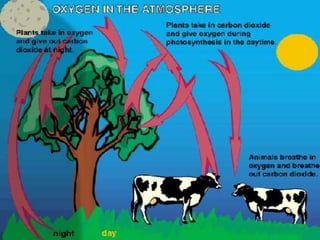
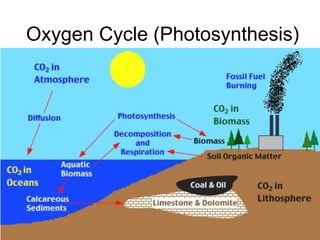
Oxygen Cycle (Photosynthesis)
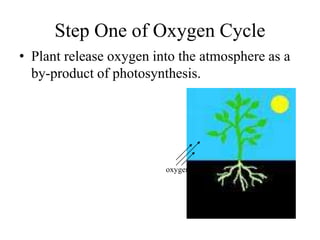
Step One of Oxygen Cycle
• Plant release oxygen into the atmosphere as a
by-product of photosynthesis.
oxygen
Step Two of Oxygen Cycle
• Animals take in oxygen through the process of
respiration.
• Animals then break down sugars and food.
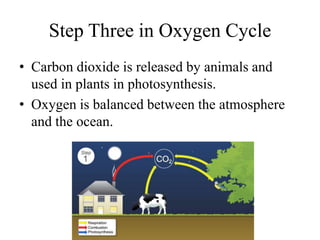
Step Three in Oxygen Cycle
• Carbon dioxide is released by animals and
used in plants in photosynthesis.
• Oxygen is balanced between the atmosphere
and the ocean.
Phosphorus (P) Cycle
Component of DNA, RNA, ATP, proteins and enzymes
- Cycles in a sedimentary cycle
- A good example of how a mineral element becomes part of an
organism.
- The source of Phosphorus (P) is rock.
- Phosphorus is released into the cycle through erosion or mining.
- Phosphorus is soluble in H2O as phosphate (PO4)
-Phosphorus is taken up by plant roots, then travels through food
chains.
- It is returned to sediment
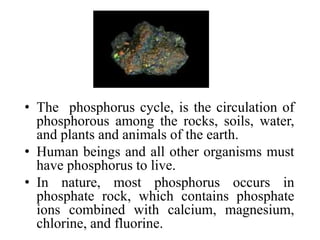
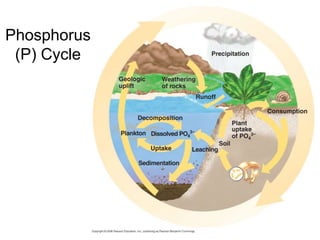
• The phosphorus cycle, is the circulation of
phosphorous among the rocks, soils, water,
and plants and animals of the earth.
• Human beings and all other organisms must
have phosphorus to live.
• In nature, most phosphorus occurs in
phosphate rock, which contains phosphate
ions combined with calcium, magnesium,
chlorine, and fluorine.
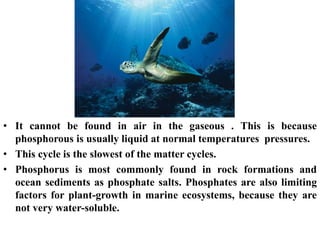
• It cannot be found in air in the gaseous . This is because
phosphorous is usually liquid at normal temperatures pressures.
• This cycle is the slowest of the matter cycles.
• Phosphorus is most commonly found in rock formations and
ocean sediments as phosphate salts. Phosphates are also limiting
factors for plant-growth in marine ecosystems, because they are
not very water-soluble.
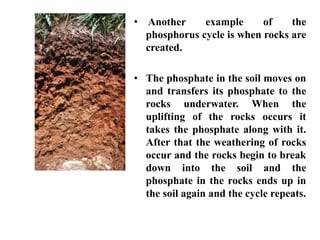
• Another example of the
phosphorus cycle is when rocks are
created.
• The phosphate in the soil moves on
and transfers its phosphate to the
rocks underwater. When the
uplifting of the rocks occurs it
takes the phosphate along with it.
After that the weathering of rocks
occur and the rocks begin to break
down into the soil and the
phosphate in the rocks ends up in
the soil again and the cycle repeats.
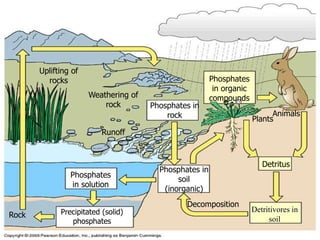
Uplifting of
rocks
Weathering of
rock
Runoff
Phosphates in
rock
Phosphates in
soil
(inorganic)
Phosphates
in solution
Precipitated (solid)
phosphates
Rock
Decomposition
Phosphates
in organic
compounds
Plants
Animals
Detritus
Detritivores in
soil
 All these examples of phosphates are inorganic
(white boxes). However, the Phosphorus Cycle is also
organic (yellow boxes).
Not all phosphates in the runoff make it to the water;
others sink into the soil. These inorganic phosphates are
transformed into organic ones by plants, which are in
turn eaten by animals.
 The dead animals, retain their internal phosphorus
stores and detritivores (scavengers which feed on dead
plants and animals or their waste) change the organic
phosphates back to inorganic ones.
Phosphorus
(P) Cycle
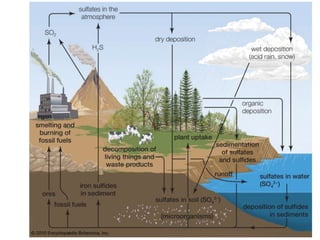
Sulfur (s) Cycle
• Component of protein
• Cycles in both a gas and sedimentary cycle.
• The source of Sulfur is the lithosphere (earth's crust)
• Sulfur (S) enters the atmosphere as hydrogen
sulfide (H2S) during fossil fuel combustion, volcanic
eruptions, gas exchange at ocean surfaces, and decomposition.
•
• SO2 and water vapor makes H2SO4 ( a weak sulfuric
acid), which is then carried to Earth in rainfall.
• Sulfur in soluble form is taken up by plant roots and
incorporated into amino acids such as cysteine. It
then travels through the food chain and is eventually
released through decomposition.
Summary
• The building blocks of life :Water ,Nitrogen, Carbon
Dioxide, Phosphorus, Sulfur
• Continually cycle through Earth's systems, the
atmosphere, hydrosphere, biosphere, and lithosphere,
on time scales that range from a few days to millions
of years.
• These cycles are called biogeochemical cycles,
because they include a variety of biological,
geological, and chemical processes.
Human impacts on the hydrologic
cycle
• Removing forests and vegetation increases runoff and
erosion, reduces transpiration and lowers water tables
• Irrigating agricultural fields depletes rivers, lakes and
streams and increases evaporation
• Damming rivers increases evaporation and infiltration
• Emitting pollutants changes the nature of precipitation
• The most threatening impact: overdrawing groundwater for
drinking, irrigation, and industrial use
– Water shortages create worldwide conflicts
Humans affect the carbon cycle
• Burning fossil fuels moves carbon from the
ground to the air
• Cutting forests and burning fields moves carbon
from vegetation to the air
• Today’s atmospheric carbon dioxide reservoir is
the largest in the past 800,000 years
– It is the driving force behind climate change
• The missing carbon sink: 1-2 billion metric tons
of carbon are unaccounted for
– It may be taken up by plants or soils of northern
temperate and boreal forests
Humans affect the nitrogen cycle
• Haber-Bosch process = production of fertilizers by
combining nitrogen and hydrogen to synthesize ammonia
– Humans overcame the limits on crop productivity
• Fixing atmospheric nitrogen with fertilizers
– Increases emissions of greenhouse gases and smog
– Washes calcium and potassium out of soil
– Acidifies water and soils
– Moves nitrogen into terrestrial systems and oceans
– Reduces diversity of plants adapted to low-nitrogen
soils
– Changed estuaries and coastal ecosystems and fisheries
Humans affect the phosphorus cycle
• Mining rocks for fertilizer moves phosphorus
from the soil to water systems
• Wastewater discharge also releases phosphorus
• Runoff containing phosphorus causes
eutrophication of aquatic systems
– Produces murkier waters
– Alters the structure and function of aquatic systems
– Do not buy detergents that contain phosphate
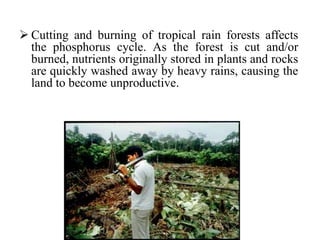
 Cutting and burning of tropical rain forests affects
the phosphorus cycle. As the forest is cut and/or
burned, nutrients originally stored in plants and rocks
are quickly washed away by heavy rains, causing the
land to become unproductive.
 Agricultural runoff
provides much of the
phosphate found in
waterways. Crops often
cannot absorb all of the
fertilizer in the soils,
causing excess fertilizer
runoff and increasing
phosphate levels in rivers
and other bodies of water.
The phosphate in the water
is eventually precipitated as
sediments at the bottom of
the body of water. In
certain lakes and ponds this
may be re-dissolved and
recycled as a problem
nutrient.
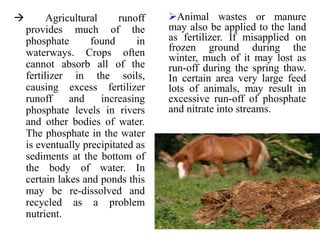
Animal wastes or manure
may also be applied to the land
as fertilizer. If misapplied on
frozen ground during the
winter, much of it may lost as
run-off during the spring thaw.
In certain area very large feed
lots of animals, may result in
excessive run-off of phosphate
and nitrate into streams.
Solutions to the dead zone
• The Harmful Algal Bloom and Hypoxia Research
and Control Act (1998)
– Called for an assessment of hypoxia in the dead zone
• Solutions outlined included:
– Reduce nitrogen fertilizer use in Midwestern farms
– Apply fertilizer at times which minimize runoff
– Use alternative crops and manage manure better
– Restore wetlands and create artificial ones
– Improve sewage treatment technologies
– Evaluate these approaches
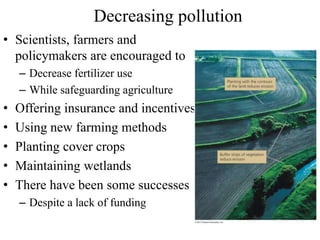
Decreasing pollution
• Scientists, farmers and
policymakers are encouraged to
– Decrease fertilizer use
– While safeguarding agriculture
• Offering insurance and incentives
• Using new farming methods
• Planting cover crops
• Maintaining wetlands
• There have been some successes
– Despite a lack of funding

Cycles

  • 1.
  • 2.
    Biogeochemical Cycle : •Chemical elements are required by life from the living and nonliving parts of the environment. • These elements cycle in either a gas cycle or a sedimentary cycle • In a gas cycle elements move through the atmosphere. • Main reservoirs are the atmosphere and the ocean. • Sedimentary cycle elements move from land to water to sediment.
  • 3.
    Components of abiogeochemical cycle • Source = a pool that releases more nutrients than it accepts • Sinks = a pool that accepts more nutrients than it releases
  • 4.
  • 5.
    Sediment storage ofcarbon • Decomposition returns carbon to the sediment – The largest reservoir of carbon – May be trapped for hundreds of millions of years • Aquatic organisms die and settle in the sediment – Older layers are buried deeply and undergo high pressure – Ultimately, it may be converted into fossil fuels • Oceans are the second largest reservoir of carbon
  • 8.
     Carbon (C)enters the biosphere during photosynthesis:  CO2 + H2O (carbon dioxide+ water)---> C6H12O6 + O2 + H2O (sugar+oxygen+water)  Carbon is returned to the biosphere in cellular respiration:  O2 +H2O + C6H12O6 ---> CO2 +H2O + energy
  • 9.
    Carbon Facts • Everyyear there is a measurable difference in the concentration of atmospheric CO2 with changes in the seasons. –For example, in winter there is almost no photosynthesis ( higher CO2 ) –During the growing season there is a measurable difference in the concentration of atmospheric CO2 over parts of each day.
  • 11.
  • 12.
    • Water isessential for biochemical reactions –It is involved in nearly every environmental system • Hydrologic cycle = summarizes how liquid, gaseous and solid water flows through the environment
  • 13.
    –Oceans are themain reservoir •Evaporation = water moves from aquatic and land systems into the atmosphere •Transpiration = release of water vapor by plants •Precipitation, runoff, and surface water = water returns to Earth as rain or snow and flows into streams, oceans, etc.
  • 14.
    Evaporation •The process bywhich liquid water is transformed into a gaseous state •Evaporation into a gas ceases when the gas reaches saturation •The molecules that escape the condensed stage have above-average energies. •Those left behind have below-average energies •Manifested by a decrease in the temperature of the condensed phase.
  • 15.
    Evaporation • Energy breaksbonds that hold molecules together • Net evaporation occurs when the rate of evaporation exceeds the rate of condensation • Removes heat from the environment: Net Cooling Primary mechanism for surface-to-atmosphere water transport
  • 16.
    Evaporation v. Precipitation •About equal on a global scale • Evaporation more prevalent over the oceans than precipitation • Over land, precipitation exceeds evaporation • Most water evaporated from the oceans falls back into the ocean as precipitation • 10% of water evaporated from the ocean is transported over land and falls as precipitation • Once evaporated, a water molecule spends ~ 10 days airborne
  • 17.
    The process ofwater loss from plants through stomata. •passive process that depends on: ~humidity of the atmosphere ~the moisture content of the soil •only 1 % of the water transpired used for growth •transports nutrients from the soil into the roots and carries them to the various cells of the plant •keeps tissues from becoming overheated (Stomata are small openings found on the underside of leaves that are connected to vascular plant tissues.) Transpiration
  • 18.
    Transpiration Accounts for ~10% of the moisture in the atmosphere Depends on: » Temperature » Humidity » Insolation » Precipitation » Soil type and saturation » Wind » Land slope
  • 19.
  • 21.
    Precipitation • The vaporthat accumulates or freezes on condensation nuclei is acted on by gravity and falls to Earth’s surface. rain, freezing rain, sleet, snow, or hail primary connection in the water cycle that provides for the delivery of atmospheric water to the Earth
  • 22.
    Groundwater • Aquifers =underground reservoirs of sponge-like regions of rock and soil that hold… – Groundwater = water found underground beneath layers of soil • Water table = the upper limit of groundwater in an aquifer – Water may be ancient (thousands of years old) • Groundwater becomes exposed to the air where the water table reaches the surface – Exposed water runs off to the ocean or evaporates
  • 23.
  • 24.
  • 25.
    Nitrogen Facts • Nitrogen(N) is an essential constituent of protein, DNA, RNA, and chlorophyll. • Nitrogen is the most abundant gas in the atmosphere. • Nitrogen must be fixed or converted into a usable form.
  • 26.
    Sources • Lightning • Inorganicfertilizers • Nitrogen Fixation • Animal Residues • Crop residues • Organic fertilizers
  • 27.
    Forms of Nitrogen •Urea  CO(NH2)2 • Ammonia  NH3 (gaseous) • Ammonium  NH4 • Nitrate  NO3 • Nitrite  NO2 • Atmospheric Dinitrogen N2 • Organic N
  • 29.
    • Nitrogen comprises78% of our atmosphere – It is contained in proteins, DNA and RNA • Nitrogen cycle = describes the routes that nitrogen atoms take through the environment – Nitrogen gas cannot be used by organisms • Nitrogen fixation = lightning or nitrogen-fixing bacteria combine (fix) nitrogen with hydrogen – To form ammonium – Which can be used by plants
  • 30.
    Nitrification and Denitrification •Nitrification = bacteria convert ammonium ions first into nitrite ions then into nitrate ions – Plants can take up these ions • Animals obtain nitrogen by eating plants or other animals • Decomposers get it from dead and decaying plants or other animals – Releasing ammonium ions to nitrifying bacteria • Denitrifying bacteria = convert nitrates in soil or water to gaseous nitrogen – Releasing it back into the atmosphere
  • 31.
  • 32.
    Nitrification Two step reactionsthat occur together : • 1rst step catalyzed by Nitrosomonas 2 NH4 + + 3 O2  2 NO2 - +2 H2O+ 4 H+ • 2nd step catalyzed by Nitrobacter • 2 NO2 - + O2  2 NO3 -
  • 33.
  • 34.
    Denitrification • Removes alimiting nutrient from the environment • 4NO3 - + C6H12O6 2N2 + 6 H20 • Inhibited by O2 • Not inhibited by ammonia • Microbial reaction • Nitrate is the terminal electron acceptor
  • 35.
  • 37.
    Sources of Oxygen: •Phototosynthes and Photo disassociation of H2O vapor • CO2 and circulates freely throughout the biosphere. • Some CO2 combines with Ca to form carbonates. • O2 combines with nitrogen compounds to form nitrates. • Oxygen combines with iron compounds to form ferric oxides. • Oxygen2 in the troposphere is reduced to O3 (ozone). • Ground level O3 (ozone) is a pollutant which damages lungs.
  • 38.
  • 39.
    Step One ofOxygen Cycle • Plant release oxygen into the atmosphere as a by-product of photosynthesis. oxygen
  • 40.
    Step Two ofOxygen Cycle • Animals take in oxygen through the process of respiration. • Animals then break down sugars and food.
  • 41.
    Step Three inOxygen Cycle • Carbon dioxide is released by animals and used in plants in photosynthesis. • Oxygen is balanced between the atmosphere and the ocean.
  • 43.
    Phosphorus (P) Cycle Componentof DNA, RNA, ATP, proteins and enzymes - Cycles in a sedimentary cycle - A good example of how a mineral element becomes part of an organism. - The source of Phosphorus (P) is rock. - Phosphorus is released into the cycle through erosion or mining. - Phosphorus is soluble in H2O as phosphate (PO4) -Phosphorus is taken up by plant roots, then travels through food chains. - It is returned to sediment
  • 44.
    • The phosphoruscycle, is the circulation of phosphorous among the rocks, soils, water, and plants and animals of the earth. • Human beings and all other organisms must have phosphorus to live. • In nature, most phosphorus occurs in phosphate rock, which contains phosphate ions combined with calcium, magnesium, chlorine, and fluorine.
  • 45.
    • It cannotbe found in air in the gaseous . This is because phosphorous is usually liquid at normal temperatures pressures. • This cycle is the slowest of the matter cycles. • Phosphorus is most commonly found in rock formations and ocean sediments as phosphate salts. Phosphates are also limiting factors for plant-growth in marine ecosystems, because they are not very water-soluble.
  • 46.
    • Another exampleof the phosphorus cycle is when rocks are created. • The phosphate in the soil moves on and transfers its phosphate to the rocks underwater. When the uplifting of the rocks occurs it takes the phosphate along with it. After that the weathering of rocks occur and the rocks begin to break down into the soil and the phosphate in the rocks ends up in the soil again and the cycle repeats.
  • 47.
    Uplifting of rocks Weathering of rock Runoff Phosphatesin rock Phosphates in soil (inorganic) Phosphates in solution Precipitated (solid) phosphates Rock Decomposition Phosphates in organic compounds Plants Animals Detritus Detritivores in soil
  • 48.
     All theseexamples of phosphates are inorganic (white boxes). However, the Phosphorus Cycle is also organic (yellow boxes). Not all phosphates in the runoff make it to the water; others sink into the soil. These inorganic phosphates are transformed into organic ones by plants, which are in turn eaten by animals.  The dead animals, retain their internal phosphorus stores and detritivores (scavengers which feed on dead plants and animals or their waste) change the organic phosphates back to inorganic ones.
  • 49.
  • 50.
    Sulfur (s) Cycle •Component of protein • Cycles in both a gas and sedimentary cycle. • The source of Sulfur is the lithosphere (earth's crust) • Sulfur (S) enters the atmosphere as hydrogen sulfide (H2S) during fossil fuel combustion, volcanic eruptions, gas exchange at ocean surfaces, and decomposition. •
  • 51.
    • SO2 andwater vapor makes H2SO4 ( a weak sulfuric acid), which is then carried to Earth in rainfall. • Sulfur in soluble form is taken up by plant roots and incorporated into amino acids such as cysteine. It then travels through the food chain and is eventually released through decomposition.
  • 53.
    Summary • The buildingblocks of life :Water ,Nitrogen, Carbon Dioxide, Phosphorus, Sulfur • Continually cycle through Earth's systems, the atmosphere, hydrosphere, biosphere, and lithosphere, on time scales that range from a few days to millions of years. • These cycles are called biogeochemical cycles, because they include a variety of biological, geological, and chemical processes.
  • 54.
    Human impacts onthe hydrologic cycle • Removing forests and vegetation increases runoff and erosion, reduces transpiration and lowers water tables • Irrigating agricultural fields depletes rivers, lakes and streams and increases evaporation • Damming rivers increases evaporation and infiltration • Emitting pollutants changes the nature of precipitation • The most threatening impact: overdrawing groundwater for drinking, irrigation, and industrial use – Water shortages create worldwide conflicts
  • 55.
    Humans affect thecarbon cycle • Burning fossil fuels moves carbon from the ground to the air • Cutting forests and burning fields moves carbon from vegetation to the air • Today’s atmospheric carbon dioxide reservoir is the largest in the past 800,000 years – It is the driving force behind climate change • The missing carbon sink: 1-2 billion metric tons of carbon are unaccounted for – It may be taken up by plants or soils of northern temperate and boreal forests
  • 56.
    Humans affect thenitrogen cycle • Haber-Bosch process = production of fertilizers by combining nitrogen and hydrogen to synthesize ammonia – Humans overcame the limits on crop productivity • Fixing atmospheric nitrogen with fertilizers – Increases emissions of greenhouse gases and smog – Washes calcium and potassium out of soil – Acidifies water and soils – Moves nitrogen into terrestrial systems and oceans – Reduces diversity of plants adapted to low-nitrogen soils – Changed estuaries and coastal ecosystems and fisheries
  • 57.
    Humans affect thephosphorus cycle • Mining rocks for fertilizer moves phosphorus from the soil to water systems • Wastewater discharge also releases phosphorus • Runoff containing phosphorus causes eutrophication of aquatic systems – Produces murkier waters – Alters the structure and function of aquatic systems – Do not buy detergents that contain phosphate
  • 58.
     Cutting andburning of tropical rain forests affects the phosphorus cycle. As the forest is cut and/or burned, nutrients originally stored in plants and rocks are quickly washed away by heavy rains, causing the land to become unproductive.
  • 59.
     Agricultural runoff providesmuch of the phosphate found in waterways. Crops often cannot absorb all of the fertilizer in the soils, causing excess fertilizer runoff and increasing phosphate levels in rivers and other bodies of water. The phosphate in the water is eventually precipitated as sediments at the bottom of the body of water. In certain lakes and ponds this may be re-dissolved and recycled as a problem nutrient. Animal wastes or manure may also be applied to the land as fertilizer. If misapplied on frozen ground during the winter, much of it may lost as run-off during the spring thaw. In certain area very large feed lots of animals, may result in excessive run-off of phosphate and nitrate into streams.
  • 60.
    Solutions to thedead zone • The Harmful Algal Bloom and Hypoxia Research and Control Act (1998) – Called for an assessment of hypoxia in the dead zone • Solutions outlined included: – Reduce nitrogen fertilizer use in Midwestern farms – Apply fertilizer at times which minimize runoff – Use alternative crops and manage manure better – Restore wetlands and create artificial ones – Improve sewage treatment technologies – Evaluate these approaches
  • 61.
    Decreasing pollution • Scientists,farmers and policymakers are encouraged to – Decrease fertilizer use – While safeguarding agriculture • Offering insurance and incentives • Using new farming methods • Planting cover crops • Maintaining wetlands • There have been some successes – Despite a lack of funding