How do soils form?
Processes
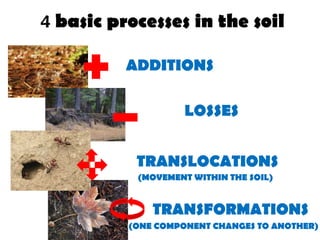
4 basic processes in the soil
ADDITIONS
LOSSES
TRANSLOCATIONS
TRANSFORMATIONS
(MOVEMENT WITHIN THE SOIL)
(ONE COMPONENT CHANGES TO ANOTHER)
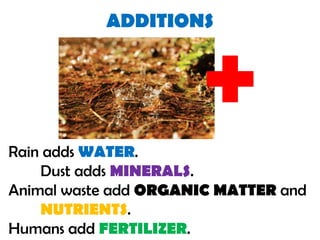
ADDITIONS
Rain adds WATER.
Dust adds MINERALS.
Animal waste add ORGANIC MATTER and
NUTRIENTS.
Humans add FERTILIZER.
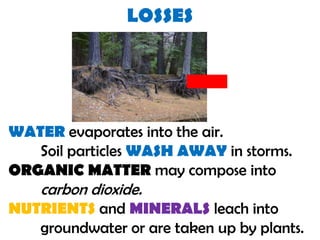
LOSSES
WATER evaporates into the air.
Soil particles WASH AWAY in storms.
ORGANIC MATTER may compose into
carbon dioxide.
NUTRIENTS and MINERALS leach into
groundwater or are taken up by plants.
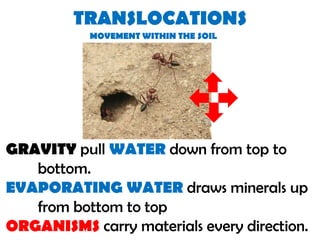
TRANSLOCATIONS
MOVEMENT WITHIN THE SOIL
GRAVITY pull WATER down from top to
bottom.
EVAPORATING WATER draws minerals up
from bottom to top
ORGANISMS carry materials every direction.
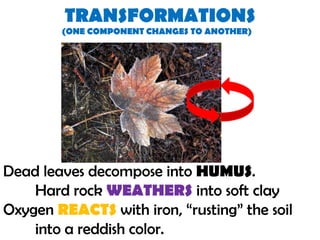
TRANSFORMATIONS
Dead leaves decompose into HUMUS.
Hard rock WEATHERS into soft clay
Oxygen REACTS with iron, “rusting” the soil
into a reddish color.
(ONE COMPONENT CHANGES TO ANOTHER)
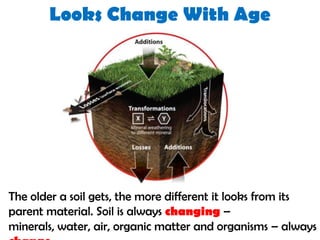
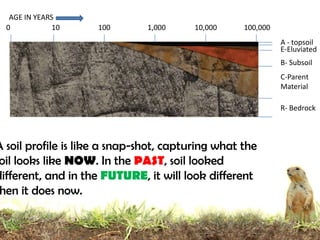
The older a soil gets, the more different it looks from its
parent material. Soil is always changing –
minerals, water, air, organic matter and organisms – always
Looks Change With Age
A - topsoil
E-Eluviated
B- Subsoil
C-Parent
Material
R- Bedrock
0 10 100 1,000 10,000 100,000
AGE IN YEARS
A soil profile is like a snap-shot, capturing what the
oil looks like NOW. In the PAST, soil looked
different, and in the FUTURE, it will look different
hen it does now.
Vocabulary
• Transform
• Weathering
• Decompose
• Leaching
• Minerals
• Organic Matter
• Organisms
• Developed Soil
• Humus
• Bedrock
Vocabulary
• Additions
• Losses
• Translocation

Soil formation-processes

  • 1.
    How do soilsform? Processes
  • 2.
    4 basic processesin the soil ADDITIONS LOSSES TRANSLOCATIONS TRANSFORMATIONS (MOVEMENT WITHIN THE SOIL) (ONE COMPONENT CHANGES TO ANOTHER)
  • 3.
    ADDITIONS Rain adds WATER. Dustadds MINERALS. Animal waste add ORGANIC MATTER and NUTRIENTS. Humans add FERTILIZER.
  • 4.
    LOSSES WATER evaporates intothe air. Soil particles WASH AWAY in storms. ORGANIC MATTER may compose into carbon dioxide. NUTRIENTS and MINERALS leach into groundwater or are taken up by plants.
  • 5.
    TRANSLOCATIONS MOVEMENT WITHIN THESOIL GRAVITY pull WATER down from top to bottom. EVAPORATING WATER draws minerals up from bottom to top ORGANISMS carry materials every direction.
  • 6.
    TRANSFORMATIONS Dead leaves decomposeinto HUMUS. Hard rock WEATHERS into soft clay Oxygen REACTS with iron, “rusting” the soil into a reddish color. (ONE COMPONENT CHANGES TO ANOTHER)
  • 7.
    The older asoil gets, the more different it looks from its parent material. Soil is always changing – minerals, water, air, organic matter and organisms – always Looks Change With Age
  • 8.
    A - topsoil E-Eluviated B-Subsoil C-Parent Material R- Bedrock 0 10 100 1,000 10,000 100,000 AGE IN YEARS A soil profile is like a snap-shot, capturing what the oil looks like NOW. In the PAST, soil looked different, and in the FUTURE, it will look different hen it does now.
  • 9.
    Vocabulary • Transform • Weathering •Decompose • Leaching • Minerals • Organic Matter • Organisms • Developed Soil • Humus • Bedrock
  • 10.

Editor's Notes

  • #2 List the processes that occur in a soil? Give an example of eachAdditions – rain adds water, dust adds minerals, as plants die and animals poop organic mater is added, humans also add fertilizerLosses – evaporation, nutrient up take, leaching of nutrients and elementsTranslocations – gravity pull water and dissolved materials down, OM can move in many directions due to critters, clay movement, eluviated horizonTransformations – decomposition, weathering, iron rusting (reddening) or dissolving (graying), clay formationDescribe how a soil will change with time.OM accumulates A horizon forms Horizons get thicker May get redder if well drained or get grayer if wet E horizon becomes more evident
  • #3 Four basic processes. Ask students to come up with more examples for each as each is discussed in the next 4 slides.
  • #4 Materials can be added to the soil in many ways. Natural ways include rainfall, dust settling, animal wastes, tree leaves in the fall etc.Humans add wastes as well as fertilizer.
  • #5 Losses are removal of components from the soil profile. Leaching can first translocate components deeper in the profile but in extreme cases where the component is removed it is referred to as a leaching loss. Erosion is another example of a loss.Decomposition can both transform (organic material to humus) and cause a loss (organic matter to carbon dioxide which then moves to the atmosphere)
  • #6 Translocation is moving components within the soil profile but not leaving the profileMovement is often due to water flow by gravity. Water moves minerals, nutrients, and organic matter. If these materials leave the profile it is a loss. So Loss can begin with simple translocation.Movement is not always down as evaporation can cause minerals dissolved in water to move upwards. An example is salts on the surface of some desert or drier soils.
  • #7 Minerals in rock weather to clayRocks break in to smaller piecesIron in minerals turns to rust (iron oxides)Leaves decompose to humus
  • #8 Soil is constantly changing due to the 4 processes. This means soil is dynamic –in a constant state of change. This diagram may help understand better how the processes affect the soil.
  • #9 The soil changes as a result of the process acting upon it. In a very general sense this diagram shows how the soil changes over time. In the next section CLORPT other factors of formation will be discussed to help further understand how a soil changes and how truly dynamic it is.Note that a well developed soil profile will have more and thicker horizons than a less developed soil profile.
  • #10 These words are defined in Soil! Get the Inside Scoop.
  • #11 These words are not defined in Soil! Get the Inside Scoop but are defined below.Additions – to add material or substance to the soil Losses – to remove material or substance from the soil Translocation – to move material or substance within the soil without adding or removing anything