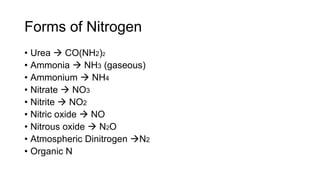
Forms of Nitrogen
• Urea  CO(NH2)2
• Ammonia  NH3 (gaseous)
• Ammonium  NH4
• Nitrate  NO3
• Nitrite  NO2
• Nitric oxide  NO
• Nitrous oxide  N2O
• Atmospheric Dinitrogen N2
• Organic N
Nitrogen
• 78% of the air is nitrogen (N2)
• Nitrogen is essential for organisms
to make DNA, protein, amino
acids, etc.
• Yet, N2 is useless to plants and
animals
How do organisms get nitrogen?
• Two natural processes convert
nitrogen gas into usable
nitrogen:
• Lightning
• Nitrogen cycle
Nitrogen Cycle
• 5 main processes cycle nitrogen through the atmosphere, biosphere,
and lithosphere:
1. Nitrogen fixation
2. Nitrification
3. Assimilation
4. Ammonification
5. Denitrification
5
The Nitrogen Cycle
• N2 gas is the most abundant gas in the atmosphere, 79% of air
volume.
• Involves several types of microbes
• 4 types of reactions:
• nitrogen fixation –atmospheric N2 gas is converted to NH4
salts; nitrogen-fixing bacteria live free or in symbiotic
relationships with plants
• ammonification – bacteria decompose nitrogen-
containing organic compounds to ammonia
• nitrification – convert NH4
+ to NO2
- and NO3
-
• denitrification – microbial conversion of various nitrogen
salts back to atmospheric N2
6
Insert figure 26.10
Nitrogen cycle
7
Insert figure 26.11
Nitrogen fixation through symbiosis
The Nitrogen Cycle
The Nitrogen Cycle
N is cycled between: NH4
+ (-3 oxidation state) and NO3
- (+5 oxidation state)
Nitrogen Reservoir Metric tons nitrogen Actively cycled
Atmosphere
N2
Ocean
Biomass
Soluble salts (NO3, NO2
-, NH4
+)
Dissolved and particulate
organics
Dissolved N2
Land
Biota
Organic matter
Earth’s crust
3.9 x 10¹⁵
5.2 x 10⁸
6.9 x 10¹¹
3.0 x 10¹¹
2.0 x 10¹³
2.5 x 10¹⁰
1.1 x 10¹¹
7.7 x 10¹⁴
No
Yes
Yes
Yes
No
Yes
Slow
No
Global Nitrogen Reservoirs
Nitrogen Cycle
Nitrogen Cycle
• Nitrogen fixation
• Bacteria (such as Rhizobium) convert gaseous nitrogen
into ammonia, which is taken up by plants
• N2 + 3H2  2NH3
Rhizobium
nodules
Biological inputs of nitrogen from N2 fixation
land - 135 million metric tons/yr (microbial)
marine - 40 million metric tons/yr (microbial)
fertilizers - 30 million metric tons/yr (anthropogenic)
Nitrogen must be fixed before it can be incorporated into biomass. This process
is called nitrogen fixation.
The enzyme that catalyzes
nitrogen fixation is nitrogenase.
N2 fixing system
Nitrogen fixation
(kg N/hectare/yr)
Rhizobium-legume
Anabaena-Azolla
Cyanobacteria-moss
Rhizosphere assoc.
Free-living bacteria
200-300
100-120
30-40
2-25
1-2
Rates of Nitrogen Fixation
1-2 kg N/hec/yr 2- 25 kg/N/hec/yr
Free-living bacteria must also protect nitrogenase from O2
complex is membrane associated
slime production
high levels of respiration
conformation change in nitrogenase when O2 is present
Azotobacter - aerobic
Beijerinckia - aerobic, likes acidic soils
Azospirillum - facultative
Clostridia - anaerobic
Examples of free-living bacteria:
Microorganisms fixing
• Azobacter
• Beijerinckia
• Azospirillum
• Clostridium
• Cyanobacteria
• Require the enzyme
nitrogenase
• Inhibited by oxygen
• Inhibited by ammonia (end
product)
Fate of ammonia (NH3) produced during nitrogen fixation
plant uptake
microbial uptake
adsorption to colloids (adds to CEC)
fixation within clay minerals
incorporation into humus
volatilization
nitrification
} assimilation and mineralization
Nitrogen Cycle
Nitrogen Cycle
• Nitrification
• Ammonia in soil converted by bacteria into nitrite ions
(NO2
-) and nitrate ions (NO3
-)
Nitrification - Chemoautotrophic aerobic process
Nitrosomonas Nitrobacter
NH4
+ NO2
- NO3
-
Nitrosomonas:
34 moles NH4
+ to fix 1 mole CO2
Nitrobacter:
100 moles NH4
+ to fix 1 mole CO2
Nitrification is important in areas that are high in ammonia (septic tanks,
landfills, feedlots, dairy operations, over fertilization of crops). The nitrate
formed is highly mobile (does not sorb to soil). As a result, nitrate
contamination of groundwater is common. *Nitrate contamination can result in
methemoglobenemia (blue baby syndrome).
What is the fate of NO3
- following nitrification?
accumulation (disturbed vs. managed)
fixation within clay minerals
leaching (groundwater contamination)
dissimilatory nitrate reduction
• nitrate ammonification
• denitrification
plant uptake
microbial uptake
biological uptake (assimilatory nitrate
reduction)
}
Assimilatory nitrate reduction
many plants prefer nitrate which is reduced in the plant prior to use however,
nitrogen in fertilizer is added as ammonia or urea.
assimilatory nitrate reduction is inhibited by ammonium
nitrate is more mobile than ammonium leading to leaching loss
microorganisms prefer ammonia since uptake of nitrate requires a reduction
step
Nitrogen Cycle
Nitrogen Cycle
• Assimilation
• Plants use ammonia (NH3),
ammonium ions (NH4
+), and
nitrate ions (NO3
-)
• Make DNA, amino acids, and
protein
• Animals get their nitrogen
from eating plants
NH3 is assimilated by cells into:
proteins
cell wall constituents
nucleic acids
Ammonia assimilation and ammonification
Release of assimilated NH3 is called ammonification. This process
can occur intracellularly or extracellularly
proteases
chitinases
nucleases
ureases
Nitrogen Cycle
Nitrogen Cycle
• Ammonification
• Animals excrete excess nitrogen in their urine and feces
• Additional nitrogen is added to the soil when organisms die
• Decomposing bacteria and fungi convert the nitrogen in their waste into
usable ammonia (NH3) and ammonium ions (NH4
+)
- -
- -
+
+
H O
2
glutamate
dehydrogenase
NAD NADH
= O
glutamate  - ketoglutarate
+ NH3
NH3
A
At high N concentrations
-
-
-
-
-
-
+
+
+
= O
glutamate
glutamate
glutamine
 - ketoglutarate
NH3
NH3
NH3
NH2
ATP
ADP + Pi
glutamine
synthetase
Ferredoxin
2H+
2e
-
glutamate-
synthase
(GOGAT)
Transamination
B
At low N concentrations
Fate of ammonia (NH3) produced during nitrogen fixation
plant uptake
microbial uptake
adsorption to colloids (adds to CEC)
fixation within clay minerals
incorporation into humus
volatilization
nitrification
Nitrogen Cycle
Nitrogen Cycle
• Denitrification
• Bacteria in the soil convert usable ammonia (NH3) and ammonium ions (NH4
+)
back into nitrogen gas (N2) and nitrous oxide gas (N2O)
Denitrification
NO, N2O deplete the ozone layer
Reaction of N2O with ozone
O2 + UV light O + O
O + O2 O3 (ozone generation)
N2O + UV light N2 + O*
N2O + O* 2NO (nitric oxide)
NO + O3 NO2 + O2 (ozone depletion)
NO2 + O* NO + O2
returns fixed N to atmosphere:
get formation of NO (Nitric oxide), N2O (Nitrous oxide)
NO3 NO N2O N2
How are humans affecting the nitrogen cycle?
• Burning fuels release nitric oxide
(NO) into the atmosphere
• Creates acid rain
• Harms vegetation
• Harms aquatic ecosystems
• Damages materials (metal, stone, etc.)
How are humans affecting the nitrogen cycle?
• Excess livestock waste and
fertilizer adds nitrous oxide (N2O)
to the atmosphere
• N2O is a greenhouse gas
• May lead to global warming
Effects of Human Activities
on the Nitrogen Cycle
• We alter the nitrogen cycle by:
• Adding gases that contribute to acid rain.
• Adding nitrous oxide to the atmosphere through farming
practices which can warm the atmosphere and deplete ozone.
• Contaminating ground water from nitrate ions in inorganic
fertilizers.
• Releasing nitrogen into the troposphere through deforestation.
How are humans affecting the nitrogen cycle?
• Runoff from agricultural
lands and sewage
facilities adds nitrogen
to aquatic ecosystems
• Results in algal blooms
• Leads to “dead zones”
Nitrogen Cycle
• Nitrogen cycle is the continuous sequence of natural processes by
which nitrogen in the atmosphere and nitrogenous compounds in
the soil are converted, as by nitrification and nitrogen fixation, into
substances that can be utilized by green plants and then returned to
the air and soil as a result of denitrification and plant decay.
Nitrogen Cycle
• Nitrogen fixation:
The conversion of atmospheric nitrogen into nitrogenous
compounds by bacteria (Rhizobia) found in the root
nodules of legumes and certain other plants, and in the
soil.
• Assimilation:
Plants take nitrogen from the soil, by absorption through
their roots in the form of their nitrate ions or ammonium
ions. All nitrogen obtained by animals can be traced back
to the eating of plants.
Nitrogen Cycle
• Ammonification:
When a plant or animal dies, or an animal expels waste, the
initial form of nitrogen is organic. Bacteria, or fungi in some
cases, convert the organic nitrogen within the remains back
into ammonium (NH4
+).
• Nitrification:
The oxidation of the ammonium compounds in dead organic
material into nitrites and nitrates by soil nitrobacteria,
making nitrogen available to plants.
Nitrosomonas species converts ammonia to nitrites (NO2
-).
Nitrobacter species are responsible for the oxidation of the
nitrites into nitrates (NO3
-).
Nitrogen Cycle
• Denitrification:
Process occurs when nitrates (NO3
-) reduced to gaseous
nitrogen (N2), as by bacterial action on soil.
NITROGEN CYCLE
N2
Crops
Fertilizer
Production
Lightning
Legume
Nitrogen-Fixing
Bacteria in
soil & roots
Nitrogen
Fixation
Ammonia
Nitrates
Nitrites
Decomposers
Denitrification
Sheep
(GAS
)
Nitrogen Cycle
Assimilitory
Nitrate
Reduction
Nitrification
Nitrification
Ammonification
Nitrogen Fixation
Denitrification
Organic N NH3
N2 + N2O
NH4
+
NO2
-
NO3
-
NO3
- NO2
- NO N2O N2
Denitrification
Nitrate
reductase
Nitrite
reductase
Nitrous oxide
reductase
+5 +3 +2 +1 0
2e- 1e- 1e-
1e-

Nitrogen cycle

  • 1.
    Forms of Nitrogen •Urea  CO(NH2)2 • Ammonia  NH3 (gaseous) • Ammonium  NH4 • Nitrate  NO3 • Nitrite  NO2 • Nitric oxide  NO • Nitrous oxide  N2O • Atmospheric Dinitrogen N2 • Organic N
  • 2.
    Nitrogen • 78% ofthe air is nitrogen (N2) • Nitrogen is essential for organisms to make DNA, protein, amino acids, etc. • Yet, N2 is useless to plants and animals
  • 3.
    How do organismsget nitrogen? • Two natural processes convert nitrogen gas into usable nitrogen: • Lightning • Nitrogen cycle
  • 4.
    Nitrogen Cycle • 5main processes cycle nitrogen through the atmosphere, biosphere, and lithosphere: 1. Nitrogen fixation 2. Nitrification 3. Assimilation 4. Ammonification 5. Denitrification
  • 5.
    5 The Nitrogen Cycle •N2 gas is the most abundant gas in the atmosphere, 79% of air volume. • Involves several types of microbes • 4 types of reactions: • nitrogen fixation –atmospheric N2 gas is converted to NH4 salts; nitrogen-fixing bacteria live free or in symbiotic relationships with plants • ammonification – bacteria decompose nitrogen- containing organic compounds to ammonia • nitrification – convert NH4 + to NO2 - and NO3 - • denitrification – microbial conversion of various nitrogen salts back to atmospheric N2
  • 6.
  • 7.
    7 Insert figure 26.11 Nitrogenfixation through symbiosis
  • 8.
  • 9.
    The Nitrogen Cycle Nis cycled between: NH4 + (-3 oxidation state) and NO3 - (+5 oxidation state)
  • 10.
    Nitrogen Reservoir Metrictons nitrogen Actively cycled Atmosphere N2 Ocean Biomass Soluble salts (NO3, NO2 -, NH4 +) Dissolved and particulate organics Dissolved N2 Land Biota Organic matter Earth’s crust 3.9 x 10¹⁵ 5.2 x 10⁸ 6.9 x 10¹¹ 3.0 x 10¹¹ 2.0 x 10¹³ 2.5 x 10¹⁰ 1.1 x 10¹¹ 7.7 x 10¹⁴ No Yes Yes Yes No Yes Slow No Global Nitrogen Reservoirs
  • 11.
  • 12.
    Nitrogen Cycle • Nitrogenfixation • Bacteria (such as Rhizobium) convert gaseous nitrogen into ammonia, which is taken up by plants • N2 + 3H2  2NH3 Rhizobium nodules
  • 13.
    Biological inputs ofnitrogen from N2 fixation land - 135 million metric tons/yr (microbial) marine - 40 million metric tons/yr (microbial) fertilizers - 30 million metric tons/yr (anthropogenic) Nitrogen must be fixed before it can be incorporated into biomass. This process is called nitrogen fixation. The enzyme that catalyzes nitrogen fixation is nitrogenase. N2 fixing system Nitrogen fixation (kg N/hectare/yr) Rhizobium-legume Anabaena-Azolla Cyanobacteria-moss Rhizosphere assoc. Free-living bacteria 200-300 100-120 30-40 2-25 1-2 Rates of Nitrogen Fixation 1-2 kg N/hec/yr 2- 25 kg/N/hec/yr
  • 14.
    Free-living bacteria mustalso protect nitrogenase from O2 complex is membrane associated slime production high levels of respiration conformation change in nitrogenase when O2 is present Azotobacter - aerobic Beijerinckia - aerobic, likes acidic soils Azospirillum - facultative Clostridia - anaerobic Examples of free-living bacteria:
  • 15.
    Microorganisms fixing • Azobacter •Beijerinckia • Azospirillum • Clostridium • Cyanobacteria • Require the enzyme nitrogenase • Inhibited by oxygen • Inhibited by ammonia (end product)
  • 16.
    Fate of ammonia(NH3) produced during nitrogen fixation plant uptake microbial uptake adsorption to colloids (adds to CEC) fixation within clay minerals incorporation into humus volatilization nitrification } assimilation and mineralization
  • 17.
  • 18.
    Nitrogen Cycle • Nitrification •Ammonia in soil converted by bacteria into nitrite ions (NO2 -) and nitrate ions (NO3 -)
  • 19.
    Nitrification - Chemoautotrophicaerobic process Nitrosomonas Nitrobacter NH4 + NO2 - NO3 - Nitrosomonas: 34 moles NH4 + to fix 1 mole CO2 Nitrobacter: 100 moles NH4 + to fix 1 mole CO2 Nitrification is important in areas that are high in ammonia (septic tanks, landfills, feedlots, dairy operations, over fertilization of crops). The nitrate formed is highly mobile (does not sorb to soil). As a result, nitrate contamination of groundwater is common. *Nitrate contamination can result in methemoglobenemia (blue baby syndrome).
  • 20.
    What is thefate of NO3 - following nitrification? accumulation (disturbed vs. managed) fixation within clay minerals leaching (groundwater contamination) dissimilatory nitrate reduction • nitrate ammonification • denitrification plant uptake microbial uptake biological uptake (assimilatory nitrate reduction) } Assimilatory nitrate reduction many plants prefer nitrate which is reduced in the plant prior to use however, nitrogen in fertilizer is added as ammonia or urea. assimilatory nitrate reduction is inhibited by ammonium nitrate is more mobile than ammonium leading to leaching loss microorganisms prefer ammonia since uptake of nitrate requires a reduction step
  • 21.
  • 22.
    Nitrogen Cycle • Assimilation •Plants use ammonia (NH3), ammonium ions (NH4 +), and nitrate ions (NO3 -) • Make DNA, amino acids, and protein • Animals get their nitrogen from eating plants
  • 23.
    NH3 is assimilatedby cells into: proteins cell wall constituents nucleic acids Ammonia assimilation and ammonification Release of assimilated NH3 is called ammonification. This process can occur intracellularly or extracellularly proteases chitinases nucleases ureases
  • 24.
  • 25.
    Nitrogen Cycle • Ammonification •Animals excrete excess nitrogen in their urine and feces • Additional nitrogen is added to the soil when organisms die • Decomposing bacteria and fungi convert the nitrogen in their waste into usable ammonia (NH3) and ammonium ions (NH4 +)
  • 26.
    - - - - + + HO 2 glutamate dehydrogenase NAD NADH = O glutamate  - ketoglutarate + NH3 NH3 A At high N concentrations - - - - - - + + + = O glutamate glutamate glutamine  - ketoglutarate NH3 NH3 NH3 NH2 ATP ADP + Pi glutamine synthetase Ferredoxin 2H+ 2e - glutamate- synthase (GOGAT) Transamination B At low N concentrations
  • 27.
    Fate of ammonia(NH3) produced during nitrogen fixation plant uptake microbial uptake adsorption to colloids (adds to CEC) fixation within clay minerals incorporation into humus volatilization nitrification
  • 28.
  • 29.
    Nitrogen Cycle • Denitrification •Bacteria in the soil convert usable ammonia (NH3) and ammonium ions (NH4 +) back into nitrogen gas (N2) and nitrous oxide gas (N2O)
  • 30.
    Denitrification NO, N2O depletethe ozone layer Reaction of N2O with ozone O2 + UV light O + O O + O2 O3 (ozone generation) N2O + UV light N2 + O* N2O + O* 2NO (nitric oxide) NO + O3 NO2 + O2 (ozone depletion) NO2 + O* NO + O2 returns fixed N to atmosphere: get formation of NO (Nitric oxide), N2O (Nitrous oxide) NO3 NO N2O N2
  • 31.
    How are humansaffecting the nitrogen cycle? • Burning fuels release nitric oxide (NO) into the atmosphere • Creates acid rain • Harms vegetation • Harms aquatic ecosystems • Damages materials (metal, stone, etc.)
  • 32.
    How are humansaffecting the nitrogen cycle? • Excess livestock waste and fertilizer adds nitrous oxide (N2O) to the atmosphere • N2O is a greenhouse gas • May lead to global warming
  • 33.
    Effects of HumanActivities on the Nitrogen Cycle • We alter the nitrogen cycle by: • Adding gases that contribute to acid rain. • Adding nitrous oxide to the atmosphere through farming practices which can warm the atmosphere and deplete ozone. • Contaminating ground water from nitrate ions in inorganic fertilizers. • Releasing nitrogen into the troposphere through deforestation.
  • 34.
    How are humansaffecting the nitrogen cycle? • Runoff from agricultural lands and sewage facilities adds nitrogen to aquatic ecosystems • Results in algal blooms • Leads to “dead zones”
  • 35.
    Nitrogen Cycle • Nitrogencycle is the continuous sequence of natural processes by which nitrogen in the atmosphere and nitrogenous compounds in the soil are converted, as by nitrification and nitrogen fixation, into substances that can be utilized by green plants and then returned to the air and soil as a result of denitrification and plant decay.
  • 36.
    Nitrogen Cycle • Nitrogenfixation: The conversion of atmospheric nitrogen into nitrogenous compounds by bacteria (Rhizobia) found in the root nodules of legumes and certain other plants, and in the soil. • Assimilation: Plants take nitrogen from the soil, by absorption through their roots in the form of their nitrate ions or ammonium ions. All nitrogen obtained by animals can be traced back to the eating of plants.
  • 37.
    Nitrogen Cycle • Ammonification: Whena plant or animal dies, or an animal expels waste, the initial form of nitrogen is organic. Bacteria, or fungi in some cases, convert the organic nitrogen within the remains back into ammonium (NH4 +). • Nitrification: The oxidation of the ammonium compounds in dead organic material into nitrites and nitrates by soil nitrobacteria, making nitrogen available to plants. Nitrosomonas species converts ammonia to nitrites (NO2 -). Nitrobacter species are responsible for the oxidation of the nitrites into nitrates (NO3 -).
  • 38.
    Nitrogen Cycle • Denitrification: Processoccurs when nitrates (NO3 -) reduced to gaseous nitrogen (N2), as by bacterial action on soil.
  • 39.
    NITROGEN CYCLE N2 Crops Fertilizer Production Lightning Legume Nitrogen-Fixing Bacteria in soil& roots Nitrogen Fixation Ammonia Nitrates Nitrites Decomposers Denitrification Sheep (GAS )
  • 40.
  • 41.
    NO3 - NO2 - NON2O N2 Denitrification Nitrate reductase Nitrite reductase Nitrous oxide reductase +5 +3 +2 +1 0 2e- 1e- 1e- 1e-