DYNAMICECOSYSTEM
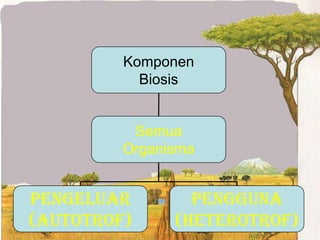
The Abiotic and Biotic Components of the EnvironmentAn ecosystem is a system formed by the interaction of living organisms with one another and with their environment.Abiotic components are the non-living components in the ecosystem such as air, water, soil, temperature and light intensity.Biotic components are the living components in the ecosystem such as plants and animals.
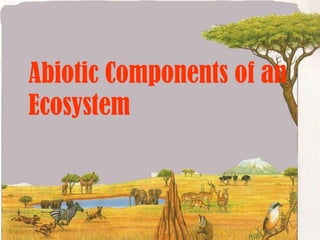
Abiotic Components of an Ecosystem
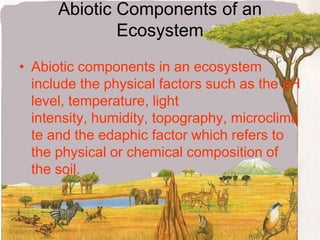
Abiotic Components of an EcosystemAbiotic components in an ecosystem include the physical factors such as the pH level, temperature, light intensity, humidity, topography, microclimate and the edaphic factor which refers to the physical or chemical composition of the soil.
pHMost organism live in natural and nearly neutral environmental (pH6 – pH7.5)Some plants, like maize, grows well in an acidic condition while coconuts grow well in alkaline condition.
Temperature Effect on biochemical reaction in the organismOrganism can live within certain range of temperaturePoikilotherms- are animal that cannot control their body temperature.Homoiotherms- are animal that able to maintain their body temperature.
Light IntensityEffect the rate of photosynthesisThe distribution of green plants will be more extensive in the area with higher light intensity
HumidityOrganism that can control the rate of water loss have and extensive distributionOrganism such as frogs, snails, earthworm and moss cannot controlthe rate of water lossand more suited to live in damp places
TopographyAltitude- There are less ogrganism at high altitude because of temperature, humidity and air pressure are low.Gradient/Slope-
MicroclimateMicroclimate refers to the climate of specific region in an habitatMicroclimate includes light intensity, amount of rainfall, temperature changes and humidity of amicrohabitat
Biotic Components of an Ecosystem
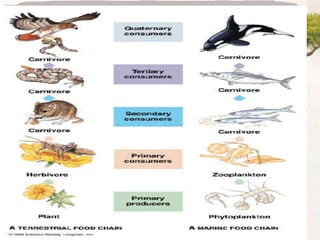
Biotic Components of an EcosystemThe biotic components are classified into three groups:	a) producers	b) consumers	c) decomposersConsumers are organisms that feed on plants or other organisms.	(a) Primary consumers are herbivores that feed on 	plants directly.	(b) Secondary condsumers are carnivores that feed on 	primary consumers directily	(c )	Tertiary consumers are carnivores or 	omnivores 	that feed 	on secondary consumer
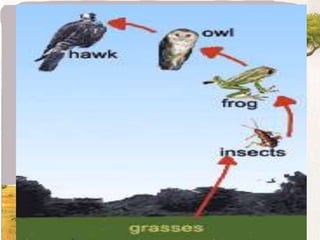
Decomposers are the bacteria and fungi that break down dead plants and dead animals into simple substances.A feeding relationship exists between the biotic components to form a food chainThrough the food chain, organisms obtain energy.Each level in a food chain is referred to as trophic level
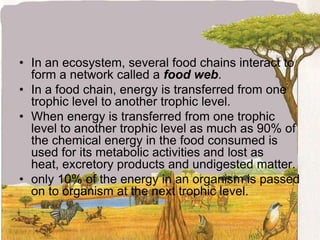
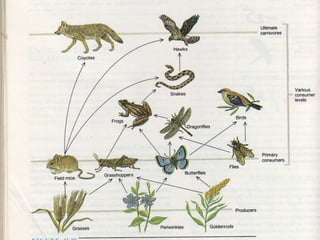
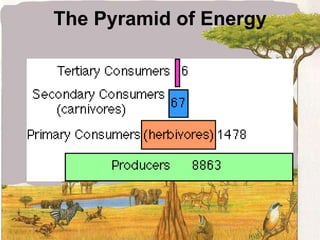
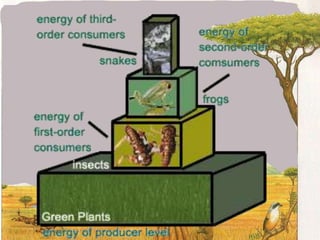
In an ecosystem, several food chains interact to form a network called a food web. In a food chain, energy is transferred from one trophic level to another trophic level.When energy is transferred from one trophic level to another trophic level as much as 90% of the chemical energy in the food consumed is used for its metabolic activities and lost as heat, excretory products and undigested matter.only 10% of the energy in an organism is passed on to organism at the next trophic level.
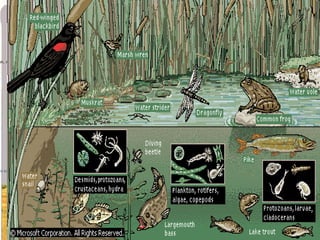
                                                                                            Pond and Lake LifeStill water, in general much warmer than rivers and streams, can support many different kinds of plant and animal life. The silty bed of ponds and the shallower parts of lakes support rooted plants and burrowing larva, food for free-swimming animals such as fish and frogs. In deeper zones, where oxygen is less abundant, only animals adapted to the cold environment exist. Plankton develop at all levels.© Microsoft Corporation. All Rights Reserved.Microsoft ® Encarta ® Encyclopedia 2005. © 1993-2004 Microsoft Corporation. All rights reserved.
The Pyramid of Energy
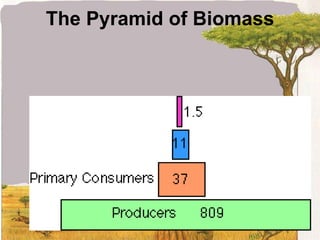
The Pyramid of Biomass
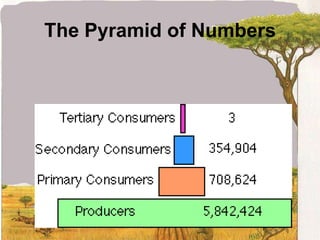
The Pyramid of Numbers
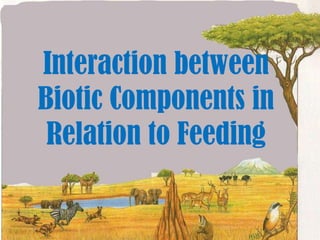
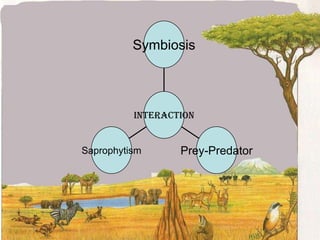
Interaction between Biotic Components in Relation to Feeding
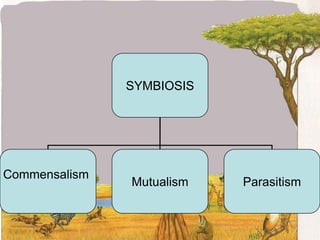
Interaction between Biotic Components in Relation to FeedingSymbiosis is an interaction between two organisms of different species that live together.Symbiosis is further classified into three types:	(a) Commensalism	(b) Parasitism	(c) Mutualism
COMMENSALISM
CommensalismCommensalism is an interaction between two different organism where only one organism benefits from the relationship. The other organism neither benefits nor is harmed.The organism that benefits is called thecommensal while the other organism	is called the host.Examples of commensal are epiphytes	and epizoites.Epiphytes are green plants which grow on other plants to obtain more sunlight and for supportExamples of epiphytes are:	(a) pigeon orchid	(b) staghorn fern	(c) birds nest fern	(e) money plant
MUTUALISM
MutualismRelationship between two species of organisms which both benefitExample of mutualism Lichen and algaeSea anemone and clown fish
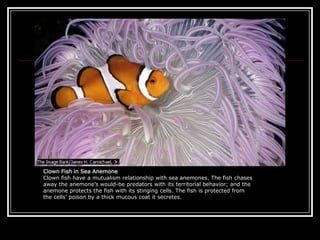
                                                                                           Clown Fish in Sea AnemoneClown fish have a mutualism relationship with sea anemones. The fish chases away the anemone’s would-be predators with its territorial behavior; and the anemone protects the fish with its stinging cells. The fish is protected from the cells’ poison by a thick mucous coat it secretes.
PARASITISM
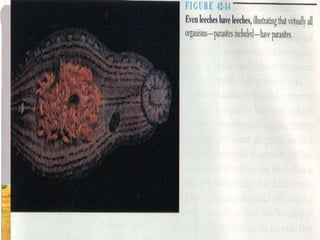
ParasitismRelationship between two organisms in which one organism benefit (parasite) and the other (the host) is harmedEctoparasite are parasite that live on the surface of host body. Eg: ticks and fleasEndoparasite refer to internal parasites. Eg: tapeworm
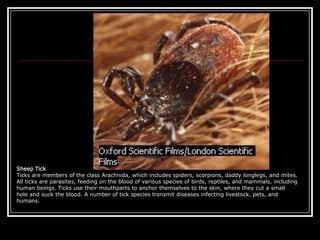
Sheep TickTicks are members of the class Arachnida, which includes spiders, scorpions, daddy longlegs, and mites. All ticks are parasites, feeding on the blood of various species of birds, reptiles, and mammals, including human beings. Ticks use their mouthparts to anchor themselves to the skin, where they cut a small hole and suck the blood. A number of tick species transmit diseases infecting livestock, pets, and humans.
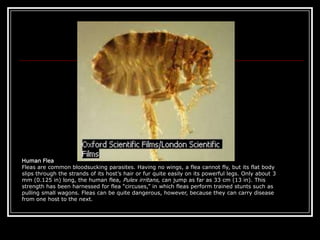
Human FleaFleas are common bloodsucking parasites. Having no wings, a flea cannot fly, but its flat body slips through the strands of its host’s hair or fur quite easily on its powerful legs. Only about 3 mm (0.125 in) long, the human flea, Pulex irritans, can jump as far as 33 cm (13 in). This strength has been harnessed for flea “circuses,” in which fleas perform trained stunts such as pulling small wagons. Fleas can be quite dangerous, however, because they can carry disease from one host to the next.
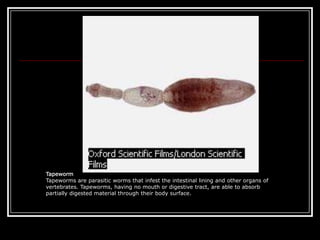
TapewormTapeworms are parasitic worms that infest the intestinal lining and other organs of vertebrates. Tapeworms, having no mouth or digestive tract, are able to absorb partially digested material through their body surface.
SAPROPHYTISM
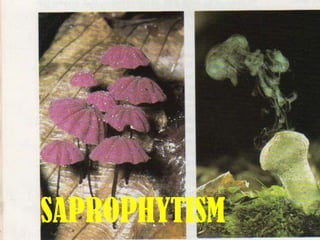
SaprophytismSaprophytism is an interaction whereby an organism lives and feeds on decaying organic matter.There are two types of organisms in this interaction and they are saprophytes and saprozoits.Saprophytes refer to plants which obtain food from decayed organic matter. Examples of saprophytes are the various types of fungi such as mushrooms, bread mould and bracket fungus .Saprozotes are microscopic animals that feed on decayed organic matter.Some examples are Paramecium sp. and Amoeba sp. which feed organic matter from dead organisms.
PREY AND PREDATOR
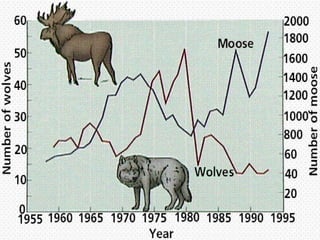
Prey-predator interactionThis is an interaction between two population of organisms t which one organism, called the predator, hunts, captures a kills the other organism, called the prey, for food.The predator benefits because it obtains food.This interaction is a natural method to regulate the population size of the prey.The size of the prey is usually smaller than the predator but number of prey is always more than the predator.
The Interaction Between Biotic Components in Relation To Competition
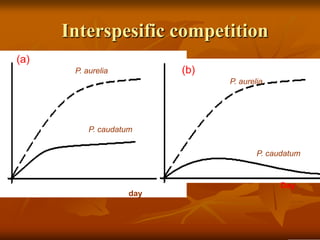
Interaction Between Biotic Components in Relation to Competition -Competition is the interaction between two organisms or two populations to obtain the common basic needs of life that are limited.In a competition, organisms which are strong will obtain their çommon basic needs to survive and hence win in the competition. The organisms which are weak will migrate to other areas or die.There are two types of competition:   (a) intraspecific competition   (b) interspecific competition
  Interspesific competition(a)(b)P. aureliaP. aureliaP. caudatumP. caudatumDayday
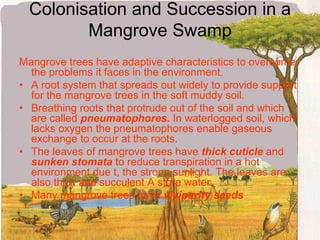
Colonisation and Succession in a Mangrove SwampMangrove trees have adaptive characteristics to overcome the problems it faces in the environment.A root system that spreads out widely to provide support for the mangrove trees in the soft muddy soil.Breathing roots that protrude out of the soil and which are called pneumatophores. In waterlogged soil, which lacks oxygen the pneumatophores enable gaseous exchange to occur at the roots.The leaves of mangrove trees have thick cuticle and sunkenstomata to reduce transpiration in a hot environment due t, the strong sunlight. The leaves are also thick and succulent A store water.Many mangrove trees have viviparity seeds
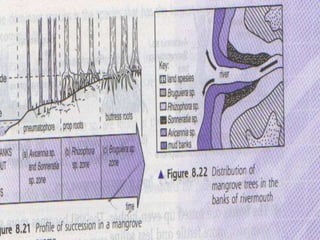
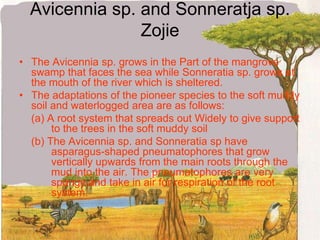
Avicennia sp. and Sonneratja sp. ZojieThe Avicennia sp. grows in the Part of the mangrove swamp that faces the sea while Sonneratia sp. grows at the mouth of the river which is sheltered.The adaptations of the pioneer species to the soft muddy soil and waterlogged area are as follows:	(a) A root system that spreads out Widely to give support 	to the trees in the soft muddy soil	(b) The Avicennia sp. and Sonneratia sp have 	asparagus-shaped pneumatophores that grow 		vertically upwards from the main roots through the 	mud into the air. The pneumatophores are very 	spongy and take in air for respiration of the root 	system.
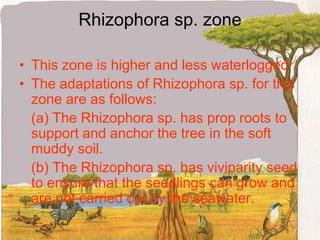
Rhizophora sp. zoneThis zone is higher and less waterloggedThe adaptations of Rhizophora sp. for this zone are as follows:	(a) The Rhizophora sp. has prop roots to support and anchor the tree in the soft muddy soil. 	(b) The Rhizophora sp. has viviparity seed to ensure that the seedlings can grow and are not carried out by the seawater.
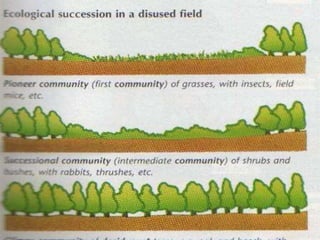
Bruguiera Sp. zoneTrees of Bruguiera sp. grow well in hard clay soil that subjects to flooding during high tide.Trees of Bruguiera sp. have buttress roots for support and knee- shaped pneumatophores for gaseous exchangemore sedimentation of decayed substances occur, new mud banks are being built up seawards while the old banks move further inland, away from the sea. The soil becomes harder and dry land is formed.Bruguiera sp. are replaced by other types of plants such as coconut trees, palm trees and Pandanus sp. These are later replaced by other land plants.Finally, after a few hundred years, the process of succession stopsand a tropical rain forest, which is the climax community, is formed.
Sampling TechniqueA sampling technique is used to study the population size of an organism.A sampling technique involves collecting, counting, and making observations on the organism studied.
POPULATION ECOLOGYEkologi populasi ialah kajian tentang pengukuran faktor2 yg mempengaruhi saiz populasi sesuatu spesis
Populasi biasanya diukur berdasarkan kepadatan sesuatu kawasan yang didiami.
Kepadatan ditakrifkan sebagai bilangan indivivu per unit luas
Faktor yang mempengaruhi kepadatan ialah Faktor biosisFaktor abiotik Kadar kelahiran Kadar kematian Imigrasi dan emigrasi
PersampelanTeknik persampelan kuadratKaudrat adalah rangka segiempat yang dibuat daripada kayu,lilitan tali atau logam
Kaedah persampelan kuadratPersampelan sistematik - jarak antara satu kuadrat dengan kuadrat yang lain adalah seragamPersampelan rawak – kuadrat dibaling secara rawak
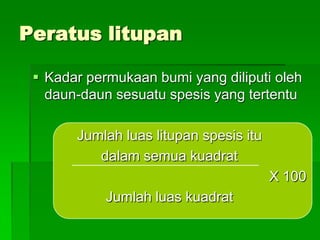
Peratus litupanKadar permukaan bumi yang diliputi oleh daun-daun sesuatu spesis yang tertentuJumlah luas litupan spesis itu dalam semua kuadratX 100Jumlah luas kuadrat
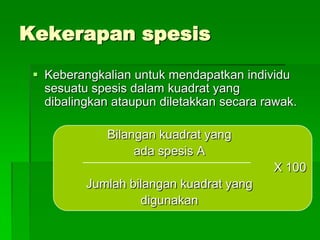
Kekerapan spesisKeberangkalian untuk mendapatkan individu sesuatu spesis dalam kuadrat yang dibalingkan ataupun diletakkan secara rawak.Bilangan kuadrat yang ada spesis AX 100Jumlah bilangan kuadrat yang digunakan
Ketumpatan spesiesDitakrifkan sebagai bilangan individu per unit luas kawasan.
KAEDAH TANGKAP-TANDA-LEPAS DAN TANGKAP SEMULASesuai untuk menganggar populasi haiwan yang bebas bergerakKaedahTangkapan pertama mengandungi beberapa ekor haiwan yang dikaji Haiwan tersebut ditanda dan dilepaskan semulaSelepas tiga hari tangkapan itu dibuat secara rawak di kawasan yang samaBilangan haiwan yang bertanda dan tidak bertanda dikira.
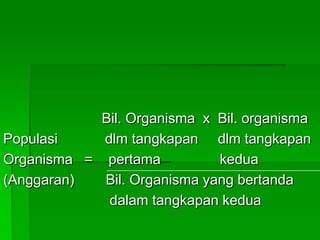
                         Bil. Organisma  x  Bil. organismaPopulasi            dlm tangkapan     dlm tangkapanOrganisma   =    pertama               kedua   (Anggaran)        Bil. Organisma yang bertanda                            dalam tangkapan kedua
Langkah berjaga-jagaPastikan dakwat yang digunakan tidak larut airPastikan dakwat tersebut tidak beracun
Andaian Organisma telah bergaul secara rawak dalam masa persampelan keduaTiada emigrasi dan imigrasi
Seorang murid ingin menganggarkan populasi dalam sebuah kebun. Dia menangkap 60 ekor siput dan menandakan siput itu sebelum dilepaskan. Selepas tiga hari dia menangkap 45 ekor siput dan mendapati 6 ekor adalah bertanda. Apakah angggaran populasi siput dalam kebun itu.JWP: 450
BIODIVERSITY AND CLASSIFICATION
NEED FOR CLASSIFICATON1.5 million species of living organisms have been described, and it is estimated more than three million remain to be discovered.The need for classification is to bring order out of chaos.
Classification of organismsOrganisms with same basic features are grouped together into a kingdomKingdom is the largest unit of classificationAll organisms are grouped into five kingdoms
KingdomsProkaryotae ProtistaFungi PlantaeAnimalia
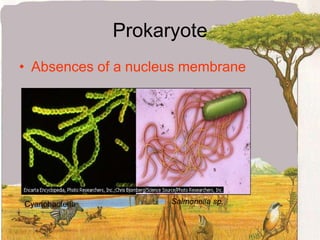
ProkaryoteAbsences of a nucleus membrane Salmonella sp.Cyanobacteria
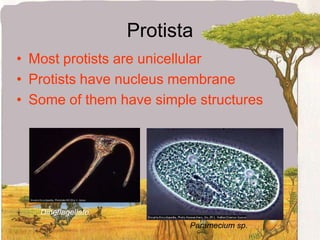
ProtistaMost protists are unicellularProtists have nucleus membraneSome of them have simple structuresDinoflagellateParamecium sp.
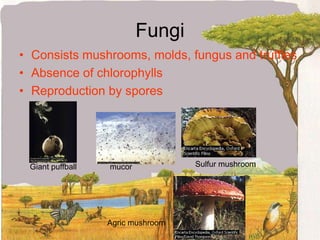
FungiConsists mushrooms, molds, fungus and trufflesAbsence of chlorophylls Reproduction by sporesSulfur mushroomGiant puffballmucorAgric mushroom
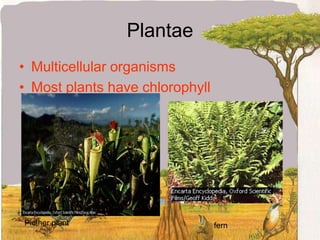
PlantaeMulticellular organismsMost plants have chlorophyllPicther plantfern
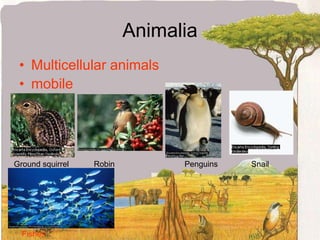
AnimaliaMulticellular animalsmobileGround squirrelRobinPenguinsSnailFishes
THE HIERARCHY IN THE CLASSIFICATION
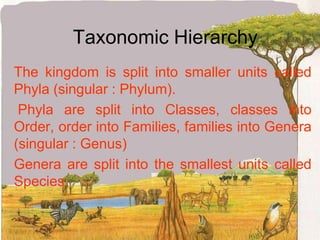
Taxonomic HierarchyThe kingdom is split into smaller units called Phyla (singular : Phylum). Phyla are split into Classes, classes into Order, order into Families, families into Genera (singular : Genus)Genera are split into the smallest units called Species
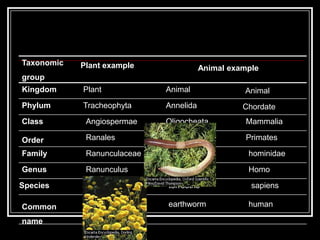
Taxonomic groupPlant exampleAnimal exampleKingdomPlantAnimalAnimalPhylumTracheophytaAnnelidaChordateClassAngiospermaeOligocheataMammaliaRanalesTerricolaePrimatesOrderFamilyRanunculaceaeLumbricidaehominidaeGenusRanunculusLumbricusHomo SpeciesacristerrestrissapiensearthwormhumanCommonnameMeadow buttercup
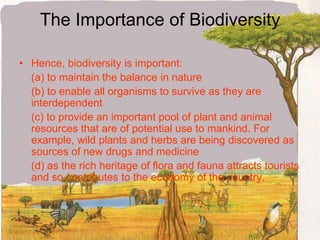
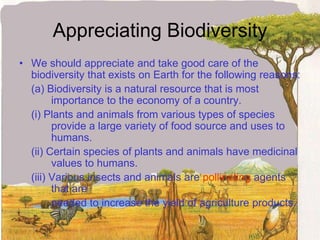
The Importance of BiodiversityHence, biodiversity is important:	(a) to maintain the balance in nature	(b) to enable all organisms to survive as they are interdependent	(c) to provide an important pool of plant and animal resources that are of potential use to mankind. For example, wild plants and herbs are being discovered as sources of new drugs and medicine	(d) as the rich heritage of flora and fauna attracts tourists and so contributes to the economy of the country.
The Impact of microorganismsOn Life
Types of MicroorganismsProtozoaaquatic unicellular animalcan be seen under a microscope at low powerhas nucleus, cytoplasm and is surrounded by a plasma membranetakes in food (feeding), removes excretory products and reproducesreproduces sexually and asexaullylives freely in the river, pond, fresh water, soil or on another organism. Some live as parasitesheterotrophsexamples: Amoeba sp., Paramecium sp., Plasmodium sp. (parasite)kingdom; Protista
Fungiunicellular plant (yeast) or multicellular plant (mushroom and Mucor spcan be seen under a microscope at low power or with a magnifying glassa plants Without chlorophyIReproduces by budding (yeast) and formation of spores (mushroom and Mucor sp.)lives as saprophytes and parasitesheterotrophsexamples: Yeast, Mucor sp. (bread mould), mushroomKingdom: Fungi
Algaeexists as unicellular, in a colony and in filaments (multicellular)lives in the sea, pond, river, paddy field, tree stem, damp soilthe most simple green plantscontains chlorophyllautotrophscarries out aerobic respirationreproduces asexualIy and sexuallyexamples: Phytoplankton (Chlamydomonas sp.)pleurococcus sp. Spirogyra sp.Kingdom: Protista
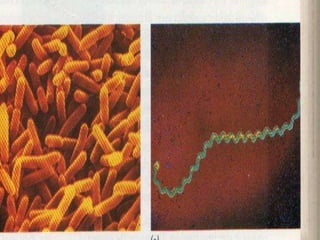
Bacteriaunicellular microorganismcan be seen under a microscope at high powerhas a cell wallgenetic material scattered in the cytoplasm because there is no nuclear membranreproduces asexualy by binary fisionforms spores when conditions are not suitableableexamples: Lactobacillus sp., StaphyIococcus sp.Kingdom: Monera
Virusmicroscopic microorganismcan only be seen under an electron microscopeconsists of nucleic acid that is ribonucleic acid (RNA) or deoxyribonucleic acid (DNA)has a layer of protein for protectionhas no cytoplasm, nucleus or plasma membraneExits as crystals outside host cells, no signs of lifecan only reproduce when in living cells of hostsexists in various formsall are parasitesexamples: Bacteriophage, tobacco mosaic virus influenza virusKingdom: Viruses cannot be placed in any kingdom because they have their own characteristics, without showing any characteristics of living things
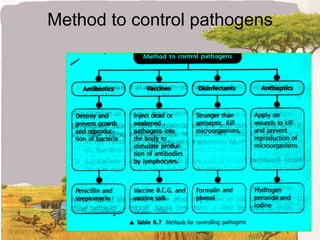
Method to control pathogens

Dynamic Ecosystem

  • 1.
  • 2.
    The Abiotic andBiotic Components of the EnvironmentAn ecosystem is a system formed by the interaction of living organisms with one another and with their environment.Abiotic components are the non-living components in the ecosystem such as air, water, soil, temperature and light intensity.Biotic components are the living components in the ecosystem such as plants and animals.
  • 3.
  • 4.
    Abiotic Components ofan EcosystemAbiotic components in an ecosystem include the physical factors such as the pH level, temperature, light intensity, humidity, topography, microclimate and the edaphic factor which refers to the physical or chemical composition of the soil.
  • 5.
    pHMost organism livein natural and nearly neutral environmental (pH6 – pH7.5)Some plants, like maize, grows well in an acidic condition while coconuts grow well in alkaline condition.
  • 6.
    Temperature Effect onbiochemical reaction in the organismOrganism can live within certain range of temperaturePoikilotherms- are animal that cannot control their body temperature.Homoiotherms- are animal that able to maintain their body temperature.
  • 7.
    Light IntensityEffect therate of photosynthesisThe distribution of green plants will be more extensive in the area with higher light intensity
  • 8.
    HumidityOrganism that cancontrol the rate of water loss have and extensive distributionOrganism such as frogs, snails, earthworm and moss cannot controlthe rate of water lossand more suited to live in damp places
  • 9.
    TopographyAltitude- There areless ogrganism at high altitude because of temperature, humidity and air pressure are low.Gradient/Slope-
  • 10.
    MicroclimateMicroclimate refers tothe climate of specific region in an habitatMicroclimate includes light intensity, amount of rainfall, temperature changes and humidity of amicrohabitat
  • 11.
  • 12.
    Biotic Components ofan EcosystemThe biotic components are classified into three groups: a) producers b) consumers c) decomposersConsumers are organisms that feed on plants or other organisms. (a) Primary consumers are herbivores that feed on plants directly. (b) Secondary condsumers are carnivores that feed on primary consumers directily (c ) Tertiary consumers are carnivores or omnivores that feed on secondary consumer
  • 13.
    Decomposers are thebacteria and fungi that break down dead plants and dead animals into simple substances.A feeding relationship exists between the biotic components to form a food chainThrough the food chain, organisms obtain energy.Each level in a food chain is referred to as trophic level
  • 17.
    In an ecosystem,several food chains interact to form a network called a food web. In a food chain, energy is transferred from one trophic level to another trophic level.When energy is transferred from one trophic level to another trophic level as much as 90% of the chemical energy in the food consumed is used for its metabolic activities and lost as heat, excretory products and undigested matter.only 10% of the energy in an organism is passed on to organism at the next trophic level.
  • 18.
                                                                                                Pond andLake LifeStill water, in general much warmer than rivers and streams, can support many different kinds of plant and animal life. The silty bed of ponds and the shallower parts of lakes support rooted plants and burrowing larva, food for free-swimming animals such as fish and frogs. In deeper zones, where oxygen is less abundant, only animals adapted to the cold environment exist. Plankton develop at all levels.© Microsoft Corporation. All Rights Reserved.Microsoft ® Encarta ® Encyclopedia 2005. © 1993-2004 Microsoft Corporation. All rights reserved.
  • 20.
  • 22.
  • 23.
  • 24.
    Interaction between BioticComponents in Relation to Feeding
  • 26.
    Interaction between BioticComponents in Relation to FeedingSymbiosis is an interaction between two organisms of different species that live together.Symbiosis is further classified into three types: (a) Commensalism (b) Parasitism (c) Mutualism
  • 28.
  • 29.
    CommensalismCommensalism is aninteraction between two different organism where only one organism benefits from the relationship. The other organism neither benefits nor is harmed.The organism that benefits is called thecommensal while the other organism is called the host.Examples of commensal are epiphytes and epizoites.Epiphytes are green plants which grow on other plants to obtain more sunlight and for supportExamples of epiphytes are: (a) pigeon orchid (b) staghorn fern (c) birds nest fern (e) money plant
  • 30.
  • 31.
    MutualismRelationship between twospecies of organisms which both benefitExample of mutualism Lichen and algaeSea anemone and clown fish
  • 32.
                                                                                               Clown Fishin Sea AnemoneClown fish have a mutualism relationship with sea anemones. The fish chases away the anemone’s would-be predators with its territorial behavior; and the anemone protects the fish with its stinging cells. The fish is protected from the cells’ poison by a thick mucous coat it secretes.
  • 34.
  • 35.
    ParasitismRelationship between twoorganisms in which one organism benefit (parasite) and the other (the host) is harmedEctoparasite are parasite that live on the surface of host body. Eg: ticks and fleasEndoparasite refer to internal parasites. Eg: tapeworm
  • 36.
    Sheep TickTicks aremembers of the class Arachnida, which includes spiders, scorpions, daddy longlegs, and mites. All ticks are parasites, feeding on the blood of various species of birds, reptiles, and mammals, including human beings. Ticks use their mouthparts to anchor themselves to the skin, where they cut a small hole and suck the blood. A number of tick species transmit diseases infecting livestock, pets, and humans.
  • 37.
    Human FleaFleas arecommon bloodsucking parasites. Having no wings, a flea cannot fly, but its flat body slips through the strands of its host’s hair or fur quite easily on its powerful legs. Only about 3 mm (0.125 in) long, the human flea, Pulex irritans, can jump as far as 33 cm (13 in). This strength has been harnessed for flea “circuses,” in which fleas perform trained stunts such as pulling small wagons. Fleas can be quite dangerous, however, because they can carry disease from one host to the next.
  • 38.
    TapewormTapeworms are parasiticworms that infest the intestinal lining and other organs of vertebrates. Tapeworms, having no mouth or digestive tract, are able to absorb partially digested material through their body surface.
  • 40.
  • 41.
    SaprophytismSaprophytism is aninteraction whereby an organism lives and feeds on decaying organic matter.There are two types of organisms in this interaction and they are saprophytes and saprozoits.Saprophytes refer to plants which obtain food from decayed organic matter. Examples of saprophytes are the various types of fungi such as mushrooms, bread mould and bracket fungus .Saprozotes are microscopic animals that feed on decayed organic matter.Some examples are Paramecium sp. and Amoeba sp. which feed organic matter from dead organisms.
  • 42.
  • 43.
    Prey-predator interactionThis isan interaction between two population of organisms t which one organism, called the predator, hunts, captures a kills the other organism, called the prey, for food.The predator benefits because it obtains food.This interaction is a natural method to regulate the population size of the prey.The size of the prey is usually smaller than the predator but number of prey is always more than the predator.
  • 45.
    The Interaction BetweenBiotic Components in Relation To Competition
  • 46.
    Interaction Between BioticComponents in Relation to Competition -Competition is the interaction between two organisms or two populations to obtain the common basic needs of life that are limited.In a competition, organisms which are strong will obtain their çommon basic needs to survive and hence win in the competition. The organisms which are weak will migrate to other areas or die.There are two types of competition: (a) intraspecific competition (b) interspecific competition
  • 47.
    Interspesificcompetition(a)(b)P. aureliaP. aureliaP. caudatumP. caudatumDayday
  • 48.
    Colonisation and Successionin a Mangrove SwampMangrove trees have adaptive characteristics to overcome the problems it faces in the environment.A root system that spreads out widely to provide support for the mangrove trees in the soft muddy soil.Breathing roots that protrude out of the soil and which are called pneumatophores. In waterlogged soil, which lacks oxygen the pneumatophores enable gaseous exchange to occur at the roots.The leaves of mangrove trees have thick cuticle and sunkenstomata to reduce transpiration in a hot environment due t, the strong sunlight. The leaves are also thick and succulent A store water.Many mangrove trees have viviparity seeds
  • 50.
    Avicennia sp. andSonneratja sp. ZojieThe Avicennia sp. grows in the Part of the mangrove swamp that faces the sea while Sonneratia sp. grows at the mouth of the river which is sheltered.The adaptations of the pioneer species to the soft muddy soil and waterlogged area are as follows: (a) A root system that spreads out Widely to give support to the trees in the soft muddy soil (b) The Avicennia sp. and Sonneratia sp have asparagus-shaped pneumatophores that grow vertically upwards from the main roots through the mud into the air. The pneumatophores are very spongy and take in air for respiration of the root system.
  • 51.
    Rhizophora sp. zoneThiszone is higher and less waterloggedThe adaptations of Rhizophora sp. for this zone are as follows: (a) The Rhizophora sp. has prop roots to support and anchor the tree in the soft muddy soil. (b) The Rhizophora sp. has viviparity seed to ensure that the seedlings can grow and are not carried out by the seawater.
  • 52.
    Bruguiera Sp. zoneTreesof Bruguiera sp. grow well in hard clay soil that subjects to flooding during high tide.Trees of Bruguiera sp. have buttress roots for support and knee- shaped pneumatophores for gaseous exchangemore sedimentation of decayed substances occur, new mud banks are being built up seawards while the old banks move further inland, away from the sea. The soil becomes harder and dry land is formed.Bruguiera sp. are replaced by other types of plants such as coconut trees, palm trees and Pandanus sp. These are later replaced by other land plants.Finally, after a few hundred years, the process of succession stopsand a tropical rain forest, which is the climax community, is formed.
  • 54.
    Sampling TechniqueA samplingtechnique is used to study the population size of an organism.A sampling technique involves collecting, counting, and making observations on the organism studied.
  • 55.
    POPULATION ECOLOGYEkologi populasiialah kajian tentang pengukuran faktor2 yg mempengaruhi saiz populasi sesuatu spesis
  • 56.
    Populasi biasanya diukurberdasarkan kepadatan sesuatu kawasan yang didiami.
  • 57.
    Kepadatan ditakrifkan sebagaibilangan indivivu per unit luas
  • 58.
    Faktor yang mempengaruhikepadatan ialah Faktor biosisFaktor abiotik Kadar kelahiran Kadar kematian Imigrasi dan emigrasi
  • 59.
    PersampelanTeknik persampelan kuadratKaudratadalah rangka segiempat yang dibuat daripada kayu,lilitan tali atau logam
  • 60.
    Kaedah persampelan kuadratPersampelansistematik - jarak antara satu kuadrat dengan kuadrat yang lain adalah seragamPersampelan rawak – kuadrat dibaling secara rawak
  • 61.
    Peratus litupanKadar permukaanbumi yang diliputi oleh daun-daun sesuatu spesis yang tertentuJumlah luas litupan spesis itu dalam semua kuadratX 100Jumlah luas kuadrat
  • 62.
    Kekerapan spesisKeberangkalian untukmendapatkan individu sesuatu spesis dalam kuadrat yang dibalingkan ataupun diletakkan secara rawak.Bilangan kuadrat yang ada spesis AX 100Jumlah bilangan kuadrat yang digunakan
  • 63.
    Ketumpatan spesiesDitakrifkan sebagaibilangan individu per unit luas kawasan.
  • 64.
    KAEDAH TANGKAP-TANDA-LEPAS DANTANGKAP SEMULASesuai untuk menganggar populasi haiwan yang bebas bergerakKaedahTangkapan pertama mengandungi beberapa ekor haiwan yang dikaji Haiwan tersebut ditanda dan dilepaskan semulaSelepas tiga hari tangkapan itu dibuat secara rawak di kawasan yang samaBilangan haiwan yang bertanda dan tidak bertanda dikira.
  • 65.
    Bil. Organisma x Bil. organismaPopulasi dlm tangkapan dlm tangkapanOrganisma = pertama kedua (Anggaran) Bil. Organisma yang bertanda dalam tangkapan kedua
  • 66.
    Langkah berjaga-jagaPastikan dakwatyang digunakan tidak larut airPastikan dakwat tersebut tidak beracun
  • 67.
    Andaian Organisma telahbergaul secara rawak dalam masa persampelan keduaTiada emigrasi dan imigrasi
  • 68.
    Seorang murid inginmenganggarkan populasi dalam sebuah kebun. Dia menangkap 60 ekor siput dan menandakan siput itu sebelum dilepaskan. Selepas tiga hari dia menangkap 45 ekor siput dan mendapati 6 ekor adalah bertanda. Apakah angggaran populasi siput dalam kebun itu.JWP: 450
  • 69.
  • 70.
    NEED FOR CLASSIFICATON1.5million species of living organisms have been described, and it is estimated more than three million remain to be discovered.The need for classification is to bring order out of chaos.
  • 71.
    Classification of organismsOrganismswith same basic features are grouped together into a kingdomKingdom is the largest unit of classificationAll organisms are grouped into five kingdoms
  • 72.
  • 73.
    ProkaryoteAbsences of anucleus membrane Salmonella sp.Cyanobacteria
  • 74.
    ProtistaMost protists areunicellularProtists have nucleus membraneSome of them have simple structuresDinoflagellateParamecium sp.
  • 75.
    FungiConsists mushrooms, molds,fungus and trufflesAbsence of chlorophylls Reproduction by sporesSulfur mushroomGiant puffballmucorAgric mushroom
  • 76.
    PlantaeMulticellular organismsMost plantshave chlorophyllPicther plantfern
  • 77.
  • 78.
    THE HIERARCHY INTHE CLASSIFICATION
  • 79.
    Taxonomic HierarchyThe kingdomis split into smaller units called Phyla (singular : Phylum). Phyla are split into Classes, classes into Order, order into Families, families into Genera (singular : Genus)Genera are split into the smallest units called Species
  • 80.
    Taxonomic groupPlant exampleAnimalexampleKingdomPlantAnimalAnimalPhylumTracheophytaAnnelidaChordateClassAngiospermaeOligocheataMammaliaRanalesTerricolaePrimatesOrderFamilyRanunculaceaeLumbricidaehominidaeGenusRanunculusLumbricusHomo SpeciesacristerrestrissapiensearthwormhumanCommonnameMeadow buttercup
  • 82.
    The Importance ofBiodiversityHence, biodiversity is important: (a) to maintain the balance in nature (b) to enable all organisms to survive as they are interdependent (c) to provide an important pool of plant and animal resources that are of potential use to mankind. For example, wild plants and herbs are being discovered as sources of new drugs and medicine (d) as the rich heritage of flora and fauna attracts tourists and so contributes to the economy of the country.
  • 83.
    The Impact ofmicroorganismsOn Life
  • 84.
    Types of MicroorganismsProtozoaaquaticunicellular animalcan be seen under a microscope at low powerhas nucleus, cytoplasm and is surrounded by a plasma membranetakes in food (feeding), removes excretory products and reproducesreproduces sexually and asexaullylives freely in the river, pond, fresh water, soil or on another organism. Some live as parasitesheterotrophsexamples: Amoeba sp., Paramecium sp., Plasmodium sp. (parasite)kingdom; Protista
  • 85.
    Fungiunicellular plant (yeast)or multicellular plant (mushroom and Mucor spcan be seen under a microscope at low power or with a magnifying glassa plants Without chlorophyIReproduces by budding (yeast) and formation of spores (mushroom and Mucor sp.)lives as saprophytes and parasitesheterotrophsexamples: Yeast, Mucor sp. (bread mould), mushroomKingdom: Fungi
  • 86.
    Algaeexists as unicellular,in a colony and in filaments (multicellular)lives in the sea, pond, river, paddy field, tree stem, damp soilthe most simple green plantscontains chlorophyllautotrophscarries out aerobic respirationreproduces asexualIy and sexuallyexamples: Phytoplankton (Chlamydomonas sp.)pleurococcus sp. Spirogyra sp.Kingdom: Protista
  • 87.
    Bacteriaunicellular microorganismcan beseen under a microscope at high powerhas a cell wallgenetic material scattered in the cytoplasm because there is no nuclear membranreproduces asexualy by binary fisionforms spores when conditions are not suitableableexamples: Lactobacillus sp., StaphyIococcus sp.Kingdom: Monera
  • 89.
    Virusmicroscopic microorganismcan onlybe seen under an electron microscopeconsists of nucleic acid that is ribonucleic acid (RNA) or deoxyribonucleic acid (DNA)has a layer of protein for protectionhas no cytoplasm, nucleus or plasma membraneExits as crystals outside host cells, no signs of lifecan only reproduce when in living cells of hostsexists in various formsall are parasitesexamples: Bacteriophage, tobacco mosaic virus influenza virusKingdom: Viruses cannot be placed in any kingdom because they have their own characteristics, without showing any characteristics of living things
  • 90.