1
Introduction to
Biological Sciences
Type in the chat box ‘present sir’ for your attendance this afternoon.
2
3
Introduction to
Biological Sciences
Objectives:
 Explore the different theories on
the origin of life.
 Understand the events that lead
to the understanding of how life
came from life.
4
5
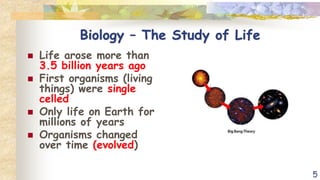
Biology – The Study of Life
 Life arose more than
3.5 billion years ago
 First organisms (living
things) were single
celled
 Only life on Earth for
millions of years
 Organisms changed
over time (evolved)
6
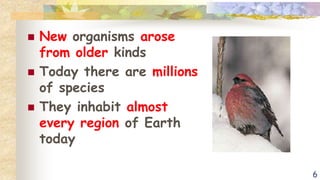
 New organisms arose
from older kinds
 Today there are millions
of species
 They inhabit almost
every region of Earth
today
Question:
What does it mean
to be alive?
7
Short Activity
Look around you and make a list of 2
objects you consider as living things.
Record your answers on a paper and give
the reason/s as to why you considered
the identified objects as living things.
Share this with the class.
8
Definitions of Life
 Life is the aspect of existence that
processes, acts, reacts, evaluates, and evolves
through growth (reproduction and
metabolism). (Tom Baranski)
 Life is self-organising chemistry which
reproduces itself and passes on its evolved
characteristics, encoded in DNA. (Dr. Harry
Fuchs)
9
 Life is an arrangement of molecules with
qualities of self-sustenance and self-
replication. (John Talley)
 Life is self-reproduction with variations.
(Edward Trifonov)
10
Characteristics of Life
 Life is Organized
 Life maintains Internal Constancy
 Life requires and uses Energy
 Life Evolves
 Life Reproduces
11
How did life
begin?
12
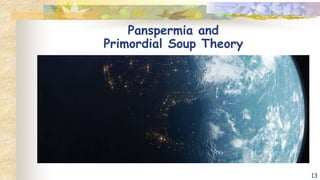
Panspermia and
Primordial Soup Theory
13
Primordial Soup Theory
 When the earth was young, the oceans were filled
with simple chemicals important for life which
would eventually self-assemble into simple living
cells.
 proposed in the 1920's by two researchers working
independently: Alexander Oparin in the USSR and
British geneticist J. B. S. Haldane.
14
The Miller-Urey Experiment
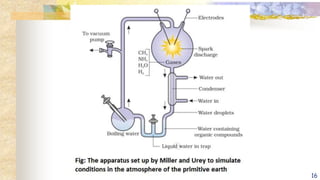
Stanley Miller, supervised by Harold Urey, mixed
four simple chemicals (CH4, NH3, H2O, H2) in glass
tubes, which were heated and shocked with electrical
sparks to mimic lightning. The experiment made
several amino acids, the building blocks of proteins.
The Miller-Urey experiment showed that the
chemicals of life could form naturally.
15
16
Panspermia Theory
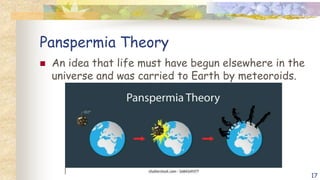
 An idea that life must have begun elsewhere in the
universe and was carried to Earth by meteoroids.
17
Where?
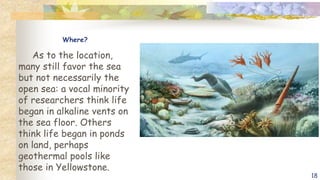
As to the location,
many still favor the sea
but not necessarily the
open sea: a vocal minority
of researchers think life
began in alkaline vents on
the sea floor. Others
think life began in ponds
on land, perhaps
geothermal pools like
those in Yellowstone.
18
Where does new
life come from?
19
The Spontaneous Generation Theory
20
Spontaneous Generation Theory
 Proposed by Greeks including Aristotle.
 The notion that life can arise from non-
living matter. (Life came from nothing.)
 Life arose from non-living material if
the material contained pneuma (“vital
heat”).
21
Examples of Spontaneous Generation
 Bougonia
 Written by the Roman poet Virgil as a recipe in
which one could make synthetic bees.
 The readers were instructed to beat a bovine
calf to death, block up its mouth and nose,
before leaving the carcass on a bed of cinnamon
sticks and thyme.
22
 How mice came to life
 The “recipe” for making a mouse requires that
sweaty underwear should be placed over an open-
mouth jar containing husks of wheat inside for
around 21 days.
 A simple explanation: mice like to eat wheat and,
with ease of entering a jar and finding a dark and
safe space, would be most likely to find
themselves at home and have a few offspring in
the new nest.
23
 Wet soil after a flood was believed to create
amphibians such as frogs and toads.
 Maggots came from meat.
 Salamanders were thought to be borne within fire
(they often hide inside logs and were probably trying
to escape the blaze!).
 Oyster shells were believed to form as the earth
solidified around them and the “vital heat” grew the
creature within.
 Crocodiles in Egypt were thought to have emerged
from the mud with the sunshine as a catalyst.
24
!!!
Spontaneous generation (also referred
to as abiogenesis) is an incorrect and
obsolete hypothesis about the possibility
of life forms being able to emerge from
non-living things. This theory peristed
until the 17th century.
25
Disproving the
Spontaneous Generation Theory
26
Francesco Redi
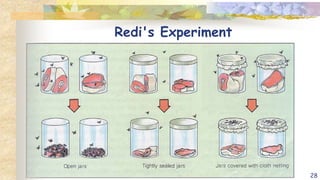
 An Italian physician who performed an experiment in
1668 that was one of the first to refute the idea that
maggots (the larvae of flies) spontaneously generate
on meat left out in the open air.
 He predicted that preventing flies from having direct
contact with the meat would also prevent the
appearance of maggots. Redi left meat in each of the
six containers
27
Redi's Experiment
28
His hypothesis was supported when
maggots developed in the uncovered jars, but
no maggots appeared in either the gauze-
covered or the tightly sealed jars. He
concluded that maggots could only form when
flies were allowed to lay eggs in the meat,
and that the maggots were the offspring of
flies, not the product of spontaneous
generation
29
John Needham
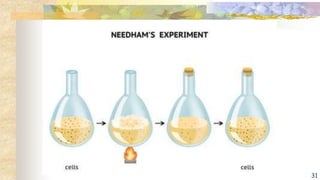
 A known supporter of SGT
 He briefly boiled broth infused with plant or animal
matter, hoping to kill all pre-existing microbes. He
then sealed the flasks. After a few days, Needham
observed that the broth had become cloudy, and a
single drop contained numerous microscopic creatures.
He argued that the new microbes must have arisen
spontaneously.
30
31
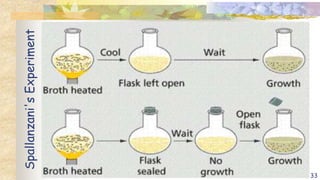
Lazzaro Spallanzani
 Did not agree with Needham's experiment.
 As in Needham’s experiment, broth in sealed jars and
unsealed jars was infused with plant and animal
matter. Spallanzani’s results contradicted the findings
of Needham: Heated but sealed flasks remained clear,
without any signs of spontaneous growth, unless the
flasks were subsequently opened to the air.
32
Spallanzani's
Experiment
33
The debate continues....
Spallanzani: Microbes were introduced into these
flasks from the air.
Needham: Life originates from a “life force” that
was destroyed during Spallanzani’s extended
boiling. Any subsequent sealing of the flasks then
prevented new life force from entering and
causing spontaneous generation.
34
French Academy of Science
 Offered a prize for the
resolution of the debate.
 Setup a contest to prove or
disprove Spontaneous Generation.
35
Louis Pasteur
Pasteur filtered air through a gun-cotton filter
and, upon microscopic examination of the
cotton, found it full of microorganisms,
suggesting that the exposure of a broth to air
was not introducing a “life force” to the broth
but rather airborne microorganisms.
36
37
Felix Archimede Pouchet
 “animals and plants could be generated in a
medium absolutely free from atmospheric air
and in which therefore no germ of organic
bodies could have been brought by air.
 He used hay medium in his experiments.
38
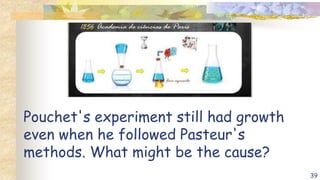
Pouchet's experiment still had growth
even when he followed Pasteur's
methods. What might be the cause?
39
What's the difference?
The yeast extract and sugar broth of
Pasteur could be sterilized with just a
few minutes of boiling, whereas the hay
medium of Pouchet required heating for
several hours to accomplish sterilization.
40
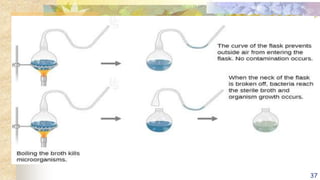
Pasteur’s set of experiments
irrefutably disproved the theory of
spontaneous generation and earned
him the prestigious Alhumbert Prize
from the Paris Academy of Sciences
in 1862.
41
"Omne vivum ex vivo"
Life only comes from life.
(biogenesis)
42

Introduction to Biological Sciences.pptx

  • 1.
    1 Introduction to Biological Sciences Typein the chat box ‘present sir’ for your attendance this afternoon.
  • 2.
  • 3.
  • 4.
    Objectives:  Explore thedifferent theories on the origin of life.  Understand the events that lead to the understanding of how life came from life. 4
  • 5.
    5 Biology – TheStudy of Life  Life arose more than 3.5 billion years ago  First organisms (living things) were single celled  Only life on Earth for millions of years  Organisms changed over time (evolved)
  • 6.
    6  New organismsarose from older kinds  Today there are millions of species  They inhabit almost every region of Earth today
  • 7.
    Question: What does itmean to be alive? 7
  • 8.
    Short Activity Look aroundyou and make a list of 2 objects you consider as living things. Record your answers on a paper and give the reason/s as to why you considered the identified objects as living things. Share this with the class. 8
  • 9.
    Definitions of Life Life is the aspect of existence that processes, acts, reacts, evaluates, and evolves through growth (reproduction and metabolism). (Tom Baranski)  Life is self-organising chemistry which reproduces itself and passes on its evolved characteristics, encoded in DNA. (Dr. Harry Fuchs) 9
  • 10.
     Life isan arrangement of molecules with qualities of self-sustenance and self- replication. (John Talley)  Life is self-reproduction with variations. (Edward Trifonov) 10
  • 11.
    Characteristics of Life Life is Organized  Life maintains Internal Constancy  Life requires and uses Energy  Life Evolves  Life Reproduces 11
  • 12.
  • 13.
  • 14.
    Primordial Soup Theory When the earth was young, the oceans were filled with simple chemicals important for life which would eventually self-assemble into simple living cells.  proposed in the 1920's by two researchers working independently: Alexander Oparin in the USSR and British geneticist J. B. S. Haldane. 14
  • 15.
    The Miller-Urey Experiment StanleyMiller, supervised by Harold Urey, mixed four simple chemicals (CH4, NH3, H2O, H2) in glass tubes, which were heated and shocked with electrical sparks to mimic lightning. The experiment made several amino acids, the building blocks of proteins. The Miller-Urey experiment showed that the chemicals of life could form naturally. 15
  • 16.
  • 17.
    Panspermia Theory  Anidea that life must have begun elsewhere in the universe and was carried to Earth by meteoroids. 17
  • 18.
    Where? As to thelocation, many still favor the sea but not necessarily the open sea: a vocal minority of researchers think life began in alkaline vents on the sea floor. Others think life began in ponds on land, perhaps geothermal pools like those in Yellowstone. 18
  • 19.
    Where does new lifecome from? 19
  • 20.
  • 21.
    Spontaneous Generation Theory Proposed by Greeks including Aristotle.  The notion that life can arise from non- living matter. (Life came from nothing.)  Life arose from non-living material if the material contained pneuma (“vital heat”). 21
  • 22.
    Examples of SpontaneousGeneration  Bougonia  Written by the Roman poet Virgil as a recipe in which one could make synthetic bees.  The readers were instructed to beat a bovine calf to death, block up its mouth and nose, before leaving the carcass on a bed of cinnamon sticks and thyme. 22
  • 23.
     How micecame to life  The “recipe” for making a mouse requires that sweaty underwear should be placed over an open- mouth jar containing husks of wheat inside for around 21 days.  A simple explanation: mice like to eat wheat and, with ease of entering a jar and finding a dark and safe space, would be most likely to find themselves at home and have a few offspring in the new nest. 23
  • 24.
     Wet soilafter a flood was believed to create amphibians such as frogs and toads.  Maggots came from meat.  Salamanders were thought to be borne within fire (they often hide inside logs and were probably trying to escape the blaze!).  Oyster shells were believed to form as the earth solidified around them and the “vital heat” grew the creature within.  Crocodiles in Egypt were thought to have emerged from the mud with the sunshine as a catalyst. 24
  • 25.
    !!! Spontaneous generation (alsoreferred to as abiogenesis) is an incorrect and obsolete hypothesis about the possibility of life forms being able to emerge from non-living things. This theory peristed until the 17th century. 25
  • 26.
  • 27.
    Francesco Redi  AnItalian physician who performed an experiment in 1668 that was one of the first to refute the idea that maggots (the larvae of flies) spontaneously generate on meat left out in the open air.  He predicted that preventing flies from having direct contact with the meat would also prevent the appearance of maggots. Redi left meat in each of the six containers 27
  • 28.
  • 29.
    His hypothesis wassupported when maggots developed in the uncovered jars, but no maggots appeared in either the gauze- covered or the tightly sealed jars. He concluded that maggots could only form when flies were allowed to lay eggs in the meat, and that the maggots were the offspring of flies, not the product of spontaneous generation 29
  • 30.
    John Needham  Aknown supporter of SGT  He briefly boiled broth infused with plant or animal matter, hoping to kill all pre-existing microbes. He then sealed the flasks. After a few days, Needham observed that the broth had become cloudy, and a single drop contained numerous microscopic creatures. He argued that the new microbes must have arisen spontaneously. 30
  • 31.
  • 32.
    Lazzaro Spallanzani  Didnot agree with Needham's experiment.  As in Needham’s experiment, broth in sealed jars and unsealed jars was infused with plant and animal matter. Spallanzani’s results contradicted the findings of Needham: Heated but sealed flasks remained clear, without any signs of spontaneous growth, unless the flasks were subsequently opened to the air. 32
  • 33.
  • 34.
    The debate continues.... Spallanzani:Microbes were introduced into these flasks from the air. Needham: Life originates from a “life force” that was destroyed during Spallanzani’s extended boiling. Any subsequent sealing of the flasks then prevented new life force from entering and causing spontaneous generation. 34
  • 35.
    French Academy ofScience  Offered a prize for the resolution of the debate.  Setup a contest to prove or disprove Spontaneous Generation. 35
  • 36.
    Louis Pasteur Pasteur filteredair through a gun-cotton filter and, upon microscopic examination of the cotton, found it full of microorganisms, suggesting that the exposure of a broth to air was not introducing a “life force” to the broth but rather airborne microorganisms. 36
  • 37.
  • 38.
    Felix Archimede Pouchet “animals and plants could be generated in a medium absolutely free from atmospheric air and in which therefore no germ of organic bodies could have been brought by air.  He used hay medium in his experiments. 38
  • 39.
    Pouchet's experiment stillhad growth even when he followed Pasteur's methods. What might be the cause? 39
  • 40.
    What's the difference? Theyeast extract and sugar broth of Pasteur could be sterilized with just a few minutes of boiling, whereas the hay medium of Pouchet required heating for several hours to accomplish sterilization. 40
  • 41.
    Pasteur’s set ofexperiments irrefutably disproved the theory of spontaneous generation and earned him the prestigious Alhumbert Prize from the Paris Academy of Sciences in 1862. 41
  • 42.
    "Omne vivum exvivo" Life only comes from life. (biogenesis) 42