WELCOME
BIOGEOCHEMICAL CYCLE
INTRODUCTION
 An ecosystem, there are dynamic interrelationships
between the living forms and their physical environment.
 These relationships are manifested as natural cycles
which provide a continuous circulation of the essential
constituents necessary for life.
The natural cycles and ecosystem operate in a balanced
manner which stabilise the entire biosphere and sustains
the life process on earth.
 Cycling of materials through the non-living and
living components of the ecosystem is called
Biogeochemical cycles or Nutrient cycles.
 Biogeochemical cycle may be defined as the cyclical
manner in which the chemical elements in the biosphere
are circulated through the non-living and living
components of the ecosystem.
 Nutrient cycles closely parallel the routes of energy
flow within the biotic components of ecosystems.
 The important distinction b/w 2 processes is the
relationship with the abiotic component.
 Energy flow-endless solar power supply
 Nutrient cycling is conservative
 Mineral elements taken up from the envt by producers
are again returned to the envt.
 In this taking and returning processes of minerals
there involves a no. of organisms as well as some
physico-chemical process.
Most biogeochemical cycles are described as elemental
cycles involving nutrient elements such as carbon [c],
Nitrogen [N], Oxygen [O], Phosphorus [P] and Sulphur [S].
Many are exogenic cycles in which the element
concerned spend parts of the cycle in the atmosphere-
O2,N2,C and CO2.
P do not have the gaseous component and it is in
Endogenic cycles.
ENDOGENIC AND EXOGENIC CYCLES
PATTERN AND BASIC TYPES OF
BIOGEOCHEMICAL CYCLES
Broadly these can be divided into Gaseous cycles and
sedimentary cycles.
1. Gaseous Cycles
In gaseous cycle there is a prominent gaseous phase
Most gaseous cycles are generally considered as perfect
cycles.
Nutrients are replaced as fast as they removed from the
reservoir .
Most important gaseous cycles are,
Water cycle [Hydrological Cycle]
Carbon Cycle
Oxygen Cycle
Nitrogen Cycle
1. CARBON cycle
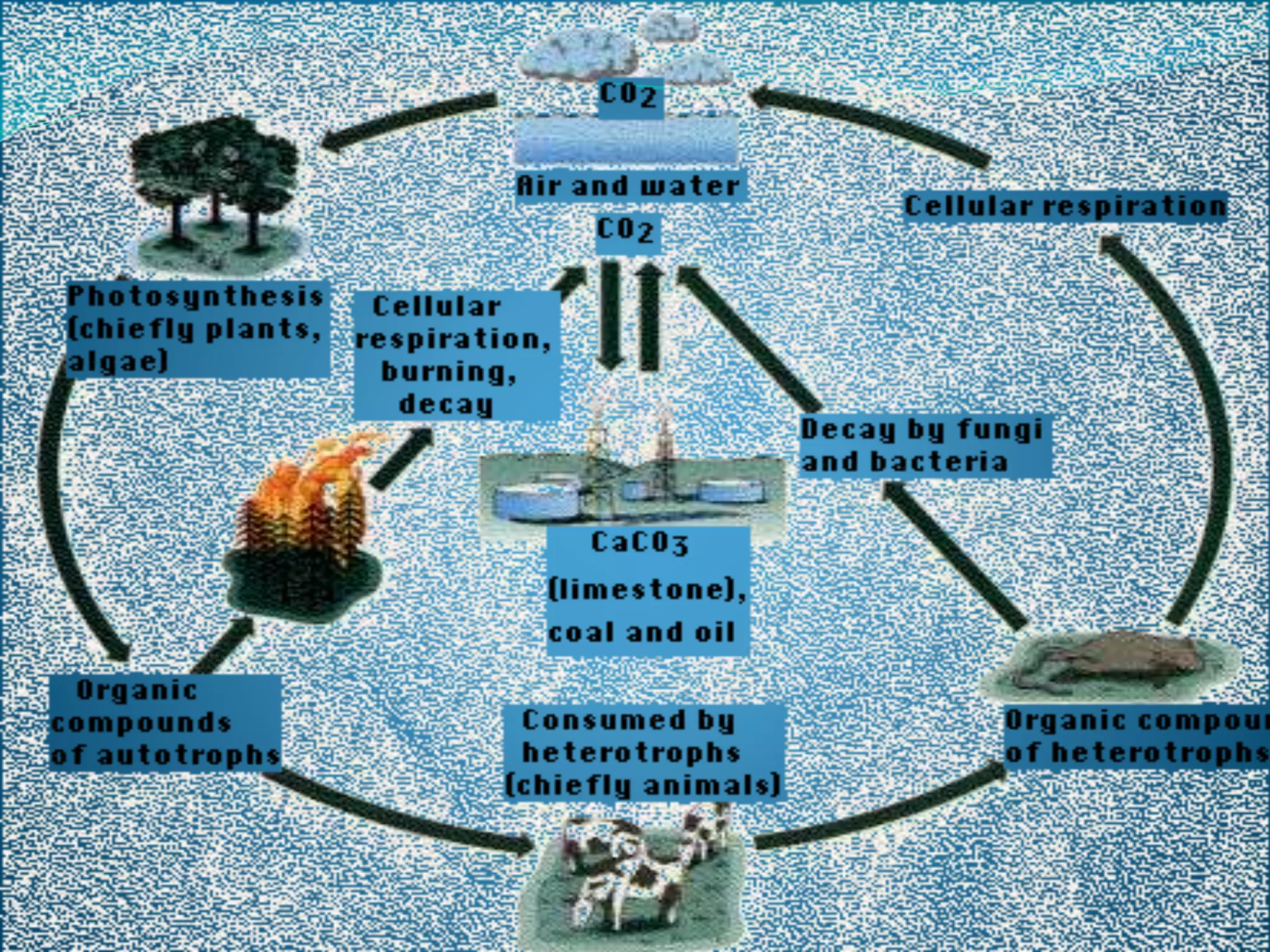
Cycling of Carbon involves the
atmospheric reservoir from where it is taken up by the
producers for photosynthesis and passed through the
consumers and then decomposers and finally returns to
atmosphere
CO2 goes into the living being from atmosphere
Form of CO2
Producers trap C from CO2 by Photosynthesis
Consumers feeds producers get organic compounds
Then reach decomposers and atmosphere
Same as in aquatic food chain
CO2 gets back in the atmosphere
CO2 released by the producers, consumers and
decomposers to atmosphere through the process
called respiration.
Decomposers release CO2 in to the atmosphere
Burning of wood, forest fire and combustion of
organic matter
By the weathering of rocks
Burning of fossil fuels
Volcanic activity
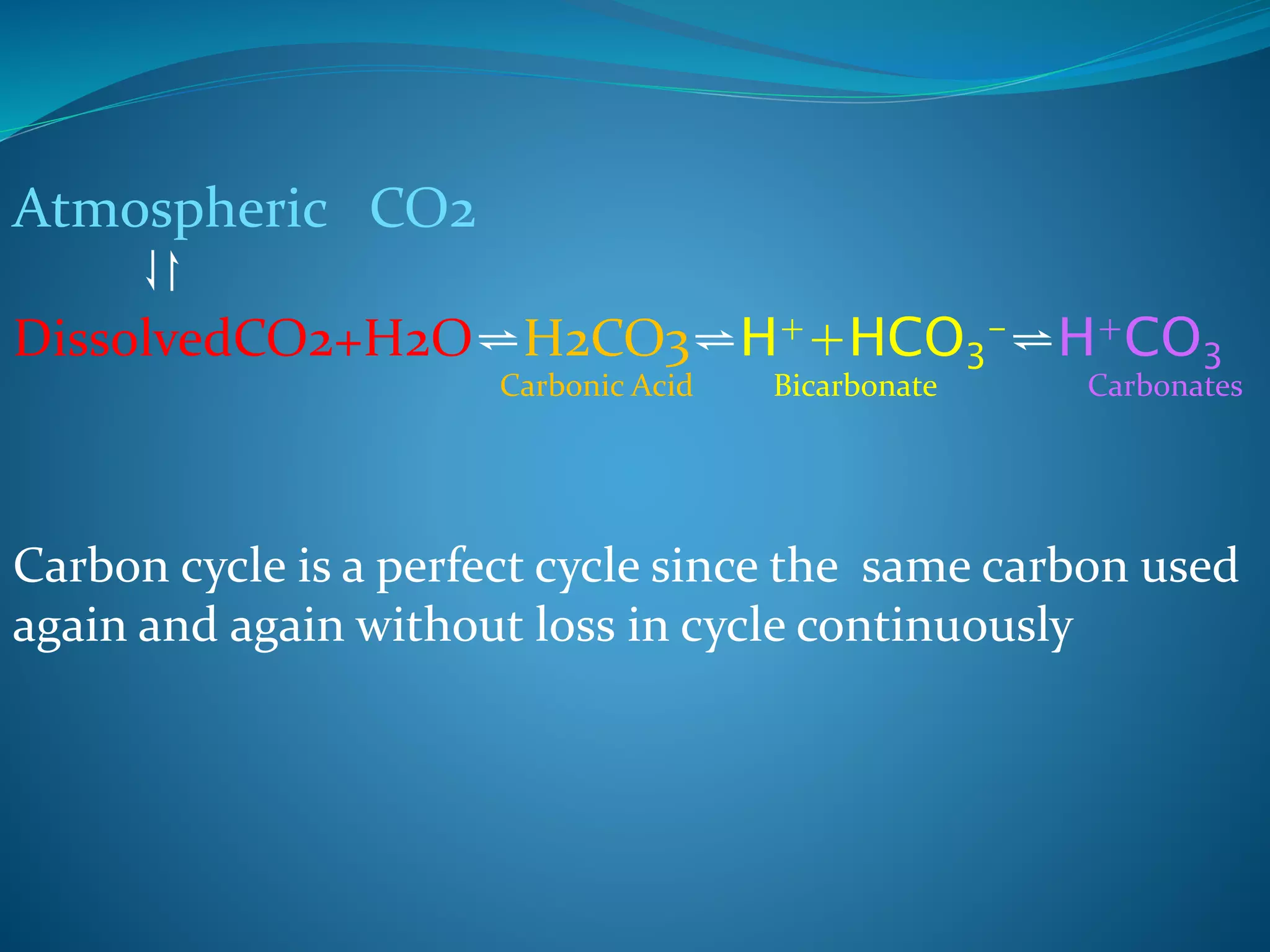
Atmospheric CO2
⇃↾
DissolvedCO2+H2O⇌H2CO3⇌H++HCO3
-⇌H+CO3
Carbonic Acid Bicarbonate Carbonates
Carbon cycle is a perfect cycle since the same carbon used
again and again without loss in cycle continuously
2. NITROgen cycle
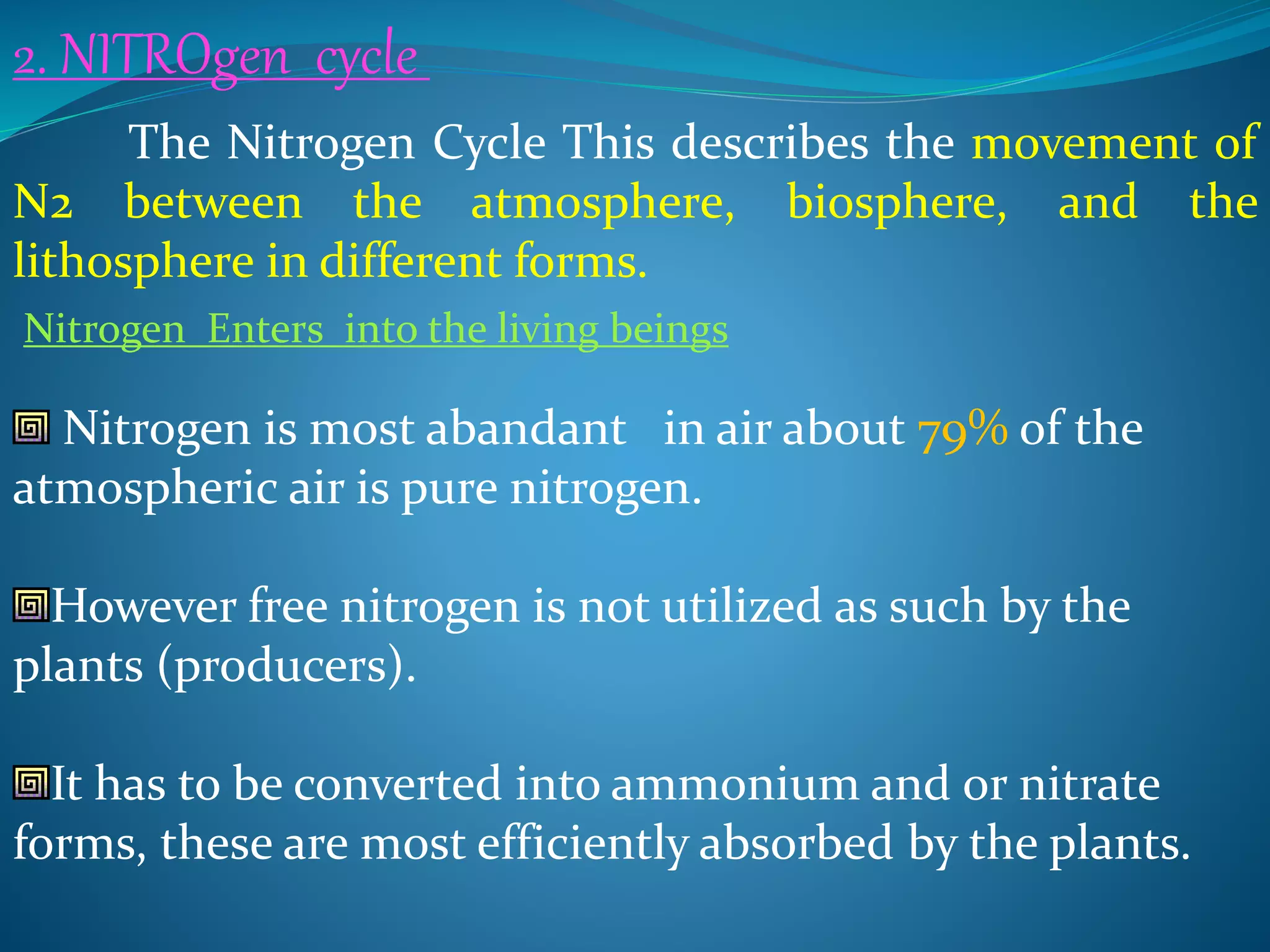
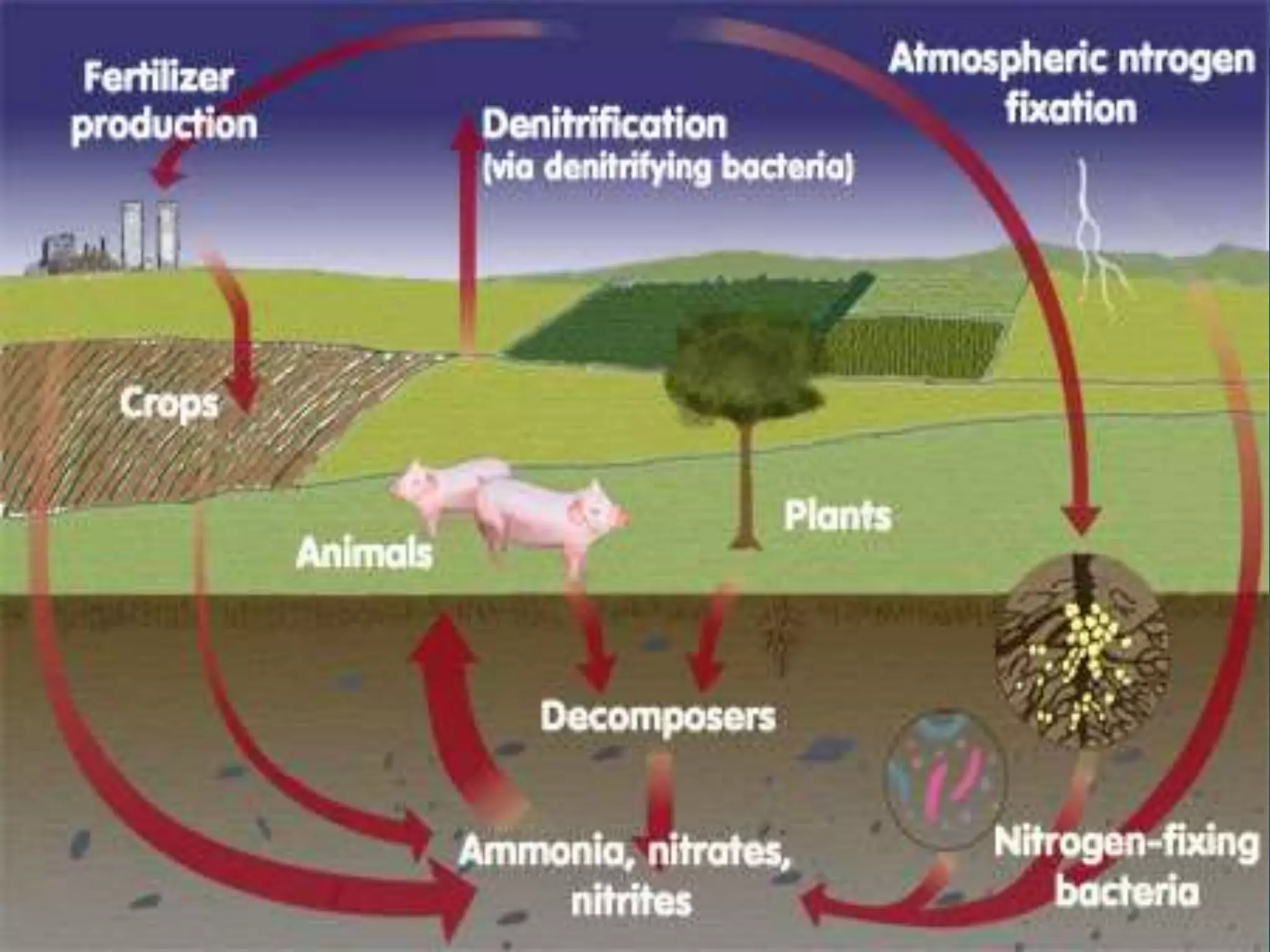
The Nitrogen Cycle This describes the movement of
N2 between the atmosphere, biosphere, and the
lithosphere in different forms.
Nitrogen Enters into the living beings
Nitrogen is most abandant in air about 79% of the
atmospheric air is pure nitrogen.
However free nitrogen is not utilized as such by the
plants (producers).
It has to be converted into ammonium and or nitrate
forms, these are most efficiently absorbed by the plants.
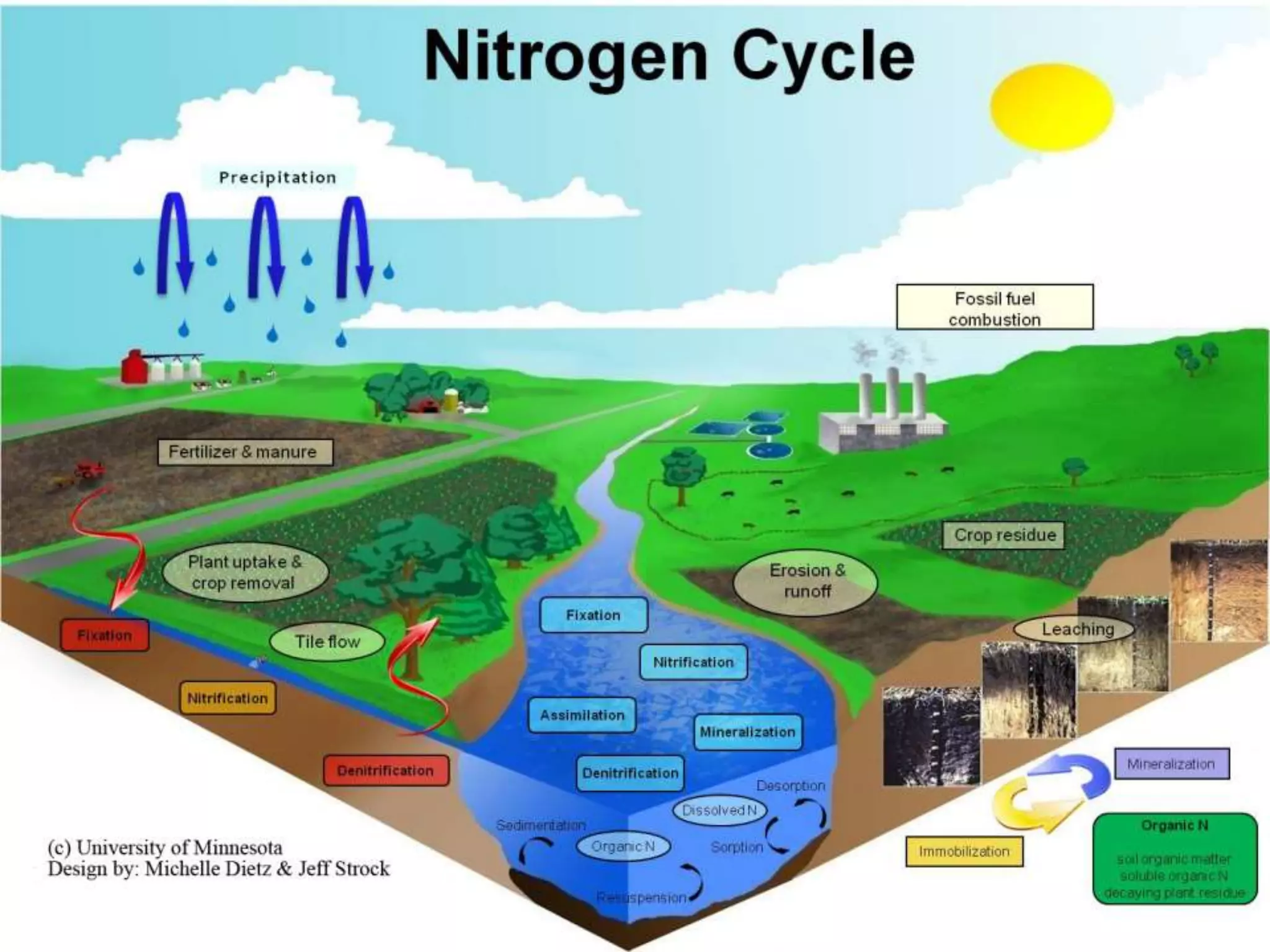
Steps of Nitrogen Cycle
Nitrogen Fixation
Ammonification
Nitrification
Denitrification
Nitrogen Assimilation
Nitrogen Fixation
Oxidation or reduction of atmospheric nitrogen to
nitrates and ammonia.
Which can be used by living organisms.
In nature nitrogen fixation occur in two ways
NON BIOLOGICAL FIXATION
 Physical process/ high energy fixation
Two processes
a) Photochemical Fixation/Natural process
The high energy is required for dissociation of nitrogen
molecule and its combination with oxygen and hydrogen
of water provided by lightening
b) Industrial Fixation/ Man Made Process
Most chemical fertilizers are nitrates or ammonium for
agriculture field to yield crop to increase soil fertility
BIOLOGICAL FIXATION
70% of all nitrogen fixed is through biological
fixation
Carried out by certain bacteria cyanobacteria and few
fungi
Nitrogen is fixed in the form of ammonia – Ammonium
salts or nitrates
Nitrogen fixing organisms are called diazotrophs
This process is two type
Symbiotic nitrogen fixation
Non-symbiotic nitrogen fixation
Symbiotic nitrogen fixation
Nitrogen fixation carried out by micro organisms living
in symbiotic association with higher plants is known as
Symbiotic nitrogen fixation .
Non Symbiotic nitrogen fixation
Carried out by micro-organisms. Living free in the soil.
Heterotrophic bacteria, actinomycetes and fungi
metabolize the organic nitrogen obtained from
the environment and release it in the form of
ammonia this process is called Ammonification
Ammonification
Nitrification
Ammonia/ ammonium salts are transformed into
nitrites and nitrates by a process nitrification
Nitrogen gets back into the atmosphere
Denitrification
Bacteria and fungi are convert nitrates – nitrites,
nitrous oxide or nitrogen gas this process is called
De-nitrification
NO3 - → NO2- → N2O → NO → N2
(Nitrate) (Nitrite) (Nitrous oxide) (Nitric oxide) (Nitrogen gas)
ASSIMILATION
The plants absorb nitrates and utilize them for
the synthesis of proteins this process is called
Nitrate Assimilation
2. Sedimentary Cycles
These are said to be imperfect cycle.
Recycling is very slow.
Constituent elements ends in sedimentary rocks.
1. SULPHUR cycle
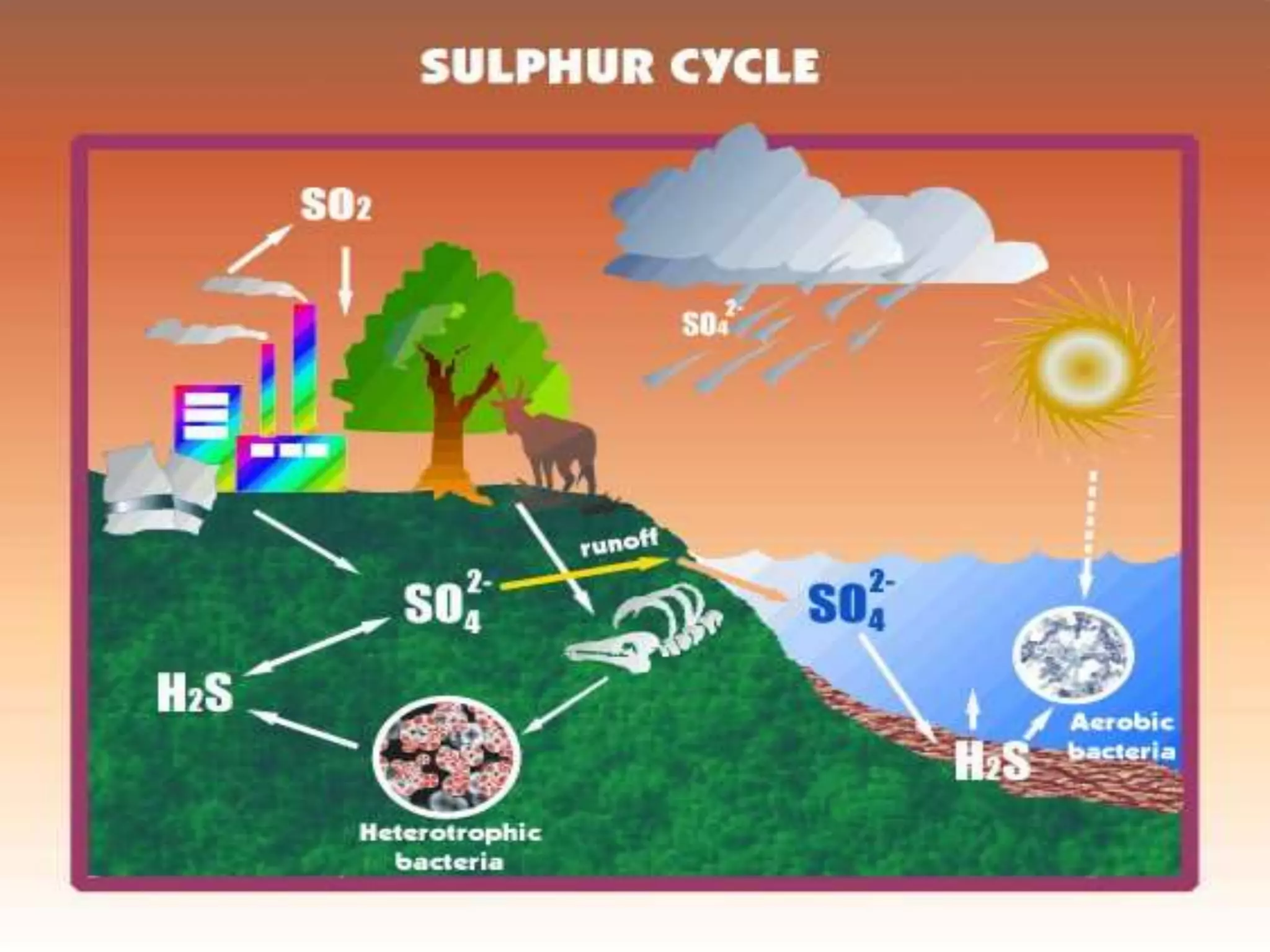
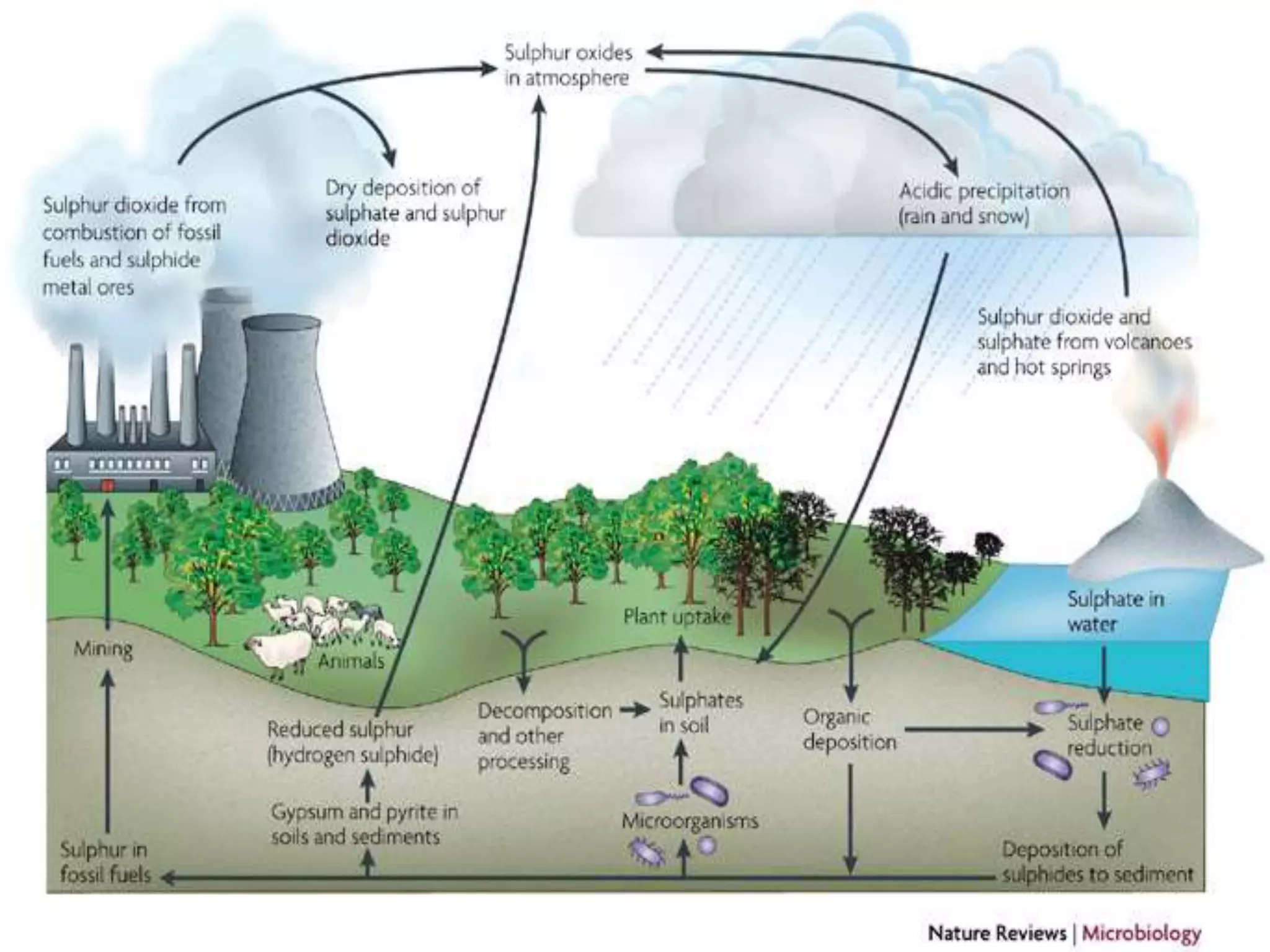
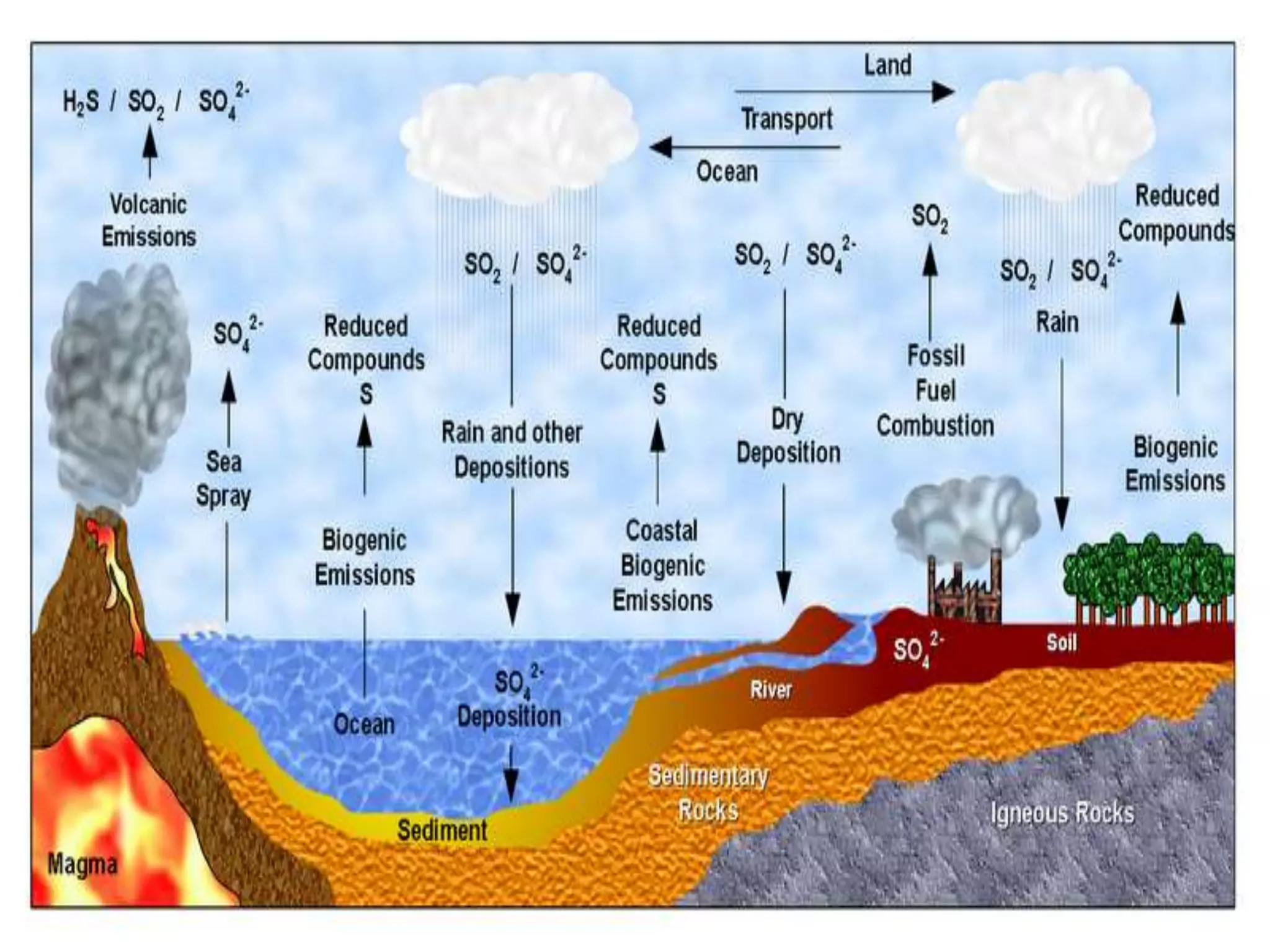
The main reservoir of sulphur is in the soil and deep
sediments.
S is released by weathering of rocks, erosional runoff
and decomposition of organic matter and carried to
terrestrial and aquatic life.
S cycle links air, water and soil.
S enters atmosphere as H2S and SO2 by decomposition
of organic matter, volcanic eruption, combustion of fossil
fuels.
Atmospheric SO2 is carried back to the earth as
sulphuric acid in rain water.
Sulphates incorporated with metabolic reaction into
the sulphur containing amino acids, from the plants amino
acids are taken by consumers.
From living organism sulphur carried back to soil, ponds
lakes and seas through excretion and decomposition of
dead organic material by bacteria and fungi.
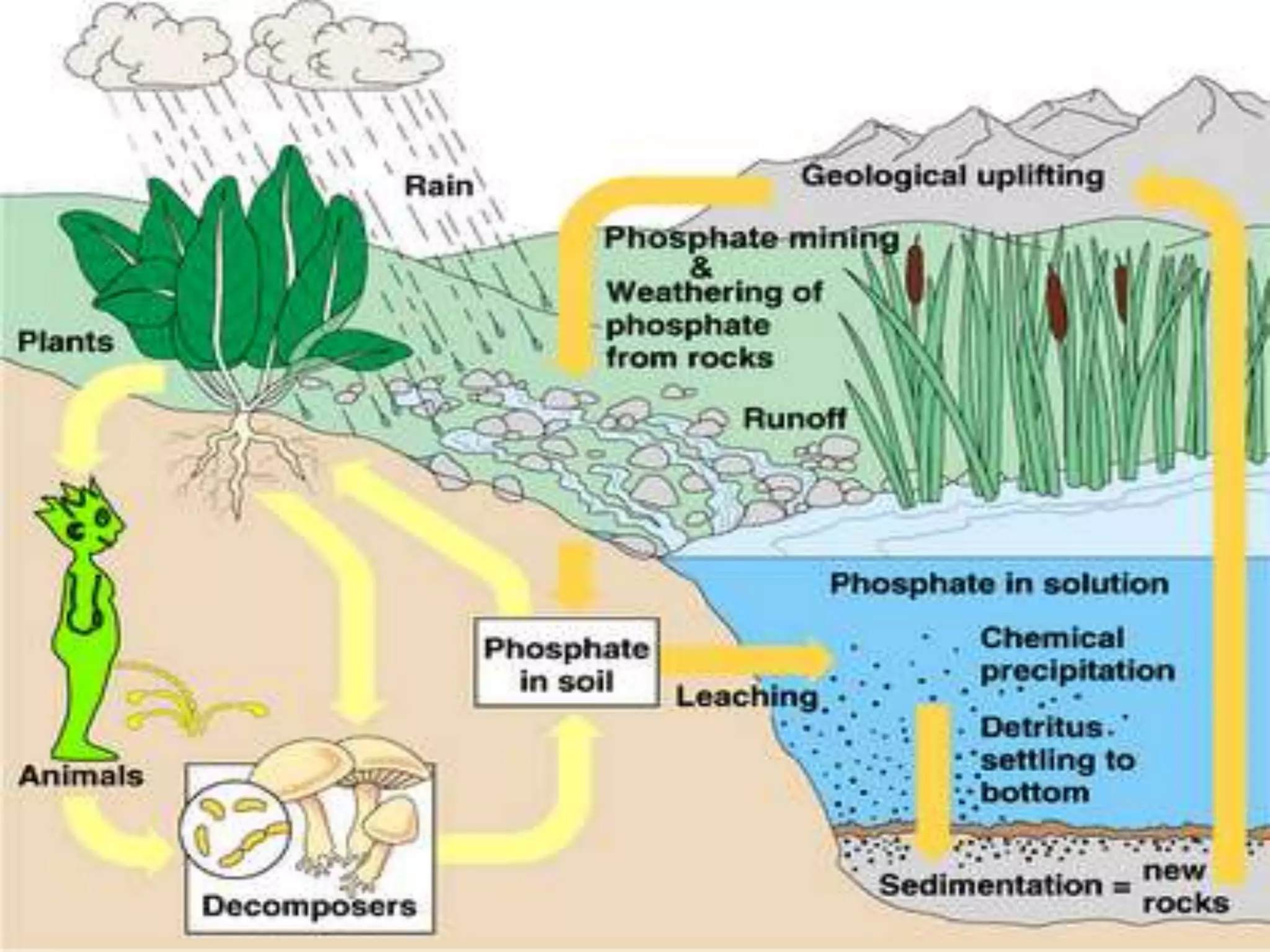
2. PHOSPHORUS cycle
The phosphorus cycle is long and slow, but it is an
important part of the environment
It helps plants grow, and is used by farmers to fertilize
them. When animals eat the plants, they absorb
phosphates.
When the animals die, their body decays and the
phosphorus is absorbed into the soil, where it re-enters
plants.
Phosphorous usually enters the hydrosphere by the
phosphate salt rocks found on the ocean floor. As the
water erodes them away, the phosphorous escapes.
Marine organisms take some of the phosphorus
particles in order to live and grow.
Phosphorous is presented in the form of rocks and soil.
Phosphates go down to the bottom of the ocean and
forms rocks over million of years.
Phosphates enters the soil when plant and animal
matter decompose, the cycle repeats.
Phosphorous is used for organisms to build DNA, RNA,
and ATP.
Phosphate is in plants, which the herbivores eat, which
the herbivores are eaten by the carnivores.
Than phosphorus is released back into the soil by the
herbivores and carnivores waste.
CONCLUSION
 BIO GEO CHEMICAL CYCLE
 GASEOUS CYCLE
WATER CYCLE
CARBON CYCLE
OXYGEN CYCLE
NITROGEN CYCLE
 SEDIMENTARY CYCLE
SULPHUR CYCLE
PHOSPHORUS CYCLE
Thank You

Biogeochemical Cycle

  • 1.
  • 2.
  • 3.
    INTRODUCTION  An ecosystem,there are dynamic interrelationships between the living forms and their physical environment.  These relationships are manifested as natural cycles which provide a continuous circulation of the essential constituents necessary for life. The natural cycles and ecosystem operate in a balanced manner which stabilise the entire biosphere and sustains the life process on earth.
  • 4.
     Cycling ofmaterials through the non-living and living components of the ecosystem is called Biogeochemical cycles or Nutrient cycles.  Biogeochemical cycle may be defined as the cyclical manner in which the chemical elements in the biosphere are circulated through the non-living and living components of the ecosystem.
  • 5.
     Nutrient cyclesclosely parallel the routes of energy flow within the biotic components of ecosystems.  The important distinction b/w 2 processes is the relationship with the abiotic component.  Energy flow-endless solar power supply  Nutrient cycling is conservative  Mineral elements taken up from the envt by producers are again returned to the envt.  In this taking and returning processes of minerals there involves a no. of organisms as well as some physico-chemical process.
  • 6.
    Most biogeochemical cyclesare described as elemental cycles involving nutrient elements such as carbon [c], Nitrogen [N], Oxygen [O], Phosphorus [P] and Sulphur [S]. Many are exogenic cycles in which the element concerned spend parts of the cycle in the atmosphere- O2,N2,C and CO2. P do not have the gaseous component and it is in Endogenic cycles. ENDOGENIC AND EXOGENIC CYCLES
  • 9.
    PATTERN AND BASICTYPES OF BIOGEOCHEMICAL CYCLES Broadly these can be divided into Gaseous cycles and sedimentary cycles. 1. Gaseous Cycles In gaseous cycle there is a prominent gaseous phase Most gaseous cycles are generally considered as perfect cycles. Nutrients are replaced as fast as they removed from the reservoir .
  • 10.
    Most important gaseouscycles are, Water cycle [Hydrological Cycle] Carbon Cycle Oxygen Cycle Nitrogen Cycle
  • 11.
    1. CARBON cycle Cyclingof Carbon involves the atmospheric reservoir from where it is taken up by the producers for photosynthesis and passed through the consumers and then decomposers and finally returns to atmosphere CO2 goes into the living being from atmosphere Form of CO2 Producers trap C from CO2 by Photosynthesis Consumers feeds producers get organic compounds Then reach decomposers and atmosphere Same as in aquatic food chain
  • 12.
    CO2 gets backin the atmosphere CO2 released by the producers, consumers and decomposers to atmosphere through the process called respiration. Decomposers release CO2 in to the atmosphere Burning of wood, forest fire and combustion of organic matter By the weathering of rocks Burning of fossil fuels Volcanic activity
  • 13.
    Atmospheric CO2 ⇃↾ DissolvedCO2+H2O⇌H2CO3⇌H++HCO3 -⇌H+CO3 Carbonic AcidBicarbonate Carbonates Carbon cycle is a perfect cycle since the same carbon used again and again without loss in cycle continuously
  • 17.
    2. NITROgen cycle TheNitrogen Cycle This describes the movement of N2 between the atmosphere, biosphere, and the lithosphere in different forms. Nitrogen Enters into the living beings Nitrogen is most abandant in air about 79% of the atmospheric air is pure nitrogen. However free nitrogen is not utilized as such by the plants (producers). It has to be converted into ammonium and or nitrate forms, these are most efficiently absorbed by the plants.
  • 18.
    Steps of NitrogenCycle Nitrogen Fixation Ammonification Nitrification Denitrification Nitrogen Assimilation Nitrogen Fixation Oxidation or reduction of atmospheric nitrogen to nitrates and ammonia. Which can be used by living organisms. In nature nitrogen fixation occur in two ways
  • 19.
    NON BIOLOGICAL FIXATION Physical process/ high energy fixation Two processes a) Photochemical Fixation/Natural process The high energy is required for dissociation of nitrogen molecule and its combination with oxygen and hydrogen of water provided by lightening b) Industrial Fixation/ Man Made Process Most chemical fertilizers are nitrates or ammonium for agriculture field to yield crop to increase soil fertility
  • 20.
    BIOLOGICAL FIXATION 70% ofall nitrogen fixed is through biological fixation Carried out by certain bacteria cyanobacteria and few fungi Nitrogen is fixed in the form of ammonia – Ammonium salts or nitrates Nitrogen fixing organisms are called diazotrophs This process is two type Symbiotic nitrogen fixation Non-symbiotic nitrogen fixation
  • 21.
    Symbiotic nitrogen fixation Nitrogenfixation carried out by micro organisms living in symbiotic association with higher plants is known as Symbiotic nitrogen fixation . Non Symbiotic nitrogen fixation Carried out by micro-organisms. Living free in the soil. Heterotrophic bacteria, actinomycetes and fungi metabolize the organic nitrogen obtained from the environment and release it in the form of ammonia this process is called Ammonification Ammonification
  • 22.
    Nitrification Ammonia/ ammonium saltsare transformed into nitrites and nitrates by a process nitrification Nitrogen gets back into the atmosphere Denitrification Bacteria and fungi are convert nitrates – nitrites, nitrous oxide or nitrogen gas this process is called De-nitrification NO3 - → NO2- → N2O → NO → N2 (Nitrate) (Nitrite) (Nitrous oxide) (Nitric oxide) (Nitrogen gas)
  • 23.
    ASSIMILATION The plants absorbnitrates and utilize them for the synthesis of proteins this process is called Nitrate Assimilation
  • 26.
    2. Sedimentary Cycles Theseare said to be imperfect cycle. Recycling is very slow. Constituent elements ends in sedimentary rocks. 1. SULPHUR cycle The main reservoir of sulphur is in the soil and deep sediments. S is released by weathering of rocks, erosional runoff and decomposition of organic matter and carried to terrestrial and aquatic life.
  • 27.
    S cycle linksair, water and soil. S enters atmosphere as H2S and SO2 by decomposition of organic matter, volcanic eruption, combustion of fossil fuels. Atmospheric SO2 is carried back to the earth as sulphuric acid in rain water. Sulphates incorporated with metabolic reaction into the sulphur containing amino acids, from the plants amino acids are taken by consumers. From living organism sulphur carried back to soil, ponds lakes and seas through excretion and decomposition of dead organic material by bacteria and fungi.
  • 31.
    2. PHOSPHORUS cycle Thephosphorus cycle is long and slow, but it is an important part of the environment It helps plants grow, and is used by farmers to fertilize them. When animals eat the plants, they absorb phosphates. When the animals die, their body decays and the phosphorus is absorbed into the soil, where it re-enters plants. Phosphorous usually enters the hydrosphere by the phosphate salt rocks found on the ocean floor. As the water erodes them away, the phosphorous escapes. Marine organisms take some of the phosphorus particles in order to live and grow.
  • 32.
    Phosphorous is presentedin the form of rocks and soil. Phosphates go down to the bottom of the ocean and forms rocks over million of years. Phosphates enters the soil when plant and animal matter decompose, the cycle repeats. Phosphorous is used for organisms to build DNA, RNA, and ATP. Phosphate is in plants, which the herbivores eat, which the herbivores are eaten by the carnivores. Than phosphorus is released back into the soil by the herbivores and carnivores waste.
  • 36.
    CONCLUSION  BIO GEOCHEMICAL CYCLE  GASEOUS CYCLE WATER CYCLE CARBON CYCLE OXYGEN CYCLE NITROGEN CYCLE  SEDIMENTARY CYCLE SULPHUR CYCLE PHOSPHORUS CYCLE
  • 37.