MIXTURES
(UNIT TWO, LESSON 2.3)
BY MARGIELENE D. JUDAN
LESSON OUTLINE
Mixture
Types of Mixtures
Separating Mixtures
MIXTURE
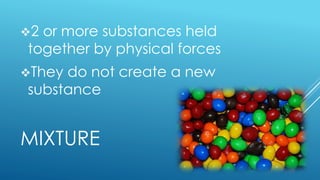
2 or more substances held
together by physical forces
They do not create a new
substance
TYPES OF MIXTURES
Homogeneous Mixture
Heterogeneous Mixture
HOMOGENEOUS MIXTURE
Homo means “same”
Components are evenly
distributed
Cannot be separated by
physical means
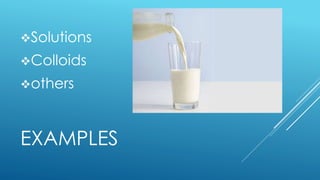
EXAMPLES
Solutions
Colloids
others
HETEROGENEOUS MIXTURE
Hetero means “different”
Components are not evenly
distributed
Can be separated by
physical means
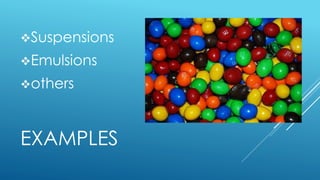
EXAMPLES
Suspensions
Emulsions
others
Identify the following if it is a
homogeneous or
heterogeneous mixture:
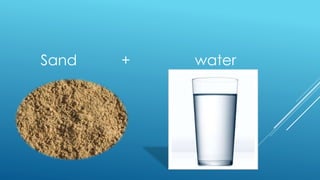
Sand + water
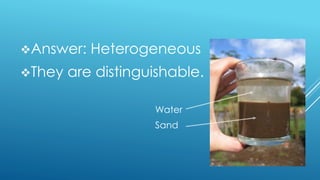
Answer: Heterogeneous
They are distinguishable.
Water
Sand
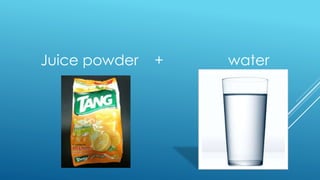
Juice powder + water
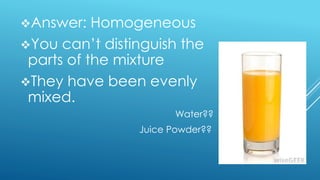
Answer: Homogeneous
You can’t distinguish the
parts of the mixture
They have been evenly
mixed.
Water??
Juice Powder??
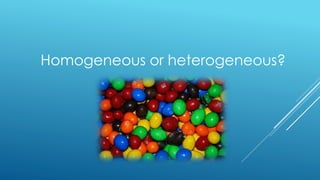
Homogeneous or heterogeneous?
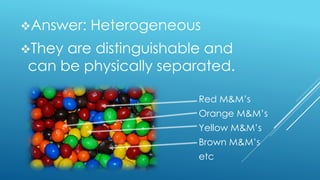
Answer: Heterogeneous
They are distinguishable and
can be physically separated.
Red M&M’s
Orange M&M’s
Yellow M&M’s
Brown M&M’s
etc
Is air a mixture? If so, what kind?
Yes. Air is composed of
78% nitrogen, 21% oxygen, and less
than 1% of argon, carbon dioxide,
and other gases. Since you cannot
distinguish them, air is a homogenous
mixture.
COMMON METHODS OF
SEPARATING MIXTURES
Picking
Magnetic Separation
Decantation
Distillation
Solar Evaporation
Filtration
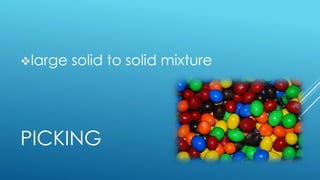
PICKING
large solid to solid mixture
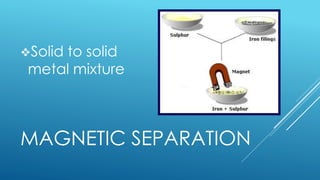
MAGNETIC SEPARATION
Solid to solid
metal mixture
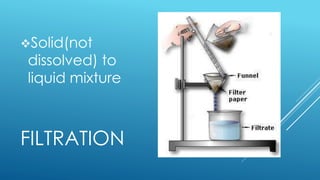
FILTRATION
Solid(not
dissolved) to
liquid mixture
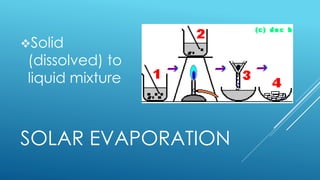
SOLAR EVAPORATION
Solid
(dissolved) to
liquid mixture
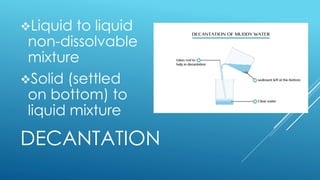
DECANTATION
Liquid to liquid
non-dissolvable
mixture
Solid (settled
on bottom) to
liquid mixture
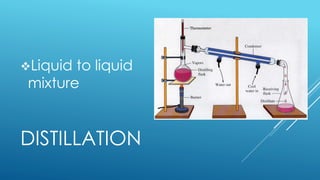
DISTILLATION
Liquid to liquid
mixture
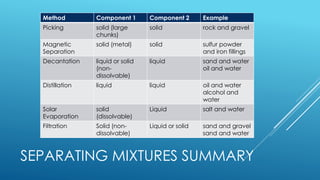
SEPARATING MIXTURES SUMMARY
Method Component 1 Component 2 Example
Picking solid (large
chunks)
solid rock and gravel
Magnetic
Separation
solid (metal) solid sulfur powder
and iron fillings
Decantation liquid or solid
(non-
dissolvable)
liquid sand and water
oil and water
Distillation liquid liquid oil and water
alcohol and
water
Solar
Evaporation
solid
(dissolvable)
Liquid salt and water
Filtration Solid (non-
dissolvable)
Liquid or solid sand and gravel
sand and water
Separating mixtures are not limited to
one method. For example, you could
separate sand and water through
decantation, filtration, and
evaporation, though some methods
work best in different situations.
Activity: (1 whole sheet of paper)
1. Write a short paragraph about the
mixtures you see at home, and tell
why are they important to us. (5 pts)
Then, relate the lesson to your
spiritual life. (5 pts)
Assignment: Notebook
I. Classify whether it is a homogeneous or
heterogeneous mixture.
1. air
2. sand water
3. ink
4. different types of stones
5. oil and water
Assignment: Notebook
II. Identify which method is best to use in
order to separate the following mixtures:
1. M&M’s chocolate
2. Alcohol and water
3. Saltwater
4. Sand and gravel
5. Iron fillings and talc powder
SOURCES:
Science Links 7
https://www.youtube.com/watch?v=Tlx
ajGi8bAI

Unit 2, Lesson 2.3 - Mixtures