CHAPTER 11-LESSONS 1 & 2 Miss Reaves 8 th  Grade Science
WHAT YOU WILL DO TODAY: First time -Just listen and watch this presentation . Don’t take notes!! Watch the presentation a second time. THIS time, fill in the blanks in your notes. DO NOT freak out if you miss something!!!!  This is posted on the 8 th  grade page of KMSstudent.com. Complete Vocabulary Squares in class and for homework.
Matter: Pure and Mixed substances http://iespebilingue.wikispaces.com
http://iespebilingue.wikispaces.com Classification SUBSTANCES MIXED SUBSTANCES OR MIXTURES PURE SUBSTANCES HETEROGENEOUS HOMOGENEOUS LIQUID SOLUTIONS GAS SOLUTIONS SOLID SOLUTIONS COMPOUNDS ELEMENTS
http://iespebilingue.wikispaces.com SUBSTANCES PURE SUBSTANCES: they have well defined specific  properties: density, fusion, boiling temperatures… MIXTURES: they are made up of two or more  different substances. They do NOT have well defined  Specific properties.
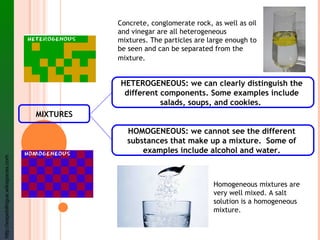
Concrete, conglomerate rock, as well as oil and vinegar are all heterogeneous mixtures. The particles are large enough to be seen and can be separated from the mixture.   Homogeneous mixtures are very well mixed. A salt solution is a homogeneous mixture.   http://iespebilingue.wikispaces.com MIXTURES HETEROGENEOUS: we can clearly distinguish the  different components. Some examples include  salads, soups, and cookies.    HOMOGENEOUS: we cannot see the different  substances that make up a mixture.    Some of  examples include alcohol and water.
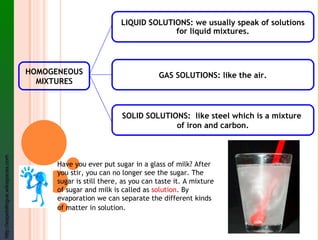
Have you ever put sugar in a glass of milk? After you stir, you can no longer see the sugar. The sugar is still there, as you can taste it. A mixture of sugar and milk is called as  solution . By evaporation we can separate the different kinds of matter in solution.   http://iespebilingue.wikispaces.com HOMOGENEOUS MIXTURES LIQUID SOLUTIONS: we usually speak of solutions  for liquid mixtures. GAS SOLUTIONS: like the air. SOLID SOLUTIONS:  like steel which is a mixture  of iron and carbon.
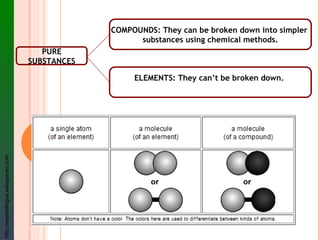
http://iespebilingue.wikispaces.com PURE  SUBSTANCES COMPOUNDS:  They can be broken down into simpler  substances using chemical methods. ELEMENTS:  They can’t be broken down.
The Periodic Table of Elements http://iespebilingue.wikispaces.com
http://iespebilingue.wikispaces.com Separating components SEPARATION  TECHNIQUES DECANTATION FILTRATION MAGNETISM SIEVING DISTILLATION CRYSTALIZATION
Decantation  is a process for the separation of mixtures. This is achieved by carefully pouring a solution from a container in order to leave the sediments in the bottom of the original container.   Decantation http://iespebilingue.wikispaces.com
Filtration Filtration  is commonly the mechanical or physical operation which is used for the separation of solids from fluids (liquids or gases) by interposing a medium through which only the fluid can pass.    http://iespebilingue.wikispaces.com
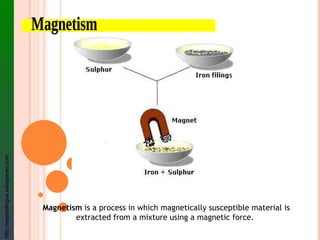
Magnetism Magnetism  is a process in which magnetically susceptible material is extracted from a mixture using a magnetic force.  http://iespebilingue.wikispaces.com
Sieving A  sieve  separates wanted elements from unwanted material.   http://iespebilingue.wikispaces.com
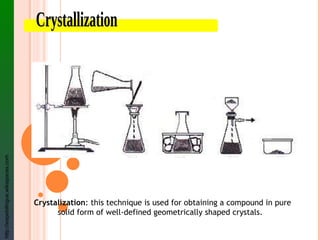
Crystalization : this technique is used for obtaining a compound in pure solid form of well-defined geometrically shaped crystals.    http://iespebilingue.wikispaces.com Crystallization
Distillation  is a method of separating mixtures. It is a   process in which a liquid or vapour mixture of two or more substances is separated into its component fractions, by the application and removal of heat.  http://iespebilingue.wikispaces.com Distillation/Evaporation
http://explore.ecb.org/videos/VLC_media?P1=VLC077&REFERER=OTHER   http://www.differencebetween.net/science/difference-between-heterogeneous-and-homogeneous/   http://www.rpdp.net/sciencetips_v3/P8A3.htm   http://chemsite.lsrhs.net/Intro/Pure_vs_mixtures.html   http://www.wineloverspage.com/vino101/decant07.phtml   http://chemistry.tutorvista.com/inorganic-chemistry/properties-of-solutions-and-types-of-mixtures.html   http://fphoto.photoshelter.com/image/I0000nrYPvzifous   http://chemsite.lsrhs.net/Intro/Pure_vs_mixtures.html   http://64.224.111.143/handbook/periodic/   http://iespebilingue.wikispaces.com References
SOLUTIONS, SUSPENSIONS, AND COLLOIDS
GOAL: To classify mixtures as solutions, suspensions, or colloids.
IT’S ALL ABOUT THE PARTICLES! The  size of the particles  has a great effect on the properties of a mixture. You must observe a mixture’s properties before deciding whether it is heterogeneous or homogeneous. Mixtures get classified as solutions, suspensions, or colloids based on particle size.
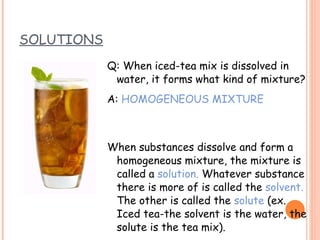
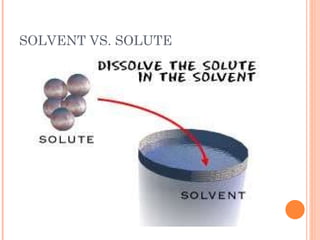
SOLUTIONS Q: When iced-tea mix is dissolved in water, it forms what kind of mixture? A:  HOMOGENEOUS MIXTURE When substances dissolve and form a homogeneous mixture, the mixture is called a  solution.  Whatever substance there is more of is called the  solvent.  The other is called the  solute  (ex. Iced tea-the solvent is the water, the solute is the tea mix).
SOLVENT VS. SOLUTE
PROPERTIES OF A SOLUTION They do not separate into layers over time. If they are poured through a filter, none of the substances will get trapped. Light passes through them. All of the particles in a solution are too small to become separated, filter out, or scatter light.
SUSPENSIONS Flour in water, like other liquids that need to be “shaken well before using”, are called  suspensions.   Muddy water taken from a swamp is another example.
PROPERTIES OF A SUSPENSION Heterogeneous mixture Separates into layers over time. Filters can separate particles that make up a suspension. Particles are larger than those in a solution. Scatter light. Suspended particles settle out of a suspension.
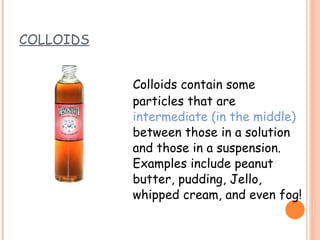
COLLOIDS Colloids contain some particles that are  intermediate (in the middle)  between those in a solution and those in a suspension. Examples include peanut butter, pudding, Jello, whipped cream, and even fog!
PROPERTIES OF COLLOIDS Do not separate into layers. Particles will not become trapped by a filter. Scatter light. Colloids and suspensions appear cloudy; unlike solutions which are much clearer. Colloids and solutions will not separate into layers; suspensions will.
Examples of Colloids      Dispersing Medium   Gas  Liquid   Solid  Gas      shaving cream, whipped cream   foam rubber, sponge, pumice   Liquid  fogs, clouds, aerosol can spray   mayonnaise, milk, face cream, hair gel  jelly, cheese, butter   Solid  smoke, car exhaust, airborne viruses   Gold in water, milk of magnesia, river silt   alloys of metals (steel, brass)
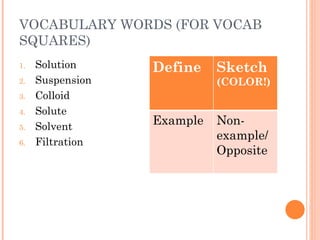
VOCABULARY WORDS (FOR VOCAB SQUARES) Solution Suspension Colloid Solute Solvent Filtration Define Sketch (COLOR!) Example Non-example/Opposite
THE END For the rest of class and for homework, complete the vocabulary squares. Use your text book if you need to. Ch. 11 pg. 388 Don’t forget to bring your new IAN tomorrow!!! Thank you!!!!!!!  

Ch 11 8th grade Lessons 1&2

  • 1.
    CHAPTER 11-LESSONS 1& 2 Miss Reaves 8 th Grade Science
  • 2.
    WHAT YOU WILLDO TODAY: First time -Just listen and watch this presentation . Don’t take notes!! Watch the presentation a second time. THIS time, fill in the blanks in your notes. DO NOT freak out if you miss something!!!! This is posted on the 8 th grade page of KMSstudent.com. Complete Vocabulary Squares in class and for homework.
  • 3.
    Matter: Pure andMixed substances http://iespebilingue.wikispaces.com
  • 4.
    http://iespebilingue.wikispaces.com Classification SUBSTANCESMIXED SUBSTANCES OR MIXTURES PURE SUBSTANCES HETEROGENEOUS HOMOGENEOUS LIQUID SOLUTIONS GAS SOLUTIONS SOLID SOLUTIONS COMPOUNDS ELEMENTS
  • 5.
    http://iespebilingue.wikispaces.com SUBSTANCES PURESUBSTANCES: they have well defined specific properties: density, fusion, boiling temperatures… MIXTURES: they are made up of two or more different substances. They do NOT have well defined Specific properties.
  • 6.
    Concrete, conglomerate rock,as well as oil and vinegar are all heterogeneous mixtures. The particles are large enough to be seen and can be separated from the mixture. Homogeneous mixtures are very well mixed. A salt solution is a homogeneous mixture.  http://iespebilingue.wikispaces.com MIXTURES HETEROGENEOUS: we can clearly distinguish the different components. Some examples include salads, soups, and cookies.   HOMOGENEOUS: we cannot see the different substances that make up a mixture.   Some of examples include alcohol and water.
  • 7.
    Have you everput sugar in a glass of milk? After you stir, you can no longer see the sugar. The sugar is still there, as you can taste it. A mixture of sugar and milk is called as solution . By evaporation we can separate the different kinds of matter in solution. http://iespebilingue.wikispaces.com HOMOGENEOUS MIXTURES LIQUID SOLUTIONS: we usually speak of solutions for liquid mixtures. GAS SOLUTIONS: like the air. SOLID SOLUTIONS: like steel which is a mixture of iron and carbon.
  • 8.
    http://iespebilingue.wikispaces.com PURE SUBSTANCES COMPOUNDS: They can be broken down into simpler substances using chemical methods. ELEMENTS: They can’t be broken down.
  • 9.
    The Periodic Tableof Elements http://iespebilingue.wikispaces.com
  • 10.
    http://iespebilingue.wikispaces.com Separating componentsSEPARATION TECHNIQUES DECANTATION FILTRATION MAGNETISM SIEVING DISTILLATION CRYSTALIZATION
  • 11.
    Decantation  is aprocess for the separation of mixtures. This is achieved by carefully pouring a solution from a container in order to leave the sediments in the bottom of the original container. Decantation http://iespebilingue.wikispaces.com
  • 12.
    Filtration Filtration  iscommonly the mechanical or physical operation which is used for the separation of solids from fluids (liquids or gases) by interposing a medium through which only the fluid can pass.  http://iespebilingue.wikispaces.com
  • 13.
    Magnetism Magnetism is a process in which magnetically susceptible material is extracted from a mixture using a magnetic force. http://iespebilingue.wikispaces.com
  • 14.
    Sieving A  sieve separates wanted elements from unwanted material. http://iespebilingue.wikispaces.com
  • 15.
    Crystalization : thistechnique is used for obtaining a compound in pure solid form of well-defined geometrically shaped crystals.  http://iespebilingue.wikispaces.com Crystallization
  • 16.
    Distillation  is amethod of separating mixtures. It is a   process in which a liquid or vapour mixture of two or more substances is separated into its component fractions, by the application and removal of heat. http://iespebilingue.wikispaces.com Distillation/Evaporation
  • 17.
    http://explore.ecb.org/videos/VLC_media?P1=VLC077&REFERER=OTHER http://www.differencebetween.net/science/difference-between-heterogeneous-and-homogeneous/ http://www.rpdp.net/sciencetips_v3/P8A3.htm http://chemsite.lsrhs.net/Intro/Pure_vs_mixtures.html http://www.wineloverspage.com/vino101/decant07.phtml http://chemistry.tutorvista.com/inorganic-chemistry/properties-of-solutions-and-types-of-mixtures.html http://fphoto.photoshelter.com/image/I0000nrYPvzifous http://chemsite.lsrhs.net/Intro/Pure_vs_mixtures.html http://64.224.111.143/handbook/periodic/ http://iespebilingue.wikispaces.com References
  • 18.
  • 19.
    GOAL: To classifymixtures as solutions, suspensions, or colloids.
  • 20.
    IT’S ALL ABOUTTHE PARTICLES! The size of the particles has a great effect on the properties of a mixture. You must observe a mixture’s properties before deciding whether it is heterogeneous or homogeneous. Mixtures get classified as solutions, suspensions, or colloids based on particle size.
  • 21.
    SOLUTIONS Q: Wheniced-tea mix is dissolved in water, it forms what kind of mixture? A: HOMOGENEOUS MIXTURE When substances dissolve and form a homogeneous mixture, the mixture is called a solution. Whatever substance there is more of is called the solvent. The other is called the solute (ex. Iced tea-the solvent is the water, the solute is the tea mix).
  • 22.
  • 23.
    PROPERTIES OF ASOLUTION They do not separate into layers over time. If they are poured through a filter, none of the substances will get trapped. Light passes through them. All of the particles in a solution are too small to become separated, filter out, or scatter light.
  • 24.
    SUSPENSIONS Flour inwater, like other liquids that need to be “shaken well before using”, are called suspensions. Muddy water taken from a swamp is another example.
  • 25.
    PROPERTIES OF ASUSPENSION Heterogeneous mixture Separates into layers over time. Filters can separate particles that make up a suspension. Particles are larger than those in a solution. Scatter light. Suspended particles settle out of a suspension.
  • 26.
    COLLOIDS Colloids containsome particles that are intermediate (in the middle) between those in a solution and those in a suspension. Examples include peanut butter, pudding, Jello, whipped cream, and even fog!
  • 27.
    PROPERTIES OF COLLOIDSDo not separate into layers. Particles will not become trapped by a filter. Scatter light. Colloids and suspensions appear cloudy; unlike solutions which are much clearer. Colloids and solutions will not separate into layers; suspensions will.
  • 28.
    Examples of Colloids   Dispersing Medium Gas Liquid Solid Gas   shaving cream, whipped cream foam rubber, sponge, pumice Liquid fogs, clouds, aerosol can spray mayonnaise, milk, face cream, hair gel jelly, cheese, butter Solid smoke, car exhaust, airborne viruses Gold in water, milk of magnesia, river silt alloys of metals (steel, brass)
  • 29.
    VOCABULARY WORDS (FORVOCAB SQUARES) Solution Suspension Colloid Solute Solvent Filtration Define Sketch (COLOR!) Example Non-example/Opposite
  • 30.
    THE END Forthe rest of class and for homework, complete the vocabulary squares. Use your text book if you need to. Ch. 11 pg. 388 Don’t forget to bring your new IAN tomorrow!!! Thank you!!!!!!! 