1
Ch.11, Lesson 2
(comparing solids,
Liquids and Gases)
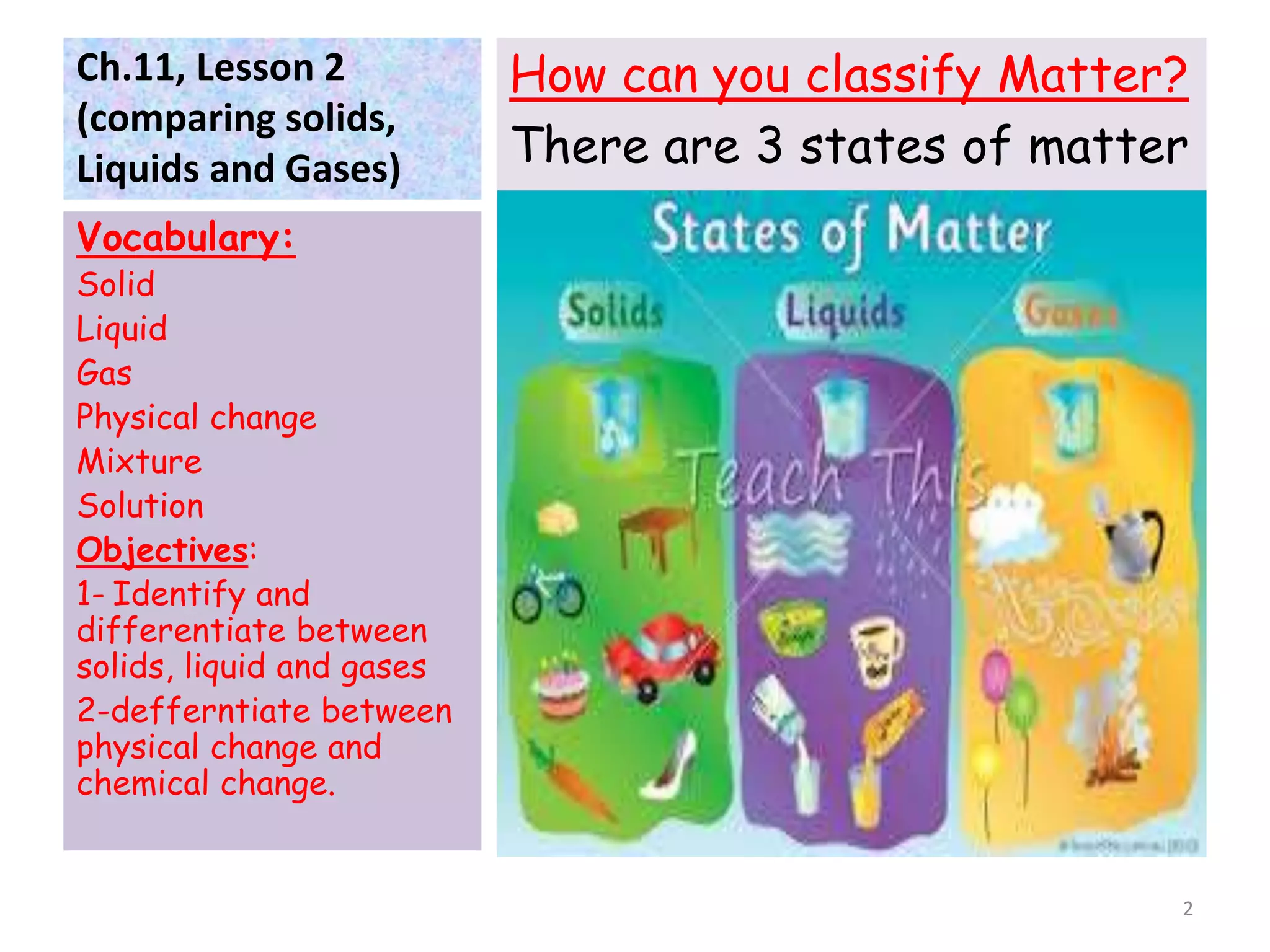
How can you classify Matter?
There are 3 states of matter
Vocabulary:
Solid
Liquid
Gas
Physical change
Mixture
Solution
Objectives:
1- Identify and
differentiate between
solids, liquid and gases
2-defferntiate between
physical change and
chemical change.
2
Ch.11, Lesson 2
(comparing solids,
Liquids and Gases)
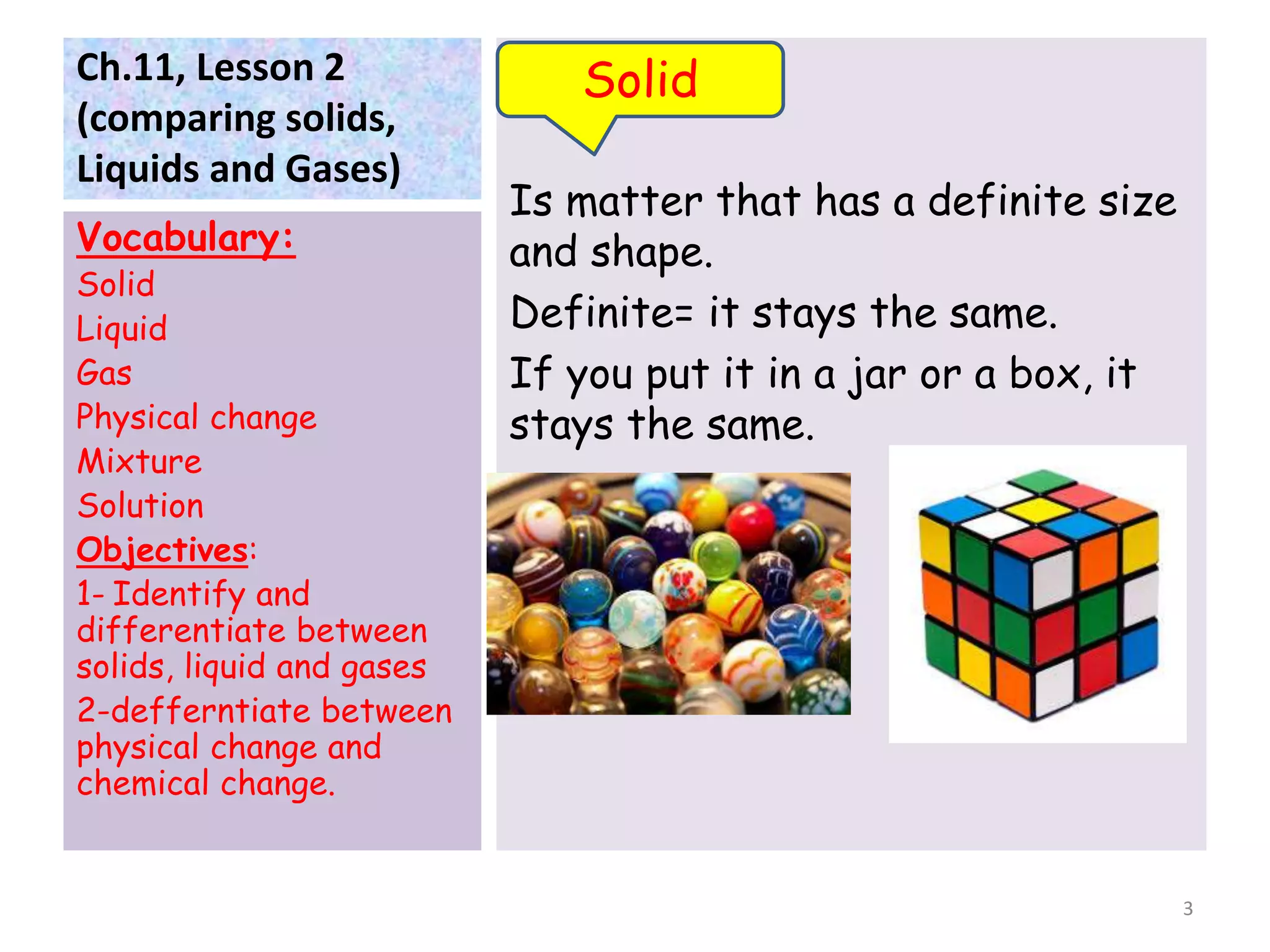
Is matter that has a definite size
and shape.
Definite= it stays the same.
If you put it in a jar or a box, it
stays the same.
Vocabulary:
Solid
Liquid
Gas
Physical change
Mixture
Solution
Objectives:
1- Identify and
differentiate between
solids, liquid and gases
2-defferntiate between
physical change and
chemical change.
3
Solid
Ch.11, Lesson 2
(comparing solids,
Liquids and Gases)
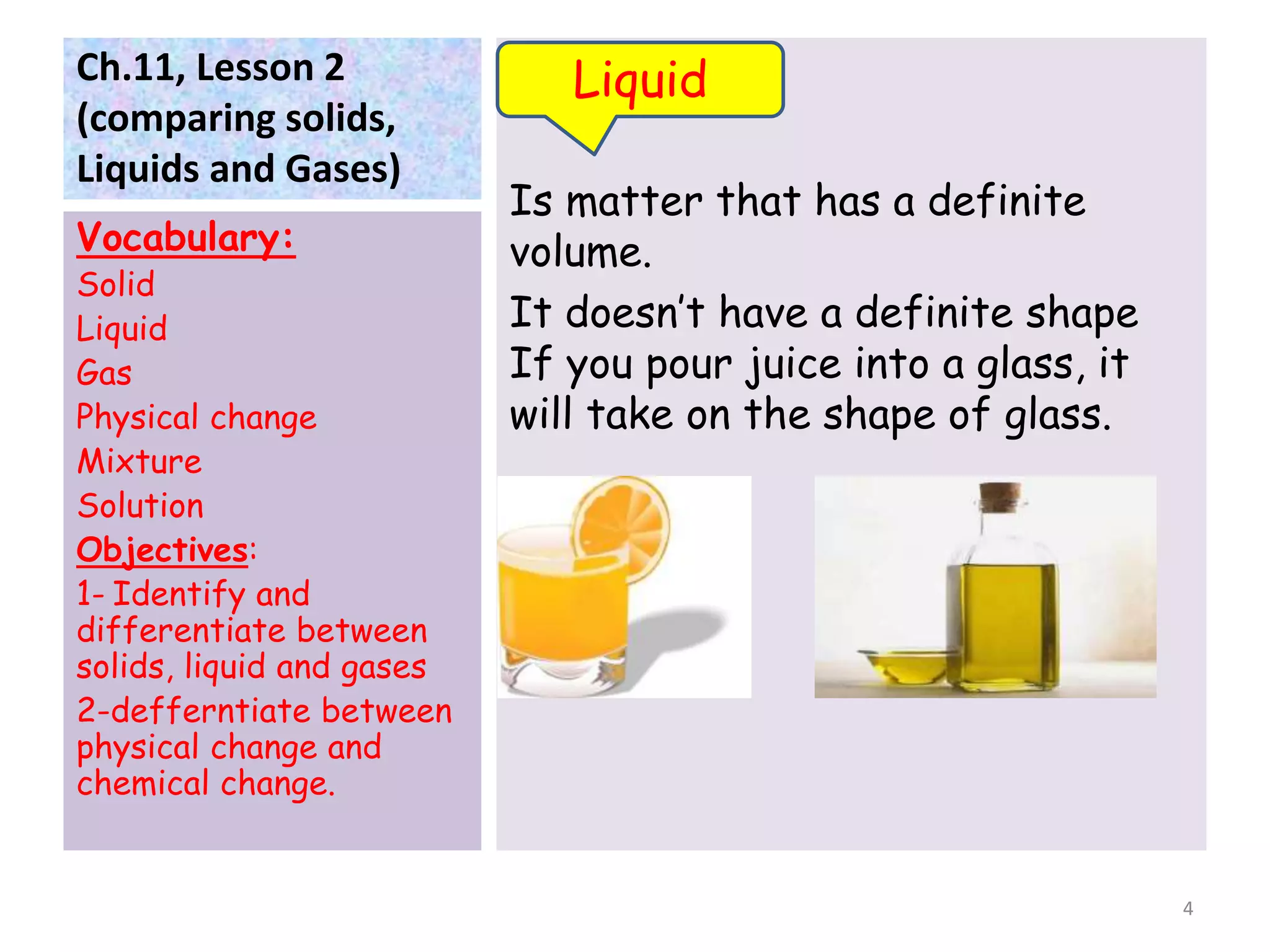
Is matter that has a definite
volume.
It doesn’t have a definite shape
If you pour juice into a glass, it
will take on the shape of glass.
Vocabulary:
Solid
Liquid
Gas
Physical change
Mixture
Solution
Objectives:
1- Identify and
differentiate between
solids, liquid and gases
2-defferntiate between
physical change and
chemical change.
4
Liquid
Ch.11, Lesson 2
(comparing solids,
Liquids and Gases)
Is matter that has no definite
shape or volume.
Gas takes the shape of whatever
container they are in.
The air all around us is a gas.
Vocabulary:
Solid
Liquid
Gas
Physical change
Mixture
Solution
Objectives:
1- Identify and
differentiate between
solids, liquid and gases
2-defferntiate between
physical change and
chemical change.
5
Gas
Ch.11, Lesson 2
(comparing solids,
Liquids and Gases)
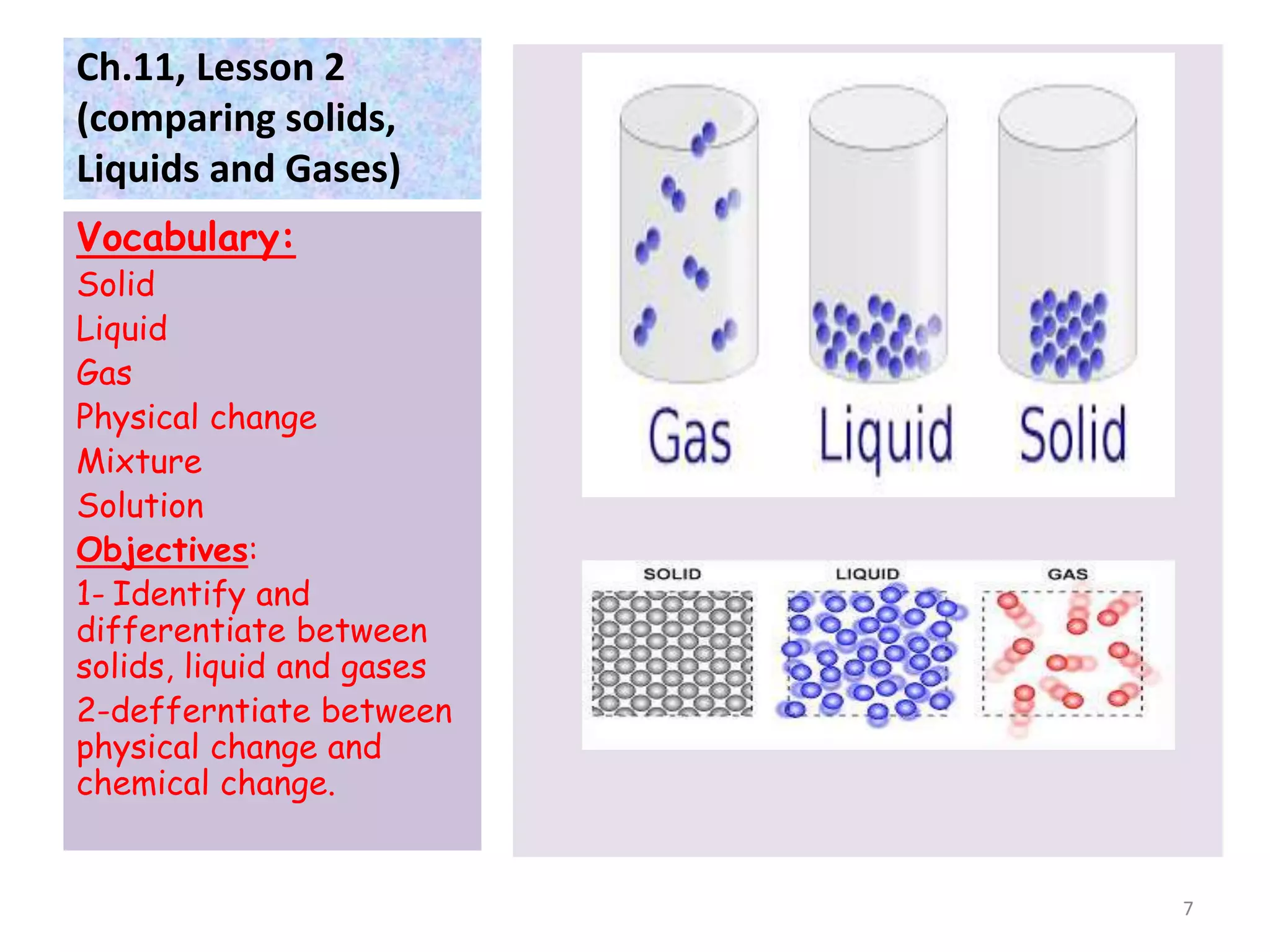
Matter is made of particles.
Particles are very, very small.
In Solids particles are packed
closely together, so they form a
certain pattern.
In Liquids particles are close
together but don’t form a pattern.
They have more energy and can
slide past one another.
In Gas particles have more
energy, they spread out to fill a
large container, or squeeze
together to fit into a small one.
Vocabulary:
Solid
Liquid
Gas
Physical change
Mixture
Solution
Objectives:
1- Identify and
differentiate between
solids, liquid and gases
2-defferntiate between
physical change and
chemical change.
6
Ch.11, Lesson 2
(comparing solids,
Liquids and Gases)
Vocabulary:
Solid
Liquid
Gas
Physical change
Mixture
Solution
Objectives:
1- Identify and
differentiate between
solids, liquid and gases
2-defferntiate between
physical change and
chemical change.
7
8
Ch.11, Lesson 2
(comparing solids,
Liquids and Gases)
How can Matter change?
Matter can change but still remain
the same kind of matter.
* If you cut a paper, it will look
different but still made of the
same particles.
* If you cut and sand the wood to
make a wooden model, its shape
and size change but it is still
wood.
Vocabulary:
Solid
Liquid
Gas
Physical change
Mixture
Solution
Objectives:
1- Identify and
differentiate between
solids, liquid and gases
2-defferntiate between
physical change and
chemical change.
9
Ch.11, Lesson 2
(comparing solids,
Liquids and Gases)
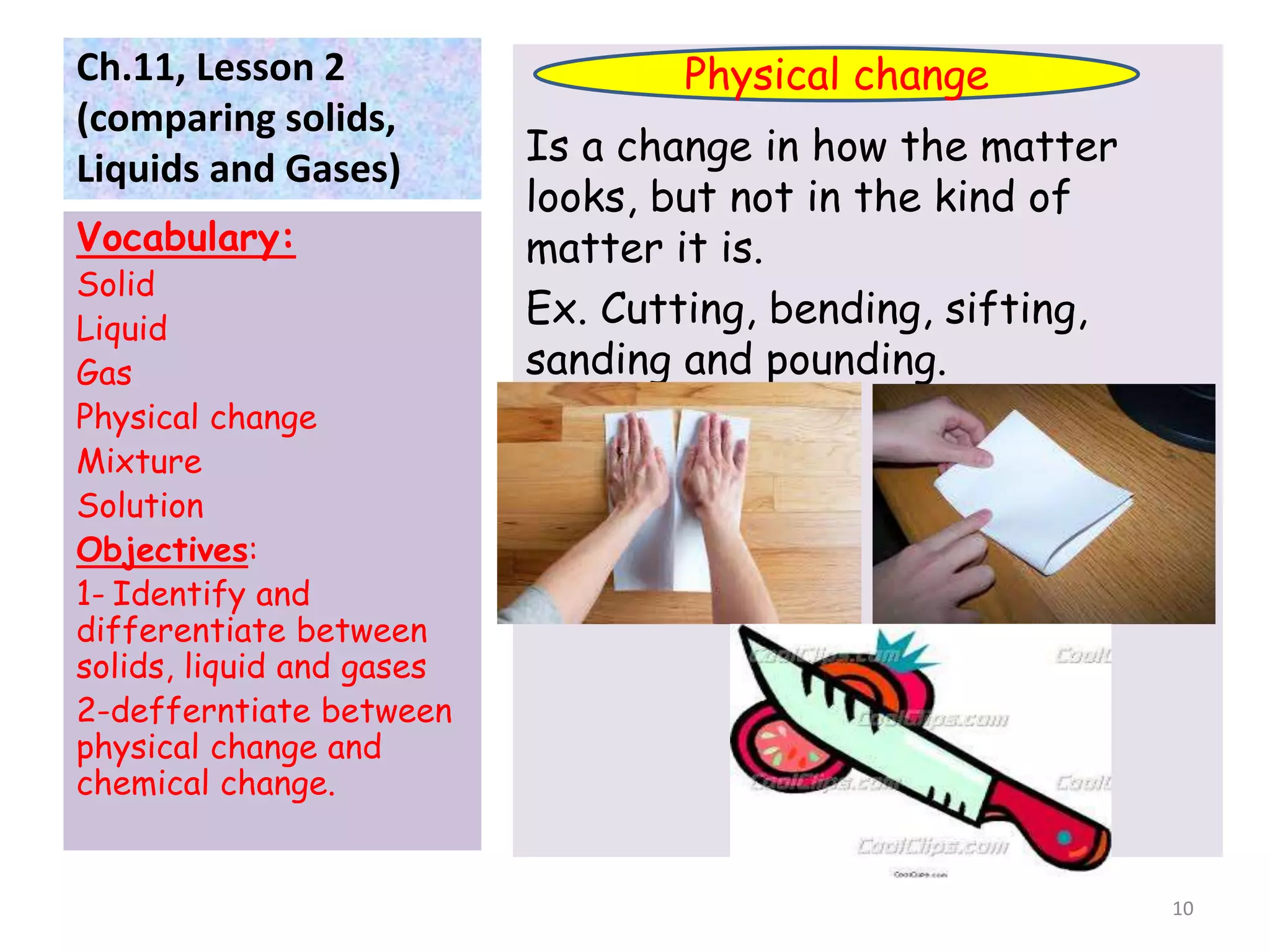
Is a change in how the matter
looks, but not in the kind of
matter it is.
Ex. Cutting, bending, sifting,
sanding and pounding.
Vocabulary:
Solid
Liquid
Gas
Physical change
Mixture
Solution
Objectives:
1- Identify and
differentiate between
solids, liquid and gases
2-defferntiate between
physical change and
chemical change.
10
Physical change
Ch.11, Lesson 2
(comparing solids,
Liquids and Gases)
Matter can also change in
state.
We can find water in the
solid, liquid, or gas state.
Water looks different in
each state but it is still the
same kind of matter.
Vocabulary:
Solid
Liquid
Gas
Physical change
Mixture
Solution
Objectives:
1- Identify and
differentiate between
solids, liquid and gases
2-defferntiate between
physical change and
chemical change.
11
Ch.11, Lesson 2
(comparing solids,
Liquids and Gases)
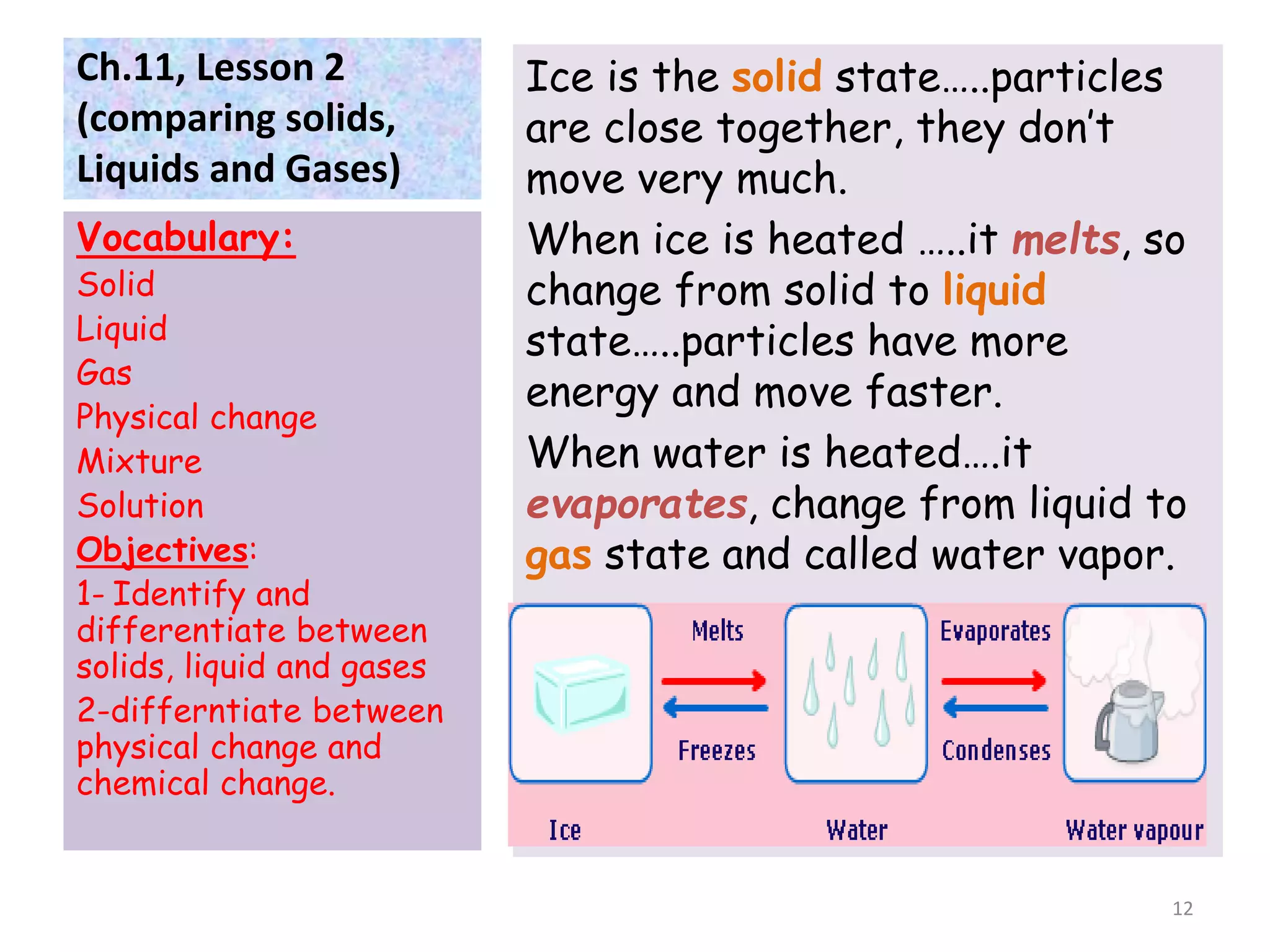
Ice is the solid state…..particles
are close together, they don’t
move very much.
When ice is heated …..it melts, so
change from solid to liquid
state…..particles have more
energy and move faster.
When water is heated….it
evaporates, change from liquid to
gas state and called water vapor.
Vocabulary:
Solid
Liquid
Gas
Physical change
Mixture
Solution
Objectives:
1- Identify and
differentiate between
solids, liquid and gases
2-differntiate between
physical change and
chemical change.
12
Ch.11, Lesson 2
(comparing solids,
Liquids and Gases)
When water vapor cools….it looses
energy and condenses…..it
becomes liquid.
When liquid water cools, it
freezes into ice.
Melting, evaporating, condensing,
and freezing are examples of
physical changes.
Vocabulary:
Solid
Liquid
Gas
Physical change
Mixture
Solution
Objectives:
1- Identify and
differentiate between
solids, liquid and gases
2-differntiate between
physical change and
chemical change.
13
Ch.11, Lesson 2
(comparing solids,
Liquids and Gases)
Can you mix different kinds of
matter together?
When you mix different kinds of
matter together.
In a mixture the properties of
each kind of matter don’t change.
Ex. Fruit salad is a mixture of
many kinds of fruit, if you pick out
a piece of orange it will look like
any orange piece.
Vocabulary:
Solid
Liquid
Gas
Physical change
Mixture
Solution
Objectives:
1- Identify and
differentiate between
solids, liquid and gases
2-differntiate between
physical change and
chemical change.
14
Mixture
Ch.11, Lesson 2
(comparing solids,
Liquids and Gases)
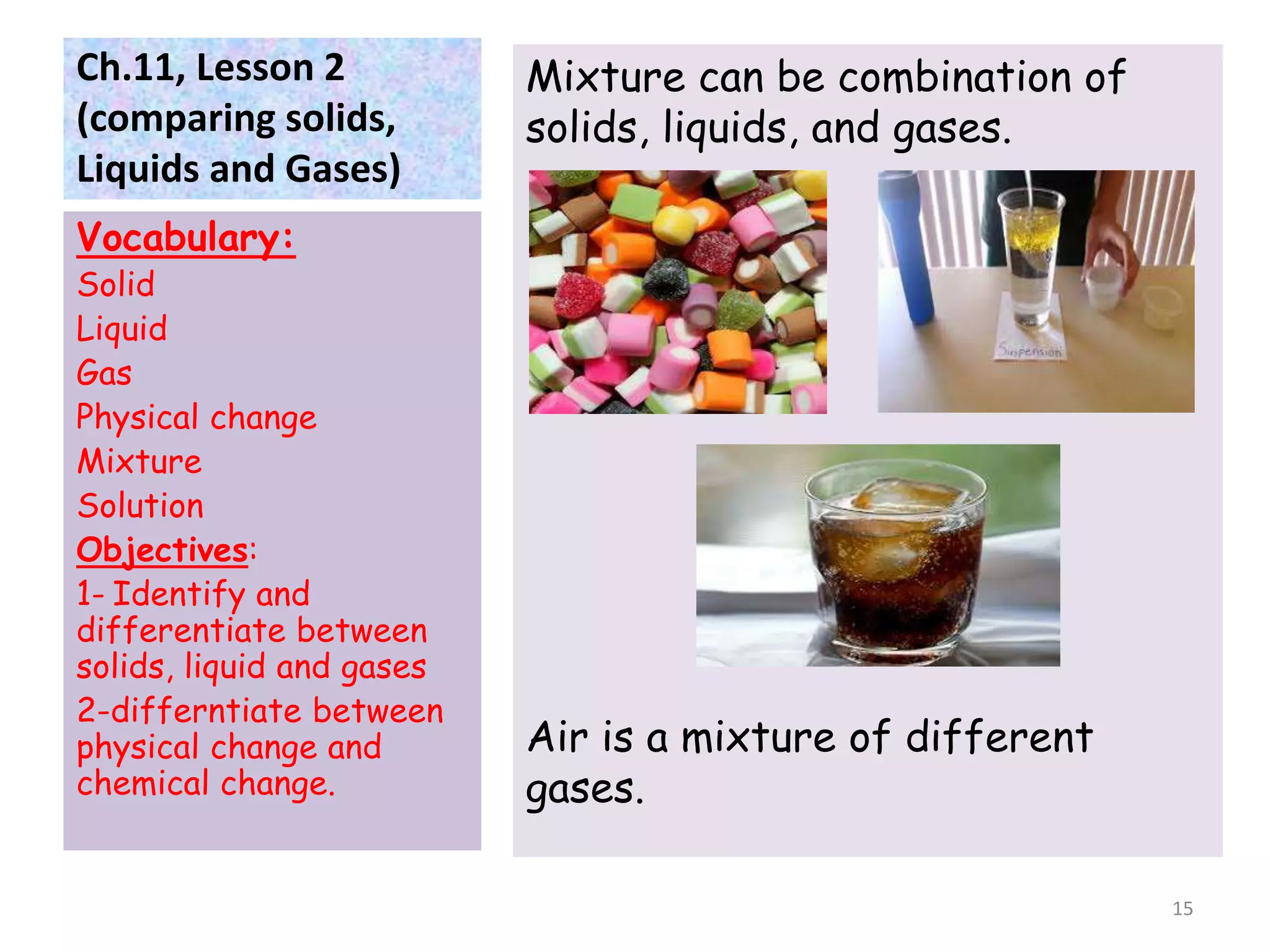
Mixture can be combination of
solids, liquids, and gases.
Air is a mixture of different
gases.
Vocabulary:
Solid
Liquid
Gas
Physical change
Mixture
Solution
Objectives:
1- Identify and
differentiate between
solids, liquid and gases
2-differntiate between
physical change and
chemical change.
15
Ch.11, Lesson 2
(comparing solids,
Liquids and Gases)
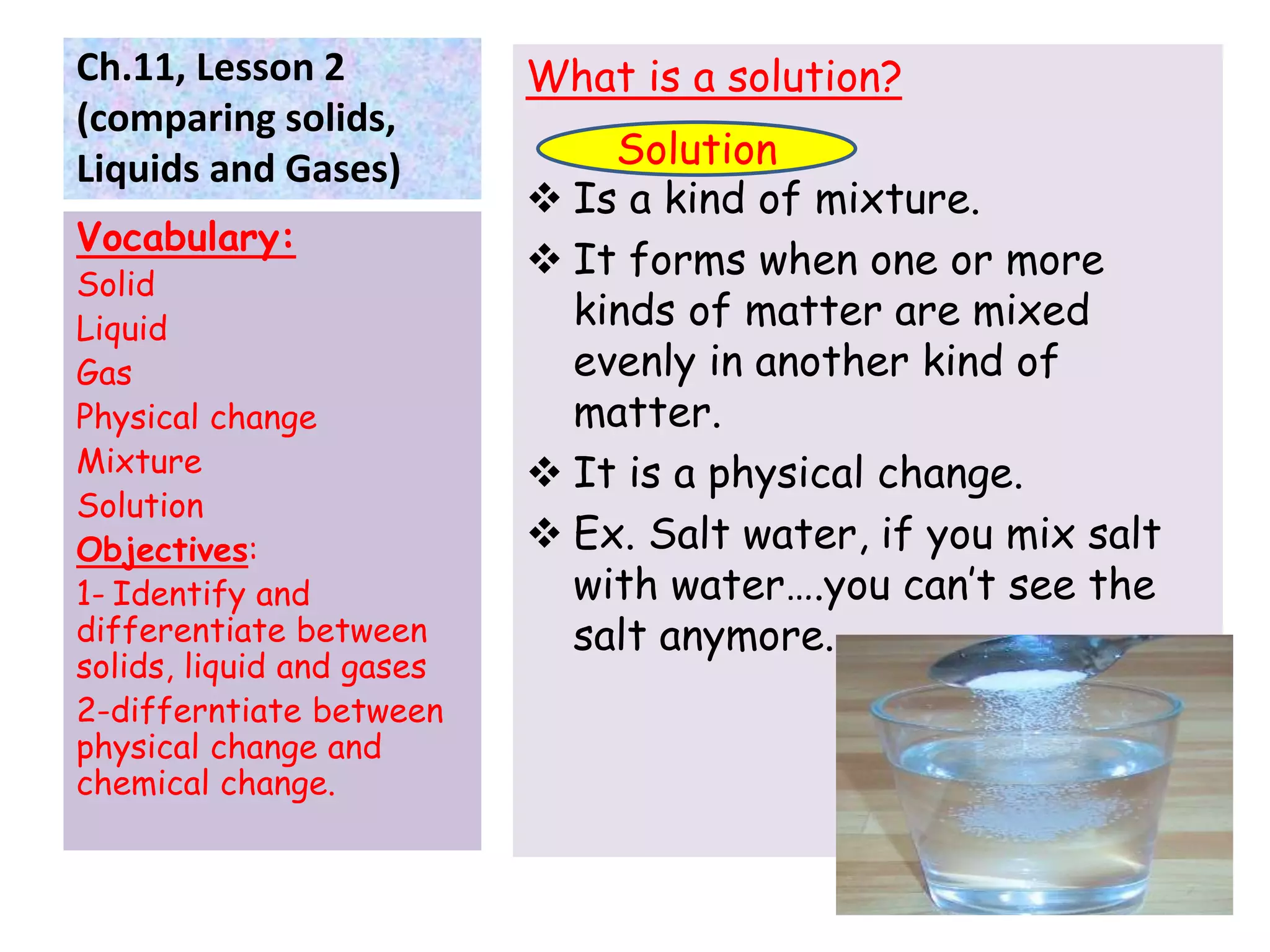
What is a solution?
 Is a kind of mixture.
 It forms when one or more
kinds of matter are mixed
evenly in another kind of
matter.
 It is a physical change.
 Ex. Salt water, if you mix salt
with water….you can’t see the
salt anymore.
Vocabulary:
Solid
Liquid
Gas
Physical change
Mixture
Solution
Objectives:
1- Identify and
differentiate between
solids, liquid and gases
2-differntiate between
physical change and
chemical change.
16
Solution
Ch.11, Lesson 2
(comparing solids,
Liquids and Gases)
If the water evaporates , the salt
will be left behind.
Not all solids form solutions in
water.
If you mix sand with water….the
sand will just sink in the bottom.
Vocabulary:
Solid
Liquid
Gas
Physical change
Mixture
Solution
Objectives:
1- Identify and
differentiate between
solids, liquid and gases
2-differntiate between
physical change and
chemical change.
17
Ch.11, Lesson 2
(comparing solids,
Liquids and Gases)
Some solutions have no liquids.
Ex. Air is a solution of different
gases.
Ex. Steel is a solution of several
solids, it is used to make cars,
bridges, and buildings.
Vocabulary:
Solid
Liquid
Gas
Physical change
Mixture
Solution
Objectives:
1- Identify and
differentiate between
solids, liquid and gases
2-differntiate between
physical change and
chemical change.
18
19

Comparing solids,liquids,and gases g3

  • 1.
  • 2.
    Ch.11, Lesson 2 (comparingsolids, Liquids and Gases) How can you classify Matter? There are 3 states of matter Vocabulary: Solid Liquid Gas Physical change Mixture Solution Objectives: 1- Identify and differentiate between solids, liquid and gases 2-defferntiate between physical change and chemical change. 2
  • 3.
    Ch.11, Lesson 2 (comparingsolids, Liquids and Gases) Is matter that has a definite size and shape. Definite= it stays the same. If you put it in a jar or a box, it stays the same. Vocabulary: Solid Liquid Gas Physical change Mixture Solution Objectives: 1- Identify and differentiate between solids, liquid and gases 2-defferntiate between physical change and chemical change. 3 Solid
  • 4.
    Ch.11, Lesson 2 (comparingsolids, Liquids and Gases) Is matter that has a definite volume. It doesn’t have a definite shape If you pour juice into a glass, it will take on the shape of glass. Vocabulary: Solid Liquid Gas Physical change Mixture Solution Objectives: 1- Identify and differentiate between solids, liquid and gases 2-defferntiate between physical change and chemical change. 4 Liquid
  • 5.
    Ch.11, Lesson 2 (comparingsolids, Liquids and Gases) Is matter that has no definite shape or volume. Gas takes the shape of whatever container they are in. The air all around us is a gas. Vocabulary: Solid Liquid Gas Physical change Mixture Solution Objectives: 1- Identify and differentiate between solids, liquid and gases 2-defferntiate between physical change and chemical change. 5 Gas
  • 6.
    Ch.11, Lesson 2 (comparingsolids, Liquids and Gases) Matter is made of particles. Particles are very, very small. In Solids particles are packed closely together, so they form a certain pattern. In Liquids particles are close together but don’t form a pattern. They have more energy and can slide past one another. In Gas particles have more energy, they spread out to fill a large container, or squeeze together to fit into a small one. Vocabulary: Solid Liquid Gas Physical change Mixture Solution Objectives: 1- Identify and differentiate between solids, liquid and gases 2-defferntiate between physical change and chemical change. 6
  • 7.
    Ch.11, Lesson 2 (comparingsolids, Liquids and Gases) Vocabulary: Solid Liquid Gas Physical change Mixture Solution Objectives: 1- Identify and differentiate between solids, liquid and gases 2-defferntiate between physical change and chemical change. 7
  • 8.
  • 9.
    Ch.11, Lesson 2 (comparingsolids, Liquids and Gases) How can Matter change? Matter can change but still remain the same kind of matter. * If you cut a paper, it will look different but still made of the same particles. * If you cut and sand the wood to make a wooden model, its shape and size change but it is still wood. Vocabulary: Solid Liquid Gas Physical change Mixture Solution Objectives: 1- Identify and differentiate between solids, liquid and gases 2-defferntiate between physical change and chemical change. 9
  • 10.
    Ch.11, Lesson 2 (comparingsolids, Liquids and Gases) Is a change in how the matter looks, but not in the kind of matter it is. Ex. Cutting, bending, sifting, sanding and pounding. Vocabulary: Solid Liquid Gas Physical change Mixture Solution Objectives: 1- Identify and differentiate between solids, liquid and gases 2-defferntiate between physical change and chemical change. 10 Physical change
  • 11.
    Ch.11, Lesson 2 (comparingsolids, Liquids and Gases) Matter can also change in state. We can find water in the solid, liquid, or gas state. Water looks different in each state but it is still the same kind of matter. Vocabulary: Solid Liquid Gas Physical change Mixture Solution Objectives: 1- Identify and differentiate between solids, liquid and gases 2-defferntiate between physical change and chemical change. 11
  • 12.
    Ch.11, Lesson 2 (comparingsolids, Liquids and Gases) Ice is the solid state…..particles are close together, they don’t move very much. When ice is heated …..it melts, so change from solid to liquid state…..particles have more energy and move faster. When water is heated….it evaporates, change from liquid to gas state and called water vapor. Vocabulary: Solid Liquid Gas Physical change Mixture Solution Objectives: 1- Identify and differentiate between solids, liquid and gases 2-differntiate between physical change and chemical change. 12
  • 13.
    Ch.11, Lesson 2 (comparingsolids, Liquids and Gases) When water vapor cools….it looses energy and condenses…..it becomes liquid. When liquid water cools, it freezes into ice. Melting, evaporating, condensing, and freezing are examples of physical changes. Vocabulary: Solid Liquid Gas Physical change Mixture Solution Objectives: 1- Identify and differentiate between solids, liquid and gases 2-differntiate between physical change and chemical change. 13
  • 14.
    Ch.11, Lesson 2 (comparingsolids, Liquids and Gases) Can you mix different kinds of matter together? When you mix different kinds of matter together. In a mixture the properties of each kind of matter don’t change. Ex. Fruit salad is a mixture of many kinds of fruit, if you pick out a piece of orange it will look like any orange piece. Vocabulary: Solid Liquid Gas Physical change Mixture Solution Objectives: 1- Identify and differentiate between solids, liquid and gases 2-differntiate between physical change and chemical change. 14 Mixture
  • 15.
    Ch.11, Lesson 2 (comparingsolids, Liquids and Gases) Mixture can be combination of solids, liquids, and gases. Air is a mixture of different gases. Vocabulary: Solid Liquid Gas Physical change Mixture Solution Objectives: 1- Identify and differentiate between solids, liquid and gases 2-differntiate between physical change and chemical change. 15
  • 16.
    Ch.11, Lesson 2 (comparingsolids, Liquids and Gases) What is a solution?  Is a kind of mixture.  It forms when one or more kinds of matter are mixed evenly in another kind of matter.  It is a physical change.  Ex. Salt water, if you mix salt with water….you can’t see the salt anymore. Vocabulary: Solid Liquid Gas Physical change Mixture Solution Objectives: 1- Identify and differentiate between solids, liquid and gases 2-differntiate between physical change and chemical change. 16 Solution
  • 17.
    Ch.11, Lesson 2 (comparingsolids, Liquids and Gases) If the water evaporates , the salt will be left behind. Not all solids form solutions in water. If you mix sand with water….the sand will just sink in the bottom. Vocabulary: Solid Liquid Gas Physical change Mixture Solution Objectives: 1- Identify and differentiate between solids, liquid and gases 2-differntiate between physical change and chemical change. 17
  • 18.
    Ch.11, Lesson 2 (comparingsolids, Liquids and Gases) Some solutions have no liquids. Ex. Air is a solution of different gases. Ex. Steel is a solution of several solids, it is used to make cars, bridges, and buildings. Vocabulary: Solid Liquid Gas Physical change Mixture Solution Objectives: 1- Identify and differentiate between solids, liquid and gases 2-differntiate between physical change and chemical change. 18
  • 19.