Chapter 2.1/2.2 Key Points

       Max Waldbaum
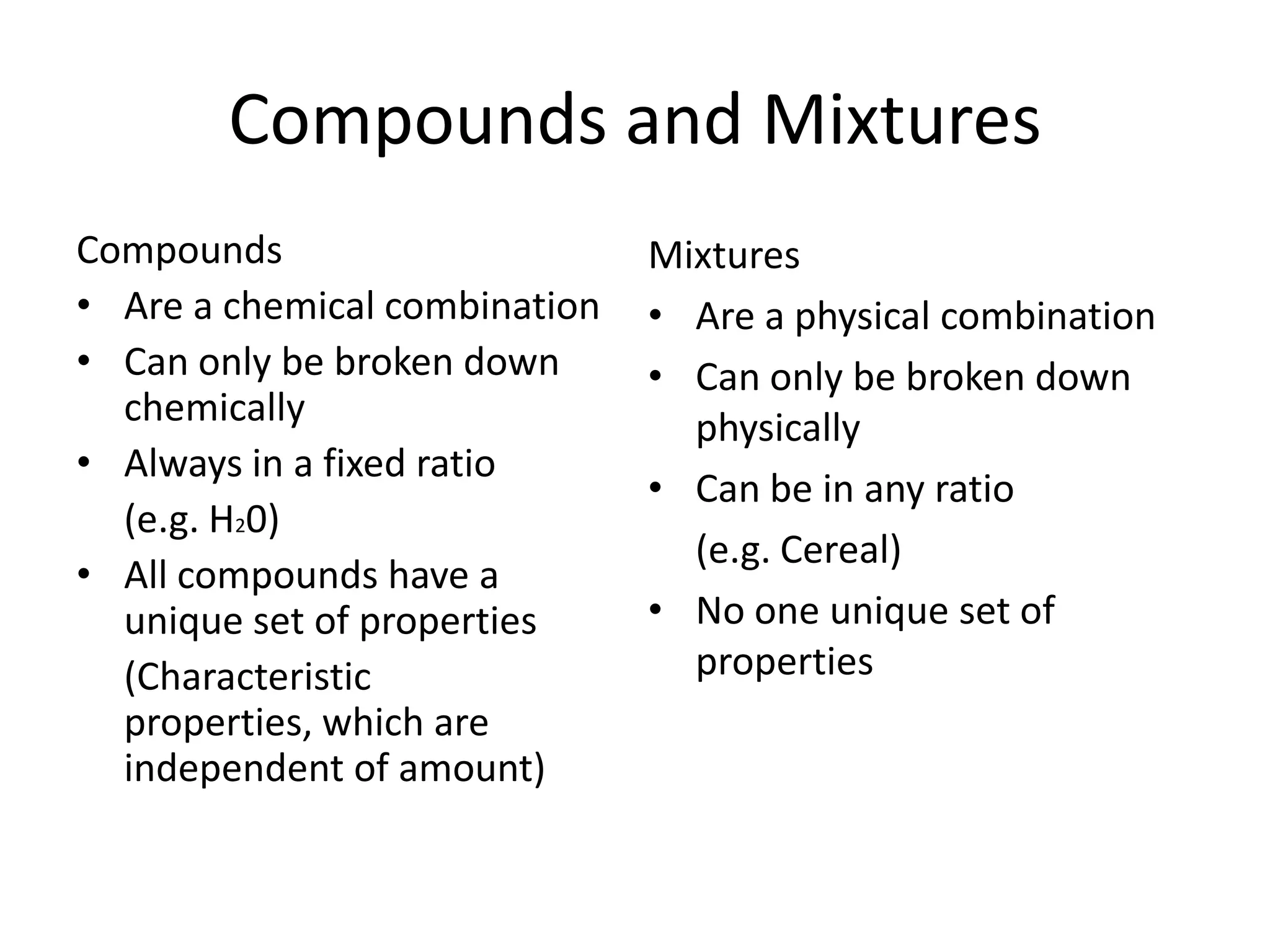
Compounds and Mixtures
Compounds                      Mixtures
• Are a chemical combination   • Are a physical combination
• Can only be broken down      • Can only be broken down
  chemically                     physically
• Always in a fixed ratio
                               • Can be in any ratio
  (e.g. H20)
                                 (e.g. Cereal)
• All compounds have a
  unique set of properties     • No one unique set of
  (Characteristic                properties
  properties, which are
  independent of amount)
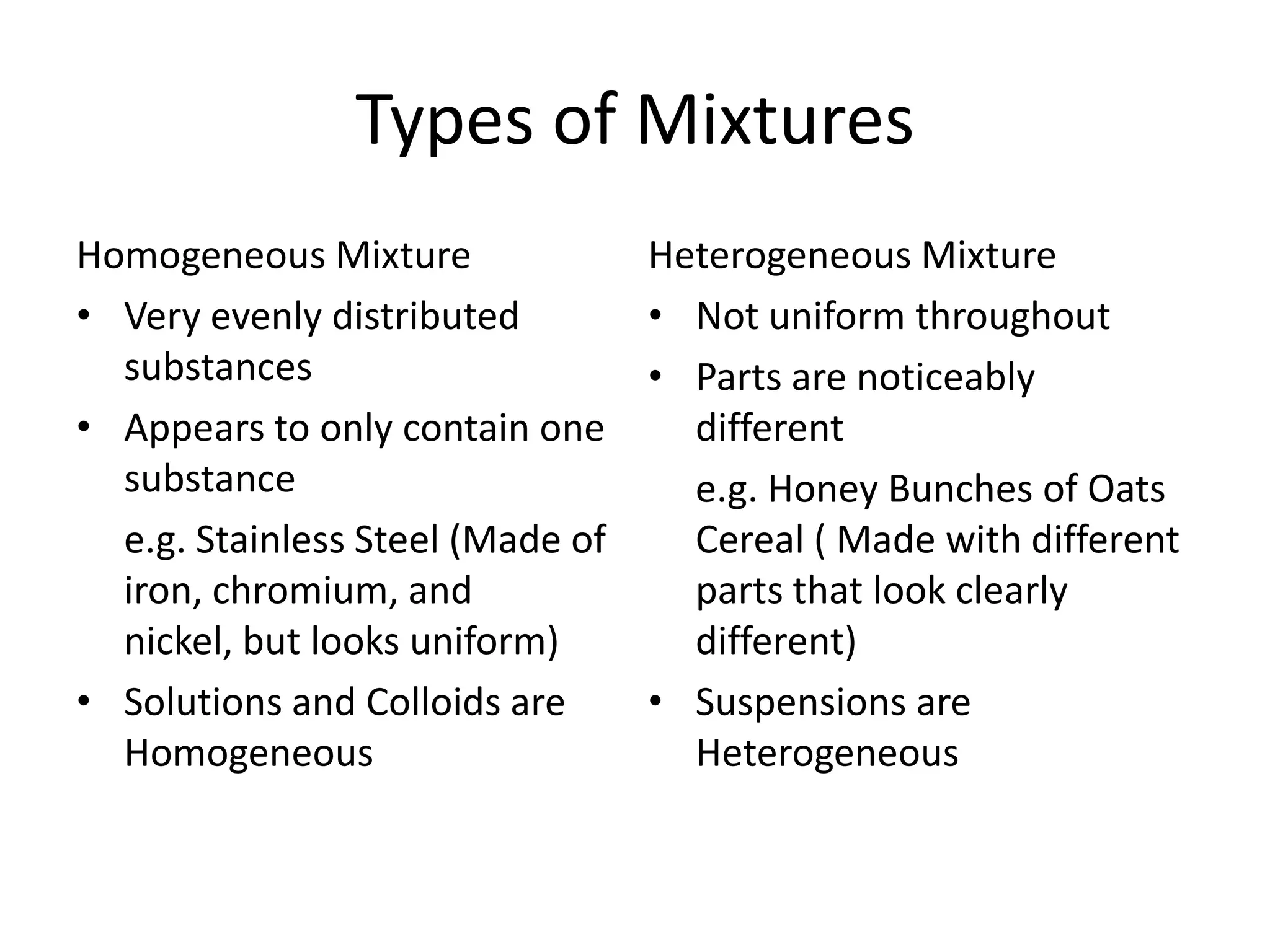
Types of Mixtures
Homogeneous Mixture               Heterogeneous Mixture
• Very evenly distributed         • Not uniform throughout
  substances                      • Parts are noticeably
• Appears to only contain one       different
  substance                         e.g. Honey Bunches of Oats
  e.g. Stainless Steel (Made of     Cereal ( Made with different
  iron, chromium, and               parts that look clearly
  nickel, but looks uniform)        different)
• Solutions and Colloids are      • Suspensions are
  Homogeneous                       Heterogeneous
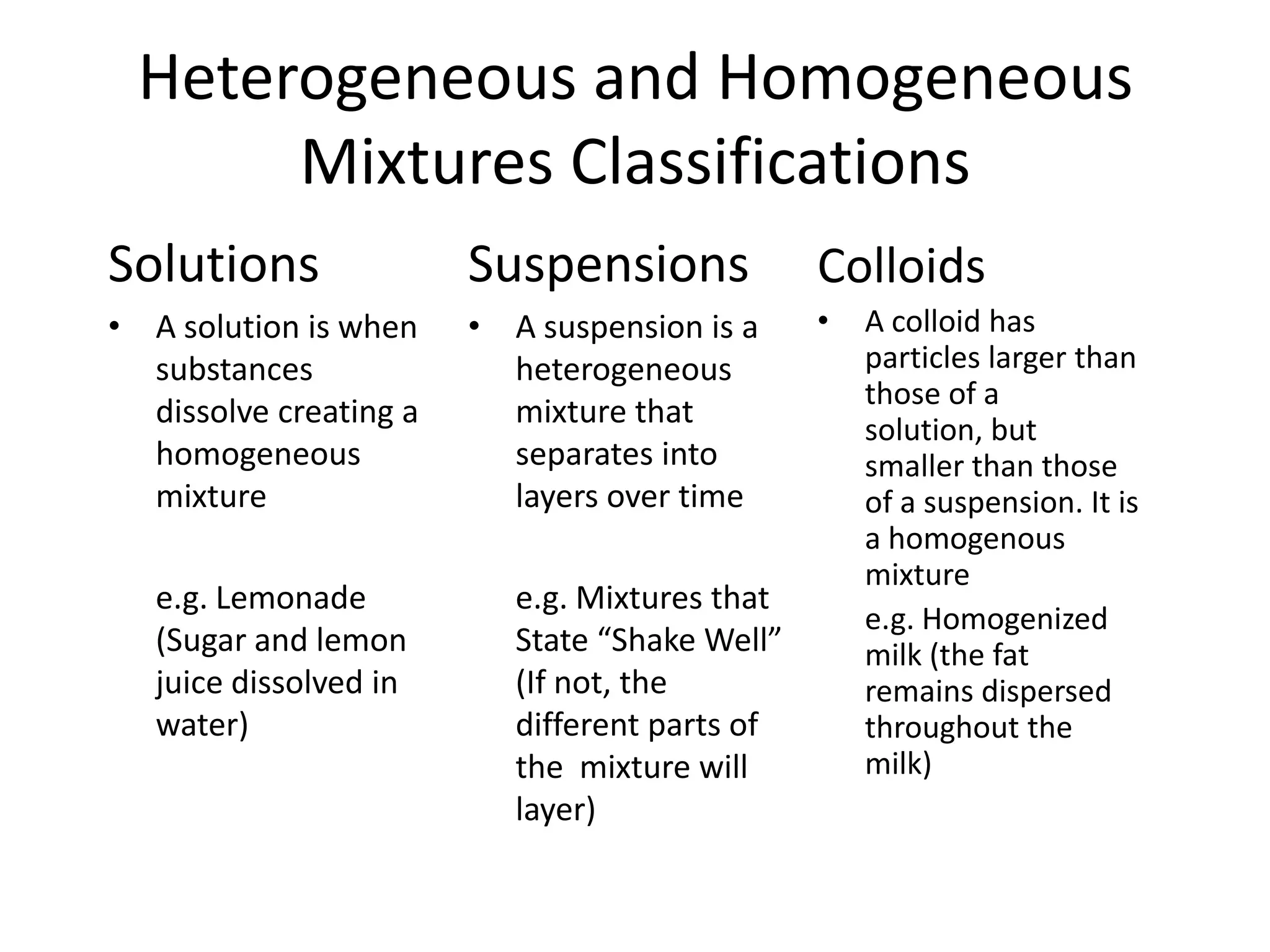
Heterogeneous and Homogeneous
       Mixtures Classifications
Solutions               Suspensions             Colloids
• A solution is when    • A suspension is a     •   A colloid has
  substances              heterogeneous             particles larger than
                                                    those of a
  dissolve creating a     mixture that
                                                    solution, but
  homogeneous             separates into            smaller than those
  mixture                 layers over time          of a suspension. It is
                                                    a homogenous
                                                    mixture
   e.g. Lemonade           e.g. Mixtures that
                                                    e.g. Homogenized
   (Sugar and lemon        State “Shake Well”       milk (the fat
   juice dissolved in      (If not, the             remains dispersed
   water)                  different parts of       throughout the
                           the mixture will         milk)
                           layer)
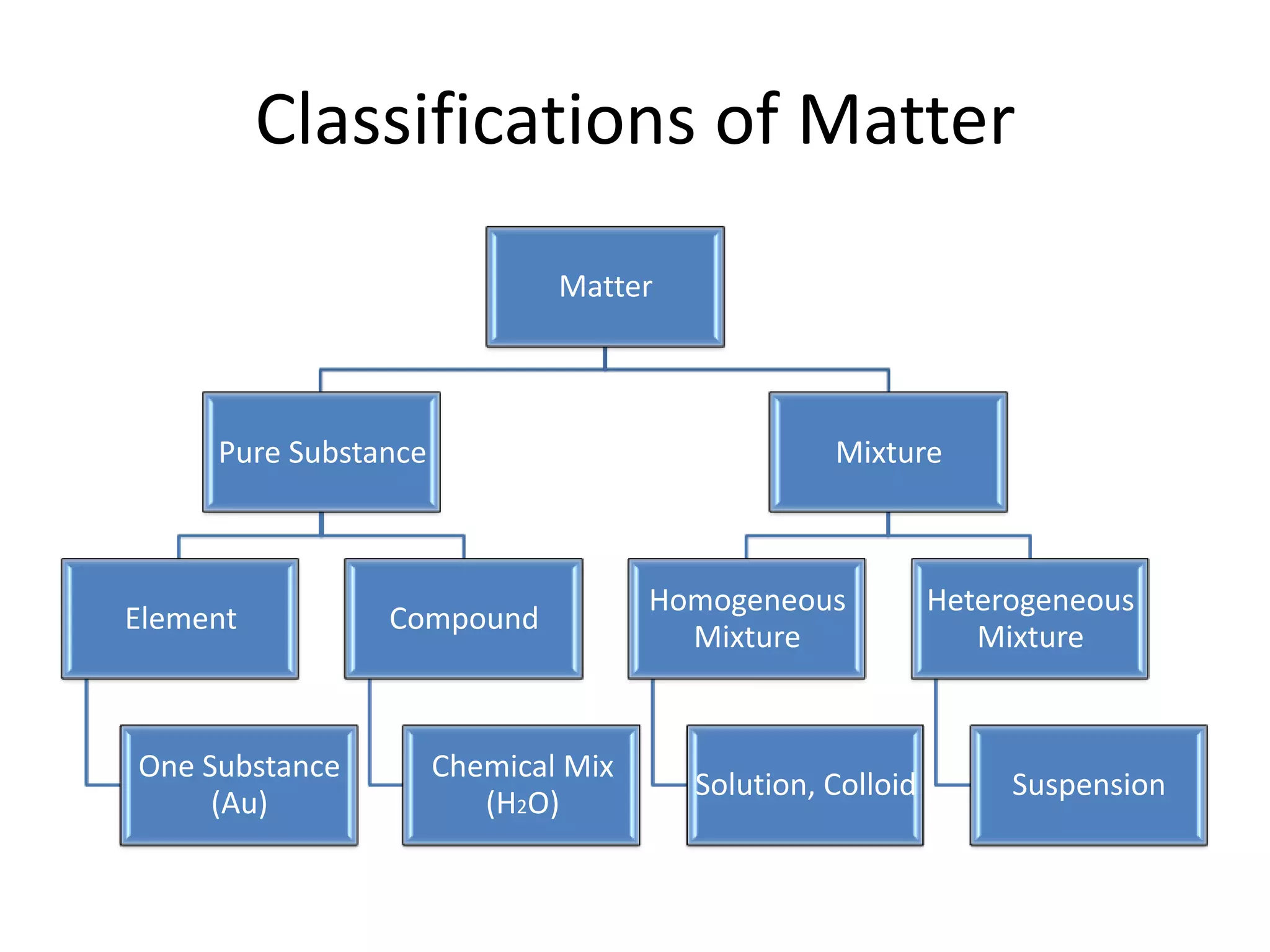
Classifications of Matter
                              Matter


     Pure Substance                              Mixture


                                     Homogeneous           Heterogeneous
Element         Compound
                                       Mixture                Mixture


One Substance         Chemical Mix
                                       Solution, Colloid        Suspension
     (Au)                (H2O)
Physical Properties
• A Physical Property is a characteristic of a material
• Examples of Physical Properties are .....
   – Viscosity (Residence to flowing- e.g. honey has a high viscosity)
   – Conductivity (Ability to allow heat to flow – e.g. metal has a high
     conductivity)
   – Malleability (Ability of a solid to be hammered without shattering –
     e.g. Gold is malleable)
   – Hardness (Which material is harder – e.g. scratch test)
   – Melting/Boiling Points
   – Density (How dense the material is – g/mL)
Using Physical Properties
• Physical Properties are mainly used to...
1. Identify a Material
2. Choose a material for a specific purpose
3. Separate the substances in a mixture

• Physical properties are key in exercising these
  steps, which are used in many scientific
  findings and labs
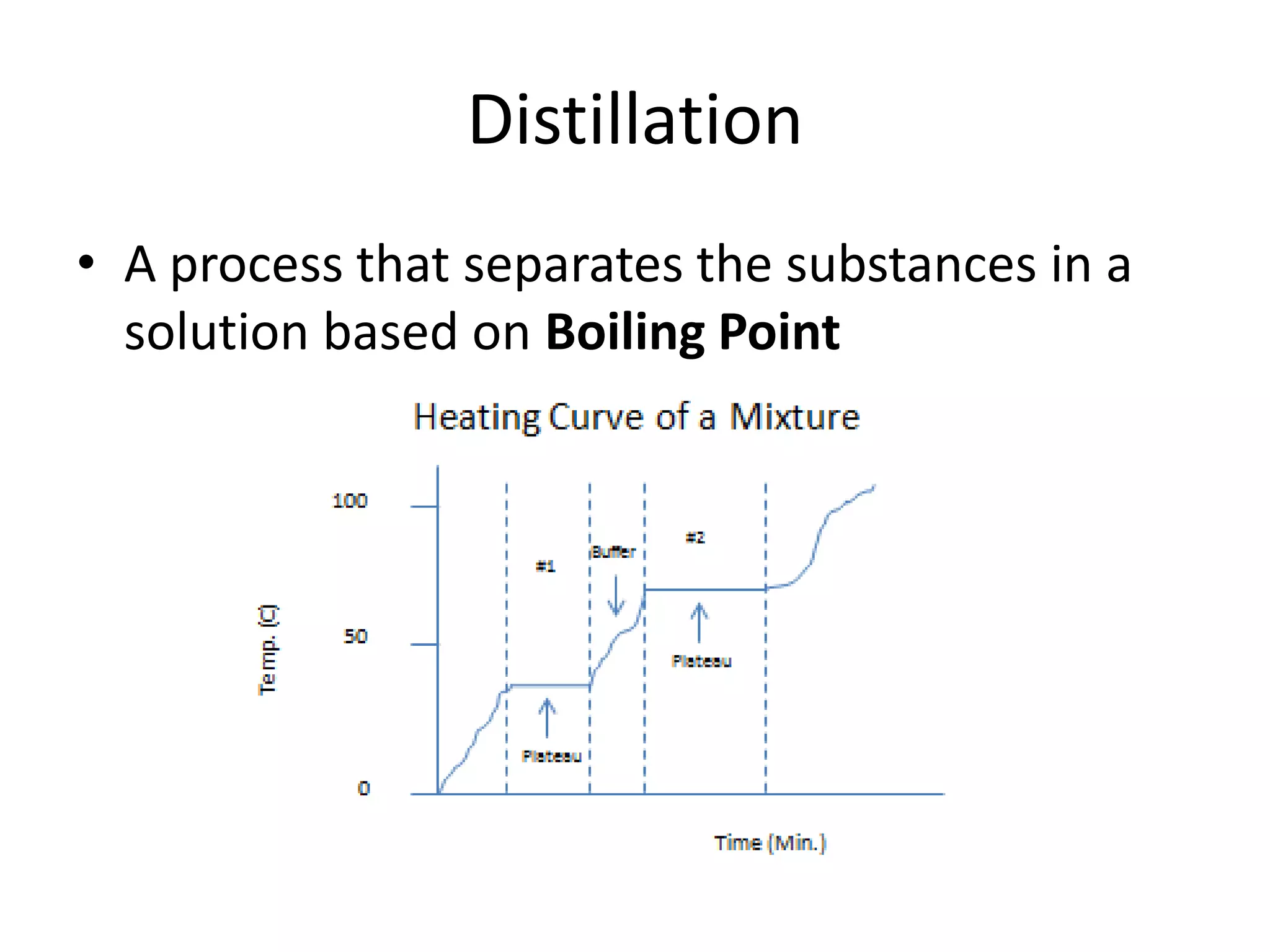
Distillation
• A process that separates the substances in a
  solution based on Boiling Point
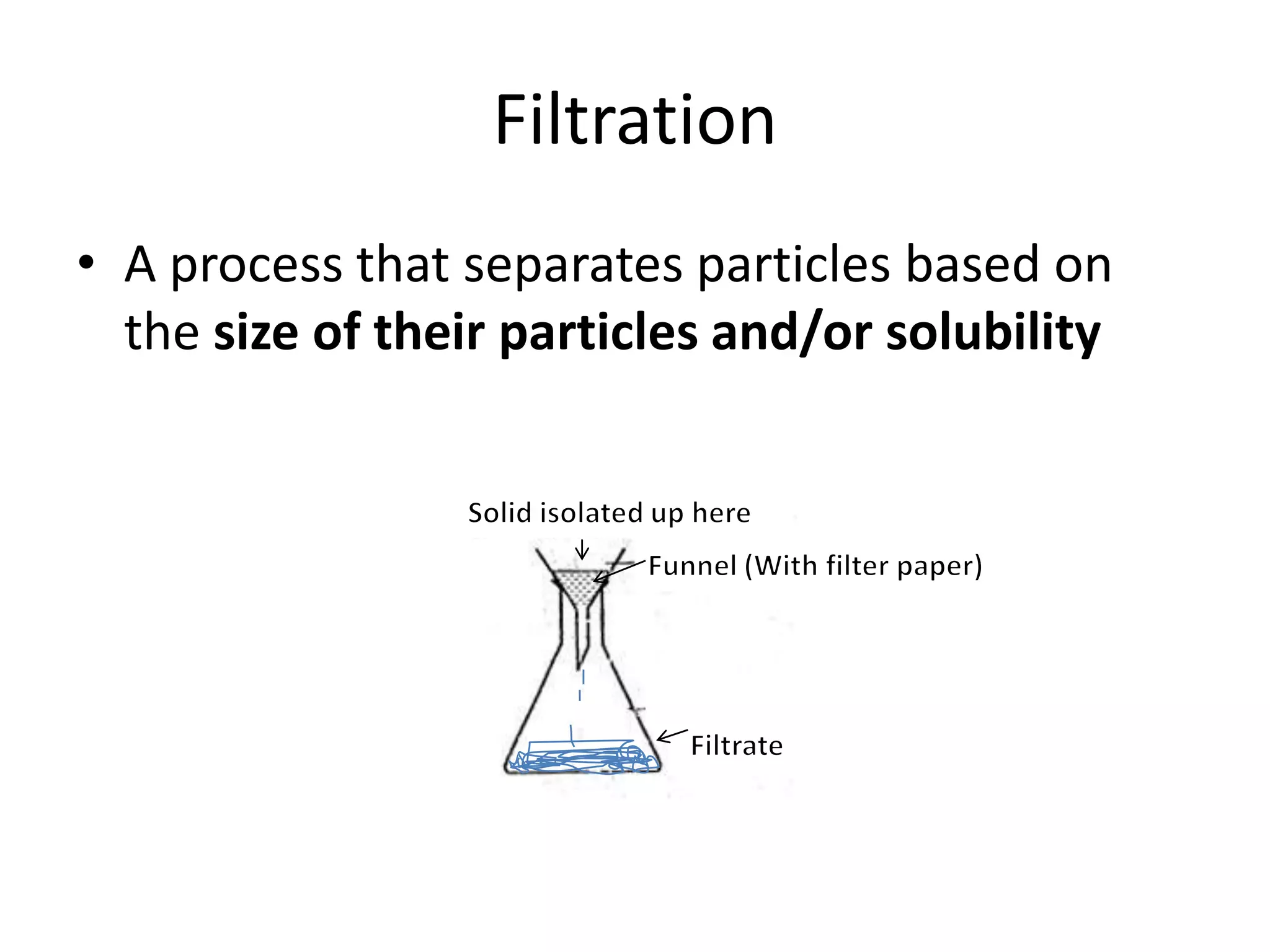
Filtration
• A process that separates particles based on
  the size of their particles and/or solubility
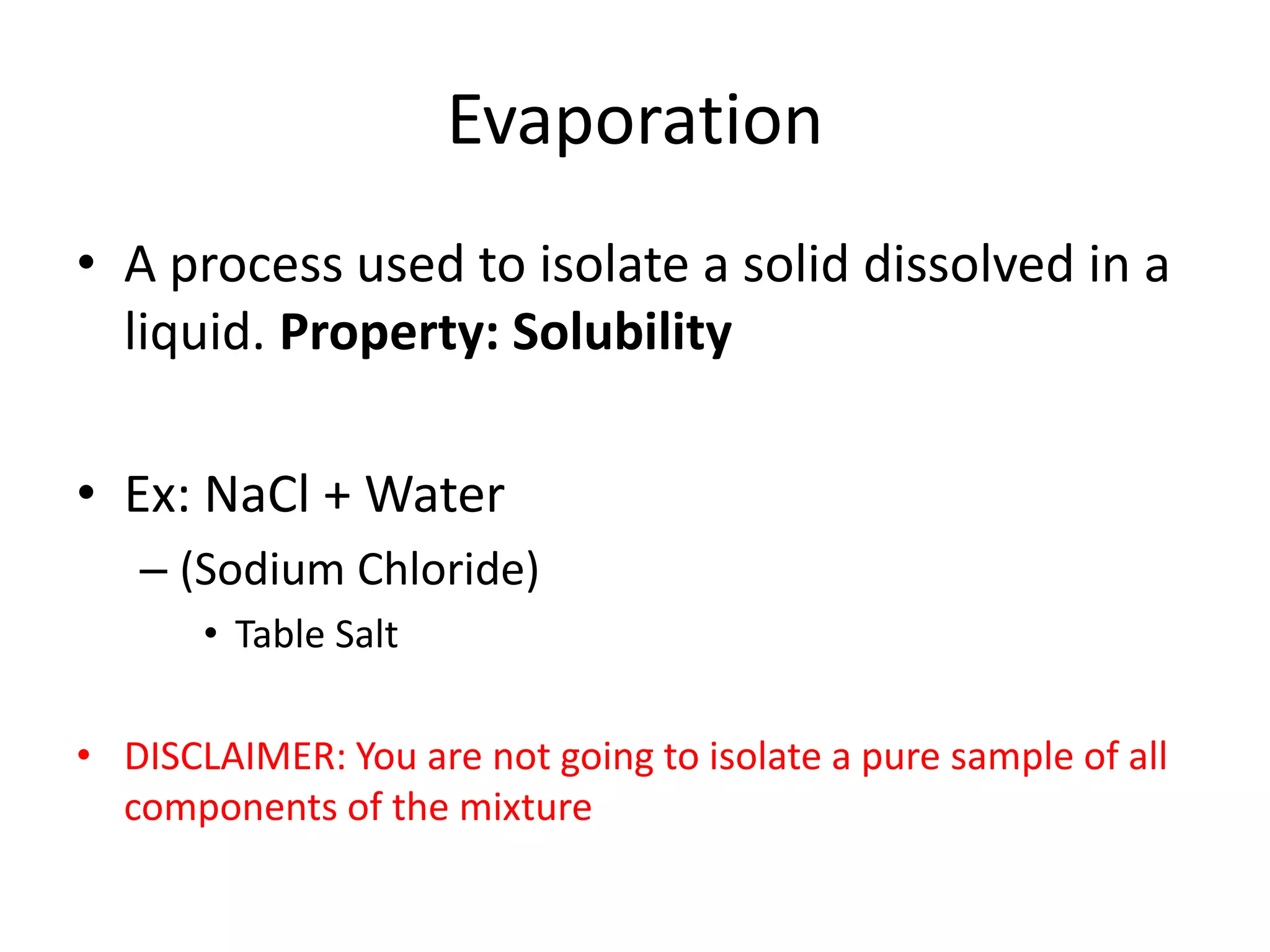
Evaporation
• A process used to isolate a solid dissolved in a
  liquid. Property: Solubility

• Ex: NaCl + Water
   – (Sodium Chloride)
       • Table Salt

• DISCLAIMER: You are not going to isolate a pure sample of all
  components of the mixture
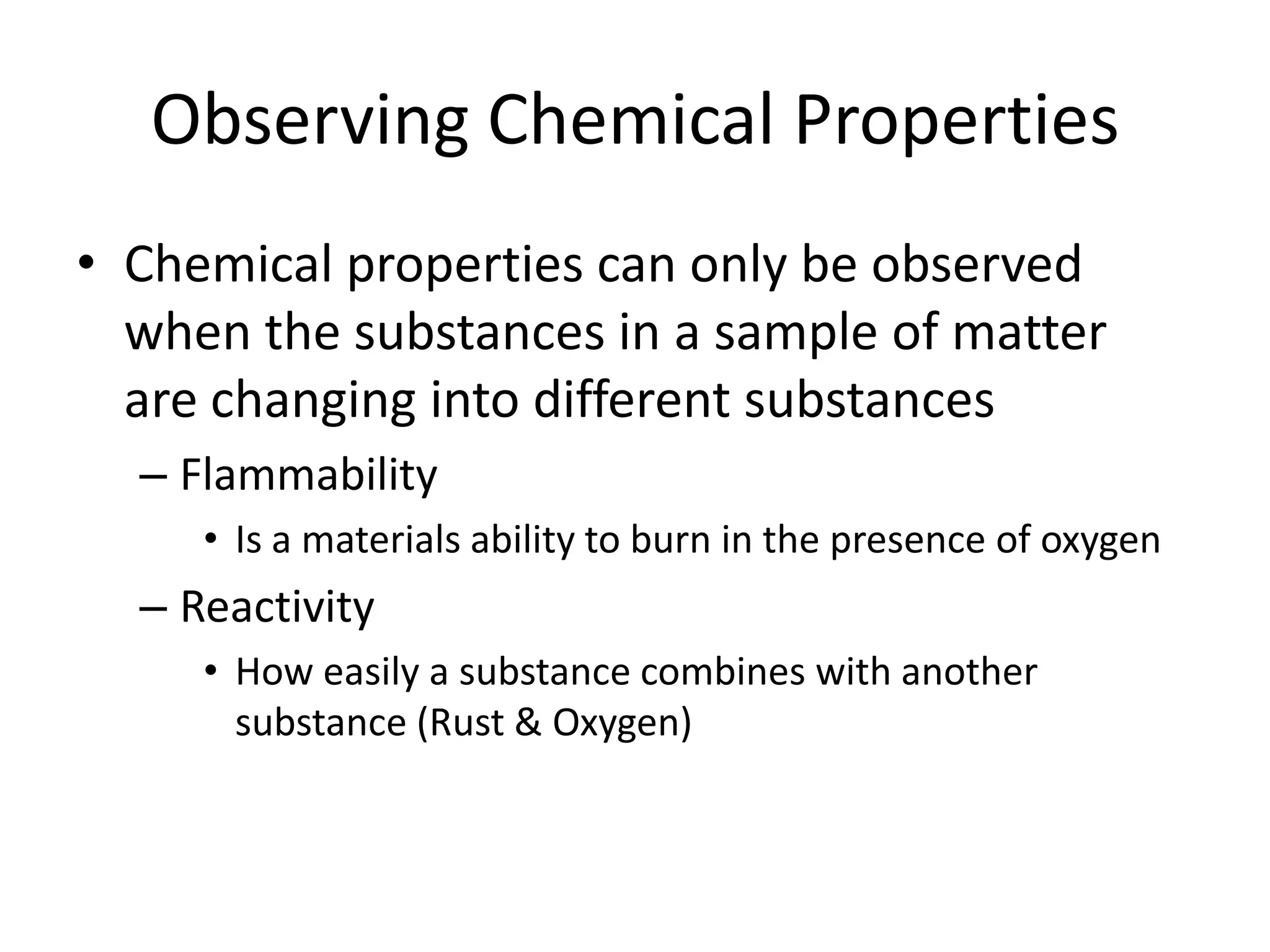
Observing Chemical Properties
• Chemical properties can only be observed
  when the substances in a sample of matter
  are changing into different substances
  – Flammability
     • Is a materials ability to burn in the presence of oxygen
  – Reactivity
     • How easily a substance combines with another
       substance (Rust & Oxygen)
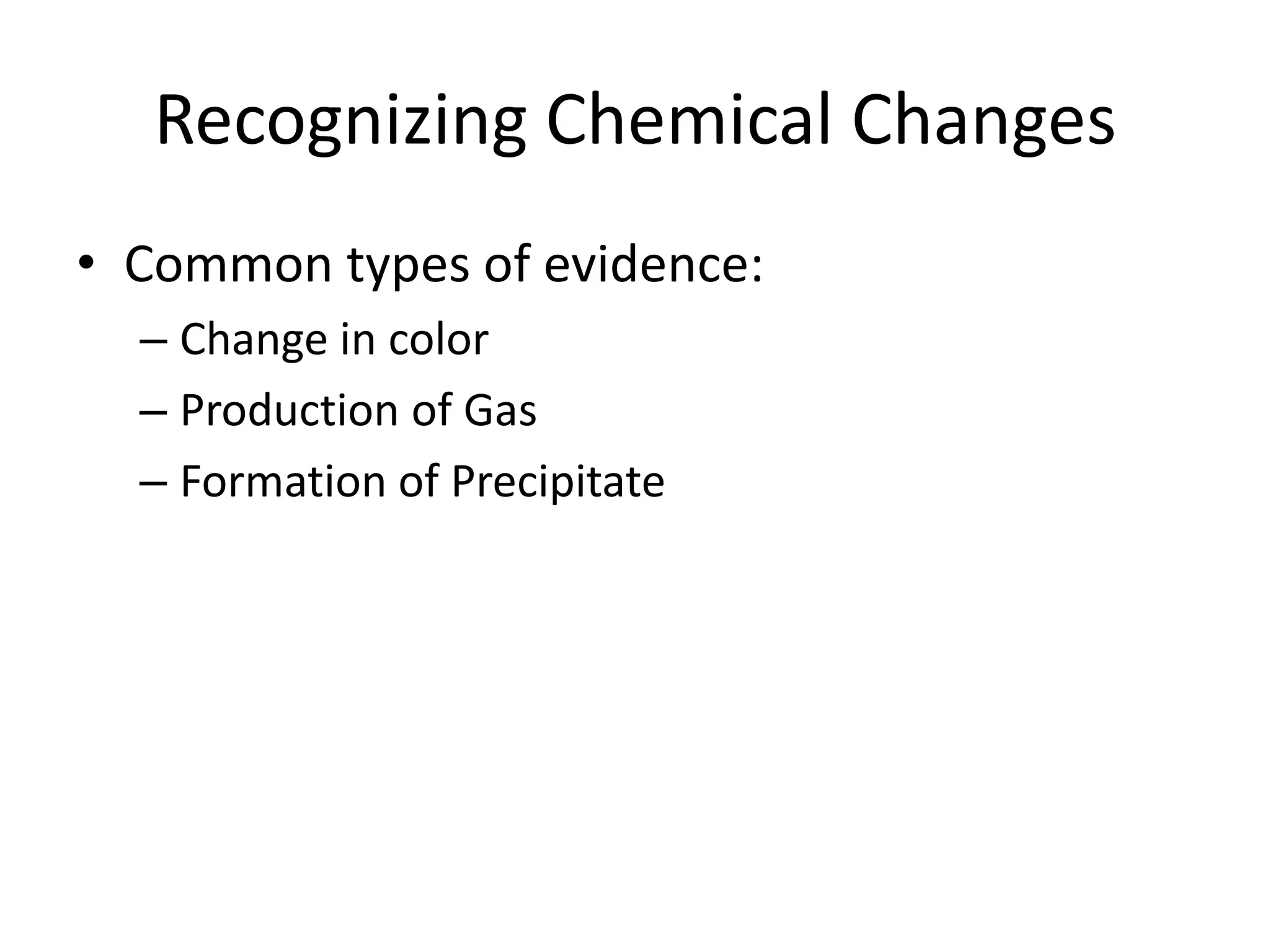
Recognizing Chemical Changes
• Common types of evidence:
  – Change in color
  – Production of Gas
  – Formation of Precipitate
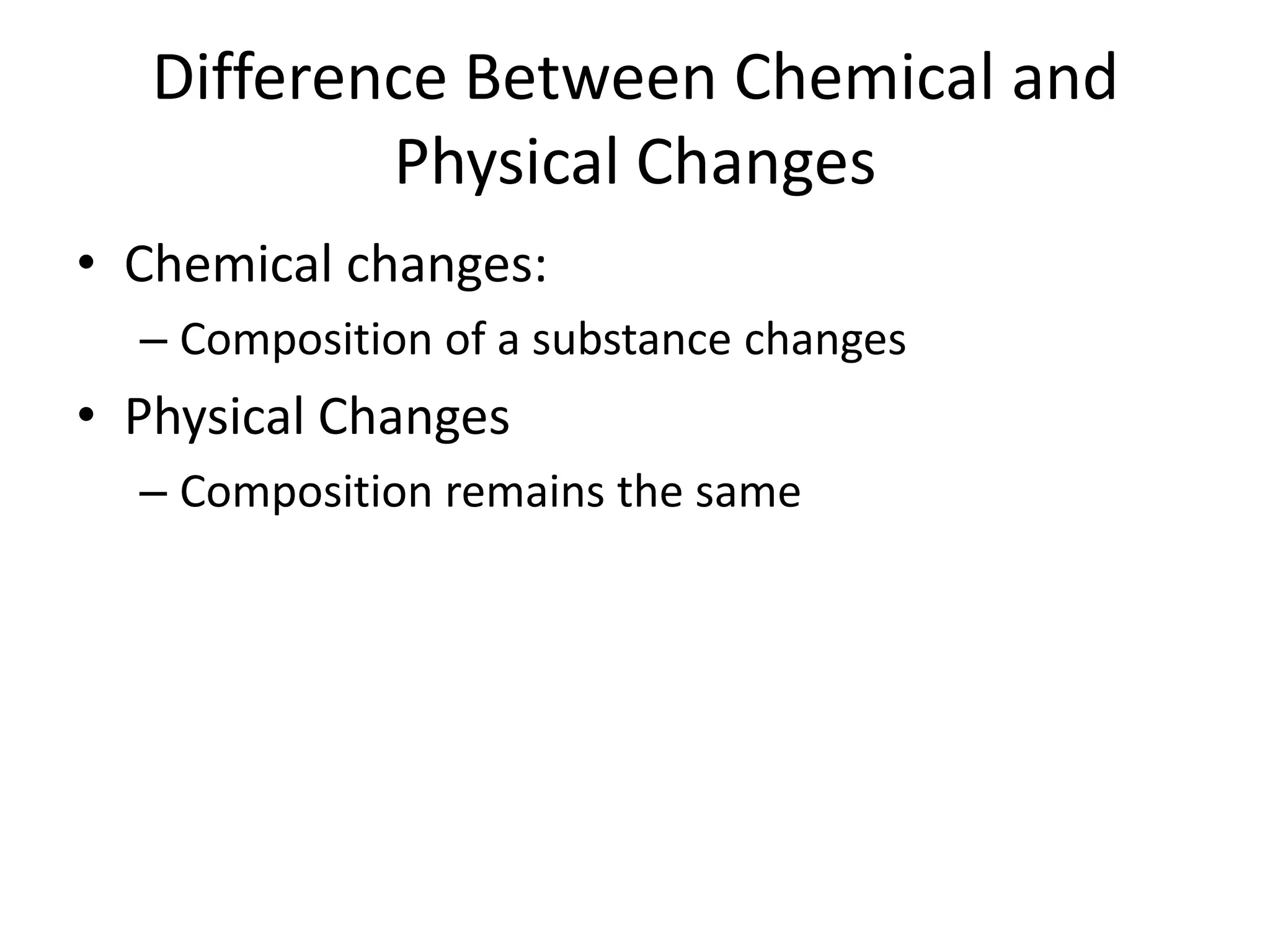
Difference Between Chemical and
           Physical Changes
• Chemical changes:
  – Composition of a substance changes
• Physical Changes
  – Composition remains the same
Questions for Test
• What is a physical property?
Questions for Test
• What is a chemical property?
What is a Physical Change?
What is a chemical change?
What are the four ways to recognize a
         chemical change?

Chapter 2 Key Points

  • 1.
    Chapter 2.1/2.2 KeyPoints Max Waldbaum
  • 2.
    Compounds and Mixtures Compounds Mixtures • Are a chemical combination • Are a physical combination • Can only be broken down • Can only be broken down chemically physically • Always in a fixed ratio • Can be in any ratio (e.g. H20) (e.g. Cereal) • All compounds have a unique set of properties • No one unique set of (Characteristic properties properties, which are independent of amount)
  • 3.
    Types of Mixtures HomogeneousMixture Heterogeneous Mixture • Very evenly distributed • Not uniform throughout substances • Parts are noticeably • Appears to only contain one different substance e.g. Honey Bunches of Oats e.g. Stainless Steel (Made of Cereal ( Made with different iron, chromium, and parts that look clearly nickel, but looks uniform) different) • Solutions and Colloids are • Suspensions are Homogeneous Heterogeneous
  • 4.
    Heterogeneous and Homogeneous Mixtures Classifications Solutions Suspensions Colloids • A solution is when • A suspension is a • A colloid has substances heterogeneous particles larger than those of a dissolve creating a mixture that solution, but homogeneous separates into smaller than those mixture layers over time of a suspension. It is a homogenous mixture e.g. Lemonade e.g. Mixtures that e.g. Homogenized (Sugar and lemon State “Shake Well” milk (the fat juice dissolved in (If not, the remains dispersed water) different parts of throughout the the mixture will milk) layer)
  • 5.
    Classifications of Matter Matter Pure Substance Mixture Homogeneous Heterogeneous Element Compound Mixture Mixture One Substance Chemical Mix Solution, Colloid Suspension (Au) (H2O)
  • 6.
    Physical Properties • APhysical Property is a characteristic of a material • Examples of Physical Properties are ..... – Viscosity (Residence to flowing- e.g. honey has a high viscosity) – Conductivity (Ability to allow heat to flow – e.g. metal has a high conductivity) – Malleability (Ability of a solid to be hammered without shattering – e.g. Gold is malleable) – Hardness (Which material is harder – e.g. scratch test) – Melting/Boiling Points – Density (How dense the material is – g/mL)
  • 7.
    Using Physical Properties •Physical Properties are mainly used to... 1. Identify a Material 2. Choose a material for a specific purpose 3. Separate the substances in a mixture • Physical properties are key in exercising these steps, which are used in many scientific findings and labs
  • 8.
    Distillation • A processthat separates the substances in a solution based on Boiling Point
  • 9.
    Filtration • A processthat separates particles based on the size of their particles and/or solubility
  • 10.
    Evaporation • A processused to isolate a solid dissolved in a liquid. Property: Solubility • Ex: NaCl + Water – (Sodium Chloride) • Table Salt • DISCLAIMER: You are not going to isolate a pure sample of all components of the mixture
  • 11.
    Observing Chemical Properties •Chemical properties can only be observed when the substances in a sample of matter are changing into different substances – Flammability • Is a materials ability to burn in the presence of oxygen – Reactivity • How easily a substance combines with another substance (Rust & Oxygen)
  • 12.
    Recognizing Chemical Changes •Common types of evidence: – Change in color – Production of Gas – Formation of Precipitate
  • 13.
    Difference Between Chemicaland Physical Changes • Chemical changes: – Composition of a substance changes • Physical Changes – Composition remains the same
  • 14.
    Questions for Test •What is a physical property?
  • 15.
    Questions for Test •What is a chemical property?
  • 16.
    What is aPhysical Change?
  • 17.
    What is achemical change?
  • 18.
    What are thefour ways to recognize a chemical change?