GRAPH OF
FUNCTIONS
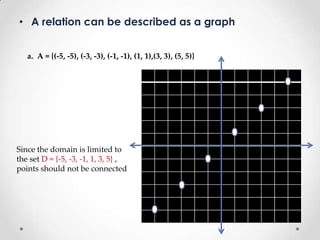
• A relation can be described as a graph
a. A = {(-5, -5), (-3, -3), (-1, -1), (1, 1),(3, 3), (5, 5)}

Since the domain is limited to
the set D = {-5, -3, -1, 1, 3, 5} ,
points should not be connected
An Equation can also be described as a graph

b. y = 2x + 1

x
y

-2

-1

0

1

2
An Equation can also be described as a graph

b. y = 2x + 1

x
y

-2
-3

-1

0

1

2
An Equation can also be described as a graph

b. y = 2x + 1

x
y

-2
-3

-1
-1

0

1

2
An Equation can also be described as a graph

b. y = 2x + 1

x
y

-2
-3

-1
-1

0
1

1

2
An Equation can also be described as a graph

b. y = 2x + 1

x
y

-2
-3

-1
-1

0
1

1
3

2
An Equation can also be described as a graph

b. y = 2x + 1

x
y

-2
-3

-1
-1

0
1

1
3

2
5
An Equation can also be described as a graph

b. y = 2x + 1

x
y

-2
-3

-1
-1

0
1

1
3

No domain is specified
when a function is
defined

2
5
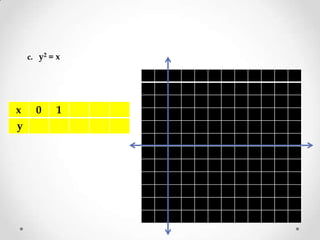
c. y2 = x

x
y

0
c. y2 = x

x
y

0

1
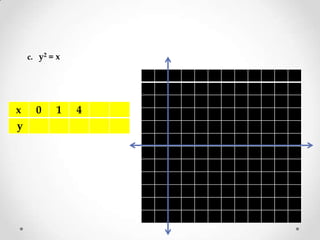
c. y2 = x

x
y

0

1

4
c. y2 = x

x
y

0

1

4

9
c. y2 = x

x
y

0
0

1

4

9

16
c. y2 = x

x
y

0
0

1
+1

4

9
c. y2 = x

x
y

0
0

1 4
+1 +2

9
c. y2 = x

x
y

0
0

1 4 9
+1 +2 +3
c. y2 = x

x
y

0
0

1 4 9
+1 +2 +3

The domain of this kind
of relation is { x x > 0 }
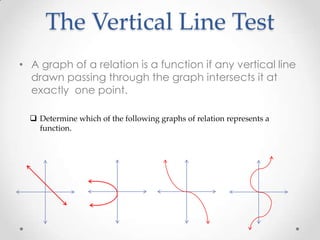
The Vertical Line Test
• A graph of a relation is a function if any vertical line
drawn passing through the graph intersects it at
exactly one point.
 Determine which of the following graphs of relation represents a
function.
• Constant Functions


A constant function C consists of a single real number k in its range for
all real numbers x in its domain.
IDENTITY
FUNCTION
I(x) = x

If the domain is specified to be the set of
all real numbers, the range of the identity
function is also the set of all real numbers
• Some points on the graph of an I(x) = x are
(-2, -2), (-1, -1), (0, 0),(1, 1), (2, 2)
POLYNOMIAL
FUNCTIONS

A constant function is a polynomial function
of the degree 0. If a polynomial function is of
the first degree, then it is called a linear
function
Polynomial Functions:
Linear Function
f (x) = mx + b

Note: f(x) = y
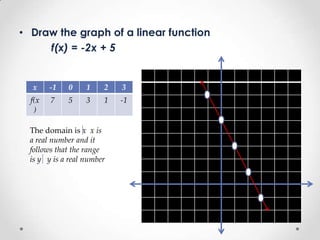
• Draw the graph of a linear function
f(x) = -2x + 5

x
f(x
)

-1

0

1

2

3
• Draw the graph of a linear function
f(x) = -2x + 5

x

-1

f(x
)

7

0

1

2

3
• Draw the graph of a linear function
f(x) = -2x + 5

x

-1

0

f(x
)

7

5

1

2

3
• Draw the graph of a linear function
f(x) = -2x + 5

x

-1

0

1

f(x
)

7

5

3

2

3
• Draw the graph of a linear function
f(x) = -2x + 5

x

-1

0

1

2

f(x
)

7

5

3

1

3
• Draw the graph of a linear function
f(x) = -2x + 5

x

-1

0

1

2

3

f(x
)

7

5

3

1

-1

The domain is x x is
a real number and it
follows that the range
is y y is a real number
If a polynomial function is of the second
degree, then it is called a quadratic
function
Polynomial Functions:
Quadratic Function
f (x) = ax2 + bx + c
• Draw the graph of the quadratic equation
g(x) = x2

x
g(x
)

-2

-1

0

1

2
• Draw the graph of the quadratic equation
g(x) = x2

x

-2

g(x
)

4

-1

0

1

2
• Draw the graph of the quadratic equation
g(x) = x2

x

-2

-1

g(x
)

4

1

0

1

2
• Draw the graph of the quadratic equation
g(x) = x2

x

-2

-1

0

g(x
)

4

1

0

1

2
• Draw the graph of the quadratic equation
g(x) = x2

x

-2

-1

0

1

g(x
)

4

1

0

1

2
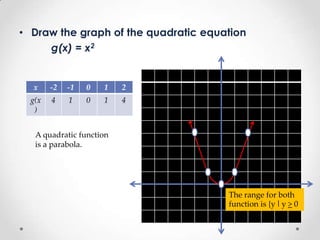
• Draw the graph of the quadratic equation
g(x) = x2

x

-2

-1

0

1

2

g(x
)

4

1

0

1

4

A quadratic function
is a parabola.

The range for both
function is {y ǀ y > 0
}
Absolute Value Functions:

f (x) = x
The domain of an absolute
value function is the set of real
numbers and the range is {f(x)
f(x) > 0 }
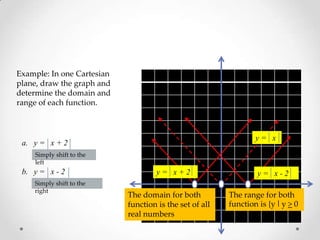
Example: In one Cartesian
plane, draw the graph and
determine the domain and
range of each function.

y= x

a. y = x + 2
Simply shift to the
left

b. y = x - 2
Simply shift to the
right

y= x+2
The domain for both
function is the set of all
real numbers

y= x-2
The range for both
function is {y ǀ y > 0
}
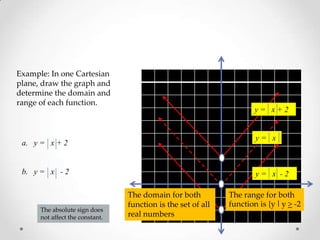
Example: In one Cartesian
plane, draw the graph and
determine the domain and
range of each function.

y= x+2

y= x

a. y = x + 2

b. y = x - 2

The absolute sign does
not affect the constant.

y= x -2
The domain for both
function is the set of all
real numbers

The range for both
function is {y ǀ y > -2
}
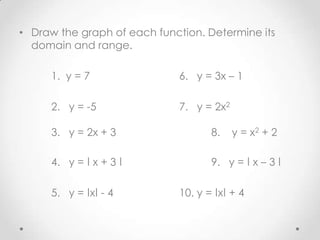
• Draw the graph of each function. Determine its
domain and range.
1. y = 7

6. y = 3x – 1

2. y = -5

7. y = 2x2

3. y = 2x + 3

8.

4. y = ǀ x + 3 ǀ

9. y = ǀ x – 3 ǀ

5. y = ǀxǀ - 4

y = x2 + 2

10. y = ǀxǀ + 4

Graph of functions

  • 1.
  • 2.
    • A relationcan be described as a graph a. A = {(-5, -5), (-3, -3), (-1, -1), (1, 1),(3, 3), (5, 5)} Since the domain is limited to the set D = {-5, -3, -1, 1, 3, 5} , points should not be connected
  • 3.
    An Equation canalso be described as a graph b. y = 2x + 1 x y -2 -1 0 1 2
  • 4.
    An Equation canalso be described as a graph b. y = 2x + 1 x y -2 -3 -1 0 1 2
  • 5.
    An Equation canalso be described as a graph b. y = 2x + 1 x y -2 -3 -1 -1 0 1 2
  • 6.
    An Equation canalso be described as a graph b. y = 2x + 1 x y -2 -3 -1 -1 0 1 1 2
  • 7.
    An Equation canalso be described as a graph b. y = 2x + 1 x y -2 -3 -1 -1 0 1 1 3 2
  • 8.
    An Equation canalso be described as a graph b. y = 2x + 1 x y -2 -3 -1 -1 0 1 1 3 2 5
  • 9.
    An Equation canalso be described as a graph b. y = 2x + 1 x y -2 -3 -1 -1 0 1 1 3 No domain is specified when a function is defined 2 5
  • 10.
    c. y2 =x x y 0
  • 11.
    c. y2 =x x y 0 1
  • 12.
    c. y2 =x x y 0 1 4
  • 13.
    c. y2 =x x y 0 1 4 9
  • 14.
    c. y2 =x x y 0 0 1 4 9 16
  • 15.
    c. y2 =x x y 0 0 1 +1 4 9
  • 16.
    c. y2 =x x y 0 0 1 4 +1 +2 9
  • 17.
    c. y2 =x x y 0 0 1 4 9 +1 +2 +3
  • 18.
    c. y2 =x x y 0 0 1 4 9 +1 +2 +3 The domain of this kind of relation is { x x > 0 }
  • 19.
    The Vertical LineTest • A graph of a relation is a function if any vertical line drawn passing through the graph intersects it at exactly one point.  Determine which of the following graphs of relation represents a function.
  • 20.
    • Constant Functions  Aconstant function C consists of a single real number k in its range for all real numbers x in its domain.
  • 21.
    IDENTITY FUNCTION I(x) = x Ifthe domain is specified to be the set of all real numbers, the range of the identity function is also the set of all real numbers
  • 22.
    • Some pointson the graph of an I(x) = x are (-2, -2), (-1, -1), (0, 0),(1, 1), (2, 2)
  • 23.
    POLYNOMIAL FUNCTIONS A constant functionis a polynomial function of the degree 0. If a polynomial function is of the first degree, then it is called a linear function
  • 24.
    Polynomial Functions: Linear Function f(x) = mx + b Note: f(x) = y
  • 25.
    • Draw thegraph of a linear function f(x) = -2x + 5 x f(x ) -1 0 1 2 3
  • 26.
    • Draw thegraph of a linear function f(x) = -2x + 5 x -1 f(x ) 7 0 1 2 3
  • 27.
    • Draw thegraph of a linear function f(x) = -2x + 5 x -1 0 f(x ) 7 5 1 2 3
  • 28.
    • Draw thegraph of a linear function f(x) = -2x + 5 x -1 0 1 f(x ) 7 5 3 2 3
  • 29.
    • Draw thegraph of a linear function f(x) = -2x + 5 x -1 0 1 2 f(x ) 7 5 3 1 3
  • 30.
    • Draw thegraph of a linear function f(x) = -2x + 5 x -1 0 1 2 3 f(x ) 7 5 3 1 -1 The domain is x x is a real number and it follows that the range is y y is a real number
  • 31.
    If a polynomialfunction is of the second degree, then it is called a quadratic function
  • 32.
  • 33.
    • Draw thegraph of the quadratic equation g(x) = x2 x g(x ) -2 -1 0 1 2
  • 34.
    • Draw thegraph of the quadratic equation g(x) = x2 x -2 g(x ) 4 -1 0 1 2
  • 35.
    • Draw thegraph of the quadratic equation g(x) = x2 x -2 -1 g(x ) 4 1 0 1 2
  • 36.
    • Draw thegraph of the quadratic equation g(x) = x2 x -2 -1 0 g(x ) 4 1 0 1 2
  • 37.
    • Draw thegraph of the quadratic equation g(x) = x2 x -2 -1 0 1 g(x ) 4 1 0 1 2
  • 38.
    • Draw thegraph of the quadratic equation g(x) = x2 x -2 -1 0 1 2 g(x ) 4 1 0 1 4 A quadratic function is a parabola. The range for both function is {y ǀ y > 0 }
  • 39.
  • 40.
    The domain ofan absolute value function is the set of real numbers and the range is {f(x) f(x) > 0 }
  • 41.
    Example: In oneCartesian plane, draw the graph and determine the domain and range of each function. y= x a. y = x + 2 Simply shift to the left b. y = x - 2 Simply shift to the right y= x+2 The domain for both function is the set of all real numbers y= x-2 The range for both function is {y ǀ y > 0 }
  • 42.
    Example: In oneCartesian plane, draw the graph and determine the domain and range of each function. y= x+2 y= x a. y = x + 2 b. y = x - 2 The absolute sign does not affect the constant. y= x -2 The domain for both function is the set of all real numbers The range for both function is {y ǀ y > -2 }
  • 43.
    • Draw thegraph of each function. Determine its domain and range. 1. y = 7 6. y = 3x – 1 2. y = -5 7. y = 2x2 3. y = 2x + 3 8. 4. y = ǀ x + 3 ǀ 9. y = ǀ x – 3 ǀ 5. y = ǀxǀ - 4 y = x2 + 2 10. y = ǀxǀ + 4