Graphs of Rational Functions
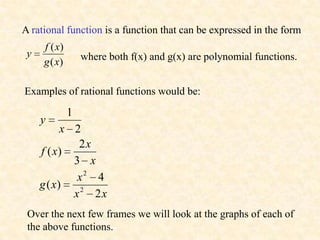
A rational function is a function that can be expressed in the form
     f ( x)
 y                where both f(x) and g(x) are polynomial functions.
     g ( x)

Examples of rational functions would be:
              1
     y
           x 2
              2x
     f ( x)
             3 x
              x2 4
     g ( x)
             x2 2x
 Over the next few frames we will look at the graphs of each of
 the above functions.
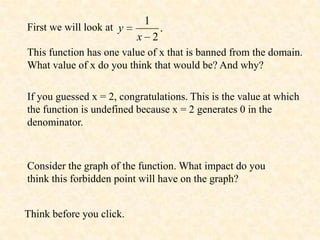
1
First we will look at y         .
                          x 2
This function has one value of x that is banned from the domain.
What value of x do you think that would be? And why?

If you guessed x = 2, congratulations. This is the value at which
the function is undefined because x = 2 generates 0 in the
denominator.


Consider the graph of the function. What impact do you
think this forbidden point will have on the graph?


Think before you click.
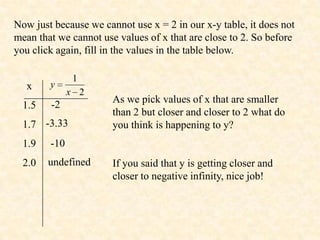
Now just because we cannot use x = 2 in our x-y table, it does not
mean that we cannot use values of x that are close to 2. So before
you click again, fill in the values in the table below.

               1
   x    y
              x 2
                       As we pick values of x that are smaller
  1.5   -2
                       than 2 but closer and closer to 2 what do
  1.7 -3.33            you think is happening to y?
  1.9   -10
  2.0   undefined      If you said that y is getting closer and
                       closer to negative infinity, nice job!
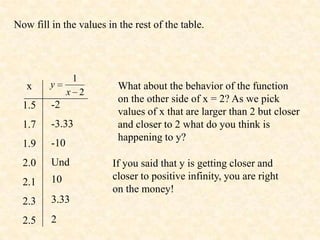
Now fill in the values in the rest of the table.


                1
   x     y                What about the behavior of the function
               x 2
                          on the other side of x = 2? As we pick
  1.5    -2
                          values of x that are larger than 2 but closer
  1.7    -3.33            and closer to 2 what do you think is
                          happening to y?
  1.9    -10
  2.0    Und            If you said that y is getting closer and
         10             closer to positive infinity, you are right
  2.1
                        on the money!
  2.3    3.33
  2.5    2
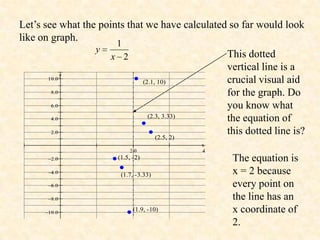
Let’s see what the points that we have calculated so far would look
like on graph.
                      1
                 y
                     x 2                              This dotted
                                                      vertical line is a
         y
                                   (2.1, 10)          crucial visual aid
                                                      for the graph. Do
                                                      you know what
                                    (2.3, 3.33)       the equation of
                                       (2.5, 2)
                                                      this dotted line is?
                                                  x

                       (1.5, -2)                       The equation is
                        (1.7, -3.33)                   x = 2 because
                                                       every point on
                                                       the line has an
                             (1.9, -10)                x coordinate of
                                                       2.
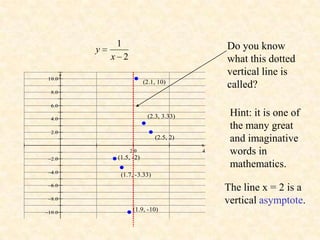
1                              Do you know
    y
        x 2                             what this dotted
y                                       vertical line is
                     (2.1, 10)
                                        called?

                      (2.3, 3.33)        Hint: it is one of
                                         the many great
                         (2.5, 2)
                                    x
                                         and imaginative
         (1.5, -2)
                                         words in
                                         mathematics.
          (1.7, -3.33)

                                        The line x = 2 is a
                                        vertical asymptote.
               (1.9, -10)
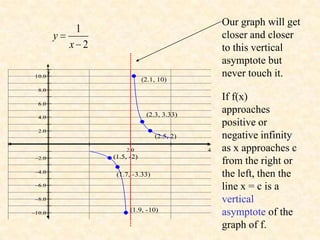
Our graph will get
         1
    y                                        closer and closer
        x 2                                  to this vertical
                                             asymptote but
y
                          (2.1, 10)
                                             never touch it.

                                             If f(x)
                           (2.3, 3.33)
                                             approaches
                                             positive or
                              (2.5, 2)       negative infinity
                                         x
                                             as x approaches c
              (1.5, -2)
                                             from the right or
               (1.7, -3.33)                  the left, then the
                                             line x = c is a
                                             vertical
                    (1.9, -10)
                                             asymptote of the
                                             graph of f.
A horizontal asymptote is a horizontal line that the graph gets
closer and closer to but never touches. The official definition of a
horizontal asymptote:
The line y = c is a horizontal asymptote for the graph of a
function f if f(x) approaches c as x approaches positive or
negative infinity.


                                           Huh?!


 Don’t you just love official definitions? At any rate,
 rational functions have a tendency to generate
 asymptotes, so lets go back to the graph and see if we can
 find a horizontal asymptote.
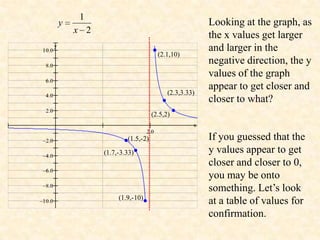
1
    y                                               Looking at the graph, as
        x 2
                                                    the x values get larger
y
                                                    and larger in the
                                   (2.1,10)
                                                    negative direction, the y
                                                    values of the graph
                                                    appear to get closer and
                                       (2.3,3.33)
                                                    closer to what?
                                 (2.5,2)
                                                x

                      (1.5,-2)                      If you guessed that the
              (1.7,-3.33)                           y values appear to get
                                                    closer and closer to 0,
                                                    you may be onto
                                                    something. Let’s look
                   (1.9,-10)
                                                    at a table of values for
                                                    confirmation.
Before you click again, take a minute to calculate the y values in
the table below. What is your conclusion about the trend?
            1
  x    y
           x 2
  0     -(1/2)
  -5    -(1/7)
 -20    -(1/22)
-100    -(1/102)

  Conclusion: as the x values get closer and closer to negative
  infinity, the y values will get closer and closer to 0.

 Question: will the same thing happen as x values get closer to
 positive infinity?
How about a guess? What do you think is going to happen to the y
values of our function as the x values get closer to positive infinity?

                      1
     As x     , y          ?
                     x 2

                      1
     As x      , y         0
                     x 2

By looking at the fraction analytically, you can hopefully see that
very large values of x will generate values of y very close to 0. If
you are uneasy about this, expand the table in the previous slide to
include values like x = 10, 100, or 1000.
On the next frame then, is our final graph for this problem
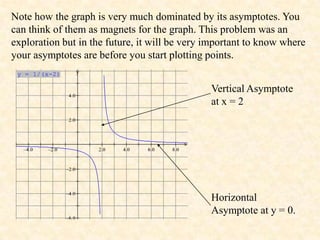
Note how the graph is very much dominated by its asymptotes. You
can think of them as magnets for the graph. This problem was an
exploration but in the future, it will be very important to know where
your asymptotes are before you start plotting points.
 y = 1/(x-2)   y


                                               Vertical Asymptote
                                               at x = 2


                                         x


                                               Horizontal
                                               Asymptote at y = 0.
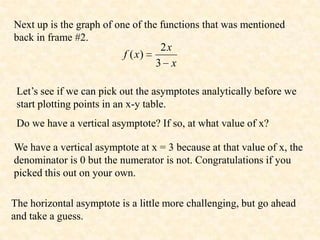
Next up is the graph of one of the functions that was mentioned
back in frame #2.
                                   2x
                          f ( x)
                                  3 x

 Let’s see if we can pick out the asymptotes analytically before we
 start plotting points in an x-y table.
 Do we have a vertical asymptote? If so, at what value of x?

We have a vertical asymptote at x = 3 because at that value of x, the
denominator is 0 but the numerator is not. Congratulations if you
picked this out on your own.

The horizontal asymptote is a little more challenging, but go ahead
and take a guess.
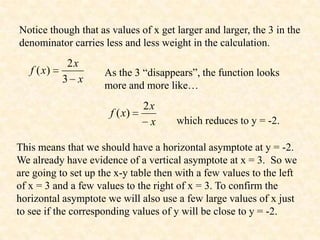
Notice though that as values of x get larger and larger, the 3 in the
denominator carries less and less weight in the calculation.
             2x
   f ( x)            As the 3 “disappears”, the function looks
            3 x
                     more and more like…
                               2x
                      f ( x)
                                x     which reduces to y = -2.

This means that we should have a horizontal asymptote at y = -2.
We already have evidence of a vertical asymptote at x = 3. So we
are going to set up the x-y table then with a few values to the left
of x = 3 and a few values to the right of x = 3. To confirm the
horizontal asymptote we will also use a few large values of x just
to see if the corresponding values of y will be close to y = -2.
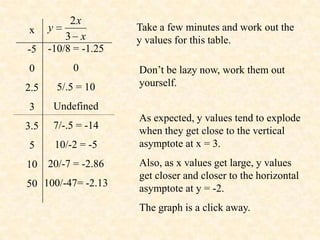
2x
x     y               Take a few minutes and work out the
          3 x         y values for this table.
-5    -10/8 = -1.25
0          0          Don’t be lazy now, work them out
2.5     5/.5 = 10     yourself.

3      Undefined
                      As expected, y values tend to explode
3.5    7/-.5 = -14    when they get close to the vertical
5      10/-2 = -5     asymptote at x = 3.
10 20/-7 = -2.86      Also, as x values get large, y values
                      get closer and closer to the horizontal
50 100/-47= -2.13     asymptote at y = -2.
                      The graph is a click away.
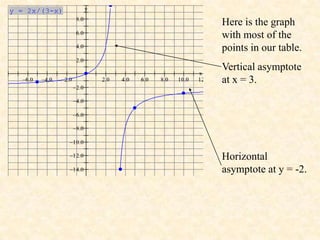
y = 2x/(3-x)   y

                       Here is the graph
                       with most of the
                       points in our table.

                   x
                       Vertical asymptote
                       at x = 3.


                       Horizontal
                       asymptote at y = -2.
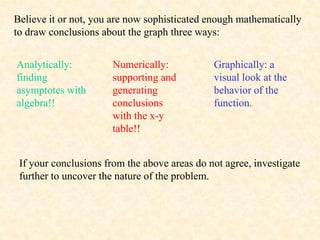
Believe it or not, you are now sophisticated enough mathematically
to draw conclusions about the graph three ways:


Analytically:         Numerically:            Graphically: a
finding               supporting and          visual look at the
asymptotes with       generating              behavior of the
algebra!!             conclusions             function.
                      with the x-y
                      table!!


 If your conclusions from the above areas do not agree, investigate
 further to uncover the nature of the problem.
We are going to finish this lesson with an analysis of the third
 function that was mentioned in the very beginning:

             2
            x 4
 g ( x)      2
                            This is a rational function so we have
           x 2x             potential for asymptotes and this is
                            what we should investigate first. Take
                            a minute to form your own opinion
                            before you continue.

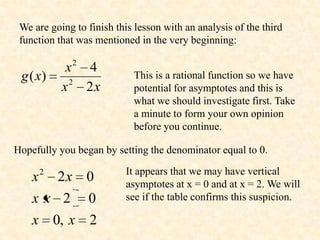
Hopefully you began by setting the denominator equal to 0.

                          It appears that we may have vertical
    x2 2x 0               asymptotes at x = 0 and at x = 2. We will
    xx 2 0                see if the table confirms this suspicion.

    x 0, x 2
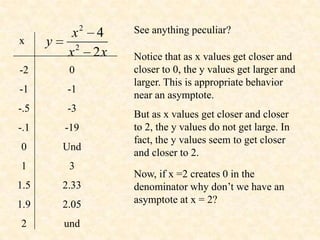
x2 4   See anything peculiar?
x     y
           x2 2x   Notice that as x values get closer and
-2         0       closer to 0, the y values get larger and
                   larger. This is appropriate behavior
-1         -1
                   near an asymptote.
-.5        -3
                   But as x values get closer and closer
-.1       -19      to 2, the y values do not get large. In
                   fact, the y values seem to get closer
0         Und
                   and closer to 2.
1          3
                   Now, if x =2 creates 0 in the
1.5       2.33     denominator why don’t we have an
1.9       2.05     asymptote at x = 2?

2         und
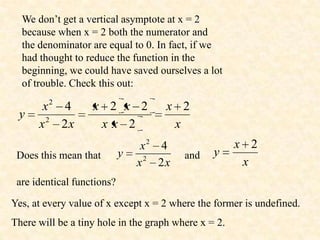
We don’t get a vertical asymptote at x = 2
  because when x = 2 both the numerator and
  the denominator are equal to 0. In fact, if we
  had thought to reduce the function in the
  beginning, we could have saved ourselves a lot
  of trouble. Check this out:

       x2 4        x 2 x 2          x 2
 y
      x2 2x         xx 2             x
                                 x2 4                 x 2
 Does this mean that        y            and    y
                                x2 2x                  x
 are identical functions?

Yes, at every value of x except x = 2 where the former is undefined.
There will be a tiny hole in the graph where x = 2.
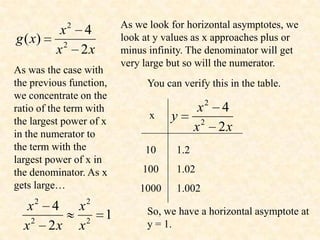
2             As we look for horizontal asymptotes, we
           x 4
g ( x)      2
                          look at y values as x approaches plus or
          x 2x            minus infinity. The denominator will get
                          very large but so will the numerator.
As was the case with
the previous function,         You can verify this in the table.
we concentrate on the
ratio of the term with                       x2 4
the largest power of x
                                x    y
in the numerator to
                                            x2 2x
the term with the              10     1.2
largest power of x in
the denominator. As x         100     1.02
gets large…                   1000    1.002
    2            2
   x 4          x              So, we have a horizontal asymptote at
    2             2
                      1
  x 2x          x              y = 1.
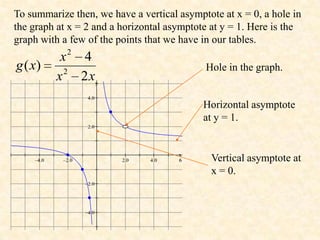
To summarize then, we have a vertical asymptote at x = 0, a hole in
the graph at x = 2 and a horizontal asymptote at y = 1. Here is the
graph with a few of the points that we have in our tables.
            2
          x 4
g ( x)     2                                Hole in the graph.
         x 2x     y


                                            Horizontal asymptote
                                            at y = 1.


                                      x
                                              Vertical asymptote at
                                              x = 0.
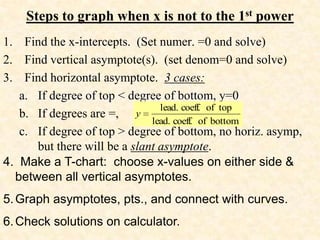
Steps to graph when x is not to the 1st power
1. Find the x-intercepts. (Set numer. =0 and solve)
2. Find vertical asymptote(s). (set denom=0 and solve)
3. Find horizontal asymptote. 3 cases:
   a. If degree of top < degree of bottom, y=0
                                lead. coeff. of top
   b. If degrees are =, y
                              lead. coeff. of bottom
   c. If degree of top > degree of bottom, no horiz. asymp,
      but there will be a slant asymptote.
4. Make a T-chart: choose x-values on either side &
  between all vertical asymptotes.
5. Graph asymptotes, pts., and connect with curves.
6. Check solutions on calculator.
Now you will get a chance to practice on exercises that use the
topics that were covered in this lesson:
Finding vertical and horizontal asymptotes in rational functions.
Graphing rational functions with asymptotes.
Good luck and watch out for those asymptotes!
Now you try!
• Pg 489 #’s 16, 18, 20, 22

Graphing rational functions

  • 1.
  • 2.
    A rational functionis a function that can be expressed in the form f ( x) y where both f(x) and g(x) are polynomial functions. g ( x) Examples of rational functions would be: 1 y x 2 2x f ( x) 3 x x2 4 g ( x) x2 2x Over the next few frames we will look at the graphs of each of the above functions.
  • 3.
    1 First we willlook at y . x 2 This function has one value of x that is banned from the domain. What value of x do you think that would be? And why? If you guessed x = 2, congratulations. This is the value at which the function is undefined because x = 2 generates 0 in the denominator. Consider the graph of the function. What impact do you think this forbidden point will have on the graph? Think before you click.
  • 4.
    Now just becausewe cannot use x = 2 in our x-y table, it does not mean that we cannot use values of x that are close to 2. So before you click again, fill in the values in the table below. 1 x y x 2 As we pick values of x that are smaller 1.5 -2 than 2 but closer and closer to 2 what do 1.7 -3.33 you think is happening to y? 1.9 -10 2.0 undefined If you said that y is getting closer and closer to negative infinity, nice job!
  • 5.
    Now fill inthe values in the rest of the table. 1 x y What about the behavior of the function x 2 on the other side of x = 2? As we pick 1.5 -2 values of x that are larger than 2 but closer 1.7 -3.33 and closer to 2 what do you think is happening to y? 1.9 -10 2.0 Und If you said that y is getting closer and 10 closer to positive infinity, you are right 2.1 on the money! 2.3 3.33 2.5 2
  • 6.
    Let’s see whatthe points that we have calculated so far would look like on graph. 1 y x 2 This dotted vertical line is a y (2.1, 10) crucial visual aid for the graph. Do you know what (2.3, 3.33) the equation of (2.5, 2) this dotted line is? x (1.5, -2) The equation is (1.7, -3.33) x = 2 because every point on the line has an (1.9, -10) x coordinate of 2.
  • 7.
    1 Do you know y x 2 what this dotted y vertical line is (2.1, 10) called? (2.3, 3.33) Hint: it is one of the many great (2.5, 2) x and imaginative (1.5, -2) words in mathematics. (1.7, -3.33) The line x = 2 is a vertical asymptote. (1.9, -10)
  • 8.
    Our graph willget 1 y closer and closer x 2 to this vertical asymptote but y (2.1, 10) never touch it. If f(x) (2.3, 3.33) approaches positive or (2.5, 2) negative infinity x as x approaches c (1.5, -2) from the right or (1.7, -3.33) the left, then the line x = c is a vertical (1.9, -10) asymptote of the graph of f.
  • 9.
    A horizontal asymptoteis a horizontal line that the graph gets closer and closer to but never touches. The official definition of a horizontal asymptote: The line y = c is a horizontal asymptote for the graph of a function f if f(x) approaches c as x approaches positive or negative infinity. Huh?! Don’t you just love official definitions? At any rate, rational functions have a tendency to generate asymptotes, so lets go back to the graph and see if we can find a horizontal asymptote.
  • 10.
    1 y Looking at the graph, as x 2 the x values get larger y and larger in the (2.1,10) negative direction, the y values of the graph appear to get closer and (2.3,3.33) closer to what? (2.5,2) x (1.5,-2) If you guessed that the (1.7,-3.33) y values appear to get closer and closer to 0, you may be onto something. Let’s look (1.9,-10) at a table of values for confirmation.
  • 11.
    Before you clickagain, take a minute to calculate the y values in the table below. What is your conclusion about the trend? 1 x y x 2 0 -(1/2) -5 -(1/7) -20 -(1/22) -100 -(1/102) Conclusion: as the x values get closer and closer to negative infinity, the y values will get closer and closer to 0. Question: will the same thing happen as x values get closer to positive infinity?
  • 12.
    How about aguess? What do you think is going to happen to the y values of our function as the x values get closer to positive infinity? 1 As x , y ? x 2 1 As x , y 0 x 2 By looking at the fraction analytically, you can hopefully see that very large values of x will generate values of y very close to 0. If you are uneasy about this, expand the table in the previous slide to include values like x = 10, 100, or 1000. On the next frame then, is our final graph for this problem
  • 13.
    Note how thegraph is very much dominated by its asymptotes. You can think of them as magnets for the graph. This problem was an exploration but in the future, it will be very important to know where your asymptotes are before you start plotting points. y = 1/(x-2) y Vertical Asymptote at x = 2 x Horizontal Asymptote at y = 0.
  • 14.
    Next up isthe graph of one of the functions that was mentioned back in frame #2. 2x f ( x) 3 x Let’s see if we can pick out the asymptotes analytically before we start plotting points in an x-y table. Do we have a vertical asymptote? If so, at what value of x? We have a vertical asymptote at x = 3 because at that value of x, the denominator is 0 but the numerator is not. Congratulations if you picked this out on your own. The horizontal asymptote is a little more challenging, but go ahead and take a guess.
  • 15.
    Notice though thatas values of x get larger and larger, the 3 in the denominator carries less and less weight in the calculation. 2x f ( x) As the 3 “disappears”, the function looks 3 x more and more like… 2x f ( x) x which reduces to y = -2. This means that we should have a horizontal asymptote at y = -2. We already have evidence of a vertical asymptote at x = 3. So we are going to set up the x-y table then with a few values to the left of x = 3 and a few values to the right of x = 3. To confirm the horizontal asymptote we will also use a few large values of x just to see if the corresponding values of y will be close to y = -2.
  • 16.
    2x x y Take a few minutes and work out the 3 x y values for this table. -5 -10/8 = -1.25 0 0 Don’t be lazy now, work them out 2.5 5/.5 = 10 yourself. 3 Undefined As expected, y values tend to explode 3.5 7/-.5 = -14 when they get close to the vertical 5 10/-2 = -5 asymptote at x = 3. 10 20/-7 = -2.86 Also, as x values get large, y values get closer and closer to the horizontal 50 100/-47= -2.13 asymptote at y = -2. The graph is a click away.
  • 17.
    y = 2x/(3-x) y Here is the graph with most of the points in our table. x Vertical asymptote at x = 3. Horizontal asymptote at y = -2.
  • 18.
    Believe it ornot, you are now sophisticated enough mathematically to draw conclusions about the graph three ways: Analytically: Numerically: Graphically: a finding supporting and visual look at the asymptotes with generating behavior of the algebra!! conclusions function. with the x-y table!! If your conclusions from the above areas do not agree, investigate further to uncover the nature of the problem.
  • 19.
    We are goingto finish this lesson with an analysis of the third function that was mentioned in the very beginning: 2 x 4 g ( x) 2 This is a rational function so we have x 2x potential for asymptotes and this is what we should investigate first. Take a minute to form your own opinion before you continue. Hopefully you began by setting the denominator equal to 0. It appears that we may have vertical x2 2x 0 asymptotes at x = 0 and at x = 2. We will xx 2 0 see if the table confirms this suspicion. x 0, x 2
  • 20.
    x2 4 See anything peculiar? x y x2 2x Notice that as x values get closer and -2 0 closer to 0, the y values get larger and larger. This is appropriate behavior -1 -1 near an asymptote. -.5 -3 But as x values get closer and closer -.1 -19 to 2, the y values do not get large. In fact, the y values seem to get closer 0 Und and closer to 2. 1 3 Now, if x =2 creates 0 in the 1.5 2.33 denominator why don’t we have an 1.9 2.05 asymptote at x = 2? 2 und
  • 21.
    We don’t geta vertical asymptote at x = 2 because when x = 2 both the numerator and the denominator are equal to 0. In fact, if we had thought to reduce the function in the beginning, we could have saved ourselves a lot of trouble. Check this out: x2 4 x 2 x 2 x 2 y x2 2x xx 2 x x2 4 x 2 Does this mean that y and y x2 2x x are identical functions? Yes, at every value of x except x = 2 where the former is undefined. There will be a tiny hole in the graph where x = 2.
  • 22.
    2 As we look for horizontal asymptotes, we x 4 g ( x) 2 look at y values as x approaches plus or x 2x minus infinity. The denominator will get very large but so will the numerator. As was the case with the previous function, You can verify this in the table. we concentrate on the ratio of the term with x2 4 the largest power of x x y in the numerator to x2 2x the term with the 10 1.2 largest power of x in the denominator. As x 100 1.02 gets large… 1000 1.002 2 2 x 4 x So, we have a horizontal asymptote at 2 2 1 x 2x x y = 1.
  • 23.
    To summarize then,we have a vertical asymptote at x = 0, a hole in the graph at x = 2 and a horizontal asymptote at y = 1. Here is the graph with a few of the points that we have in our tables. 2 x 4 g ( x) 2 Hole in the graph. x 2x y Horizontal asymptote at y = 1. x Vertical asymptote at x = 0.
  • 24.
    Steps to graphwhen x is not to the 1st power 1. Find the x-intercepts. (Set numer. =0 and solve) 2. Find vertical asymptote(s). (set denom=0 and solve) 3. Find horizontal asymptote. 3 cases: a. If degree of top < degree of bottom, y=0 lead. coeff. of top b. If degrees are =, y lead. coeff. of bottom c. If degree of top > degree of bottom, no horiz. asymp, but there will be a slant asymptote. 4. Make a T-chart: choose x-values on either side & between all vertical asymptotes. 5. Graph asymptotes, pts., and connect with curves. 6. Check solutions on calculator.
  • 25.
    Now you willget a chance to practice on exercises that use the topics that were covered in this lesson: Finding vertical and horizontal asymptotes in rational functions. Graphing rational functions with asymptotes. Good luck and watch out for those asymptotes!
  • 26.
    Now you try! •Pg 489 #’s 16, 18, 20, 22