Presented By: M.Darwesh khosa
Faisal Munir Sahoo
Noman Hafeez Khosa
BS.Microbiology (7th Semester)
Dated: 15-10-2015
Marek’s Disease
 Marek’s disease is characteristically a
disease of young chickens, but older
birds can also be affected.
 It’s name after Jozsed Marek.
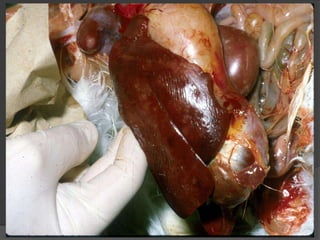
 Frequently there at tumors in the lymph
nodes, skeletal muscle, visceral organs.
Marek’s Disease
 Commonly affected organs
 Ovary
 Spleen
 Liver
 Kidneys
 Lungs
 Heart
 Tumors can cause organ failure and kill
the bird.
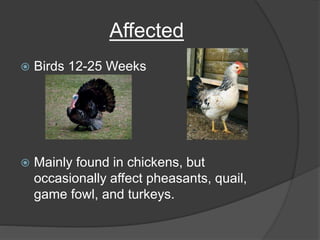
Affected
 Birds 12-25 Weeks
 Mainly found in chickens, but
occasionally affect pheasants, quail,
game fowl, and turkeys.
Causes
 Marek’s disease is caused by a virus
belonging to the herpes virus group.
 It appears that the virus is concentrated
in the feather follicles and shed in the
dander.
 The virus can survival months in dander
from birds.
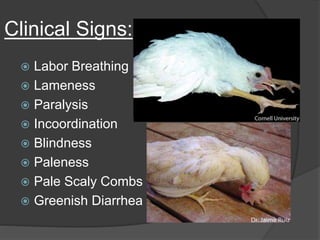
Clinical Signs:
 Labor Breathing
 Lameness
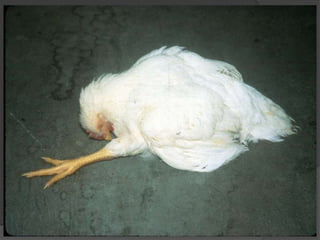
 Paralysis
 Incoordination
 Blindness
 Paleness
 Pale Scaly Combs
 Greenish Diarrhea
Diagnosis
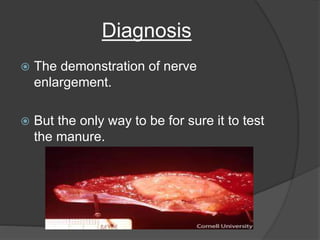
 The demonstration of nerve
enlargement.
 But the only way to be for sure it to test
the manure.
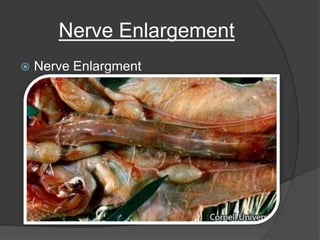
Nerve Enlargement
 Nerve Enlargment
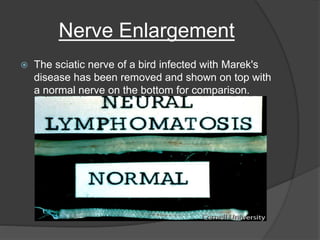
Nerve Enlargement
 The sciatic nerve of a bird infected with Marek's
disease has been removed and shown on top with
a normal nerve on the bottom for comparison.
Transmission
 Spread by airborne infection involving follicle cells
called chicken dander.
 Transmission of the virus is horizontal.
 At room temperature the virus of Marek's disease
remains viable for 16 weeks and in litter for 6 weeks.
 More susceptibility of infection during the first few
weeks of life.
 Infected birds will start to shed the virus in the
second or third week after infection.
 And will continue to do so throughout their life,
although they do develop antibodies against the
virus.
Treatment/Prevention
 No treatment has been found yet.
 Marek’s can be vaccinated for within 3
days of birth.
 Vaccination prevent tumors, but doesn’t
prevent the virus.
 Also keep facilities clean and don’t bring
in foreign birds, and don’t visit other
chicken farms.
Control
 Marek’s Disease is highly contagious. If
you have suspicion that a bird has it,
isolate it quick.
 If the birds get it, and don’t die, they will
be carriers for life and will infect any new
birds that are introduced.
Types of Marek’s Disease
 Peracute in 3–5 weeks old chicks; manifested with sudden
death
 Anaemia in 3–6 weeks old chicken
 Classical Marek's disease (range paralysis) showing paralysis
of two wings and legs due to peripheral nerve involvement. The
nerves are 2–3 times their normal size. Central nerve
involvement may also occur.
 Acute Marek's disease occurs mainly in 6–12 weeks old birds. It
is manifested with tumours in the liver, spleen, kidneys, brain,
spinal cord and dorsal root ganglia and with sudden death. The
heart, lungs, gonads and muscles may also be involved.
 Skin leucosis. Noted in broiler chicken on postmortem
examination in abattoirs as enlargement of feather follicles and
associated lymphoid infiltrations (Fig. 199).
 Transient paralysis in 12–18 weeks old pullets become
paralysed and may recover with 24 hours if moved to a quiet
place.
The End!
Hope You
Learn
Something!!!!!

Marek's disease in poultry

  • 1.
    Presented By: M.Darweshkhosa Faisal Munir Sahoo Noman Hafeez Khosa BS.Microbiology (7th Semester) Dated: 15-10-2015
  • 3.
    Marek’s Disease  Marek’sdisease is characteristically a disease of young chickens, but older birds can also be affected.  It’s name after Jozsed Marek.  Frequently there at tumors in the lymph nodes, skeletal muscle, visceral organs.
  • 5.
    Marek’s Disease  Commonlyaffected organs  Ovary  Spleen  Liver  Kidneys  Lungs  Heart  Tumors can cause organ failure and kill the bird.
  • 6.
    Affected  Birds 12-25Weeks  Mainly found in chickens, but occasionally affect pheasants, quail, game fowl, and turkeys.
  • 7.
    Causes  Marek’s diseaseis caused by a virus belonging to the herpes virus group.  It appears that the virus is concentrated in the feather follicles and shed in the dander.  The virus can survival months in dander from birds.
  • 8.
    Clinical Signs:  LaborBreathing  Lameness  Paralysis  Incoordination  Blindness  Paleness  Pale Scaly Combs  Greenish Diarrhea
  • 9.
    Diagnosis  The demonstrationof nerve enlargement.  But the only way to be for sure it to test the manure.
  • 10.
  • 11.
    Nerve Enlargement  Thesciatic nerve of a bird infected with Marek's disease has been removed and shown on top with a normal nerve on the bottom for comparison.
  • 12.
    Transmission  Spread byairborne infection involving follicle cells called chicken dander.  Transmission of the virus is horizontal.  At room temperature the virus of Marek's disease remains viable for 16 weeks and in litter for 6 weeks.  More susceptibility of infection during the first few weeks of life.  Infected birds will start to shed the virus in the second or third week after infection.  And will continue to do so throughout their life, although they do develop antibodies against the virus.
  • 13.
    Treatment/Prevention  No treatmenthas been found yet.  Marek’s can be vaccinated for within 3 days of birth.  Vaccination prevent tumors, but doesn’t prevent the virus.  Also keep facilities clean and don’t bring in foreign birds, and don’t visit other chicken farms.
  • 14.
    Control  Marek’s Diseaseis highly contagious. If you have suspicion that a bird has it, isolate it quick.  If the birds get it, and don’t die, they will be carriers for life and will infect any new birds that are introduced.
  • 15.
    Types of Marek’sDisease  Peracute in 3–5 weeks old chicks; manifested with sudden death  Anaemia in 3–6 weeks old chicken  Classical Marek's disease (range paralysis) showing paralysis of two wings and legs due to peripheral nerve involvement. The nerves are 2–3 times their normal size. Central nerve involvement may also occur.  Acute Marek's disease occurs mainly in 6–12 weeks old birds. It is manifested with tumours in the liver, spleen, kidneys, brain, spinal cord and dorsal root ganglia and with sudden death. The heart, lungs, gonads and muscles may also be involved.  Skin leucosis. Noted in broiler chicken on postmortem examination in abattoirs as enlargement of feather follicles and associated lymphoid infiltrations (Fig. 199).  Transient paralysis in 12–18 weeks old pullets become paralysed and may recover with 24 hours if moved to a quiet place.
  • 16.