

TRIPLETRIPLE
SUGAR IRONSUGAR IRON
AGARAGAR
PREPARED. BYPREPARED. BY::
GHASSANGHASSAN
ABU HAJJAJABU HAJJAJ..
SUPERVISORSUPERVISOR::
DR. Abdelraouf A. ElmanamaDR. Abdelraouf A. Elmanama
INTRODUCTION:
Triple sugar iron agar (TSI) is a
differential medium that contains
lactose, sucrose, a small amount of
glucose (dextrose), ferrous sulfate,
and the pH indicator phenol red. It
is used to differentiate enterics
based on the ability to reduce
sulfur and ferment carbohydrates.
THE TEST:
As with the phenol red fermentation
broths, if an organism can ferment
any of the three sugars present in the
medium, the medium will turn yellow.
If an organism can only ferment
dextrose, the small amount of
dextrose in the medium is used by the
organism within the first ten hours of
incubation..
After that time, the reaction that
produced acid reverts in the aerobic
areas of the slant, and the medium in
those areas turns red, indicating
alkaline conditions. The anaerobic
areas of the slant, such as the butt, will
not revert to an alkaline state, and they
will remain yellow. This happens with
Salmonella and Shigella.
NOTE:
SIM medium should be read after an
incubation of only 24 hours because a
longer incubation time can cause a
false negative. Vigorous fermenters
such as Escherichia coli and
Entrobacter cloacae will ferment all the
available sugars and then begin using
the amino acids. This will produce
amine groups and cause the medium to
turn alkaline.
If an organism can reduce sulfur, the
hydrogen sulfide gas which is produced
will react with the iron to form iron
sulfide, which appears as a black
precipitate. If the precipitate is formed, it
can mask any acid/alkaline results.
Sulfur reduction requires an acidic
environment, so if the black precipitate
is present, some fermentation took
place.
If the butt of the slant is obscured by the
precipitate, look at the top of the slant to
determine if the organism could ferment
only dextrose (red), or if it could ferment
either lactose and/or sucrose (yellow).
If the fermentation produced gas, you
may see fissures in the medium, or the
entire slant may be raised above the
bottom of the test tube.
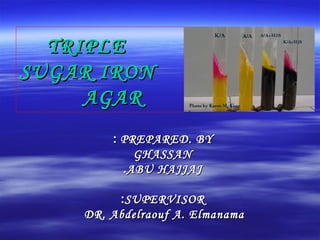
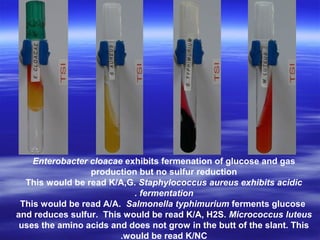
Enterobacter cloacae exhibits fermenation of glucose and gas
production but no sulfur reduction
This would be read K/A,G. Staphylococcus aureus exhibits acidic
fermentation.
This would be read A/A. Salmonella typhimurium ferments glucose
and reduces sulfur. This would be read K/A, H2S. Micrococcus luteus
uses the amino acids and does not grow in the butt of the slant. This
would be read K/NC.
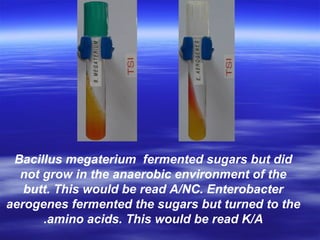
Bacillus megaterium fermented sugars but did
not grow in the anaerobic environment of the
butt. This would be read A/NC. Enterobacter
aerogenes fermented the sugars but turned to the
amino acids. This would be read K/A.
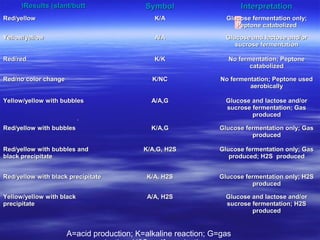
Results (slant/buttResults (slant/butt(( SymbolSymbol InterpretationInterpretation
Red/yellowRed/yellow K/AK/A Glucose fermentation only;Glucose fermentation only;
Peptone catabolizedPeptone catabolized
Yellow/yellowYellow/yellow A/AA/A Glucose and lactose and/orGlucose and lactose and/or
sucrose fermentationsucrose fermentation
Red/redRed/red K/KK/K No fermentation; PeptoneNo fermentation; Peptone
catabolizedcatabolized
Red/no color changeRed/no color change K/NCK/NC No fermentation; Peptone usedNo fermentation; Peptone used
aerobicallyaerobically
Yellow/yellow with bubblesYellow/yellow with bubbles A/A,GA/A,G Glucose and lactose and/orGlucose and lactose and/or
sucrose fermentation; Gassucrose fermentation; Gas
producedproduced
Red/yellow with bubblesRed/yellow with bubbles K/A,GK/A,G Glucose fermentation only; GasGlucose fermentation only; Gas
producedproduced
Red/yellow with bubbles andRed/yellow with bubbles and
black precipitateblack precipitate
K/A,G, H2SK/A,G, H2S Glucose fermentation only; GasGlucose fermentation only; Gas
produced; H2S producedproduced; H2S produced
Red/yellow with black precipitateRed/yellow with black precipitate K/A, H2SK/A, H2S Glucose fermentation only; H2SGlucose fermentation only; H2S
producedproduced
Yellow/yellow with blackYellow/yellow with black
precipitateprecipitate
A/A, H2SA/A, H2S Glucose and lactose and/orGlucose and lactose and/or
sucrose fermentation; H2Ssucrose fermentation; H2S
producedproduced
A=acid production; K=alkaline reaction; G=gas
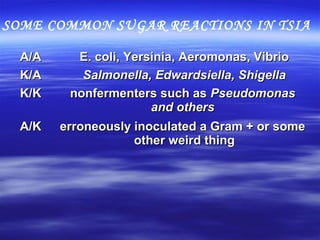
A/AA/A E. coli, Yersinia, Aeromonas, VibrioE. coli, Yersinia, Aeromonas, Vibrio
K/AK/A Salmonella, Edwardsiella, ShigellaSalmonella, Edwardsiella, Shigella
K/KK/K nonfermenters such asnonfermenters such as PseudomonasPseudomonas
and othersand others
A/KA/K erroneously inoculated a Gram + or someerroneously inoculated a Gram + or some
other weird thingother weird thing
SOME COMMON SUGAR REACTIONS IN TSIA
Triple sugar iron_agar

Triple sugar iron_agar

  • 1.
    TRIPLETRIPLE SUGAR IRONSUGAR IRON AGARAGAR PREPARED.BYPREPARED. BY:: GHASSANGHASSAN ABU HAJJAJABU HAJJAJ.. SUPERVISORSUPERVISOR:: DR. Abdelraouf A. ElmanamaDR. Abdelraouf A. Elmanama
  • 2.
    INTRODUCTION: Triple sugar ironagar (TSI) is a differential medium that contains lactose, sucrose, a small amount of glucose (dextrose), ferrous sulfate, and the pH indicator phenol red. It is used to differentiate enterics based on the ability to reduce sulfur and ferment carbohydrates.
  • 3.
    THE TEST: As withthe phenol red fermentation broths, if an organism can ferment any of the three sugars present in the medium, the medium will turn yellow. If an organism can only ferment dextrose, the small amount of dextrose in the medium is used by the organism within the first ten hours of incubation..
  • 4.
    After that time,the reaction that produced acid reverts in the aerobic areas of the slant, and the medium in those areas turns red, indicating alkaline conditions. The anaerobic areas of the slant, such as the butt, will not revert to an alkaline state, and they will remain yellow. This happens with Salmonella and Shigella.
  • 5.
    NOTE: SIM medium shouldbe read after an incubation of only 24 hours because a longer incubation time can cause a false negative. Vigorous fermenters such as Escherichia coli and Entrobacter cloacae will ferment all the available sugars and then begin using the amino acids. This will produce amine groups and cause the medium to turn alkaline.
  • 6.
    If an organismcan reduce sulfur, the hydrogen sulfide gas which is produced will react with the iron to form iron sulfide, which appears as a black precipitate. If the precipitate is formed, it can mask any acid/alkaline results. Sulfur reduction requires an acidic environment, so if the black precipitate is present, some fermentation took place.
  • 7.
    If the buttof the slant is obscured by the precipitate, look at the top of the slant to determine if the organism could ferment only dextrose (red), or if it could ferment either lactose and/or sucrose (yellow). If the fermentation produced gas, you may see fissures in the medium, or the entire slant may be raised above the bottom of the test tube.
  • 8.
    Enterobacter cloacae exhibitsfermenation of glucose and gas production but no sulfur reduction This would be read K/A,G. Staphylococcus aureus exhibits acidic fermentation. This would be read A/A. Salmonella typhimurium ferments glucose and reduces sulfur. This would be read K/A, H2S. Micrococcus luteus uses the amino acids and does not grow in the butt of the slant. This would be read K/NC.
  • 9.
    Bacillus megaterium fermentedsugars but did not grow in the anaerobic environment of the butt. This would be read A/NC. Enterobacter aerogenes fermented the sugars but turned to the amino acids. This would be read K/A.
  • 10.
    Results (slant/buttResults (slant/butt((SymbolSymbol InterpretationInterpretation Red/yellowRed/yellow K/AK/A Glucose fermentation only;Glucose fermentation only; Peptone catabolizedPeptone catabolized Yellow/yellowYellow/yellow A/AA/A Glucose and lactose and/orGlucose and lactose and/or sucrose fermentationsucrose fermentation Red/redRed/red K/KK/K No fermentation; PeptoneNo fermentation; Peptone catabolizedcatabolized Red/no color changeRed/no color change K/NCK/NC No fermentation; Peptone usedNo fermentation; Peptone used aerobicallyaerobically Yellow/yellow with bubblesYellow/yellow with bubbles A/A,GA/A,G Glucose and lactose and/orGlucose and lactose and/or sucrose fermentation; Gassucrose fermentation; Gas producedproduced Red/yellow with bubblesRed/yellow with bubbles K/A,GK/A,G Glucose fermentation only; GasGlucose fermentation only; Gas producedproduced Red/yellow with bubbles andRed/yellow with bubbles and black precipitateblack precipitate K/A,G, H2SK/A,G, H2S Glucose fermentation only; GasGlucose fermentation only; Gas produced; H2S producedproduced; H2S produced Red/yellow with black precipitateRed/yellow with black precipitate K/A, H2SK/A, H2S Glucose fermentation only; H2SGlucose fermentation only; H2S producedproduced Yellow/yellow with blackYellow/yellow with black precipitateprecipitate A/A, H2SA/A, H2S Glucose and lactose and/orGlucose and lactose and/or sucrose fermentation; H2Ssucrose fermentation; H2S producedproduced A=acid production; K=alkaline reaction; G=gas
  • 11.
    A/AA/A E. coli,Yersinia, Aeromonas, VibrioE. coli, Yersinia, Aeromonas, Vibrio K/AK/A Salmonella, Edwardsiella, ShigellaSalmonella, Edwardsiella, Shigella K/KK/K nonfermenters such asnonfermenters such as PseudomonasPseudomonas and othersand others A/KA/K erroneously inoculated a Gram + or someerroneously inoculated a Gram + or some other weird thingother weird thing SOME COMMON SUGAR REACTIONS IN TSIA