Dr Sohil Takodara
Ketogenesis and
Ketolysis
Ketone bodies and their biological significance
Ketogenesis and its regulation
Utilization of ketone bodies
Disorders associated with ketone bodies
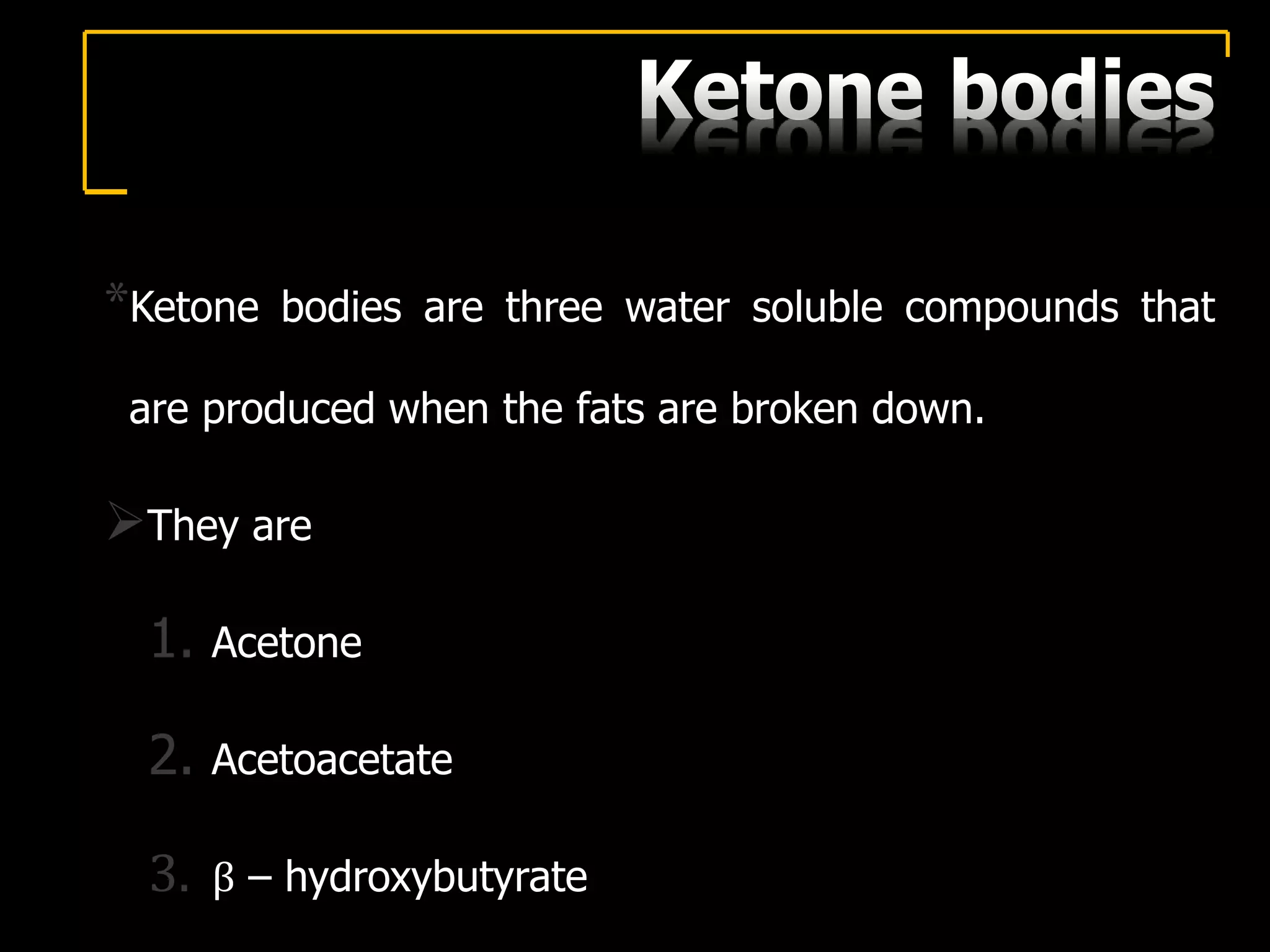
*Ketone bodies are three water soluble compounds that
are produced when the fats are broken down.
They are
1. Acetone
2. Acetoacetate
3. β – hydroxybutyrate
*Ketone bodies are transported from the liver to other
tissues, where oxaloacetate and β – hydroxybutyrate can
be reconverted into acetyl CoA to produce energy
*They are water soluble compounds
*They can be transported across inner mitochondrial
membrane
*As well as they can cross the blood brain barrier
*Act as a source of energy for brain, heart and muscles
*Major source of energy for brain during starvation – 75%
Site – Liver mitochondria
Occur only in liver because HMG-CoA lyase is
present only in liver
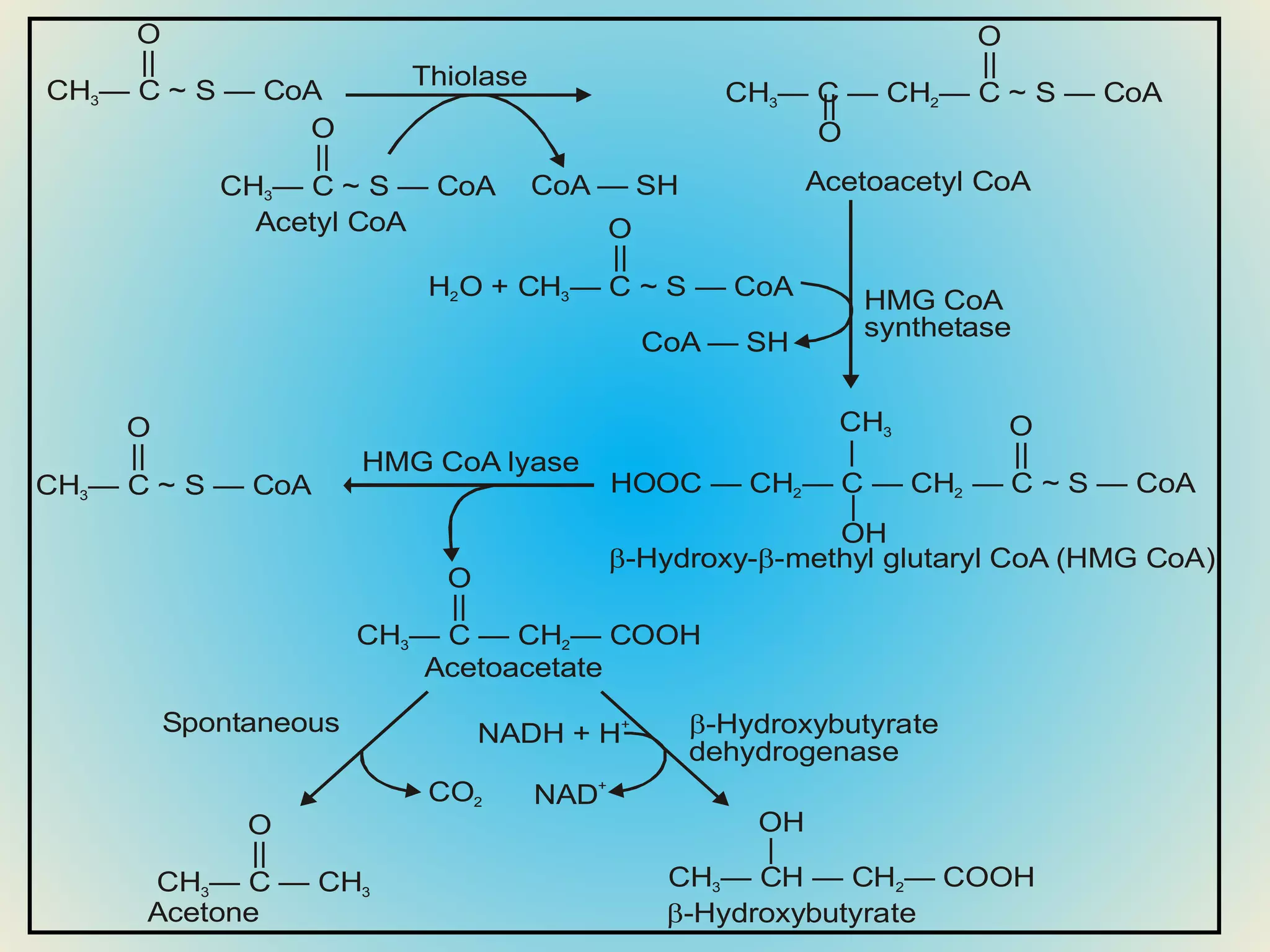
CH — C ~ S — CoA3 CH — C — CH — C ~ S — CoA3 2
CoA — SH
O
||
CH — C ~ S — CoA3
O
||
Thiolase
O
||
O
||
Acetyl CoA
Acetoacetyl CoA
HMG CoA
synthetase
H O + CH — C ~ S — CoA2 3
O
||
CoA — SH
CH — C ~ S — CoA3
O
||
HMG CoA lyase
HOOC — CH — C — CH — C ~ S — CoA2 2
O
||
CH
|
3
|
OH
 -Hydroxy- -methyl glutaryl CoA (HMG CoA)
CH — C — CH — COOH3 2
Acetoacetate
Spontaneous -Hydroxybutyrate
dehydrogenase
Acetone
NADH + H+
NAD
+
CO2
CH — C — CH3 3
OH
|
CH — CH — CH — COOH3 2
-Hydroxybutyrate
O
||
O
||
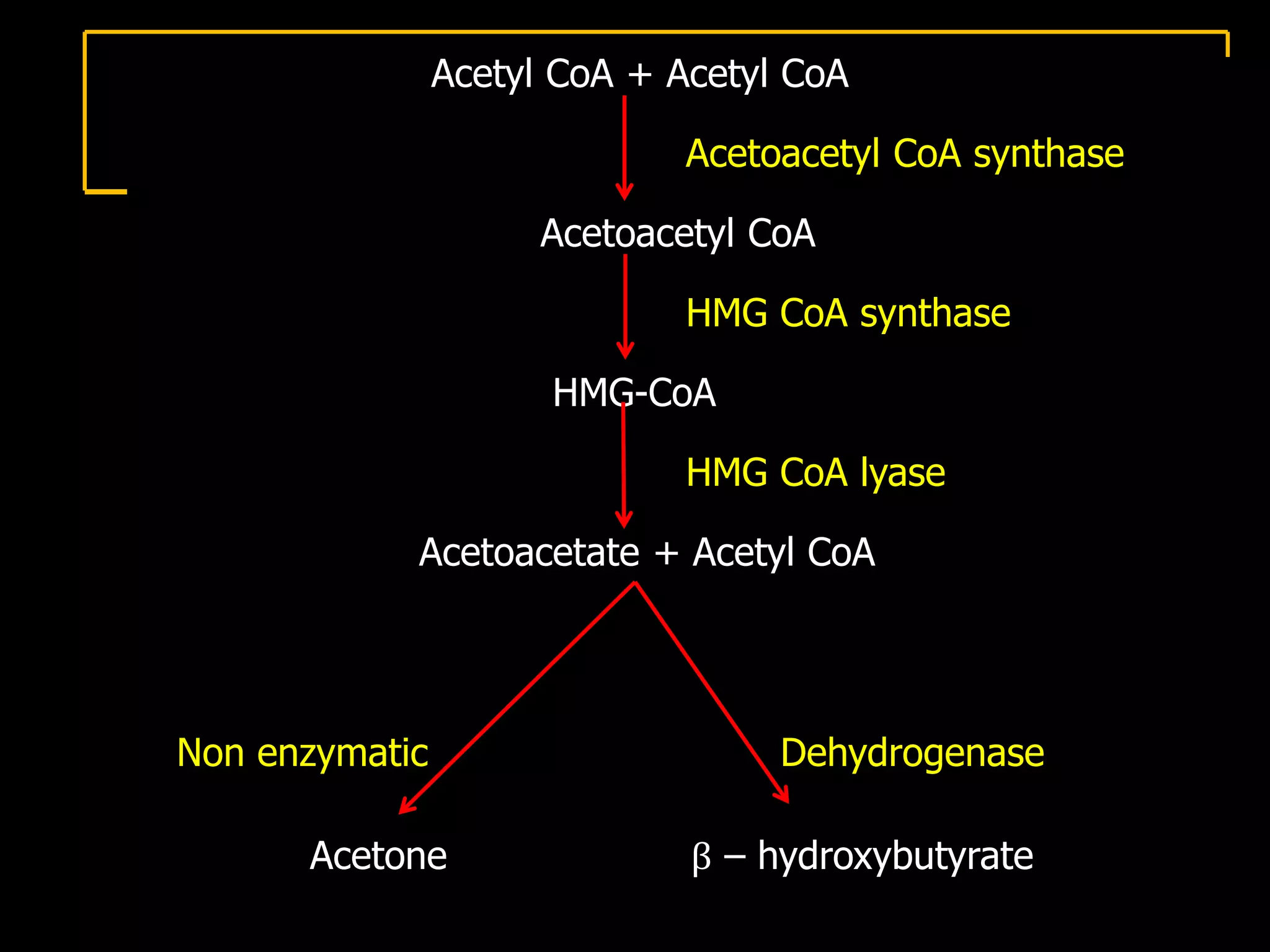
Acetyl CoA + Acetyl CoA
Acetoacetyl CoA synthase
Acetoacetyl CoA
HMG CoA synthase
HMG-CoA
HMG CoA lyase
Acetoacetate + Acetyl CoA
Non enzymatic Dehydrogenase
Acetone β – hydroxybutyrate
Acetoacetate is the primary ketone body
Acetone and β – hydroxybutyrate are the secondary ketone
bodies
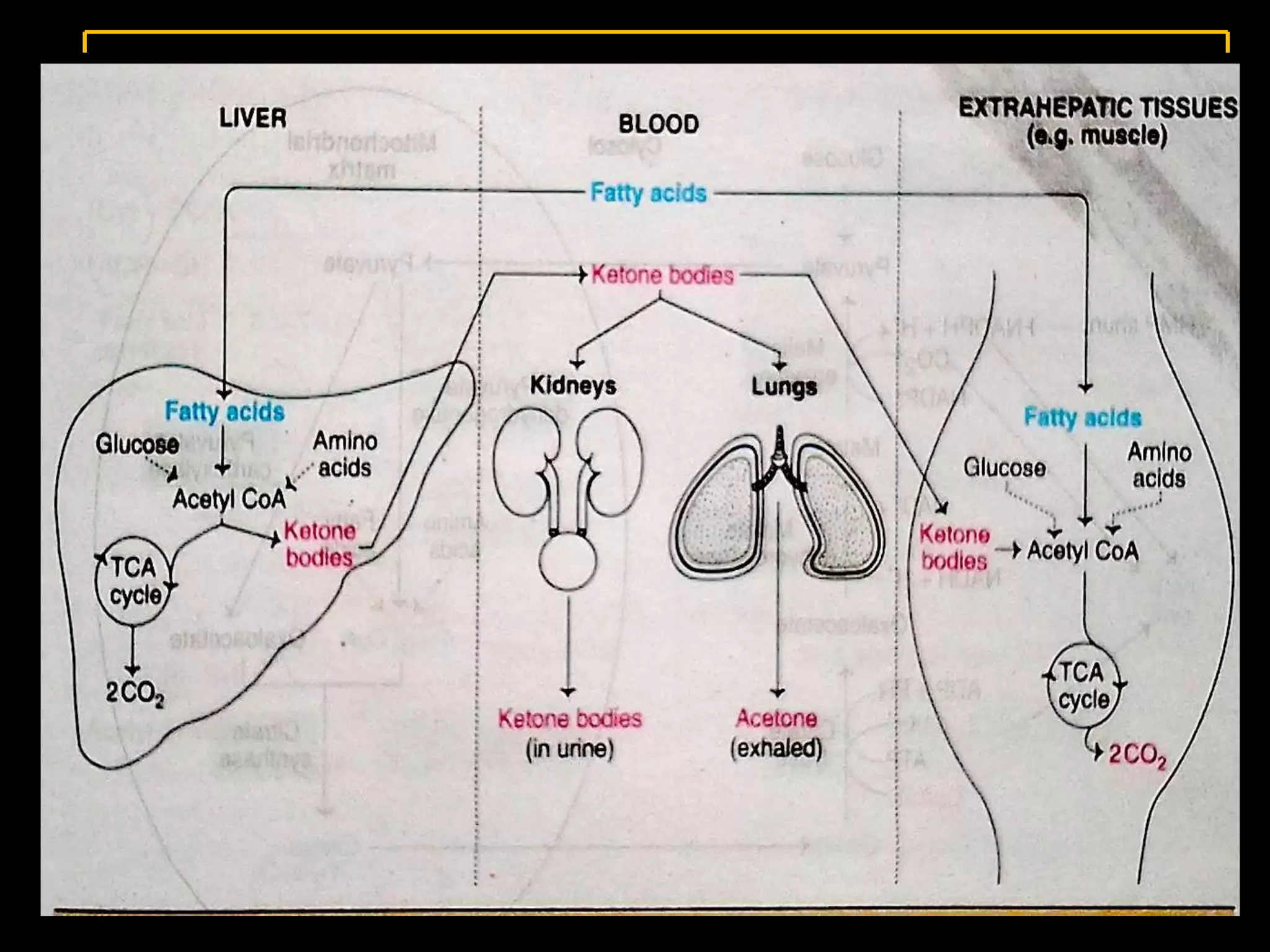
Liver BLOOD Extrahepatic tissue
Acetyl CoA
Ketone bodies
FFA
Ketone bodies
Acetone Ketone
in lungs in urine
Acetyl CoA
Ketone bodies
Citric acid cycle
CO2
Occur in extrahepatic tissues
Not in liver – Because the enzyme thiophorase is
absent in liver
*The formation of ketone bodies take place in liver mitochondria
but the enzymes for its utilization are not present in the liver.
*Therefore, ketone bodies are released into circulation,
and are taken up by tissues possessing the enzymatic
machinery for their utilisation.
*The first step is the activation of ketone bodies to acetoacetyl
CoA.
* β-Hydroxybutyrate is converted into acetoacetate which reacts
with succinyl CoA to form succinate and acetoacetyl CoA
* Acetoacetyl CoA is converted into two molecules of acetyl CoA
which are oxidised in the citric acid cycle
*β-Hydroxybutyrate is converted to acetoacetate for energy.
*For oxidation of acetoacetate, it has to be activated to
Acetoacetyl CoA by “ Succinyl CoA acetoacetate CoA
transferase” or Thiophorase.
*This is absent in liver.
*Ketone bodies in plasma : 0.2 mmol/L
*In starvation : 3-5 mmol/L
*Diabetic Ketoacidosis : >12mmol/L
*Ketone bodies in urine : <1 mg/L
Ketosis
*Accumlation of ketone bodies in body due to increases
synthesis than utilization - Ketonemia
*Also they are excreted in urine – Ketonuria
*With acetone in breath
*Due to untreated hyperglycemia
*Is due to deficiency of Insulin
*So more and more breakdown of fats
*More fatty acids in the blood
*Oxidation of these fatty acids increases the acetyl CoA pool.
*Oxidation of acetyl-CoA by TCA cycle is reduced as the availability of
oxaloacetate is reduced.
*Supply of glucose to body is decreased.
*Oxaloacetate is directed to gluconeogenesis
*Lipolysis also takes place
*Excess acetyl CoA is converted to ketone bodies.
*Due to elevated levels of circulating hCG in the blood in first
trimester of pregnancy
*Causes vomiting (Morning sickness)
*Blood glucose level decreases
*Ketone bodies come as a source of fuel to body.
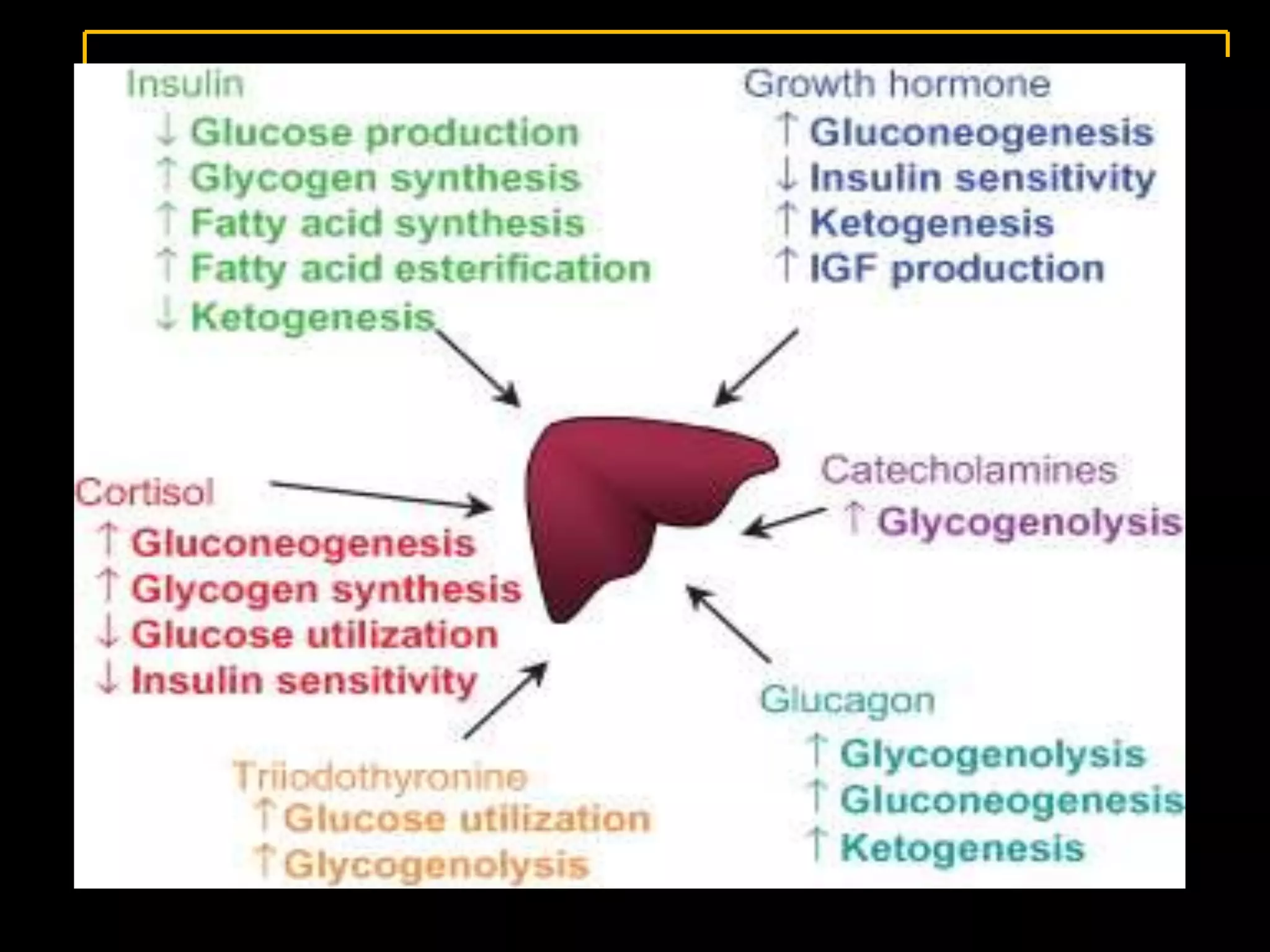
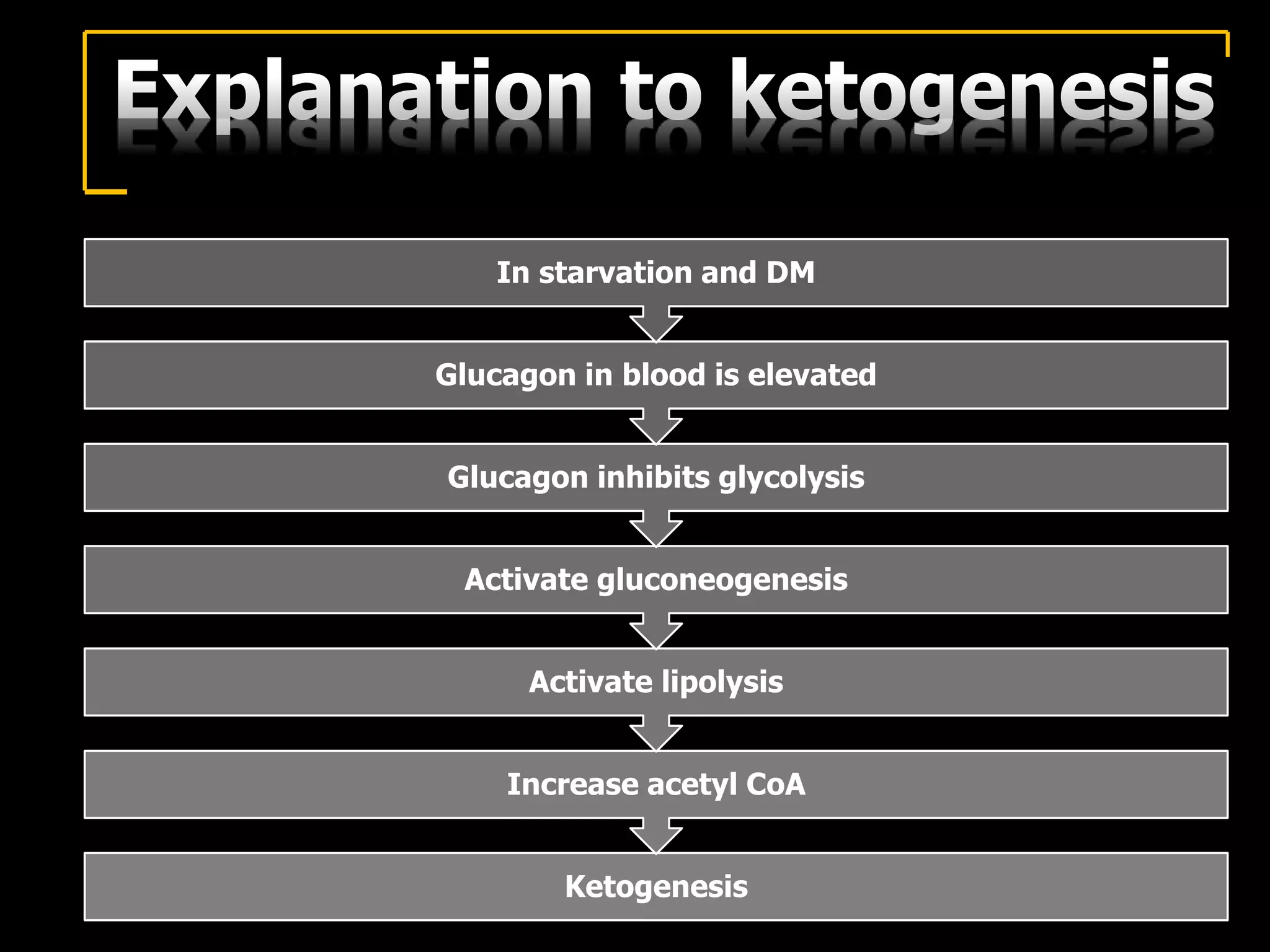
Ketogenesis
Increase acetyl CoA
Activate lipolysis
Activate gluconeogenesis
Glucagon inhibits glycolysis
Glucagon in blood is elevated
In starvation and DM
A 40 yrs old female is brought to the emergency department by her
mother after being found unresponsive at home. She had been ill the
day before with nausea and vomiting, but was not running a fever. Her
parents had kept her home from school that day. When her mother
came home at lunchtime to check on her, she was very lethargic and
not responding coherently. When brought to hospital she shows diffuse
abdominal tenderness with guarding. She appears pale, mucous
membrane are dry and she only respond to painful stimulus.
*BP – 92/68
*Respiratory rate – 30
*Radial pulse - 126
Normal – 120/80 mm Hg
Normal – 12 – 16 breath pm
Normal – 60 – 90 beats pm
Differential diagnosis
What is the initial treatment
What labs would you order
Any X ray or ECG report ??
*Hct – 45%
*Creatine – 1.5
*Glucose – 4+ in urine
*Ketone – 4+ in urine (Rothra’s test +ve)
*Increase anion gap
*Urea levels elevated – Pre renal failure
*Leucocytosis – marked feature
Inc. lactate, dec HCO3- , Inc Anion gap
Diabetic Ketoacidosis
Absolute or relative insulin deficiency
Increase cortisol, GH, E/NE
Inc. gluconeogenesis, glycogenolysis, lipolysis
Hyperglycemia and Inc. serum FFA
Inc ketone bodies due to lipolysis
Ketonemia
Ketonuria
Ketoacidosis
Rapid shallow breathing (Kussmal Breathing)
Features-
oMental confusion
oAbdominal pain
oKussmaul Breathing with Tachypenia
oDehydration
oHypotension
Increase osmotic load in blood
Due to dehydration
Due to ketoacidosis
As ketone bodies can cross BBB so they
in excess can cause CNS depression
oTachycardia
oFruity breathing
oFever +/-
oIf not treated timely it may lead to Coma and death
Compensatory mechanism to adjust hypovolemia
due to exhaled acetone
Hyperosmolar
coma
*Inferior wall Myocardial infarction
*Porphyria
*Addisonian crisis
*Basal Pneumonia
*Appendicitis at the level of T10
*Disseminated Intravascular coagulation
*Alcoholic ketoacidosis
*Hyperosmolar coma
*Hypothermia
*Metabolic acidosis
*MI
*Salicylate toxicity
*UTI
*In Pancreatitis both amylase and lipase are
elivated but in DKA only amylase levels Increases
Can lead to neurological
disturbances, coma, semicoma
*Cerebral Edema
*Venous thrombosis
*MI in systole – due to elevated K+ level
*Acute gastric diarrhoea
*Hyperglycemia – d/t inc gluconeogenesis, glycogenolysis
*Polyuria – Ketone and glucose are osmotically active
*Dehydration – due to polyuria
*Polydypsia – to compensate polyuria
*Pregnancy – In pregnancy can lead to gestational DM
*Hyperventilate
*Blood glucose level monitor
*Normal saline solution – to prevent dehydration
*To check blood pH as due to hyperventilation acidosis may
turn to alkalosis
*Bicarbonate levels
*Regular Insulin shot IV
*Electrolyte levels
*Urine and blood culture – infective organism
like Helicobacter pylori
*Elevated amylase even in absence of pancreatitis
*Serum PO4 3-
*Chest radiography to rule out pulmonary edema. MRI to detect
cerebral edema which is very common in pediatric cases.
*If cerebral edema present – Mannitol or hypertonic saline to be
administered immediately as it will cause osmotic diuresis
while acting on Glomerulus.
*To see the levels of K+ in blood regular check, on ECG as it
may result in cardiac arrest in systole
*Short acting insulin – Humalog
*Regular insulin IV
*Long acting insulin – Lantus
*Sulphonyl urea - Tolbutamide
R
*
GLUT - 2
ATP sensitive K+
channels
Voltage gated Ca++ channels
Beta cell
Thank You

Ketogenesis and ketolysis

  • 1.
  • 2.
    Ketone bodies andtheir biological significance Ketogenesis and its regulation Utilization of ketone bodies Disorders associated with ketone bodies
  • 3.
    *Ketone bodies arethree water soluble compounds that are produced when the fats are broken down. They are 1. Acetone 2. Acetoacetate 3. β – hydroxybutyrate
  • 5.
    *Ketone bodies aretransported from the liver to other tissues, where oxaloacetate and β – hydroxybutyrate can be reconverted into acetyl CoA to produce energy
  • 6.
    *They are watersoluble compounds *They can be transported across inner mitochondrial membrane *As well as they can cross the blood brain barrier *Act as a source of energy for brain, heart and muscles *Major source of energy for brain during starvation – 75%
  • 7.
    Site – Livermitochondria Occur only in liver because HMG-CoA lyase is present only in liver
  • 8.
    CH — C~ S — CoA3 CH — C — CH — C ~ S — CoA3 2 CoA — SH O || CH — C ~ S — CoA3 O || Thiolase O || O || Acetyl CoA Acetoacetyl CoA HMG CoA synthetase H O + CH — C ~ S — CoA2 3 O || CoA — SH CH — C ~ S — CoA3 O || HMG CoA lyase HOOC — CH — C — CH — C ~ S — CoA2 2 O || CH | 3 | OH  -Hydroxy- -methyl glutaryl CoA (HMG CoA) CH — C — CH — COOH3 2 Acetoacetate Spontaneous -Hydroxybutyrate dehydrogenase Acetone NADH + H+ NAD + CO2 CH — C — CH3 3 OH | CH — CH — CH — COOH3 2 -Hydroxybutyrate O || O ||
  • 9.
    Acetyl CoA +Acetyl CoA Acetoacetyl CoA synthase Acetoacetyl CoA HMG CoA synthase HMG-CoA HMG CoA lyase Acetoacetate + Acetyl CoA Non enzymatic Dehydrogenase Acetone β – hydroxybutyrate
  • 10.
    Acetoacetate is theprimary ketone body Acetone and β – hydroxybutyrate are the secondary ketone bodies
  • 11.
    Liver BLOOD Extrahepatictissue Acetyl CoA Ketone bodies FFA Ketone bodies Acetone Ketone in lungs in urine Acetyl CoA Ketone bodies Citric acid cycle CO2
  • 15.
    Occur in extrahepatictissues Not in liver – Because the enzyme thiophorase is absent in liver
  • 16.
    *The formation ofketone bodies take place in liver mitochondria but the enzymes for its utilization are not present in the liver. *Therefore, ketone bodies are released into circulation, and are taken up by tissues possessing the enzymatic machinery for their utilisation.
  • 17.
    *The first stepis the activation of ketone bodies to acetoacetyl CoA. * β-Hydroxybutyrate is converted into acetoacetate which reacts with succinyl CoA to form succinate and acetoacetyl CoA * Acetoacetyl CoA is converted into two molecules of acetyl CoA which are oxidised in the citric acid cycle
  • 19.
    *β-Hydroxybutyrate is convertedto acetoacetate for energy. *For oxidation of acetoacetate, it has to be activated to Acetoacetyl CoA by “ Succinyl CoA acetoacetate CoA transferase” or Thiophorase. *This is absent in liver.
  • 20.
    *Ketone bodies inplasma : 0.2 mmol/L *In starvation : 3-5 mmol/L *Diabetic Ketoacidosis : >12mmol/L *Ketone bodies in urine : <1 mg/L
  • 21.
  • 22.
    *Accumlation of ketonebodies in body due to increases synthesis than utilization - Ketonemia *Also they are excreted in urine – Ketonuria *With acetone in breath
  • 23.
    *Due to untreatedhyperglycemia *Is due to deficiency of Insulin *So more and more breakdown of fats *More fatty acids in the blood *Oxidation of these fatty acids increases the acetyl CoA pool. *Oxidation of acetyl-CoA by TCA cycle is reduced as the availability of oxaloacetate is reduced.
  • 24.
    *Supply of glucoseto body is decreased. *Oxaloacetate is directed to gluconeogenesis *Lipolysis also takes place *Excess acetyl CoA is converted to ketone bodies.
  • 25.
    *Due to elevatedlevels of circulating hCG in the blood in first trimester of pregnancy *Causes vomiting (Morning sickness) *Blood glucose level decreases *Ketone bodies come as a source of fuel to body.
  • 27.
    Ketogenesis Increase acetyl CoA Activatelipolysis Activate gluconeogenesis Glucagon inhibits glycolysis Glucagon in blood is elevated In starvation and DM
  • 29.
    A 40 yrsold female is brought to the emergency department by her mother after being found unresponsive at home. She had been ill the day before with nausea and vomiting, but was not running a fever. Her parents had kept her home from school that day. When her mother came home at lunchtime to check on her, she was very lethargic and not responding coherently. When brought to hospital she shows diffuse abdominal tenderness with guarding. She appears pale, mucous membrane are dry and she only respond to painful stimulus.
  • 30.
    *BP – 92/68 *Respiratoryrate – 30 *Radial pulse - 126 Normal – 120/80 mm Hg Normal – 12 – 16 breath pm Normal – 60 – 90 beats pm
  • 31.
    Differential diagnosis What isthe initial treatment What labs would you order Any X ray or ECG report ??
  • 32.
    *Hct – 45% *Creatine– 1.5 *Glucose – 4+ in urine *Ketone – 4+ in urine (Rothra’s test +ve) *Increase anion gap *Urea levels elevated – Pre renal failure *Leucocytosis – marked feature Inc. lactate, dec HCO3- , Inc Anion gap
  • 33.
  • 34.
    Absolute or relativeinsulin deficiency Increase cortisol, GH, E/NE Inc. gluconeogenesis, glycogenolysis, lipolysis Hyperglycemia and Inc. serum FFA Inc ketone bodies due to lipolysis Ketonemia Ketonuria Ketoacidosis Rapid shallow breathing (Kussmal Breathing)
  • 35.
    Features- oMental confusion oAbdominal pain oKussmaulBreathing with Tachypenia oDehydration oHypotension Increase osmotic load in blood Due to dehydration Due to ketoacidosis As ketone bodies can cross BBB so they in excess can cause CNS depression
  • 36.
    oTachycardia oFruity breathing oFever +/- oIfnot treated timely it may lead to Coma and death Compensatory mechanism to adjust hypovolemia due to exhaled acetone Hyperosmolar coma
  • 37.
    *Inferior wall Myocardialinfarction *Porphyria *Addisonian crisis *Basal Pneumonia *Appendicitis at the level of T10 *Disseminated Intravascular coagulation
  • 38.
    *Alcoholic ketoacidosis *Hyperosmolar coma *Hypothermia *Metabolicacidosis *MI *Salicylate toxicity *UTI *In Pancreatitis both amylase and lipase are elivated but in DKA only amylase levels Increases Can lead to neurological disturbances, coma, semicoma
  • 39.
    *Cerebral Edema *Venous thrombosis *MIin systole – due to elevated K+ level *Acute gastric diarrhoea
  • 40.
    *Hyperglycemia – d/tinc gluconeogenesis, glycogenolysis *Polyuria – Ketone and glucose are osmotically active *Dehydration – due to polyuria *Polydypsia – to compensate polyuria *Pregnancy – In pregnancy can lead to gestational DM
  • 41.
    *Hyperventilate *Blood glucose levelmonitor *Normal saline solution – to prevent dehydration *To check blood pH as due to hyperventilation acidosis may turn to alkalosis *Bicarbonate levels *Regular Insulin shot IV *Electrolyte levels
  • 42.
    *Urine and bloodculture – infective organism like Helicobacter pylori *Elevated amylase even in absence of pancreatitis *Serum PO4 3-
  • 43.
    *Chest radiography torule out pulmonary edema. MRI to detect cerebral edema which is very common in pediatric cases. *If cerebral edema present – Mannitol or hypertonic saline to be administered immediately as it will cause osmotic diuresis while acting on Glomerulus. *To see the levels of K+ in blood regular check, on ECG as it may result in cardiac arrest in systole
  • 44.
    *Short acting insulin– Humalog *Regular insulin IV *Long acting insulin – Lantus *Sulphonyl urea - Tolbutamide R
  • 45.
    * GLUT - 2 ATPsensitive K+ channels Voltage gated Ca++ channels Beta cell
  • 46.