NSF Grant DMR-1720415
Amorphous Materials: Structural
Principles and Characterization
Paul M. Voyles and Paul G. Evans
Department of Materials Science and Engineering
Overview
• Basic structural features of amorphous
materials:
• short-range order dominated by atomic bonding
• no long-range translational order
• Common methods of structural characterization
for amorphous materials:
• variations on the theme of pair distribution functions
• Structure of various classes of amorphous
materials:
• metallic glasses
• molecular glasses
• covalent network glasses, especially silicates
• ionic amorphous solids, especially metal oxides
• Summary
2
https://go.wisc.edu/u2069r
Articles available at:
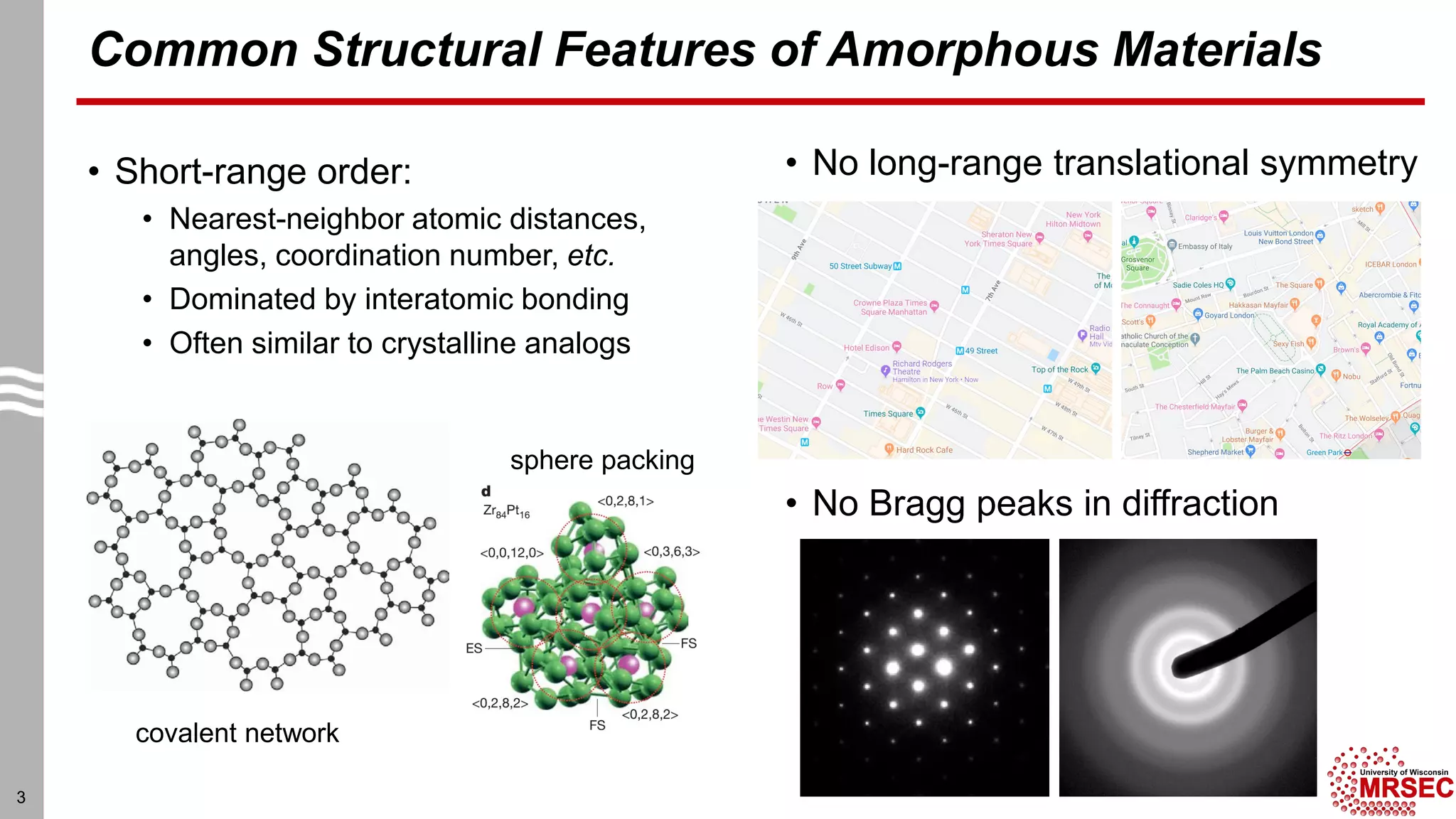
Common Structural Features of Amorphous Materials
• Short-range order:
• Nearest-neighbor atomic distances,
angles, coordination number, etc.
• Dominated by interatomic bonding
• Often similar to crystalline analogs
• No long-range translational symmetry
3
• No Bragg peaks in diffraction
covalent network
sphere packing
Goals of Structural Characterization
• Chemical state and coordination of component atoms/molecules
• Local and global structural order
• Impact of amorphous structure on stability, crystallization, and other
properties and processes
• Many tools available:
• X-ray scattering, diffraction, and spectroscopy
• Neutron diffraction
• Electron microscopy and scattering
• Raman spectroscopy
• Nuclear magnetic resonance
• Inelastic x-ray and neutron scattering
4
X-ray, Neutron, and Electron Scattering
• Measure scattered intensity as a function of direction
• Precise measurement, wide angular range
5
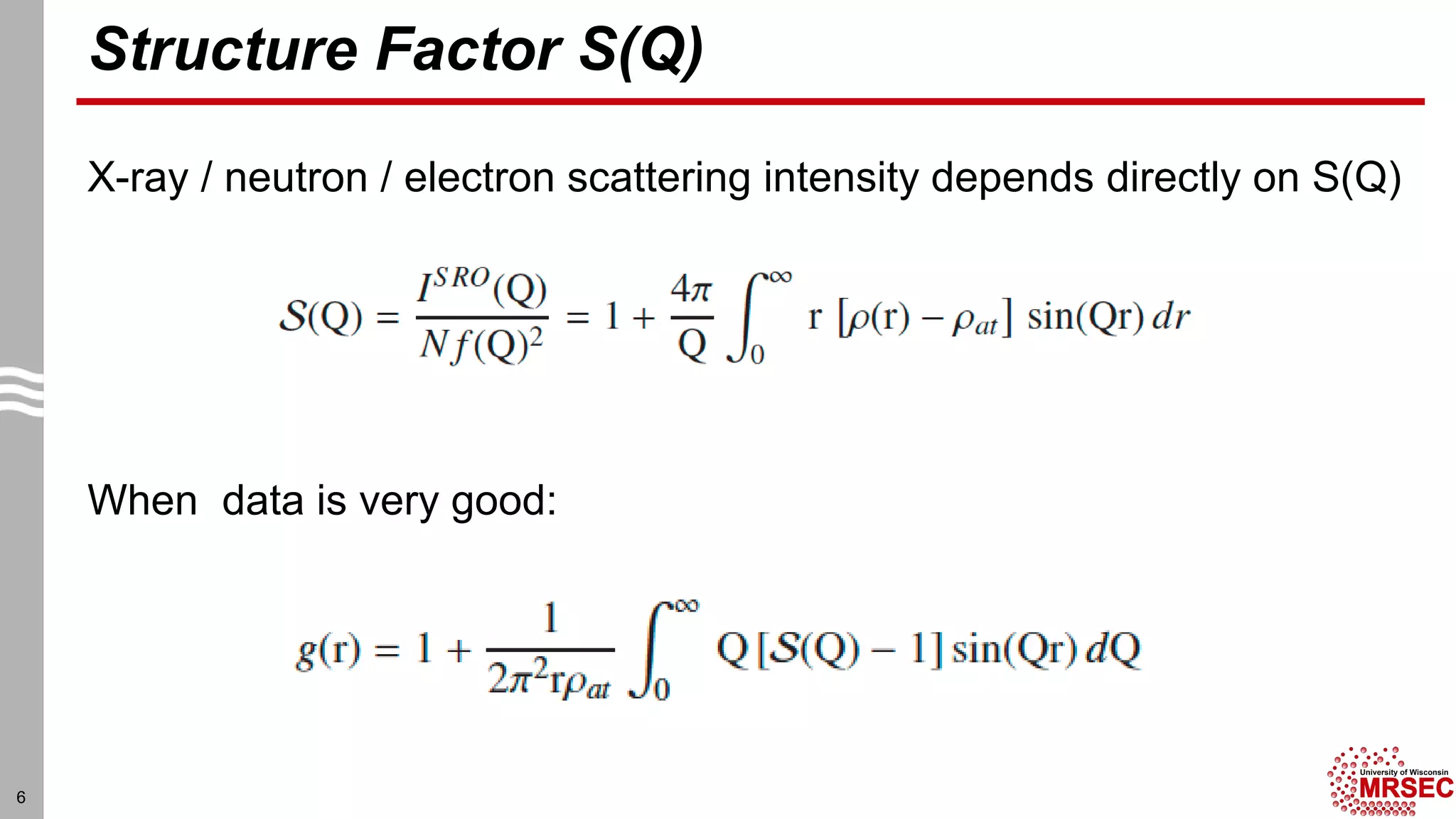
Structure Factor S(Q)
6
X-ray / neutron / electron scattering intensity depends directly on S(Q)
When data is very good:
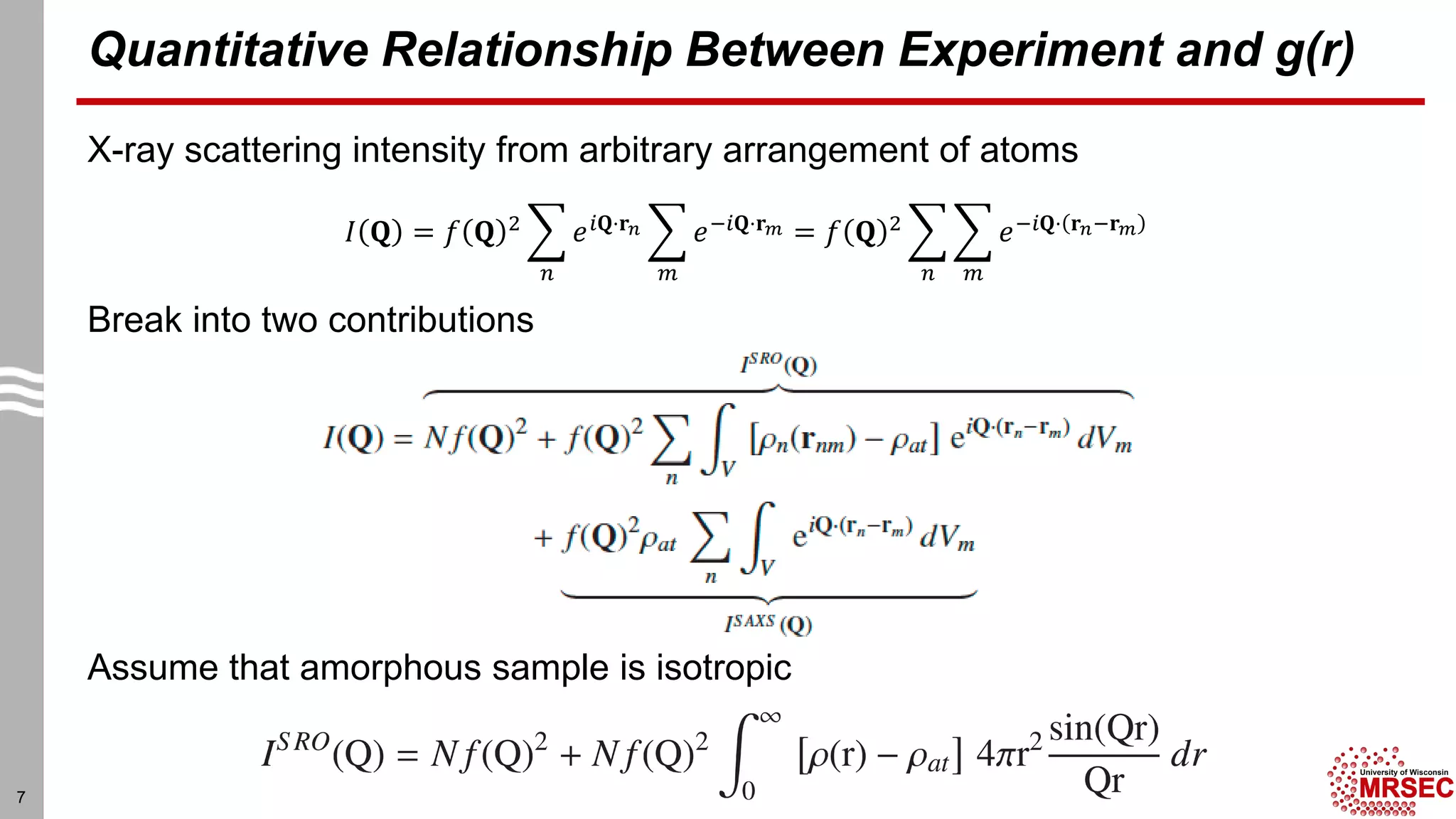
Quantitative Relationship Between Experiment and g(r)
7
X-ray scattering intensity from arbitrary arrangement of atoms
Break into two contributions
Assume that amorphous sample is isotropic
𝐼𝐼 𝐐𝐐 = 𝑓𝑓 𝐐𝐐 2
�
𝑛𝑛
𝑒𝑒𝑖𝑖 𝐐𝐐⋅𝐫𝐫𝑛𝑛 �
𝑚𝑚
𝑒𝑒−𝑖𝑖 𝐐𝐐⋅𝐫𝐫𝑚𝑚 = 𝑓𝑓 𝐐𝐐 2
�
𝑛𝑛
�
𝑚𝑚
𝑒𝑒−𝑖𝑖 𝐐𝐐⋅ 𝐫𝐫𝑛𝑛−𝐫𝐫𝑚𝑚
Structure of Non-crystalline Materials
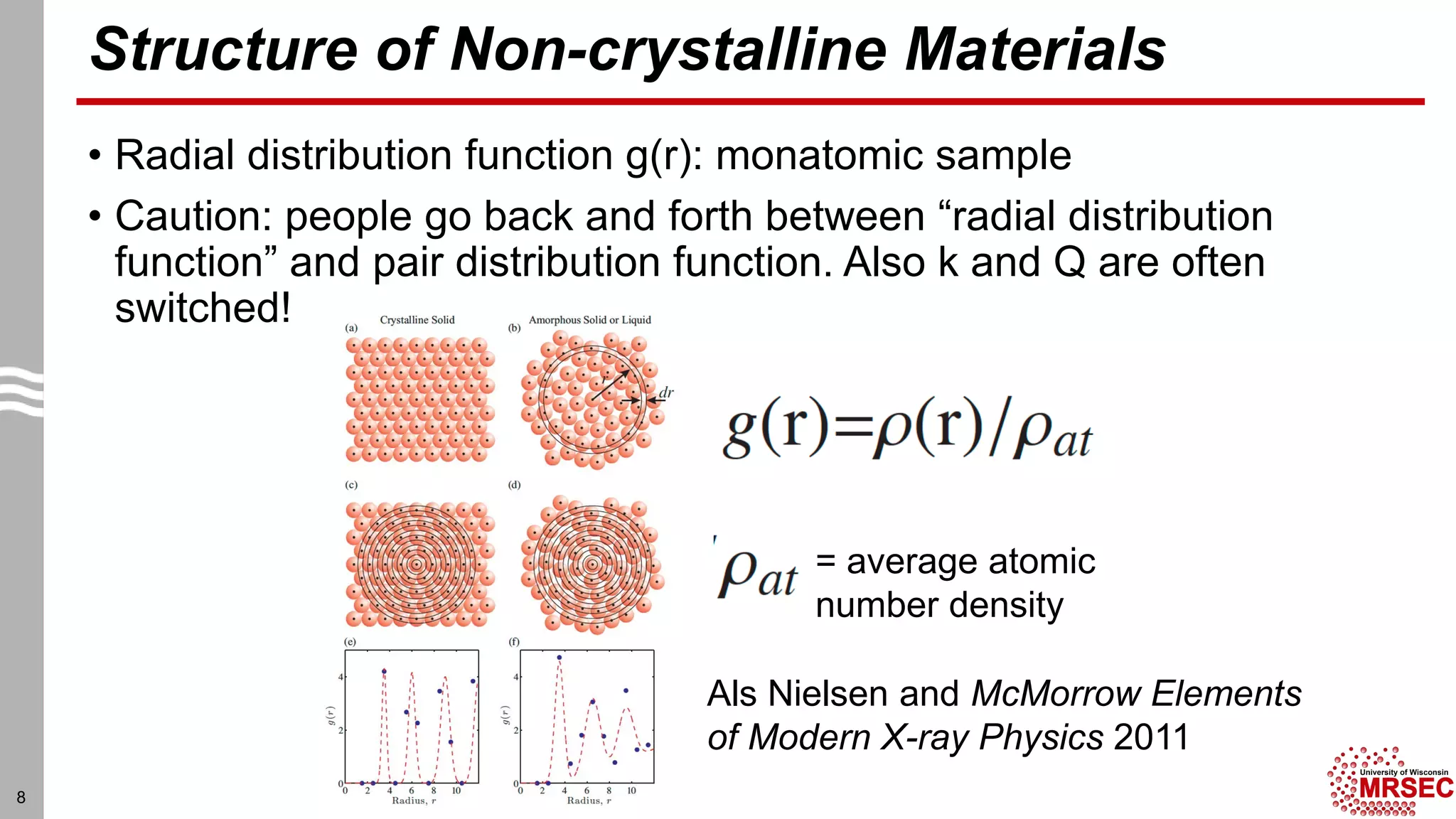
• Radial distribution function g(r): monatomic sample
• Caution: people go back and forth between “radial distribution
function” and pair distribution function. Also k and Q are often
switched!
8
= average atomic
number density
Als Nielsen and McMorrow Elements
of Modern X-ray Physics 2011
Radial Distribution Function
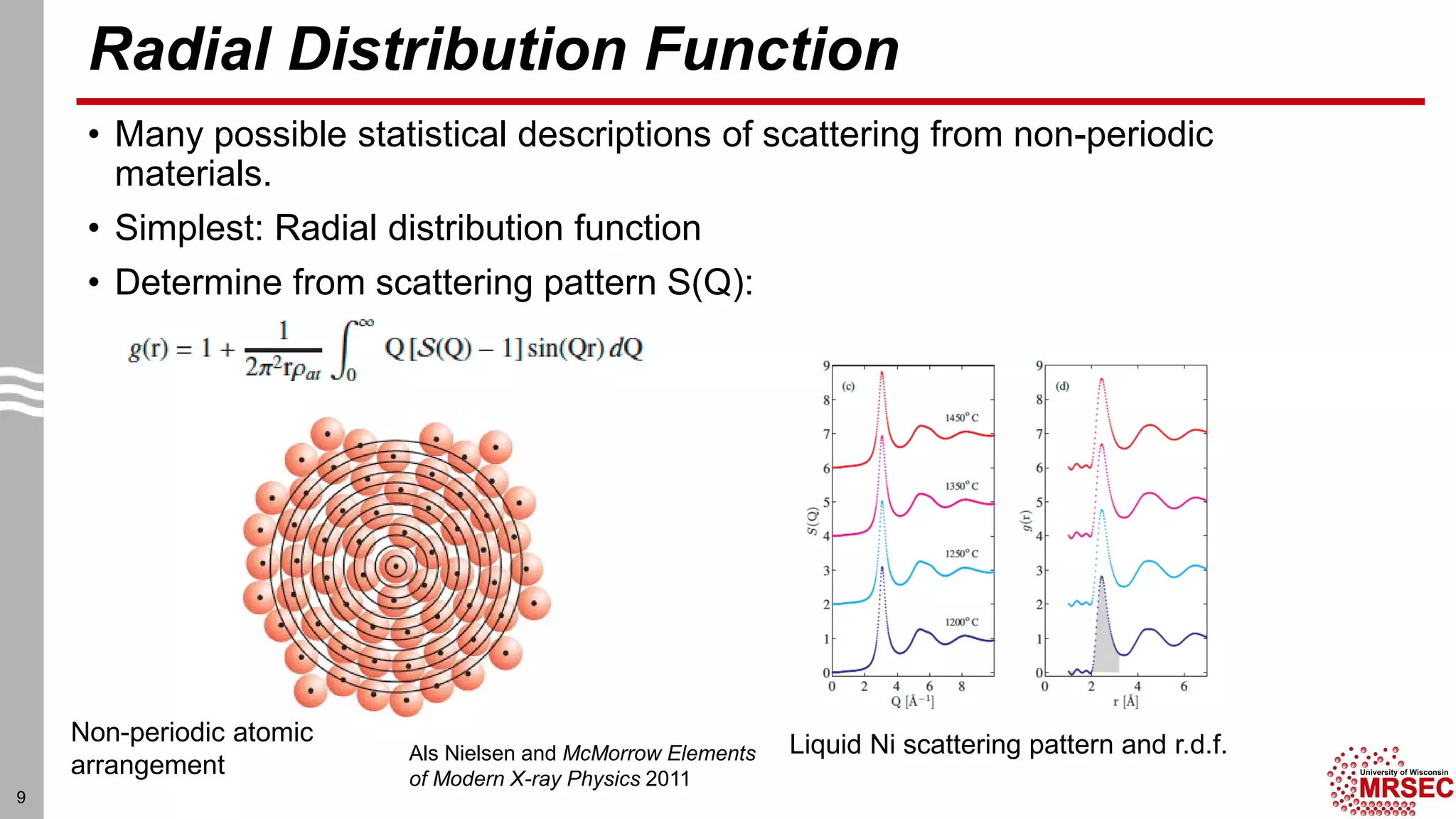
• Many possible statistical descriptions of scattering from non-periodic
materials.
• Simplest: Radial distribution function
• Determine from scattering pattern S(Q):
Non-periodic atomic
arrangement
Liquid Ni scattering pattern and r.d.f.Als Nielsen and McMorrow Elements
of Modern X-ray Physics 2011
9
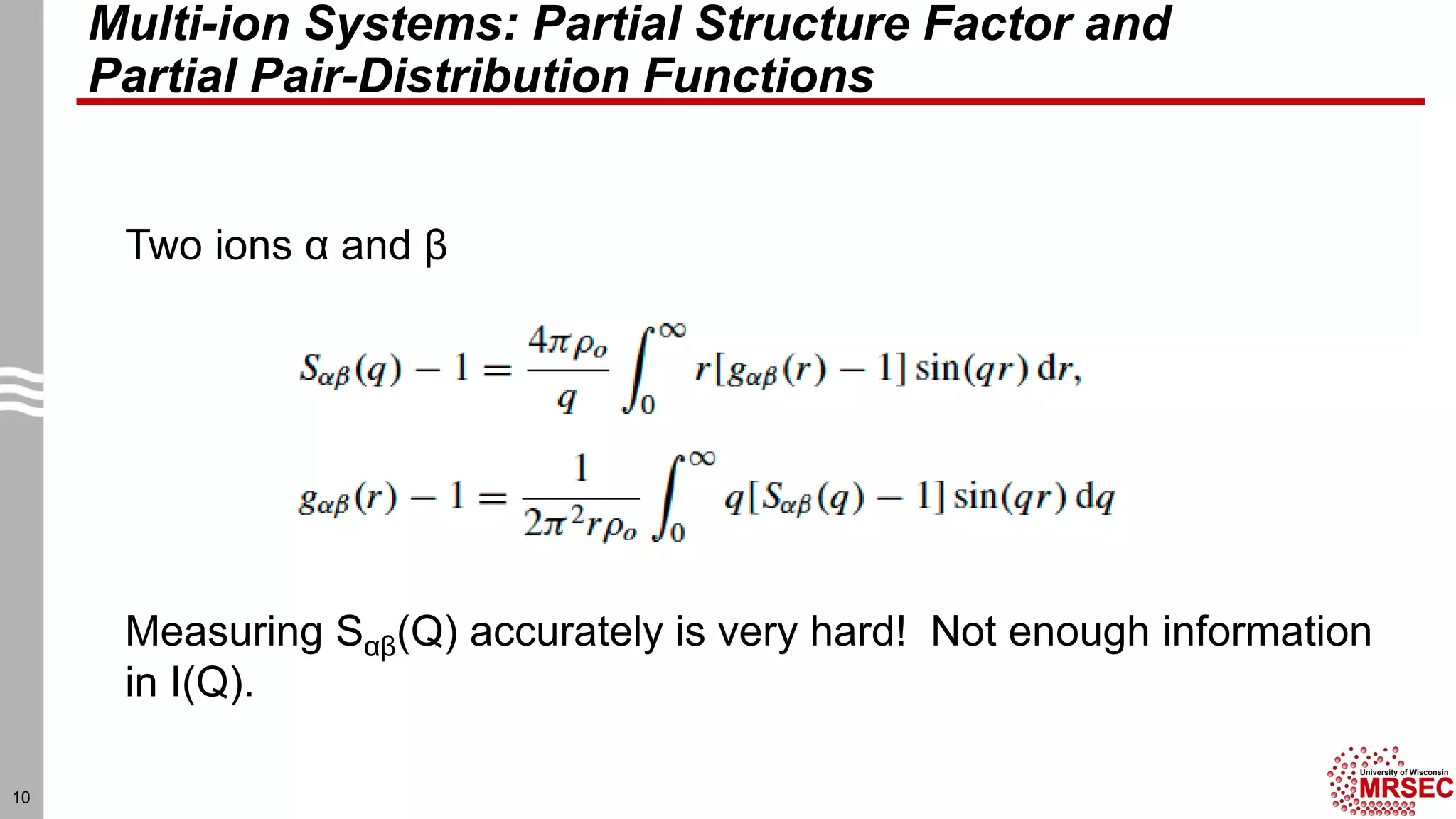
Multi-ion Systems: Partial Structure Factor and
Partial Pair-Distribution Functions
10
Measuring Sαβ(Q) accurately is very hard! Not enough information
in I(Q).
Two ions α and β
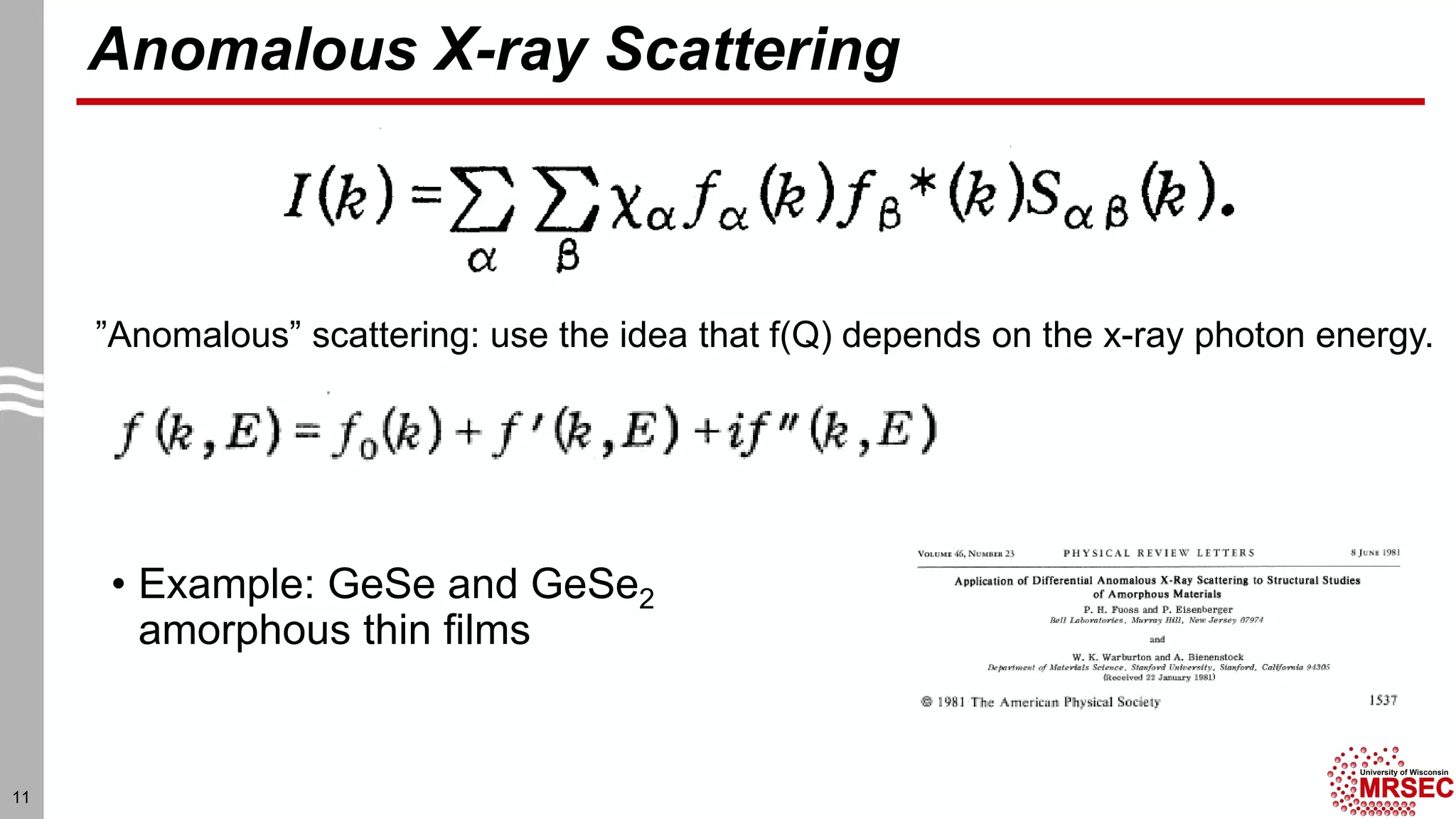
Anomalous X-ray Scattering
11
• Example: GeSe and GeSe2
amorphous thin films
”Anomalous” scattering: use the idea that f(Q) depends on the x-ray photon energy.
Difference pdf “d-pdf”
12
KnownMeasurable
Strategy: Find Sαβ(Q), transform to find ραβ.
Amorphous Metals / Metallic Glasses
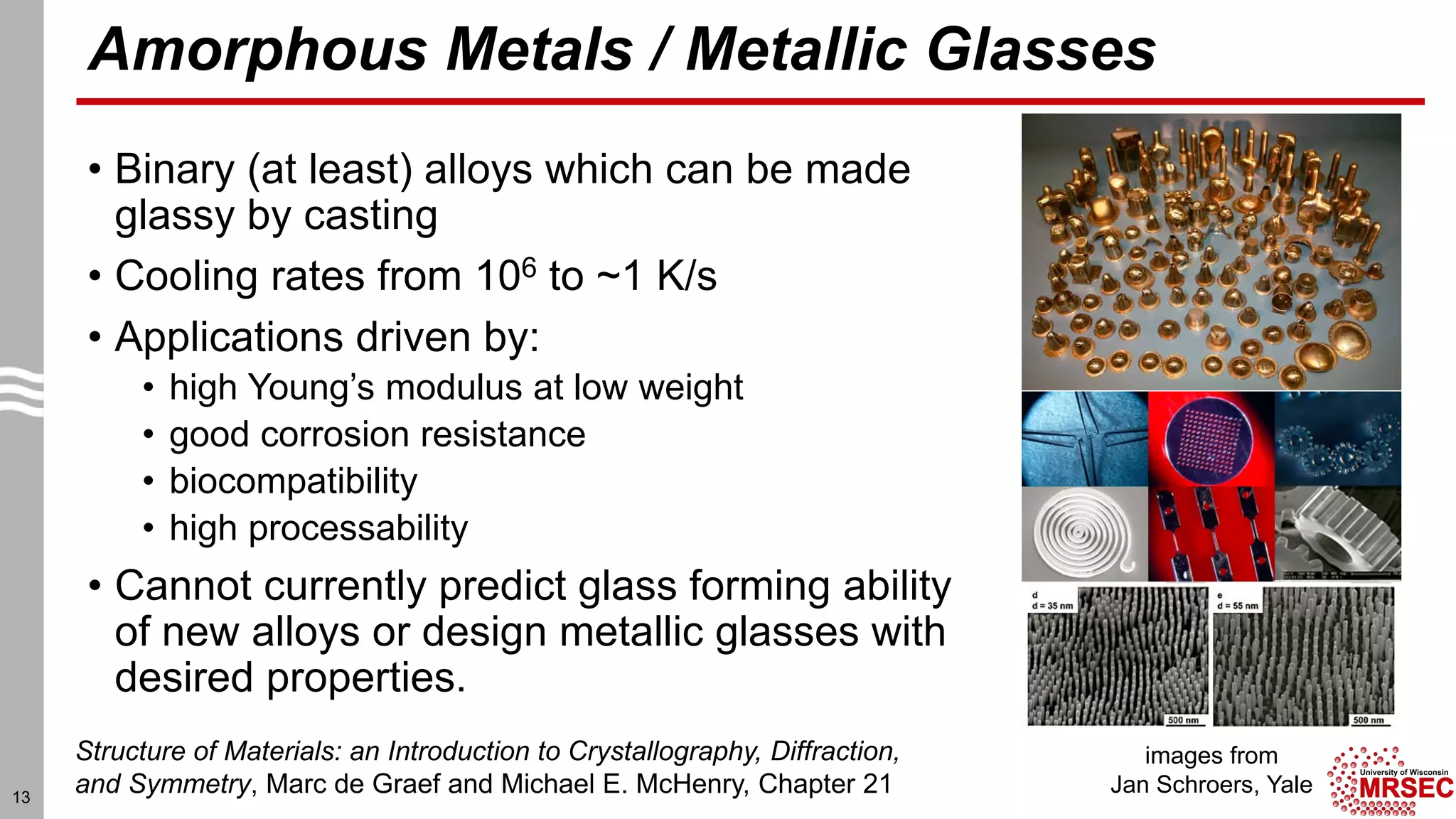
• Binary (at least) alloys which can be made
glassy by casting
• Cooling rates from 106 to ~1 K/s
• Applications driven by:
• high Young’s modulus at low weight
• good corrosion resistance
• biocompatibility
• high processability
• Cannot currently predict glass forming ability
of new alloys or design metallic glasses with
desired properties.
images from
Jan Schroers, Yale
Structure of Materials: an Introduction to Crystallography, Diffraction,
and Symmetry, Marc de Graef and Michael E. McHenry, Chapter 2113
Dense Random Packing
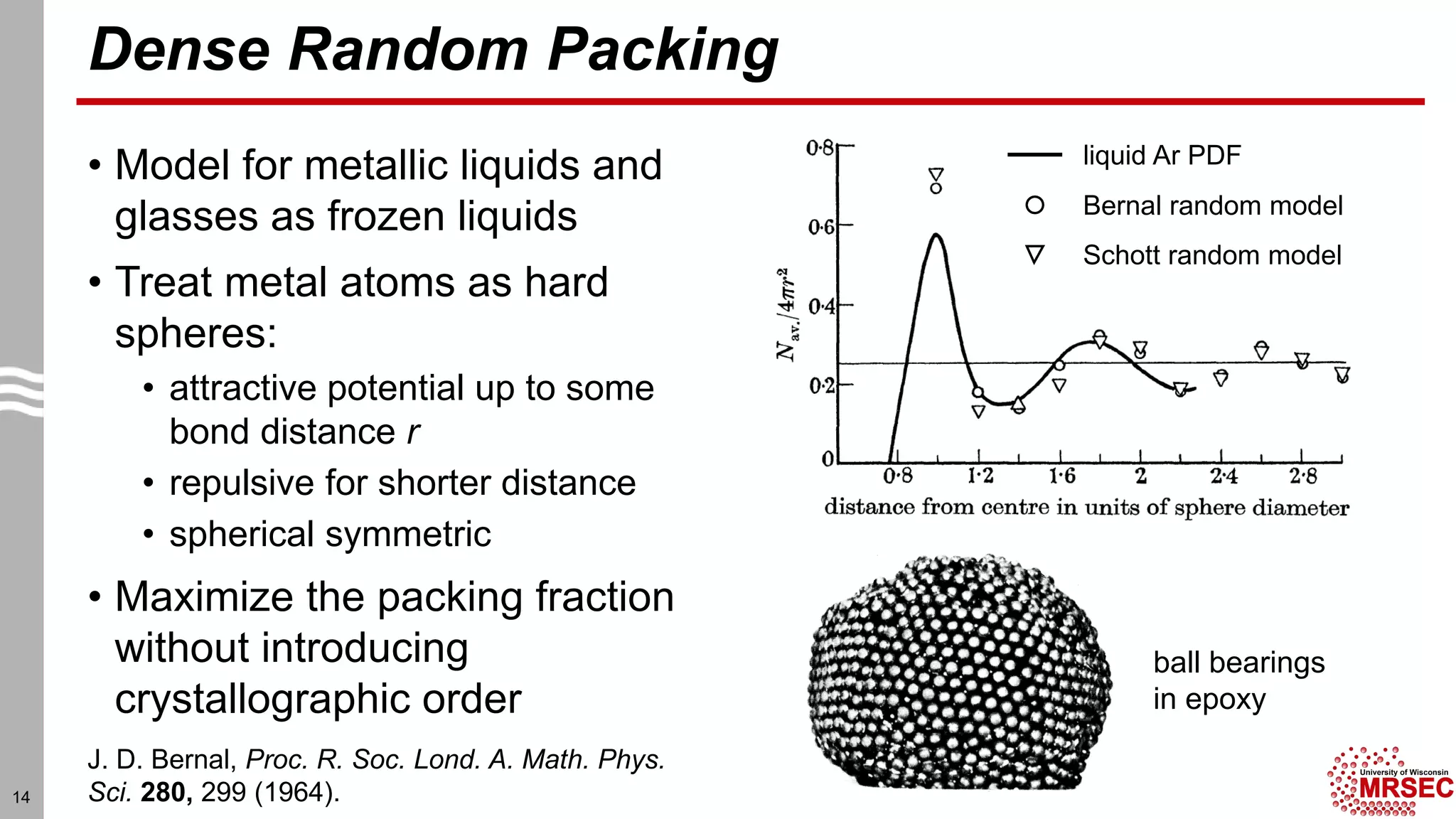
• Model for metallic liquids and
glasses as frozen liquids
• Treat metal atoms as hard
spheres:
• attractive potential up to some
bond distance r
• repulsive for shorter distance
• spherical symmetric
• Maximize the packing fraction
without introducing
crystallographic order
14
J. D. Bernal, Proc. R. Soc. Lond. A. Math. Phys.
Sci. 280, 299 (1964).
liquid Ar PDF
Bernal random model
Schott random model
ball bearings
in epoxy
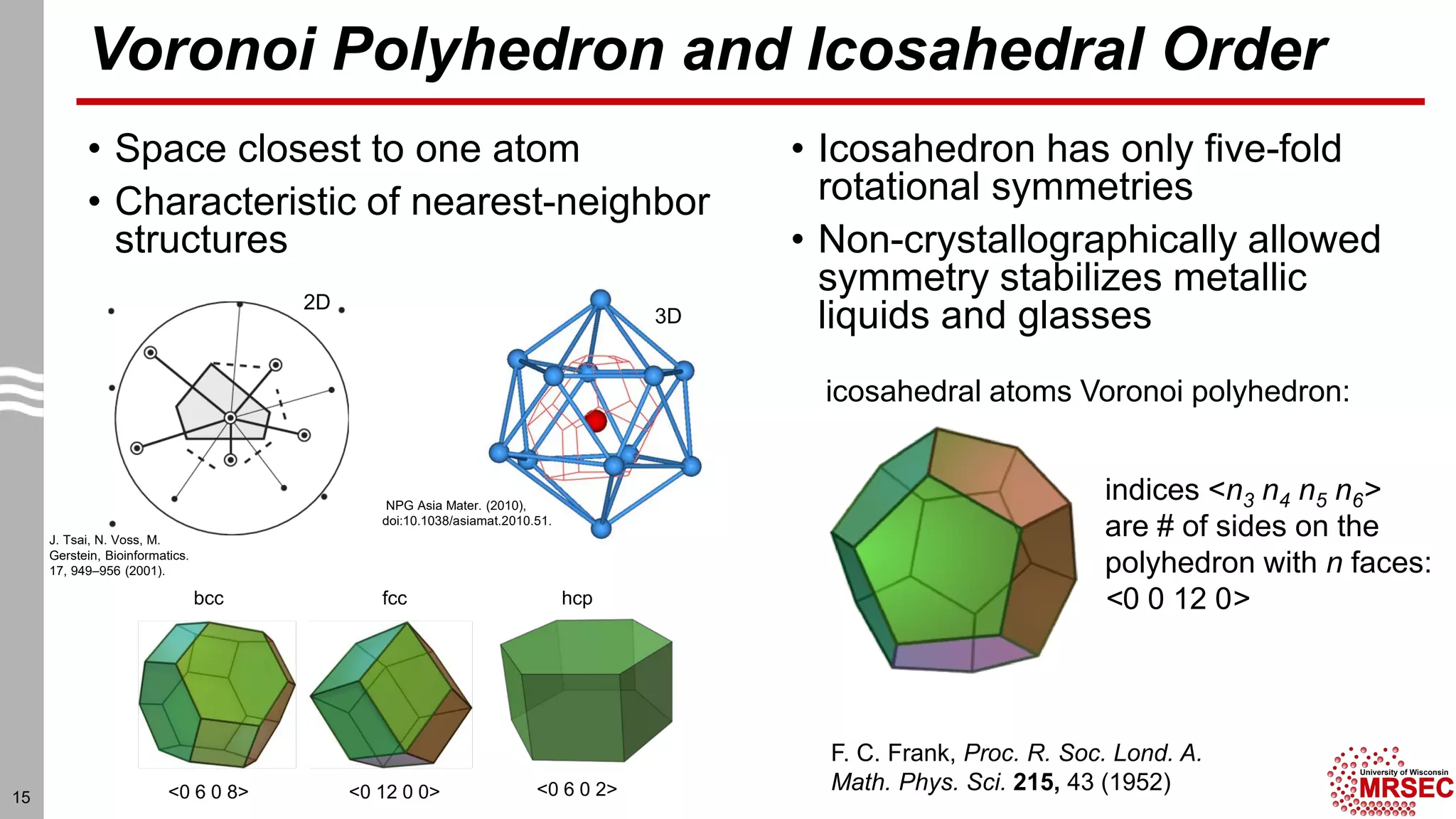
Voronoi Polyhedron and Icosahedral Order
• Space closest to one atom
• Characteristic of nearest-neighbor
structures
• Icosahedron has only five-fold
rotational symmetries
• Non-crystallographically allowed
symmetry stabilizes metallic
liquids and glasses
15
2D
J. Tsai, N. Voss, M.
Gerstein, Bioinformatics.
17, 949–956 (2001).
3D
bcc fcc
<0 6 0 8> <0 12 0 0>
hcp
<0 6 0 2>
icosahedral atoms Voronoi polyhedron:
NPG Asia Mater. (2010),
doi:10.1038/asiamat.2010.51.
F. C. Frank, Proc. R. Soc. Lond. A.
Math. Phys. Sci. 215, 43 (1952)
indices <n3 n4 n5 n6>
are # of sides on the
polyhedron with n faces:
<0 0 12 0>
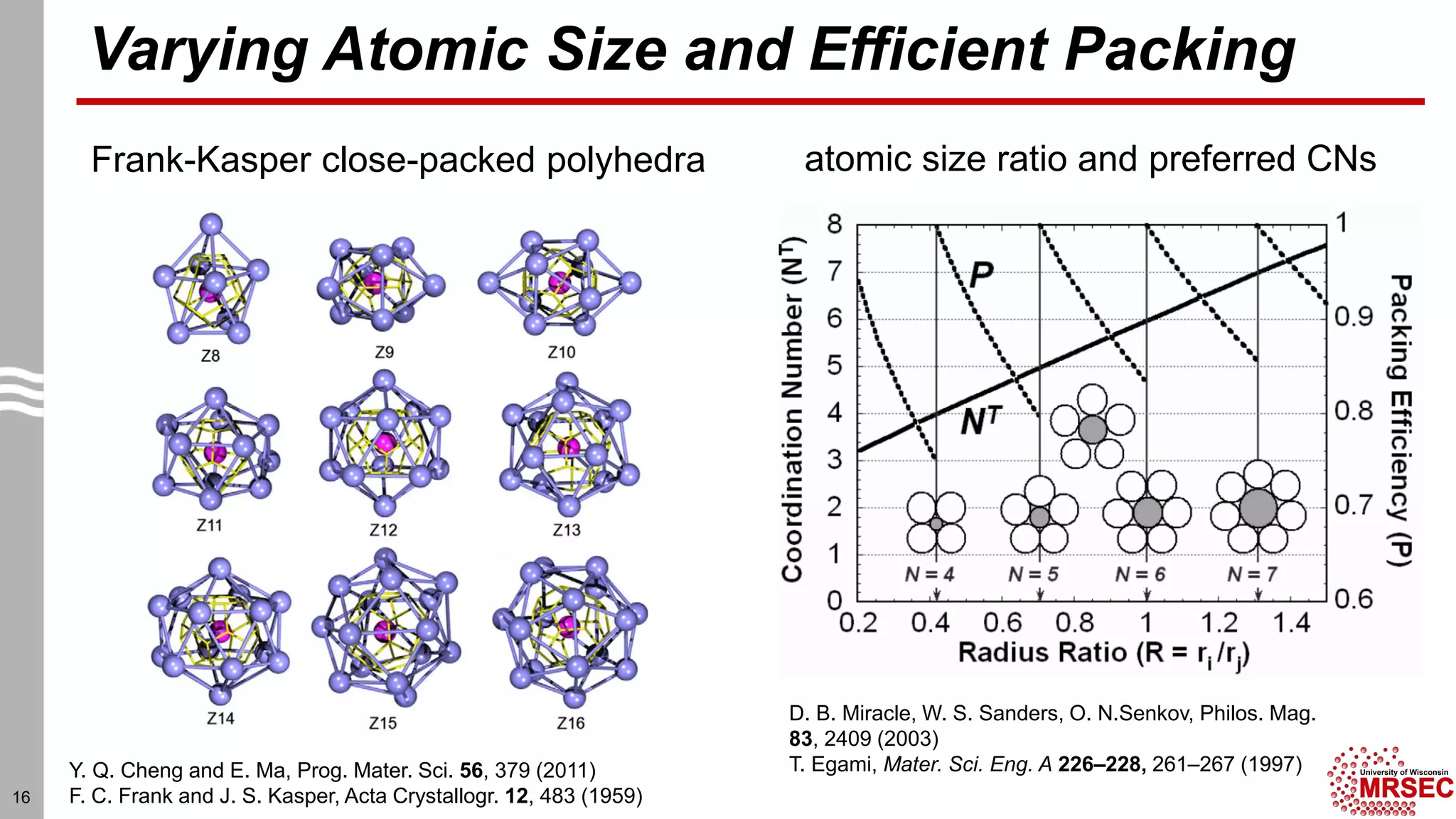
Varying Atomic Size and Efficient Packing
16
Y. Q. Cheng and E. Ma, Prog. Mater. Sci. 56, 379 (2011)
F. C. Frank and J. S. Kasper, Acta Crystallogr. 12, 483 (1959)
Frank-Kasper close-packed polyhedra atomic size ratio and preferred CNs
D. B. Miracle, W. S. Sanders, O. N.Senkov, Philos. Mag.
83, 2409 (2003)
T. Egami, Mater. Sci. Eng. A 226–228, 261–267 (1997)
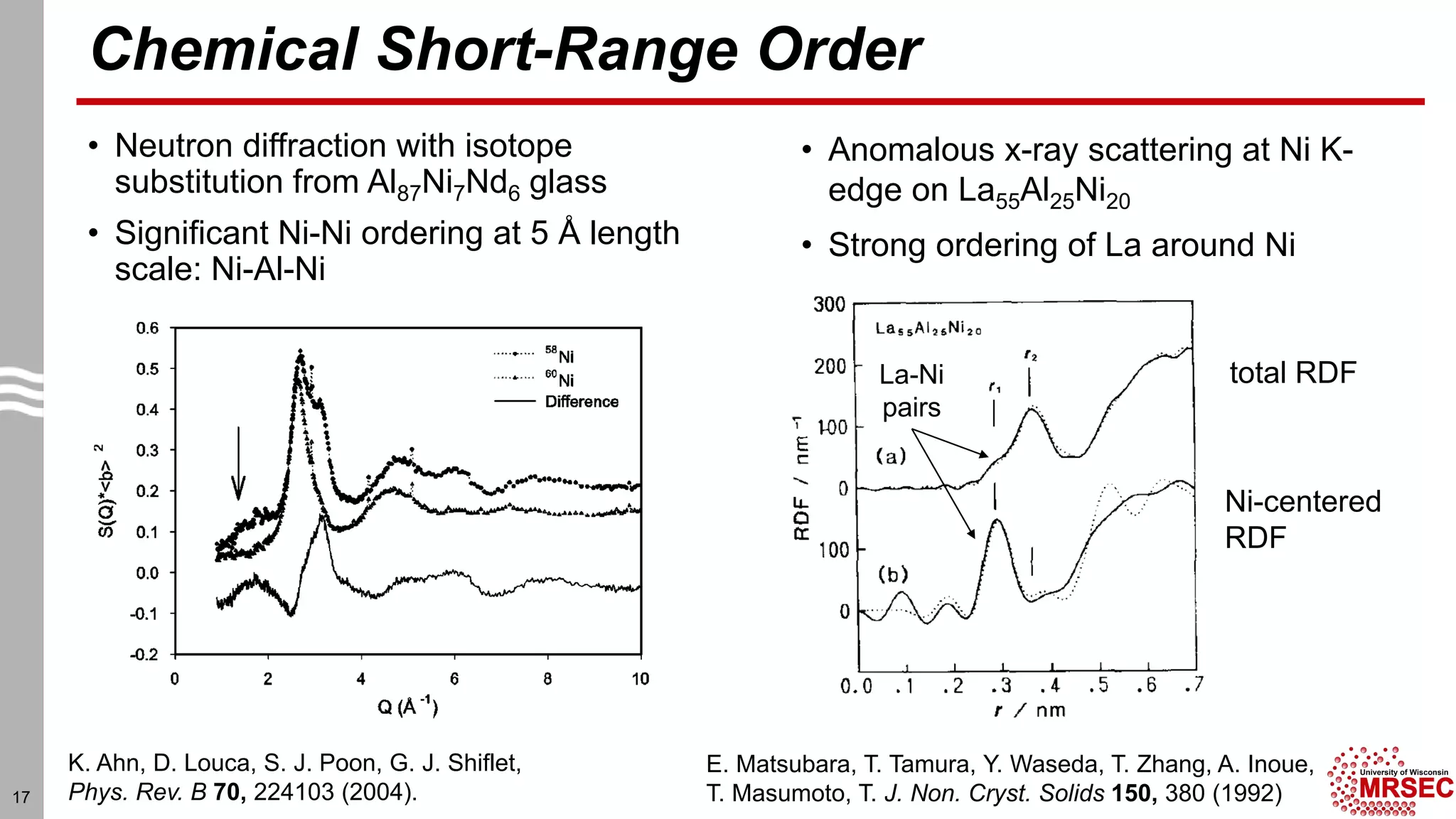
Chemical Short-Range Order
• Neutron diffraction with isotope
substitution from Al87Ni7Nd6 glass
• Significant Ni-Ni ordering at 5 Å length
scale: Ni-Al-Ni
• Anomalous x-ray scattering at Ni K-
edge on La55Al25Ni20
• Strong ordering of La around Ni
17
K. Ahn, D. Louca, S. J. Poon, G. J. Shiflet,
Phys. Rev. B 70, 224103 (2004).
E. Matsubara, T. Tamura, Y. Waseda, T. Zhang, A. Inoue,
T. Masumoto, T. J. Non. Cryst. Solids 150, 380 (1992)
total RDF
Ni-centered
RDF
La-Ni
pairs
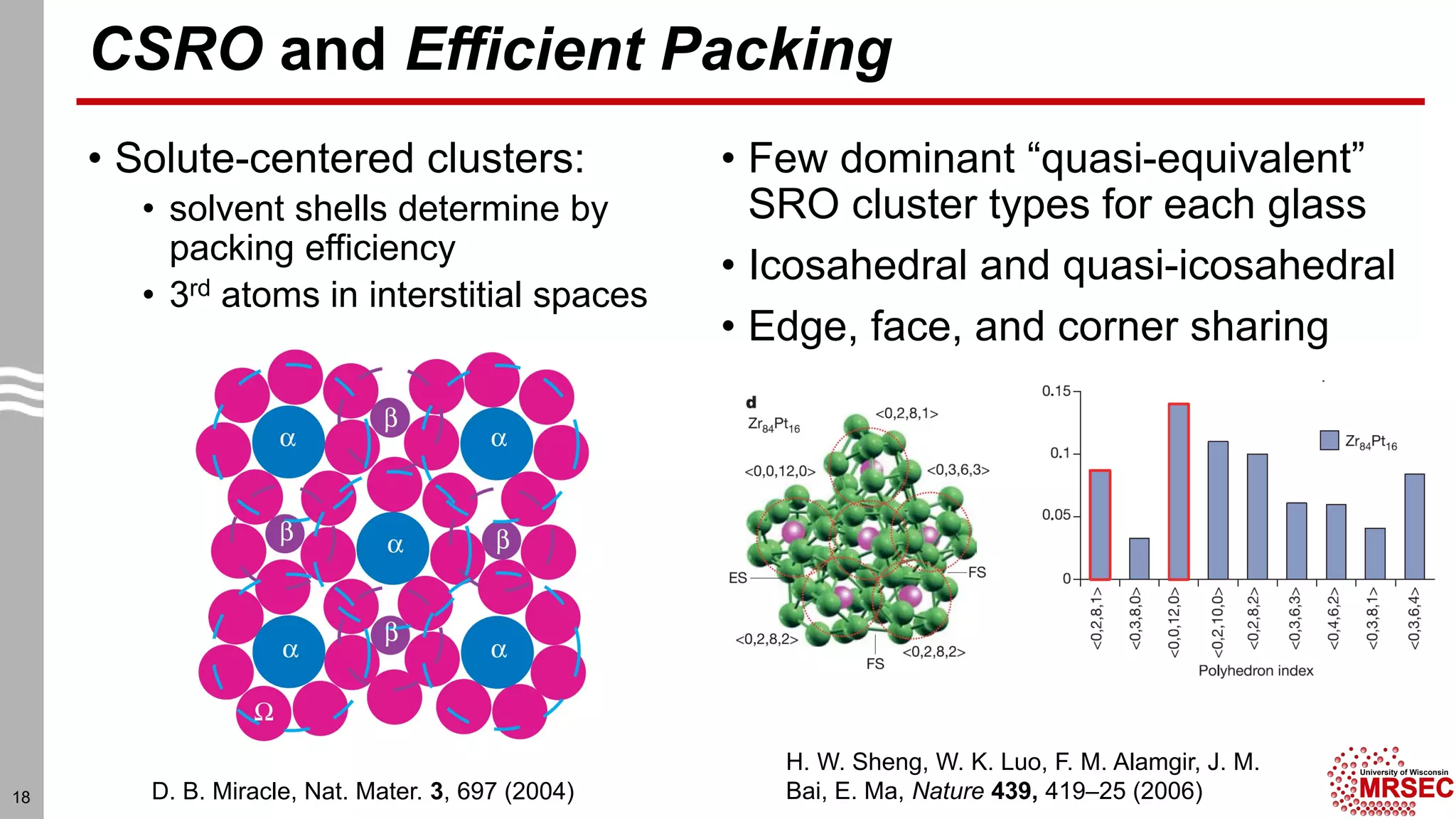
CSRO and Efficient Packing
• Solute-centered clusters:
• solvent shells determine by
packing efficiency
• 3rd atoms in interstitial spaces
• Few dominant “quasi-equivalent”
SRO cluster types for each glass
• Icosahedral and quasi-icosahedral
• Edge, face, and corner sharing
18 D. B. Miracle, Nat. Mater. 3, 697 (2004)
H. W. Sheng, W. K. Luo, F. M. Alamgir, J. M.
Bai, E. Ma, Nature 439, 419–25 (2006)
Non-icosahedral Glasses
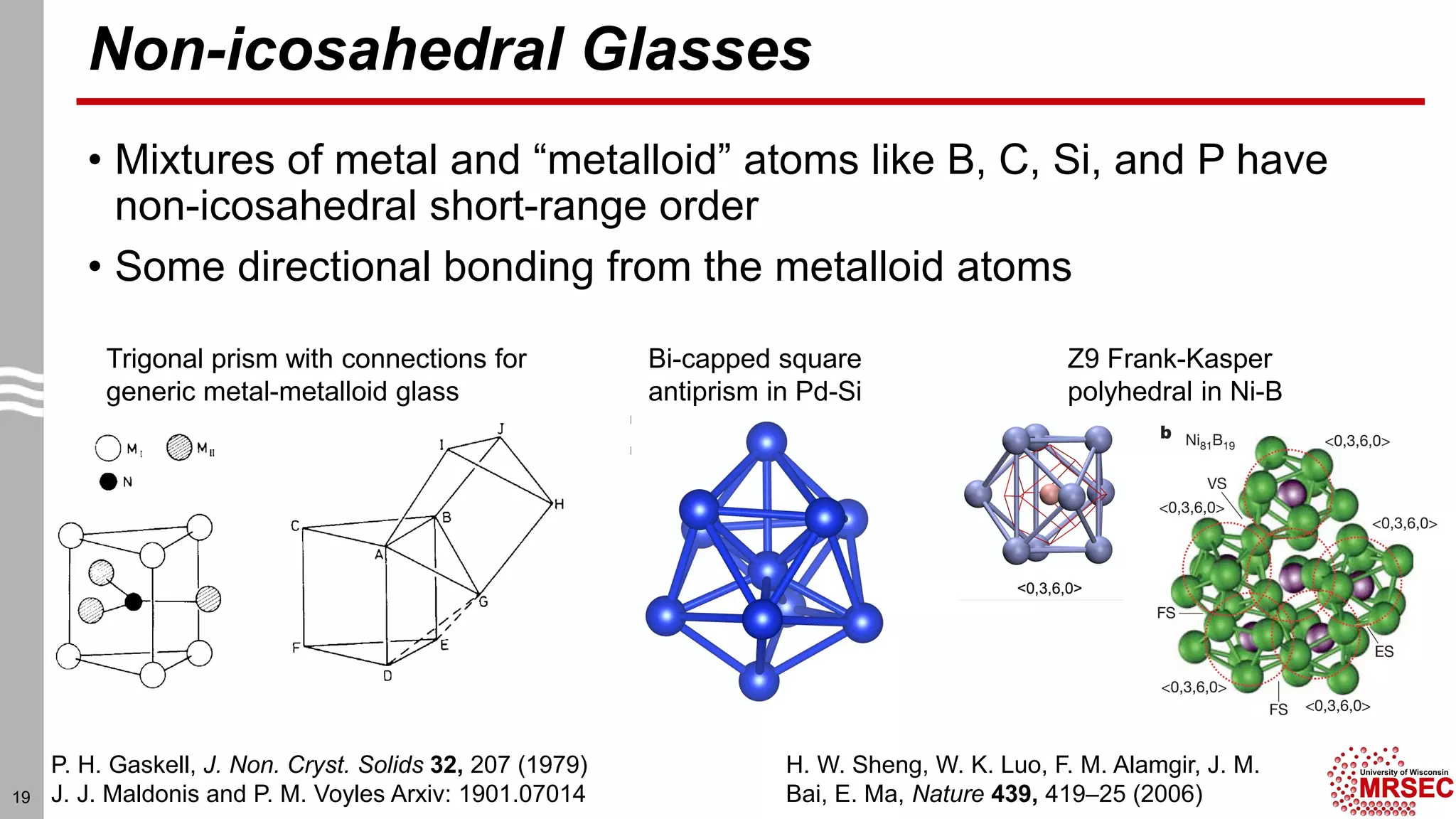
• Mixtures of metal and “metalloid” atoms like B, C, Si, and P have
non-icosahedral short-range order
• Some directional bonding from the metalloid atoms
19
P. H. Gaskell, J. Non. Cryst. Solids 32, 207 (1979)
J. J. Maldonis and P. M. Voyles Arxiv: 1901.07014
Trigonal prism with connections for
generic metal-metalloid glass
Bi-capped square
antiprism in Pd-Si
Z9 Frank-Kasper
polyhedral in Ni-B
H. W. Sheng, W. K. Luo, F. M. Alamgir, J. M.
Bai, E. Ma, Nature 439, 419–25 (2006)
Nanodiffraction with Electrons
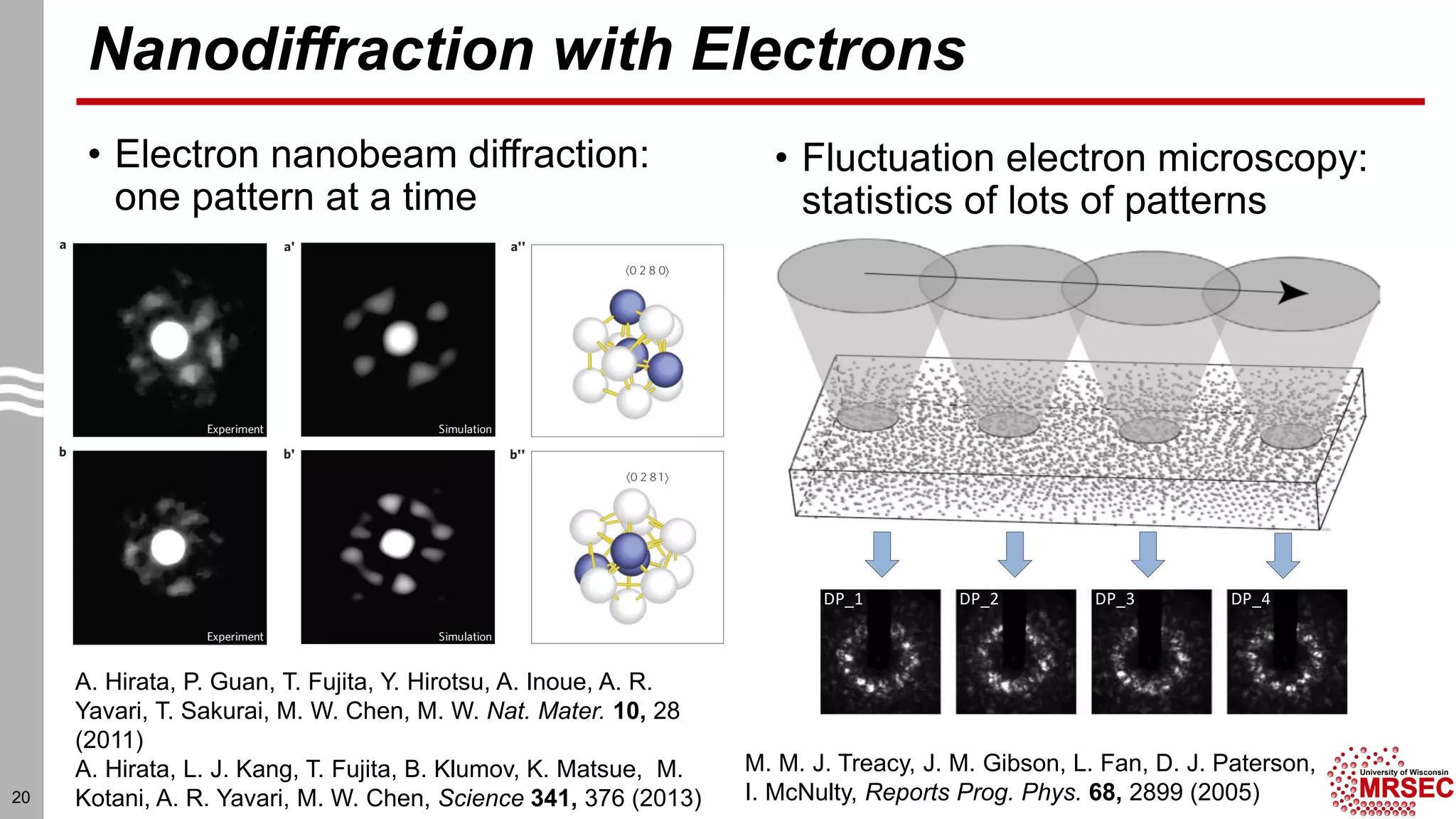
• Electron nanobeam diffraction:
one pattern at a time
• Fluctuation electron microscopy:
statistics of lots of patterns
20
DP_1 DP_2 DP_3 DP_4
A. Hirata, P. Guan, T. Fujita, Y. Hirotsu, A. Inoue, A. R.
Yavari, T. Sakurai, M. W. Chen, M. W. Nat. Mater. 10, 28
(2011)
A. Hirata, L. J. Kang, T. Fujita, B. Klumov, K. Matsue, M.
Kotani, A. R. Yavari, M. W. Chen, Science 341, 376 (2013)
M. M. J. Treacy, J. M. Gibson, L. Fan, D. J. Paterson,
I. McNulty, Reports Prog. Phys. 68, 2899 (2005)
Competing Icosahedral and Crystal-like Clusters
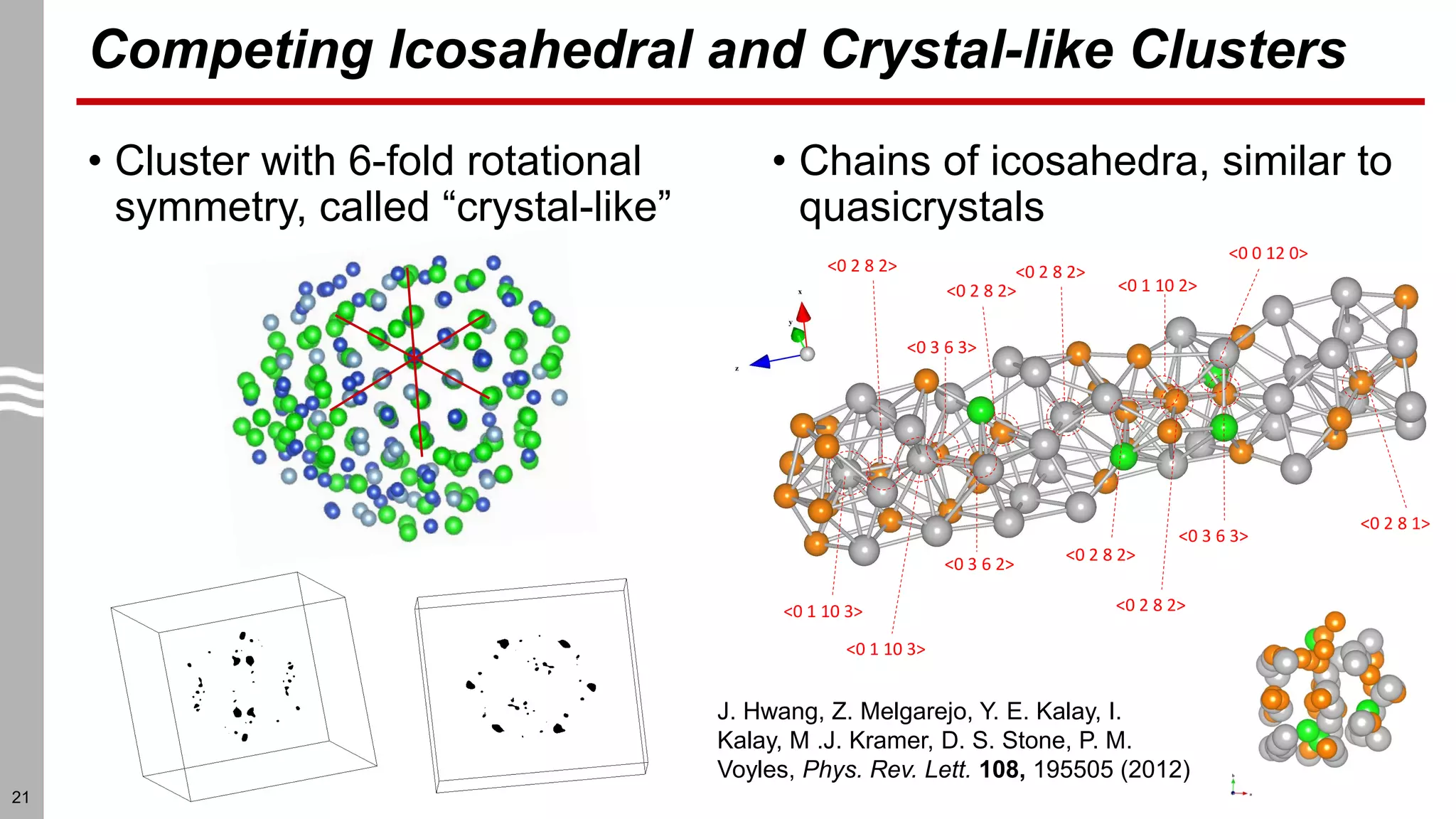
• Cluster with 6-fold rotational
symmetry, called “crystal-like”
• Chains of icosahedra, similar to
quasicrystals
21
<0 1 10 3>
<0 1 10 3>
<0 3 6 3>
<0 3 6 2>
<0 2 8 2>
<0 2 8 2>
<0 2 8 2>
<0 1 10 2>
<0 2 8 2>
<0 3 6 3>
<0 2 8 1>
<0 0 12 0>
<0 2 8 2>
J. Hwang, Z. Melgarejo, Y. E. Kalay, I.
Kalay, M .J. Kramer, D. S. Stone, P. M.
Voyles, Phys. Rev. Lett. 108, 195505 (2012)
Structure and Glass-Forming Ability
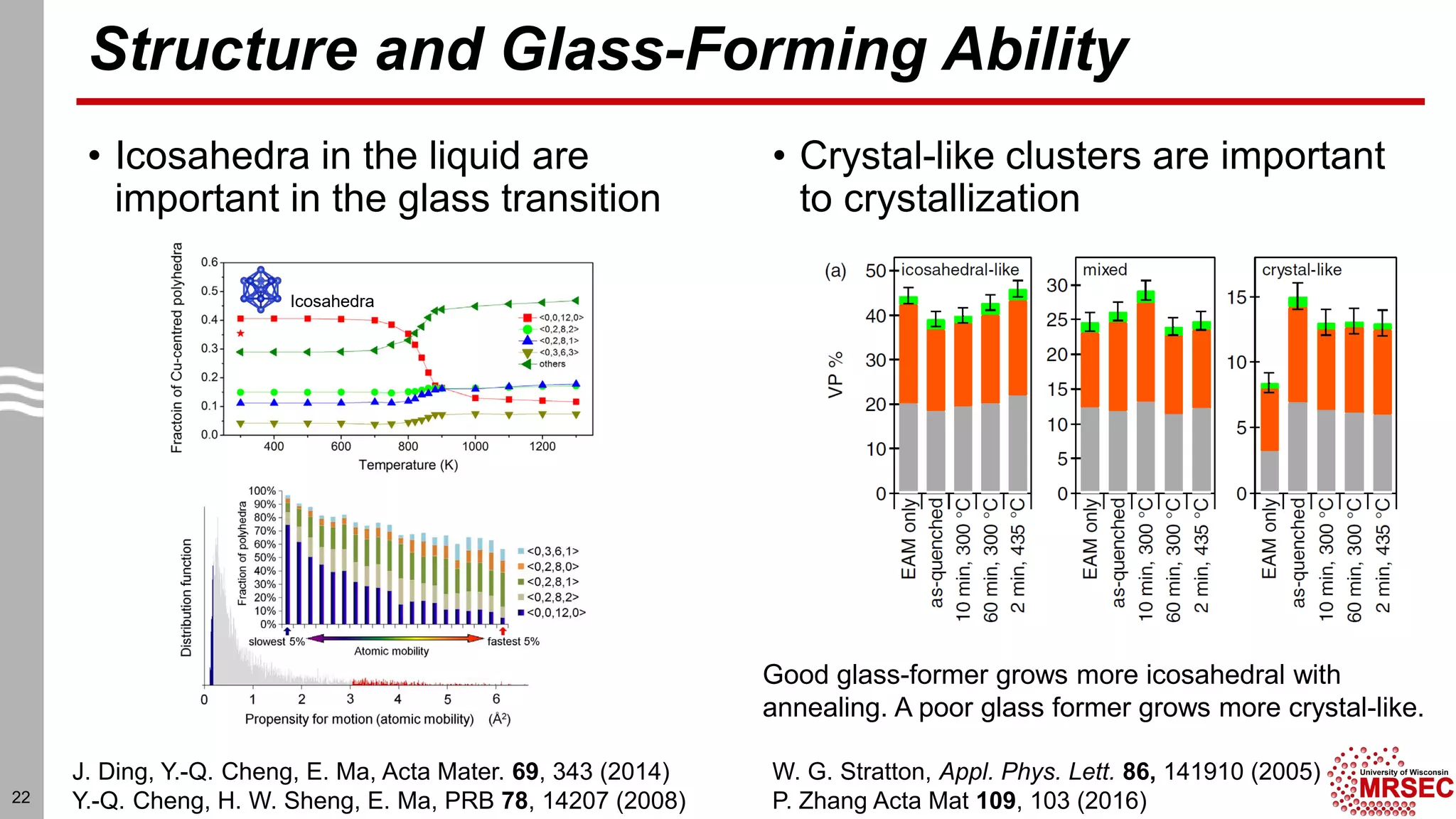
• Icosahedra in the liquid are
important in the glass transition
• Crystal-like clusters are important
to crystallization
22
Icosahedra
J. Ding, Y.-Q. Cheng, E. Ma, Acta Mater. 69, 343 (2014)
Y.-Q. Cheng, H. W. Sheng, E. Ma, PRB 78, 14207 (2008)
W. G. Stratton, Appl. Phys. Lett. 86, 141910 (2005)
P. Zhang Acta Mat 109, 103 (2016)
Good glass-former grows more icosahedral with
annealing. A poor glass former grows more crystal-like.
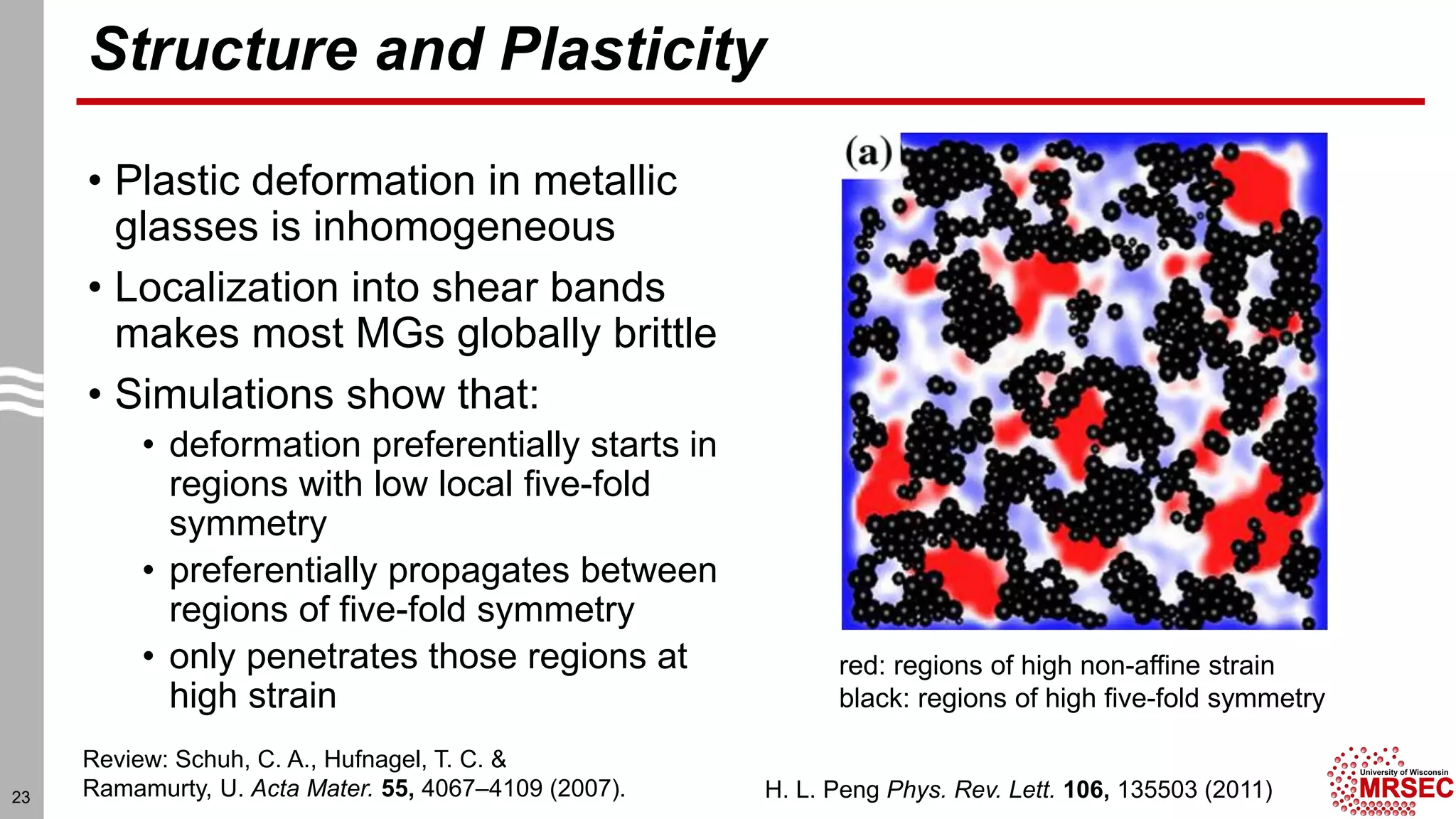
Structure and Plasticity
• Plastic deformation in metallic
glasses is inhomogeneous
• Localization into shear bands
makes most MGs globally brittle
• Simulations show that:
• deformation preferentially starts in
regions with low local five-fold
symmetry
• preferentially propagates between
regions of five-fold symmetry
• only penetrates those regions at
high strain
23 H. L. Peng Phys. Rev. Lett. 106, 135503 (2011)
red: regions of high non-affine strain
black: regions of high five-fold symmetry
Review: Schuh, C. A., Hufnagel, T. C. &
Ramamurty, U. Acta Mater. 55, 4067–4109 (2007).
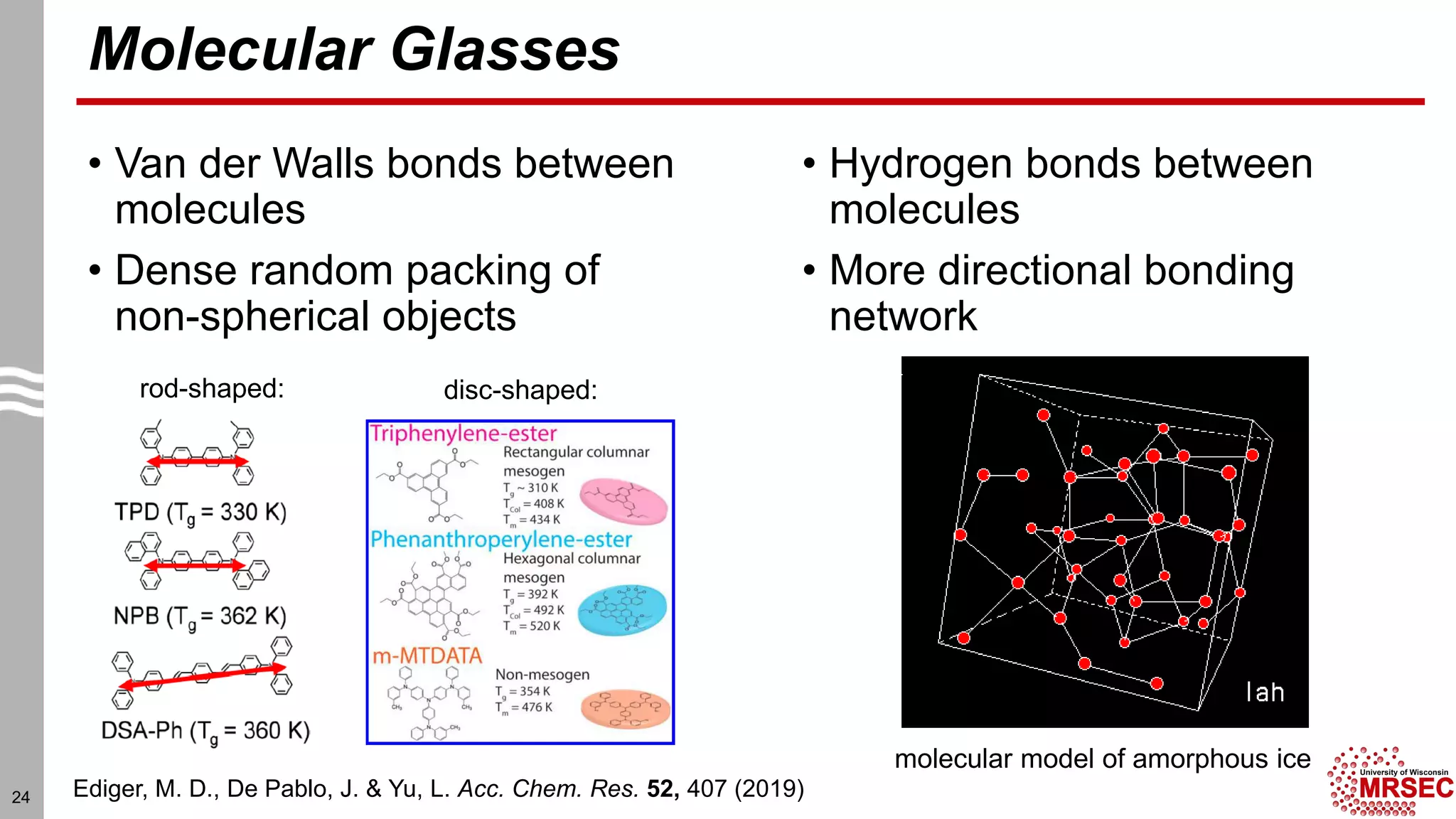
Molecular Glasses
• Van der Walls bonds between
molecules
• Dense random packing of
non-spherical objects
• Hydrogen bonds between
molecules
• More directional bonding
network
24 Ediger, M. D., De Pablo, J. & Yu, L. Acc. Chem. Res. 52, 407 (2019)
rod-shaped: disc-shaped:
molecular model of amorphous ice
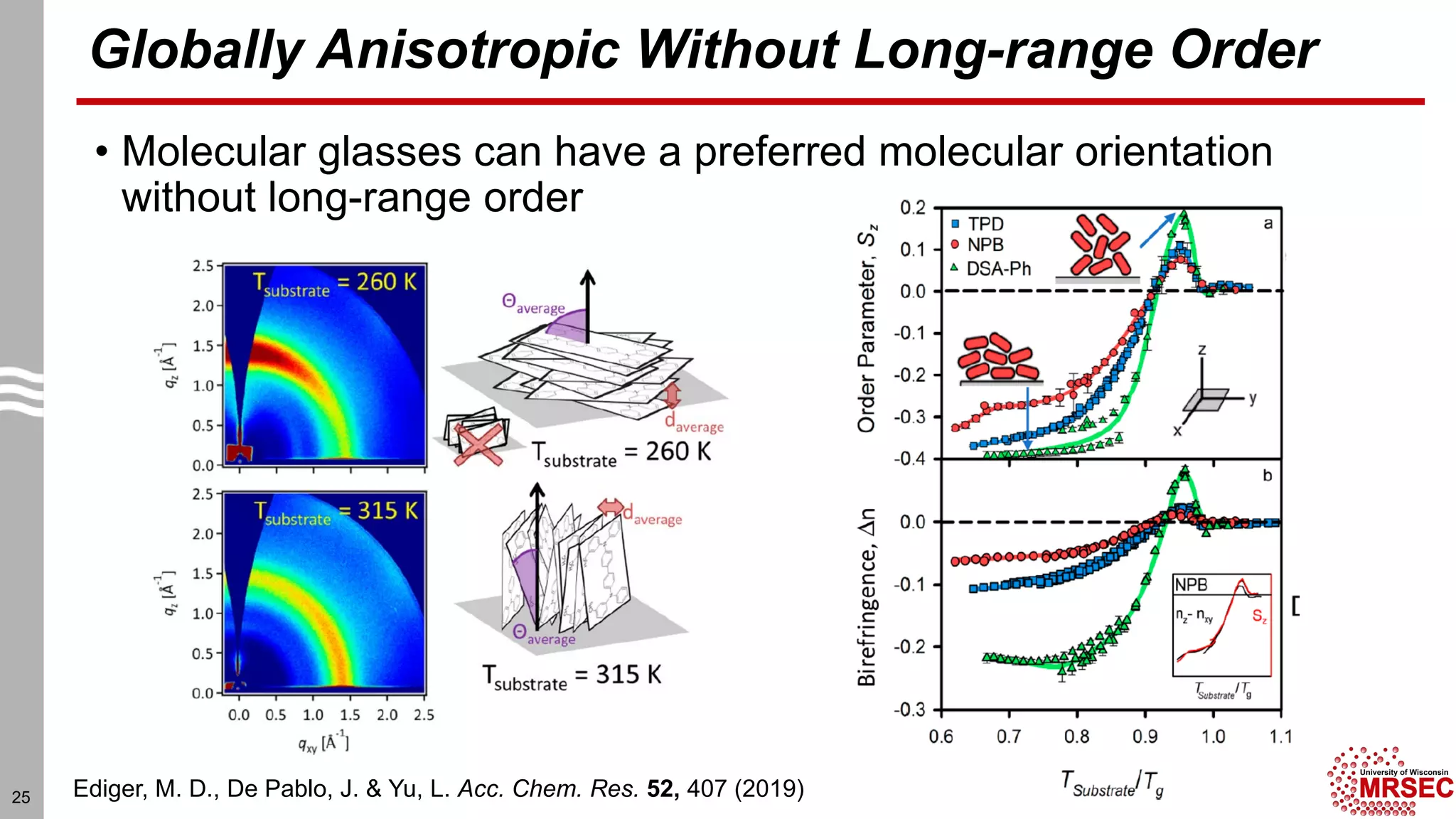
Globally Anisotropic Without Long-range Order
• Molecular glasses can have a preferred molecular orientation
without long-range order
25 Ediger, M. D., De Pablo, J. & Yu, L. Acc. Chem. Res. 52, 407 (2019)
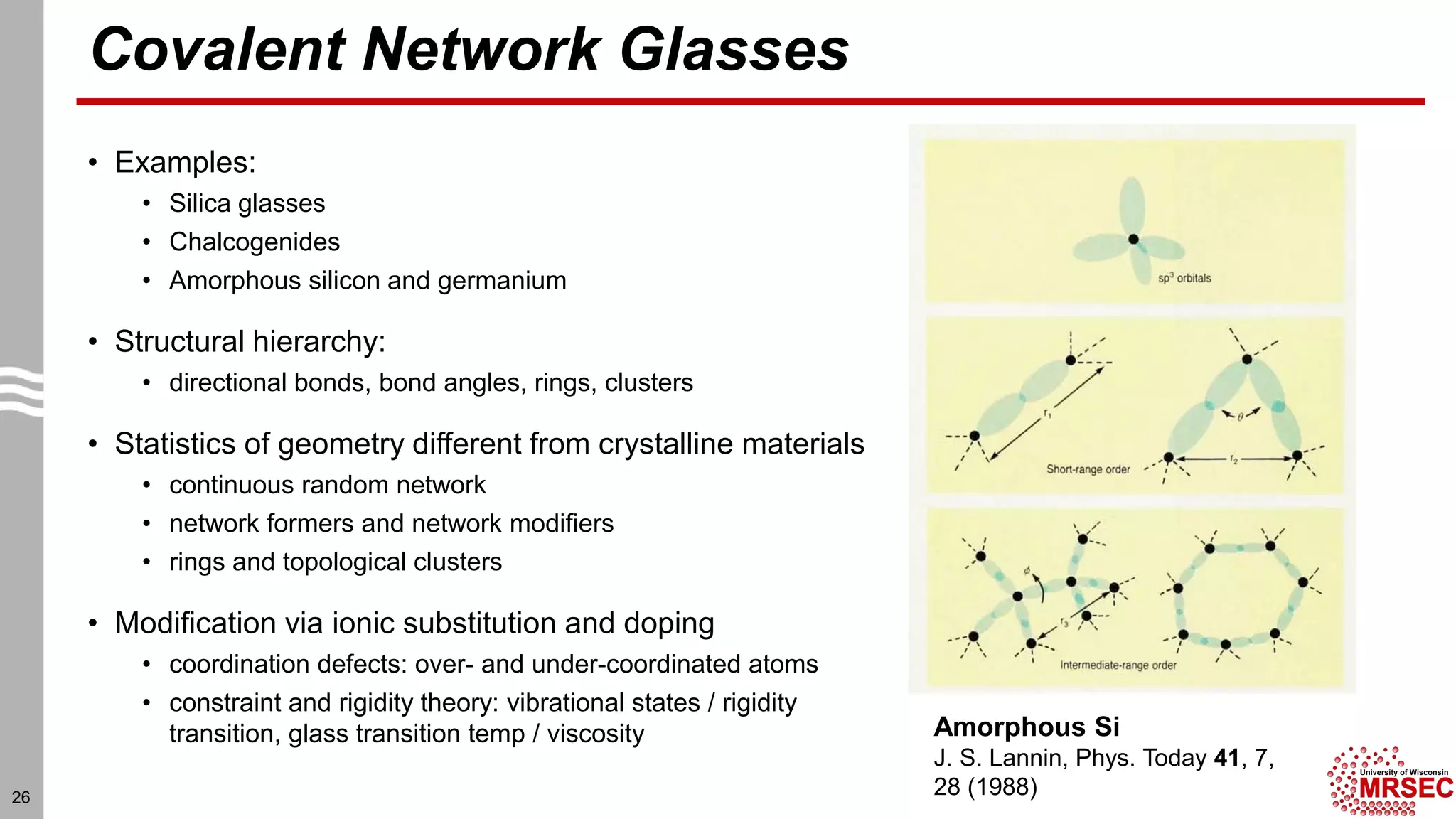
Covalent Network Glasses
• Examples:
• Silica glasses
• Chalcogenides
• Amorphous silicon and germanium
• Structural hierarchy:
• directional bonds, bond angles, rings, clusters
• Statistics of geometry different from crystalline materials
• continuous random network
• network formers and network modifiers
• rings and topological clusters
• Modification via ionic substitution and doping
• coordination defects: over- and under-coordinated atoms
• constraint and rigidity theory: vibrational states / rigidity
transition, glass transition temp / viscosity
26
Amorphous Si
J. S. Lannin, Phys. Today 41, 7,
28 (1988)
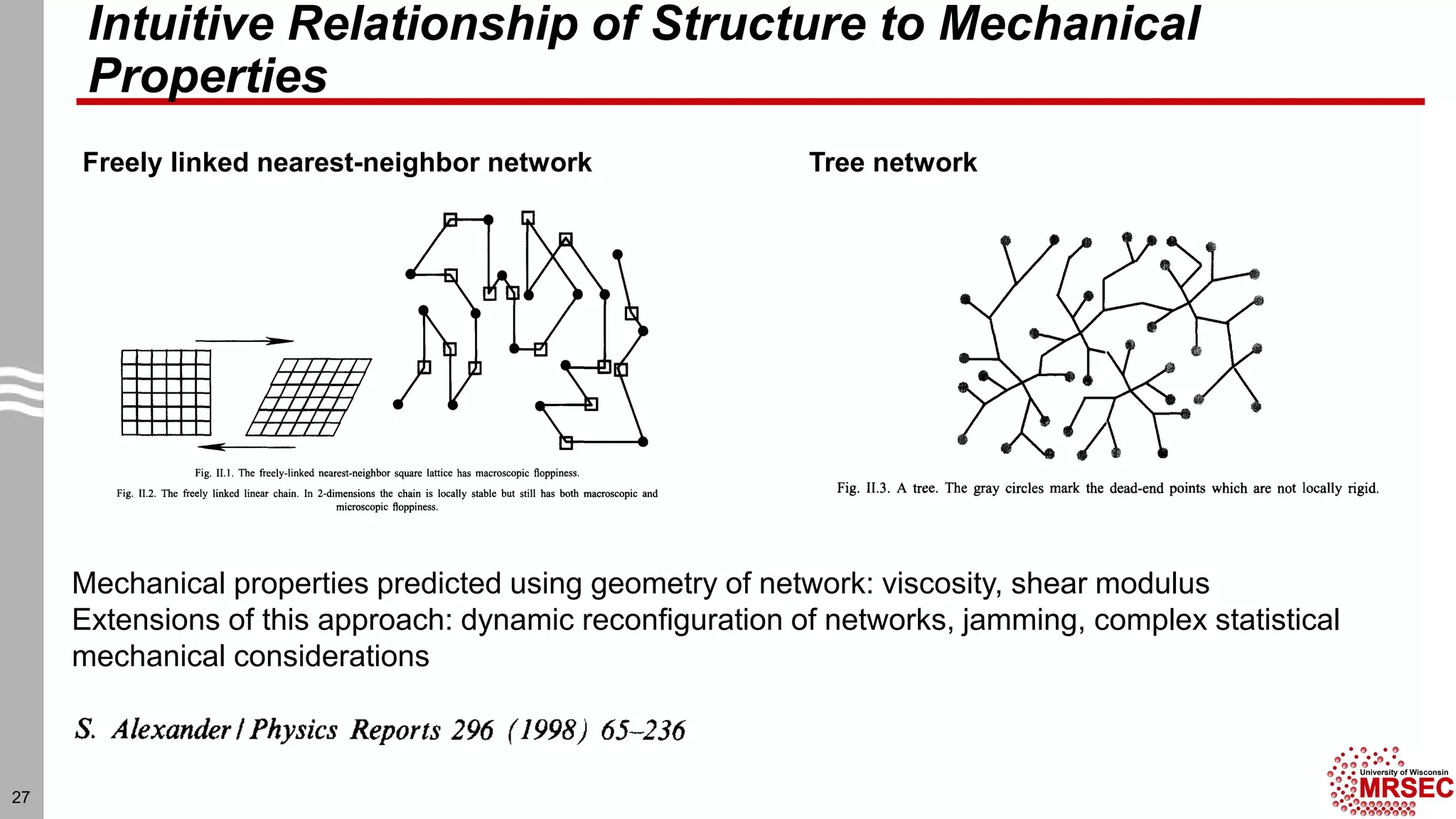
Intuitive Relationship of Structure to Mechanical
Properties
27
Freely linked nearest-neighbor network Tree network
Mechanical properties predicted using geometry of network: viscosity, shear modulus
Extensions of this approach: dynamic reconfiguration of networks, jamming, complex statistical
mechanical considerations
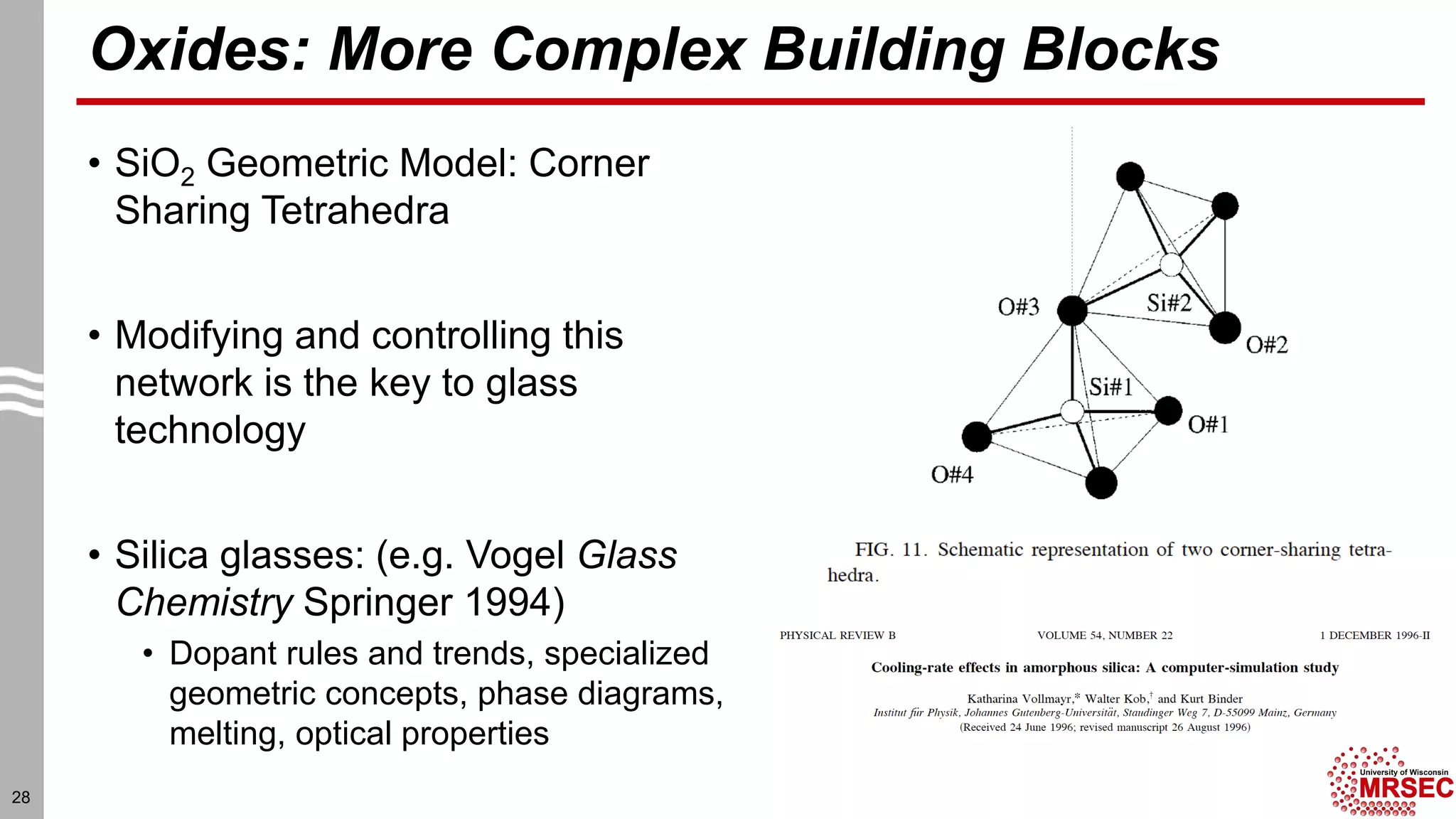
Oxides: More Complex Building Blocks
• SiO2 Geometric Model: Corner
Sharing Tetrahedra
• Modifying and controlling this
network is the key to glass
technology
• Silica glasses: (e.g. Vogel Glass
Chemistry Springer 1994)
• Dopant rules and trends, specialized
geometric concepts, phase diagrams,
melting, optical properties
28
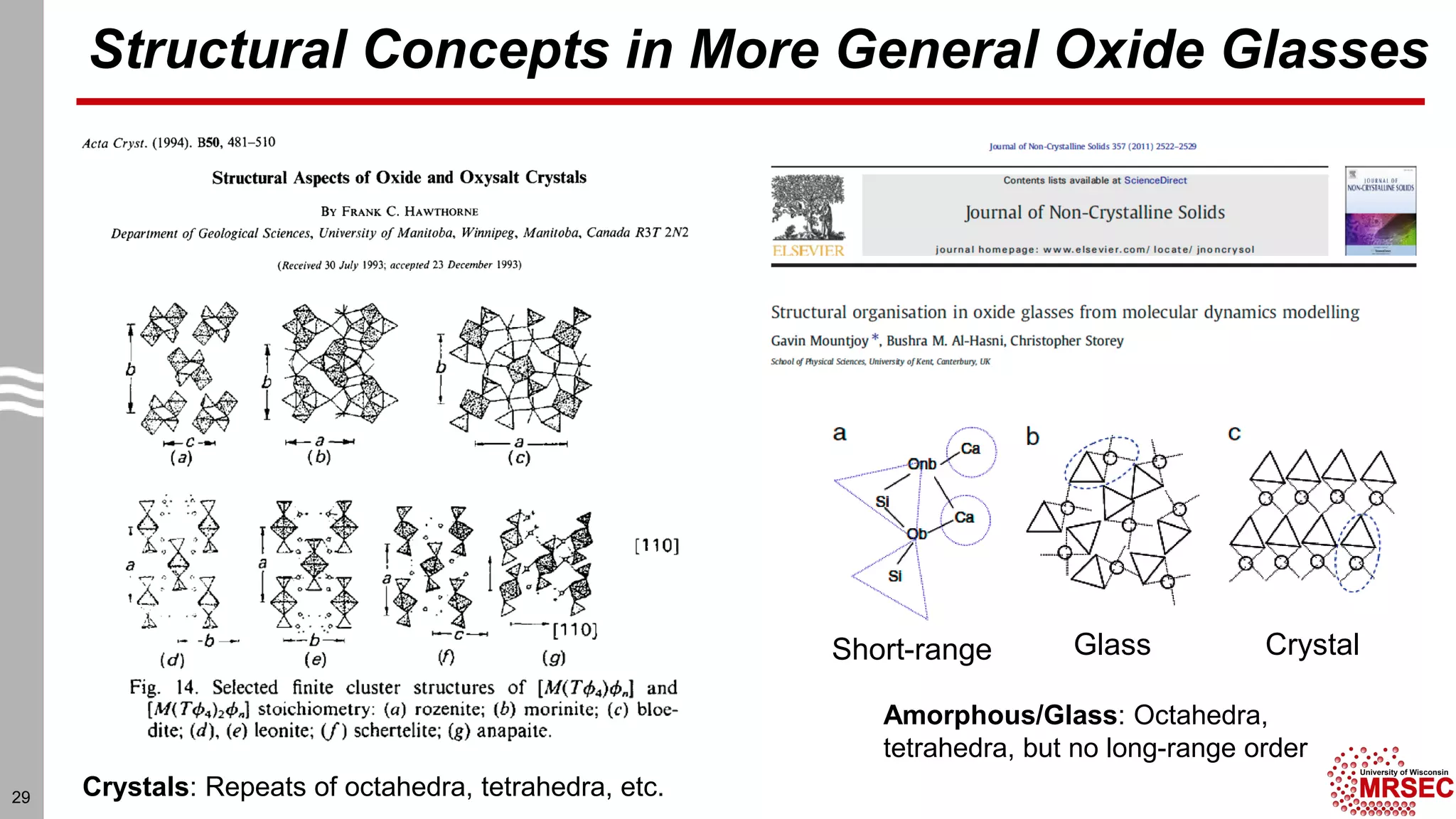
Structural Concepts in More General Oxide Glasses
29 Crystals: Repeats of octahedra, tetrahedra, etc.
Amorphous/Glass: Octahedra,
tetrahedra, but no long-range order
Short-range Glass Crystal
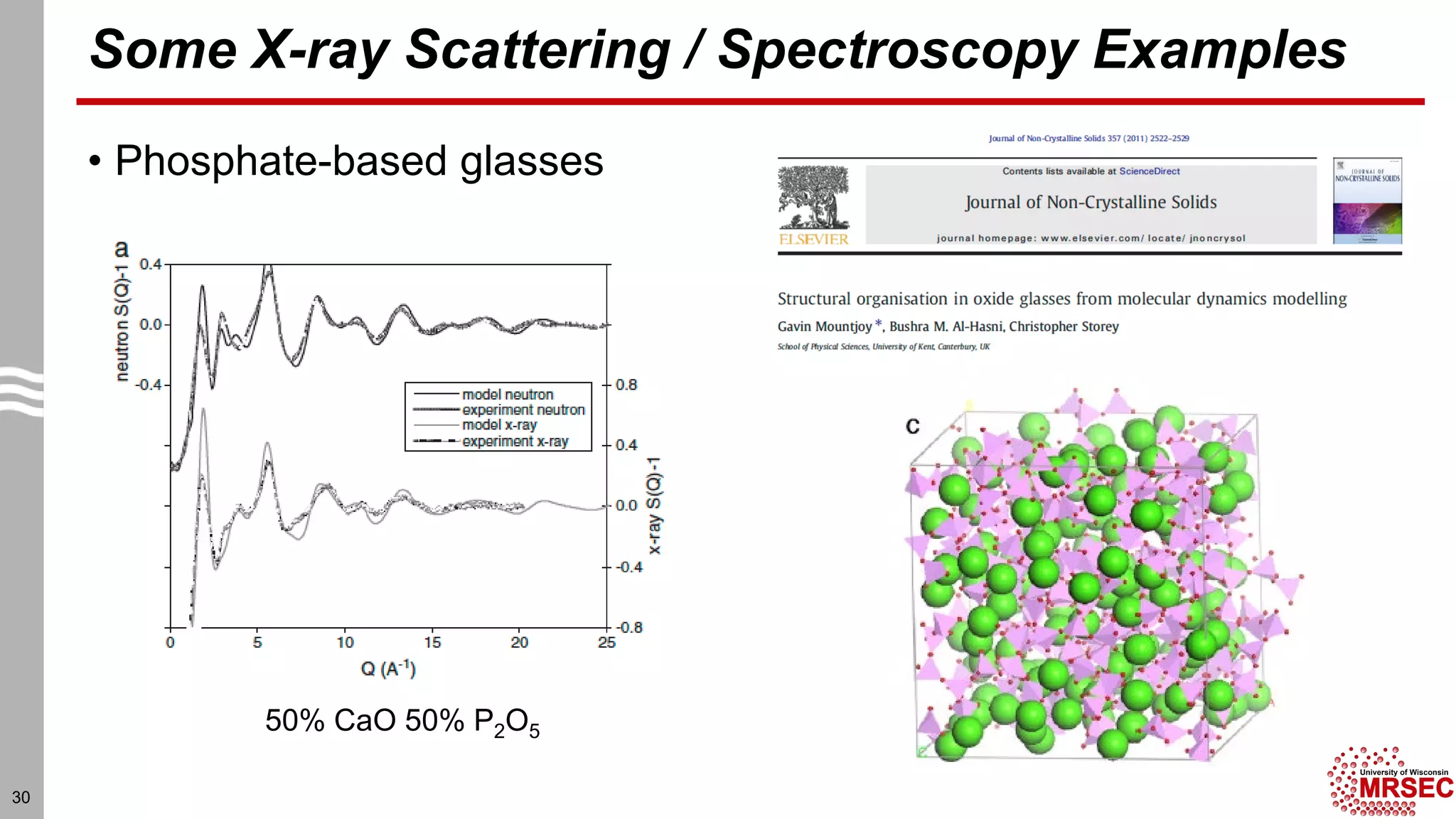
Some X-ray Scattering / Spectroscopy Examples
• Phosphate-based glasses
30
50% CaO 50% P2O5
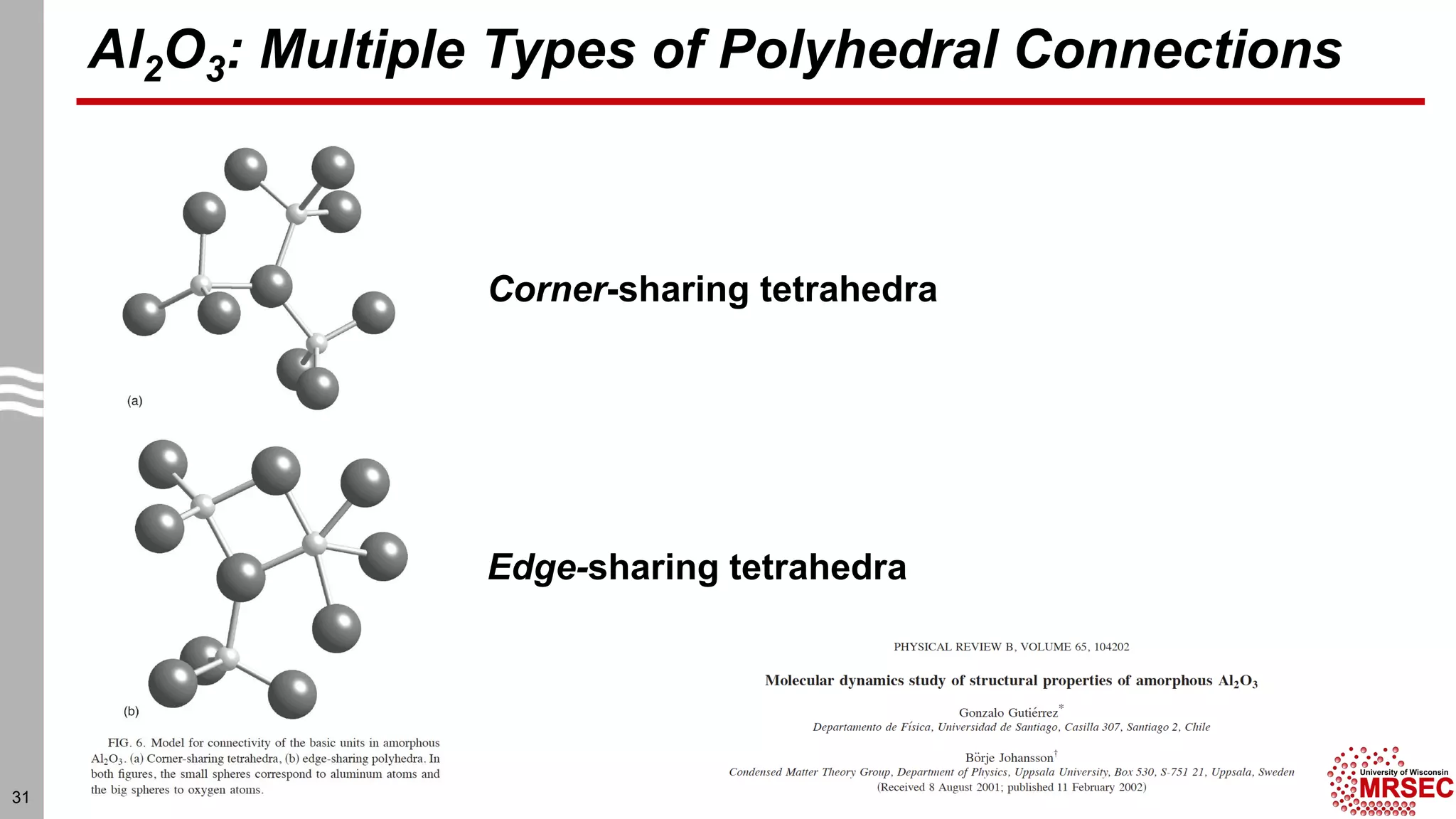
Al2O3: Multiple Types of Polyhedral Connections
31
Corner-sharing tetrahedra
Edge-sharing tetrahedra
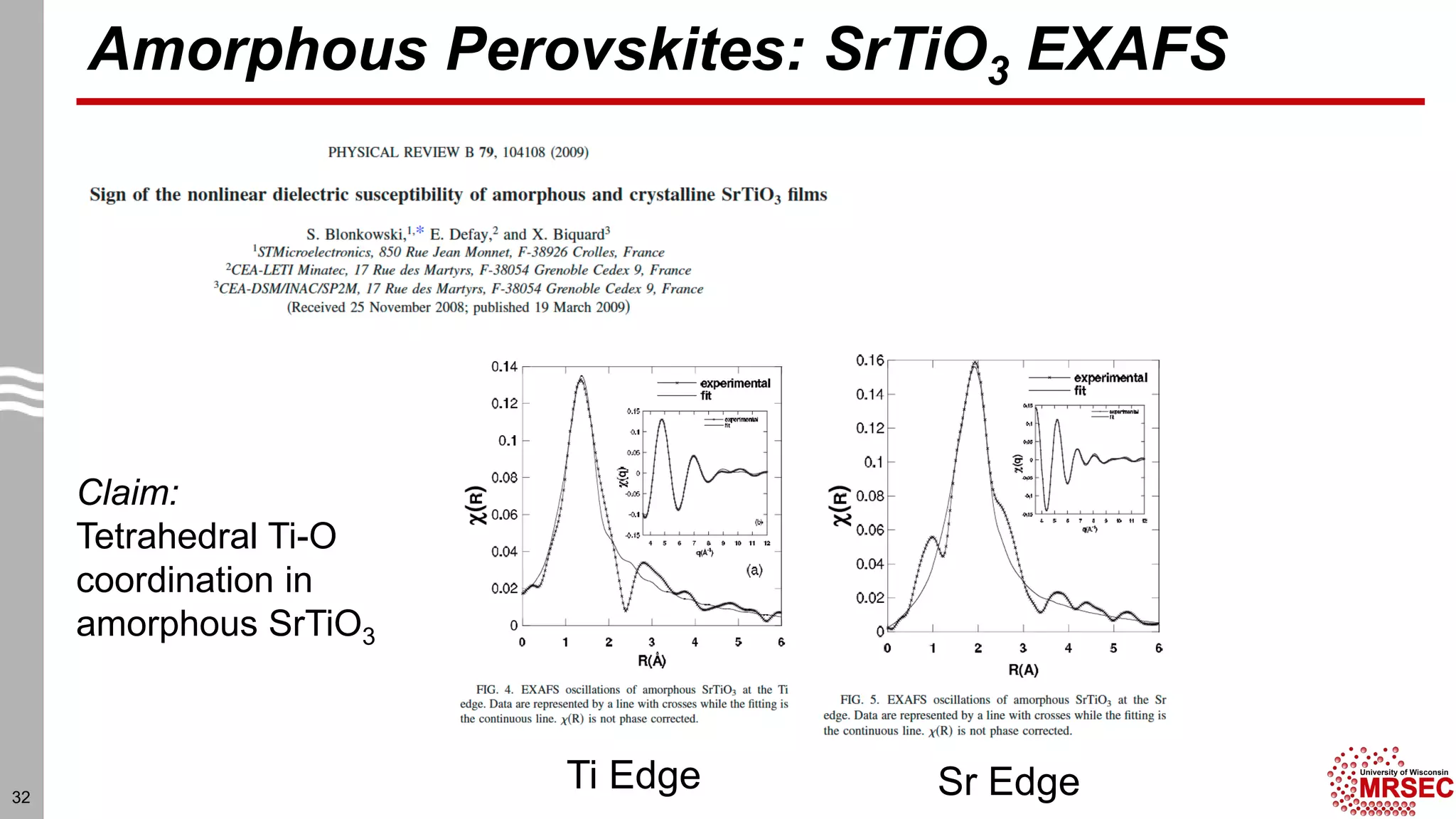
Amorphous Perovskites: SrTiO3 EXAFS
32
Ti Edge Sr Edge
Claim:
Tetrahedral Ti-O
coordination in
amorphous SrTiO3
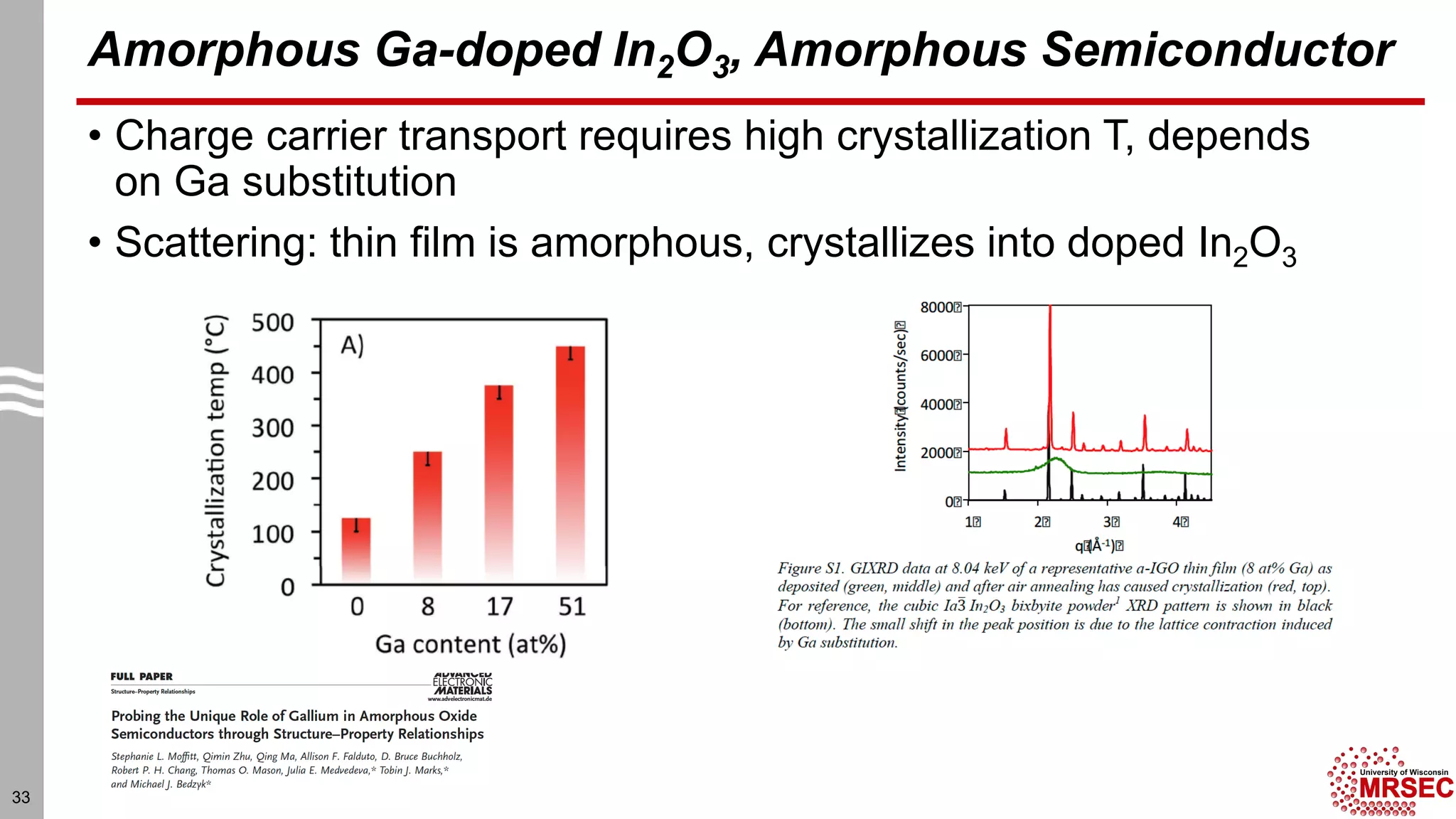
Amorphous Ga-doped In2O3, Amorphous Semiconductor
• Charge carrier transport requires high crystallization T, depends
on Ga substitution
• Scattering: thin film is amorphous, crystallizes into doped In2O3
33
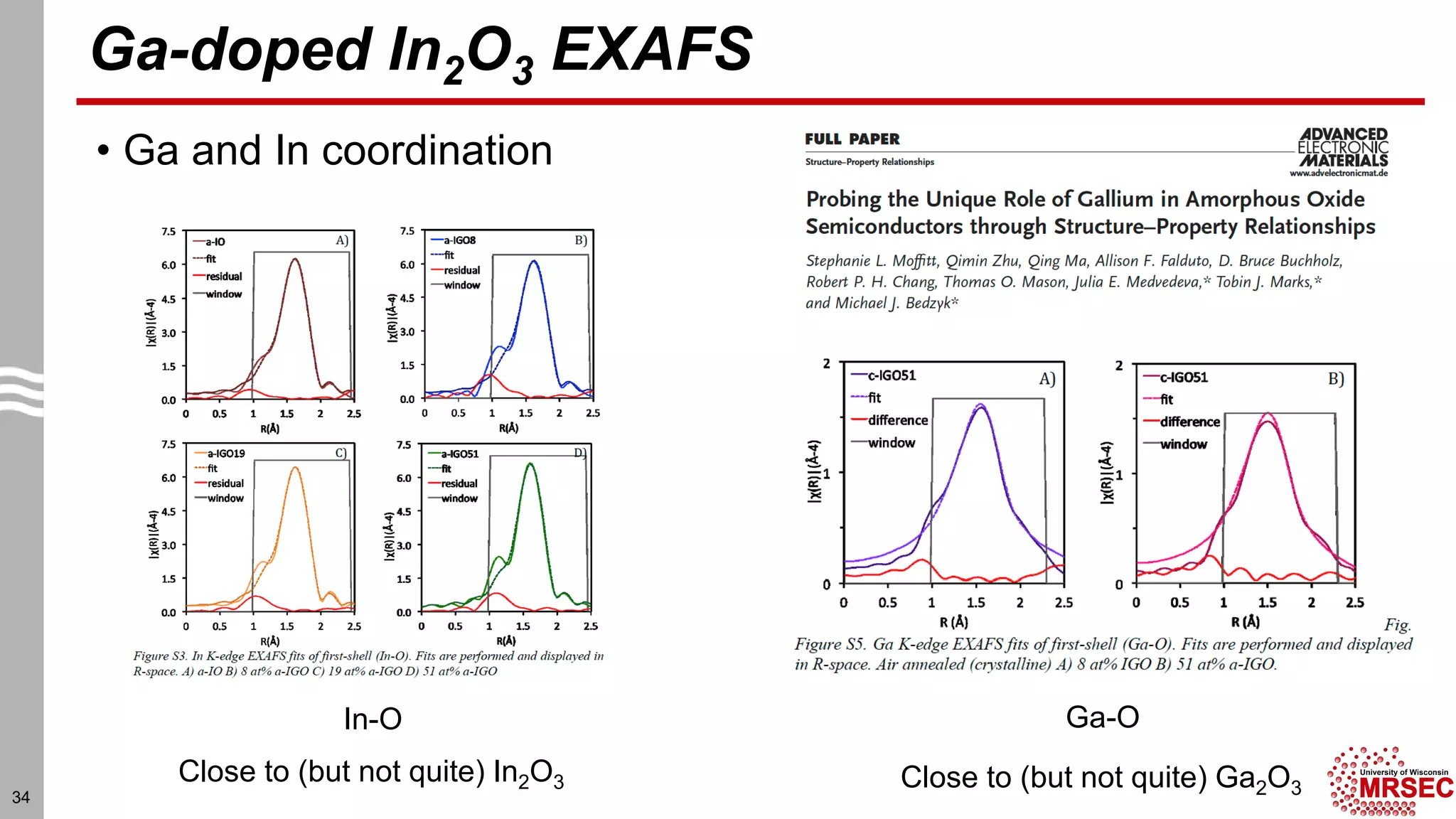
Ga-doped In2O3 EXAFS
• Ga and In coordination
34
In-O Ga-O
Close to (but not quite) In2O3 Close to (but not quite) Ga2O3
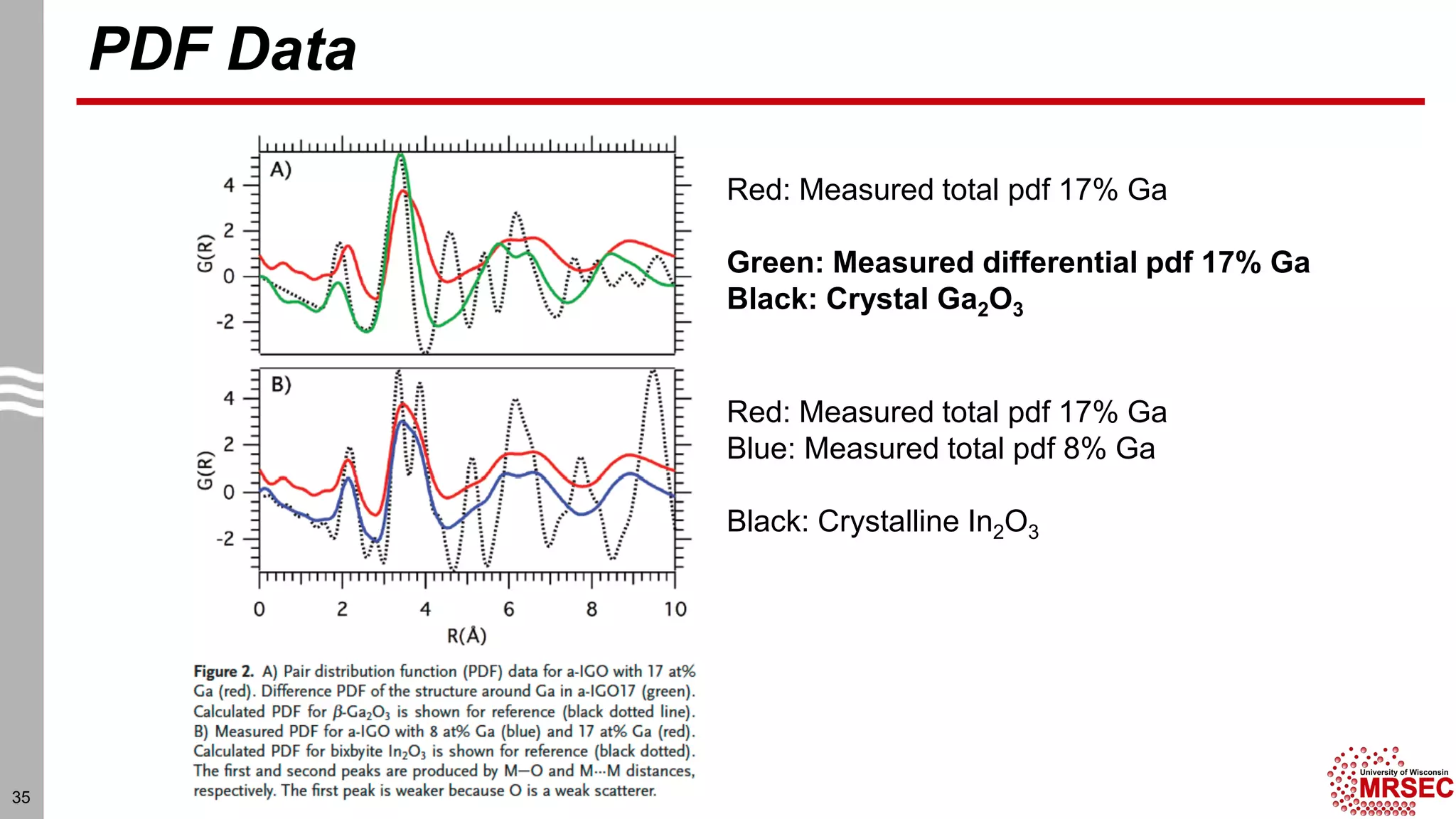
PDF Data
35
Red: Measured total pdf 17% Ga
Green: Measured differential pdf 17% Ga
Black: Crystal Ga2O3
Red: Measured total pdf 17% Ga
Blue: Measured total pdf 8% Ga
Black: Crystalline In2O3
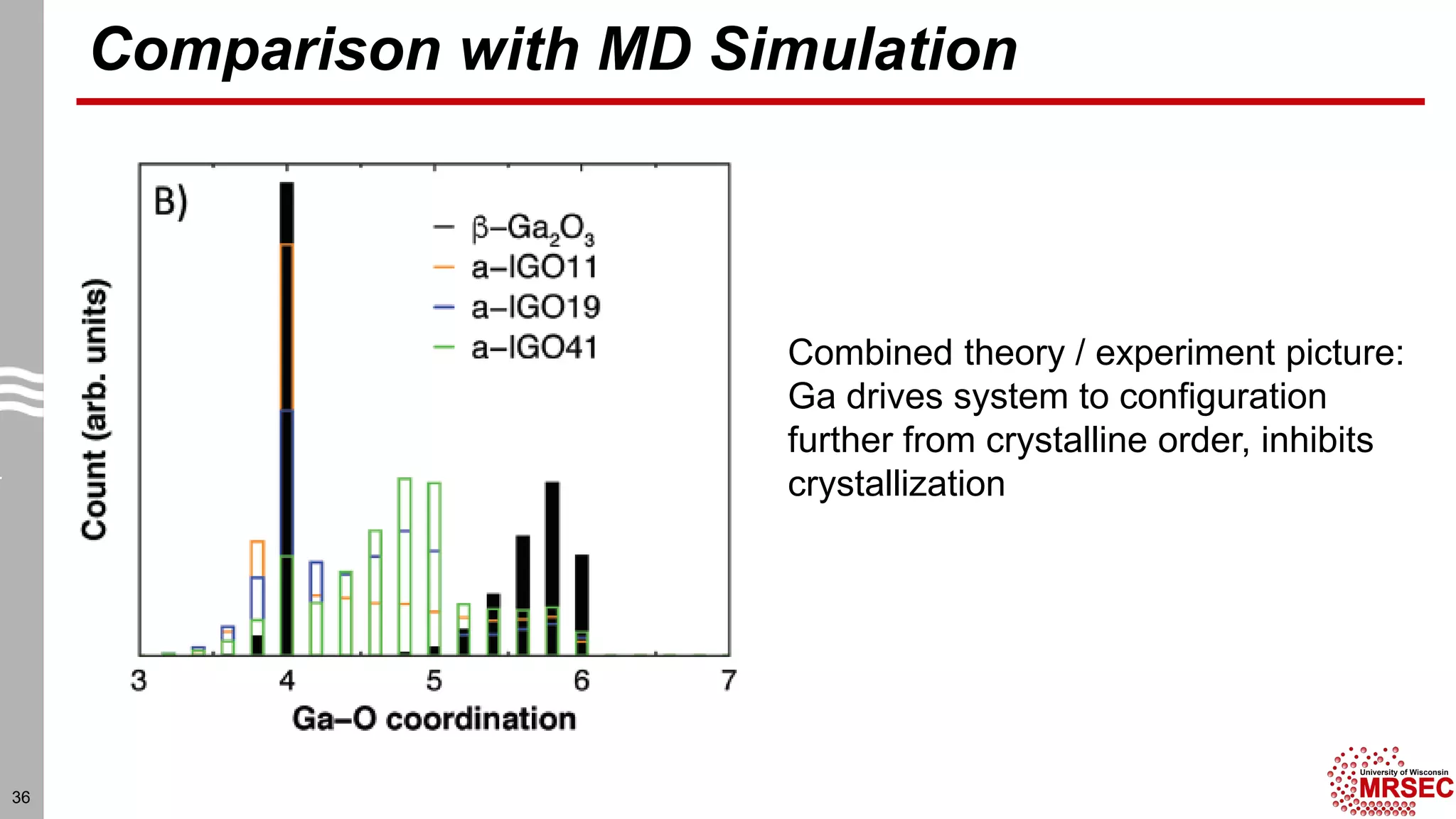
Comparison with MD Simulation
36
Combined theory / experiment picture:
Ga drives system to configuration
further from crystalline order, inhibits
crystallization
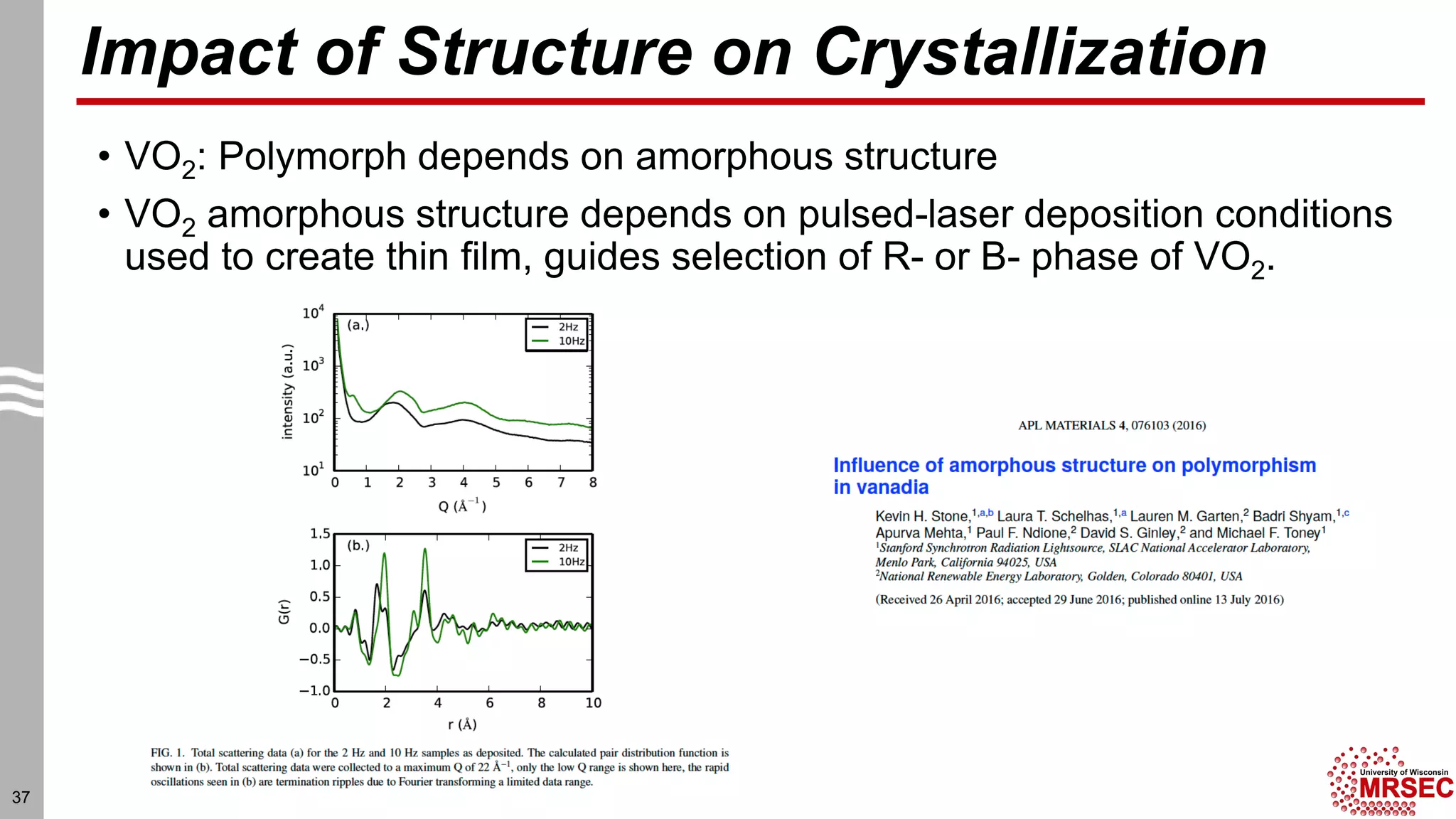
37
• VO2: Polymorph depends on amorphous structure
• VO2 amorphous structure depends on pulsed-laser deposition conditions
used to create thin film, guides selection of R- or B- phase of VO2.
Impact of Structure on Crystallization
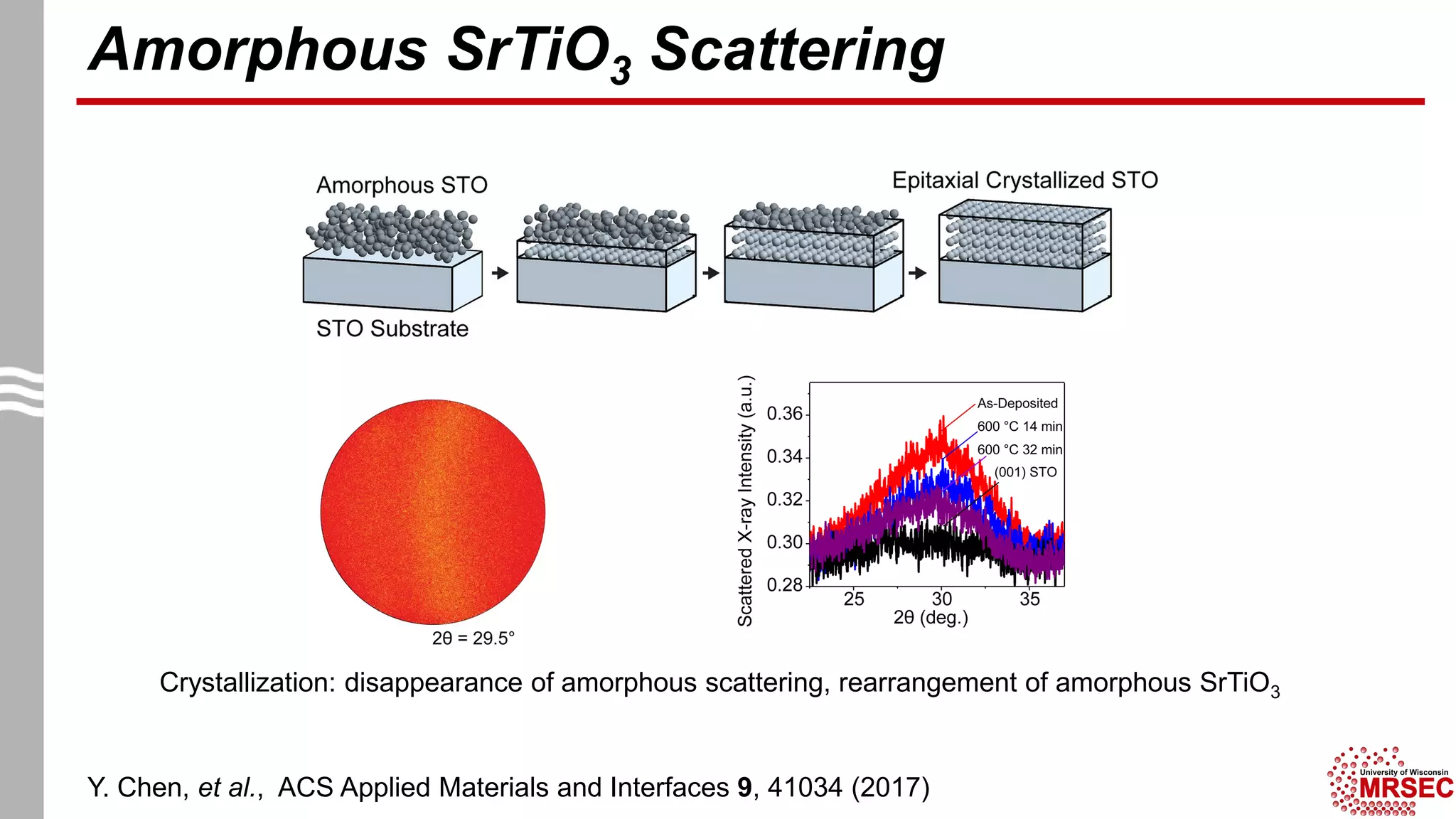
Amorphous SrTiO3 Scattering
Crystallization: disappearance of amorphous scattering, rearrangement of amorphous SrTiO3
Y. Chen, et al., ACS Applied Materials and Interfaces 9, 41034 (2017)
Amorphous Complex Oxides
• No simple rule for the real-space interpretation of amorphous x-
ray scattering patterns from complex oxides
• Often combined with calculation to test structural models
• Combination of scattering with spectroscopic methods to
provide elemental sensitivity
39
Summary
• Amorphous solids lack long-range translational order, but often have
strong short-range order
• Short-range order is controlled by interatomic bonding:
• packing efficiency for spherical bonds (metals and molecules)
• directional bond networks for covalent and hydrogen bonds (silicates and
water)
• preferred polyhedral for ionic bonds (metal oxides)
• Short-range structure in an amorphous solid often mimics structure
of corresponding crystals
• Lots of ways to characterize amorphous structures with experiments
and simulations.
• Structure impacts crystallization, stability in the amorphous state,
mechanical, electronic, and other properties.
40

Amorphous Materials: Structural Principles and Characterization

  • 1.
    NSF Grant DMR-1720415 AmorphousMaterials: Structural Principles and Characterization Paul M. Voyles and Paul G. Evans Department of Materials Science and Engineering
  • 2.
    Overview • Basic structuralfeatures of amorphous materials: • short-range order dominated by atomic bonding • no long-range translational order • Common methods of structural characterization for amorphous materials: • variations on the theme of pair distribution functions • Structure of various classes of amorphous materials: • metallic glasses • molecular glasses • covalent network glasses, especially silicates • ionic amorphous solids, especially metal oxides • Summary 2 https://go.wisc.edu/u2069r Articles available at:
  • 3.
    Common Structural Featuresof Amorphous Materials • Short-range order: • Nearest-neighbor atomic distances, angles, coordination number, etc. • Dominated by interatomic bonding • Often similar to crystalline analogs • No long-range translational symmetry 3 • No Bragg peaks in diffraction covalent network sphere packing
  • 4.
    Goals of StructuralCharacterization • Chemical state and coordination of component atoms/molecules • Local and global structural order • Impact of amorphous structure on stability, crystallization, and other properties and processes • Many tools available: • X-ray scattering, diffraction, and spectroscopy • Neutron diffraction • Electron microscopy and scattering • Raman spectroscopy • Nuclear magnetic resonance • Inelastic x-ray and neutron scattering 4
  • 5.
    X-ray, Neutron, andElectron Scattering • Measure scattered intensity as a function of direction • Precise measurement, wide angular range 5
  • 6.
    Structure Factor S(Q) 6 X-ray/ neutron / electron scattering intensity depends directly on S(Q) When data is very good:
  • 7.
    Quantitative Relationship BetweenExperiment and g(r) 7 X-ray scattering intensity from arbitrary arrangement of atoms Break into two contributions Assume that amorphous sample is isotropic 𝐼𝐼 𝐐𝐐 = 𝑓𝑓 𝐐𝐐 2 � 𝑛𝑛 𝑒𝑒𝑖𝑖 𝐐𝐐⋅𝐫𝐫𝑛𝑛 � 𝑚𝑚 𝑒𝑒−𝑖𝑖 𝐐𝐐⋅𝐫𝐫𝑚𝑚 = 𝑓𝑓 𝐐𝐐 2 � 𝑛𝑛 � 𝑚𝑚 𝑒𝑒−𝑖𝑖 𝐐𝐐⋅ 𝐫𝐫𝑛𝑛−𝐫𝐫𝑚𝑚
  • 8.
    Structure of Non-crystallineMaterials • Radial distribution function g(r): monatomic sample • Caution: people go back and forth between “radial distribution function” and pair distribution function. Also k and Q are often switched! 8 = average atomic number density Als Nielsen and McMorrow Elements of Modern X-ray Physics 2011
  • 9.
    Radial Distribution Function •Many possible statistical descriptions of scattering from non-periodic materials. • Simplest: Radial distribution function • Determine from scattering pattern S(Q): Non-periodic atomic arrangement Liquid Ni scattering pattern and r.d.f.Als Nielsen and McMorrow Elements of Modern X-ray Physics 2011 9
  • 10.
    Multi-ion Systems: PartialStructure Factor and Partial Pair-Distribution Functions 10 Measuring Sαβ(Q) accurately is very hard! Not enough information in I(Q). Two ions α and β
  • 11.
    Anomalous X-ray Scattering 11 •Example: GeSe and GeSe2 amorphous thin films ”Anomalous” scattering: use the idea that f(Q) depends on the x-ray photon energy.
  • 12.
    Difference pdf “d-pdf” 12 KnownMeasurable Strategy:Find Sαβ(Q), transform to find ραβ.
  • 13.
    Amorphous Metals /Metallic Glasses • Binary (at least) alloys which can be made glassy by casting • Cooling rates from 106 to ~1 K/s • Applications driven by: • high Young’s modulus at low weight • good corrosion resistance • biocompatibility • high processability • Cannot currently predict glass forming ability of new alloys or design metallic glasses with desired properties. images from Jan Schroers, Yale Structure of Materials: an Introduction to Crystallography, Diffraction, and Symmetry, Marc de Graef and Michael E. McHenry, Chapter 2113
  • 14.
    Dense Random Packing •Model for metallic liquids and glasses as frozen liquids • Treat metal atoms as hard spheres: • attractive potential up to some bond distance r • repulsive for shorter distance • spherical symmetric • Maximize the packing fraction without introducing crystallographic order 14 J. D. Bernal, Proc. R. Soc. Lond. A. Math. Phys. Sci. 280, 299 (1964). liquid Ar PDF Bernal random model Schott random model ball bearings in epoxy
  • 15.
    Voronoi Polyhedron andIcosahedral Order • Space closest to one atom • Characteristic of nearest-neighbor structures • Icosahedron has only five-fold rotational symmetries • Non-crystallographically allowed symmetry stabilizes metallic liquids and glasses 15 2D J. Tsai, N. Voss, M. Gerstein, Bioinformatics. 17, 949–956 (2001). 3D bcc fcc <0 6 0 8> <0 12 0 0> hcp <0 6 0 2> icosahedral atoms Voronoi polyhedron: NPG Asia Mater. (2010), doi:10.1038/asiamat.2010.51. F. C. Frank, Proc. R. Soc. Lond. A. Math. Phys. Sci. 215, 43 (1952) indices <n3 n4 n5 n6> are # of sides on the polyhedron with n faces: <0 0 12 0>
  • 16.
    Varying Atomic Sizeand Efficient Packing 16 Y. Q. Cheng and E. Ma, Prog. Mater. Sci. 56, 379 (2011) F. C. Frank and J. S. Kasper, Acta Crystallogr. 12, 483 (1959) Frank-Kasper close-packed polyhedra atomic size ratio and preferred CNs D. B. Miracle, W. S. Sanders, O. N.Senkov, Philos. Mag. 83, 2409 (2003) T. Egami, Mater. Sci. Eng. A 226–228, 261–267 (1997)
  • 17.
    Chemical Short-Range Order •Neutron diffraction with isotope substitution from Al87Ni7Nd6 glass • Significant Ni-Ni ordering at 5 Å length scale: Ni-Al-Ni • Anomalous x-ray scattering at Ni K- edge on La55Al25Ni20 • Strong ordering of La around Ni 17 K. Ahn, D. Louca, S. J. Poon, G. J. Shiflet, Phys. Rev. B 70, 224103 (2004). E. Matsubara, T. Tamura, Y. Waseda, T. Zhang, A. Inoue, T. Masumoto, T. J. Non. Cryst. Solids 150, 380 (1992) total RDF Ni-centered RDF La-Ni pairs
  • 18.
    CSRO and EfficientPacking • Solute-centered clusters: • solvent shells determine by packing efficiency • 3rd atoms in interstitial spaces • Few dominant “quasi-equivalent” SRO cluster types for each glass • Icosahedral and quasi-icosahedral • Edge, face, and corner sharing 18 D. B. Miracle, Nat. Mater. 3, 697 (2004) H. W. Sheng, W. K. Luo, F. M. Alamgir, J. M. Bai, E. Ma, Nature 439, 419–25 (2006)
  • 19.
    Non-icosahedral Glasses • Mixturesof metal and “metalloid” atoms like B, C, Si, and P have non-icosahedral short-range order • Some directional bonding from the metalloid atoms 19 P. H. Gaskell, J. Non. Cryst. Solids 32, 207 (1979) J. J. Maldonis and P. M. Voyles Arxiv: 1901.07014 Trigonal prism with connections for generic metal-metalloid glass Bi-capped square antiprism in Pd-Si Z9 Frank-Kasper polyhedral in Ni-B H. W. Sheng, W. K. Luo, F. M. Alamgir, J. M. Bai, E. Ma, Nature 439, 419–25 (2006)
  • 20.
    Nanodiffraction with Electrons •Electron nanobeam diffraction: one pattern at a time • Fluctuation electron microscopy: statistics of lots of patterns 20 DP_1 DP_2 DP_3 DP_4 A. Hirata, P. Guan, T. Fujita, Y. Hirotsu, A. Inoue, A. R. Yavari, T. Sakurai, M. W. Chen, M. W. Nat. Mater. 10, 28 (2011) A. Hirata, L. J. Kang, T. Fujita, B. Klumov, K. Matsue, M. Kotani, A. R. Yavari, M. W. Chen, Science 341, 376 (2013) M. M. J. Treacy, J. M. Gibson, L. Fan, D. J. Paterson, I. McNulty, Reports Prog. Phys. 68, 2899 (2005)
  • 21.
    Competing Icosahedral andCrystal-like Clusters • Cluster with 6-fold rotational symmetry, called “crystal-like” • Chains of icosahedra, similar to quasicrystals 21 <0 1 10 3> <0 1 10 3> <0 3 6 3> <0 3 6 2> <0 2 8 2> <0 2 8 2> <0 2 8 2> <0 1 10 2> <0 2 8 2> <0 3 6 3> <0 2 8 1> <0 0 12 0> <0 2 8 2> J. Hwang, Z. Melgarejo, Y. E. Kalay, I. Kalay, M .J. Kramer, D. S. Stone, P. M. Voyles, Phys. Rev. Lett. 108, 195505 (2012)
  • 22.
    Structure and Glass-FormingAbility • Icosahedra in the liquid are important in the glass transition • Crystal-like clusters are important to crystallization 22 Icosahedra J. Ding, Y.-Q. Cheng, E. Ma, Acta Mater. 69, 343 (2014) Y.-Q. Cheng, H. W. Sheng, E. Ma, PRB 78, 14207 (2008) W. G. Stratton, Appl. Phys. Lett. 86, 141910 (2005) P. Zhang Acta Mat 109, 103 (2016) Good glass-former grows more icosahedral with annealing. A poor glass former grows more crystal-like.
  • 23.
    Structure and Plasticity •Plastic deformation in metallic glasses is inhomogeneous • Localization into shear bands makes most MGs globally brittle • Simulations show that: • deformation preferentially starts in regions with low local five-fold symmetry • preferentially propagates between regions of five-fold symmetry • only penetrates those regions at high strain 23 H. L. Peng Phys. Rev. Lett. 106, 135503 (2011) red: regions of high non-affine strain black: regions of high five-fold symmetry Review: Schuh, C. A., Hufnagel, T. C. & Ramamurty, U. Acta Mater. 55, 4067–4109 (2007).
  • 24.
    Molecular Glasses • Vander Walls bonds between molecules • Dense random packing of non-spherical objects • Hydrogen bonds between molecules • More directional bonding network 24 Ediger, M. D., De Pablo, J. & Yu, L. Acc. Chem. Res. 52, 407 (2019) rod-shaped: disc-shaped: molecular model of amorphous ice
  • 25.
    Globally Anisotropic WithoutLong-range Order • Molecular glasses can have a preferred molecular orientation without long-range order 25 Ediger, M. D., De Pablo, J. & Yu, L. Acc. Chem. Res. 52, 407 (2019)
  • 26.
    Covalent Network Glasses •Examples: • Silica glasses • Chalcogenides • Amorphous silicon and germanium • Structural hierarchy: • directional bonds, bond angles, rings, clusters • Statistics of geometry different from crystalline materials • continuous random network • network formers and network modifiers • rings and topological clusters • Modification via ionic substitution and doping • coordination defects: over- and under-coordinated atoms • constraint and rigidity theory: vibrational states / rigidity transition, glass transition temp / viscosity 26 Amorphous Si J. S. Lannin, Phys. Today 41, 7, 28 (1988)
  • 27.
    Intuitive Relationship ofStructure to Mechanical Properties 27 Freely linked nearest-neighbor network Tree network Mechanical properties predicted using geometry of network: viscosity, shear modulus Extensions of this approach: dynamic reconfiguration of networks, jamming, complex statistical mechanical considerations
  • 28.
    Oxides: More ComplexBuilding Blocks • SiO2 Geometric Model: Corner Sharing Tetrahedra • Modifying and controlling this network is the key to glass technology • Silica glasses: (e.g. Vogel Glass Chemistry Springer 1994) • Dopant rules and trends, specialized geometric concepts, phase diagrams, melting, optical properties 28
  • 29.
    Structural Concepts inMore General Oxide Glasses 29 Crystals: Repeats of octahedra, tetrahedra, etc. Amorphous/Glass: Octahedra, tetrahedra, but no long-range order Short-range Glass Crystal
  • 30.
    Some X-ray Scattering/ Spectroscopy Examples • Phosphate-based glasses 30 50% CaO 50% P2O5
  • 31.
    Al2O3: Multiple Typesof Polyhedral Connections 31 Corner-sharing tetrahedra Edge-sharing tetrahedra
  • 32.
    Amorphous Perovskites: SrTiO3EXAFS 32 Ti Edge Sr Edge Claim: Tetrahedral Ti-O coordination in amorphous SrTiO3
  • 33.
    Amorphous Ga-doped In2O3,Amorphous Semiconductor • Charge carrier transport requires high crystallization T, depends on Ga substitution • Scattering: thin film is amorphous, crystallizes into doped In2O3 33
  • 34.
    Ga-doped In2O3 EXAFS •Ga and In coordination 34 In-O Ga-O Close to (but not quite) In2O3 Close to (but not quite) Ga2O3
  • 35.
    PDF Data 35 Red: Measuredtotal pdf 17% Ga Green: Measured differential pdf 17% Ga Black: Crystal Ga2O3 Red: Measured total pdf 17% Ga Blue: Measured total pdf 8% Ga Black: Crystalline In2O3
  • 36.
    Comparison with MDSimulation 36 Combined theory / experiment picture: Ga drives system to configuration further from crystalline order, inhibits crystallization
  • 37.
    37 • VO2: Polymorphdepends on amorphous structure • VO2 amorphous structure depends on pulsed-laser deposition conditions used to create thin film, guides selection of R- or B- phase of VO2. Impact of Structure on Crystallization
  • 38.
    Amorphous SrTiO3 Scattering Crystallization:disappearance of amorphous scattering, rearrangement of amorphous SrTiO3 Y. Chen, et al., ACS Applied Materials and Interfaces 9, 41034 (2017)
  • 39.
    Amorphous Complex Oxides •No simple rule for the real-space interpretation of amorphous x- ray scattering patterns from complex oxides • Often combined with calculation to test structural models • Combination of scattering with spectroscopic methods to provide elemental sensitivity 39
  • 40.
    Summary • Amorphous solidslack long-range translational order, but often have strong short-range order • Short-range order is controlled by interatomic bonding: • packing efficiency for spherical bonds (metals and molecules) • directional bond networks for covalent and hydrogen bonds (silicates and water) • preferred polyhedral for ionic bonds (metal oxides) • Short-range structure in an amorphous solid often mimics structure of corresponding crystals • Lots of ways to characterize amorphous structures with experiments and simulations. • Structure impacts crystallization, stability in the amorphous state, mechanical, electronic, and other properties. 40