Typetheories
Personality Theories
Prepared By
Manu Melwin Joy
Research Scholar
School of Management Studies
CUSAT, Kerala, India.
Phone – 9744551114
Mail – manu_melwinjoy@yahoo.com
Kindly restrict the use of slides for personal purpose.
Please seek permission to reproduce the same in public
forms and presentations.
SAMSAMANTHA Type
TypeA
Choleric
Types Vs Traits
Personalitytypereferstothe psychological
classificationofdifferenttypesofpeople
Personalitytraitreferstopsychological
classification ofdifferentlevels ordegrees
For example, according to type theories, there are two types of people, introverts and extroverts. According to trait
theories, introversion and extroversion are part of a continuous dimension,with manypeople in the middle.
4 Temperamenttheory
Temperament theory has its roots in the ancient four humors theory.
It may have origins in ancient Egypt or Mesopotamia, but it was the
Greek physician Hippocrates (460–370 BC) who developed it into a
medical theory. Next, Galen (AD 131–200) developed the first
typology of temperament. The word "temperament" itself comes
from Latin "temperare", "to mix". In the ideal personality, the
complementary characteristics or warm-cool and dry-moist were
exquisitely balanced.
Temperament theory
Blood
Yellow bile
Black bile
Phlegm.
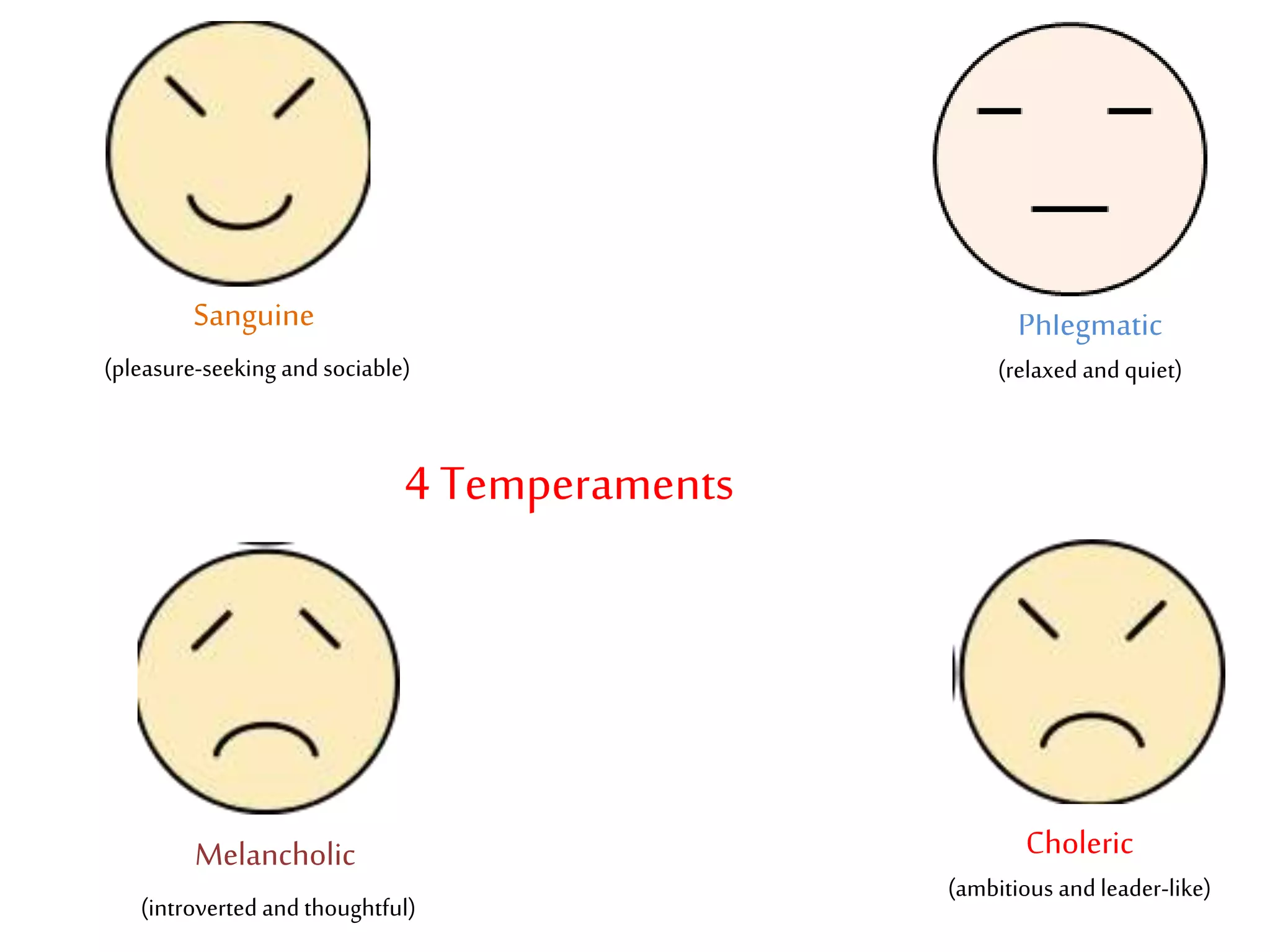
Sanguine (pleasure-seeking and sociable)
Choleric (ambitious and leader-like)
Melancholic (introverted and thoughtful)
Phlegmatic (relaxed and quiet)
4 Temperaments4 humors
Melancholic
(introverted and thoughtful)
Sanguine
(pleasure-seeking and sociable)
Choleric
(ambitious and leader-like)
4 Temperaments
Phlegmatic
(relaxed and quiet)
5 Temperament theory
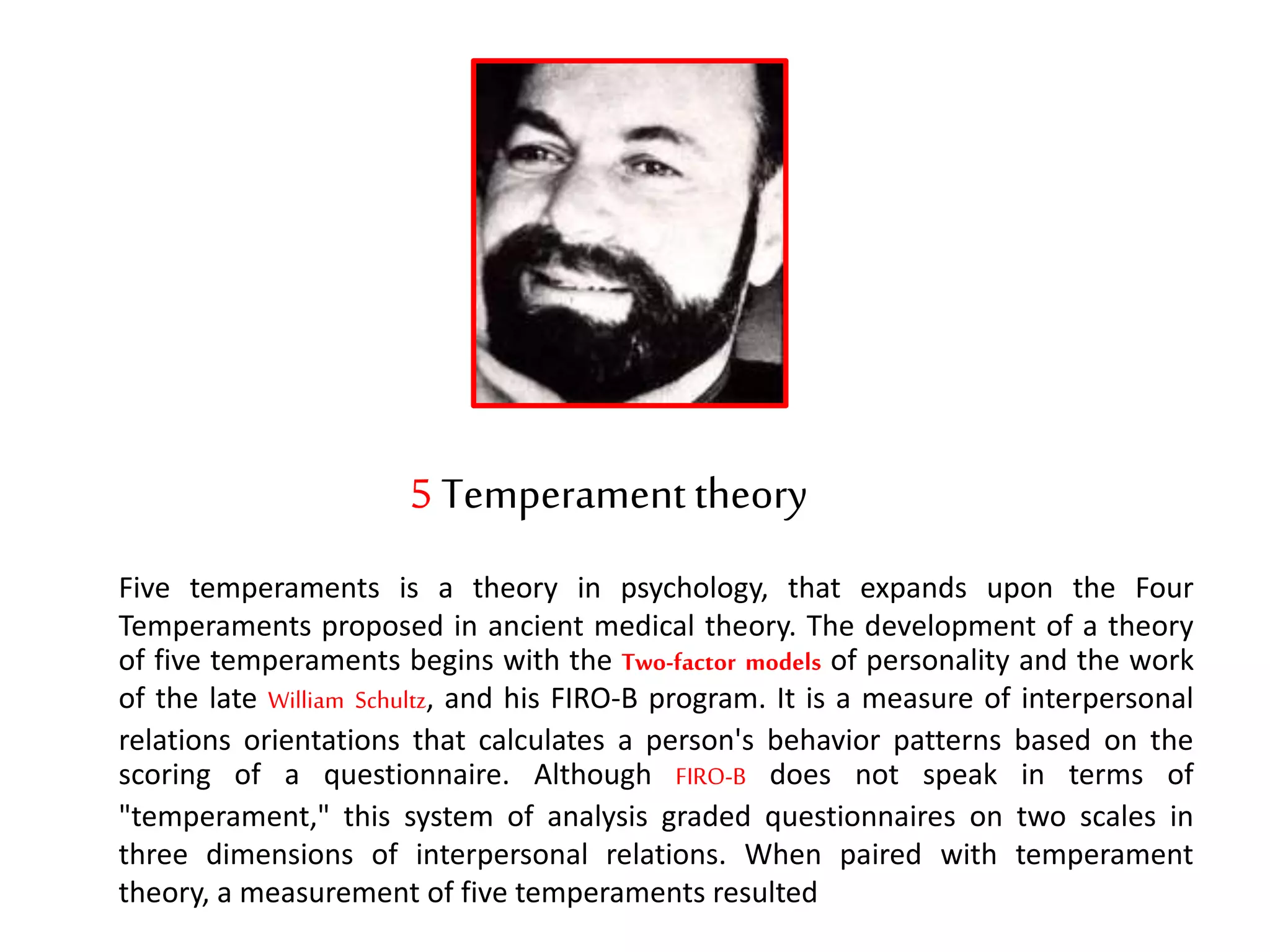
Five temperaments is a theory in psychology, that expands upon the Four
Temperaments proposed in ancient medical theory. The development of a theory
of five temperaments begins with the Two-factor models of personality and the work
of the late William Schultz, and his FIRO-B program. It is a measure of interpersonal
relations orientations that calculates a person's behavior patterns based on the
scoring of a questionnaire. Although FIRO-B does not speak in terms of
"temperament," this system of analysis graded questionnaires on two scales in
three dimensions of interpersonal relations. When paired with temperament
theory, a measurement of five temperaments resulted
5 Temperament theory
Blood
Yellow bile
Black bile
Phlegm.
Sanguine (pleasure-seeking and sociable)
Choleric (ambitious and leader-like)
Melancholic (introverted and thoughtful)
Phlegmatic (relaxed and quiet)
5 Temperaments4 humors
Supine (Low self esteem)
Melancholic
(introverted and thoughtful)
Phlegmatic
(relaxed and quiet)
Choleric
(ambitious and leader-like)
Supine
(Low Self esteem)
Sanguine
(pleasure-seeking and sociable)
Type A andType B theory
Type A personality behavior was first described as a potential risk
factor for heart disease in the 1950s by cardiologists Meyer Friedman
and Ray Rosenman. After a ten-year study of healthy men between the
ages of 35 and 59, Friedman and Rosenman estimated that Type A
behavior doubles the risk of coronary heart disease in otherwise
healthy individuals.[
TypeA and Type Btheory
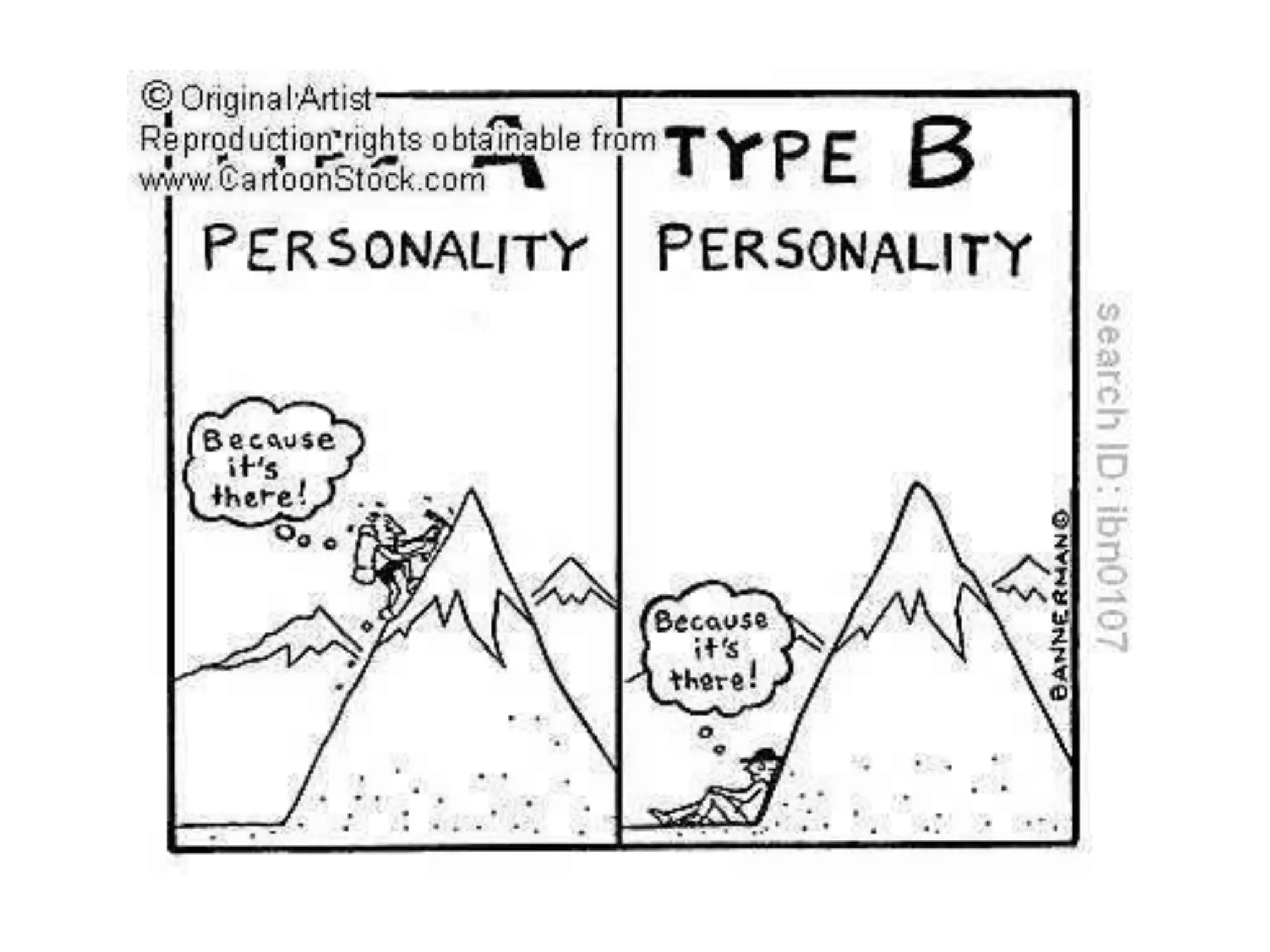
Ambitious, rigidly organized, highly status
conscious, can be sensitive, care for other
people, are truthful, impatient, always try
to help others, take on more than they can
handle, want other people to get to the
point, proactive, and obsessed with time
management. People with Type A
personalities are often high-achieving
"workaholics" who multi-task, push
themselves with deadlines, and hate both
delays and ambivalence.
Type A
Live at a lower stress level and typically work
steadily, enjoying achievements but not
becoming stressed when they are not
achieved. When faced with competition,
they do not mind losing and either enjoy
the game or back down. They are often
reflective, thinking about the outer and
inner worlds. Furthermore, Type B
personalities may have a poor sense of
time schedule and can be predominately
right brained thinkers.
Type B
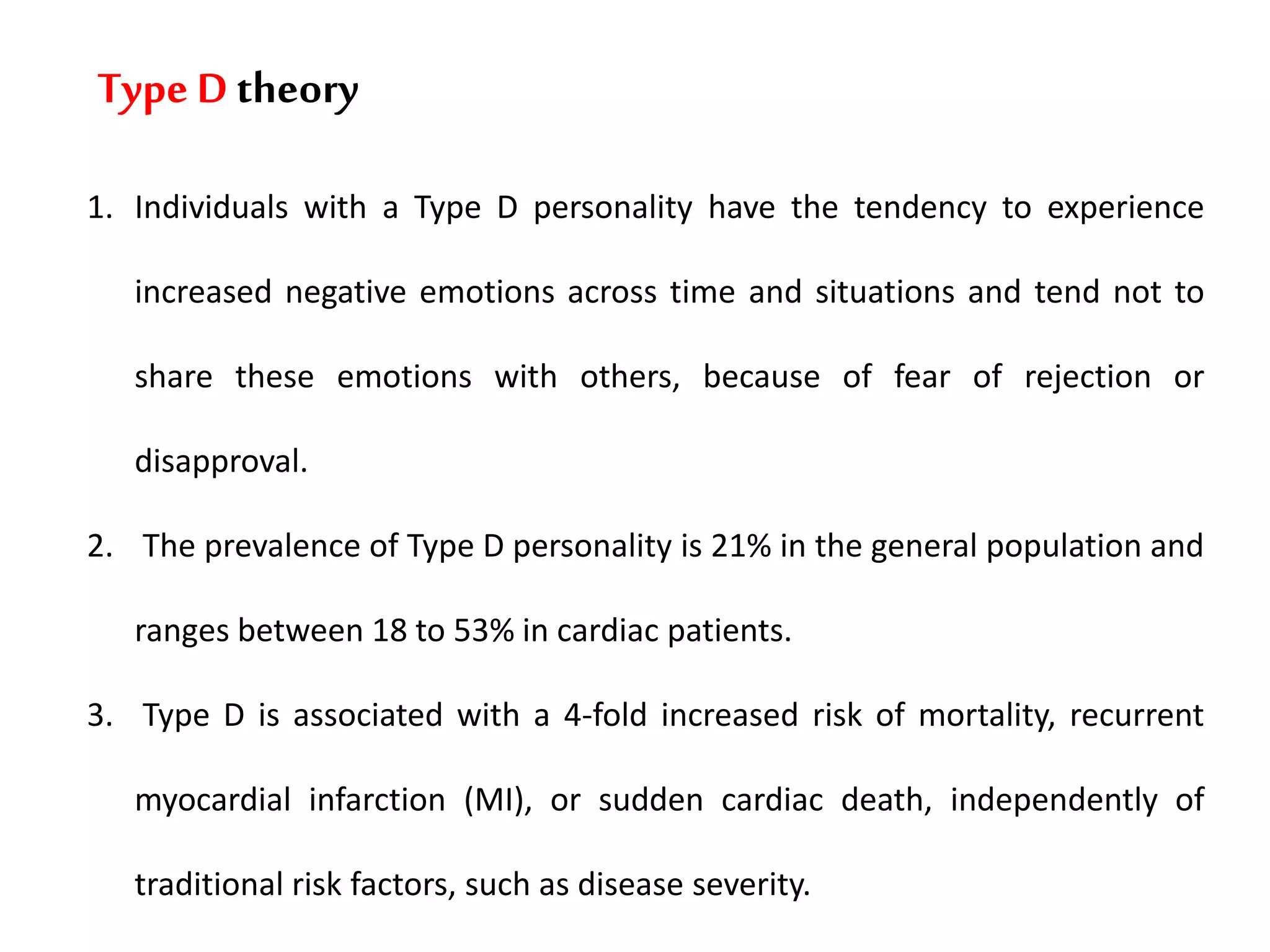
Type D theory
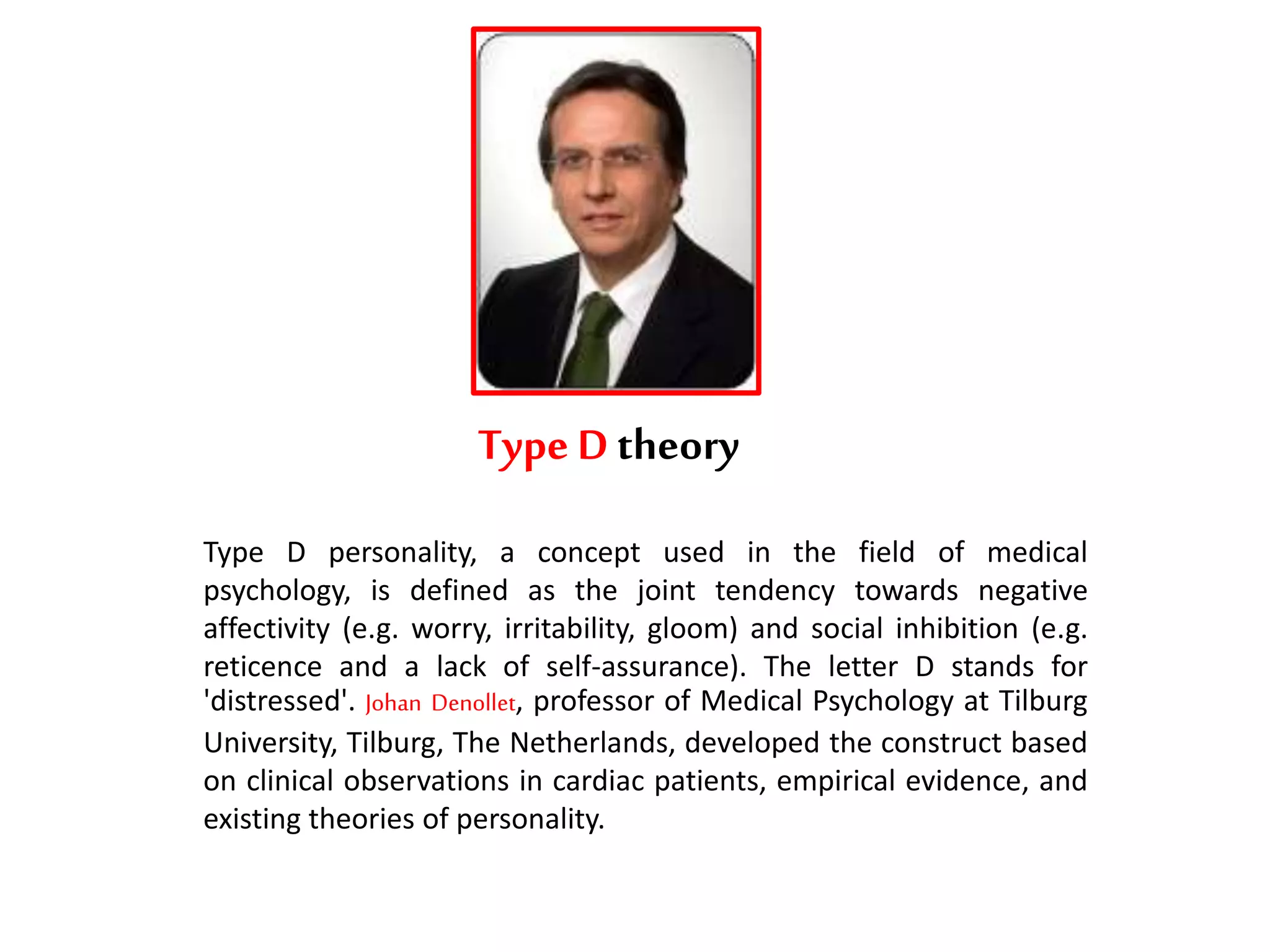
Type D personality, a concept used in the field of medical
psychology, is defined as the joint tendency towards negative
affectivity (e.g. worry, irritability, gloom) and social inhibition (e.g.
reticence and a lack of self-assurance). The letter D stands for
'distressed'. Johan Denollet, professor of Medical Psychology at Tilburg
University, Tilburg, The Netherlands, developed the construct based
on clinical observations in cardiac patients, empirical evidence, and
existing theories of personality.
Type D theory
1. Individuals with a Type D personality have the tendency to experience
increased negative emotions across time and situations and tend not to
share these emotions with others, because of fear of rejection or
disapproval.
2. The prevalence of Type D personality is 21% in the general population and
ranges between 18 to 53% in cardiac patients.
3. Type D is associated with a 4-fold increased risk of mortality, recurrent
myocardial infarction (MI), or sudden cardiac death, independently of
traditional risk factors, such as disease severity.
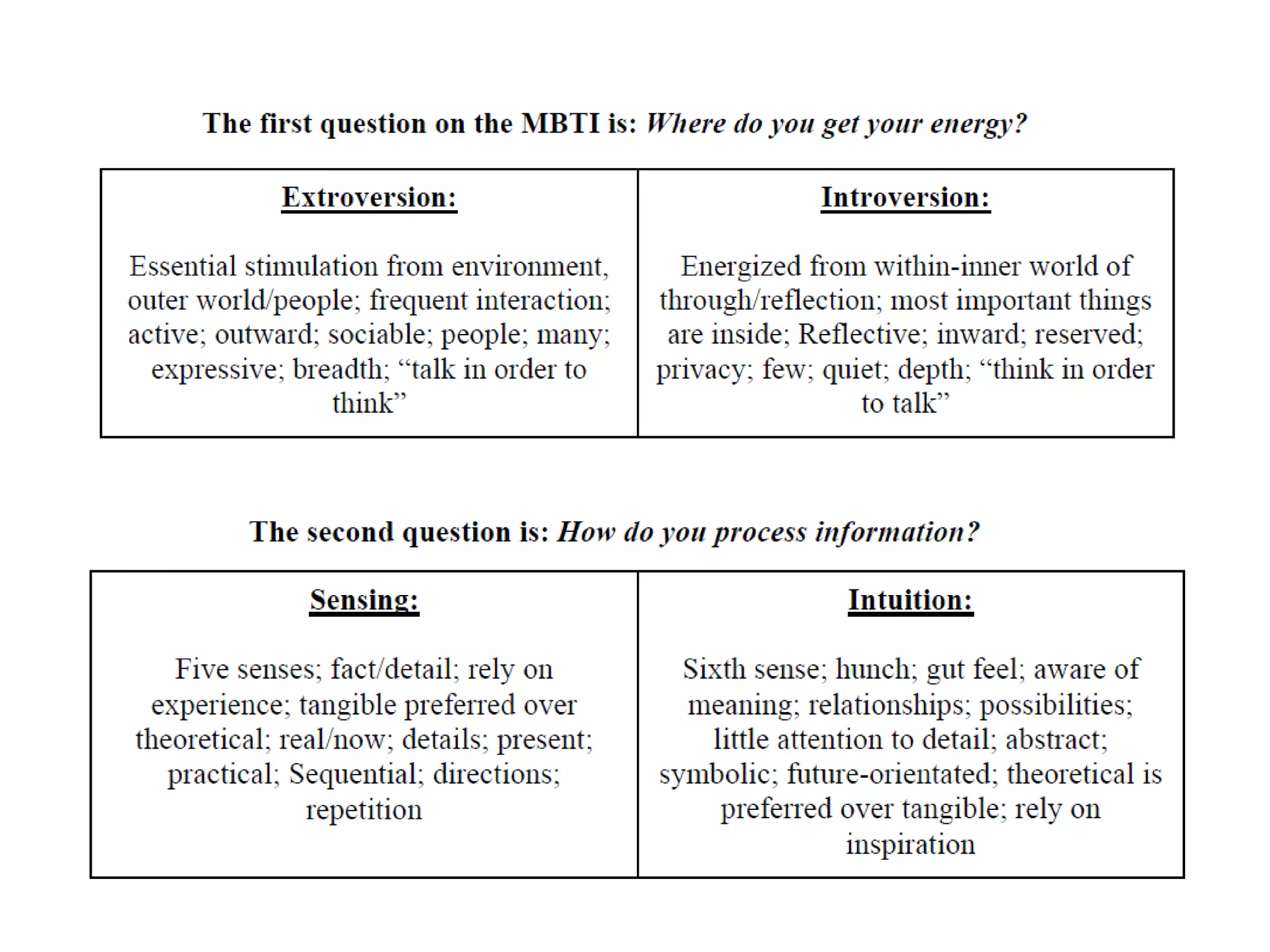
Myers Briggs Type Indicator (MBTI)
This was one of the more influential ideas originated in the
theoretical work of Carl Jung as published in the book Psychological
Types. The original developers of the personality inventory were
Katharine Cook Briggs and her daughter, Isabel Briggs Myers. these
two, having studied extensively the work of Jung, turned their
interest of human behavior into a devotion of turning the theory of
psychological types to practical use.
Enneagram of Personality
The Enneagram of Personality (or simply the Enneagram, from the
Greek words ennea [nine] and gramma [something written or
drawn]) is a model of human personality which is principally used as
a typology of nine interconnected personality types. Principally
developed by Oscar Ichazo and Claudio Naranjo, it is also partly based on
earlier teachings of G. I. Gurdjieff. The typology defines nine personality
types which are represented by the points of a geometric figure
called an enneagram.
Enneagramof Personality
Men Are from Mars, Women Are from Venus
Men Are from Mars, Women Are from Venus is a book written by American
author, and relationship counsellor, John Gray. The book asserts that most of
common relationship problems between men and women are a result of
fundamental differences between the genders, which the author exemplifies by
means of the book's eponymous metaphor: that men and women are from
distinct planets – men from Mars and women from Venus – and that each
gender is acclimated to its own planet's society and customs, but not those of
the other.
Men Are from Mars, Women Are from Venus
1. When men are stressed, they withdraw until they find a solution to the
problem. When women are stressed their natural reaction is to talk about
issues (even if talking does not solve the problem).
Thank you
Other TA topics available on slideshare
1. Strokes - http://www.slideshare.net/manumjoy/strokes-24081607.
2. Games People Play - http://www.slideshare.net/manumjoy/psychological-
games-people-play.
3. Structural Analysis - http://www.slideshare.net/manumjoy/the-ego-state-model.
4. What is TA? - http://www.slideshare.net/manumjoy/what-ta-is
5. Cycles of Development - http://www.slideshare.net/manumjoy/cycles-of-
developement-pamela-levin-transactional-analysis.
6. Stages of Cure - http://www.slideshare.net/manumjoy/stages-of-cure.
7. Transactions - http://www.slideshare.net/manumjoy/transactions-33677298.
8. Time Structuring - http://www.slideshare.net/manumjoy/time-structuring.
9. Life Position - http://www.slideshare.net/manumjoy/life-position.
10. Autonomy - http://www.slideshare.net/manumjoy/autonomy-33690557.
11. Structural Pathology - http://www.slideshare.net/manumjoy/structural-pathology.
12. Game Analysis - http://www.slideshare.net/manumjoy/game-analysis-33725636.
13. Integrated Adult - http://www.slideshare.net/manumjoy/integrated-adult.
14. Stroke Economy - http://www.slideshare.net/manumjoy/stroke-economy-
33826702.

Type theories personality theories (4 Temperament theory, 5 Temperament theory, Type A and Type B theory, Type D theory, Myers Briggs Type Indicator (MBTI), Enneagram of Personality, Men Are from Mars, Women Are from Venus)

  • 1.
  • 2.
    Prepared By Manu MelwinJoy Research Scholar School of Management Studies CUSAT, Kerala, India. Phone – 9744551114 Mail – manu_melwinjoy@yahoo.com Kindly restrict the use of slides for personal purpose. Please seek permission to reproduce the same in public forms and presentations.
  • 3.
  • 4.
    Types Vs Traits Personalitytypereferstothepsychological classificationofdifferenttypesofpeople Personalitytraitreferstopsychological classification ofdifferentlevels ordegrees For example, according to type theories, there are two types of people, introverts and extroverts. According to trait theories, introversion and extroversion are part of a continuous dimension,with manypeople in the middle.
  • 5.
    4 Temperamenttheory Temperament theoryhas its roots in the ancient four humors theory. It may have origins in ancient Egypt or Mesopotamia, but it was the Greek physician Hippocrates (460–370 BC) who developed it into a medical theory. Next, Galen (AD 131–200) developed the first typology of temperament. The word "temperament" itself comes from Latin "temperare", "to mix". In the ideal personality, the complementary characteristics or warm-cool and dry-moist were exquisitely balanced.
  • 6.
    Temperament theory Blood Yellow bile Blackbile Phlegm. Sanguine (pleasure-seeking and sociable) Choleric (ambitious and leader-like) Melancholic (introverted and thoughtful) Phlegmatic (relaxed and quiet) 4 Temperaments4 humors
  • 7.
    Melancholic (introverted and thoughtful) Sanguine (pleasure-seekingand sociable) Choleric (ambitious and leader-like) 4 Temperaments Phlegmatic (relaxed and quiet)
  • 9.
    5 Temperament theory Fivetemperaments is a theory in psychology, that expands upon the Four Temperaments proposed in ancient medical theory. The development of a theory of five temperaments begins with the Two-factor models of personality and the work of the late William Schultz, and his FIRO-B program. It is a measure of interpersonal relations orientations that calculates a person's behavior patterns based on the scoring of a questionnaire. Although FIRO-B does not speak in terms of "temperament," this system of analysis graded questionnaires on two scales in three dimensions of interpersonal relations. When paired with temperament theory, a measurement of five temperaments resulted
  • 10.
    5 Temperament theory Blood Yellowbile Black bile Phlegm. Sanguine (pleasure-seeking and sociable) Choleric (ambitious and leader-like) Melancholic (introverted and thoughtful) Phlegmatic (relaxed and quiet) 5 Temperaments4 humors Supine (Low self esteem)
  • 11.
    Melancholic (introverted and thoughtful) Phlegmatic (relaxedand quiet) Choleric (ambitious and leader-like) Supine (Low Self esteem) Sanguine (pleasure-seeking and sociable)
  • 12.
    Type A andTypeB theory Type A personality behavior was first described as a potential risk factor for heart disease in the 1950s by cardiologists Meyer Friedman and Ray Rosenman. After a ten-year study of healthy men between the ages of 35 and 59, Friedman and Rosenman estimated that Type A behavior doubles the risk of coronary heart disease in otherwise healthy individuals.[
  • 13.
    TypeA and TypeBtheory Ambitious, rigidly organized, highly status conscious, can be sensitive, care for other people, are truthful, impatient, always try to help others, take on more than they can handle, want other people to get to the point, proactive, and obsessed with time management. People with Type A personalities are often high-achieving "workaholics" who multi-task, push themselves with deadlines, and hate both delays and ambivalence. Type A Live at a lower stress level and typically work steadily, enjoying achievements but not becoming stressed when they are not achieved. When faced with competition, they do not mind losing and either enjoy the game or back down. They are often reflective, thinking about the outer and inner worlds. Furthermore, Type B personalities may have a poor sense of time schedule and can be predominately right brained thinkers. Type B
  • 15.
    Type D theory TypeD personality, a concept used in the field of medical psychology, is defined as the joint tendency towards negative affectivity (e.g. worry, irritability, gloom) and social inhibition (e.g. reticence and a lack of self-assurance). The letter D stands for 'distressed'. Johan Denollet, professor of Medical Psychology at Tilburg University, Tilburg, The Netherlands, developed the construct based on clinical observations in cardiac patients, empirical evidence, and existing theories of personality.
  • 16.
    Type D theory 1.Individuals with a Type D personality have the tendency to experience increased negative emotions across time and situations and tend not to share these emotions with others, because of fear of rejection or disapproval. 2. The prevalence of Type D personality is 21% in the general population and ranges between 18 to 53% in cardiac patients. 3. Type D is associated with a 4-fold increased risk of mortality, recurrent myocardial infarction (MI), or sudden cardiac death, independently of traditional risk factors, such as disease severity.
  • 17.
    Myers Briggs TypeIndicator (MBTI) This was one of the more influential ideas originated in the theoretical work of Carl Jung as published in the book Psychological Types. The original developers of the personality inventory were Katharine Cook Briggs and her daughter, Isabel Briggs Myers. these two, having studied extensively the work of Jung, turned their interest of human behavior into a devotion of turning the theory of psychological types to practical use.
  • 21.
    Enneagram of Personality TheEnneagram of Personality (or simply the Enneagram, from the Greek words ennea [nine] and gramma [something written or drawn]) is a model of human personality which is principally used as a typology of nine interconnected personality types. Principally developed by Oscar Ichazo and Claudio Naranjo, it is also partly based on earlier teachings of G. I. Gurdjieff. The typology defines nine personality types which are represented by the points of a geometric figure called an enneagram.
  • 22.
  • 23.
    Men Are fromMars, Women Are from Venus Men Are from Mars, Women Are from Venus is a book written by American author, and relationship counsellor, John Gray. The book asserts that most of common relationship problems between men and women are a result of fundamental differences between the genders, which the author exemplifies by means of the book's eponymous metaphor: that men and women are from distinct planets – men from Mars and women from Venus – and that each gender is acclimated to its own planet's society and customs, but not those of the other.
  • 24.
    Men Are fromMars, Women Are from Venus 1. When men are stressed, they withdraw until they find a solution to the problem. When women are stressed their natural reaction is to talk about issues (even if talking does not solve the problem).
  • 25.
  • 26.
    Other TA topicsavailable on slideshare 1. Strokes - http://www.slideshare.net/manumjoy/strokes-24081607. 2. Games People Play - http://www.slideshare.net/manumjoy/psychological- games-people-play. 3. Structural Analysis - http://www.slideshare.net/manumjoy/the-ego-state-model. 4. What is TA? - http://www.slideshare.net/manumjoy/what-ta-is 5. Cycles of Development - http://www.slideshare.net/manumjoy/cycles-of- developement-pamela-levin-transactional-analysis. 6. Stages of Cure - http://www.slideshare.net/manumjoy/stages-of-cure. 7. Transactions - http://www.slideshare.net/manumjoy/transactions-33677298. 8. Time Structuring - http://www.slideshare.net/manumjoy/time-structuring. 9. Life Position - http://www.slideshare.net/manumjoy/life-position. 10. Autonomy - http://www.slideshare.net/manumjoy/autonomy-33690557. 11. Structural Pathology - http://www.slideshare.net/manumjoy/structural-pathology. 12. Game Analysis - http://www.slideshare.net/manumjoy/game-analysis-33725636. 13. Integrated Adult - http://www.slideshare.net/manumjoy/integrated-adult. 14. Stroke Economy - http://www.slideshare.net/manumjoy/stroke-economy- 33826702.