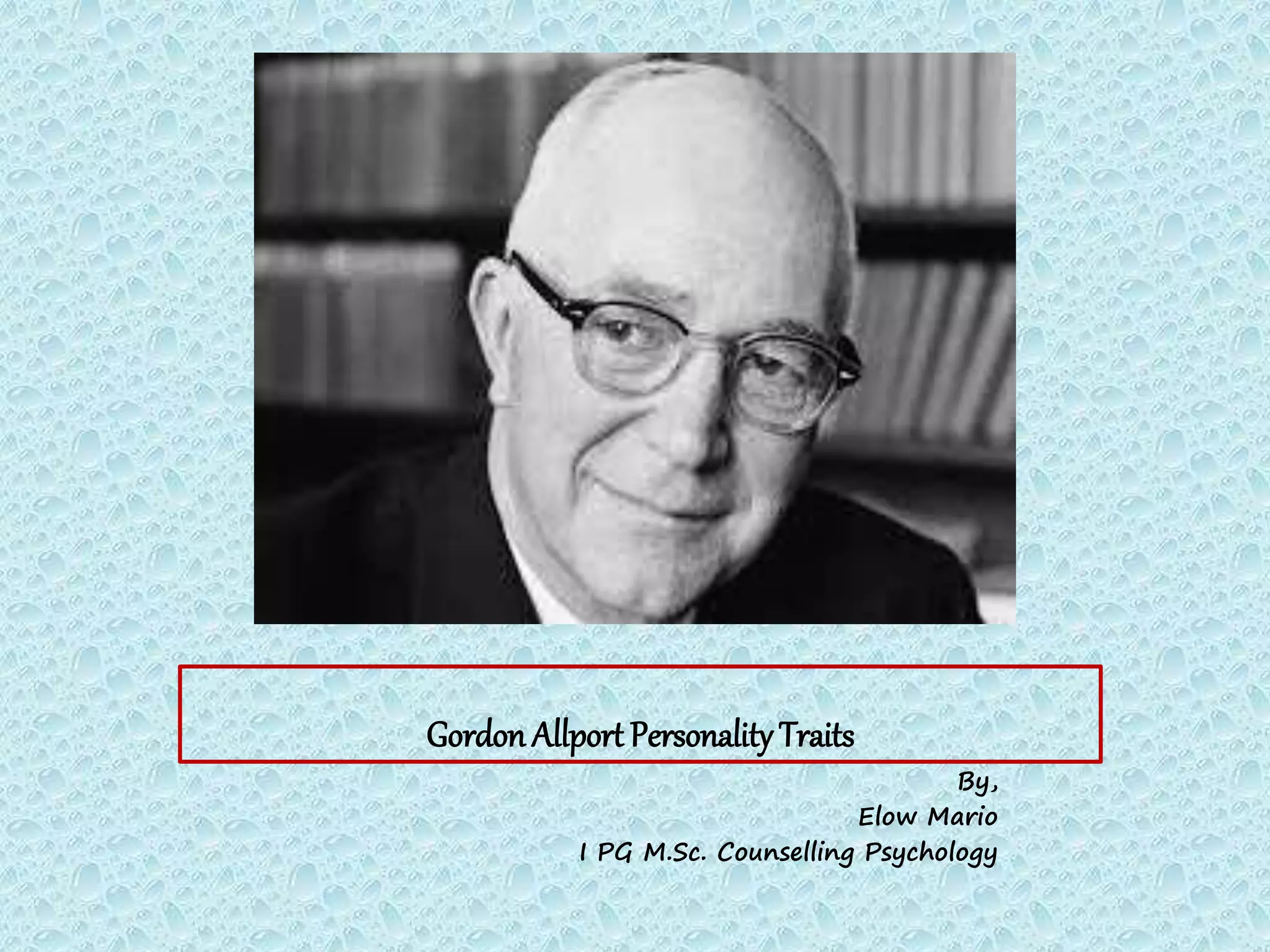
Gordon Allport PersonalityTraits
By,
Elow Mario
I PG M.Sc. Counselling Psychology
INTRODUCTION
 Personality has been a
subject of interest since
Ancient Times.
 Can be traced back to
the Ancient Greek
Philosophers.
 370 BCE: Hippocrates’
Four Humours tries to
understand personality.
What is Personality?
 Origin: Latin word- ‘persona’ meaning Mask.
 Combination of an individuals thoughts,
characteristics, behaviours, attitudes, ideas and
habits.
 APA: “personality refers to individual differences
in characteristics patters of thinking, feeling and
behaving.
“the traits that predicts a persons’ behaviour”
-Raymond Cattell
“ it refers to the unique and consistent pattern of
thinking and feeling and behaving” –Pervin
Personality usually refers to the distinctive patterns
of behaviour, including thoughts and emotions that
characterize each individuals.
SOME DEFINITIONS OF
PERSONALITY:
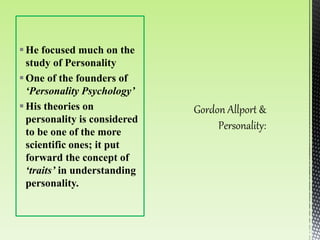
He focused much on the
study of Personality
One of the founders of
‘Personality Psychology’
His theories on
personality is considered
to be one of the more
scientific ones; it put
forward the concept of
‘traits’ in understanding
personality.
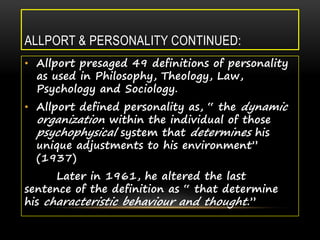
ALLPORT & PERSONALITY CONTINUED:
• Allport presaged 49 definitions of personality
as used in Philosophy, Theology, Law,
Psychology and Sociology.
• Allport defined personality as, “ the dynamic
organization within the individual of those
psychophysical system that determines his
unique adjustments to his environment”
(1937)
Later in 1961, he altered the last
sentence of the definition as “ that determine
his characteristic behaviour and thought.”
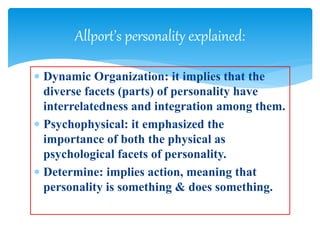
 Dynamic Organization: it implies that the
diverse facets (parts) of personality have
interrelatedness and integration among them.
 Psychophysical: it emphasized the
importance of both the physical as
psychological facets of personality.
 Determine: implies action, meaning that
personality is something & does something.
Allport’s personality explained:
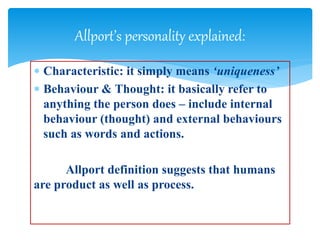
 Characteristic: it simply means ‘uniqueness’
 Behaviour & Thought: it basically refer to
anything the person does – include internal
behaviour (thought) and external behaviours
such as words and actions.
Allport definition suggests that humans
are product as well as process.
Allport’s personality explained:
S
IX
STANDARDS
OF
PERSONALITY
:
Allport
acknowledged
Six standards for
the Mature
Personality;
according to
him, an
individual should
have the
following
characteristics in
their personality.
i. An extension of the sense of self:
not self centered, but concerned
and involved on things not
centered on them.
ii. Warm relating of self to others:
they are capable of loving others
in an intimate and emphatic
manner; unselfishly and non-
possesively.
iii. Emotional security or Self
Acceptance: accept themselves as
they are- emotional poise and they
don’t over react.
S
IX
STANDARD
OF
PERSONALITY
:
#Allport
i. Realistic perception of their
environment: they are reality minded;
they do not twist reality, nor do they
live in a fantasy world of their own.
ii. Insight and Humour: ability to see
and understand something.
iii. Unifying philosophy of life: having a
goal or purpose in life.
Allport speaks of a mature
religious orientation as a vital
ingredient in psychological
maturity.
WHAT ARE TRAITS?
They are relatively permanent entities in the individual; they are
reflected in the individuals many behaviours in different
situations.
They are not theoretical structures or constructs, but are real and
found within the individual.
They are verified empirically and it guide and direct behaviour and
enable the individual to behave in a particular manner.
According to Allport, Traits constitute the basic unit of individuals
personality. He defined trait as the predisposition to respond
and reach in the same or similar manner.
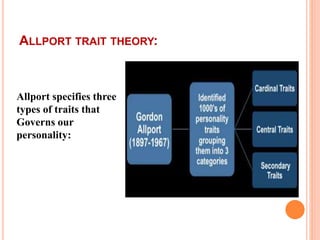
ALLPORT TRAIT THEORY:
Allport specifies three
types of traits that
Governs our
personality:
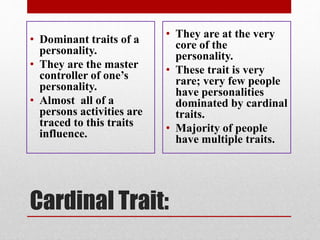
Cardinal Trait:
• Dominant traits of a
personality.
• They are the master
controller of one’s
personality.
• Almost all of a
persons activities are
traced to this traits
influence.
• They are at the very
core of the
personality.
• These trait is very
rare; very few people
have personalities
dominated by cardinal
traits.
• Majority of people
have multiple traits.
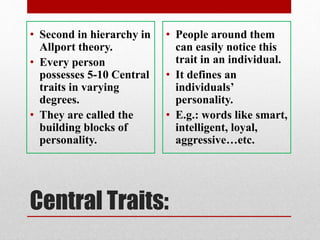
Central Traits:
• Second in hierarchy in
Allport theory.
• Every person
possesses 5-10 Central
traits in varying
degrees.
• They are called the
building blocks of
personality.
• People around them
can easily notice this
trait in an individual.
• It defines an
individuals’
personality.
• E.g.: words like smart,
intelligent, loyal,
aggressive…etc.
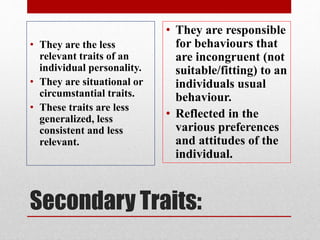
Secondary Traits:
• They are the less
relevant traits of an
individual personality.
• They are situational or
circumstantial traits.
• These traits are less
generalized, less
consistent and less
relevant.
• They are responsible
for behaviours that
are incongruent (not
suitable/fitting) to an
individuals usual
behaviour.
• Reflected in the
various preferences
and attitudes of the
individual.
CRITICAL ANALYSIS:
• Allport’s theory of personality is based
heavily on common sense and
philosophical speculations than on
scientific investigations.
• His theory focuses on the individual that
it is unfeasible to generalize from one
person to another.
THANK YOU

Gordon Allport Trait Theory.pptx

  • 1.
    Gordon Allport PersonalityTraits By, ElowMario I PG M.Sc. Counselling Psychology
  • 2.
    INTRODUCTION  Personality hasbeen a subject of interest since Ancient Times.  Can be traced back to the Ancient Greek Philosophers.  370 BCE: Hippocrates’ Four Humours tries to understand personality.
  • 3.
    What is Personality? Origin: Latin word- ‘persona’ meaning Mask.  Combination of an individuals thoughts, characteristics, behaviours, attitudes, ideas and habits.  APA: “personality refers to individual differences in characteristics patters of thinking, feeling and behaving.
  • 4.
    “the traits thatpredicts a persons’ behaviour” -Raymond Cattell “ it refers to the unique and consistent pattern of thinking and feeling and behaving” –Pervin Personality usually refers to the distinctive patterns of behaviour, including thoughts and emotions that characterize each individuals. SOME DEFINITIONS OF PERSONALITY:
  • 5.
    He focused muchon the study of Personality One of the founders of ‘Personality Psychology’ His theories on personality is considered to be one of the more scientific ones; it put forward the concept of ‘traits’ in understanding personality.
  • 6.
    ALLPORT & PERSONALITYCONTINUED: • Allport presaged 49 definitions of personality as used in Philosophy, Theology, Law, Psychology and Sociology. • Allport defined personality as, “ the dynamic organization within the individual of those psychophysical system that determines his unique adjustments to his environment” (1937) Later in 1961, he altered the last sentence of the definition as “ that determine his characteristic behaviour and thought.”
  • 7.
     Dynamic Organization:it implies that the diverse facets (parts) of personality have interrelatedness and integration among them.  Psychophysical: it emphasized the importance of both the physical as psychological facets of personality.  Determine: implies action, meaning that personality is something & does something. Allport’s personality explained:
  • 8.
     Characteristic: itsimply means ‘uniqueness’  Behaviour & Thought: it basically refer to anything the person does – include internal behaviour (thought) and external behaviours such as words and actions. Allport definition suggests that humans are product as well as process. Allport’s personality explained:
  • 9.
    S IX STANDARDS OF PERSONALITY : Allport acknowledged Six standards for theMature Personality; according to him, an individual should have the following characteristics in their personality. i. An extension of the sense of self: not self centered, but concerned and involved on things not centered on them. ii. Warm relating of self to others: they are capable of loving others in an intimate and emphatic manner; unselfishly and non- possesively. iii. Emotional security or Self Acceptance: accept themselves as they are- emotional poise and they don’t over react.
  • 10.
    S IX STANDARD OF PERSONALITY : #Allport i. Realistic perceptionof their environment: they are reality minded; they do not twist reality, nor do they live in a fantasy world of their own. ii. Insight and Humour: ability to see and understand something. iii. Unifying philosophy of life: having a goal or purpose in life. Allport speaks of a mature religious orientation as a vital ingredient in psychological maturity.
  • 11.
    WHAT ARE TRAITS? Theyare relatively permanent entities in the individual; they are reflected in the individuals many behaviours in different situations. They are not theoretical structures or constructs, but are real and found within the individual. They are verified empirically and it guide and direct behaviour and enable the individual to behave in a particular manner. According to Allport, Traits constitute the basic unit of individuals personality. He defined trait as the predisposition to respond and reach in the same or similar manner.
  • 12.
    ALLPORT TRAIT THEORY: Allportspecifies three types of traits that Governs our personality:
  • 13.
    Cardinal Trait: • Dominanttraits of a personality. • They are the master controller of one’s personality. • Almost all of a persons activities are traced to this traits influence. • They are at the very core of the personality. • These trait is very rare; very few people have personalities dominated by cardinal traits. • Majority of people have multiple traits.
  • 14.
    Central Traits: • Secondin hierarchy in Allport theory. • Every person possesses 5-10 Central traits in varying degrees. • They are called the building blocks of personality. • People around them can easily notice this trait in an individual. • It defines an individuals’ personality. • E.g.: words like smart, intelligent, loyal, aggressive…etc.
  • 15.
    Secondary Traits: • Theyare the less relevant traits of an individual personality. • They are situational or circumstantial traits. • These traits are less generalized, less consistent and less relevant. • They are responsible for behaviours that are incongruent (not suitable/fitting) to an individuals usual behaviour. • Reflected in the various preferences and attitudes of the individual.
  • 16.
    CRITICAL ANALYSIS: • Allport’stheory of personality is based heavily on common sense and philosophical speculations than on scientific investigations. • His theory focuses on the individual that it is unfeasible to generalize from one person to another.
  • 17.