Theories Of Personality

By:
Harleen Kaur
Kanika Seokhand
Shobitash Jamwal
The Nature of Personality

•
•

Personality is “an individual’s unique arrangements
of consistent behavioral traits”.
A personality trait is “a durable disposition to
behave in a particular way in a variety of situations”.
– Common personality traits include:
• Honest
• Moody
• Impulsive
• Friendly
The Nature of Personality
•

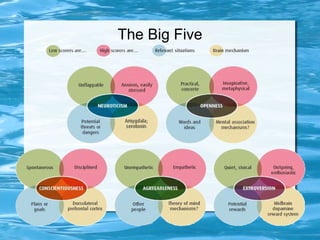
Robert McCrae and Paul Costa (1987, 1997, 1999) state
that there are five “higher-order” traits that are known as
the “Big Five” :
1. Extroversion (or positive emotionality)
2. Neuroticism (or negative emotionality)
3. Openness to experience
4. Agreeableness
5. Conscientiousness

•

However, this is but one of many perspectives on human
personality.
The Big Five
Psycho dynamic Perspectives

•
•
•

Psycho dynamic theories include a variety of
theoretical models derived from the work of Sigmund
Freud.
All focus on unconscious mental forces that shape our
personalities.
Well known psycho dynamic theorists include:
– Freud
– Jung
– Adler
– Sheldon
Myers Briggs Type Indicator
Identify basic types and preferences as used by Carl
Jung in the type indicator


Recognize common behaviors related to each type to
enhance team communication


Uncover hidden stereotypes regarding preferences as
a means of building trust, understanding, and respect
among team members


Analyze the strengths of the team and potential areas
of growth to improve the team’s overall functioning.

Katherine
Cook Briggs

Lyman
Briggs
Isabel
Briggs
Myers

“I dream that long after I am gone my work will go on helping people.”
Isabel Briggs Myers, 1979
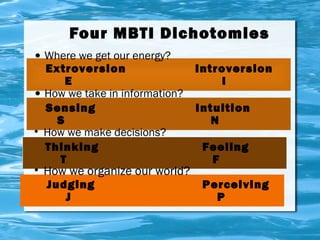
Four MBTI Dichotomies
• Where we get our energy?
Extroversion
E
• How we take in information?
Sensing
S
• How we make decisions?
Thinking
T

• How we organize our world?
Judging
J

Introversion
I
Intuition
N
Feeling
F
Perceiving
P
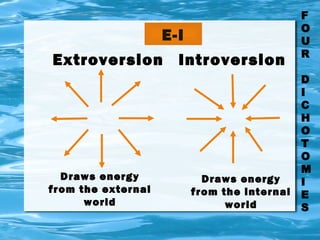
E-I
Extroversion

Draws energy
from the external
world

Introversion

Draws energy
from the internal
world

F
O
U
R
D
I
C
H
O
T
O
M
I
E
S
S-N
Sensing
1

2

Intuition

3

Taking in and
presenting information
in a sequential way

F
O
U
R

D
I
Taking in and
C
presenting information
H
in a snap shot big
O
picture way
T
O
M
I
E
S
T-F
Thinking
Making decisions by
stepping back from the
situation, taking an
objective view

Feeling
Making decisions by
stepping into the
situation, taking an
empathetic view

F
O
U
R
D
I
C
H
O
T
O
M
I
E
S
J-P
Judging

Perceiving

Timeline

Just in Time!

Deadline
A planned approach
to meeting the
deadline in a
scheduled way

Deadline
A Spontaneous
approach to meeting
the deadline with a
rush of activity

F
O
U
R
D
I
C
H
O
T
O
M
I
E
S
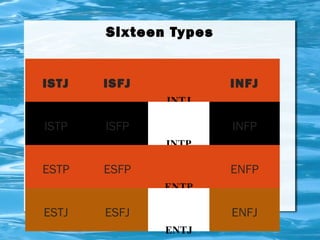
Sixteen Types

ISTJ

ISFJ

INFJ
INTJ

ISTP

ISFP

INFP
INTP

ESTP

ESFP

ENFP
ENTP

ESTJ

ESFJ

ENFJ
ENTJ
Sigmund Freud
Sigismund Schlomo Freud; 6
May 1856 – 23 September
1939) was an Austrian
neurologist who became
known as the founding father
of psychoanalysis.
Psycho dynamic Perspectives
Freud’s Psychoanalytic theory of personality is
somewhat controversial and is based on three main
assumptions:
1. Personality is governed by unconscious forces that
we cannot control.
2. Childhood experiences play a significant role in
determining adult personality.
3. Personality is shaped by the manner in which
children cope with sexual urges.
Freud’s Psychoanalytic Theory
Freud argued that personality is divided into three structures:
1. The id is “ the primitive, instinctive component of
personality that operates according to the pleasure
principle”.The two major drives under Id are- Eros and
Thanatos.
2. The ego is “the decision-making component of
personality that operates according to the reality
principle”.
3. The superego is “the moral component of personality
that incorporates social standards about what represents
right and wrong”.
Freud’s Psychoanalytic Theory
The id, ego and superego are arranged into different layers
of awareness including:
1. The conscious layer – this includes thoughts or
feelings we are fully aware of.
2. The preconscious layer – this includes information
just beneath the surface of our awareness.
3. The unconscious layer – this includes thoughts,
memories, feelings and desires that we are not aware
of, but that greatly influence our behavior.
Freud’s Psychoanalytic Theory

•
•
•

Freud believed that behavior is the result of ongoing
internal conflict among the id, ego and superego.
Conflicts stemming from sexual and aggressive urges
are especially significant.
Such conflicts arouse anxiety and we use defense
mechanisms – “largely unconscious reactions that
protect a person from painful emotions such as anxiety
and guilt”.
Freud’s Psychoanalytic Theory
Personality development:
– Freud believed that the basic elements of adult
personality are in place by age five and result from
the outcome of five psycho sexual stages.
– In each stage, children must cope with distinct
immature sexual urges that influence adult
personality.
– Fixation results if the child fails to move forward
from one stage to another, and is usually caused by
excessive gratification, or frustration of needs at a
particular stage.
Sheldon Theory






In the 1950’s, William Sheldon (b. 1899) became
interested in the variety of human bodies.
He built upon earlier work done by Ernst
Kretschmer in the 1930's. Kretschmer believed that
there was a relationship between three different
physical types and certain psychological disorders.
His research, although involving thousands of
institutionalized patients, was suspect because he
failed to control for age and the schizophrenics were
considerably younger than the bipolar patients, and so
more likely to be thinner.
Classification According to Sheldon
Theory
Few of the classifications given by Sheldon Theory
are as follows:


Endomorph.



Mesomorph.



Ectomorph.
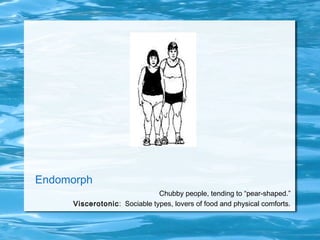
Endomorph
Chubby people, tending to “pear-shaped.”
Viscerotonic:  Sociable types, lovers of food and physical comforts.
Mesomorph
Stockier people, with broad shoulders and good musculature.
Somatotonic:  Active types, physically fit and energetic.
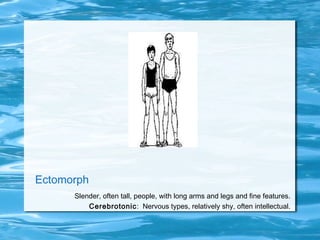
Ectomorph
Slender, often tall, people, with long arms and legs and fine features.
Cerebrotonic:  Nervous types, relatively shy, often intellectual.
Carl Jung
Carl Gustav Jung 26 July
1875 – 6 June 1961), often
referred to as just C. G. Jung,
was a Swiss psychiatrist &
psychotherapist who founded
analytical psychology.[2]
Jung proposed and developed
the concepts of extraversion
and introversion; archetypes,
and the collective
unconscious.
Psycho dynamic Perspectives
Jung’s Analytical Psychology.
• Jung also focused on the role of the unconscious
in shaping personality.
• However, he argued that the unconscious is
comprised of two layers:
1. The personal unconscious (this contains the
same material as Freud’s unconscious layer),
and
2. The collective unconscious – this contains
traces of memories, shared by the entire
human race, inherited from our ancestors.
Jung’s Analytical Psychology

•
•

The collective unconscious does not contain memories
of distinct, personal experiences.
Rather, it contains archetypes – “emotionally charged
images and thought forms that have universal
meaning”.
Jung was also the first to describe the:
– Introverted (inner-directed), and the
– Extroverted (outer-directed) personality types.
Alfred Adler
Alfred W. Adler (February 7,
1870 – May 28, 1937) was an
Austrian medical doctor,
psychotherapist, and founder of
the school of individual
psychology.His emphasis on
the importance of feelings of
inferiority—the inferiority
complex—is recognized as
isolating an element which
plays a key role in personality
development.
Psycho dynamic Perspectives
Adler’s Individual Psychology.
• Adler believed that the most important human drive
is not sexuality, but our drive for superiority.
• Adler stated that we use compensation - “efforts to
overcome imagined or real inferiorities by
developing one’s abilities”.
• If we are unsuccessful, we may develop an
inferiority complex – “exaggerated feelings of
weakness and inadequacy”.
• Adler also believed that birth order may contribute
to personality.
Evaluating Psycho dynamic
Perspectives

Psycho dynamic theory contributed the following
important ideas:
1. Unconscious forces may contribute to
personality.
2. Internal conflict may play a key role in
psychological distress.
3. Early childhood experiences can influence
adult personality.
4. People may rely on defense mechanisms to
reduce unpleasant emotions.
Evaluating Psycho dynamic
Psycho dynamic theory has also been criticized on the
following grounds:
1. Poor testability – it is too vague to subject to
scientific tests.
2. Inadequate evidence – the theories depend too
much on case studies of clients whose recollections
may have been distorted to fit the theory.
3. Sexism – the theories have a male-oriented bias and
do not adequately address women’s issues.
Thank You

Any Queries?

Theories of personality

  • 1.
    Theories Of Personality By: HarleenKaur Kanika Seokhand Shobitash Jamwal
  • 2.
    The Nature ofPersonality • • Personality is “an individual’s unique arrangements of consistent behavioral traits”. A personality trait is “a durable disposition to behave in a particular way in a variety of situations”. – Common personality traits include: • Honest • Moody • Impulsive • Friendly
  • 3.
    The Nature ofPersonality • Robert McCrae and Paul Costa (1987, 1997, 1999) state that there are five “higher-order” traits that are known as the “Big Five” : 1. Extroversion (or positive emotionality) 2. Neuroticism (or negative emotionality) 3. Openness to experience 4. Agreeableness 5. Conscientiousness • However, this is but one of many perspectives on human personality.
  • 4.
  • 5.
    Psycho dynamic Perspectives • • • Psychodynamic theories include a variety of theoretical models derived from the work of Sigmund Freud. All focus on unconscious mental forces that shape our personalities. Well known psycho dynamic theorists include: – Freud – Jung – Adler – Sheldon
  • 7.
    Myers Briggs TypeIndicator Identify basic types and preferences as used by Carl Jung in the type indicator  Recognize common behaviors related to each type to enhance team communication  Uncover hidden stereotypes regarding preferences as a means of building trust, understanding, and respect among team members  Analyze the strengths of the team and potential areas of growth to improve the team’s overall functioning. 
  • 8.
    Katherine Cook Briggs Lyman Briggs Isabel Briggs Myers “I dreamthat long after I am gone my work will go on helping people.” Isabel Briggs Myers, 1979
  • 9.
    Four MBTI Dichotomies •Where we get our energy? Extroversion E • How we take in information? Sensing S • How we make decisions? Thinking T • How we organize our world? Judging J Introversion I Intuition N Feeling F Perceiving P
  • 10.
    E-I Extroversion Draws energy from theexternal world Introversion Draws energy from the internal world F O U R D I C H O T O M I E S
  • 11.
    S-N Sensing 1 2 Intuition 3 Taking in and presentinginformation in a sequential way F O U R D I Taking in and C presenting information H in a snap shot big O picture way T O M I E S
  • 12.
    T-F Thinking Making decisions by steppingback from the situation, taking an objective view Feeling Making decisions by stepping into the situation, taking an empathetic view F O U R D I C H O T O M I E S
  • 13.
    J-P Judging Perceiving Timeline Just in Time! Deadline Aplanned approach to meeting the deadline in a scheduled way Deadline A Spontaneous approach to meeting the deadline with a rush of activity F O U R D I C H O T O M I E S
  • 14.
  • 15.
    Sigmund Freud Sigismund SchlomoFreud; 6 May 1856 – 23 September 1939) was an Austrian neurologist who became known as the founding father of psychoanalysis.
  • 16.
    Psycho dynamic Perspectives Freud’sPsychoanalytic theory of personality is somewhat controversial and is based on three main assumptions: 1. Personality is governed by unconscious forces that we cannot control. 2. Childhood experiences play a significant role in determining adult personality. 3. Personality is shaped by the manner in which children cope with sexual urges.
  • 17.
    Freud’s Psychoanalytic Theory Freudargued that personality is divided into three structures: 1. The id is “ the primitive, instinctive component of personality that operates according to the pleasure principle”.The two major drives under Id are- Eros and Thanatos. 2. The ego is “the decision-making component of personality that operates according to the reality principle”. 3. The superego is “the moral component of personality that incorporates social standards about what represents right and wrong”.
  • 18.
    Freud’s Psychoanalytic Theory Theid, ego and superego are arranged into different layers of awareness including: 1. The conscious layer – this includes thoughts or feelings we are fully aware of. 2. The preconscious layer – this includes information just beneath the surface of our awareness. 3. The unconscious layer – this includes thoughts, memories, feelings and desires that we are not aware of, but that greatly influence our behavior.
  • 20.
    Freud’s Psychoanalytic Theory • • • Freudbelieved that behavior is the result of ongoing internal conflict among the id, ego and superego. Conflicts stemming from sexual and aggressive urges are especially significant. Such conflicts arouse anxiety and we use defense mechanisms – “largely unconscious reactions that protect a person from painful emotions such as anxiety and guilt”.
  • 21.
    Freud’s Psychoanalytic Theory Personalitydevelopment: – Freud believed that the basic elements of adult personality are in place by age five and result from the outcome of five psycho sexual stages. – In each stage, children must cope with distinct immature sexual urges that influence adult personality. – Fixation results if the child fails to move forward from one stage to another, and is usually caused by excessive gratification, or frustration of needs at a particular stage.
  • 22.
    Sheldon Theory    In the1950’s, William Sheldon (b. 1899) became interested in the variety of human bodies. He built upon earlier work done by Ernst Kretschmer in the 1930's. Kretschmer believed that there was a relationship between three different physical types and certain psychological disorders. His research, although involving thousands of institutionalized patients, was suspect because he failed to control for age and the schizophrenics were considerably younger than the bipolar patients, and so more likely to be thinner.
  • 23.
    Classification According toSheldon Theory Few of the classifications given by Sheldon Theory are as follows:  Endomorph.  Mesomorph.  Ectomorph.
  • 24.
    Endomorph Chubby people, tendingto “pear-shaped.” Viscerotonic:  Sociable types, lovers of food and physical comforts.
  • 25.
    Mesomorph Stockier people, withbroad shoulders and good musculature. Somatotonic:  Active types, physically fit and energetic.
  • 26.
    Ectomorph Slender, often tall,people, with long arms and legs and fine features. Cerebrotonic:  Nervous types, relatively shy, often intellectual.
  • 27.
    Carl Jung Carl GustavJung 26 July 1875 – 6 June 1961), often referred to as just C. G. Jung, was a Swiss psychiatrist & psychotherapist who founded analytical psychology.[2] Jung proposed and developed the concepts of extraversion and introversion; archetypes, and the collective unconscious.
  • 28.
    Psycho dynamic Perspectives Jung’sAnalytical Psychology. • Jung also focused on the role of the unconscious in shaping personality. • However, he argued that the unconscious is comprised of two layers: 1. The personal unconscious (this contains the same material as Freud’s unconscious layer), and 2. The collective unconscious – this contains traces of memories, shared by the entire human race, inherited from our ancestors.
  • 29.
    Jung’s Analytical Psychology • • Thecollective unconscious does not contain memories of distinct, personal experiences. Rather, it contains archetypes – “emotionally charged images and thought forms that have universal meaning”.
  • 31.
    Jung was alsothe first to describe the: – Introverted (inner-directed), and the – Extroverted (outer-directed) personality types.
  • 32.
    Alfred Adler Alfred W.Adler (February 7, 1870 – May 28, 1937) was an Austrian medical doctor, psychotherapist, and founder of the school of individual psychology.His emphasis on the importance of feelings of inferiority—the inferiority complex—is recognized as isolating an element which plays a key role in personality development.
  • 33.
    Psycho dynamic Perspectives Adler’sIndividual Psychology. • Adler believed that the most important human drive is not sexuality, but our drive for superiority. • Adler stated that we use compensation - “efforts to overcome imagined or real inferiorities by developing one’s abilities”. • If we are unsuccessful, we may develop an inferiority complex – “exaggerated feelings of weakness and inadequacy”. • Adler also believed that birth order may contribute to personality.
  • 34.
    Evaluating Psycho dynamic Perspectives Psychodynamic theory contributed the following important ideas: 1. Unconscious forces may contribute to personality. 2. Internal conflict may play a key role in psychological distress. 3. Early childhood experiences can influence adult personality. 4. People may rely on defense mechanisms to reduce unpleasant emotions.
  • 35.
    Evaluating Psycho dynamic Psychodynamic theory has also been criticized on the following grounds: 1. Poor testability – it is too vague to subject to scientific tests. 2. Inadequate evidence – the theories depend too much on case studies of clients whose recollections may have been distorted to fit the theory. 3. Sexism – the theories have a male-oriented bias and do not adequately address women’s issues.
  • 36.

Editor's Notes

  • #2 {"11":"Sensing\nType Theory describes people who prefer sensing as practical and concrete\nA person who prefers sensing (s) notice and trust facts, details, and present realities.\nIntuition\nType theory describes people who prefer intuition as future oriented and conceptual\nA person who prefers intuition attend to and trust interrelationships, theories, and future possibilities.\n","12":"Thinking\nType theory describes people who prefer thinking and making decisions by using logical analysis\nA person who prefers thinking make decisions using logical, objective analysis.\nFeeling\nType theory describes people who prefer feeling as making decisions by considering personal and group values\nA person who prefers feeling make decisions by applying person-centered values.\n","13":"Judging\nType theory describes people who prefer judging as systematic and scheduled\nA person who prefers judging tend to be organized and orderly, and to make decisions quickly.\nPerceiving\nType theory describes people who prefer perceiving as flexible and open-ended \nA person who prefers perceiving tend to be flexible and adaptable, and to keep their options open as long as possible.\n","2":"The ‘Nature of Personality’ material relates to APA goal 1.2: Demonstrate knowledge and understanding representing appropriate breadth and depth in selected content areas in Psychology. \nIn particular, the ‘personality’ component of section A(2): Individual differences, psychometrics, personality, and social processes, including those related to sociocultural and international dimensions, is relevant here.\n","8":"Isabel Briggs Myers was the only child of Lyman Briggs and Katherine Cook\nLyman Briggs a renowned physicist and director of the National Bureau of standard during Franklin Roosevelt’s presidency\nIsabel was influenced by her mother Katherine Cook Briggs who was fascinated with children’s educational and social development theories.\nAt the beginning of WWII Isabel Myers wanted to help as she noticed people taking war-related jobs out of patriotism, but hating the tasks that went against their grain-instead of using their gifts and sought to develop a psychological instrument that had as it’s foundation the understanding and appreciation of human differences.\nIsabel influence by her mother-Katherine Briggs admiration of Jungian typology was determined to devise a method of making Jung’s theory into practical use and the idea for the “type indicator” was born.\nTo the instructor;\nSpeak briefly to the class that Isabel had no formal training in psychology and statistics which cause many renowned psychologists of her time to dismiss her and reject her ideas but her determination aka obsession and persistence until Henry Chauncey the head of the Educational Testing Service impressed with Isabel’s work approached her in 1962 with a proposal for ETS to distribute the test for research purposes.\nOn may 5, 1980 Isabel Briggs Myers died for a battle with cancer.\n","14":"References:\nPages 2-5 Understanding your type booklet\nPages 1-10 Intro to type booklet\n","9":"The MBTI assessment reports preferences on four dichotomies, each consist of two opposite poles\nConduct hand writing exercise on page 8 (introduction to type booklet)\nThe words the participants use to describe preference for one hand over the other illustrate the theory of preference in the MBTI assessment. Just as one has a preference for one hand everyone has a natural preference for one of the two opposites on each of the four MBTI dichotomies. When use our preferred methods, we are generally at our best and feel most competent, natural, and energetic. \nTo the Instructor;\nEmphasize that there is no right or wrong to these preferences….by using or preferences in each of these areas we develop what Jung and Myers define as psychological type.\nQuiz participants!\n","10":"The natural focus of extraversion is the external world\nExtroverts draw their energy from the external world\nA person who prefers extraversion focus on the outside world to get their energy though\ninteracting with people and/or doing things (understanding your MBTI Results booklet page 2) \nThe natural focus of introversion is the internal world\nIntroverts draw their energy from their internal world\nA person who prefers introversion focus on their inner world and get energy through reflecting on information, ideas, and/or concepts. (understanding your MBTI Results Booklet page 2)\n"}