1
* Maslow (1943) developed a hierarchical theory of human
   motivation.
* Carl Rogers (1946) publishes Significant aspects of client-
   centered therapy (also called person centered therapy).
* In 1957 and 1958, at the invitation of Abraham Maslow and
   Clark Moustakas, two meetings were held in Detroit among
   psychologists who were interested in founding a professional
   association dedicated to a more meaningful, more
   humanistic vision.
                                                         2
* In 1962, with the sponsorship of Brandeis University, this
   movement was formally launched as the Association for
   Humanistic Psychology.

* The first issue of the Journal of Humanistic Psychology
  appeared in the Spring of 1961.

* Humanistic Psychology is base on philosophies of
  existentialism and humanism

                                                            3
 is a psychological approach that emphasizes the study
 of the whole person, and the uniqueness of each
 individual.

EXISTENTIALISM
 Emphasized the quest for personal meaning and
  determining personal values.

                                                   4
1.   Someone’s present functioning is their most
     significant aspect.
2.   To be mentally healthy, individuals must take
     personal responsibility for their actions.
3.   Each person, simply by being, is inherently worthy.
4.   The ultimate goal of living is to attain personal
     growth and understanding.
                                                      5
 Humanistic theories of personality stress the basic goodness
  of human beings and the need to achieve one's full potential.
 Rejected the assumptions of behaviourism and
  psychoanalytic approach.
     TWO WELL-KNOWN PSYCHOLOGISTS FOR THEIR HUMANISTIC
      THEORIES
           - Carl Rogers
           - Abraham Maslow
                                                        6
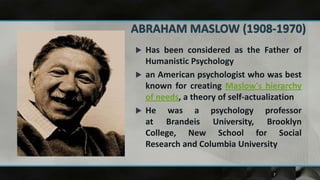
 Has been considered as the Father of
  Humanistic Psychology
 an American psychologist who was best
  known for creating Maslow's hierarchy
  of needs, a theory of self-actualization
 He    was a psychology professor
  at Brandeis University, Brooklyn
  College, New School for Social
  Research and Columbia University


                                  7
 He placed emphasis on choice, creativity, values, self-
 realization, all distinctively human qualities, and
 believed that meaningfulness and subjectivity were
 more important than objectivity.


                                                   8
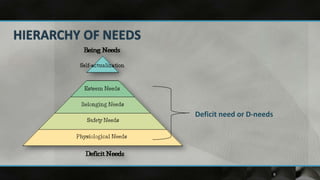
Deficit need or D-needs


                          9
10
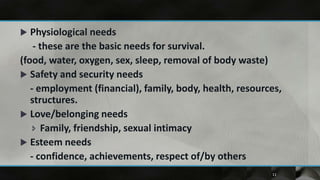
  Physiological needs
    - these are the basic needs for survival.
(food, water, oxygen, sex, sleep, removal of body waste)
 Safety and security needs
   - employment (financial), family, body, health, resources,
   structures.
 Love/belonging needs
     Family, friendship, sexual intimacy
 Esteem needs
   - confidence, achievements, respect of/by others
                                                          11
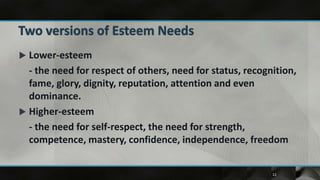
 Lower-esteem
  - the need for respect of others, need for status, recognition,
  fame, glory, dignity, reputation, attention and even
  dominance.
 Higher-esteem
  - the need for self-respect, the need for strength,
  competence, mastery, confidence, independence, freedom


                                                           12
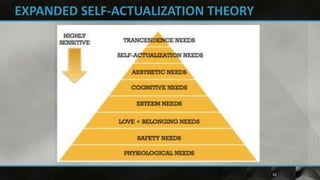
   Cognitive needs – knowledge and understanding needs

   Aesthetic needs – the needs for beauty, order and symmetry


   Transcendence needs- the needs for helping others


                                                                 13
   "Self Actualization is the intrinsic growth of what is already
    in the organism, or more accurately, of what the organism
    is.“ Abraham Maslow

 The quest for attaining the highest possible level of our
  potential.
 Emphasize our inner drive to grow and improve ourselves

                                                             14
   Acceptance and Realism
   Problem-centering
   Openness and spontaneity
   Autonomy and Solitude
   Continued Freshness of Appreciation
   The tendency to have peak experiences that are spiritually or
    emotionally satisfying
   Critical thinking
   Social interest

                                                                    15
"For any man of good will, there is work to be
done here, effective, virtuous, satisfying work
which can give rich meaning to one's own life
and to others” Abraham Maslow


                                       Reported by:
                                       Maria Cristina d.L Payofelin


                                                                      16
http://www.lifecircles-
inc.com/Learningtheories/humanist/maslow.html
http://www.ryerson.ca/~glassman/humanist.html
http://en.wikipedia.org/wiki/Abraham_Maslow
http://www.sparknotes.com/psychology/psych101/p
ersonality/section5.rhtml


                                                  17

Humanistic theory

  • 1.
  • 2.
    * Maslow (1943)developed a hierarchical theory of human motivation. * Carl Rogers (1946) publishes Significant aspects of client- centered therapy (also called person centered therapy). * In 1957 and 1958, at the invitation of Abraham Maslow and Clark Moustakas, two meetings were held in Detroit among psychologists who were interested in founding a professional association dedicated to a more meaningful, more humanistic vision. 2
  • 3.
    * In 1962,with the sponsorship of Brandeis University, this movement was formally launched as the Association for Humanistic Psychology. * The first issue of the Journal of Humanistic Psychology appeared in the Spring of 1961. * Humanistic Psychology is base on philosophies of existentialism and humanism 3
  • 4.
     is apsychological approach that emphasizes the study of the whole person, and the uniqueness of each individual. EXISTENTIALISM  Emphasized the quest for personal meaning and determining personal values. 4
  • 5.
    1. Someone’s present functioning is their most significant aspect. 2. To be mentally healthy, individuals must take personal responsibility for their actions. 3. Each person, simply by being, is inherently worthy. 4. The ultimate goal of living is to attain personal growth and understanding. 5
  • 6.
     Humanistic theoriesof personality stress the basic goodness of human beings and the need to achieve one's full potential.  Rejected the assumptions of behaviourism and psychoanalytic approach.  TWO WELL-KNOWN PSYCHOLOGISTS FOR THEIR HUMANISTIC THEORIES - Carl Rogers - Abraham Maslow 6
  • 7.
     Has beenconsidered as the Father of Humanistic Psychology  an American psychologist who was best known for creating Maslow's hierarchy of needs, a theory of self-actualization  He was a psychology professor at Brandeis University, Brooklyn College, New School for Social Research and Columbia University 7
  • 8.
     He placedemphasis on choice, creativity, values, self- realization, all distinctively human qualities, and believed that meaningfulness and subjectivity were more important than objectivity. 8
  • 9.
    Deficit need orD-needs 9
  • 10.
  • 11.
     Physiologicalneeds - these are the basic needs for survival. (food, water, oxygen, sex, sleep, removal of body waste)  Safety and security needs - employment (financial), family, body, health, resources, structures.  Love/belonging needs  Family, friendship, sexual intimacy  Esteem needs - confidence, achievements, respect of/by others 11
  • 12.
     Lower-esteem - the need for respect of others, need for status, recognition, fame, glory, dignity, reputation, attention and even dominance.  Higher-esteem - the need for self-respect, the need for strength, competence, mastery, confidence, independence, freedom 12
  • 13.
    Cognitive needs – knowledge and understanding needs  Aesthetic needs – the needs for beauty, order and symmetry  Transcendence needs- the needs for helping others 13
  • 14.
    "Self Actualization is the intrinsic growth of what is already in the organism, or more accurately, of what the organism is.“ Abraham Maslow  The quest for attaining the highest possible level of our potential.  Emphasize our inner drive to grow and improve ourselves 14
  • 15.
    Acceptance and Realism  Problem-centering  Openness and spontaneity  Autonomy and Solitude  Continued Freshness of Appreciation  The tendency to have peak experiences that are spiritually or emotionally satisfying  Critical thinking  Social interest 15
  • 16.
    "For any manof good will, there is work to be done here, effective, virtuous, satisfying work which can give rich meaning to one's own life and to others” Abraham Maslow Reported by: Maria Cristina d.L Payofelin 16
  • 17.