Type A
and Type B
Personality
Nayab Arshad
Roll no. 1263
Personality has been conceptualized as a pattern of
behavior that includes attributes, traits and
mannerism distinguishing one individual from
another.
Introduction
Theoretical Background
 Meyer Friedman and Ray Rosenman
(1974)
 Two distinct patterns of personality traits
 The type B – Common
 Type A – Outliers
The Type A Personality
“An action-emotion complex that can be
observed in any person who is aggressively
involved in a chronic, incessant struggle to
achieve more and more in less and less time.”
(Friedman and Rosenman, 1974)
Underlying Defense Mechanism
Compensation
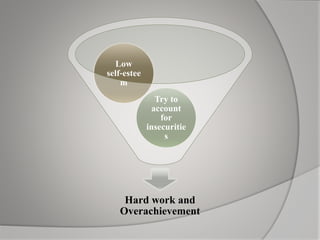
Hard work and
Overachievement
Try to
account
for
insecuritie
s
Low
self‐estee
m
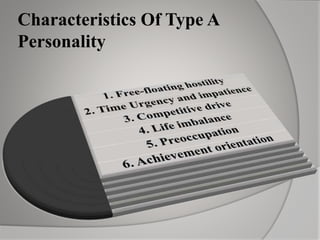
Characteristics Of Type A
Personality
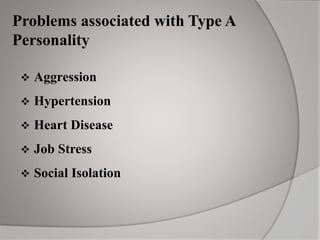
Problems associated with Type A
Personality
 Aggression
 Hypertension
 Heart Disease
 Job Stress
 Social Isolation
Assessment
Personality type test by Dr. Howard Glazer
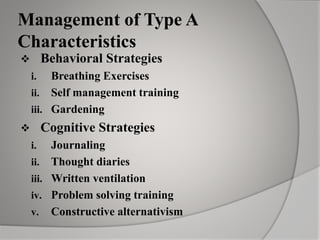
Management of Type A
Characteristics
 Behavioral Strategies
i. Breathing Exercises
ii. Self management training
iii. Gardening
 Cognitive Strategies
i. Journaling
ii. Thought diaries
iii. Written ventilation
iv. Problem solving training
v. Constructive alternativism
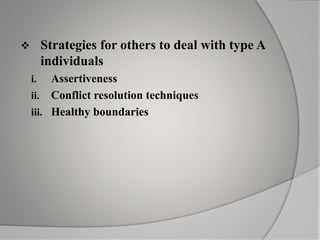
 Strategies for others to deal with type A
individuals
i. Assertiveness
ii. Conflict resolution techniques
iii. Healthy boundaries
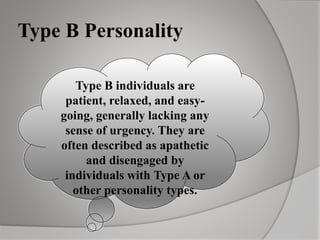
Type B individuals are
patient, relaxed, and easy-
going, generally lacking any
sense of urgency. They are
often described as apathetic
and disengaged by
individuals with Type A or
other personality types.
Type B Personality
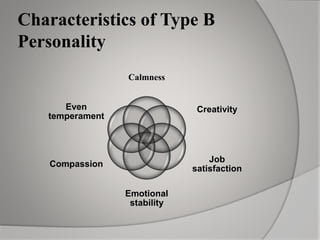
Characteristics of Type B
Personality
Calmness
Creativity
Job
satisfaction
Emotional
stability
Compassion
Even
temperament
Management of Type B Personality
 Motivation building
 Collaboration
 Social acceptance
Individuals with type C
personality pattern have
difficulty expressing emotion
and tend to suppress
emotions. Such individuals
display pathological niceness,
conflict avoidance,
high social desirability,
over compliance and over
patience.
Type C Personality
Underlying defense mechanism
 Pathological niceness
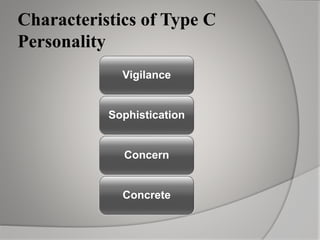
Characteristics of Type C
Personality
Vigilance
Sophistication
Concern
Concrete
Management of Type C
Personality
 Cognitive restructuring
 Detail-oriented tasks
 Autonomy to solve complex challenges
 Data-driven activities
Personality Hardiness
A set of personality characteristics that
allow the individual to defend against the
negative effects of stress
The 3 C’s of hardiness
 Control
 Commitment
 Challenge
Research into the ‘hardy’
personality
 To investigate whether a ‘hardy’ personality
impacts on an individuals ability to defend
against the negative effects of stress
Findings
 Hardy personality type is linked to stress
levels
 Defends against the negative effects of stress
 Encourages resilience and helps an individual
to cope with stress (Kobasa, 2006).
Empirical Research on Type A/B Theory
 Friedman & Rosenman (1976) - longitudinal study
to test hypothesis that type A personality predicts
incidents of heart disease.
 Type A participants were twice as likely to develop
heart disease as Type B’s
 Type A behavior makes individuals more prone
to stress-related illnesses.
(Friedman & Rosenman, 1976)
Critical Evaluation
 Description of complex human experiences within
narrowly defined parameters.
 Type A behavior is not a good predictor of coronary
heart disease.
 A much more sophisticated model is needed to
predict coronary heart disease.
Conclusion
 The distinction of type A and B personality - not
entirely supported by professionals
 Significant in terms of the characteristics that can
help understand the underlying mechanisms
 Effective intervention plans, keeping in view
pattern of individuals dealt in the spectrum of
health psychology.
References
Baum, T. A. Revenson & J. E. Singer (Eds.) Handbook of Health
Psychology. Mahwah, NJ: Erlbaum.
Friedman, M. (1996). Type A Behavior: Its Diagnosis and Treatment.
New York, Plenum Press (Kluwer Academic Press), pp. 31 ff.
McLeod, S. A. (2011). Type A Personality. Retrieved on April 26th, 2015
from http://www.simplypsychology.org/personality-a.html.
Scott, E. (2004). How To Soften Type A Traits. Retrieved on April 26th,
2015 from
http://stress.about.co/od/understandingstress/a/type_a_person_2.ht
ml.
Type A and Type B personality theory Retrieved on April 26th, 2015
from http://en.wikipedia.org/w/index.php?oldid=463058306.
Thank You

Type A, B & C Personalities

  • 1.
    Type A and TypeB Personality Nayab Arshad Roll no. 1263
  • 2.
    Personality has beenconceptualized as a pattern of behavior that includes attributes, traits and mannerism distinguishing one individual from another. Introduction
  • 3.
    Theoretical Background  MeyerFriedman and Ray Rosenman (1974)  Two distinct patterns of personality traits  The type B – Common  Type A – Outliers
  • 4.
    The Type APersonality “An action-emotion complex that can be observed in any person who is aggressively involved in a chronic, incessant struggle to achieve more and more in less and less time.” (Friedman and Rosenman, 1974)
  • 5.
  • 6.
    Hard work and Overachievement Tryto account for insecuritie s Low self‐estee m
  • 7.
  • 8.
    Problems associated withType A Personality  Aggression  Hypertension  Heart Disease  Job Stress  Social Isolation
  • 9.
  • 10.
    Management of TypeA Characteristics  Behavioral Strategies i. Breathing Exercises ii. Self management training iii. Gardening  Cognitive Strategies i. Journaling ii. Thought diaries iii. Written ventilation iv. Problem solving training v. Constructive alternativism
  • 11.
     Strategies forothers to deal with type A individuals i. Assertiveness ii. Conflict resolution techniques iii. Healthy boundaries
  • 12.
    Type B individualsare patient, relaxed, and easy- going, generally lacking any sense of urgency. They are often described as apathetic and disengaged by individuals with Type A or other personality types. Type B Personality
  • 13.
    Characteristics of TypeB Personality Calmness Creativity Job satisfaction Emotional stability Compassion Even temperament
  • 14.
    Management of TypeB Personality  Motivation building  Collaboration  Social acceptance
  • 15.
    Individuals with typeC personality pattern have difficulty expressing emotion and tend to suppress emotions. Such individuals display pathological niceness, conflict avoidance, high social desirability, over compliance and over patience. Type C Personality
  • 16.
    Underlying defense mechanism Pathological niceness
  • 17.
    Characteristics of TypeC Personality Vigilance Sophistication Concern Concrete
  • 18.
    Management of TypeC Personality  Cognitive restructuring  Detail-oriented tasks  Autonomy to solve complex challenges  Data-driven activities
  • 19.
    Personality Hardiness A setof personality characteristics that allow the individual to defend against the negative effects of stress
  • 20.
    The 3 C’sof hardiness  Control  Commitment  Challenge
  • 21.
    Research into the‘hardy’ personality  To investigate whether a ‘hardy’ personality impacts on an individuals ability to defend against the negative effects of stress Findings  Hardy personality type is linked to stress levels  Defends against the negative effects of stress  Encourages resilience and helps an individual to cope with stress (Kobasa, 2006).
  • 22.
    Empirical Research onType A/B Theory  Friedman & Rosenman (1976) - longitudinal study to test hypothesis that type A personality predicts incidents of heart disease.  Type A participants were twice as likely to develop heart disease as Type B’s  Type A behavior makes individuals more prone to stress-related illnesses. (Friedman & Rosenman, 1976)
  • 23.
    Critical Evaluation  Descriptionof complex human experiences within narrowly defined parameters.  Type A behavior is not a good predictor of coronary heart disease.  A much more sophisticated model is needed to predict coronary heart disease.
  • 24.
    Conclusion  The distinctionof type A and B personality - not entirely supported by professionals  Significant in terms of the characteristics that can help understand the underlying mechanisms  Effective intervention plans, keeping in view pattern of individuals dealt in the spectrum of health psychology.
  • 25.
    References Baum, T. A.Revenson & J. E. Singer (Eds.) Handbook of Health Psychology. Mahwah, NJ: Erlbaum. Friedman, M. (1996). Type A Behavior: Its Diagnosis and Treatment. New York, Plenum Press (Kluwer Academic Press), pp. 31 ff. McLeod, S. A. (2011). Type A Personality. Retrieved on April 26th, 2015 from http://www.simplypsychology.org/personality-a.html. Scott, E. (2004). How To Soften Type A Traits. Retrieved on April 26th, 2015 from http://stress.about.co/od/understandingstress/a/type_a_person_2.ht ml. Type A and Type B personality theory Retrieved on April 26th, 2015 from http://en.wikipedia.org/w/index.php?oldid=463058306.
  • 26.