PERSONALITY :
HUMAN LIFE AND STYLE FOR BEING
Dr. Sankar Prasad Mohanty
Associate Professor of Education,
PG Department of Education
Rama Devi Women’s University, Bhubaneswar, India
E-mail: sankarprasadmohanty@rdwu.ac.in
3/28/2020 1
3/28/2020 2
3/28/2020 3
3/28/2020 4
3/28/2020 5
3/28/2020 6
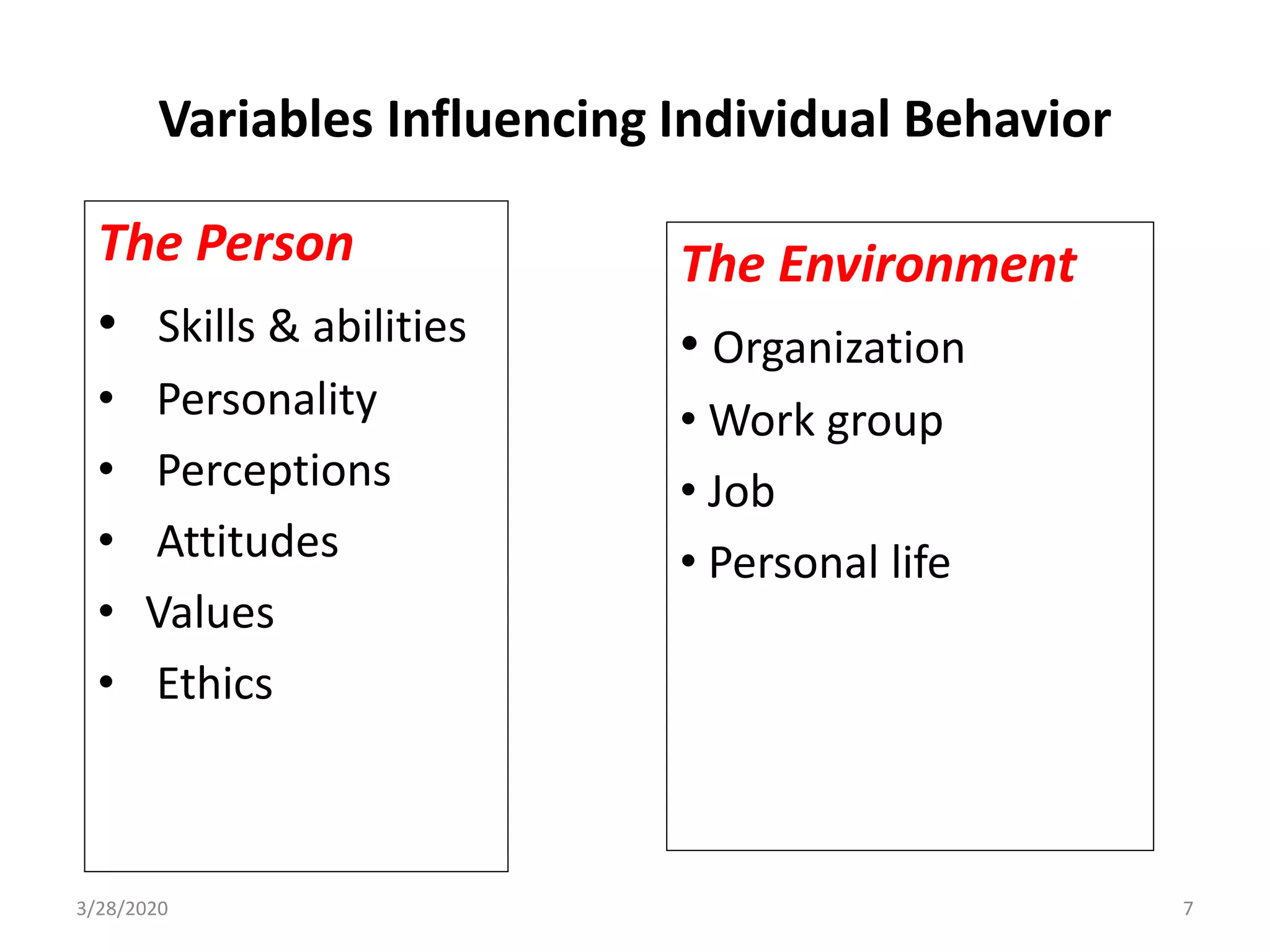
Variables Influencing Individual Behavior
The Environment
• Organization
• Work group
• Job
• Personal life
The Person
• Skills & abilities
• Personality
• Perceptions
• Attitudes
• Values
• Ethics
3/28/2020 7
People having:
• Poor Personality
• Fine Personality
• Having good manner
• Good body language
• Short temper
• Well behaviour
• Well dressed
3/28/2020 8
PERSONALITY
Latin word: Persona (Mask) Covering face by
Greek actors
An individual’s characteristic pattern of thinking,
feeling, and acting
3/28/2020 9
Personality -A relatively stable set of characteristics
that influences an individual’s behavior
A stimulus:
• Social stimulus value
• Affects other persons with contact
• Impressive, dominating, submissive personality
• Physical appearance, clothing, talking style
• Selection in interviews for job..
3/28/2020 10
Summative approach:
• Sum total various activities
• Habits, impulses, emotional activities, innate
qualities etc.
Integrative approach:
• Organization of all the cognitive, affective, conative
and physical characteristics
3/28/2020 11
G.W.Allport (1948):
“Personality is dynamic organization within
the individual of those psycho-physical
systems that determine his unique adjustment
to his environment.”
3/28/2020 12
Thus, Personality:
• is something unique and specific
• exhibits self consciousness
• it is internal as well as external
• Is more than collection of so many traits (elephant
story)
• remains stable for a large extent
• Is dynamic; continuous adjustment to environment
• Is subjected to disorganization (illness, injury, stress,
brain damage)
• is determined by both heredity and environment.
• can be measured
3/28/2020 13
Theories to study personality
1930’s and 1940’s-Allport and Murray began writing
about personality and theories of personality
• Type theory
• Trait theory
• Psycho analytic theory
3/28/2020 14
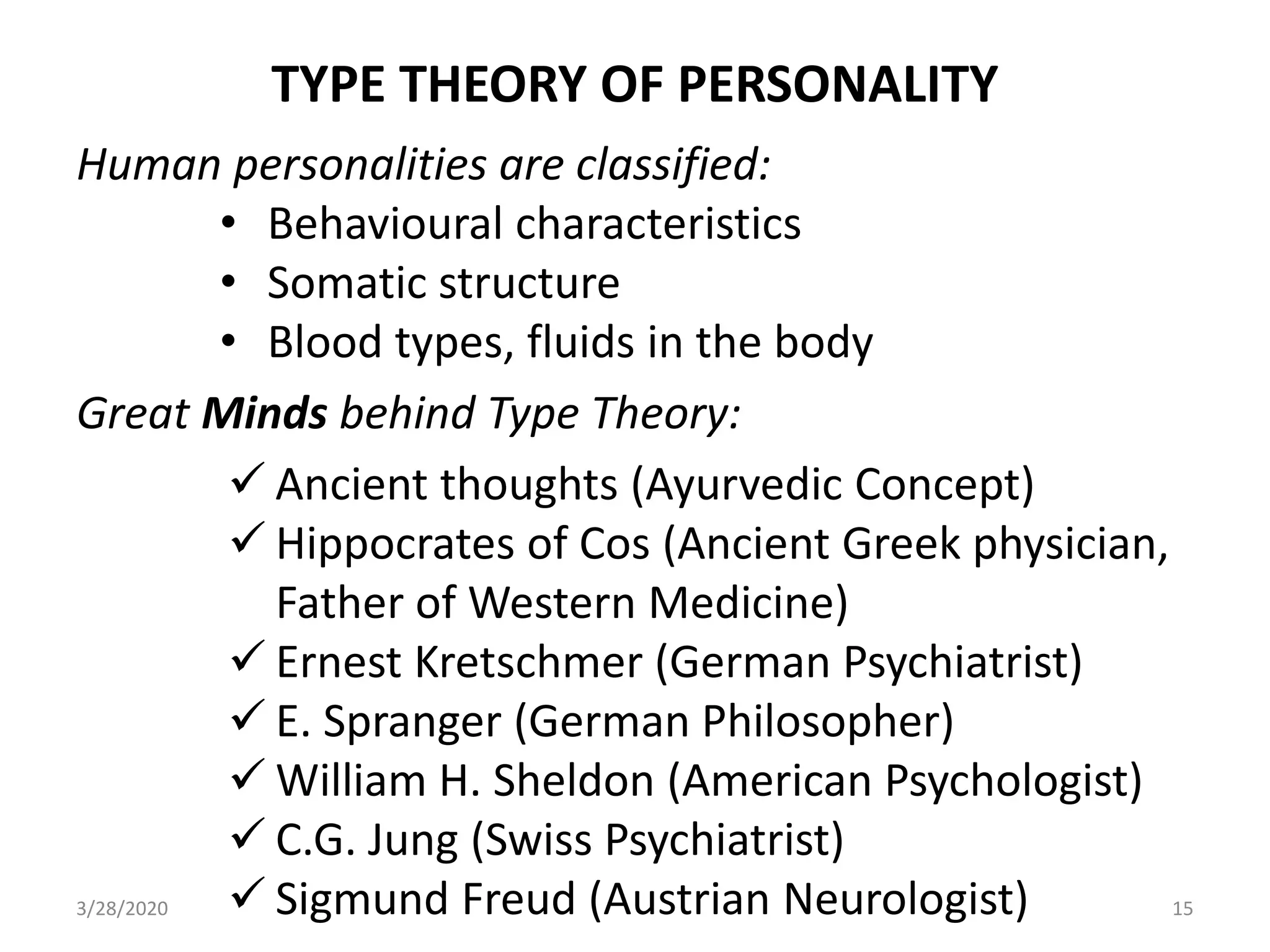
TYPE THEORY OF PERSONALITY
Human personalities are classified:
• Behavioural characteristics
• Somatic structure
• Blood types, fluids in the body
Great Minds behind Type Theory:
 Ancient thoughts (Ayurvedic Concept)
 Hippocrates of Cos (Ancient Greek physician,
Father of Western Medicine)
 Ernest Kretschmer (German Psychiatrist)
 E. Spranger (German Philosopher)
 William H. Sheldon (American Psychologist)
 C.G. Jung (Swiss Psychiatrist)
 Sigmund Freud (Austrian Neurologist)3/28/2020 15
Ancient Classifications (Ayurveda)
Entire Universe- Living and Non- living entities:
• made up of Air, Fire, Water, Earth and Space
(Panchamahabhutas)
• Human body is constituted of these
Panchamahabhutas and controlled by them.
• Such elements (Vata, Kapha, Pitta) are
responsible for physiological and psychological
characteristics
3/28/2020 16
Elements Somatic Characteristics Personality Charcteristics
Air and
Space (Vata)
Slightly built, dark hair &
eyes, dry skin, suffer
from joint pain,
constipation etc
Restless , active mind,
emotionally insecure,
poor memory, night
dream, enjoy travelling,
solitary, resisting
authority
Water and
Earth
(Kapha)
Over weight, eyes are
wide and attractive,
sinus problem, lethargy,
nausea, Big bones,
shining hair
Sleepy, rational speech,
move slowly, emotionally
secure, romantic and
sentimental
Fire and
Water (Pitta)
Average built, red hair,
moles, acne, may be
bald, green and piercing
eyes
argumentative, sharp
intelligence, , enjoy sports
and politics, vivid dreams
3/28/2020 17
Hippocrate’s Classification
460 BC-370 BC
Typology on the basis of body fluids:
Blood, Yellow bile, Phlegm (mucus) and Black
bile (Four types of humours)
Fluid
type
Personality type Characteristics
Blood Sanguine Optimistic, happy,
hopeful
Yellow
Bile
Choleric Irritable, angry,, active
imagination
Phlegm
(Mucus)
Phlegmatic Cold, Calm, Slow,
Sluggish, Indifferent
Black Bile Melancholic Sad, Depressed,
Pessimistic, Slow, Bad
tempered3/28/2020 18
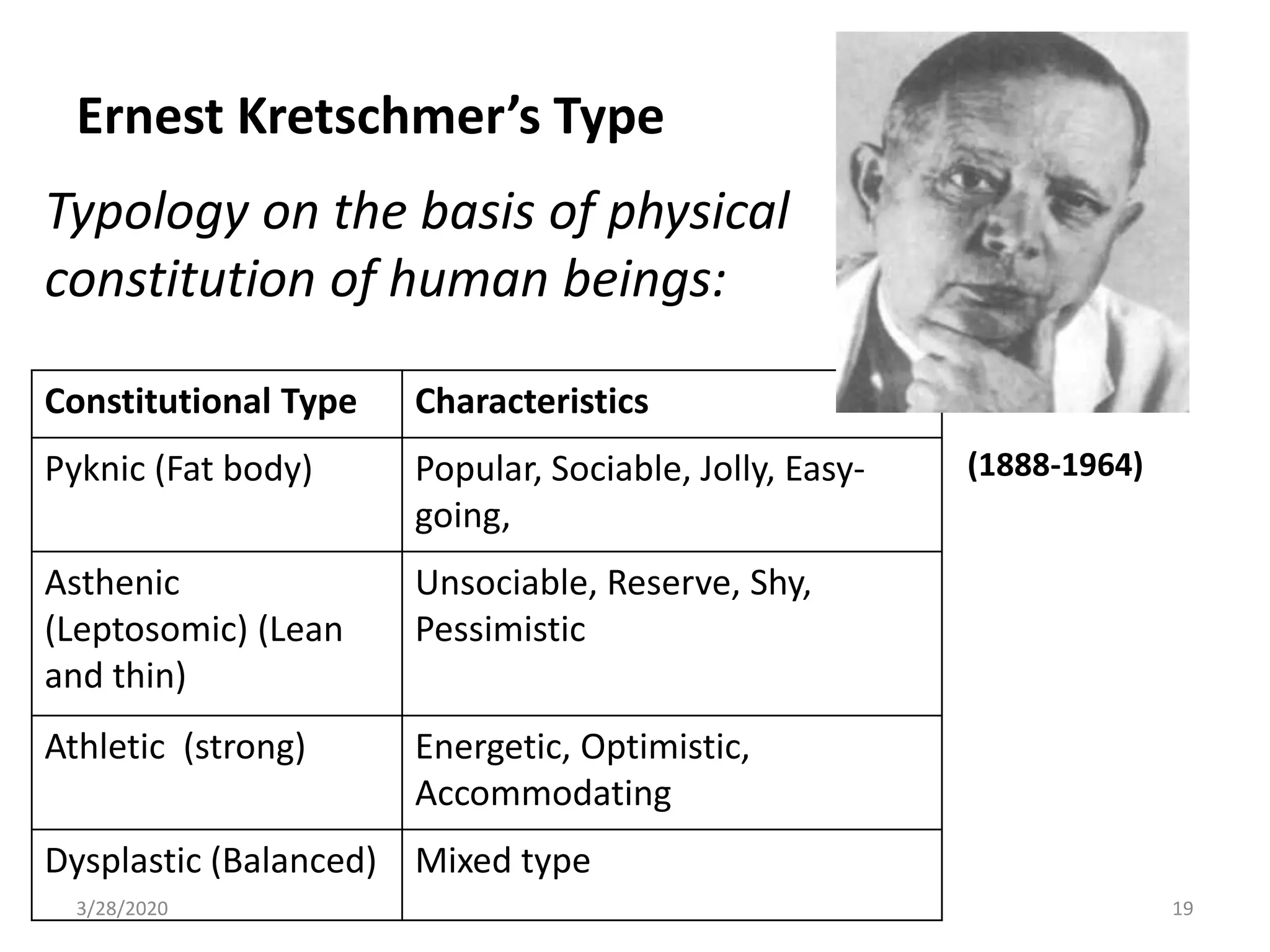
Ernest Kretschmer’s Type
Typology on the basis of physical
constitution of human beings:
(1888-1964)
Constitutional Type Characteristics
Pyknic (Fat body) Popular, Sociable, Jolly, Easy-
going,
Asthenic
(Leptosomic) (Lean
and thin)
Unsociable, Reserve, Shy,
Pessimistic
Athletic (strong) Energetic, Optimistic,
Accommodating
Dysplastic (Balanced) Mixed type
3/28/2020 19
Eduard Spranger’ Type
(1882-1963)
• Theoretical : Theoretical in nature
neglect social and political participation
• Economic: Interested in money
Hoarding
• Aesthetic: Lover of Beauty, form and
harmony
• Social: love of people, interested in
social activities
• Political: Dominating, Power desirous
• Religious: Unity, Religious activities
3/28/2020 20
William H. Sheldon’s Type
(1898-1977)
Typology on the basis of Somatic
structure of Human Beings:
Types Somatic Characteristics/ temperament
Endomorphic Weak somatic,
highly developed
structure (Soft and
Round)
Viscerotonic: Easy-going,
Sociable, Affectionate,
Extrovert, Needs Physical
Comfort
Mesomorphic Balanced (Muscular
and strong)
Somatotonic: Craving Muscular
activities, Loves risk, Adventure,
Energetic
Ectomorphic Weak somatic,
undeveloped
viscera
Cerebrotonic: Fearful, Introvert,
Unsociable, Pessimistic
3/28/2020 21
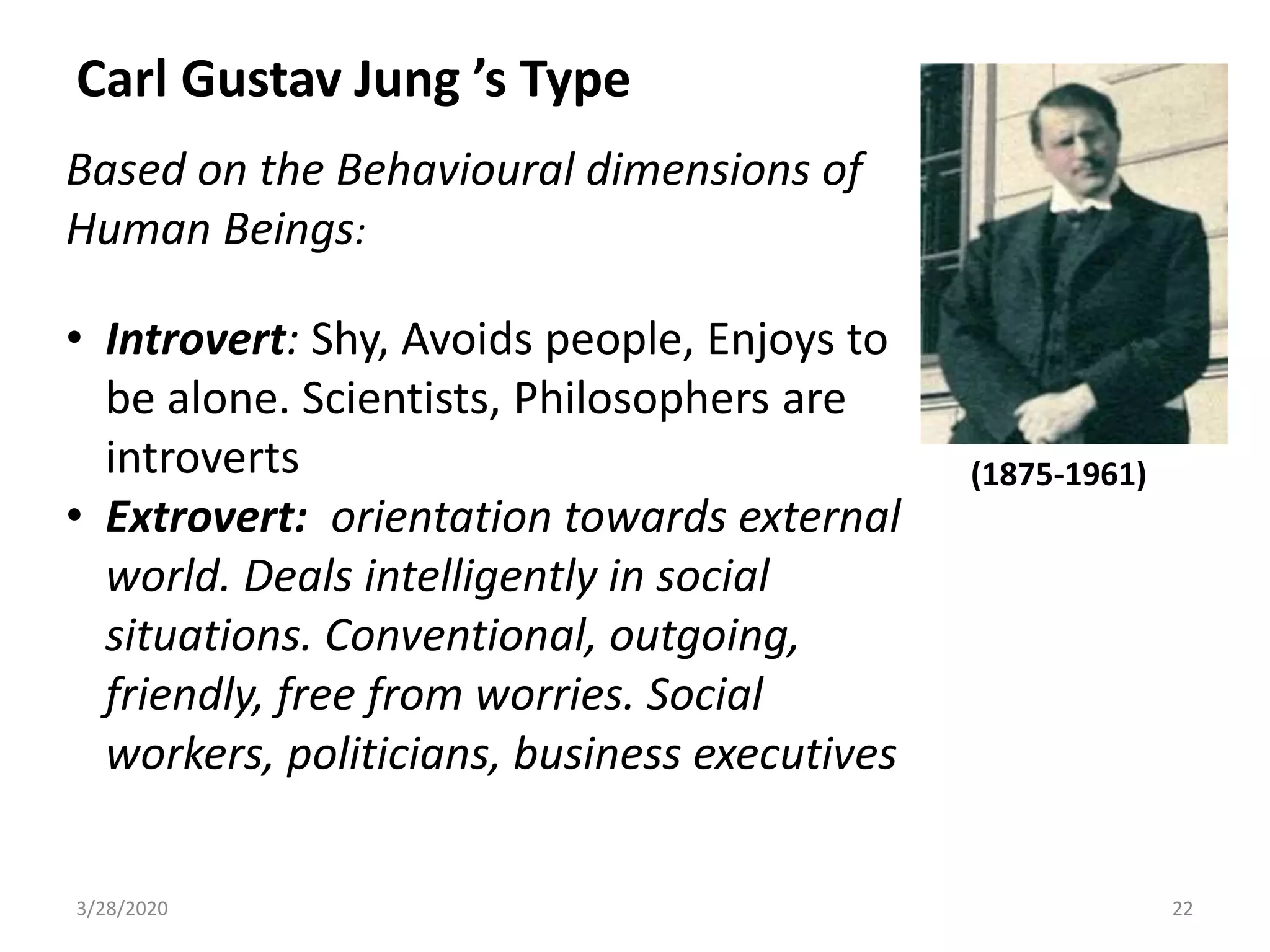
Carl Gustav Jung ’s Type
(1875-1961)
Based on the Behavioural dimensions of
Human Beings:
• Introvert: Shy, Avoids people, Enjoys to
be alone. Scientists, Philosophers are
introverts
• Extrovert: orientation towards external
world. Deals intelligently in social
situations. Conventional, outgoing,
friendly, free from worries. Social
workers, politicians, business executives
3/28/2020 22
Sigmund Freud’s Type
(1856-1939)3/28/2020 23
Sigmund Freud’s Type
Based on the fixation of sexual energy at a particular
stage of sex development:
• Oral-erotic type: Sex is located in mouth. Excessive degree of
pleasures associated with oral activity. Sucking,, Putting
anything in mouth
• Oral Passive Type: Dependent, optimistic, immature thinking,
Child like activities, Expect help from elders
• Oral sadistic type: Pessimistic, aggressive, Bitter in dealing with
others
• Anal Type: Gratification through anal activities.. Obstinacy,
miserliness, Orderliness etc.
• Phallic Type: Self-love, exhibitionism, Draws attention of others,
at early adolescence.
3/28/2020 24
Trait Theory of Personality
• Trait..?: a property within the individual that accounts
for his unique and stable reactions to environment
• Type and Trait theories/approaches are interrelated
• Typology classifies individuals in broad types
(outdated)
• Trait approach labels a person by his/her mode of
behaviour (widely accepted and used): we label by
trait e.g., irritable, Slow etc.
3/28/2020 25
Properties of Traits
• Scalability
• Inference from one’s activities
• Flexibility
• Universal
• Psychological process
• Traits are learned (interaction with env.)
3/28/2020 26
Classifications of Traits
• Allport’s Classifications
• Cattell’s Classification
• Eysenck’s Classification
3/28/2020 27
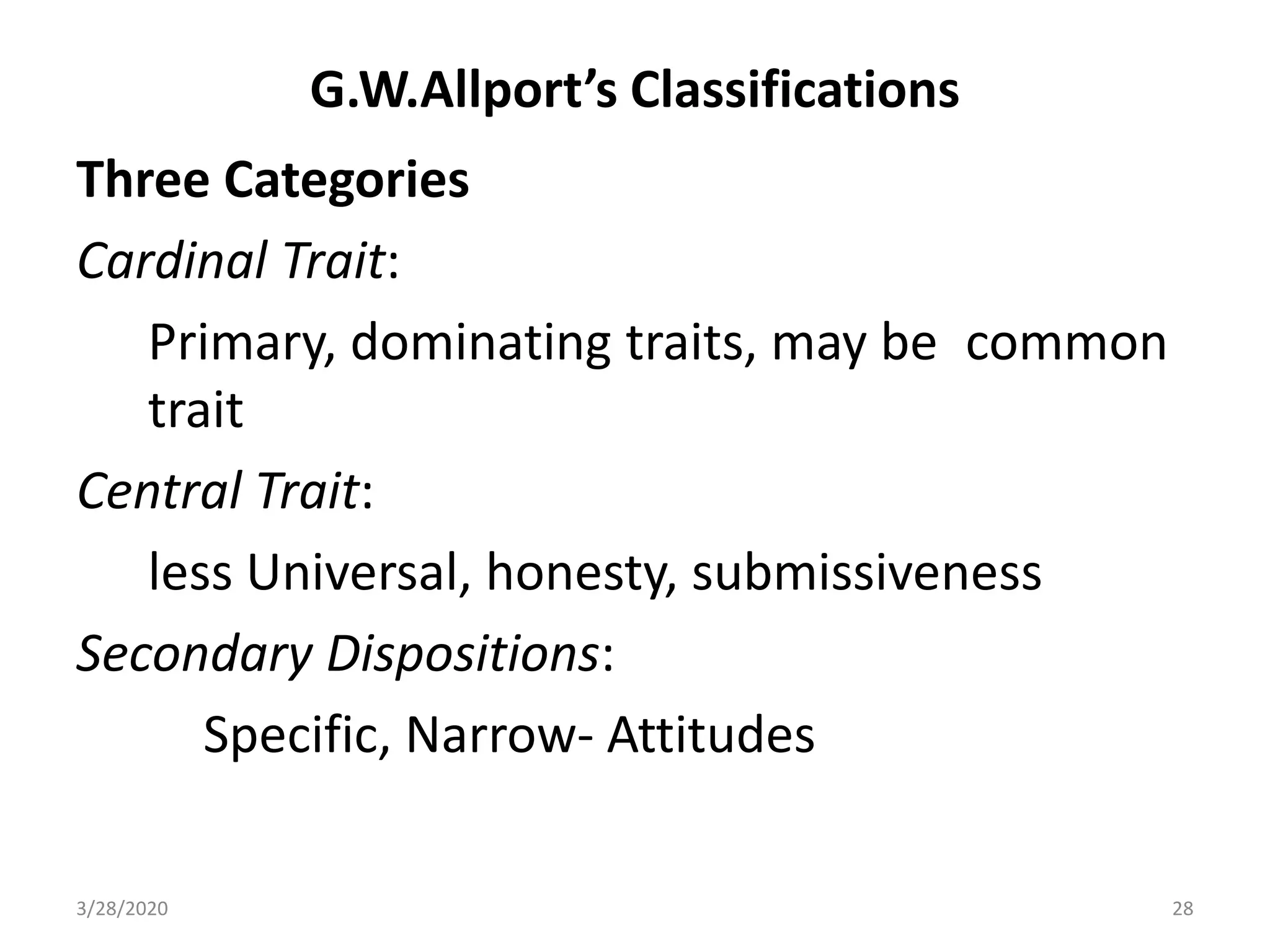
G.W.Allport’s Classifications
Three Categories
Cardinal Trait:
Primary, dominating traits, may be common
trait
Central Trait:
less Universal, honesty, submissiveness
Secondary Dispositions:
Specific, Narrow- Attitudes
3/28/2020 28
R.B.Cattel’s Clasifications
Four Categories:
• Common traits:
widely distributed in general population, honesty,
aggression etc.
• Unique traits:
among particular persons, emotional reactions, energy
etc.
• Surface traits:
as overt behaviour, honestys, life kills, dependability etc
• Source traits:
are determined fromn one’s behavious, emotional
status,
3/28/2020 29
MAJOR PERSONALITY FACTORS
• outgoing—reserved
• more intelligent—less intelligent
• stable—emotional
• assertive—humble
• happy-go-lucky—sober
• conscientious—expedient
• venturesome—shy
• tender-minded—tough-minded
• suspicious—trusting
• imaginative—practical
• shrewd—forthright
• apprehensive—placid
3/28/2020 30
H.J.Eysenck’s Classifications (1916-1998):, A British
Psychologist
• He explored personality traits by conducting research on
10,000 soldiers who had been psychologically damaged
in World War II.
• Jeffrey A. Gray's personality theory as a modification to
the Eysenck theory
• has a genetic basis - we’re born that way
• has a biological explanation - personality shaped by a
part of the mid brain called the reticular activating
system
• He said that our personality is shaped by the activity and
arousal of parts of our nervous system network - we
can’t help being disagreeable, shy, open etc.3/28/2020 31
• Trait - means a relatively stable and enduring
tendency to behave in a particular way (e.g. being
punctual, considerate, happy or helpful)
• Eysenck believed that a combination of personality
traits was the self or identity of a person
3/28/2020 32
Three dimensions:
• Introversion- extroversion (extraversion)-how
outgoing we are.
• Extraversion - Introversion:
– Introversion: tender mindedness;
introspectiveness; seriousness; performance
interfered with by excitement; easily aroused but
restrained, inhibited; preference for solitary
vocations; sensitivity to pain.
– Extraversion: tough-mindedness; impulsiveness;
tendency to be outgoing; desire for novelty;
performance enhanced by excitement; preference
for vocations involving contact with other people;
tolerance for pain.3/28/2020 33
• High Extraversion:
– Outgoing, Social, Lively, Friendly.
• Low Extraversion [Introversion]:
– Shy, Passive, Withdrawn.
3/28/2020 34
• Neuroticism (how emotionally stable we are)
Neuroticism-stability (N) is associated with
arousability of the limbic circuit, such that
neurotics become more aroused than stable
individuals as a consequence of emotion-
inducing stimulation.
Below-average emotional control, will-power, and
capacity to exert self; slowness in thought and
action; suggestibility; lack of persistence; tendency to
repress unpleasant facts; lack of sociability; below-
average sensory acuity but high level of activation
3/28/2020 35
Thank you
3/28/2020 36

PERSONALITY: HUMAN LIFE AND STYLE FOR BEING

  • 1.
    PERSONALITY : HUMAN LIFEAND STYLE FOR BEING Dr. Sankar Prasad Mohanty Associate Professor of Education, PG Department of Education Rama Devi Women’s University, Bhubaneswar, India E-mail: sankarprasadmohanty@rdwu.ac.in 3/28/2020 1
  • 2.
  • 3.
  • 4.
  • 5.
  • 6.
  • 7.
    Variables Influencing IndividualBehavior The Environment • Organization • Work group • Job • Personal life The Person • Skills & abilities • Personality • Perceptions • Attitudes • Values • Ethics 3/28/2020 7
  • 8.
    People having: • PoorPersonality • Fine Personality • Having good manner • Good body language • Short temper • Well behaviour • Well dressed 3/28/2020 8
  • 9.
    PERSONALITY Latin word: Persona(Mask) Covering face by Greek actors An individual’s characteristic pattern of thinking, feeling, and acting 3/28/2020 9
  • 10.
    Personality -A relativelystable set of characteristics that influences an individual’s behavior A stimulus: • Social stimulus value • Affects other persons with contact • Impressive, dominating, submissive personality • Physical appearance, clothing, talking style • Selection in interviews for job.. 3/28/2020 10
  • 11.
    Summative approach: • Sumtotal various activities • Habits, impulses, emotional activities, innate qualities etc. Integrative approach: • Organization of all the cognitive, affective, conative and physical characteristics 3/28/2020 11
  • 12.
    G.W.Allport (1948): “Personality isdynamic organization within the individual of those psycho-physical systems that determine his unique adjustment to his environment.” 3/28/2020 12
  • 13.
    Thus, Personality: • issomething unique and specific • exhibits self consciousness • it is internal as well as external • Is more than collection of so many traits (elephant story) • remains stable for a large extent • Is dynamic; continuous adjustment to environment • Is subjected to disorganization (illness, injury, stress, brain damage) • is determined by both heredity and environment. • can be measured 3/28/2020 13
  • 14.
    Theories to studypersonality 1930’s and 1940’s-Allport and Murray began writing about personality and theories of personality • Type theory • Trait theory • Psycho analytic theory 3/28/2020 14
  • 15.
    TYPE THEORY OFPERSONALITY Human personalities are classified: • Behavioural characteristics • Somatic structure • Blood types, fluids in the body Great Minds behind Type Theory:  Ancient thoughts (Ayurvedic Concept)  Hippocrates of Cos (Ancient Greek physician, Father of Western Medicine)  Ernest Kretschmer (German Psychiatrist)  E. Spranger (German Philosopher)  William H. Sheldon (American Psychologist)  C.G. Jung (Swiss Psychiatrist)  Sigmund Freud (Austrian Neurologist)3/28/2020 15
  • 16.
    Ancient Classifications (Ayurveda) EntireUniverse- Living and Non- living entities: • made up of Air, Fire, Water, Earth and Space (Panchamahabhutas) • Human body is constituted of these Panchamahabhutas and controlled by them. • Such elements (Vata, Kapha, Pitta) are responsible for physiological and psychological characteristics 3/28/2020 16
  • 17.
    Elements Somatic CharacteristicsPersonality Charcteristics Air and Space (Vata) Slightly built, dark hair & eyes, dry skin, suffer from joint pain, constipation etc Restless , active mind, emotionally insecure, poor memory, night dream, enjoy travelling, solitary, resisting authority Water and Earth (Kapha) Over weight, eyes are wide and attractive, sinus problem, lethargy, nausea, Big bones, shining hair Sleepy, rational speech, move slowly, emotionally secure, romantic and sentimental Fire and Water (Pitta) Average built, red hair, moles, acne, may be bald, green and piercing eyes argumentative, sharp intelligence, , enjoy sports and politics, vivid dreams 3/28/2020 17
  • 18.
    Hippocrate’s Classification 460 BC-370BC Typology on the basis of body fluids: Blood, Yellow bile, Phlegm (mucus) and Black bile (Four types of humours) Fluid type Personality type Characteristics Blood Sanguine Optimistic, happy, hopeful Yellow Bile Choleric Irritable, angry,, active imagination Phlegm (Mucus) Phlegmatic Cold, Calm, Slow, Sluggish, Indifferent Black Bile Melancholic Sad, Depressed, Pessimistic, Slow, Bad tempered3/28/2020 18
  • 19.
    Ernest Kretschmer’s Type Typologyon the basis of physical constitution of human beings: (1888-1964) Constitutional Type Characteristics Pyknic (Fat body) Popular, Sociable, Jolly, Easy- going, Asthenic (Leptosomic) (Lean and thin) Unsociable, Reserve, Shy, Pessimistic Athletic (strong) Energetic, Optimistic, Accommodating Dysplastic (Balanced) Mixed type 3/28/2020 19
  • 20.
    Eduard Spranger’ Type (1882-1963) •Theoretical : Theoretical in nature neglect social and political participation • Economic: Interested in money Hoarding • Aesthetic: Lover of Beauty, form and harmony • Social: love of people, interested in social activities • Political: Dominating, Power desirous • Religious: Unity, Religious activities 3/28/2020 20
  • 21.
    William H. Sheldon’sType (1898-1977) Typology on the basis of Somatic structure of Human Beings: Types Somatic Characteristics/ temperament Endomorphic Weak somatic, highly developed structure (Soft and Round) Viscerotonic: Easy-going, Sociable, Affectionate, Extrovert, Needs Physical Comfort Mesomorphic Balanced (Muscular and strong) Somatotonic: Craving Muscular activities, Loves risk, Adventure, Energetic Ectomorphic Weak somatic, undeveloped viscera Cerebrotonic: Fearful, Introvert, Unsociable, Pessimistic 3/28/2020 21
  • 22.
    Carl Gustav Jung’s Type (1875-1961) Based on the Behavioural dimensions of Human Beings: • Introvert: Shy, Avoids people, Enjoys to be alone. Scientists, Philosophers are introverts • Extrovert: orientation towards external world. Deals intelligently in social situations. Conventional, outgoing, friendly, free from worries. Social workers, politicians, business executives 3/28/2020 22
  • 23.
  • 24.
    Sigmund Freud’s Type Basedon the fixation of sexual energy at a particular stage of sex development: • Oral-erotic type: Sex is located in mouth. Excessive degree of pleasures associated with oral activity. Sucking,, Putting anything in mouth • Oral Passive Type: Dependent, optimistic, immature thinking, Child like activities, Expect help from elders • Oral sadistic type: Pessimistic, aggressive, Bitter in dealing with others • Anal Type: Gratification through anal activities.. Obstinacy, miserliness, Orderliness etc. • Phallic Type: Self-love, exhibitionism, Draws attention of others, at early adolescence. 3/28/2020 24
  • 25.
    Trait Theory ofPersonality • Trait..?: a property within the individual that accounts for his unique and stable reactions to environment • Type and Trait theories/approaches are interrelated • Typology classifies individuals in broad types (outdated) • Trait approach labels a person by his/her mode of behaviour (widely accepted and used): we label by trait e.g., irritable, Slow etc. 3/28/2020 25
  • 26.
    Properties of Traits •Scalability • Inference from one’s activities • Flexibility • Universal • Psychological process • Traits are learned (interaction with env.) 3/28/2020 26
  • 27.
    Classifications of Traits •Allport’s Classifications • Cattell’s Classification • Eysenck’s Classification 3/28/2020 27
  • 28.
    G.W.Allport’s Classifications Three Categories CardinalTrait: Primary, dominating traits, may be common trait Central Trait: less Universal, honesty, submissiveness Secondary Dispositions: Specific, Narrow- Attitudes 3/28/2020 28
  • 29.
    R.B.Cattel’s Clasifications Four Categories: •Common traits: widely distributed in general population, honesty, aggression etc. • Unique traits: among particular persons, emotional reactions, energy etc. • Surface traits: as overt behaviour, honestys, life kills, dependability etc • Source traits: are determined fromn one’s behavious, emotional status, 3/28/2020 29
  • 30.
    MAJOR PERSONALITY FACTORS •outgoing—reserved • more intelligent—less intelligent • stable—emotional • assertive—humble • happy-go-lucky—sober • conscientious—expedient • venturesome—shy • tender-minded—tough-minded • suspicious—trusting • imaginative—practical • shrewd—forthright • apprehensive—placid 3/28/2020 30
  • 31.
    H.J.Eysenck’s Classifications (1916-1998):,A British Psychologist • He explored personality traits by conducting research on 10,000 soldiers who had been psychologically damaged in World War II. • Jeffrey A. Gray's personality theory as a modification to the Eysenck theory • has a genetic basis - we’re born that way • has a biological explanation - personality shaped by a part of the mid brain called the reticular activating system • He said that our personality is shaped by the activity and arousal of parts of our nervous system network - we can’t help being disagreeable, shy, open etc.3/28/2020 31
  • 32.
    • Trait -means a relatively stable and enduring tendency to behave in a particular way (e.g. being punctual, considerate, happy or helpful) • Eysenck believed that a combination of personality traits was the self or identity of a person 3/28/2020 32
  • 33.
    Three dimensions: • Introversion-extroversion (extraversion)-how outgoing we are. • Extraversion - Introversion: – Introversion: tender mindedness; introspectiveness; seriousness; performance interfered with by excitement; easily aroused but restrained, inhibited; preference for solitary vocations; sensitivity to pain. – Extraversion: tough-mindedness; impulsiveness; tendency to be outgoing; desire for novelty; performance enhanced by excitement; preference for vocations involving contact with other people; tolerance for pain.3/28/2020 33
  • 34.
    • High Extraversion: –Outgoing, Social, Lively, Friendly. • Low Extraversion [Introversion]: – Shy, Passive, Withdrawn. 3/28/2020 34
  • 35.
    • Neuroticism (howemotionally stable we are) Neuroticism-stability (N) is associated with arousability of the limbic circuit, such that neurotics become more aroused than stable individuals as a consequence of emotion- inducing stimulation. Below-average emotional control, will-power, and capacity to exert self; slowness in thought and action; suggestibility; lack of persistence; tendency to repress unpleasant facts; lack of sociability; below- average sensory acuity but high level of activation 3/28/2020 35
  • 36.