Organisational Behaviour
Lecture session 6.1
Personality
Lecture session 6.2
Big 5 Test - OCEAN Model - Activity
Presented by : Mr. Dheeraj Rongala
Contact email : [email protected]
Topics covered in Week 6
Organisational Behaviour
Lecture session 6.3
Organisational ethics
Lecture session 6.4
Queries and clarifications
Presented by : Mr. Dheeraj Rongala
Contact email : [email protected]
Topics covered in Week 6
Learning objectives
By the end of the session, learners will be able to know about:
Personality and its associated theories.
Big 5 Personality traits.
Characteristics of groups and teams.
Tuckman's theory of groups and.
Belbin's team roles.
Personality
Personality
What is Personality?
The relatively enduring combination of traits which make an
individual unique and at the same time produce consistencies in
his or her thought and behaviour”. Fincham & Rhodes(2005,
p95).
The observable manifestation of social identity which a person
develops and constructs through negotiation and interaction
with others”. Thompson & McHugh (2009, p287).
Personality
What is Personality?
Personality is the particular combination of emotional,
attitudinal, and behavioral response patterns of an individual.
Personality commonly refers to:
Personality psychology, the theory and study of individual
differences, traits, and types.
Personality trait theory, attributes by which people may vary in
relative terms.
Personality is made up of the characteristic patterns of thoughts,
feelings and behaviors that make a person unique. In addition to
this, personality arises from within the individual and remains
fairly consistent throughout life.
Fundamental characteristics of Personality
Consistency - There is generally a recognizable order and
regularity to behaviors. Essentially, people act in the same ways
or similar ways in a variety of situations.
Psychological and physiological - Personality is a psychological
construct, but research suggests that it is also influenced by
biological processes and needs.
It impacts behaviors and actions - Personality does not just
influence how we move and respond in our environment; it
also causes us to act in certain ways.
Multiple expressions - Personality is displayed in more than just
behavior. It can also be seen in our thoughts, feelings, close
relationships and other social interactions.
Types of Personality theories
There are a number of different theories about how personality
develops. Different schools of thought in psychology influence
many of these theories.
Some of these major perspectives on personality include:
Type theories are the early perspectives on personality. These
theories suggested that there are a limited number of
"personality types" which are related to biological influences.
Trait theories viewed personality as the result of internal
characteristics that are genetically based.
Humanist theories emphasize the importance of free will and
individual experience in the development of personality.
Humanist theorists include Carl Rogers and Abraham Maslow.
Types of Personality theories
Psychodynamic theories of personality are heavily influenced
by the work of Sigmund Freud, and emphasize the influence of
the unconscious on personality. Psychodynamic theories include
Sigmund Freud’s psychosexual stage theory and Erik
Erikson’s stages of psychosocial development.
Behavioural theories suggest that personality is a result of
interaction between the individual and the environment.
Behavioral theorists study observable and measurable
behaviors, rejecting theories that take internal thoughts and
feelings into account. Behavioral theorists
include B.F.Skinner and John B.Watson.
Types of Personality theories
A. Trait theories:
According to the Diagnostic and Statistical Manual of
the American Psychiatric Association, personality traits are
"enduring patterns of perceiving, relating to, and thinking about
the environment and oneself that are exhibited in a wide range
of social and personal contexts."
Theorists generally assume
a) traits are relatively stable over time,
b) traits differ among individuals (for instance, some people are
outgoing while others are reserved), and
c) traits influence behavior.
Types of Personality theories
Trait theories:
Gordon Allport delineated different kinds of traits, which he
also called dispositions. Central traits are basic to an
individual's personality, while secondary traits are more
peripheral. Terms such as
intelligent, honest, shy and anxious are considered central
traits. Common traits are those recognized within a culture and
thus may vary from culture to culture. Cardinal traits are those
by which an individual may be strongly recognized.
Types of Personality theories
Raymond Cattell’s Trait theories:
Cattell took the thousands of traits described by Allport and
condensed them down to 16 primary traits using the statistical
method of factor analysis.
His research propagated a two-tiered personality structure with
sixteen "primary factors" (16 Personality factors) and five
"secondary factors."
Types of Personality theories
Raymond Cattell’s Trait theories:
Types of Personality theories
Eysenck Trait theories:
Eysenck proposed that only two factors (Extraversion and
Intraversion) were necessary to explain individual differences in
personality.
Eysenck argued that Cattell's model contained too many factors
which were similar to each other, and that a simple two factor
model could encompass the 16 traits proposed by Cattell.
This model had the dimensions reflected in the diagram
presented on the next slide.
Types of Personality theories
Eysenck Trait theories:
Types of Personality theories
Eysenck Trait theories:
Eysenck argued that these traits were associated with innate
biological differences. For example, extraverts need more
stimulation than introverts do because they have lower resting
levels of nervous system arousal than introverts. Eysenck
developed a third factor, psychoticism, which dealt with a
predisposition to be psychotic (not grounded in reality) or
sociopathic (psychologically unattached).
Hans Eysenck believed just three traits — extraversion,
neuroticism and psychoticism - were sufficient to describe
human personality. The result was the so called PEN personality
model.
Types of Personality theories
Eysenck Trait theories:
PEN personality model.
P scale: Psychoticism ----- High Impulse Control
Aggressive, cold, egocentric, [Nonagressive, warm, concerned
for others
impersonal, impulsive, antisocial, personally involved,
considerate, social,
unemphathetic, creative, tough-minded empathetic, uncreative,
persuadable]
E scale: Extraversion ---- Introversion
Sociable, lively, active, assertive, [Hermetic, taciturn, passive,
unassertive,
sensation-seeking, carefree, stoical, reserved, dependent,
dominant, surgent, venturesome even-tempered, risk-averse]
N scale: Neuroticism ----- Emotional Stability
Anxious, depressed, guilt-feelings, unconcerned, happy, without
regret,
low self-esteem, tense, irrational, high self-esteem, relaxed,
rational,
shy, moody, emotional confident, content, controlled.
Types of Personality theories
Trait theories:
Lewis Goldberg proposed a five-dimension personality model,
nicknamed the “Big Five”.
Openness to Experience: the tendency to be imaginative,
independent, and interested in variety vs. practical, conforming,
and interested in routine.
Conscientiousness: the tendency to be organized, careful, and
disciplined vs. disorganized, careless, and impulsive.
Extraversion: the tendency to be sociable, fun-loving, and
affectionate vs. retiring, somber, and reserved.
Types of Personality theories
Trait theories:
Lewis Goldberg proposed a five-dimension personality model,
nicknamed the “Big Five”.
Agreeableness: the tendency to be soft hearted, trusting, and
helpful vs. ruthless, suspicious, and uncooperative.
Neuroticism: the tendency to be calm, secure, and self-satisfied
vs. anxious, insecure, and self-pitying.
Big 5 Personality Test- Activity
Big 5 Personality Test
Read each statement carefully and kindly ask lecturer if you
cant understand the meaning of any words within any
statements.
Please write any of the below numbers next to each statement
for all 44 statements depending on whether you agree / disagree
/ neither agree nor disagree.
5 - if agree strongly.
4 – if agree a little.
3 – if neither agree nor disagree.
2 – if disagree a little.
1 – if disagree strongly.
Big 5 Personality Test
You can now put the scores as per BFI scale scoring (“R”
denotes reverse scored items which means if you have written
score for a R item as 5, then it has to be counted as 1; if the
written score for a R item is 4, then it has to be counted as 2; if
the written score for a R item is 3, then it has to be counted as
3; if the written score for a R item is 2, then it has to be counted
as 4; if the written score for a R item is 1, then it has to be
counted as 5 ).
Now add all scores under each category.
You can notice that,
The max score for E is 40 and min is 8.
The max score for A is 45 and min is 9.
The max score for C is 45 and min is 9.
The max score for N is 40 and min is 8.
The max score for O is 50 and min is 10.
Big 5 Personality Test
Check your actual scores for E,A,C,N and O. That will be the
mean score. See towards which direction you incline more
towards and that is your personality.
Now, think for sometime reflecting on your true personality and
see if the results match it.
Do you agree / disagree?
Now, sit in groups of 4 and discuss your results and opinions
with your fellow members in class.
Types of Personality theories
Criticism to Trait theories:
Trait models have been criticized as being purely descriptive
and offering little explanation of the underlying causes of
personality. Another potential weakness of trait theories is that
they may lead some people to accept oversimplified
classifications—or worse, offer advice—based on a superficial
analysis of personality.
Types of Personality theories
B. Type theories:
Personality type refers to the psychological classification of
different types of people. Personality types are distinguished
from personality traits, which come in different levels or
degrees. For example, according to type theories, there are two
types of people, introverts and extraverts. According to trait
theories, introversion and extraversion are part of a continuous
dimension, with many people in the middle.
Building on the writings and observations of Jung, during World
War II, Isabel Briggs Myers and her mother, Katharine C.
Briggs, delineated personality types by constructing the Myers –
Briggs Type Indicator.
Types of Personality theories
Type theories:
Myers – Briggs Type Indicator :
The model is an older and more theoretical approach to
personality, accepting extraversion and introversion as basic
psychological orientations in connection with two pairs of
psychological functions :
Perceiving functions: sensing and intuition (trust in concrete,
sensory-oriented facts vs. trust in abstract concepts and
imagined possibilities)
Judging functions: thinking and feeling (basing decisions
primarily on logic vs. considering the effect on people).
Types of Personality theories
Myers – Briggs Type Indicator:
Types of Personality theories
Type theories:
Type A and Type B personality theory :
During the 1950s, Meyer Friedman and his co-workers defined
what they called Type A and Type B behavior patterns. They
theorized that intense, hard-driving Type A personalities had a
higher risk of coronary disease because they are "stress
junkies."
Type B people, on the other hand, tended to be relaxed, less
competitive, and lower in risk.
There was also a Type AB mixed profile.
Types of Personality theories
C. Psychoanalytic theories:
Psychoanalytic theories explain human behaviour in terms of
the interaction of various components of personality.
Freud drew on the physics of his day (thermodynamics) to coin
the term psychodynamics. Based on the idea of converting heat
into mechanical energy, he proposed psychic energy could be
converted into behavior. Freud's theory places central
importance on dynamic, unconscious psychological conflicts.
Freud divides human personality into three significant
components: the id, ego and super-ego.
Types of Personality theories
Psychoanalytic theories:
The id acts according to the pleasure principle, demanding
immediate gratification of its needs regardless of external
environment; the ego then must emerge in order to realistically
meet the wishes and demands of the id in accordance with the
outside world, adhering to the reality principle.
Finally, the superego (conscience) inculcates moral judgment
and societal rules upon the ego, thus forcing the demands of the
id to be met not only realistically but morally. The superego is
the last function of the personality to develop, and is the
embodiment of parental / social ideals established during
childhood.
Types of Personality theories
D. Behaviourist theories:
Behaviourists explain personality in terms of the effects
external stimuli have on behavior. It was a radical shift away
from Freudian philosophy. This school of thought was
developed by B.F. Skinner who put forth a model which
emphasized the mutual interaction of the person or "the
organism" with its environment.
According to this theory, people's behavior is formed by
processes such as operant conditioning. Skinner put forward a
"three term contingency model" which helped promote analysis
of behavior based on the "Stimulus - Response - Consequence
Model“.
Types of Personality theories
Behaviourist theories:
Stimulus - Response - Consequence Model
Types of Personality theories
Behaviourist theories:
Stimulus - Response - Consequence Model
Arguing that a simple stimulus-response formula cannot explain
a large part of behavior which is not under control of eliciting
stimuli, Skinner made distinctions between respondent behavior
and operant behavior.
According to Skinner, acquisition of behavior is viewed as
resulting from a three-component contingent relationship. The
interconnected relationship is between the stimuli that precede a
response (antecedents/discriminative stimuli), the stimuli that
follow response (consequences/reinforcing stimuli), and the
response (operant) itself.
Types of Personality theories
Behaviourist theories:
Stimulus - Response - Consequence Model
Types of Personality theories
E. Humanistic theories:
In humanistic psychology it is emphasized people have free
will and they play an active role in determining how they
behave.
Accordingly, humanistic psychology focuses on subjective
experiences of persons as opposed to forced, definitive factors
that determine behavior.
Maslow spent much of his time studying what he called "self-
actualizing persons", those who are "fulfilling themselves and
doing the best they are capable of doing".
Types of Personality theories
Humanistic theories:
Maslow believes all who are interested in growth move towards
self-actualizing (growth, happiness, satisfaction) views. Many
of these people demonstrate a trend in dimensions of their
personalities.
Characteristics of self-actualizers according to Maslow include
the four key dimensions:
Awareness.
Reality and Problem centred.
Acceptance / Spontaneity.
Unhostile sense of humor / democratic.
Types of Personality theories
Humanistic theories:
Maslow four key dimensions in detail.
Awareness - maintaining constant enjoyment and awe of life.
These individuals often experienced a "peak experience". He
defined a peak experience as an "intensification of any
experience to the degree there is a loss or transcendence of
self".
A peak experience is one in which an individual perceives an
expansion of his or herself, and detects a unity and
meaningfulness in life. Intense concentration on an activity one
is involved in, such as running a marathon, may invoke a peak
experience.
Types of Personality theories
Humanistic theories:
Maslow four key dimensions in detail.
Reality and problem centred - they have tendency to be
concerned with "problems" in their surroundings.
Acceptance / Spontaneity - they accept their surroundings and
what cannot be changed.
Unhostile sense of humor / democratic - they do not like joking
about others, which can be viewed as offensive. They have
friends of all backgrounds and religions and hold very close
friendships.
Types of Personality theories
Humanistic theories:
Maslow and Rogers emphasized a view of the person as an
active, creative, experiencing human being who lives in the
present and subjectively responds to current perceptions,
relationships, and encounters. They disagree with the dark,
pessimistic outlook of those in the Freudian psychoanalysis
ranks, but rather view humanistic theories as positive and
optimistic proposals which stress the tendency of the human
personality towards growth and self-actualization.
Types and traits
Extroversion
Gregarious, optimistic and assertive.
Care-free, easy going and low boredom threshold.
Introversion
Anxious, passive and unsociable.
Reliable, careful and calm.
41
Few examples of personality tests
Myers Briggs Type Indicator (MBTI) -
http://www.myersbriggs.org/my-mbti-personality-type/mbti-
basics/
Thematic Apperception Test (TAT).
16 Personality factor questionnaire -
http://www.16personalities.com/free-personality-test
Big five personality test – OCEAN model.
42
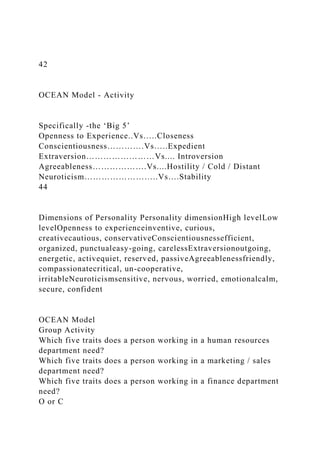
OCEAN Model - Activity
Specifically -the ‘Big 5’
Openness to Experience..Vs…..Closeness
Conscientiousness………….Vs…..Expedient
Extraversion……………………Vs.... Introversion
Agreeableness……………….Vs....Hostility / Cold / Distant
Neuroticism……………………..Vs….Stability
44
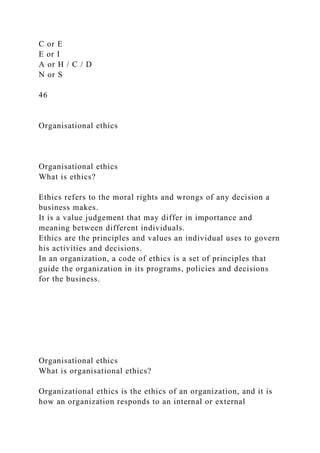
Dimensions of Personality Personality dimensionHigh levelLow
levelOpenness to experienceinventive, curious,
creativecautious, conservativeConscientiousnessefficient,
organized, punctualeasy-going, carelessExtraversionoutgoing,
energetic, activequiet, reserved, passiveAgreeablenessfriendly,
compassionatecritical, un-cooperative,
irritableNeuroticismsensitive, nervous, worried, emotionalcalm,
secure, confident
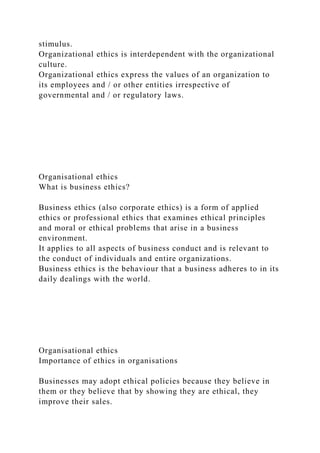
OCEAN Model
Group Activity
Which five traits does a person working in a human resources
department need?
Which five traits does a person working in a marketing / sales
department need?
Which five traits does a person working in a finance department
need?
O or C
C or E
E or I
A or H / C / D
N or S
46
Organisational ethics
What is ethics?
Ethics refers to the moral rights and wrongs of any decision a
business makes.
It is a value judgement that may differ in importance and
meaning between different individuals.
Ethics are the principles and values an individual uses to govern
his activities and decisions.
In an organization, a code of ethics is a set of principles that
guide the organization in its programs, policies and decisions
for the business.
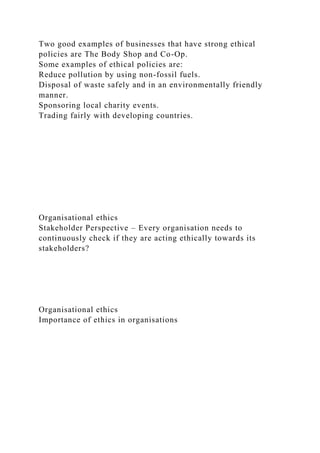
Organisational ethics
What is organisational ethics?
Organizational ethics is the ethics of an organization, and it is
how an organization responds to an internal or external
stimulus.
Organizational ethics is interdependent with the organizational
culture.
Organizational ethics express the values of an organization to
its employees and / or other entities irrespective of
governmental and / or regulatory laws.
Organisational ethics
What is business ethics?
Business ethics (also corporate ethics) is a form of applied
ethics or professional ethics that examines ethical principles
and moral or ethical problems that arise in a business
environment.
It applies to all aspects of business conduct and is relevant to
the conduct of individuals and entire organizations.
Business ethics is the behaviour that a business adheres to in its
daily dealings with the world.
Organisational ethics
Importance of ethics in organisations
Businesses may adopt ethical policies because they believe in
them or they believe that by showing they are ethical, they
improve their sales.
Two good examples of businesses that have strong ethical
policies are The Body Shop and Co-Op.
Some examples of ethical policies are:
Reduce pollution by using non-fossil fuels.
Disposal of waste safely and in an environmentally friendly
manner.
Sponsoring local charity events.
Trading fairly with developing countries.
Organisational ethics
Stakeholder Perspective – Every organisation needs to
continuously check if they are acting ethically towards its
stakeholders?
Organisational ethics
Importance of ethics in organisations
Organisational ethics
Importance of ethics in organisations
For example, a business cannot claim to be ethical firm if it
ignores unethical practices by its suppliers.
Use of child labour and forced labour.
Production in sweatshops.
Violation of the basic rights of workers.
Ignoring health, safety and environmental standards.
Organisational ethics
Pressure for businesses to act ethically
Businesses and industries increasingly find themselves
facing external pressure to improve their ethical track record.
An interesting feature of the rise of consumer activism online
has been increased scrutiny of business activities. Pressure
groups are a good example of this.
Direct consumer action is another way in which business ethics
can be challenged.
Organisational ethics
Pressure for businesses to act ethically
Pressure groups are external stakeholders and they
Tend to focus on activities & ethical practice of multinationals
or industries with ethical issues.
Combine direct and indirect action can damage the target
business or industry.
Organisational ethics
Pressure for businesses to act ethically
Consumers may take action against:
Businesses they consider to be unethical in some ways (e.g.
animal furs).
Business acting irresponsibly.
Businesses that use business practices they find unacceptable.
Consumer action can also be positive – supporting businesses
with a strong ethical stance & record. A good example of this
is Fair trade.
Organisational ethics
The advantages of ethical behaviour include:
Higher revenues – demand from positive consumer support.
Improved brand and business awareness and recognition.
Better employee motivation and recruitment.
New sources of finance – e.g. from ethical investors.
Avoidance of expensive and embarrassing PR disasters.
Organisational ethics
The disadvantages of ethical behaviour include:
Increased costs - e.g. sourcing from Fairtrade suppliers rather
than lowest price.
Conflict between profit and ethical standards.
Business practice and organisational culture will have to be
changed.
Changes in relations with suppliers.
Higher overheads – e.g. training & communication of ethical
policy.
A danger of building up false expectations.
Any queries please?
Bibliographic Resources
Core text books for OB :
Mullins, L. J. with Christy, G (2013) Management and
Organisational Behaviour. 10e. Harlow : FT Prentice Hall.
French, R. Rayner, C. Rees, G & Rumbles, S. (2011).
Organizational Behaviour. 2e. Chichester : Wiley.
Special recommended text on HR :
Foot, M. And Hook, C. (2011) Introducing Human Resource
Management, 6th ed., Harlow: FT Prentice Hall.
Alternative text book for OB :
Huczynski, A. and Buchanan, D. (2013) Organisational
Behaviour, 8th ed., Harlow: FT Prentice Hall.
Organisational Behaviour
Lecture session 5.1
HR – Training and Development
Lecture session 5.2
Organisational learning and behaviour
(Continuation from previous session)
Presented by : Mr. Dheeraj Rongala
Contact email : [email protected]
Topics covered in Week 5
Organisational Behaviour
Lecture session 5.3
Groups and Teams
Lecture session 5.4
Presented by : Mr. Dheeraj Rongala
Contact email : [email protected]
Topics covered in Week 5
Course work surgery
Learning objectives
By the end of the session, learners will be able to know about:
Benefits of training.
Types of training.
Learning and behaviour models.
Groups and Teams.
Tuckman's theory of groups.
Belbins team roles.
HR – Training and Development
What is Training?
Training can be defined as:
The process of increasing the knowledge and skills of the
workforce to enable them to perform their jobs effectively.
Training is, therefore, a process whereby an individual
acquires job-related skills and knowledge.
Training costs can be significant in any business. However,
many employers are prepared to incur these costs because they
expect their business to benefit from employees' development
and progress.
HR – Training and Development
What are the benefits of Training?
Effective training has the potential to provide a range of
benefits for a business:
Higher quality.
Better productivity.
Improved motivation - through greater empowerment.
More flexibility through better skills.
Less supervision required (cost saving in supervision).
Better recruitment and employee retention.
Easier to implement change in the business.
HR – Training and Development
What should be an effective training strategy?
Effective training starts with a “training strategy”. The three
stages of a training strategy are:
Identify the skills and abilities needed by employees.
Draw up an action plan to show how investment in training and
development will help meet business goals and objectives.
Implement the plan, monitoring progress and training
effectiveness.
Systematic Training Cycle (STC)
HR – Training and Development
What are the methods for training employees?
Induction training.
On the Job training.
Off the Job training.
HR – Training and Development
What is induction training?
Induction training is training given to new employees.
The purpose of the induction period (which may be a few hours
or a few days) is to help a new employee settle down quickly
into the job by becoming familiar with the people, the
surroundings, the job and the business.
It is important to give a new employee a good impression on the
first day of work. However, the induction programme should not
end there.
It is also important to have a systematic induction programme,
spread out over several days, to cover all the ground in the
shortest effective time.
HR – Training and Development
What does the induction training involve?
Usually induction involves the new employee meeting and
listening to different people talk about aspects of the business.
Other methods include written information, audio visual aids
and group discussion.
The following items should be covered in an effective induction
programme:
Introduction to the business / department and its personnel /
management structure.
HR – Training and Development
What does the induction training involve?
• Layout of the buildings (factory / offices).
• Terms and conditions of employment (explaining the
contract of employment).
• Relevant personnel policies, such as training, promotion
and health and safety.
• Business rules and procedures.
• Arrangements for employee involvement and
communication.
• Welfare and employee benefits or facilities.
HR – Training and Development
On - the – job training
With on the job training, employees receive training whilst
remaining in the workplace.
The main methods of on-the-job training include:
Demonstration / instruction - showing the trainee how to do the
job.
Coaching - a more intensive method of training that involves a
close working relationship between an experienced employee
and the trainee.
HR – Training and Development
On - the – job training
Job rotation - where the trainee is given several jobs in
succession, to gain experience of a wide range of activities (e.g.
a graduate management trainee might spend periods in several
different departments).
Projects - employees join a project team - which gives them
exposure to other parts of the business and allow them to take
part in new activities. Most successful project teams are "multi-
disciplinary“.
HR – Training and Development
On - the – job training
AdvantagesDisadvantagesGenerally most cost-
effective Quality depends on ability of trainer and time
available Employees are actually productiveBad habits might be
passed on Opportunity to learn whilst doingLearning
environment may not be conducive Training alongside real
colleaguesPotential disruption to production
HR – Training and Development
Off - the – job training
This occurs when employees are taken away from their place of
work to be trained.
Common methods of off-the-job training include:
Day release (employee takes time off work to attend a local
college or training centre).
Distance learning / evening classes.
HR – Training and Development
Off - the – job training
Block release courses - which may involve several weeks at a
local college.
Sandwich courses - where the employee spends a longer period
of time at college (e.g. six months) before returning to work.
Sponsored courses in higher education.
Self-study, computer-based training.
HR – Training and Development
Off - the – job training
AdvantagesDisadvantagesA wider range of skills or
qualifications can be obtained More expensive – e.g. transport
and accommodation Can learn from outside specialists or
experts Lost working time and potential output from
employee Employees can be more confident when starting
jobNew employees may still need some induction training.
Employees now have new skills / qualifications and may leave
for better jobs
Organisational Learning and Behaviour
(Continuation from previous session)
Anthony Gregorc’s model
Gregorc and Butler worked to organize a model describing how
the mind works. This model is based on the existence of
perceptions—our evaluation of the world by means of an
approach that makes sense to us.
These perceptions in turn are the foundation of our specific
learning strengths, or learning styles.
In this model, there are two perceptual qualities
concrete and 2) abstract;
and two ordering abilities
1) random and 2) sequential.
Anthony Gregorc’s model
Concrete perceptions involve registering information through
the five senses, while abstract perceptions involve the
understanding of ideas, qualities, and concepts which cannot be
seen.
In regard to the two ordering abilities, sequential involves the
organization of information in a linear, logical way and random
involves the organization of information in chunks and in no
specific order.
Both of the perceptual qualities and both of the ordering
abilities are present in each individual, but some qualities and
ordering abilities are more dominant within certain individuals.
Anthony Gregorc’s model
There are four combinations of perceptual qualities and
ordering abilities based on dominance:
Concrete Sequential;
Abstract Random;
Abstract Sequential;
Concrete Random.
Individuals with different combinations learn in different
ways—they have different strengths, different things make
sense to them, different things are difficult for them, and they
ask different questions throughout the learning process.
Anthony Gregorc’s model
Sudbury model
Sudbury model asserts that there are many ways to study and
learn. They argue that learning is a process you do, not a
process that is done to you.
The experience of Sudbury model democratic schools shows
that there are many ways to learn without the intervention of
teaching, to say, without the intervention of a teacher being
imperative. In the case of reading for instance in the Sudbury
model democratic schools, some children learn from being read
to, memorizing the stories and then ultimately reading them.
Others learn from cereal boxes, others from games instructions,
others from street signs.
Sudbury model
Sudbury model democratic schools evidence that in their
schools no one child has ever been forced, pushed, urged,
cajoled, or bribed into learning how to read or write; and they
have had no dyslexia (difficulty in learning to read or interpret
words, letters and other symbols).
Fleming's VAK/VARK model
One of the most common and widely-used categorizations of the
various types of learning styles is Fleming’s VARK model
(sometimes VAK) which expanded upon earlier Neuro-linguistic
programming models:
Visual learners;
Auditory learners;
Kinesthetic learners or tactile learners.
Fleming claimed that visual learners have a preference for
seeing (think in pictures; visual aids such as overhead slides,
diagrams, handouts, etc.). Auditory learners best learn through
listening (lectures, discussions, tapes, etc.).
Fleming's VAK/VARK model
Tactile / Kinesthetic learners prefer to learn via experience—
moving, touching, and doing (active exploration of the world;
science projects; experiments, etc.).
Its use in pedagogy allows teachers to prepare classes that
address each of these areas. Students can also use the model to
identify their preferred learning style and maximize their
educational experience by focusing on what benefits them the
most.
Factors influencing the learning process
Mullins 2013 (page 174)
32
Groups and Teams
Groups and Teams
Group
A group is usually composed of 2-4 members that work
interdependently with each other to a significant degree. They
are committed to work together and willing to be handled by a
leader.
Though they are interdependent with each other, still they have
individual responsibility that they have to perform, and that
specific accountability, when done well, can help the group
accomplish their goals.
Groups and Teams
Team
A team is considered to work interdependently and is committed
to achieve one common goal. They share the responsibilities and
deliver results until they reached the conceived output of their
efforts.
They are usually composed of 7-12 members and are helping
each other to develop new skills to which it can help improve
their performance. They don’t usually rely on a leader for
supervision.
Groups and Teams
Although a group is easier to manage and they are great for
short term output, since they would divide the work amongst
their skills, they can easily get the job done.
A team on the other hand works best for long term projects,
since they work together as a whole equally distributing the
tasks at hand regardless if they have the proper skills or not.
This paves the way for the each member of the team to have
ample time to develop abilities that can further enhance their
performance as a whole. Due to the span of time that the
members spend with each other, it’s a good ground as well for
camaraderie within the team.
https://www.youtube.com/watch?v=S0qjK3TWZE8
Tuckman’s theory of groups
If team development is going to be achieved, managers must
gain an understanding of group dynamics, how people actually
behave with each other. Tuckman’s model, developed in 1965,
is widely used and has the advantage of being easily
remembered.
Tuckman found that all groups follow the stages of:
Forming
Storming
Norming
Performing
Ending / Dorming / Adjourning.
Forming
This is the early stage of getting to know other people in the
group and of committing yourselves to the achievement of a
task. The main managerial responsibility here is to create a
good atmosphere where team members feel safe enough to take
risks, providing adequate resources, providing confidence the
task can be completed, etc.
Tuckman’s theory of groups
Storming
As the name suggests, this may be a turbulent time for some
teams! The group raise questions about power and influence –
‘Who has the control here?’ They may also be about the role of
the manager, ‘What will you do if….?’, ‘Do you make all the
decisions or are some things negotiable?’ They may also relate
to power issues between group members – do they have things
in common, is one person trying to gain control, etc. Concerns
are not always overtly raised, but some dialogue must take place
to settle the worries of the group members.
Tuckman’s theory of groups
Norming
This is a settling down period with the establishment of rules
and codes of conduct. Written procedures may well be put in
place to help solidify overt norms, although underlying norms
are being established all the time through non-verbal effective
communication.
These more predictable patterns of behaviour contribute to a
feeling of safety amongst group members.
Tuckman’s theory of groups
Performing
This only occurs once the group has settled and is more
predictable and when rules of behaviour have been agreed.
Work can then begin on the tasks at hand.
Ending / Dorming
This could be the end of the task or of a particular team, for
example, when someone leaves. The ending of any group needs
to be given attention, not only through learnt lessons, but
because it acknowledges the importance of what has occurred.
Tuckman’s theory of groups
It is fair to say that the four stages are never as clear cut as this.
There are times when the group can go back in stages at any
time; Norming is generally taking place at least non-verbally
during the forming phase, etc. Also, the timing varies
considerably. However, whatever happens in your group, a
constant awareness of these processes is a sensible approach.
You must also remember that teams need building and
developing if they are to remain effective and energised.
Tuckman’s theory of groups
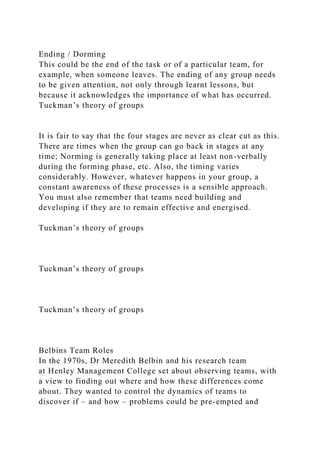
Belbins Team Roles
In the 1970s, Dr Meredith Belbin and his research team
at Henley Management College set about observing teams, with
a view to finding out where and how these differences come
about. They wanted to control the dynamics of teams to
discover if – and how – problems could be pre-empted and
avoided.
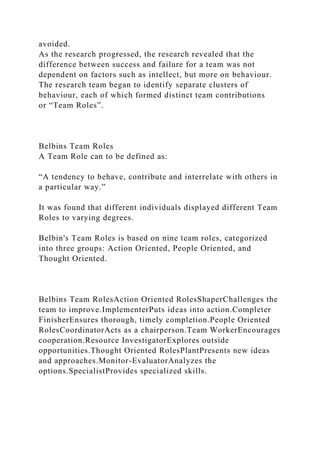
As the research progressed, the research revealed that the
difference between success and failure for a team was not
dependent on factors such as intellect, but more on behaviour.
The research team began to identify separate clusters of
behaviour, each of which formed distinct team contributions
or “Team Roles”.
Belbins Team Roles
A Team Role can to be defined as:
“A tendency to behave, contribute and interrelate with others in
a particular way.”
It was found that different individuals displayed different Team
Roles to varying degrees.
Belbin's Team Roles is based on nine team roles, categorized
into three groups: Action Oriented, People Oriented, and
Thought Oriented.
Belbins Team RolesAction Oriented RolesShaperChallenges the
team to improve.ImplementerPuts ideas into action.Completer
FinisherEnsures thorough, timely completion.People Oriented
RolesCoordinatorActs as a chairperson.Team WorkerEncourages
cooperation.Resource InvestigatorExplores outside
opportunities.Thought Oriented RolesPlantPresents new ideas
and approaches.Monitor-EvaluatorAnalyzes the
options.SpecialistProvides specialized skills.
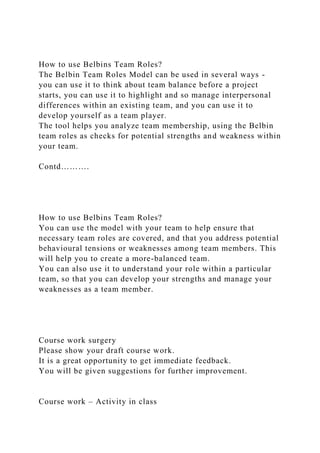
How to use Belbins Team Roles?
The Belbin Team Roles Model can be used in several ways -
you can use it to think about team balance before a project
starts, you can use it to highlight and so manage interpersonal
differences within an existing team, and you can use it to
develop yourself as a team player.
The tool helps you analyze team membership, using the Belbin
team roles as checks for potential strengths and weakness within
your team.
Contd……….
How to use Belbins Team Roles?
You can use the model with your team to help ensure that
necessary team roles are covered, and that you address potential
behavioural tensions or weaknesses among team members. This
will help you to create a more-balanced team.
You can also use it to understand your role within a particular
team, so that you can develop your strengths and manage your
weaknesses as a team member.
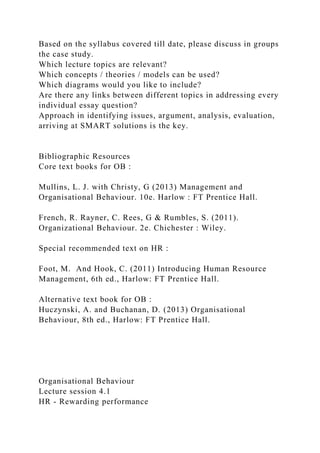
Course work surgery
Please show your draft course work.
It is a great opportunity to get immediate feedback.
You will be given suggestions for further improvement.
Course work – Activity in class
Based on the syllabus covered till date, please discuss in groups
the case study.
Which lecture topics are relevant?
Which concepts / theories / models can be used?
Which diagrams would you like to include?
Are there any links between different topics in addressing every
individual essay question?
Approach in identifying issues, argument, analysis, evaluation,
arriving at SMART solutions is the key.
Bibliographic Resources
Core text books for OB :
Mullins, L. J. with Christy, G (2013) Management and
Organisational Behaviour. 10e. Harlow : FT Prentice Hall.
French, R. Rayner, C. Rees, G & Rumbles, S. (2011).
Organizational Behaviour. 2e. Chichester : Wiley.
Special recommended text on HR :
Foot, M. And Hook, C. (2011) Introducing Human Resource
Management, 6th ed., Harlow: FT Prentice Hall.
Alternative text book for OB :
Huczynski, A. and Buchanan, D. (2013) Organisational
Behaviour, 8th ed., Harlow: FT Prentice Hall.
Organisational Behaviour
Lecture session 4.1
HR - Rewarding performance
Lecture session 4.2
Interpersonal and Organisational Communication (Continuation
from previous session)
Presented by : Mr. Dheeraj Rongala
Contact email : [email protected]
Topics covered in Week 4
Organisational Behaviour
Lecture session 4.3
Organisational Learning and Behaviour
Lecture session 4.4
Course work - Activity
Presented by : Mr. Dheeraj Rongala
Contact email : [email protected]
Topics covered in Week 4
Organisational Behaviour
Lecture session 4.5
Course work surgery
Lecture session 4.6
Course work – Queries and clarifications
Presented by : Mr. Dheeraj Rongala
Contact email : [email protected]
Topics covered in Week 4
Learning objectives
By the end of the session, learners will be able to know about:
Importance of rewarding performance.
Difference between pay and reward.
Types of reward payment systems.
Communication models.
Barriers and steps for improving communication.
Learning styles and related models.
HR – Rewarding performance
HR – Pay and Reward
Pay and Reward :
The term ‘reward’ is generally understood to cover all financial
provisions made to employees including both cash pay and the
wider benefits package (pensions, paid leave and so on).
It may also refer to wider provisions for employees, with the
term ‘total reward’ encompassing elements such as training
opportunities or a congenial working environment in addition to
pay and benefits.
HR – Pay and Reward
Pay and Reward :
Pay may be divided into two categories:
Base or fixed pay – that is, the guaranteed cash wage or salary
paid to individual employees for performing their work for a
contracted period of time.
Total earnings – this includes base pay plus additional variable
elements of earnings such as bonus payments, while the term
could also be used to include aspects such as overtime earnings.
HR – Pay and Reward
Why is pay important?
It is an important cost for a business (in some “labour-
intensive” businesses, payroll costs are over 50% of total costs).
Pay is the subject of important business legislation
(e.g. national minimum wage; equal opportunities).
It helps attract reliable employees with the skills the business
needs for success.
Pay also helps retain employees – rather than them leave and
perhaps join a competitor.
HR – Pay and Reward
How do businesses decide how much to pay?
Job evaluation / content - this is usually the most important
factor. What is involved in the job being paid? How does it
compare with similar jobs?
Fairness – pay needs to be perceived and be seen to match the
level of work.
Negotiated pay rates – the rate of pay may have been
determined elsewhere and the business needs to ensure that it
complies with these rates.
Contd…
HR – Pay and Reward
How do businesses decide how much to pay?
Market rates – If a business tries to pay below the “market rate”
then it will probably have difficulty in recruiting and retaining
suitable staff.
Individual performance – increasingly, businesses include an
element of “performance-related” reward in their pay structures.
Company affordability – whether the organisation has enough
financial resources to pay?
HR – Pay and Reward
What are the different types of reward payment systems?
Time – rate pay.
Piece – rate pay.
Commission.
Performance related pay.
Fringe benefits.
Profit sharing.
Group incentives.
HR – Pay and Reward
A. Time – rate pay
Time rates are used when employees are paid for the amount of
time they spend at work.
The usual form of time rate is the weekly wage or monthly
salary.
The employment contract for a time-rate employee will also
stipulate the amount of paid leave that the employee can take
each year (e.g. 5 weeks paid holiday).
HR – Pay and Reward
A. Time – rate pay
Advantages :
Time rates are simple for a business to calculate and administer.
They are suitable for businesses that wish to employ staff to
provide general roles (e.g. financial management,
administration, maintenance) where employee productivity is
not easy to measure.
It is easy to understand from an employee’s perspective.
HR – Pay and Reward
A. Time – rate pay
Advantages :
The employee can budget personal finance with some certainty.
Makes it easier for the employer to plan and budget for
employee costs (e.g. payroll costs will be a function of overall
headcount rather than estimated output).
HR – Pay and Reward
A. Time – rate pay
Disadvantages :
Does little to encourage greater productivity – there is no
incentive to achieve greater output.
Time-rate payroll costs have a tendency to creep upwards (e.g.
due to inflation-related pay rises and employee promotion.
HR – Pay and Reward
B. Piece – rate pay
Piece-rate pay gives a payment for each item produced – it is
therefore the easiest way for a business to ensure that
employees are paid for the amount of work they do. It is also
called as “payment by results system”.
Piece-rate pay encourages effort, but, it is argued, often at the
expense of quality.
HR – Pay and Reward
B. Piece – rate pay
From the employee’s perspective, there are some problems.
What happens if production machinery breaks down?
What happens if there is a problem with the delivery of raw
materials that slows production?
These factors are outside of the employee’s control – but could
potentially affect their pay.
HR – Pay and Reward
B. Piece – rate pay
Piece-rate pay systems tend, in reality, to have two elements:
A basic pay element – this is fixed (time-based).
An output-related element (piece-rate). Often the piece-rate
element is only triggered by the business exceeding a target
output in a defined period of time.
HR – Pay and Reward
C. Commission
Commission is a payment made to employees based on the value
of sales achieved. It can form all or (more often) part of a pay
package. Commission is, therefore, a form of “incentive pay”.
Commission, like piece-rates, is a reward for value of work
achieved. In most cases, the employee is paid a flat
percentage of the value of the good or service that is sold.
HR – Pay and Reward
C. Commission
The rate of commission depends on the selling price and the
amount of effort required in making the sale. For example,
commission rates could range from 5% where the product sells
easily (e.g. household goods sold door-to-door) to 30% where
the effort is substantial.
HR – Pay and Reward
C. Commission
Advantages :
The main advantage of commission from an employee’s point-
of-view is that it enables high performing sales people to earn
huge amounts.
The main advantage to the employer is that the payroll cost is
related to the value of business achieved rather than just the
amount produced.
HR – Pay and Reward
C. Commission
Disadvantages :
Sales people may cut corners to make sales (e.g. not explain the
product or service in enough detail to potential customers) – i.e.
customers are misled & missold.
High commission earnings enjoyed by some of the sales team
may be resented elsewhere in the business – particularly if the
sales actually depend on a team effort.
It is difficult to change what proves to be an over-generous
commission structure without upsetting and demoralising the
sales team.
HR – Pay and Reward
C. Commission
Disadvantages :
Once commission payments have been made, the sales force
may lose some motivation until they begin to focus on the next
payment (which might be up to 12 months away).
As a result of the above disadvantages, most businesses that use
commission as an incentive payment method offer a basic pay
plus a moderate commission level. In this way, if sales and
profits justify the change, the commission rate can always be
increased slightly.
HR – Pay and Reward
D. Performance related pay
Performance-related pay is a financial reward to employees
whose work is considered to have reached a required standard,
and/or above average.
Performance related pay is generally used where employee
performance cannot be appropriately measured in terms of
output produced or sales achieved.
HR – Pay and Reward
D. Performance related pay – Common features
Individual performance is reviewed regularly (usually once per
year) against agreed objectives or performance standards. This
is the performance appraisal.
At the end of the appraisal, employees are categorised into
performance groups – which determine what the reward will be.
The method of reward will vary, but traditionally it involves a
cash bonus and / or increase in wage rate or salary.
HR – Pay and Reward
D. Performance related pay
Advantages :
Rewards the individual by linking systematic assessment of
their performance to their level of pay or a bonus.
The factors taken into account may be weighted to reflect their
relative importance to the organisation.
It can be used where an incentive is needed but the actual work
rate is difficult to measure.
It can reward factors not easily taken into account in other
payment systems.
HR – Pay and Reward
D. Performance related pay
Disadvantages :
There may be disagreements about the performance factors to be
assessed.
Bonus payments may be too infrequent to provide a direct
incentive.
HR – Pay and Reward
E. Fringe benefits
Fringe benefits are financial benefits that are not paid out
directly in cash (or cash equivalents such as shares).
Examples of these include:
Company cars.
Discounted season tickets.
Health insurance.
Pensions.
Holiday and other entitlements to take time off work.
Childcare provision.
Staff uniforms, discounts etc.
HR – Pay and Reward
E. Fringe benefits
These benefits in kind have become a much more popular and
widespread form of remuneration. This is partly because
businesses pay less tax on providing them, but also because they
cause a business less hassle and can help to differentiate the
remuneration package.
HR – Pay and Reward
E. Fringe benefits
Advantages :
Usually, most employers enjoy tax breaks especially if they
provide group health plans.
Workers will usually prefer better fringe benefits than higher
salary, allowing employers to reduce their expenses.
Several studies suggested that employees who are covered by a
good health insurance are less likely to be absent from their
work.
HR – Pay and Reward
E. Fringe benefits
Disadvantages :
For small employers, fringe benefits will cost more. Also, they
have less choice in drafting their worker’s retirement or health
plan because of administrative costs.
Employers may face lawsuit (usually on the basis of
discrimination) if they fail to provide fringe benefits to all
workers or exclude someone from receiving this.
HR – Pay and Reward
F. Profit sharing
Profit sharing refers to any system whereby employees receive a
proportion of business profits. Profit sharing is generally
accepted as having many advantages, providing that all
employees are able to participate.
Ex : Bonus payments.
HR – Pay and Reward
F. Profit sharing
Key advantages include:
Creates a direct link between pay and performance.
Creates a sense of team spirit- helps remove ‘them and us’
barrier between managers and workers.
May improve employee’s loyalty to company.
Employees more likely to accept changes in working practices if
they can see that profits will increase overall.
2014 Best companies to work for
http://features.thesundaytimes.co.uk/public/best100companies/li
ve/template
http://www.telegraph.co.uk/finance/jobs/11283053/The-top-25-
places-to-work-in-the-UK.-Does-your-company-make-the-
list.html
Videos :
IHG – https://www.youtube.com/watch?v=kcfKk6tGcBA
Iceland Foods -
http://jobs.iceland.co.uk/a_great_place_to_work/a_great_place_
to_work_2.php
American Express -
https://www.youtube.com/watch?v=EkvjW3FfVGQ
PwC - https://www.youtube.com/watch?v=aRRFKLM-AF8
Introduction to Interpersonal and Organisational
Communication
(Continuation from previous session)
Shannon and Weaver model
Shannon and Weaver model simply proposes that a message
actually originates from the person who gets the thought or has
the information.
The sender is also called the Source of information or the
Information Source.
The information then gets transmitted from the brain to the
mouth and comes out as a signal which then reaches the
recipient after joining hands with several noises and other
disturbances.
The recipient then further passes on the message to its final
destination or other minds of other individuals.
Shannon and Weaver
model of communication
Schramm’s model of communication
Wilber Schramm proposed the model of communication in 1954.
Information is of no use unless and until it is carefully put into
words and conveyed to others. Encoding plays a very important
role because it initiates the process of communication by
converting the thought into content. When the information
reaches the recipient his prime responsibility is to understand
what the speaker intends to convey.
Schramm’s model of communication
Unless and until the second party is able to understand or
decode the information what the sender wants to communicate,
the message is actually of no use.
Encoding and decoding are two most important factors of an
effective communication without which information can never
flow between two individuals.
According to the Schramm’s model, encoding and decoding are
the two essential processes of an effective communication.
Schramm’s model of communication
Schramm also emphasizes that the communication is incomplete
unless and until the sender receives a feedback from the
recipient.
According to Schramm’s model, whenever the information
reaches the recipient, it becomes his responsibility to give the
feedback and let him know if he has downloaded the message in
exactly the same manner the speaker wanted. If he is not clear
with anything or has any doubts, it must be cleared with the
speaker.
Thus, when the speaker conveys any message to the listener, the
listener, decodes the message and once again passes the
message to the speaker after understanding it and completing
the full circle.
Schramm’s model of communication
Schramm’s model of communicationSenderM↓ ↑MReceiver
Schramm’s model of communication
Schramm believed that an individual’s knowledge, experience
and cultural background also play an important role in
communication. Individuals from diverse cultures, religion or
background tend to interpret the message in different ways.
To conclude according to this model of communication, when a
sender passes on the information to the receiver, the receiver
must interpret it in the desired form the sender wants and give
him the feedback or respond accordingly. Any communication
where the sender does not get the feedback, the communication
is not complete and thus ineffective.
Helical model of communication
The Helical Model of communication was proposed by Frank
Dance in 1967 to throw some more light on communication
process. Dance thought of communication process similar to
helix.
A Helix is nothing but a smooth curve just like a spring which if
goes upwards also comes downwards. The Helical model of
communication was designed by Frank Dance keeping the
simple Helix in mind.
Helical model of communication
According to the Helical model of communication, the process
of communication evolves from the very birth of an individual
and continues till the existing moment.
All living entities start communicating from the very first day
of their origin.
For example, when seeds are planted, they convey the message
to the gardener that they need to be watered daily and should be
treated well with fertilizers and manure. When a plant emerges
from the seed it also starts communicating its need for water,
sunlight, manure and fertilizers, thus supporting the Helical
model of communication.
The same also applies for animals, birds, fishes and all living
creatures.
Helical model of communication
Helical model of communicationChild (Day 1) communication
evolves↓Communication continues↓ ↑(Communication depends
on past activities)↓(Current day) communication continues with
modifications
Helical model of communication
According to the Helical model as the process of
communication moves forward it also comes back and is largely
dependant on the past behaviour of the individual. The model
believes that communication process is just like a helix which
moves forward as well as comes backward and is dependent on
the behaviour patterns of the past definitely with some
modifications and changes.
For example, as the child grows up, he does make slight
changes in his past body movements or past pronunciation or
facial expressions. He makes certain changes, modifications in
his communication and tries to get rid of the communication
errors. An individual will definitely get less nervous in his
teenage days as compared to his childhood days, thus a slight
change in his behaviour.
Helical model of communication
The Helical model of communication understands
communication in a broader perspective and considers almost
all the activities of an individual from day one to till date.
It cumulates all the activities occurring in the complete span of
an individual that affects the process of communication, which
in turn goes forward and also depends on the past activities.
Interpersonal Communication
50
The Information Source may be a person or group of persons
with a reason to communicate with some other person(s), the
receiver(s).
Encoding is the process of translating an idea or thought into
meaningful symbols.
Transmission is the actual communication of a message from
one person to another through a chose channel.
Channels are the media through which the message may be
delivered.
The receiver is the individual or group of individuals that hear
or read or see the message.
Decoding is the interpretation of the symbols sent from the
sender to the receiver.
Feedback is the process of telling someone else about how you
feel about something the person did or said, or about the
situation in general.
Noise is anything that interferes with the effectiveness of the
communication attempt.
Barriers to communication
No matter how good the communication system in an
organisation is, unfortunately barriers can and do often occur.
This may be caused by a number of factors which can usually be
summarised as being due to physical barriers, system design
faults or additional barriers.
Physical Barriers.
System Design.
Attitudinal Barriers.
Psychological factors.
Linguistic Barriers.
Physiological Barriers.
Barriers to communication
Physical barriers are often due to the nature of the
environment. Thus, for example, the natural barrier which
exists, if staff are located in different buildings or on different
sites.
Likewise, poor or outdated equipment, particularly the failure
of management to introduce new technology, may also cause
problems.
Background noise, poor lighting or an environment which is too
hot or cold can all affect people's morale and concentration
thereby interfering with effective communication.
Barriers to communication
System design faults refer to problems with the structures or
systems in place in an organisation.
Examples might include an organisational structure which is
unclear and therefore makes it confusing to know who to
communicate with.
Other examples could be inefficient or inappropriate
information systems, a lack of supervision or training, and a
lack of clarity in roles and responsibilities which can lead to
staff being uncertain about what is expected of them.
Barriers to communication
Attitudinal barriers come about as a result of problems with
staff in an organisation. These may be brought about, for
example, by such factors as poor management, lack of
consultation with employees, personality conflicts which can
result in people delaying or refusing to communicate, the
personal attitudes of individual employees which may be due to
lack of motivation or dissatisfaction at work, brought about by
insufficient training to enable them to carry out particular tasks,
or just resistance to change due to entrenched attitudes and
ideas.
Barriers to communication
Psychological factors such as people's state of mind. If
someone has personal problems like worries about their health
or marriage, then this will probably affect them.
Different languages and cultures represent a national barrier
which is particularly important for organisations involved in
overseas business.
Individual linguistic ability is also important. The use of
difficult or inappropriate words in communication can prevent
people from understanding the message. Poorly explained or
misunderstood messages can also result in confusion.
Physiological barriers may result from individuals' personal
discomfort, caused, for example, by ill health, poor eye sight or
hearing difficulties.
Gender and Emotional barriers
How to overcome
Business Communication Barriers?
Eliminating differences in perception.
Use of Simple Language.
Reduction and elimination of noise levels.
Active Listening.
Emotional State.
Simple Organizational Structure.
Avoid Information Overload.
Give Constructive Feedback.
Proper Media Selection.
Flexibility in meeting the targets.
Types of Communications
Formal Vs Informal communication.
Upward Vs Downward communication.
Lateral communication.
Oral Vs Written communication.
Verbal Vs Non verbal communication.
How to facilitate Communication?
Listen carefully to the message - Stay focused.
Resist distractions.
Withhold initial judgment - Keep an open mind.
Listen for feelings.
Pay attention to non-verbal cues.
Use simple language.
Ask questions for clarifications.
Give feedback – Restate what you understand.
Videos :
https://www.youtube.com/watch?v=4kyvjEpXuPg
https://www.youtube.com/watch?v=FljoEitkIeM
Organisational Learning and Behaviour
Cognitive Theory
Cognitive theory is a learning theory of psychology that
attempts to explain human behavior by understanding the
thought processes. The assumption is that humans are logical
beings that make the choices that make the most sense to them.
Pure cognitive theory largely rejects behaviourism on the basis
that behaviorism reduces complex human behavior to simple
cause and effect. However, the trend in past decades has been
towards merging the two into a comprehensive cognitive-
behavioural theory. This allows therapists to use techniques
from both schools of thought to help clients achieve their goals.
Cognitive Theory
Social cognitive theory is a subset of cognitive theory.
Primarily focused on the ways in which we learn to model the
behavior of others, social cognitive theory can be seen in
advertising campaigns and peer pressure situations. It is also
useful in the treatment of psychological disorders including
phobias.
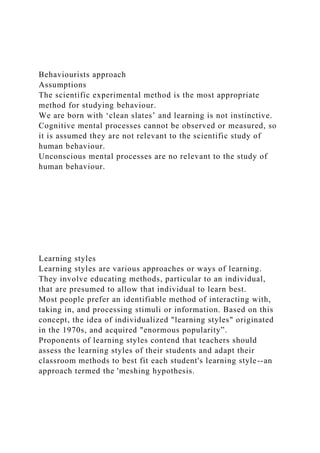
Behaviourists approach
Assumptions
All behaviour is learnt from experience.
All behaviour occurs via learning from experiences of the
environment.
The theory of classical conditioning assumes that we learn by
association.
The theory of operant conditioning assumes that the law of
effect explains why if behaviour is reinforced i.e. rewarded it
will be repeated.
General laws derived from the animal experiments can be
extrapolated and applied to humans.
Behaviourists approach
Assumptions
The scientific experimental method is the most appropriate
method for studying behaviour.
We are born with ‘clean slates’ and learning is not instinctive.
Cognitive mental processes cannot be observed or measured, so
it is assumed they are not relevant to the scientific study of
human behaviour.
Unconscious mental processes are no relevant to the study of
human behaviour.
Learning styles
Learning styles are various approaches or ways of learning.
They involve educating methods, particular to an individual,
that are presumed to allow that individual to learn best.
Most people prefer an identifiable method of interacting with,
taking in, and processing stimuli or information. Based on this
concept, the idea of individualized "learning styles" originated
in the 1970s, and acquired "enormous popularity”.
Proponents of learning styles contend that teachers should
assess the learning styles of their students and adapt their
classroom methods to best fit each student's learning style--an
approach termed the 'meshing hypothesis.
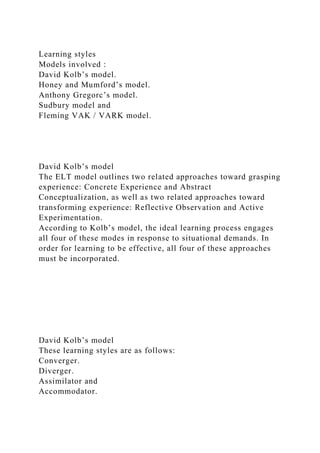
Learning styles
Models involved :
David Kolb’s model.
Honey and Mumford’s model.
Anthony Gregorc’s model.
Sudbury model and
Fleming VAK / VARK model.
David Kolb’s model
The ELT model outlines two related approaches toward grasping
experience: Concrete Experience and Abstract
Conceptualization, as well as two related approaches toward
transforming experience: Reflective Observation and Active
Experimentation.
According to Kolb’s model, the ideal learning process engages
all four of these modes in response to situational demands. In
order for learning to be effective, all four of these approaches
must be incorporated.
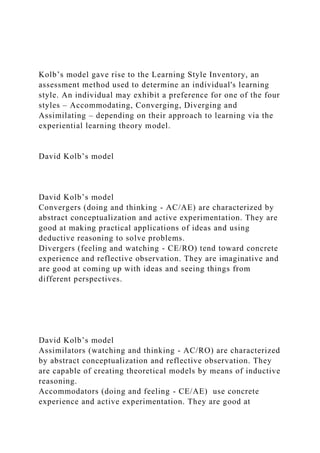
David Kolb’s model
These learning styles are as follows:
Converger.
Diverger.
Assimilator and
Accommodator.
Kolb’s model gave rise to the Learning Style Inventory, an
assessment method used to determine an individual's learning
style. An individual may exhibit a preference for one of the four
styles – Accommodating, Converging, Diverging and
Assimilating – depending on their approach to learning via the
experiential learning theory model.
David Kolb’s model
David Kolb’s model
Convergers (doing and thinking - AC/AE) are characterized by
abstract conceptualization and active experimentation. They are
good at making practical applications of ideas and using
deductive reasoning to solve problems.
Divergers (feeling and watching - CE/RO) tend toward concrete
experience and reflective observation. They are imaginative and
are good at coming up with ideas and seeing things from
different perspectives.
David Kolb’s model
Assimilators (watching and thinking - AC/RO) are characterized
by abstract conceptualization and reflective observation. They
are capable of creating theoretical models by means of inductive
reasoning.
Accommodators (doing and feeling - CE/AE) use concrete
experience and active experimentation. They are good at
actively engaging with the world and actually doing things
instead of merely reading about and studying them.
David Kolb’s learning style matrixdoing (Active
Experimentation - AE)watching (Reflective Observation -
RO)feeling (Concrete Experience - CE)accommodating
(CE/AE)diverging (CE/RO)thinking (Abstract Conceptualization
- AC)converging (AC/AE)assimilating (AC/RO)
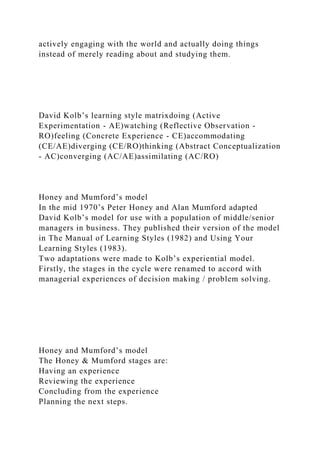
Honey and Mumford’s model
In the mid 1970’s Peter Honey and Alan Mumford adapted
David Kolb’s model for use with a population of middle/senior
managers in business. They published their version of the model
in The Manual of Learning Styles (1982) and Using Your
Learning Styles (1983).
Two adaptations were made to Kolb’s experiential model.
Firstly, the stages in the cycle were renamed to accord with
managerial experiences of decision making / problem solving.
Honey and Mumford’s model
The Honey & Mumford stages are:
Having an experience
Reviewing the experience
Concluding from the experience
Planning the next steps.
Secondly, the styles were directly aligned to the stages in the
cycle and named Activist, Reflector, Theorist and Pragmatist.
These are assumed to be acquired preferences that are
adaptable, either at will or through changed circumstances,
rather than being fixed personality characteristics.
Honey and Mumford’s model
The Honey & Mumford Learning Styles Questionnaire (LSQ) is
a self-development tool and differs from Kolb’s Learning Style
inventory by inviting managers to complete a checklist of work-
related behaviours without directly asking managers how they
learn. Having completed the self-assessment, managers are
encouraged to focus on strengthening underutilised styles in
order to become better equipped to learn from a wide range of
everyday experiences.
A MORI survey commissioned by [The Campaign for Learning]
in 1999 found the Honey & Mumford LSQ to be the most widely
used system for assessing preferred learning styles in the local
government sector in the UK.
This topic to be continued next week
Course work – Activity in class
Based on the syllabus covered till date, please discuss in groups
the case study.
Which lecture topics are relevant?
Which concepts / theories / models can be used?
Which diagrams would you like to include?
Are there any links between different topics in addressing every
individual essay question?
Approach in identifying issues, argument, analysis, evaluation,
arriving at SMART solutions is the key.
Course work surgery
Course work surgery
Please show your draft course work.
It is a great opportunity to get immediate feedback.
You will be given suggestions for further improvement.
Any queries on OB course work please?
Bibliographic Resources
Core text books for OB :
Mullins, L. J. with Christy, G (2013) Management and
Organisational Behaviour. 10e. Harlow : FT Prentice Hall.
French, R. Rayner, C. Rees, G & Rumbles, S. (2011).
Organizational Behaviour. 2e. Chichester : Wiley.
Special recommended text on HR :
Foot, M. And Hook, C. (2011) Introducing Human Resource
Management, 6th ed., Harlow: FT Prentice Hall.
Alternative text book for OB :
Huczynski, A. and Buchanan, D. (2013) Organisational
Behaviour, 8th ed., Harlow: FT Prentice Hall.
Organisational Behaviour
Lecture session 3.1
Lecture session 3.2
Work and Job design
Presented by : Mr. Dheeraj Rongala
Contact email : [email protected]
Topics covered in Week 3
HR function – Recruitment and Selection
Organisational Behaviour
Lecture session 3.3
HR function - Managing performance
Lecture session 3.4
Presented by : Mr. Dheeraj Rongala
Contact email : [email protected]
Topics covered in Week 3
Interpersonal and Organisational Communication
Organisational Behaviour
Lecture session 3.5
OB Course work – Activity
Lecture session 3.6
Presented by : Mr. Dheeraj Rongala
Contact email : [email protected]
Topics covered in Week 3
Queries and clarifications
Learning objectives
By the end of the session, learners will be able to know about:
Approaches to work and job design.
Sources and methods for recruitment.
Methods for selection.
Selection process adopted by few reputed organisations.
Various methods for rewarding performance.
Importance of performance appraisal and its process.
Significance of communication and associated models.
Work and Job design
Staff turnover.
Succession plans.
Skills inventory.
Training plans.
Review.
Is staffing in organisation okay?
HR Planning – Existing staff analysis
Management personnel
replacement chart
Is the identification of the tasks and skills that make up a
job.
It is the procedure used to determine the duties of particular
jobs and the kinds of people (in terms of skills and
experience) who should be hired for them.
Job analysis provides the information for two significant
documents.
Job description and
Job specification.
HR Planning - Job analysis
It is a broad, general and written statement of a specific
job, based on the findings of a job analysis.
It is a document that identifies a particular job, provides a
brief job summary, and lists specific responsibilities and
duties of the job.
Job description usually forms the basis of a job
specification.
HR Planning - Job description
It emphasises on the human qualifications in terms of traits,
skills, and experiences required to accomplish a job.
Is a statement of employee characteristics and qualifications
required for satisfactory performance of
defined duties and tasks comprising a specific job or function.
Job specification is derived from job analysis.
HR Planning - Person specification
Job descriptionPerson specificationJob title‘HUMAN
TERMS’Grade / rate of pay Specifies type of person needed
Line Manager Skills Level of responsibilitiesKnowledgePurpose
of the jobAptitudePrincipal dutiesExperienceSpecific conditions
of work
Minimum relevant qualificationsCan specify evidence source
Activity
Design a Job description and person specification for a
Marketing Campaigns Officer vacancy.
HR Planning - Job specification
Physical Make-up – e.g. Lifting heavy loads.
Attainments – educational or professional.
General Intelligence – ability to solve problems.
Special Aptitudes – skills, attributes.
Interests – relevant work and leisure related.
Disposition – attitude to work, staff, customers, friendliness and
assertiveness.
Circumstances – domestic commitments, mobility and family
support.
Rodgers – 7 point plan
Equal Pay Act – 1970.
Rehabilitation of Offenders Act – 1974.
Sex Discrimination Acts – 1975 & 1986.
Race Relations Act -1976
Working Time Regulations – 1998.
The Part-time Workers (Prevention of Less Favourable
Treatment) Regulations – 2000.
Disability Discrimination Act – 2005.
The Age Discrimination Regulations – 2006.
Equality Act – 2010 and .....
Equal Opportunities – Legal framework
HR - Recruitment and Selection
What is meant by Recruitment?
It is the overall process of attracting, selecting and appointing
suitable candidates for jobs within an organisation, either
permanent or temporary. Recruitment can also refer to
processes involved in choosing individuals for unpaid
positions, such as voluntary roles or training programmes.
The different activities of attracting applicants to an
organisation and the selection of people to fill vacancies is
considered as recruitment.
HR function – Recruitment and Selection
What is meant by Selection?
It is the process of interviewing and evaluating candidates for
a specific job and selecting
an individual for employment based on
certain criteria. Employee selection can range from a very
simple process to a very complicated process depending on
the firm hiring and the position.
It consists of sifting through the pool of applicants and making
decisions about their appropriateness”
HR function – Recruitment and Selection
The Process
HR function – Recruitment and Selection
The Process
Internal RecruitmentExternal RecruitmentFill vacancies from
withinEmployment servicesInternal emailEducational
sourcesIntranetProfessional and Industry
contactsNoticeboardNewsprint Team meetingsWord of
mouthStaff newslettersRecruitment fairs (stalls)Direct
approachesOther media sources
Recruitment sources and Methods
AdvantagesDisadvantagesCheaper and QuickerNo new ideas
from outside.People already familiarMay cause employee
resentment if not selected.Provides opportunities for existing
employeesCreates another vacancy and that needs to be
filled.Motivates employeesHR already knows employees
strengths and weaknesses.Limits the number of potential
applicants.
Internal Recruitment
AdvantagesDisadvantagesOutside people bring in new
ideas.Longer processLarger pool of workers from which to find
the best candidateMore expensive process due to advertising
and interviews requiredPeople have a wider range of
experienceSelection process may not be effective enough to
reveal the best candidate
External Recruitment
Selection
Shortlisting checklist
Atleast two people to shortlist applications independently.
Note where applications meet and fall short of the person
specification / competency profile.
Separate all applications according to agreed criteria : suitable /
possible / unsuitable.
Rank the suitable applications.
Shortlisters to confer on person specification / competency
criteria only and select suitable number to call for interview.
Use IT systems with caution.
Selection
Assessment centres
Work simulations.
Work samples.
In – tray exercises.
Role plays.
Group exercises and discussions.
Psychological tests.
Interviews.
Peer assessment and self – assessment.
Selection
Common interview errors
Making snap decisions.
Gathering negative / positive information to support first
impressions.
Hiring in one’s own image.
Stereotyping.
Making assumptions.
Gathering insufficient / irrelevant information.
Contrast effect.
Job Interviews – Few video clips
Pepsi Max Advert -
http://www.youtube.com/watch?v=HbJHkwHZCCM
Funny job interviews -
http://www.youtube.com/watch?v=Q0RdmhSO-wA
Selection
Good practices to eliminate interview errors
Gather sufficient information.
Structured interviews.
More than one interviewer.
Only trained people involved in interviews.
Allow sufficient time for interviews.
Selection process
IBM - http://www-
05.ibm.com/employment/uk/students/application_process.shtml
Toyota -
http://recruitment.toyotauk.com/graduates/recruitment.jsp
Barclays bank - http://www.jobs.barclays.co.uk/about-joining/
Royal Navy - http://www.royalnavy.mod.uk/careers/how-to-
join#1-apply
HR Decision and after
Appointing....... or not?
Informing (successful and unsuccessful).
Offer and acceptance.
References.
Contract of employment.
Induction.
Probation and
Review of the process.
HR – Managing performance
HR – Performance Management
What is Performance Management?
Armstrong and Baron define performance management as ‘a
process which contributes to the effective management of
individuals and teams in order to achieve high levels of
organisational performance.
It establishes shared understanding about what is to be achieved
and an approach to leading and developing people which will
ensure that it is achieved.’
HR – Performance Management
What is Performance Management?
Performance management is ‘a strategy which relates to every
activity of the organisation set in the context of its human
resource policies, culture, style and communications systems.
In other words performance management should be:
Strategic – it is about broad issues and long-term goals.
Integrated – it should link various aspects of the business,
people management, individuals and teams.
HR – Performance Management
What is Performance Management?
Performance management is about creating a culture that
encourages the continuous improvement of business processes
and of individuals’ skills, behaviour and contributions.
It is an ongoing process that takes place throughout the year.
The way to manage performance should be fair to all staff and
decisions should be based on merit, managers must not
discriminate against employees in the way they manage
performance.
HR – Performance Management
What should Performance Management include?
Performance management should incorporate:
Performance improvement - throughout the organisation, in
respect of individual, team and organisational effectiveness.
Development - unless there is continuous development of
individuals and teams, performance will not improve.
Managing behaviour - ensuring that individuals are encouraged
to behave in a way that allows and fosters better working
relationships.
HR – Performance Management
Tools used in Performance Management are:
Performance and development reviews.
Learning and development.
Coaching.
Objectives and performance standards.
Competences and competencies.
Pay.
Teams.
360 degree feedback.
Performance problem solving.
HR – Performance Management
What is Performance appraisal?
Performance appraisal (or performance review) is a process for
individual employees and those concerned with their
performance, typically line managers, to engage in a dialogue
about their performance and development and the support they
need in their role.
It is used to both assess recent performance and focus on future
objectives, opportunities and resources needed.
HR – Performance Management
What are the uses of Performance appraisal?
To improve current performance.
To provide feedback.
To increase motivation and retention.
To identify potential.
To identify training needs.
To aid in career development.
To award salary increases.
To solve job problems.
Contd………
HR – Performance Management
What are the uses of Performance appraisal?
To let individuals know what is expected of them.
To clarify job objectives.
To provide information about the effectiveness of selection
process.
To aid in career planning and development.
To provide information for human resource planning.
To explore scope for rewards.
To assess competencies.
HR – Performance Management
Key elements for effective Performance appraisal :
Set objectives - decide what is needed from employees and
agree these objectives with them. If appropriate, set timescales
for achieving them.
Manage performance - give employees the tools, resources and
training they need to perform well. If appropriate, set timescales
for achieving objectives.
Contd………
HR – Performance Management
Key elements for effective Performance appraisal :
Carry out the appraisal - monitor and assess employees'
performance, discuss those assessments with them and agree on
future objectives.
Provide rewards / remedies - consider pay awards and / or
promotion based on the appraisal and decide how to tackle poor
performance.
41
HR - Performance Management Cycle
Human Resource Management
Methods of Performance appraisalIndividual
evaluation methodsMultiple person
evaluation methods
Other methodsConfidential reportRankingPerformance
testsEssay evaluationPaired comparisonField review
techniquesCritical incidentsForced distributionCheck
listGraphic rating scaleBehaviourally anchored rating
scaleForced choice methodMBO
Introduction to Interpersonal and Organisational
Communication
Communication
Definition
Communication is a two-way process of reaching
mutual understanding, in which participants not
only exchange information, news, ideas and feelings but
also create and share meaning.
In general, communication is a means of connecting people
or places. In business, it is a key function of management
an organization cannot operate without communication between
levels, departments and employees.
KEY PARTS OF THE COMMUNICATION PROCESS
SENDER -- initiator of the message.
ENCODING -- creating a message we want to send.
MESSAGE -- the specific words, signals, and images we send.
CHANNEL -- the method of delivery of the message.
DECODING -- translating, interpreting the meaning.
RECEIVER -- the target of the message.
NOISE -- signals which compete with (disrupt) the intended
message.
FEEDBACK -- checking to be sure the message was
understood.
Types of communication models
Aristotle model of communication.
Berlo’s model of communication.
Shannon and Weaver model of communication.
Schramm’s model of communication.
Helical model of communication.
Aristotle model of communication
According to this model, the speaker plays a key role in
communication. The sender first prepares a content which he
does by carefully putting his thoughts in words with an
objective of influencing the listeners or the recipients, who
would then respond in the sender’s desired way.
The model says that the speaker communicates in such a way
that the listeners get influenced and respond accordingly.
Aristotle model of communication
The speaker must be very careful about his selection of words
and content in this model of communication.
He should understand his target audience and then prepare his
speech. Making eye contact is also important.
The speaker tone and pitch should also be loud and clear enough
for the people to hear and understand the speech properly.
Stammering, getting nervous in between of a conversation must
be avoided.
Aristotle model of communication
Voice modulations also play a very important role in creating
the desired effect.
Blank expressions, confused looks and similar pitch all through
the speech make it monotonous and nullify its effect.
The speaker should know where to lay more stress on, highlight
which words to influence the listeners.
Aristotle model of communication
The Aristotle model of communication is the widely accepted
and the most common model of communication.
Aristotle model of communication is the golden rule to excel in
public speaking, seminars, lectures etc.
Here the sender is the active member and the receiver is passive
one.
Berlo’s model of communication
While the Aristotle model of communication puts the speaker in
the central position and suggests that the speaker is the one who
drives the entire communication, the Berlo’s model of
communication takes into account the emotional aspect of the
message.
Berlo’s model of communication operates on the SMCR model.
In the SMCR model
S - Stands for Source.
M - Message.
C - Channel.
R - Receiver.
Berlo’s model of communication
The receiver should be on the same platform as the speaker for
smooth flow of information and better understanding of the
message.
He should possess good communication skills to understand
what the speaker is trying to convey.
He should have the right attitude to understand the message in a
positive way.
His knowledge should also be at par with the listener and must
know about the subject.
He should also be from the same social and cultural background
just like the speaker.
Berlo’s model of communication
There are several loopholes in the Berlo’s model of
communication.
According to the Berlo’s model of communication, the speaker
and the listener must be on a common ground for smooth
conversion which is sometimes not practical in the real
scenario.
Course work issued today
Course work – Our expectations
As a minimum, we look for below things in your essays.
Definitions of relevant terms.
Critical analysis.
Identification, integration and application of models or concepts
or theories or frameworks demonstrated.
Inclusion of relevant diagrams.
Argumentative debate kind of discussion.
Integration of core concept with other concepts or models of OB
by adopting logical approach.
Wide range of solutions to problems identified in the case with
sufficient reasoning and justification provided.
Topics from Week 1 – 6 to be considered for answers.
Course work
Read, read and read the case study many times as new ideas
keep coming every time.
Try to look at the case study from different perspectives.
Please follow ICP In house style.
Plan as per the submission deadlines.
Check work through draft Turnitin – Only 5 attempts allowed.
Soft copy of course work available on Moodle.
Understand the marking criteria.
Discuss any queries with your lecturer in class.
Final submission to be made through final Turnitin link.
Course work – Activity in class
Based on the syllabus covered till Week 3, please discuss in
groups the case study.
Which lecture topics are relevant?
Which concepts / theories / models can be used?
Are there any links between different topics in addressing every
individual essay question?
Approach in identifying issues, argument, analysis, evaluation,
arriving at SMART solutions is the key.
Any queries on OB course work?
Bibliographic Resources
Core text books for OB :
Mullins, L. J. with Christy, G (2013) Management and
Organisational Behaviour. 10e. Harlow : FT Prentice Hall.
French, R. Rayner, C. Rees, G & Rumbles, S. (2011).
Organizational Behaviour. 2e. Chichester : Wiley.
Special recommended text on HR :
Foot, M. And Hook, C. (2011) Introducing Human Resource
Management, 6th ed., Harlow: FT Prentice Hall.
Alternative text book for OB :
Huczynski, A. and Buchanan, D. (2013) Organisational
Behaviour, 8th ed., Harlow: FT Prentice Hall.
Organisational Behaviour
Lecture session 2.1
Values
Lecture session 2.2
Motivation and performance
Presented by : Mr. Dheeraj Rongala
Contact email : [email protected]
Topics covered in Week 2
Organisational Behaviour
Lecture session 2.3
Course work sample – Previous copy review
Lecture session 2.4
Introduction to HR and PM
Presented by : Mr. Dheeraj Rongala
Contact email : [email protected]
Topics covered in Week 2
Learning objectives
By the end of the session, learners will be able to know about:
What are Values and how to evaluate values?
What are the different types of Values?
What is motivation?
Different theories in motivation.
Previous course work sample.
Introduction to Human Resources and Personnel Management.
Values
What are Values?
Values represent basic, enduring convictions that “a specific
mode of conduct or end-state of existence is personally or
socially preferable to an opposite or converse mode of conduct
or end-state of existence.”
Values involve judgment because they represent an individual’s
ideas about what is right, good, or desirable.
How to evaluate Values?
Values are often very specific, describing belief systems rather
than behavioural tendencies.
Some beliefs or values don’t say much about a person’s
personality, and people don’t always act in ways consistent
with their values.
We can evaluate values in relation to two attributes:
1. The content attribute, which says that a mode of conduct or
end-state of existence is important.
2. The intensity attribute, which specifies how important it is.
When we rank an individual’s values in terms of their intensity,
we obtain that person’s value system.
Types of Values
Milton Rokeach created the Rokeach Value Survey (RVS).
The RVS consists of two sets of values, with each set
containing 18 individual value items.
One set, called terminal values, refers to desirable end-states.
These are the goals that a person would like to achieve during
his or her lifetime.
The other set, called instrumental values, refers to preferable
modes of behavior, or means of achieving the terminal values.
Terminal Values
A comfortable life (a prosperous life)
An exciting life (a stimulating, active life)
A sense of accomplishment (lasting contribution)
A world at peace (free of war and conflict)
A world of beauty (beauty of nature and the arts)
Equality (brotherhood, equal opportunity for all)
Family security (taking care of loved ones)
Freedom (independence, free choice)
Happiness (contentedness)
Instrumental Values
Ambitious (hardworking, aspiring)
Broad-minded (open-minded)
Capable (competent, efficient)
Cheerful (light hearted, joyful)
Clean (neat, tidy)
Courageous (standing up for your beliefs)
Forgiving (willing to pardon others)
Helpful (working for the welfare of others)
Honest (sincere, truthful)
Imaginative (daring, creative)
Examples of Values
Terminal Values
Inner harmony (freedom from inner conflict)
Mature love (sexual and spiritual intimacy)
National security (protection from attack)
Pleasure (an enjoyable, leisurely life)
Salvation (saved, eternal life)
Self-respect (self-esteem)
Social recognition (respect, admiration)
True friendship (close companionship)
Wisdom (a mature understanding of life)
Instrumental Values
Independent (self-reliant, self-sufficient)
Intellectual (intelligent, reflective)
Logical (consistent, rational)
Loving (affectionate, tender)
Obedient (dutiful, respectful)
Polite (courteous, well-mannered)
Responsible (dependable, reliable)
Self-controlled (restrained, self-disciplined)
Examples of Values
Motivation and performance
Definitions of Motivation
Motivation is defined as the process that initiates, guides, and
maintains goal-oriented behaviours.
Motivation can be thought of as the degree to which an
individual wants AND chooses to engage in certain behaviours.
"Motivation is a decision-making process, through which
individuals choose the desired outcomes and sets in motion the
behaviour appropriate to them".
Motivation is essentially about commitment to doing
something. In the context of a business, motivation can be said
to be about “The will to work”
Highly motivated workforce - Benefits
Better productivity.
Lower levels of absenteeism.
Lower levels of staff turnover.
Improved industrial relations with trade unions.
Gives the firm a good reputation as an employer.
Helps improve product quality.
Helps improve the customer service.
Motivational theories
Content Vs Process theories :
Content Theories deal with “what” motivates people and it is
concerned with individual needs and goals. Maslow, Alderfer,
Herzberg and McCelland studied motivation from a “content”
perspective.
Process Theories deal with the “process” of motivation and is
concerned with “how” motivation occurs. Vroom, Porter &
Lawler, Adams and Locke studied motivation from a “process”
perspective.
Motivational theories
Content / Needs and Process theories :
Content theory explains why human needs change with time.
Content theory includes the work of David McClelland,
Abraham Maslow (hierarchy of needs) and other psychologists
as they attempted to explain why human needs change, but not
how they change.
Content theories explain the specific factors that motivate
people. In other words, they answer the question What drives
behaviour?
They are helpful in providing a contextual framework for
dealing with individuals.
Motivational theories
Content / Needs and Process theories :
Process theory explains human behavior. Process theory is a
commonly used form of scientific research study in which
events or occurrences are said to be the result of certain input
states leading to a certain output state, following a set process.
Process theory holds that if an outcome is to be duplicated, so
too must the process which originally created it, and that there
are certain constant necessary conditions for the outcome to be
reached.
Some of the theories that fall in this category are expectancy
theory, equity theory and goal setting.
Motivational theories
Maslow’s Hierarchy of needs :
Maslow's hierarchy of needs is a theory in psychology,
proposed by Abraham Maslow in his 1943 paper A Theory of
Human Motivation.
Maslow subsequently extended the idea to include his
observations of humans' innate curiosity.
Maslow's hierarchy of needs is often portrayed in the shape of a
pyramid, with the largest and most fundamental levels of needs
at the bottom, and the need for self-actualization at the top.
Motivational theories
Maslow’s Hierarchy of needs :
Each of us is motivated by needs. Our most basic needs are
inborn, having evolved over tens of thousands of years.
Abraham Maslow's Hierarchy of Needs helps to explain how
these needs motivate us all.
Maslow's Hierarchy of Needs states that we must satisfy each
need in turn, starting with the first, which deals with the most
obvious needs for survival itself.
Only when the lower order needs of physical and emotional
well-being are satisfied are we concerned with the higher order
needs of influence and personal development.
Conversely, if the things that satisfy our lower order needs are
swept away, we are no longer concerned about the maintenance
of our higher order needs.
Motivational theories
Maslow’s Hierarchy of needs :
Motivational theories
Maslow’s Hierarchy of needs :
1. Biological and Physiological needs - air, food, drink, shelter,
warmth, sex, sleep, etc.
2. Safety needs - protection from elements, security, order, law,
limits, stability etc.
3. Belongingness and Love needs - work group, family,
affection, relationships etc.
4. Esteem needs - self-esteem, achievement, mastery,
independence, status, dominance, prestige, managerial
responsibility, etc.
5. Self-Actualization needs - realising personal potential, self-
fulfillment, seeking personal growth and peak experiences.
Motivational theories
Problems with Maslow’s Hierarchy of needs :
There are several problems with the Maslow model when real-
life working practice is considered:
Individual behaviour seems to respond to several needs - not
just one.
The same need (e.g. the need to interact socially at work) may
cause quite different behaviour in different individuals.
There is a problem in deciding when a level has actually been
"satisfied“.
The model ignores the often-observed behaviour of individuals
who tolerate low-pay for the promise of future benefits.
There is little empirical evidence to support the model. Some
critics suggest that Maslow's model is only really relevant to
understanding the behaviour of middle-class workers in the UK
and the USA (where Maslow undertook his research).
Motivational theories
Alderfer’s ERG theory:
Clayton P. Alderfer's ERG theory from 1969 condenses
Maslow's five human needs into three categories namely
Existence Needs
Include all material and physiological desires (e.g., food, water,
air, clothing, safety, physical love and affection). Maslow's first
two levels.
Relatedness Needs
Encompass social and external esteem; relationships with
significant others like family, friends, co-workers and
employers. This also means to be recognized and feel secure as
part of a group or family. Maslow's third and fourth levels.
Motivational theories
Alderfer’s ERG theory:
Growth Needs
Internal esteem and self actualization; these impel a person to
make creative or productive effects on himself and the
environment (e.g., to progress toward one's ideal self).
Maslow's fourth and fifth levels. This includes desires to be
creative and productive, and to complete meaningful tasks.
Motivational theories
Alderfer’s ERG theory:
Motivational theories
Alderfer’s ERG theory:
Even though the priority of these needs differ from person to
person, Alberger's ERG theory prioritises in terms of the
categories' concreteness.
Existence needs are the most concrete, and easiest to verify.
Relatedness needs are less concrete than existence needs, which
depend on a relationship between two or more people.
Finally, growth needs are the least concrete in that their specific
objectives depend on the uniqueness of each person.
Motivational theories
Alderfer’s ERG and Maslows theory : A comparison
Motivational theories
Herzberg two factor motivation theory:
Frederick Herzberg (1923-) had close links with Maslow and
believed in a two-factor theory of motivation. He argued that
there were certain factors that a business could introduce that
would directly motivate employees to work harder (Motivators).
However there were also factors that would de-motivate an
employee if not present but would not in themselves actually
motivate employees to work harder (Hygiene factors).
Motivational theories
Herzberg two factor motivation theory:
Motivators are more concerned with the actual job itself. For
instance how interesting the work is and how much opportunity
it gives for extra responsibility, recognition and promotion.
Hygiene factors are factors which ‘surround the job’ rather than
the job itself. For example a worker will only turn up to work if
a business has provided a reasonable level of pay and safe
working conditions but these factors will not make him work
harder at his job once he is there.
Importantly Herzberg viewed pay as a hygiene factor which is
in direct contrast to Taylor who viewed pay, and piece-rate in
particular.
Motivational theories
Herzberg two factor motivation theory:
Motivational theories
Herzberg two factor motivation theory:
Herzberg believed that businesses should motivate employees
by adopting a democratic approach to management and by
improving the nature and content of the actual job through
certain methods.
Some of the methods managers could use to achieve this are:
Job enlargement – workers being given a greater variety of
tasks to perform (not necessarily more challenging) which
should make the work more interesting.
Job enrichment - involves workers being given a wider range of
more complex, interesting and challenging tasks surrounding a
complete unit of work. This should give a greater sense of
achievement.
Empowerment means delegating more power to employees to
make their own decisions over areas of their working life.
Motivational theories
Herzberg and Maslow's theory: A comparison
Both suggest that needs have to be satisfied for the employee to
be motivated. However, Herzberg argues that only the higher
levels of the Maslow Hierarchy (e.g. self-actualisation, esteem
needs) act as a motivator. The remaining needs can only cause
dissatisfaction if not addressed.
Motivational theories
Vroom and Lawler expectation theory:
Expectancy Theory of Motivation also known as Valence-
Instrumentality- Expectancy Theory.
Vroom realized that an employee's performance is based on
individuals factors such as personality, skills, knowledge,
experience and abilities.
The theory suggests that although individuals may have
different sets of goals, they can be motivated if they believe
that:
There is a positive correlation between efforts and
performance.
Favourable performance will result in a desirable reward.
The reward will satisfy an important need.
The desire to satisfy the need is strong enough to make the
effort worthwhile.
Motivational theories
Vroom and Lawler expectation theory:
Expectancy Theory proposes that a person will decide to
behave or act in a certain way because they are motivated
to select a specific behavior over other behaviours due to
what they expect the result of that selected behavior will
be.
Expectancy theory is about the mental processes regarding
choice, or choosing. It explains the processes that an
individual undergoes to make choices.
"This theory emphasizes the needs for organizations to relate
rewards directly to performance and to ensure that the
rewards provided are those rewards deserved and wanted
by the recipients.“
Motivational theories
Vroom and Lawler expectation theory:
The Expectancy Theory of Motivation explains the behavioural
process of why individuals choose one behavioural option over
another. It also explains how they make decisions to achieve the
end they value.
Motivational Force (MF) = Expectancy x Instrumentality x
Valence
Vroom suggests that an employee's beliefs about Expectancy,
Instrumentality, and Valence interact psychologically to create
a motivational force such that the employee acts in ways that
bring pleasure and avoid pain.
Motivational theories
Vroom and Lawler expectation theory:
The theory is based upon the following beliefs:
Valence - Valance is the value that the individual associates
with the outcome (reward). A positive valance indicates that the
individual has a preference for getting the reward as opposed to,
vice-versa, a negative valance that is indicative that the
individual, based on his perception evaluated that the reward
doesn't fill a need or personal goal.
Expectancy - Expectancy refers to the "effort-performance"
relation. Thus, the perception of the individual is that the effort
that he or she will put forward will actually result in the
attainment of the "performance". This cognitive evaluation is
heavily weighted by an individual's past experiences,
personality, self-confidence and emotional state.
Motivational theories
Vroom and Lawler expectation theory:
The theory is based upon the following beliefs:
Instrumentality - Instrumentality refers to the "performance-
reward" relation. The individual evaluates the likelihood or
probability that achieving the performance level will actually
result in the attainment of the reward.
Motivational theories
Vroom and Lawler expectation theory: Managerial implications
Motivational theories
Vroom and Lawler expectation theory:
Motivational theories
Integrating content and process theories :
Course work – Sample copy review
Course work – Our expectations
As a minimum, we look for below things in your essays.
Definitions of relevant terms.
Critical analysis.
Identification, integration and application of models or concepts
or theories or frameworks demonstrated.
Inclusion of relevant diagrams.
Argumentative debate kind of discussion.
Integration of core concept with other concepts or models of OB
by adopting logical approach.
Wide range of solutions to problems identified in the case with
sufficient reasoning and justification provided.
Topics from Week 1 – 5 to be considered for answers.
Course work
Read, read and read the case study many times as new ideas
keep coming every time.
Try to look at the case study from different perspectives.
Please follow ICP In house style.
Plan as per the submission deadlines.
Check work through draft Turnitin – Only 5 attempts allowed.
Soft copy of course work available on Moodle.
Understand the marking criteria.
Discuss any queries with your lecturer in class.
Final submission to be made through final Turnitin link.
Your course work will be issued
in Week 3 / Next week
Introduction to HR
Human Resource Management
What is Human Resource Management?
Human Resource Management (HRM) is the function within an
organization that focuses on recruitment of, management of, and
providing direction for the people who work in the organization.
Human Resource Management can also be performed by line
managers.
Human Resource Management is the organizational function
that deals with issues related to people such as compensation,
hiring, performance management, organization development,
safety, wellness, benefits, employee motivation,
communication, administration, and training.
PM and HRM - Differences
Human Resource Management
Roles of Personnel Management
Maintaining awareness of and compliance with local, state and
federal labour laws.
Recruitment, selection, and on boarding (resourcing).
Employee record-keeping and confidentiality.
Organizational design and development.
Business transformation and change management.
Performance, conduct and behavior management.
Human Resource Management
Roles of Personnel Management
Industrial and employee relations.
Human resources (workforce) analysis and workforce personnel
data management.
Compensation and employee benefit management.
Training and development (learning management).
Employee motivation and morale-building (employee retention
and loyalty).
HRM – Hard vs Soft approach
Human Resource Management
The Traditional and Strategic view of HR
Traditionally, HR has always played the role of a support
function, catering to resourcing, training and motivation
requirements, the modern organisation demands a more
enhanced participation from the HR department.
Strategic HR (SHR), the new avatar, is a realisation that HR can
play a more important and proactive role in the emerging
flexible new organisation paradigm. The HR function is well
linked with the strategic goals and objectives of an
organisation, such that HR can augment the organisation’s
ethos, and foster a participative culture.
Human Resource Management
The Traditional view of HR
A traditional HR company focuses on clearly laid out and more
operational responsibilities of :
Staffing / resourcing / hiring: Getting the right people for the
appropriate role/position.
Evaluating / rewarding: Setting a system of evaluating
performance and ensuring adequate returns and rewards.
Motivating / mentoring / counselling: Keeping employees happy
with their roles/ work and work environment, minimising
dissent or conflicts.
Human Resource Management
The Traditional view of HR
A traditional HR company focuses on clearly laid out and more
operational responsibilities of :
Developing / maintaining culture: Developing the organisation’s
unique character, values, ethics and principles.
Managing / controlling: In the administrative capacity, to ensure
that policies / processes and standards are appropriately
implemented.
Human Resource Management
The Strategic view of HR
In this enhanced capacity, HR is required to balance the roles of
a change agent, an administrative expert, a strategic partner,
and an employee champion—and add value on all these counts.
Change agent - Mergers, Strategic partnerships, Acquisitions
– Cross cultural management.
Administrative expert - HRIS, new systems and models.
Strategic partner - Strategic decision making and business
plans.
Employee Champion – Bonding, Trust, Confidence with
employees; employee training and career planning.
Human Resource Management
The Traditional and Emerging view of HR
Human Resource Management
HR Policies and Plans
Affirmative Action.
Attendance.
Classification Compensation or Pay.
Computers.
Conflict of Interest and Ethics.
Discipline and or Termination.
Dispute Resolution.
Drugs.
Harassment and Sexual Harassment.
Hours of Work and Work Schedules.
Contd………
Human Resource Management
HR Policies and Plans
Jury Duty.
Leaves of Absence.
Miscellaneous.
Nepotism.
New Employees.
Occupational Health and Safety.
Performance.
Personnel Files and Confidential Info.
Staff Development.
Vacations of Holidays.
Human Resource Management
HR Policies and Plans
Who performs HR Functions ?
Operating manager
Person who manages people directly involved with the
production of an organization’s products or services.
Production manager in a manufacturing plant, loan manager in a
bank.
Who performs HR Functions ?
Human resource generalist
Person who devotes a majority of working time to human
resource issues, but does not specialize in any specific areas.
Human resource specialist
Person specially trained in one or more areas of human resource
management
labor relations specialist, wage and salary specialist.
HR Videos
https://www.youtube.com/watch?v=otVy1P86yaY
https://www.youtube.com/watch?v=R6yRfBRgzu0
https://www.youtube.com/watch?v=COQgJyCpU4A
Bibliographic Resources
Core text books for OB :
Mullins, L. J. with Christy, G (2013) Management and
Organisational Behaviour. 10e. Harlow : FT Prentice Hall.
French, R. Rayner, C. Rees, G & Rumbles, S. (2011).
Organizational Behaviour. 2e. Chichester : Wiley.
Special recommended text on HR :
Foot, M. And Hook, C. (2011) Introducing Human Resource
Management, 6th ed., Harlow: FT Prentice Hall.
Alternative text book for OB :
Huczynski, A. and Buchanan, D. (2013) Organisational
Behaviour, 8th ed., Harlow: FT Prentice Hall.
Organisational Behaviour
Lecture session 1.1
Introduction to the module
Lecture session 1.2
Organisational behaviour environment
Presented by : Paul Bennett
Contact email : [email protected]
Topics covered in Week 1
Organisational Behaviour
Lecture session 1.3
Management challenge
Lecture session 1.4
Evolution of organisational theory and management
Topics covered in Week 1
Presented by : Paul Bennett
Contact email : paulbe@learning.icpl-uk.co.uk
Organisational Behaviour
Lecture session 1.5
Psychological contract
Lecture session 1.6
Emotional Bank Account
Topics covered in Week 1
Presented by : Paul Bennett
Contact email : [email protected]
Learning objectives
By the end of the session, learners will be able to know about:
Organisational Behaviour and its environment.
Role of managers.
Theory X and Theory Y.
Fayol’s fourteen principles of management / administration.
Peter Drucker’s Management by Objectives (MBO).
Differences between leaders and managers.
Psychological Contract and Emotional Bank Account.
Introduction to module
Topics studied in
Organisational Behaviour
Introduction to the module.
Organisational behaviour environment.
Organisational theories.
Psychological contract.
Groups and teams.
Interpersonal and Organisational communication.
Organisational learning and behaviour.
Theories of personality.
Motivation and performance.
Organisational culture and psychology.
Work and job design.
Topics studied in
Organisational Behaviour
Organisational structures.
Basic concepts and theories in Human Resource Management
(HRM).
Recruitment and Selection.
Managing and rewarding performance.
Introduction to industrial relations.
Flexibility and changing nature of employment – the new
workplace.
Ethical issues in organisations.
Globalisation of work and management.
Organisational change.
Skills gained –
Intellectual / Cognitive skills
By studying this module, you will develop the ability to
Understand the nature and context of work, behaviour and
managing in organisations.
Understand and evaluate a range of theoretical and conceptual
frameworks used in the analysis and discussion of people, work
and organisations.
Explain and evaluate some contemporary issues in managing
work and organisations and identify the implications of these
for managers, other staff and organisations.
2 minute presentation
Name of the person you have been talking to
Where are they from ?
What business would they like to work in?
Skills gained – Practical skills
By studying this module, you will develop the ability to
analyse, understand and propose solutions to business problems
using appropriate principles and techniques.
Assessments
Business Students :
Assessment A – Essay of 3000 words (Based on topics covered
from Week 1 to 5) – 40% weightage.
Assessment B – Exam of 2 hours – Two questions to be
answered out of a choice of four – 60% weightage.
Accounting and Finance Students :
Assessment A – Essay of 1500 words (Based on topics covered
from Week 1 to 5) – 30% weightage.
Assessment B – Exam of 2 hours – Two questions to be
answered out of a choice of four – 70% weightage.
Standard Progression Criteria
GradeClassificationMarkAHigh Distinction70-
100%BDistinction60-69%CMerit50-59%DPass40-49%FFailLess
than 39%
Bibliographic Resources
Core text books for OB :
Mullins, L. J. with Christy, G (2013) Management and
Organisational Behaviour. 10e. Harlow : FT Prentice Hall.
French, R. Rayner, C. Rees, G & Rumbles, S. (2011).
Organizational Behaviour. 2e. Chichester : Wiley.
Special recommended text on HR :
Foot, M. And Hook, C. (2011) Introducing Human Resource
Management, 6th ed., Harlow: FT Prentice Hall.
Alternative text book for OB :
Huczynski, A. and Buchanan, D. (2013) Organisational
Behaviour, 8th ed., Harlow: FT Prentice Hall.
What is Organisational Behaviour?
Organisational behaviour is concerned with the study of people
within an organizational setting. It involves the understanding,
prediction and control of human behaviour.
Organisational behaviour is a composite subject – often
regarded as multidisciplinary – which draws on individual
subject disciplines such as psychology (study of mental life),
sociology (study of social structures and patterns in societies
and individual groups) and anthropology (study of different
societies or tribes).
What is Organisational Behaviour?
Organisational behaviour is the study of individuals and groups
in organizations.
“Organizational behaviour is a field of study that investigates
the impact that individuals, groups and organizational structure
have on behaviour within the organization, for the purpose of
applying such knowledge towards improving an Organisational
effectiveness”.
Why study Organisational Behaviour?
OB theories help you to
Make sense of the workplace.
Question and rebuild your personal theories for work.
Gain knowledge / tools to work with others.
Get things done.
Improve an organization’s financial health.
Influences on
organisational behaviour
The individual
The group
The organisation
The environment
17
The individual
Individuals are central to the study of OB.
Organisations are made up of individual members.
Conflict arises if needs and demands of the organisation and the
individual are incompatible.
The role of management is to integrate individuals and the
organisation as a means to attaining organisational goals.
18
The group
Groups are essential to organisation work and performance
Can be formal or informal
Often develop their own hierarchies and leaders
Can influence individual behaviour
An understanding of group structure and behaviour
complements knowledge of individual behaviour.
19
The organisation
Individuals and groups interact within the formal organisation.
Behaviour is influenced by:
Patterns of structure
Technology
Styles of leadership
Systems of management.
Systems of management plan, direct and monitor organisational
processes.
20
The environment
External environment affects organisations as the result of:
Technological development
Economic activity
Social and cultural influences
The impact of government actions
Corporate responsibility and ethical behaviour.
Study of the organisational environment helps organisations
adapt to change.
21
Management theories
Role of Managers
Planning – Operational and Strategic level.
Organizing – Resource allocation to achieve goals.
Staffing – Job analysis, recruitment and selection.
Leading / Directing – Inspire, Direct and Motivate to get things
done through people.
Controlling / Monitoring – Checking progress against plans.
Reviewing and Budgeting – Quarterly, Monthly, Half yearly and
Annually.
What do managers think under
Theory X and Y?
Theory X
Management assumes employees are lazy, try to avoid work if
they can and inherently dislike work.
According to this theory, employees show little ambition
without an enticing incentive program and will avoid
responsibility whenever they can.
Theory Y
Management assumes employees may be ambitious, self-
motivated and exercise self-control.
According to this theory, employees enjoy their physical and
mental work duties, take responsibilities and initiative given
the proper work conditions.
What do managers believe as a solution?
Theory X
Management believes that employees need to be closely
supervised and comprehensive systems of control have to be
developed.
Hierarchical structure needed with narrow span of control at
each and every level.
Theory Y
Management believes Theory Y as a positive set of beliefs
about workers.
As long as the employees are encouraged and supported they are
highly motivated to take up the tasks and deliver good results
with tremendous satisfaction.
What are the implications involved?
Theory X
Due to management reliance heavily on threat and coercion to
gain employees compliance, it leads to mistrust, highly
restrictive supervision and punitive atmosphere.
In very large organisations it can lead to dis-economies of scale.
Theory Y
Due to the positive influence here, employees build trust,
loyalty, healthy atmosphere and contribute well to the growth of
the organisation.
It leads to effective economies of scale in any organisation
irrespective of its size.
Fayol developed fourteen principles of administration to go
along with management’s five primary roles.
These principles are enumerated below:
1. Specialization / division of labour.
2. Authority with responsibility.
3. Discipline.
4. Unity of command.
5. Unity of direction.
6. Subordination of individual interest to the general interest .
7. Remuneration of staff.
8. Centralization .
Fayol – 14 Principles of Administration
Continuation of principles:
9. Scalar chain / line of authority.
10. Order.
11. Equity.
12. Stability of tenure.
13. Initiative.
14. Esprit de corps.
Fayol – 14 Principles of Administration
Specialization / Division of Labour :
Work should be divided among individuals and groups to ensure
that effort and attention are focused on special portions of the
task. Fayol presented work specialization as the best way to use
the human resources of the organization.
2. Authority with responsibility :
The concepts of Authority and responsibility are closely related.
Authority was defined by Fayol as the right to give orders and
the power to exact obedience. Responsibility involves being
accountable, and is therefore naturally associated with
authority. Whoever assumes authority also assumes
responsibility.
Fayol – 14 Principles of Administration
3. Discipline :
A successful organization requires the common effort of
workers. Penalties should be applied judiciously to encourage
this common effort.
4. Unity of Command :
Workers should receive orders from only one manager.
5. Unity of Direction :
The entire organization should be moving towards a common
objective in a common direction.
6. Sub ordination of Individual interests to the General
interests:
The interests of one person should not take priority over the
interests of the organization as a whole.
Fayol – 14 Principles of Administration
7. Remuneration of staff :
Many variables, such as cost of living, supply of qualified
personnel, general business conditions, and success of the
business, should be considered in determining a worker’s rate of
pay.
8. Centralization:
Fayol defined centralization as lowering the importance of the
subordinate role. Decentralization is increasing the importance.
The degree to which centralization or decentralization should be
adopted depends on the specific organization in which the
manager is working.
Fayol – 14 Principles of Administration
9. Scalar Chain :
Managers in hierarchies are part of a chain like authority scale.
Each manager, from the first line supervisor to the president,
possess certain amounts of authority. The President possesses
the most authority; the first line supervisor the least. Lower
level managers should always keep upper level managers
informed of their work activities. The existence of a scalar
chain and adherence to it are necessary if the organization is to
be successful.
Fayol – 14 Principles of Administration
10. Order :
For the sake of efficiency and coordination, all materials and
people related to a specific kind of work should be treated as
equally as possible.
11. Equity :
All employees should be treated as equally as possible.
12. Stability of tenure of personnel :
Retaining productive employees should always be a high
priority of management. Recruitment and Selection Costs, as
well as increased product-reject rates are usually associated
with hiring new workers.
Fayol – 14 Principles of Administration
13. Initiative :
Management should take steps to encourage worker initiative,
which is defined as new or additional work activity undertaken
through self direction.
14. Espirit De Corps :
Management should encourage harmony and general good
feelings among employees.
Taylor positioned scientific management as the best
management approach for achieving productivity increases. It
rested on the manager's superior ability and responsibility to
apply systematic knowledge to the organizational work setting.
Taylor developed four principles of scientific management:
1. A scientific management methodology be developed.
2. Managers should assume the responsibility for selecting,
training and developing the employee.
3. Managers should fully cooperate with employees to insure the
proper application of the scientific management method.
4. Management should become involved with the work of their
employees as much as possible.
Taylor – 4 Principles of Scientific Management
Peter Drucker is the father of management by objectives
(MBO).
When utilizing MBO, subordinate and management joint
consultations produce agreement on areas of organizational
responsibility. This results in the mutual establishment and
acceptance of organizational goals.
The employee is involved in the larger management issues of
the organization, and a new level of communication is
developed with management. For its part, MBO permits
management to spend more time on strategic policy
development and implementation, rather than being distracted
with supervisory issues.
Peter Drucker – Management by Objectives
Managers and Leaders
Obama:https://www.youtube.com/watch?v=CzII3W2MLYYhttps
://www.youtube.com/watch?v=OFPwDe22CoY
Richard Branson :
https://www.youtube.com/watch?v=oRqhoy4AVIM
Managers and Leaders
Psychological contract
Defining the Psychological Contract
A psychological contract can be understood as a ‘deal’ between
employer and employee concerning ‘the perception of the two
parties, employer and employee, of what their mutual
obligations are towards each other. CIPD 2005:2
The state of the psychological contract is concerned with
whether the promises and obligations have been met, whether
they are fair and their implications for trust.
“The perceptions of both parties to the
employment relationship, organization
and individual, of the reciprocal promises
and obligations implied in that relationship”
Psychological Contract
A psychological contract represents the mutual beliefs,
perceptions, and informal obligations between an employer and
an employee.
It sets the dynamics for the relationship and defines the detailed
practicality of the work to be done.
It is distinguishable from the formal written contract of
employment which, for the most part, only identifies mutual
duties and responsibilities in a generalized form.
Framework for applying the psychological contract to the
employment relationship
Contextual and Background Factors
Policy and Practice
State of the Psychological Contract
Outcomes
Individual :
Age
Gender
Education
Level in organisation
Type of work
Hours worked
Employment contract
Ethnicity
Tenure
Income
Organizational :
Sector
Size
Ownership
Business strategy
Union recognition
HR policy and practices
Leadership/
Climate
Employment relations
Quality of
workplace
Reciprocal promises and obligations
Delivery of the deal
Fairness
Trust
Attitudinal Consequences :
Organizational commitment
Work satisfaction
Work-life balance
Job security
Motivation
Stress
Behavioural Consequences :
Attendance
Intention to stay/quit
Job performance
OCB
Psychological
Contract
Psychological Contract – Venn diagram
VC = Visible contract
PC = Psychological contract
R = relationship
Individuals’ expectations
Figure 1.4 The psychological contract: possible examples of
individual and organisational expectations
49
Organisational expectations
Figure 1.4 The psychological contract: possible examples of
individual and organisational expectations (Continued)
50
Process of balancing
Caring
Demonstrating genuine concern for individuals.
Communicating
Talking about what the company hopes to achieve.
Listening
Hearing the words and the meaning behind them.
Knowing
The individuals who work for you.
Rewarding
Not necessarily with money, but recognition.
Stalker
51
Psychological Contract
Breach of Psychological Contract :
Psychological contract breach may occur if employees perceive
that their firm has failed to deliver on what they perceive was
promised, or vice versa. Employees or employers who perceive
a breach are likely to respond negatively and may occur in the
form of reduced loyalty, commitment, and organizational
citizenship behaviors.
The impact may be localized, but if morale is more generally
affected, the performance of the organization may be
diminished. Further, if the activities of the organization are
perceived as being unjust or immoral, e.g. Outsourcing causing
significant unemployment, its public reputation and brand image
may also be damaged.
Psychological Contract – Iceberg model
Above the water level: factors mostly visible and agreed by
both sides.
Work | Pay = visible written employment contract.
Black arrows = mostly visible and clear market influences on
the work and pay.
Red arrows = iceberg rises with success and maturity,
experience, etc., (bringing invisible perceived factors into the
visible agreed contract).
Below the water level: factors mostly perceived differently by
both sides, or hidden, and not agreed.
Blue arrows = influences on employee and employer affecting
perceptions, mostly invisible or misunderstood by the other
side.
Emotional Bank Account
The term was coined by Stephen Covey.
Covey tells us that we’re keeping an emotional bank account
with everyone we have a relationship with. It is true for the one
you love, your spouse, children, family, your friends, your co-
workers and your employees. This account represent the level of
trust and confidence we have with people.
Any account we have with people will start at a neutral level.
As we make deposits in this account, the level of trust and
confidence go higher, the relationship grows. If we start making
withdrawal from the account, the relationship and the trust
suffer. The goal is to have a positive account with people at all
time, deposit often so that the relationship will have a greater
tolerance to mistakes we might make.
What “deposits” would you expect to see in your “Emotional
Bank Account?”
Emotional Bank Account
Deposits
Understanding.
Kindness and Courtesy.
Keeping promises.
Honouring expectations.
Loyalty to the Absent.
Making apologies.
Forgiveness.
Withdrawals
Ignoring.
Unkindness and Rudeness.
Breaking promises.
Violating expectations.
Disloyalty and Duplicity.
Pride, Conceit and Ego.
Grudges.
Emotional Bank Account
Covey describes the below 6 major ways of making deposit into
all your emotional bank accounts you have with people.
Understand the Individual.
Keep commitments.
Clarify expectations.
Remember the little attention.
Show personal integrity.
Apologize with sincerity.
The Peter Principle
‘In a hierarchy every employee tends to rise to their level of
incompetence’.
57
Parkinson’s Law
‘Work expands to fill the time available for its completion’.
58
Management as an
integrating activity
Figure 1.6 Management as the cornerstone of organisational
effectiveness
59
Globalisation and
the international context
Origins
Improvements in international communication
International competitive pressure
Increased mobility of labour
International business activity
Greater cross-cultural awareness and acceptance of diversity
60
Managing people from
different cultures
‘Managers must develop organisational systems that are flexible
enough to take into account the meaning of work and the
relative value of rewards within the range of cultures where
they operate’.
Francesco and Gold
61
Factors affecting national culture
Figure 1.7 Factors affecting national culture
Source: From Brooks, I. Organisational Behaviour: Individuals,
Groups and Organisation, fourth edition, Financial Times
Prentice Hall (2009), p. 286. Reproduced with permission from
Pearson Education Ltd.
62
Bibliographic Resources
Core text books for OB :
Mullins, L. J. with Christy, G (2013) Management and
Organisational Behaviour. 10e. Harlow : FT Prentice Hall.
French, R. Rayner, C. Rees, G & Rumbles, S. (2011).
Organizational Behaviour. 2e. Chichester : Wiley.
Special recommended text on HR :
Foot, M. And Hook, C. (2011) Introducing Human Resource
Management, 6th ed., Harlow: FT Prentice Hall.
Alternative text book for OB :
Huczynski, A. and Buchanan, D. (2013) Organisational
Behaviour, 8th ed., Harlow: FT Prentice Hall.
Paul Bennett
My email address :
[email protected]
https://moodle.icpl-
uk.co.uk/pluginfile.php/13229/mod_resource/content/1/U%20Po
rts%20Harvard%20APA.pdf
ASSIGNMENT BRIEF
ORGANISATIONAL BEHAVIOUR COURSEWORK
(Stage 2 Business students)
Assessment
Skyline International
You are a management consultant and Dean Osman has
approached you on behalf of Skyline International for
consultation and advice.
Attached is the Skyline Internationalcase study. You are
required to write one essay, for the following:
· 1 - Explain how the psychological contract can be integrated
in Skyline Internationalconsidering the significant amount of
negative feedback from staff being faced by the organisation?
(30 marks)
· 2 - Describe the types of communication mechanisms that can
be adopted by Dean and the top management to help ensure
better understanding and co-ordination not only between
themselves, but also with employees? (30 marks)
· 3 - Considering the events that happened in Skyline
International, discuss the importance of conducting appraisals
and rewarding employee performance on a regular basis, besides
providing possible solutions for retaining employees using
above processes? (40 marks)
Needs to contain the following format.
· Introduction.
· Body (definitions of relevant terms to be provided, appropriate
theories or concepts or models including diagrams to be
integrated and applied to case with considerable level of logical
reasoning and analysis).
· Conclusion with Recommendations and
· Bibliography / Reference list.
Total Word count is 3000 words.
The essay content should reflect logical and analytical
application of theories or concepts or models to the case. More
details on this will be discussed by the lecturer in the class.
An electronic file of the essay needs to be submitted via the
Turnitin link for this module before the deadline of Week 7
Friday 17th March 2017, before 16.00hrs. of this semester. This
deadline cannot be changed in any circumstance.
You must follow ICP In house style guidelines. The font should
be of Times New Roman with size 12. Headings can be of size
14. Page margins should be of Top 2.54 cms, Bottom 2.54 cms,
Left 2.54 cms and Right 2.54 cms. Line spacing should be 1.5
cms.
Important note to students:
Please see the case study and marking criteria at the end of this
Case Study.
Skyline International
Skyline International is an airlines company set up by Dean
Osman in 1994. The company started its operations initially
from London to New York with four flights and then gradually
extended its travel destinations to more than 48 countries with
around 280 flights in its fleet as of August 2014. More than
50,000 employees including pilots, co-pilots, flight engineers,
maintenance engineers, ground crew and other administrative
staff work 365 days 24X7 across a range of shifts trying to
achieve a balance between offering efficient and effective
service to the customers and also to ensure the business is
sustaining with healthy profit portfolio thereby satisfying the
shareholders expectations. Even though the company started
initially in 1994 with the capital invested by Dean who is
originally a property developer, from the year 1999, it started
sourcing majority of its finance from venture capitalists, banks
and other investors to meet its financial needs. As the company
has been performing well with a strong balance sheet and
impressive track record, sourcing investment has never been a
problem to Dean.
Majority of Skyline International fleet transports passengers
between Europe and American destinations and the company has
been performing well compared to its every previous year till
2007, but from 2008 it has noticed that the growth signs have
been dwindling. It mainly started with the effect of global
economic recession which has posed a great challenge not only
to the airlines industry but also to many other industries across
the whole world. Most of them have lost jobs in a number of
companies and for majority of businesses the stakeholders
(suppliers, customers, banks, employees etc.) and shareholders
confidence levels have gone down. Skyline International fleet
have been running only with 30-40% capacity and 60-70% of
the seats are left empty. At this stage, many of the employees
requested to Dean and Skyline International Board of
Directors to lower the fares as this strategy is followed by most
of its competitors as it would lead to at least 60-70% of the
seats being filled up, but the Head of Finance has not agreed for
it saying that it will not be economically viable for the
company. The Head of Marketing has also stated that, lowering
the fares could affect the company reputation and credibility,
and instead it would be better to opt for diverting the flights
towards profitable destinations elsewhere in the world. The
Head of Human Resources
expressed to the Board that it probably would be a good idea to
come up with some travel offers or schemes or packages for
attracting more customers and also to help company in retaining
its existing customers but his idea has not received any
attention.
In the year 2009, Dean and his Board of Directors have taken a
decision of giving up the not so profitable destinations within
the Europe and American continents and diverting some of the
fleet towards Asia and African continents. The company has
again experienced good level of profits in various routes and
kept on increasing its fleet size gradually to cover more
destinations within South Asia, Asia Pacific and also made an
entry into Middle East. The company has given tough
competition to other flight operators within the airline industry
during the period 2009-2012 in few countries but from 2012 it
again started experiencing downside due to various challenges
within the company and industry. Dean was always interested in
long term growth of the company and therefore he wanted the
company mainly to use the profits as reserves for further
investments and business expansion. Ofcourse, due to this
strategy, the company was able to cope up with losses during
tough times and employees did not lose jobs. However, the
employees of Skyline International are not happy with the
company as they have felt that, the salary that they get is not
worth for the level of hard work, loyalty and commitment they
have been showing for all the years and also that there has not
been any salary increase from many years. They have expressed
their frustration that, the company is keeping all the profit but
not sharing atleast a part of it for the welfare of employees.
Skyline International staff have been demanding pay rises,
bonuses and other benefits with impressive package in line with
other airline companies since 2007 but Dean and the Human
resource department have been sending message to company
employees that it has been facing lot of challenges and that a
mutually agreeable decision will be taken at the right time. He
also stated that, high fuel costs, airport taxes, maintenance
costs, cut throat competition etc are few of the challenges
continuously being faced by the industry. Added to this, the
political situations and social unrest in various countries within
the Middle East and few countries within Asia have further
aggravated the problem. Crashes of other airline companies also
affected the traveller’s confidence. Balancing between costs and
revenues for moving towards profit lines has posed a great
challenge from 2012. Company debt levels have been increasing
slowly as most of its fleet are not running in full capacity and in
few cases with only 20% capacity utilisation and this has been
the trend from the past two years.
Skyline International has always been a commercial airliner and
had international travel as its main core area of business since it
started in 1994. In June 2013, Dean and his Board of Directors
have taken a decision to add low cost carriers to its fleet similar
to the lines of Easy Jet, Ryanair etc. with the objective of using
them for transporting passengers between important cities
within a country and also to connect small countries wherever
possible. This idea came up after the company marketing
department researched that, this has been a very popular profit
model within the industry. However, in order to purchase
sufficient number of low cost carriers, the company is left with
no option other than to sell off at least 30% to 40% of its
existing jumbo fleet which can result in considerable number of
layoffs.
The Head of Finance considered that selling off part of its fleet
is a good option as majority of its fleet is not running with full
capacity anyway and that the HR expenses (staff salaries) can
also go down as the low cost carrier shall operate as a separate
business with different set of HR policies and some of the
employees would be made redundant as well. The Head of
Human Resources has requested Dean that employees need to be
provided clear communication and enough information on the
company situation, future strategy, the associated implications
of company decisions on its employees including the measures
that will be kept in place for their safe career within the
company.
Dean sent an internal communication by email to all his
employees in July 2013 that the company will be entering into
the business of operating low cost carriers which will be
operated by the same company but with a different name called
Skyline Mini and that it can be a great opportunity for
employees at Skyline International to join Skyline Mini. He
further stated that, the company will be adding 12 mini flights
to its fleet by May 2014 as a start and in the meantime all sorts
of formalities will be looked into and that the HR department
will be in touch with them. He also stated in his email, that it is
a painful decision to take but it is necessary considering the
developments. The words ‘painful decision’ has created lot of
uncertainty, frustration, disappointment and confusion among
the employees as they have been expecting some good news
which did not happen and were mostly worried that there could
be layoffs and many of them could be made redundant.
The HR department sent an email in August 2013 which stated
that, the Head of Operations received a message from airlines
manufacturers that there could be delays in handover of new
mini flights and that they can only come into business after
January 2015. Also, that it needs to reduce the number of shifts
and also keep off few employees to stay at home for some time
as the company doesn’t have much business at the moment and
can’t afford to pay them the same salaries. It further stated that,
there will be performance appraisals and reviews shortly with
scope for getting them involved in trainings for skills
improvement and that they will be kept informed. In November
2013, employees received communication from HR with clear
details on their performance appraisals schedules and that the
final results will be informed in December 2013. However,
employees are not informed about the procedure that the HR
will follow for carrying out the performance appraisal and not
even the criteria that could be adopted for measuring their
performance. Also, there is no communication on what will
happen for those who may not pass through the appraisal
process.
In January 2014, HR department has provided through its
internal communications newsletter, the details of employees
who have to take leave from office and have been informed that
they will be paid 25% of their current pay with no other
additional benefits attached till further information is provided
to them. Employees were also given an offer for voluntary
retirement but the company stated that it is not compulsory for
them to abide to it as they may wait and see the developments.
However, with respect to voluntary retirement, the HR
department hasn’t given any clear guidelines on retirement
package etc. Also, there is no information on training for the
employees. Having noticed all the development, employees were
very frustrated with the company communications and started
experiencing lot of stress at the work place. They are deeply
concerned that, there are no specific guidelines on what is going
to happen in future and there is no clarity on how the employees
for Skyline Mini are going to be recruited or selected, details on
salary package, job roles etc. Employees informed the HR that,
they are not happy with the way things are progressing in the
company.
In March 2014, Dean said in an interview to a popular
newspaper that, Skyline International will be merging with Jet
speed Airways in next few months and will be formed into a
new company, but Skyline Mini will still be operating as a
separate company of his own. For one of the questions, he
stated that, those employees who would be made redundant at
Skyline International due to the merger may be absorbed into
Skyline Mini subject to meeting the low cost carrier company’s
rules and regulations. Employees after going through the news
have become very sceptical of the developments and thought
that something is happening within the company without much
information being provided to them and had doubts on whether
they all will be absorbed into Skyline Mini.
In April 2014, the HR department has sent an email that all its
functions will be outsourced and that an external organisation
will be looking into recruitment, selection, training,
performance appraisals, rewards and any other HR matters for
Skyline Mini. This raised lot of concerns within the employees
as they had no increase in pay since 2007 and from January
2014, most of them have been receiving only 25% of the basic
pay and even now they are not clear if their job will continue
for Skyline Mini and the employees union have handed over the
strike notice.
The strike notice stated that, the company made lot of profit
over a period of years but employees have not been given any
pay rises or incentives from many years and now that the
company has decided for merger with a strategy to fire a
number of employees to keep up its profit lines. Also that, their
motivational needs have never been taken care of and even the
communications from company management are not clear in
most cases. Moreover, the appraisal process is highly suspicious
and used as a method to find reasons for firing the employees
rather than being a constructive process to help them build their
careers. They have demanded that, if the company decided to go
for a merger, it should still keep all the employees, convert all
temporary employees into permanent employees and award them
decent pay package in par with any international airlines
operating within the industry even though they may work for
low cost carrier, the Skyline Mini. Finally, it stated that, all
their pending arrears need to be paid within a months’ time.
In May 2014, employees handed over another notice to the
company that, the management will be given four weeks’ time
from the date of current notice to respond and action things
within the set period. Otherwise, that they will go for an
indefinite strike from June 2014. On the second day, Dean
appointed a committee to negotiate with the employees but it
failed to convince them after having lengthy talks for first two
weeks. Having only two more weeks left, there have been
reports in media that a range of events have led to this situation
and the company needs to think carefully about the way
forward.
Marking criteria
Mark
Introduction
Mentioned brief background and stated clear objectives of
essay.
10
Body
Explained and used good level of theories or models or concepts
showing research besides application to the case study.
50
Organised into paragraphs with each paragraph linked in a
meaningful way to those that precede and follow it.
Appropriate images or diagrams have been used in relevance to
the topic discussed wherever applicable.
Analysis, integration and logical interpretation of the
information provided.
Conclusion and / or Recommendations
15
Reminded what the essay is meant to do.
Provided an answer to the title and reminded on how the answer
has been reached.
Clear and practical recommendations given closely applicable to
case
Reference list
10
Good and wide range of references used.
List of references used in the essay have been provided in
Harvard APA format with in-text citations reflected in main
body.
Overall structure
15
Good general format and continuous flow of the essay.
No spelling mistakes.
Correct grammar used.
Academic style of writing demonstrated.
Complied with ICP in-house style of formatting.
International College Portsmouth, Associate College of the
University of Portsmouth, St Andrew’s Court St Michael’s
Road, Portsmouth, Hants, PO1 2PR
T: +44 23 9284 8540 F: +44 23 9284 8541 W:
www.port.ac.uk/icp

Organisational BehaviourLecture session 6.1 PersonalityL.docx

  • 1.
    Organisational Behaviour Lecture session6.1 Personality Lecture session 6.2 Big 5 Test - OCEAN Model - Activity Presented by : Mr. Dheeraj Rongala Contact email : [email protected] Topics covered in Week 6 Organisational Behaviour Lecture session 6.3 Organisational ethics Lecture session 6.4 Queries and clarifications Presented by : Mr. Dheeraj Rongala Contact email : [email protected] Topics covered in Week 6 Learning objectives By the end of the session, learners will be able to know about: Personality and its associated theories. Big 5 Personality traits. Characteristics of groups and teams. Tuckman's theory of groups and. Belbin's team roles.
  • 2.
    Personality Personality What is Personality? Therelatively enduring combination of traits which make an individual unique and at the same time produce consistencies in his or her thought and behaviour”. Fincham & Rhodes(2005, p95). The observable manifestation of social identity which a person develops and constructs through negotiation and interaction with others”. Thompson & McHugh (2009, p287). Personality What is Personality? Personality is the particular combination of emotional, attitudinal, and behavioral response patterns of an individual. Personality commonly refers to: Personality psychology, the theory and study of individual differences, traits, and types. Personality trait theory, attributes by which people may vary in relative terms. Personality is made up of the characteristic patterns of thoughts, feelings and behaviors that make a person unique. In addition to this, personality arises from within the individual and remains fairly consistent throughout life. Fundamental characteristics of Personality
  • 3.
    Consistency - Thereis generally a recognizable order and regularity to behaviors. Essentially, people act in the same ways or similar ways in a variety of situations. Psychological and physiological - Personality is a psychological construct, but research suggests that it is also influenced by biological processes and needs. It impacts behaviors and actions - Personality does not just influence how we move and respond in our environment; it also causes us to act in certain ways. Multiple expressions - Personality is displayed in more than just behavior. It can also be seen in our thoughts, feelings, close relationships and other social interactions. Types of Personality theories There are a number of different theories about how personality develops. Different schools of thought in psychology influence many of these theories. Some of these major perspectives on personality include: Type theories are the early perspectives on personality. These theories suggested that there are a limited number of "personality types" which are related to biological influences. Trait theories viewed personality as the result of internal characteristics that are genetically based. Humanist theories emphasize the importance of free will and individual experience in the development of personality. Humanist theorists include Carl Rogers and Abraham Maslow. Types of Personality theories Psychodynamic theories of personality are heavily influenced by the work of Sigmund Freud, and emphasize the influence of
  • 4.
    the unconscious onpersonality. Psychodynamic theories include Sigmund Freud’s psychosexual stage theory and Erik Erikson’s stages of psychosocial development. Behavioural theories suggest that personality is a result of interaction between the individual and the environment. Behavioral theorists study observable and measurable behaviors, rejecting theories that take internal thoughts and feelings into account. Behavioral theorists include B.F.Skinner and John B.Watson. Types of Personality theories A. Trait theories: According to the Diagnostic and Statistical Manual of the American Psychiatric Association, personality traits are "enduring patterns of perceiving, relating to, and thinking about the environment and oneself that are exhibited in a wide range of social and personal contexts." Theorists generally assume a) traits are relatively stable over time, b) traits differ among individuals (for instance, some people are outgoing while others are reserved), and c) traits influence behavior. Types of Personality theories Trait theories: Gordon Allport delineated different kinds of traits, which he also called dispositions. Central traits are basic to an individual's personality, while secondary traits are more peripheral. Terms such as intelligent, honest, shy and anxious are considered central traits. Common traits are those recognized within a culture and
  • 5.
    thus may varyfrom culture to culture. Cardinal traits are those by which an individual may be strongly recognized. Types of Personality theories Raymond Cattell’s Trait theories: Cattell took the thousands of traits described by Allport and condensed them down to 16 primary traits using the statistical method of factor analysis. His research propagated a two-tiered personality structure with sixteen "primary factors" (16 Personality factors) and five "secondary factors." Types of Personality theories Raymond Cattell’s Trait theories: Types of Personality theories Eysenck Trait theories: Eysenck proposed that only two factors (Extraversion and Intraversion) were necessary to explain individual differences in personality. Eysenck argued that Cattell's model contained too many factors which were similar to each other, and that a simple two factor model could encompass the 16 traits proposed by Cattell. This model had the dimensions reflected in the diagram presented on the next slide.
  • 6.
    Types of Personalitytheories Eysenck Trait theories: Types of Personality theories Eysenck Trait theories: Eysenck argued that these traits were associated with innate biological differences. For example, extraverts need more stimulation than introverts do because they have lower resting levels of nervous system arousal than introverts. Eysenck developed a third factor, psychoticism, which dealt with a predisposition to be psychotic (not grounded in reality) or sociopathic (psychologically unattached). Hans Eysenck believed just three traits — extraversion, neuroticism and psychoticism - were sufficient to describe human personality. The result was the so called PEN personality model. Types of Personality theories Eysenck Trait theories: PEN personality model. P scale: Psychoticism ----- High Impulse Control Aggressive, cold, egocentric, [Nonagressive, warm, concerned for others impersonal, impulsive, antisocial, personally involved, considerate, social, unemphathetic, creative, tough-minded empathetic, uncreative, persuadable]
  • 7.
    E scale: Extraversion---- Introversion Sociable, lively, active, assertive, [Hermetic, taciturn, passive, unassertive, sensation-seeking, carefree, stoical, reserved, dependent, dominant, surgent, venturesome even-tempered, risk-averse] N scale: Neuroticism ----- Emotional Stability Anxious, depressed, guilt-feelings, unconcerned, happy, without regret, low self-esteem, tense, irrational, high self-esteem, relaxed, rational, shy, moody, emotional confident, content, controlled. Types of Personality theories Trait theories: Lewis Goldberg proposed a five-dimension personality model, nicknamed the “Big Five”. Openness to Experience: the tendency to be imaginative, independent, and interested in variety vs. practical, conforming, and interested in routine. Conscientiousness: the tendency to be organized, careful, and disciplined vs. disorganized, careless, and impulsive. Extraversion: the tendency to be sociable, fun-loving, and affectionate vs. retiring, somber, and reserved. Types of Personality theories Trait theories: Lewis Goldberg proposed a five-dimension personality model, nicknamed the “Big Five”. Agreeableness: the tendency to be soft hearted, trusting, and helpful vs. ruthless, suspicious, and uncooperative.
  • 8.
    Neuroticism: the tendencyto be calm, secure, and self-satisfied vs. anxious, insecure, and self-pitying. Big 5 Personality Test- Activity Big 5 Personality Test Read each statement carefully and kindly ask lecturer if you cant understand the meaning of any words within any statements. Please write any of the below numbers next to each statement for all 44 statements depending on whether you agree / disagree / neither agree nor disagree. 5 - if agree strongly. 4 – if agree a little. 3 – if neither agree nor disagree. 2 – if disagree a little. 1 – if disagree strongly. Big 5 Personality Test You can now put the scores as per BFI scale scoring (“R” denotes reverse scored items which means if you have written score for a R item as 5, then it has to be counted as 1; if the written score for a R item is 4, then it has to be counted as 2; if the written score for a R item is 3, then it has to be counted as 3; if the written score for a R item is 2, then it has to be counted as 4; if the written score for a R item is 1, then it has to be counted as 5 ). Now add all scores under each category. You can notice that, The max score for E is 40 and min is 8. The max score for A is 45 and min is 9. The max score for C is 45 and min is 9. The max score for N is 40 and min is 8.
  • 9.
    The max scorefor O is 50 and min is 10. Big 5 Personality Test Check your actual scores for E,A,C,N and O. That will be the mean score. See towards which direction you incline more towards and that is your personality. Now, think for sometime reflecting on your true personality and see if the results match it. Do you agree / disagree? Now, sit in groups of 4 and discuss your results and opinions with your fellow members in class. Types of Personality theories Criticism to Trait theories: Trait models have been criticized as being purely descriptive and offering little explanation of the underlying causes of personality. Another potential weakness of trait theories is that they may lead some people to accept oversimplified classifications—or worse, offer advice—based on a superficial analysis of personality. Types of Personality theories B. Type theories: Personality type refers to the psychological classification of different types of people. Personality types are distinguished from personality traits, which come in different levels or degrees. For example, according to type theories, there are two types of people, introverts and extraverts. According to trait theories, introversion and extraversion are part of a continuous dimension, with many people in the middle.
  • 10.
    Building on thewritings and observations of Jung, during World War II, Isabel Briggs Myers and her mother, Katharine C. Briggs, delineated personality types by constructing the Myers – Briggs Type Indicator. Types of Personality theories Type theories: Myers – Briggs Type Indicator : The model is an older and more theoretical approach to personality, accepting extraversion and introversion as basic psychological orientations in connection with two pairs of psychological functions : Perceiving functions: sensing and intuition (trust in concrete, sensory-oriented facts vs. trust in abstract concepts and imagined possibilities) Judging functions: thinking and feeling (basing decisions primarily on logic vs. considering the effect on people). Types of Personality theories Myers – Briggs Type Indicator: Types of Personality theories Types of Personality theories Type theories: Type A and Type B personality theory :
  • 11.
    During the 1950s,Meyer Friedman and his co-workers defined what they called Type A and Type B behavior patterns. They theorized that intense, hard-driving Type A personalities had a higher risk of coronary disease because they are "stress junkies." Type B people, on the other hand, tended to be relaxed, less competitive, and lower in risk. There was also a Type AB mixed profile. Types of Personality theories C. Psychoanalytic theories: Psychoanalytic theories explain human behaviour in terms of the interaction of various components of personality. Freud drew on the physics of his day (thermodynamics) to coin the term psychodynamics. Based on the idea of converting heat into mechanical energy, he proposed psychic energy could be converted into behavior. Freud's theory places central importance on dynamic, unconscious psychological conflicts. Freud divides human personality into three significant components: the id, ego and super-ego. Types of Personality theories Psychoanalytic theories: The id acts according to the pleasure principle, demanding immediate gratification of its needs regardless of external environment; the ego then must emerge in order to realistically meet the wishes and demands of the id in accordance with the outside world, adhering to the reality principle. Finally, the superego (conscience) inculcates moral judgment and societal rules upon the ego, thus forcing the demands of the id to be met not only realistically but morally. The superego is the last function of the personality to develop, and is the embodiment of parental / social ideals established during
  • 12.
    childhood. Types of Personalitytheories D. Behaviourist theories: Behaviourists explain personality in terms of the effects external stimuli have on behavior. It was a radical shift away from Freudian philosophy. This school of thought was developed by B.F. Skinner who put forth a model which emphasized the mutual interaction of the person or "the organism" with its environment. According to this theory, people's behavior is formed by processes such as operant conditioning. Skinner put forward a "three term contingency model" which helped promote analysis of behavior based on the "Stimulus - Response - Consequence Model“. Types of Personality theories Behaviourist theories: Stimulus - Response - Consequence Model Types of Personality theories Behaviourist theories: Stimulus - Response - Consequence Model Arguing that a simple stimulus-response formula cannot explain a large part of behavior which is not under control of eliciting stimuli, Skinner made distinctions between respondent behavior and operant behavior. According to Skinner, acquisition of behavior is viewed as resulting from a three-component contingent relationship. The interconnected relationship is between the stimuli that precede a
  • 13.
    response (antecedents/discriminative stimuli),the stimuli that follow response (consequences/reinforcing stimuli), and the response (operant) itself. Types of Personality theories Behaviourist theories: Stimulus - Response - Consequence Model Types of Personality theories E. Humanistic theories: In humanistic psychology it is emphasized people have free will and they play an active role in determining how they behave. Accordingly, humanistic psychology focuses on subjective experiences of persons as opposed to forced, definitive factors that determine behavior. Maslow spent much of his time studying what he called "self- actualizing persons", those who are "fulfilling themselves and doing the best they are capable of doing". Types of Personality theories Humanistic theories: Maslow believes all who are interested in growth move towards self-actualizing (growth, happiness, satisfaction) views. Many of these people demonstrate a trend in dimensions of their personalities. Characteristics of self-actualizers according to Maslow include the four key dimensions: Awareness. Reality and Problem centred. Acceptance / Spontaneity. Unhostile sense of humor / democratic.
  • 14.
    Types of Personalitytheories Humanistic theories: Maslow four key dimensions in detail. Awareness - maintaining constant enjoyment and awe of life. These individuals often experienced a "peak experience". He defined a peak experience as an "intensification of any experience to the degree there is a loss or transcendence of self". A peak experience is one in which an individual perceives an expansion of his or herself, and detects a unity and meaningfulness in life. Intense concentration on an activity one is involved in, such as running a marathon, may invoke a peak experience. Types of Personality theories Humanistic theories: Maslow four key dimensions in detail. Reality and problem centred - they have tendency to be concerned with "problems" in their surroundings. Acceptance / Spontaneity - they accept their surroundings and what cannot be changed. Unhostile sense of humor / democratic - they do not like joking about others, which can be viewed as offensive. They have friends of all backgrounds and religions and hold very close friendships.
  • 15.
    Types of Personalitytheories Humanistic theories: Maslow and Rogers emphasized a view of the person as an active, creative, experiencing human being who lives in the present and subjectively responds to current perceptions, relationships, and encounters. They disagree with the dark, pessimistic outlook of those in the Freudian psychoanalysis ranks, but rather view humanistic theories as positive and optimistic proposals which stress the tendency of the human personality towards growth and self-actualization. Types and traits Extroversion Gregarious, optimistic and assertive. Care-free, easy going and low boredom threshold. Introversion Anxious, passive and unsociable. Reliable, careful and calm. 41 Few examples of personality tests Myers Briggs Type Indicator (MBTI) - http://www.myersbriggs.org/my-mbti-personality-type/mbti- basics/ Thematic Apperception Test (TAT). 16 Personality factor questionnaire - http://www.16personalities.com/free-personality-test Big five personality test – OCEAN model.
  • 16.
    42 OCEAN Model -Activity Specifically -the ‘Big 5’ Openness to Experience..Vs…..Closeness Conscientiousness………….Vs…..Expedient Extraversion……………………Vs.... Introversion Agreeableness……………….Vs....Hostility / Cold / Distant Neuroticism……………………..Vs….Stability 44 Dimensions of Personality Personality dimensionHigh levelLow levelOpenness to experienceinventive, curious, creativecautious, conservativeConscientiousnessefficient, organized, punctualeasy-going, carelessExtraversionoutgoing, energetic, activequiet, reserved, passiveAgreeablenessfriendly, compassionatecritical, un-cooperative, irritableNeuroticismsensitive, nervous, worried, emotionalcalm, secure, confident OCEAN Model Group Activity Which five traits does a person working in a human resources department need? Which five traits does a person working in a marketing / sales department need? Which five traits does a person working in a finance department need? O or C
  • 17.
    C or E Eor I A or H / C / D N or S 46 Organisational ethics Organisational ethics What is ethics? Ethics refers to the moral rights and wrongs of any decision a business makes. It is a value judgement that may differ in importance and meaning between different individuals. Ethics are the principles and values an individual uses to govern his activities and decisions. In an organization, a code of ethics is a set of principles that guide the organization in its programs, policies and decisions for the business. Organisational ethics What is organisational ethics? Organizational ethics is the ethics of an organization, and it is how an organization responds to an internal or external
  • 18.
    stimulus. Organizational ethics isinterdependent with the organizational culture. Organizational ethics express the values of an organization to its employees and / or other entities irrespective of governmental and / or regulatory laws. Organisational ethics What is business ethics? Business ethics (also corporate ethics) is a form of applied ethics or professional ethics that examines ethical principles and moral or ethical problems that arise in a business environment. It applies to all aspects of business conduct and is relevant to the conduct of individuals and entire organizations. Business ethics is the behaviour that a business adheres to in its daily dealings with the world. Organisational ethics Importance of ethics in organisations Businesses may adopt ethical policies because they believe in them or they believe that by showing they are ethical, they improve their sales.
  • 19.
    Two good examplesof businesses that have strong ethical policies are The Body Shop and Co-Op. Some examples of ethical policies are: Reduce pollution by using non-fossil fuels. Disposal of waste safely and in an environmentally friendly manner. Sponsoring local charity events. Trading fairly with developing countries. Organisational ethics Stakeholder Perspective – Every organisation needs to continuously check if they are acting ethically towards its stakeholders? Organisational ethics Importance of ethics in organisations
  • 20.
    Organisational ethics Importance ofethics in organisations For example, a business cannot claim to be ethical firm if it ignores unethical practices by its suppliers. Use of child labour and forced labour. Production in sweatshops. Violation of the basic rights of workers. Ignoring health, safety and environmental standards. Organisational ethics Pressure for businesses to act ethically Businesses and industries increasingly find themselves facing external pressure to improve their ethical track record. An interesting feature of the rise of consumer activism online has been increased scrutiny of business activities. Pressure groups are a good example of this. Direct consumer action is another way in which business ethics can be challenged.
  • 21.
    Organisational ethics Pressure forbusinesses to act ethically Pressure groups are external stakeholders and they Tend to focus on activities & ethical practice of multinationals or industries with ethical issues. Combine direct and indirect action can damage the target business or industry. Organisational ethics Pressure for businesses to act ethically Consumers may take action against: Businesses they consider to be unethical in some ways (e.g. animal furs). Business acting irresponsibly. Businesses that use business practices they find unacceptable. Consumer action can also be positive – supporting businesses with a strong ethical stance & record. A good example of this is Fair trade.
  • 22.
    Organisational ethics The advantagesof ethical behaviour include: Higher revenues – demand from positive consumer support. Improved brand and business awareness and recognition. Better employee motivation and recruitment. New sources of finance – e.g. from ethical investors. Avoidance of expensive and embarrassing PR disasters. Organisational ethics The disadvantages of ethical behaviour include: Increased costs - e.g. sourcing from Fairtrade suppliers rather than lowest price. Conflict between profit and ethical standards. Business practice and organisational culture will have to be changed. Changes in relations with suppliers. Higher overheads – e.g. training & communication of ethical policy. A danger of building up false expectations.
  • 23.
    Any queries please? BibliographicResources Core text books for OB : Mullins, L. J. with Christy, G (2013) Management and Organisational Behaviour. 10e. Harlow : FT Prentice Hall. French, R. Rayner, C. Rees, G & Rumbles, S. (2011). Organizational Behaviour. 2e. Chichester : Wiley. Special recommended text on HR : Foot, M. And Hook, C. (2011) Introducing Human Resource Management, 6th ed., Harlow: FT Prentice Hall. Alternative text book for OB : Huczynski, A. and Buchanan, D. (2013) Organisational Behaviour, 8th ed., Harlow: FT Prentice Hall. Organisational Behaviour Lecture session 5.1 HR – Training and Development Lecture session 5.2 Organisational learning and behaviour (Continuation from previous session) Presented by : Mr. Dheeraj Rongala Contact email : [email protected]
  • 24.
    Topics covered inWeek 5 Organisational Behaviour Lecture session 5.3 Groups and Teams Lecture session 5.4 Presented by : Mr. Dheeraj Rongala Contact email : [email protected] Topics covered in Week 5 Course work surgery Learning objectives By the end of the session, learners will be able to know about: Benefits of training. Types of training. Learning and behaviour models. Groups and Teams. Tuckman's theory of groups. Belbins team roles. HR – Training and Development HR – Training and Development What is Training? Training can be defined as: The process of increasing the knowledge and skills of the workforce to enable them to perform their jobs effectively.
  • 25.
    Training is, therefore,a process whereby an individual acquires job-related skills and knowledge. Training costs can be significant in any business. However, many employers are prepared to incur these costs because they expect their business to benefit from employees' development and progress. HR – Training and Development What are the benefits of Training? Effective training has the potential to provide a range of benefits for a business: Higher quality. Better productivity. Improved motivation - through greater empowerment. More flexibility through better skills. Less supervision required (cost saving in supervision). Better recruitment and employee retention. Easier to implement change in the business. HR – Training and Development What should be an effective training strategy? Effective training starts with a “training strategy”. The three stages of a training strategy are: Identify the skills and abilities needed by employees. Draw up an action plan to show how investment in training and development will help meet business goals and objectives. Implement the plan, monitoring progress and training effectiveness.
  • 26.
    Systematic Training Cycle(STC) HR – Training and Development What are the methods for training employees? Induction training. On the Job training. Off the Job training. HR – Training and Development What is induction training? Induction training is training given to new employees. The purpose of the induction period (which may be a few hours or a few days) is to help a new employee settle down quickly into the job by becoming familiar with the people, the surroundings, the job and the business. It is important to give a new employee a good impression on the first day of work. However, the induction programme should not end there. It is also important to have a systematic induction programme, spread out over several days, to cover all the ground in the shortest effective time. HR – Training and Development What does the induction training involve? Usually induction involves the new employee meeting and listening to different people talk about aspects of the business.
  • 27.
    Other methods includewritten information, audio visual aids and group discussion. The following items should be covered in an effective induction programme: Introduction to the business / department and its personnel / management structure. HR – Training and Development What does the induction training involve? • Layout of the buildings (factory / offices). • Terms and conditions of employment (explaining the contract of employment). • Relevant personnel policies, such as training, promotion and health and safety. • Business rules and procedures. • Arrangements for employee involvement and communication. • Welfare and employee benefits or facilities. HR – Training and Development On - the – job training With on the job training, employees receive training whilst remaining in the workplace. The main methods of on-the-job training include: Demonstration / instruction - showing the trainee how to do the job. Coaching - a more intensive method of training that involves a close working relationship between an experienced employee and the trainee.
  • 28.
    HR – Trainingand Development On - the – job training Job rotation - where the trainee is given several jobs in succession, to gain experience of a wide range of activities (e.g. a graduate management trainee might spend periods in several different departments). Projects - employees join a project team - which gives them exposure to other parts of the business and allow them to take part in new activities. Most successful project teams are "multi- disciplinary“. HR – Training and Development On - the – job training AdvantagesDisadvantagesGenerally most cost- effective Quality depends on ability of trainer and time available Employees are actually productiveBad habits might be passed on Opportunity to learn whilst doingLearning environment may not be conducive Training alongside real colleaguesPotential disruption to production HR – Training and Development Off - the – job training This occurs when employees are taken away from their place of work to be trained. Common methods of off-the-job training include: Day release (employee takes time off work to attend a local college or training centre).
  • 29.
    Distance learning /evening classes. HR – Training and Development Off - the – job training Block release courses - which may involve several weeks at a local college. Sandwich courses - where the employee spends a longer period of time at college (e.g. six months) before returning to work. Sponsored courses in higher education. Self-study, computer-based training. HR – Training and Development Off - the – job training AdvantagesDisadvantagesA wider range of skills or qualifications can be obtained More expensive – e.g. transport and accommodation Can learn from outside specialists or experts Lost working time and potential output from employee Employees can be more confident when starting jobNew employees may still need some induction training. Employees now have new skills / qualifications and may leave for better jobs Organisational Learning and Behaviour (Continuation from previous session) Anthony Gregorc’s model Gregorc and Butler worked to organize a model describing how
  • 30.
    the mind works.This model is based on the existence of perceptions—our evaluation of the world by means of an approach that makes sense to us. These perceptions in turn are the foundation of our specific learning strengths, or learning styles. In this model, there are two perceptual qualities concrete and 2) abstract; and two ordering abilities 1) random and 2) sequential. Anthony Gregorc’s model Concrete perceptions involve registering information through the five senses, while abstract perceptions involve the understanding of ideas, qualities, and concepts which cannot be seen. In regard to the two ordering abilities, sequential involves the organization of information in a linear, logical way and random involves the organization of information in chunks and in no specific order. Both of the perceptual qualities and both of the ordering abilities are present in each individual, but some qualities and ordering abilities are more dominant within certain individuals.
  • 31.
    Anthony Gregorc’s model Thereare four combinations of perceptual qualities and ordering abilities based on dominance: Concrete Sequential; Abstract Random; Abstract Sequential; Concrete Random. Individuals with different combinations learn in different ways—they have different strengths, different things make sense to them, different things are difficult for them, and they ask different questions throughout the learning process. Anthony Gregorc’s model Anthony Gregorc’s model
  • 32.
    Anthony Gregorc’s model AnthonyGregorc’s model Anthony Gregorc’s model Sudbury model Sudbury model asserts that there are many ways to study and learn. They argue that learning is a process you do, not a process that is done to you. The experience of Sudbury model democratic schools shows that there are many ways to learn without the intervention of teaching, to say, without the intervention of a teacher being imperative. In the case of reading for instance in the Sudbury model democratic schools, some children learn from being read to, memorizing the stories and then ultimately reading them. Others learn from cereal boxes, others from games instructions, others from street signs.
  • 33.
    Sudbury model Sudbury modeldemocratic schools evidence that in their schools no one child has ever been forced, pushed, urged, cajoled, or bribed into learning how to read or write; and they have had no dyslexia (difficulty in learning to read or interpret words, letters and other symbols). Fleming's VAK/VARK model One of the most common and widely-used categorizations of the various types of learning styles is Fleming’s VARK model (sometimes VAK) which expanded upon earlier Neuro-linguistic programming models: Visual learners; Auditory learners; Kinesthetic learners or tactile learners. Fleming claimed that visual learners have a preference for seeing (think in pictures; visual aids such as overhead slides, diagrams, handouts, etc.). Auditory learners best learn through listening (lectures, discussions, tapes, etc.).
  • 34.
    Fleming's VAK/VARK model Tactile/ Kinesthetic learners prefer to learn via experience— moving, touching, and doing (active exploration of the world; science projects; experiments, etc.). Its use in pedagogy allows teachers to prepare classes that address each of these areas. Students can also use the model to identify their preferred learning style and maximize their educational experience by focusing on what benefits them the most. Factors influencing the learning process Mullins 2013 (page 174) 32 Groups and Teams
  • 35.
    Groups and Teams Group Agroup is usually composed of 2-4 members that work interdependently with each other to a significant degree. They are committed to work together and willing to be handled by a leader. Though they are interdependent with each other, still they have individual responsibility that they have to perform, and that specific accountability, when done well, can help the group accomplish their goals. Groups and Teams Team A team is considered to work interdependently and is committed to achieve one common goal. They share the responsibilities and deliver results until they reached the conceived output of their efforts. They are usually composed of 7-12 members and are helping each other to develop new skills to which it can help improve their performance. They don’t usually rely on a leader for supervision.
  • 36.
    Groups and Teams Althougha group is easier to manage and they are great for short term output, since they would divide the work amongst their skills, they can easily get the job done. A team on the other hand works best for long term projects, since they work together as a whole equally distributing the tasks at hand regardless if they have the proper skills or not. This paves the way for the each member of the team to have ample time to develop abilities that can further enhance their performance as a whole. Due to the span of time that the members spend with each other, it’s a good ground as well for camaraderie within the team. https://www.youtube.com/watch?v=S0qjK3TWZE8 Tuckman’s theory of groups If team development is going to be achieved, managers must gain an understanding of group dynamics, how people actually behave with each other. Tuckman’s model, developed in 1965, is widely used and has the advantage of being easily remembered. Tuckman found that all groups follow the stages of: Forming Storming Norming Performing Ending / Dorming / Adjourning. Forming This is the early stage of getting to know other people in the group and of committing yourselves to the achievement of a task. The main managerial responsibility here is to create a
  • 37.
    good atmosphere whereteam members feel safe enough to take risks, providing adequate resources, providing confidence the task can be completed, etc. Tuckman’s theory of groups Storming As the name suggests, this may be a turbulent time for some teams! The group raise questions about power and influence – ‘Who has the control here?’ They may also be about the role of the manager, ‘What will you do if….?’, ‘Do you make all the decisions or are some things negotiable?’ They may also relate to power issues between group members – do they have things in common, is one person trying to gain control, etc. Concerns are not always overtly raised, but some dialogue must take place to settle the worries of the group members. Tuckman’s theory of groups Norming This is a settling down period with the establishment of rules and codes of conduct. Written procedures may well be put in place to help solidify overt norms, although underlying norms are being established all the time through non-verbal effective communication. These more predictable patterns of behaviour contribute to a feeling of safety amongst group members. Tuckman’s theory of groups Performing This only occurs once the group has settled and is more predictable and when rules of behaviour have been agreed. Work can then begin on the tasks at hand.
  • 38.
    Ending / Dorming Thiscould be the end of the task or of a particular team, for example, when someone leaves. The ending of any group needs to be given attention, not only through learnt lessons, but because it acknowledges the importance of what has occurred. Tuckman’s theory of groups It is fair to say that the four stages are never as clear cut as this. There are times when the group can go back in stages at any time; Norming is generally taking place at least non-verbally during the forming phase, etc. Also, the timing varies considerably. However, whatever happens in your group, a constant awareness of these processes is a sensible approach. You must also remember that teams need building and developing if they are to remain effective and energised. Tuckman’s theory of groups Tuckman’s theory of groups Tuckman’s theory of groups Belbins Team Roles In the 1970s, Dr Meredith Belbin and his research team at Henley Management College set about observing teams, with a view to finding out where and how these differences come about. They wanted to control the dynamics of teams to discover if – and how – problems could be pre-empted and
  • 39.
    avoided. As the researchprogressed, the research revealed that the difference between success and failure for a team was not dependent on factors such as intellect, but more on behaviour. The research team began to identify separate clusters of behaviour, each of which formed distinct team contributions or “Team Roles”. Belbins Team Roles A Team Role can to be defined as: “A tendency to behave, contribute and interrelate with others in a particular way.” It was found that different individuals displayed different Team Roles to varying degrees. Belbin's Team Roles is based on nine team roles, categorized into three groups: Action Oriented, People Oriented, and Thought Oriented. Belbins Team RolesAction Oriented RolesShaperChallenges the team to improve.ImplementerPuts ideas into action.Completer FinisherEnsures thorough, timely completion.People Oriented RolesCoordinatorActs as a chairperson.Team WorkerEncourages cooperation.Resource InvestigatorExplores outside opportunities.Thought Oriented RolesPlantPresents new ideas and approaches.Monitor-EvaluatorAnalyzes the options.SpecialistProvides specialized skills.
  • 40.
    How to useBelbins Team Roles? The Belbin Team Roles Model can be used in several ways - you can use it to think about team balance before a project starts, you can use it to highlight and so manage interpersonal differences within an existing team, and you can use it to develop yourself as a team player. The tool helps you analyze team membership, using the Belbin team roles as checks for potential strengths and weakness within your team. Contd………. How to use Belbins Team Roles? You can use the model with your team to help ensure that necessary team roles are covered, and that you address potential behavioural tensions or weaknesses among team members. This will help you to create a more-balanced team. You can also use it to understand your role within a particular team, so that you can develop your strengths and manage your weaknesses as a team member. Course work surgery Please show your draft course work. It is a great opportunity to get immediate feedback. You will be given suggestions for further improvement. Course work – Activity in class
  • 41.
    Based on thesyllabus covered till date, please discuss in groups the case study. Which lecture topics are relevant? Which concepts / theories / models can be used? Which diagrams would you like to include? Are there any links between different topics in addressing every individual essay question? Approach in identifying issues, argument, analysis, evaluation, arriving at SMART solutions is the key. Bibliographic Resources Core text books for OB : Mullins, L. J. with Christy, G (2013) Management and Organisational Behaviour. 10e. Harlow : FT Prentice Hall. French, R. Rayner, C. Rees, G & Rumbles, S. (2011). Organizational Behaviour. 2e. Chichester : Wiley. Special recommended text on HR : Foot, M. And Hook, C. (2011) Introducing Human Resource Management, 6th ed., Harlow: FT Prentice Hall. Alternative text book for OB : Huczynski, A. and Buchanan, D. (2013) Organisational Behaviour, 8th ed., Harlow: FT Prentice Hall. Organisational Behaviour Lecture session 4.1 HR - Rewarding performance
  • 42.
    Lecture session 4.2 Interpersonaland Organisational Communication (Continuation from previous session) Presented by : Mr. Dheeraj Rongala Contact email : [email protected] Topics covered in Week 4 Organisational Behaviour Lecture session 4.3 Organisational Learning and Behaviour Lecture session 4.4 Course work - Activity Presented by : Mr. Dheeraj Rongala Contact email : [email protected] Topics covered in Week 4 Organisational Behaviour Lecture session 4.5 Course work surgery Lecture session 4.6 Course work – Queries and clarifications Presented by : Mr. Dheeraj Rongala Contact email : [email protected] Topics covered in Week 4 Learning objectives By the end of the session, learners will be able to know about: Importance of rewarding performance. Difference between pay and reward. Types of reward payment systems. Communication models.
  • 43.
    Barriers and stepsfor improving communication. Learning styles and related models. HR – Rewarding performance HR – Pay and Reward Pay and Reward : The term ‘reward’ is generally understood to cover all financial provisions made to employees including both cash pay and the wider benefits package (pensions, paid leave and so on). It may also refer to wider provisions for employees, with the term ‘total reward’ encompassing elements such as training opportunities or a congenial working environment in addition to pay and benefits. HR – Pay and Reward Pay and Reward : Pay may be divided into two categories: Base or fixed pay – that is, the guaranteed cash wage or salary paid to individual employees for performing their work for a contracted period of time. Total earnings – this includes base pay plus additional variable elements of earnings such as bonus payments, while the term could also be used to include aspects such as overtime earnings. HR – Pay and Reward Why is pay important?
  • 44.
    It is animportant cost for a business (in some “labour- intensive” businesses, payroll costs are over 50% of total costs). Pay is the subject of important business legislation (e.g. national minimum wage; equal opportunities). It helps attract reliable employees with the skills the business needs for success. Pay also helps retain employees – rather than them leave and perhaps join a competitor. HR – Pay and Reward How do businesses decide how much to pay? Job evaluation / content - this is usually the most important factor. What is involved in the job being paid? How does it compare with similar jobs? Fairness – pay needs to be perceived and be seen to match the level of work. Negotiated pay rates – the rate of pay may have been determined elsewhere and the business needs to ensure that it complies with these rates. Contd… HR – Pay and Reward How do businesses decide how much to pay? Market rates – If a business tries to pay below the “market rate” then it will probably have difficulty in recruiting and retaining suitable staff. Individual performance – increasingly, businesses include an element of “performance-related” reward in their pay structures. Company affordability – whether the organisation has enough financial resources to pay?
  • 45.
    HR – Payand Reward What are the different types of reward payment systems? Time – rate pay. Piece – rate pay. Commission. Performance related pay. Fringe benefits. Profit sharing. Group incentives. HR – Pay and Reward A. Time – rate pay Time rates are used when employees are paid for the amount of time they spend at work. The usual form of time rate is the weekly wage or monthly salary. The employment contract for a time-rate employee will also stipulate the amount of paid leave that the employee can take each year (e.g. 5 weeks paid holiday). HR – Pay and Reward A. Time – rate pay Advantages : Time rates are simple for a business to calculate and administer. They are suitable for businesses that wish to employ staff to provide general roles (e.g. financial management, administration, maintenance) where employee productivity is not easy to measure. It is easy to understand from an employee’s perspective.
  • 46.
    HR – Payand Reward A. Time – rate pay Advantages : The employee can budget personal finance with some certainty. Makes it easier for the employer to plan and budget for employee costs (e.g. payroll costs will be a function of overall headcount rather than estimated output). HR – Pay and Reward A. Time – rate pay Disadvantages : Does little to encourage greater productivity – there is no incentive to achieve greater output. Time-rate payroll costs have a tendency to creep upwards (e.g. due to inflation-related pay rises and employee promotion. HR – Pay and Reward B. Piece – rate pay Piece-rate pay gives a payment for each item produced – it is therefore the easiest way for a business to ensure that employees are paid for the amount of work they do. It is also called as “payment by results system”. Piece-rate pay encourages effort, but, it is argued, often at the expense of quality.
  • 47.
    HR – Payand Reward B. Piece – rate pay From the employee’s perspective, there are some problems. What happens if production machinery breaks down? What happens if there is a problem with the delivery of raw materials that slows production? These factors are outside of the employee’s control – but could potentially affect their pay. HR – Pay and Reward B. Piece – rate pay Piece-rate pay systems tend, in reality, to have two elements: A basic pay element – this is fixed (time-based). An output-related element (piece-rate). Often the piece-rate element is only triggered by the business exceeding a target output in a defined period of time. HR – Pay and Reward C. Commission Commission is a payment made to employees based on the value of sales achieved. It can form all or (more often) part of a pay package. Commission is, therefore, a form of “incentive pay”. Commission, like piece-rates, is a reward for value of work achieved. In most cases, the employee is paid a flat percentage of the value of the good or service that is sold. HR – Pay and Reward C. Commission
  • 48.
    The rate ofcommission depends on the selling price and the amount of effort required in making the sale. For example, commission rates could range from 5% where the product sells easily (e.g. household goods sold door-to-door) to 30% where the effort is substantial. HR – Pay and Reward C. Commission Advantages : The main advantage of commission from an employee’s point- of-view is that it enables high performing sales people to earn huge amounts. The main advantage to the employer is that the payroll cost is related to the value of business achieved rather than just the amount produced. HR – Pay and Reward C. Commission Disadvantages : Sales people may cut corners to make sales (e.g. not explain the product or service in enough detail to potential customers) – i.e. customers are misled & missold. High commission earnings enjoyed by some of the sales team may be resented elsewhere in the business – particularly if the sales actually depend on a team effort. It is difficult to change what proves to be an over-generous commission structure without upsetting and demoralising the sales team. HR – Pay and Reward C. Commission
  • 49.
    Disadvantages : Once commissionpayments have been made, the sales force may lose some motivation until they begin to focus on the next payment (which might be up to 12 months away). As a result of the above disadvantages, most businesses that use commission as an incentive payment method offer a basic pay plus a moderate commission level. In this way, if sales and profits justify the change, the commission rate can always be increased slightly. HR – Pay and Reward D. Performance related pay Performance-related pay is a financial reward to employees whose work is considered to have reached a required standard, and/or above average. Performance related pay is generally used where employee performance cannot be appropriately measured in terms of output produced or sales achieved. HR – Pay and Reward D. Performance related pay – Common features Individual performance is reviewed regularly (usually once per year) against agreed objectives or performance standards. This is the performance appraisal. At the end of the appraisal, employees are categorised into performance groups – which determine what the reward will be. The method of reward will vary, but traditionally it involves a cash bonus and / or increase in wage rate or salary.
  • 50.
    HR – Payand Reward D. Performance related pay Advantages : Rewards the individual by linking systematic assessment of their performance to their level of pay or a bonus. The factors taken into account may be weighted to reflect their relative importance to the organisation. It can be used where an incentive is needed but the actual work rate is difficult to measure. It can reward factors not easily taken into account in other payment systems. HR – Pay and Reward D. Performance related pay Disadvantages : There may be disagreements about the performance factors to be assessed. Bonus payments may be too infrequent to provide a direct incentive. HR – Pay and Reward E. Fringe benefits Fringe benefits are financial benefits that are not paid out directly in cash (or cash equivalents such as shares). Examples of these include: Company cars. Discounted season tickets. Health insurance. Pensions. Holiday and other entitlements to take time off work. Childcare provision. Staff uniforms, discounts etc.
  • 51.
    HR – Payand Reward E. Fringe benefits These benefits in kind have become a much more popular and widespread form of remuneration. This is partly because businesses pay less tax on providing them, but also because they cause a business less hassle and can help to differentiate the remuneration package. HR – Pay and Reward E. Fringe benefits Advantages : Usually, most employers enjoy tax breaks especially if they provide group health plans. Workers will usually prefer better fringe benefits than higher salary, allowing employers to reduce their expenses. Several studies suggested that employees who are covered by a good health insurance are less likely to be absent from their work. HR – Pay and Reward E. Fringe benefits Disadvantages : For small employers, fringe benefits will cost more. Also, they have less choice in drafting their worker’s retirement or health plan because of administrative costs. Employers may face lawsuit (usually on the basis of discrimination) if they fail to provide fringe benefits to all workers or exclude someone from receiving this.
  • 52.
    HR – Payand Reward F. Profit sharing Profit sharing refers to any system whereby employees receive a proportion of business profits. Profit sharing is generally accepted as having many advantages, providing that all employees are able to participate. Ex : Bonus payments. HR – Pay and Reward F. Profit sharing Key advantages include: Creates a direct link between pay and performance. Creates a sense of team spirit- helps remove ‘them and us’ barrier between managers and workers. May improve employee’s loyalty to company. Employees more likely to accept changes in working practices if they can see that profits will increase overall. 2014 Best companies to work for http://features.thesundaytimes.co.uk/public/best100companies/li ve/template http://www.telegraph.co.uk/finance/jobs/11283053/The-top-25- places-to-work-in-the-UK.-Does-your-company-make-the- list.html Videos : IHG – https://www.youtube.com/watch?v=kcfKk6tGcBA
  • 53.
    Iceland Foods - http://jobs.iceland.co.uk/a_great_place_to_work/a_great_place_ to_work_2.php AmericanExpress - https://www.youtube.com/watch?v=EkvjW3FfVGQ PwC - https://www.youtube.com/watch?v=aRRFKLM-AF8 Introduction to Interpersonal and Organisational Communication (Continuation from previous session) Shannon and Weaver model Shannon and Weaver model simply proposes that a message actually originates from the person who gets the thought or has the information. The sender is also called the Source of information or the Information Source. The information then gets transmitted from the brain to the mouth and comes out as a signal which then reaches the recipient after joining hands with several noises and other disturbances. The recipient then further passes on the message to its final destination or other minds of other individuals. Shannon and Weaver
  • 54.
    model of communication Schramm’smodel of communication Wilber Schramm proposed the model of communication in 1954. Information is of no use unless and until it is carefully put into words and conveyed to others. Encoding plays a very important role because it initiates the process of communication by converting the thought into content. When the information reaches the recipient his prime responsibility is to understand what the speaker intends to convey. Schramm’s model of communication Unless and until the second party is able to understand or decode the information what the sender wants to communicate, the message is actually of no use. Encoding and decoding are two most important factors of an effective communication without which information can never flow between two individuals. According to the Schramm’s model, encoding and decoding are the two essential processes of an effective communication. Schramm’s model of communication Schramm also emphasizes that the communication is incomplete unless and until the sender receives a feedback from the recipient. According to Schramm’s model, whenever the information reaches the recipient, it becomes his responsibility to give the feedback and let him know if he has downloaded the message in exactly the same manner the speaker wanted. If he is not clear with anything or has any doubts, it must be cleared with the
  • 55.
    speaker. Thus, when thespeaker conveys any message to the listener, the listener, decodes the message and once again passes the message to the speaker after understanding it and completing the full circle. Schramm’s model of communication Schramm’s model of communicationSenderM↓ ↑MReceiver Schramm’s model of communication Schramm believed that an individual’s knowledge, experience and cultural background also play an important role in communication. Individuals from diverse cultures, religion or background tend to interpret the message in different ways. To conclude according to this model of communication, when a sender passes on the information to the receiver, the receiver must interpret it in the desired form the sender wants and give him the feedback or respond accordingly. Any communication where the sender does not get the feedback, the communication is not complete and thus ineffective. Helical model of communication The Helical Model of communication was proposed by Frank Dance in 1967 to throw some more light on communication process. Dance thought of communication process similar to helix. A Helix is nothing but a smooth curve just like a spring which if
  • 56.
    goes upwards alsocomes downwards. The Helical model of communication was designed by Frank Dance keeping the simple Helix in mind. Helical model of communication According to the Helical model of communication, the process of communication evolves from the very birth of an individual and continues till the existing moment. All living entities start communicating from the very first day of their origin. For example, when seeds are planted, they convey the message to the gardener that they need to be watered daily and should be treated well with fertilizers and manure. When a plant emerges from the seed it also starts communicating its need for water, sunlight, manure and fertilizers, thus supporting the Helical model of communication. The same also applies for animals, birds, fishes and all living creatures. Helical model of communication Helical model of communicationChild (Day 1) communication evolves↓Communication continues↓ ↑(Communication depends on past activities)↓(Current day) communication continues with modifications Helical model of communication According to the Helical model as the process of
  • 57.
    communication moves forwardit also comes back and is largely dependant on the past behaviour of the individual. The model believes that communication process is just like a helix which moves forward as well as comes backward and is dependent on the behaviour patterns of the past definitely with some modifications and changes. For example, as the child grows up, he does make slight changes in his past body movements or past pronunciation or facial expressions. He makes certain changes, modifications in his communication and tries to get rid of the communication errors. An individual will definitely get less nervous in his teenage days as compared to his childhood days, thus a slight change in his behaviour. Helical model of communication The Helical model of communication understands communication in a broader perspective and considers almost all the activities of an individual from day one to till date. It cumulates all the activities occurring in the complete span of an individual that affects the process of communication, which in turn goes forward and also depends on the past activities. Interpersonal Communication 50 The Information Source may be a person or group of persons with a reason to communicate with some other person(s), the receiver(s). Encoding is the process of translating an idea or thought into meaningful symbols. Transmission is the actual communication of a message from
  • 58.
    one person toanother through a chose channel. Channels are the media through which the message may be delivered. The receiver is the individual or group of individuals that hear or read or see the message. Decoding is the interpretation of the symbols sent from the sender to the receiver. Feedback is the process of telling someone else about how you feel about something the person did or said, or about the situation in general. Noise is anything that interferes with the effectiveness of the communication attempt. Barriers to communication No matter how good the communication system in an organisation is, unfortunately barriers can and do often occur. This may be caused by a number of factors which can usually be summarised as being due to physical barriers, system design faults or additional barriers. Physical Barriers. System Design. Attitudinal Barriers. Psychological factors. Linguistic Barriers. Physiological Barriers. Barriers to communication Physical barriers are often due to the nature of the
  • 59.
    environment. Thus, forexample, the natural barrier which exists, if staff are located in different buildings or on different sites. Likewise, poor or outdated equipment, particularly the failure of management to introduce new technology, may also cause problems. Background noise, poor lighting or an environment which is too hot or cold can all affect people's morale and concentration thereby interfering with effective communication. Barriers to communication System design faults refer to problems with the structures or systems in place in an organisation. Examples might include an organisational structure which is unclear and therefore makes it confusing to know who to communicate with. Other examples could be inefficient or inappropriate information systems, a lack of supervision or training, and a lack of clarity in roles and responsibilities which can lead to staff being uncertain about what is expected of them. Barriers to communication Attitudinal barriers come about as a result of problems with staff in an organisation. These may be brought about, for example, by such factors as poor management, lack of consultation with employees, personality conflicts which can result in people delaying or refusing to communicate, the personal attitudes of individual employees which may be due to lack of motivation or dissatisfaction at work, brought about by insufficient training to enable them to carry out particular tasks,
  • 60.
    or just resistanceto change due to entrenched attitudes and ideas. Barriers to communication Psychological factors such as people's state of mind. If someone has personal problems like worries about their health or marriage, then this will probably affect them. Different languages and cultures represent a national barrier which is particularly important for organisations involved in overseas business. Individual linguistic ability is also important. The use of difficult or inappropriate words in communication can prevent people from understanding the message. Poorly explained or misunderstood messages can also result in confusion. Physiological barriers may result from individuals' personal discomfort, caused, for example, by ill health, poor eye sight or hearing difficulties. Gender and Emotional barriers How to overcome Business Communication Barriers? Eliminating differences in perception. Use of Simple Language. Reduction and elimination of noise levels. Active Listening. Emotional State. Simple Organizational Structure. Avoid Information Overload. Give Constructive Feedback. Proper Media Selection.
  • 61.
    Flexibility in meetingthe targets. Types of Communications Formal Vs Informal communication. Upward Vs Downward communication. Lateral communication. Oral Vs Written communication. Verbal Vs Non verbal communication. How to facilitate Communication? Listen carefully to the message - Stay focused. Resist distractions. Withhold initial judgment - Keep an open mind. Listen for feelings. Pay attention to non-verbal cues. Use simple language. Ask questions for clarifications. Give feedback – Restate what you understand. Videos : https://www.youtube.com/watch?v=4kyvjEpXuPg https://www.youtube.com/watch?v=FljoEitkIeM Organisational Learning and Behaviour Cognitive Theory Cognitive theory is a learning theory of psychology that attempts to explain human behavior by understanding the thought processes. The assumption is that humans are logical beings that make the choices that make the most sense to them.
  • 62.
    Pure cognitive theorylargely rejects behaviourism on the basis that behaviorism reduces complex human behavior to simple cause and effect. However, the trend in past decades has been towards merging the two into a comprehensive cognitive- behavioural theory. This allows therapists to use techniques from both schools of thought to help clients achieve their goals. Cognitive Theory Social cognitive theory is a subset of cognitive theory. Primarily focused on the ways in which we learn to model the behavior of others, social cognitive theory can be seen in advertising campaigns and peer pressure situations. It is also useful in the treatment of psychological disorders including phobias. Behaviourists approach Assumptions All behaviour is learnt from experience. All behaviour occurs via learning from experiences of the environment. The theory of classical conditioning assumes that we learn by association. The theory of operant conditioning assumes that the law of effect explains why if behaviour is reinforced i.e. rewarded it will be repeated. General laws derived from the animal experiments can be extrapolated and applied to humans.
  • 63.
    Behaviourists approach Assumptions The scientificexperimental method is the most appropriate method for studying behaviour. We are born with ‘clean slates’ and learning is not instinctive. Cognitive mental processes cannot be observed or measured, so it is assumed they are not relevant to the scientific study of human behaviour. Unconscious mental processes are no relevant to the study of human behaviour. Learning styles Learning styles are various approaches or ways of learning. They involve educating methods, particular to an individual, that are presumed to allow that individual to learn best. Most people prefer an identifiable method of interacting with, taking in, and processing stimuli or information. Based on this concept, the idea of individualized "learning styles" originated in the 1970s, and acquired "enormous popularity”. Proponents of learning styles contend that teachers should assess the learning styles of their students and adapt their classroom methods to best fit each student's learning style--an approach termed the 'meshing hypothesis.
  • 64.
    Learning styles Models involved: David Kolb’s model. Honey and Mumford’s model. Anthony Gregorc’s model. Sudbury model and Fleming VAK / VARK model. David Kolb’s model The ELT model outlines two related approaches toward grasping experience: Concrete Experience and Abstract Conceptualization, as well as two related approaches toward transforming experience: Reflective Observation and Active Experimentation. According to Kolb’s model, the ideal learning process engages all four of these modes in response to situational demands. In order for learning to be effective, all four of these approaches must be incorporated. David Kolb’s model These learning styles are as follows: Converger. Diverger. Assimilator and Accommodator.
  • 65.
    Kolb’s model gaverise to the Learning Style Inventory, an assessment method used to determine an individual's learning style. An individual may exhibit a preference for one of the four styles – Accommodating, Converging, Diverging and Assimilating – depending on their approach to learning via the experiential learning theory model. David Kolb’s model David Kolb’s model Convergers (doing and thinking - AC/AE) are characterized by abstract conceptualization and active experimentation. They are good at making practical applications of ideas and using deductive reasoning to solve problems. Divergers (feeling and watching - CE/RO) tend toward concrete experience and reflective observation. They are imaginative and are good at coming up with ideas and seeing things from different perspectives. David Kolb’s model Assimilators (watching and thinking - AC/RO) are characterized by abstract conceptualization and reflective observation. They are capable of creating theoretical models by means of inductive reasoning. Accommodators (doing and feeling - CE/AE) use concrete experience and active experimentation. They are good at
  • 66.
    actively engaging withthe world and actually doing things instead of merely reading about and studying them. David Kolb’s learning style matrixdoing (Active Experimentation - AE)watching (Reflective Observation - RO)feeling (Concrete Experience - CE)accommodating (CE/AE)diverging (CE/RO)thinking (Abstract Conceptualization - AC)converging (AC/AE)assimilating (AC/RO) Honey and Mumford’s model In the mid 1970’s Peter Honey and Alan Mumford adapted David Kolb’s model for use with a population of middle/senior managers in business. They published their version of the model in The Manual of Learning Styles (1982) and Using Your Learning Styles (1983). Two adaptations were made to Kolb’s experiential model. Firstly, the stages in the cycle were renamed to accord with managerial experiences of decision making / problem solving. Honey and Mumford’s model The Honey & Mumford stages are: Having an experience Reviewing the experience Concluding from the experience Planning the next steps.
  • 67.
    Secondly, the styleswere directly aligned to the stages in the cycle and named Activist, Reflector, Theorist and Pragmatist. These are assumed to be acquired preferences that are adaptable, either at will or through changed circumstances, rather than being fixed personality characteristics. Honey and Mumford’s model Honey and Mumford’s model The Honey & Mumford Learning Styles Questionnaire (LSQ) is a self-development tool and differs from Kolb’s Learning Style inventory by inviting managers to complete a checklist of work- related behaviours without directly asking managers how they learn. Having completed the self-assessment, managers are encouraged to focus on strengthening underutilised styles in order to become better equipped to learn from a wide range of everyday experiences. A MORI survey commissioned by [The Campaign for Learning] in 1999 found the Honey & Mumford LSQ to be the most widely used system for assessing preferred learning styles in the local government sector in the UK. This topic to be continued next week
  • 68.
    Course work –Activity in class Based on the syllabus covered till date, please discuss in groups the case study. Which lecture topics are relevant? Which concepts / theories / models can be used? Which diagrams would you like to include? Are there any links between different topics in addressing every individual essay question? Approach in identifying issues, argument, analysis, evaluation, arriving at SMART solutions is the key. Course work surgery Course work surgery Please show your draft course work. It is a great opportunity to get immediate feedback. You will be given suggestions for further improvement. Any queries on OB course work please? Bibliographic Resources Core text books for OB : Mullins, L. J. with Christy, G (2013) Management and Organisational Behaviour. 10e. Harlow : FT Prentice Hall. French, R. Rayner, C. Rees, G & Rumbles, S. (2011). Organizational Behaviour. 2e. Chichester : Wiley. Special recommended text on HR :
  • 69.
    Foot, M. AndHook, C. (2011) Introducing Human Resource Management, 6th ed., Harlow: FT Prentice Hall. Alternative text book for OB : Huczynski, A. and Buchanan, D. (2013) Organisational Behaviour, 8th ed., Harlow: FT Prentice Hall. Organisational Behaviour Lecture session 3.1 Lecture session 3.2 Work and Job design Presented by : Mr. Dheeraj Rongala Contact email : [email protected] Topics covered in Week 3 HR function – Recruitment and Selection Organisational Behaviour Lecture session 3.3 HR function - Managing performance Lecture session 3.4 Presented by : Mr. Dheeraj Rongala Contact email : [email protected] Topics covered in Week 3 Interpersonal and Organisational Communication Organisational Behaviour Lecture session 3.5 OB Course work – Activity
  • 70.
    Lecture session 3.6 Presentedby : Mr. Dheeraj Rongala Contact email : [email protected] Topics covered in Week 3 Queries and clarifications Learning objectives By the end of the session, learners will be able to know about: Approaches to work and job design. Sources and methods for recruitment. Methods for selection. Selection process adopted by few reputed organisations. Various methods for rewarding performance. Importance of performance appraisal and its process. Significance of communication and associated models. Work and Job design Staff turnover. Succession plans. Skills inventory. Training plans. Review. Is staffing in organisation okay? HR Planning – Existing staff analysis
  • 71.
    Management personnel replacement chart Isthe identification of the tasks and skills that make up a job. It is the procedure used to determine the duties of particular jobs and the kinds of people (in terms of skills and experience) who should be hired for them. Job analysis provides the information for two significant documents. Job description and Job specification. HR Planning - Job analysis It is a broad, general and written statement of a specific job, based on the findings of a job analysis. It is a document that identifies a particular job, provides a brief job summary, and lists specific responsibilities and duties of the job. Job description usually forms the basis of a job specification. HR Planning - Job description It emphasises on the human qualifications in terms of traits, skills, and experiences required to accomplish a job. Is a statement of employee characteristics and qualifications required for satisfactory performance of defined duties and tasks comprising a specific job or function. Job specification is derived from job analysis.
  • 72.
    HR Planning -Person specification Job descriptionPerson specificationJob title‘HUMAN TERMS’Grade / rate of pay Specifies type of person needed Line Manager Skills Level of responsibilitiesKnowledgePurpose of the jobAptitudePrincipal dutiesExperienceSpecific conditions of work Minimum relevant qualificationsCan specify evidence source Activity Design a Job description and person specification for a Marketing Campaigns Officer vacancy. HR Planning - Job specification Physical Make-up – e.g. Lifting heavy loads. Attainments – educational or professional. General Intelligence – ability to solve problems. Special Aptitudes – skills, attributes. Interests – relevant work and leisure related. Disposition – attitude to work, staff, customers, friendliness and assertiveness. Circumstances – domestic commitments, mobility and family support. Rodgers – 7 point plan Equal Pay Act – 1970. Rehabilitation of Offenders Act – 1974.
  • 73.
    Sex Discrimination Acts– 1975 & 1986. Race Relations Act -1976 Working Time Regulations – 1998. The Part-time Workers (Prevention of Less Favourable Treatment) Regulations – 2000. Disability Discrimination Act – 2005. The Age Discrimination Regulations – 2006. Equality Act – 2010 and ..... Equal Opportunities – Legal framework HR - Recruitment and Selection What is meant by Recruitment? It is the overall process of attracting, selecting and appointing suitable candidates for jobs within an organisation, either permanent or temporary. Recruitment can also refer to processes involved in choosing individuals for unpaid positions, such as voluntary roles or training programmes. The different activities of attracting applicants to an organisation and the selection of people to fill vacancies is considered as recruitment. HR function – Recruitment and Selection What is meant by Selection? It is the process of interviewing and evaluating candidates for a specific job and selecting
  • 74.
    an individual foremployment based on certain criteria. Employee selection can range from a very simple process to a very complicated process depending on the firm hiring and the position. It consists of sifting through the pool of applicants and making decisions about their appropriateness” HR function – Recruitment and Selection HR function – Recruitment and Selection The Process HR function – Recruitment and Selection The Process Internal RecruitmentExternal RecruitmentFill vacancies from withinEmployment servicesInternal emailEducational sourcesIntranetProfessional and Industry contactsNoticeboardNewsprint Team meetingsWord of mouthStaff newslettersRecruitment fairs (stalls)Direct approachesOther media sources Recruitment sources and Methods AdvantagesDisadvantagesCheaper and QuickerNo new ideas
  • 75.
    from outside.People alreadyfamiliarMay cause employee resentment if not selected.Provides opportunities for existing employeesCreates another vacancy and that needs to be filled.Motivates employeesHR already knows employees strengths and weaknesses.Limits the number of potential applicants. Internal Recruitment AdvantagesDisadvantagesOutside people bring in new ideas.Longer processLarger pool of workers from which to find the best candidateMore expensive process due to advertising and interviews requiredPeople have a wider range of experienceSelection process may not be effective enough to reveal the best candidate External Recruitment Selection Shortlisting checklist Atleast two people to shortlist applications independently. Note where applications meet and fall short of the person specification / competency profile. Separate all applications according to agreed criteria : suitable / possible / unsuitable. Rank the suitable applications. Shortlisters to confer on person specification / competency criteria only and select suitable number to call for interview. Use IT systems with caution. Selection Assessment centres Work simulations. Work samples.
  • 76.
    In – trayexercises. Role plays. Group exercises and discussions. Psychological tests. Interviews. Peer assessment and self – assessment. Selection Common interview errors Making snap decisions. Gathering negative / positive information to support first impressions. Hiring in one’s own image. Stereotyping. Making assumptions. Gathering insufficient / irrelevant information. Contrast effect. Job Interviews – Few video clips Pepsi Max Advert - http://www.youtube.com/watch?v=HbJHkwHZCCM Funny job interviews - http://www.youtube.com/watch?v=Q0RdmhSO-wA Selection Good practices to eliminate interview errors
  • 77.
    Gather sufficient information. Structuredinterviews. More than one interviewer. Only trained people involved in interviews. Allow sufficient time for interviews. Selection process IBM - http://www- 05.ibm.com/employment/uk/students/application_process.shtml Toyota - http://recruitment.toyotauk.com/graduates/recruitment.jsp Barclays bank - http://www.jobs.barclays.co.uk/about-joining/ Royal Navy - http://www.royalnavy.mod.uk/careers/how-to- join#1-apply HR Decision and after Appointing....... or not? Informing (successful and unsuccessful). Offer and acceptance. References. Contract of employment. Induction. Probation and Review of the process. HR – Managing performance HR – Performance Management
  • 78.
    What is PerformanceManagement? Armstrong and Baron define performance management as ‘a process which contributes to the effective management of individuals and teams in order to achieve high levels of organisational performance. It establishes shared understanding about what is to be achieved and an approach to leading and developing people which will ensure that it is achieved.’ HR – Performance Management What is Performance Management? Performance management is ‘a strategy which relates to every activity of the organisation set in the context of its human resource policies, culture, style and communications systems. In other words performance management should be: Strategic – it is about broad issues and long-term goals. Integrated – it should link various aspects of the business, people management, individuals and teams. HR – Performance Management What is Performance Management? Performance management is about creating a culture that encourages the continuous improvement of business processes and of individuals’ skills, behaviour and contributions. It is an ongoing process that takes place throughout the year.
  • 79.
    The way tomanage performance should be fair to all staff and decisions should be based on merit, managers must not discriminate against employees in the way they manage performance. HR – Performance Management What should Performance Management include? Performance management should incorporate: Performance improvement - throughout the organisation, in respect of individual, team and organisational effectiveness. Development - unless there is continuous development of individuals and teams, performance will not improve. Managing behaviour - ensuring that individuals are encouraged to behave in a way that allows and fosters better working relationships. HR – Performance Management Tools used in Performance Management are: Performance and development reviews. Learning and development. Coaching. Objectives and performance standards. Competences and competencies. Pay. Teams. 360 degree feedback. Performance problem solving. HR – Performance Management What is Performance appraisal?
  • 80.
    Performance appraisal (orperformance review) is a process for individual employees and those concerned with their performance, typically line managers, to engage in a dialogue about their performance and development and the support they need in their role. It is used to both assess recent performance and focus on future objectives, opportunities and resources needed. HR – Performance Management What are the uses of Performance appraisal? To improve current performance. To provide feedback. To increase motivation and retention. To identify potential. To identify training needs. To aid in career development. To award salary increases. To solve job problems. Contd……… HR – Performance Management What are the uses of Performance appraisal? To let individuals know what is expected of them. To clarify job objectives. To provide information about the effectiveness of selection process. To aid in career planning and development. To provide information for human resource planning. To explore scope for rewards. To assess competencies. HR – Performance Management
  • 81.
    Key elements foreffective Performance appraisal : Set objectives - decide what is needed from employees and agree these objectives with them. If appropriate, set timescales for achieving them. Manage performance - give employees the tools, resources and training they need to perform well. If appropriate, set timescales for achieving objectives. Contd……… HR – Performance Management Key elements for effective Performance appraisal : Carry out the appraisal - monitor and assess employees' performance, discuss those assessments with them and agree on future objectives. Provide rewards / remedies - consider pay awards and / or promotion based on the appraisal and decide how to tackle poor performance. 41 HR - Performance Management Cycle Human Resource Management Methods of Performance appraisalIndividual evaluation methodsMultiple person evaluation methods Other methodsConfidential reportRankingPerformance testsEssay evaluationPaired comparisonField review techniquesCritical incidentsForced distributionCheck listGraphic rating scaleBehaviourally anchored rating scaleForced choice methodMBO
  • 82.
    Introduction to Interpersonaland Organisational Communication Communication Definition Communication is a two-way process of reaching mutual understanding, in which participants not only exchange information, news, ideas and feelings but also create and share meaning. In general, communication is a means of connecting people or places. In business, it is a key function of management an organization cannot operate without communication between levels, departments and employees. KEY PARTS OF THE COMMUNICATION PROCESS SENDER -- initiator of the message. ENCODING -- creating a message we want to send. MESSAGE -- the specific words, signals, and images we send. CHANNEL -- the method of delivery of the message. DECODING -- translating, interpreting the meaning. RECEIVER -- the target of the message. NOISE -- signals which compete with (disrupt) the intended
  • 83.
    message. FEEDBACK -- checkingto be sure the message was understood. Types of communication models Aristotle model of communication. Berlo’s model of communication. Shannon and Weaver model of communication. Schramm’s model of communication. Helical model of communication. Aristotle model of communication According to this model, the speaker plays a key role in communication. The sender first prepares a content which he does by carefully putting his thoughts in words with an objective of influencing the listeners or the recipients, who would then respond in the sender’s desired way. The model says that the speaker communicates in such a way that the listeners get influenced and respond accordingly. Aristotle model of communication The speaker must be very careful about his selection of words and content in this model of communication. He should understand his target audience and then prepare his speech. Making eye contact is also important. The speaker tone and pitch should also be loud and clear enough for the people to hear and understand the speech properly. Stammering, getting nervous in between of a conversation must
  • 84.
    be avoided. Aristotle modelof communication Aristotle model of communication Voice modulations also play a very important role in creating the desired effect. Blank expressions, confused looks and similar pitch all through the speech make it monotonous and nullify its effect. The speaker should know where to lay more stress on, highlight which words to influence the listeners. Aristotle model of communication The Aristotle model of communication is the widely accepted and the most common model of communication. Aristotle model of communication is the golden rule to excel in public speaking, seminars, lectures etc. Here the sender is the active member and the receiver is passive one. Berlo’s model of communication While the Aristotle model of communication puts the speaker in the central position and suggests that the speaker is the one who drives the entire communication, the Berlo’s model of communication takes into account the emotional aspect of the message. Berlo’s model of communication operates on the SMCR model. In the SMCR model S - Stands for Source.
  • 85.
    M - Message. C- Channel. R - Receiver. Berlo’s model of communication The receiver should be on the same platform as the speaker for smooth flow of information and better understanding of the message. He should possess good communication skills to understand what the speaker is trying to convey. He should have the right attitude to understand the message in a positive way. His knowledge should also be at par with the listener and must know about the subject. He should also be from the same social and cultural background just like the speaker. Berlo’s model of communication Berlo’s model of communication There are several loopholes in the Berlo’s model of communication. According to the Berlo’s model of communication, the speaker and the listener must be on a common ground for smooth conversion which is sometimes not practical in the real scenario. Course work issued today
  • 86.
    Course work –Our expectations As a minimum, we look for below things in your essays. Definitions of relevant terms. Critical analysis. Identification, integration and application of models or concepts or theories or frameworks demonstrated. Inclusion of relevant diagrams. Argumentative debate kind of discussion. Integration of core concept with other concepts or models of OB by adopting logical approach. Wide range of solutions to problems identified in the case with sufficient reasoning and justification provided. Topics from Week 1 – 6 to be considered for answers. Course work Read, read and read the case study many times as new ideas keep coming every time. Try to look at the case study from different perspectives. Please follow ICP In house style. Plan as per the submission deadlines. Check work through draft Turnitin – Only 5 attempts allowed. Soft copy of course work available on Moodle. Understand the marking criteria. Discuss any queries with your lecturer in class. Final submission to be made through final Turnitin link.
  • 87.
    Course work –Activity in class Based on the syllabus covered till Week 3, please discuss in groups the case study. Which lecture topics are relevant? Which concepts / theories / models can be used? Are there any links between different topics in addressing every individual essay question? Approach in identifying issues, argument, analysis, evaluation, arriving at SMART solutions is the key. Any queries on OB course work? Bibliographic Resources Core text books for OB : Mullins, L. J. with Christy, G (2013) Management and Organisational Behaviour. 10e. Harlow : FT Prentice Hall. French, R. Rayner, C. Rees, G & Rumbles, S. (2011). Organizational Behaviour. 2e. Chichester : Wiley. Special recommended text on HR : Foot, M. And Hook, C. (2011) Introducing Human Resource Management, 6th ed., Harlow: FT Prentice Hall. Alternative text book for OB : Huczynski, A. and Buchanan, D. (2013) Organisational Behaviour, 8th ed., Harlow: FT Prentice Hall.
  • 88.
    Organisational Behaviour Lecture session2.1 Values Lecture session 2.2 Motivation and performance Presented by : Mr. Dheeraj Rongala Contact email : [email protected] Topics covered in Week 2 Organisational Behaviour Lecture session 2.3 Course work sample – Previous copy review Lecture session 2.4 Introduction to HR and PM Presented by : Mr. Dheeraj Rongala Contact email : [email protected] Topics covered in Week 2 Learning objectives By the end of the session, learners will be able to know about: What are Values and how to evaluate values? What are the different types of Values? What is motivation? Different theories in motivation. Previous course work sample. Introduction to Human Resources and Personnel Management. Values
  • 89.
    What are Values? Valuesrepresent basic, enduring convictions that “a specific mode of conduct or end-state of existence is personally or socially preferable to an opposite or converse mode of conduct or end-state of existence.” Values involve judgment because they represent an individual’s ideas about what is right, good, or desirable. How to evaluate Values? Values are often very specific, describing belief systems rather than behavioural tendencies. Some beliefs or values don’t say much about a person’s personality, and people don’t always act in ways consistent with their values. We can evaluate values in relation to two attributes: 1. The content attribute, which says that a mode of conduct or end-state of existence is important. 2. The intensity attribute, which specifies how important it is. When we rank an individual’s values in terms of their intensity, we obtain that person’s value system. Types of Values Milton Rokeach created the Rokeach Value Survey (RVS). The RVS consists of two sets of values, with each set containing 18 individual value items. One set, called terminal values, refers to desirable end-states. These are the goals that a person would like to achieve during his or her lifetime. The other set, called instrumental values, refers to preferable modes of behavior, or means of achieving the terminal values.
  • 90.
    Terminal Values A comfortablelife (a prosperous life) An exciting life (a stimulating, active life) A sense of accomplishment (lasting contribution) A world at peace (free of war and conflict) A world of beauty (beauty of nature and the arts) Equality (brotherhood, equal opportunity for all) Family security (taking care of loved ones) Freedom (independence, free choice) Happiness (contentedness) Instrumental Values Ambitious (hardworking, aspiring) Broad-minded (open-minded) Capable (competent, efficient) Cheerful (light hearted, joyful) Clean (neat, tidy) Courageous (standing up for your beliefs) Forgiving (willing to pardon others) Helpful (working for the welfare of others) Honest (sincere, truthful) Imaginative (daring, creative) Examples of Values Terminal Values Inner harmony (freedom from inner conflict) Mature love (sexual and spiritual intimacy) National security (protection from attack) Pleasure (an enjoyable, leisurely life)
  • 91.
    Salvation (saved, eternallife) Self-respect (self-esteem) Social recognition (respect, admiration) True friendship (close companionship) Wisdom (a mature understanding of life) Instrumental Values Independent (self-reliant, self-sufficient) Intellectual (intelligent, reflective) Logical (consistent, rational) Loving (affectionate, tender) Obedient (dutiful, respectful) Polite (courteous, well-mannered) Responsible (dependable, reliable) Self-controlled (restrained, self-disciplined) Examples of Values Motivation and performance Definitions of Motivation Motivation is defined as the process that initiates, guides, and maintains goal-oriented behaviours. Motivation can be thought of as the degree to which an individual wants AND chooses to engage in certain behaviours. "Motivation is a decision-making process, through which individuals choose the desired outcomes and sets in motion the behaviour appropriate to them".
  • 92.
    Motivation is essentiallyabout commitment to doing something. In the context of a business, motivation can be said to be about “The will to work” Highly motivated workforce - Benefits Better productivity. Lower levels of absenteeism. Lower levels of staff turnover. Improved industrial relations with trade unions. Gives the firm a good reputation as an employer. Helps improve product quality. Helps improve the customer service. Motivational theories Content Vs Process theories : Content Theories deal with “what” motivates people and it is concerned with individual needs and goals. Maslow, Alderfer, Herzberg and McCelland studied motivation from a “content” perspective. Process Theories deal with the “process” of motivation and is concerned with “how” motivation occurs. Vroom, Porter & Lawler, Adams and Locke studied motivation from a “process” perspective.
  • 93.
    Motivational theories Content /Needs and Process theories : Content theory explains why human needs change with time. Content theory includes the work of David McClelland, Abraham Maslow (hierarchy of needs) and other psychologists as they attempted to explain why human needs change, but not how they change. Content theories explain the specific factors that motivate people. In other words, they answer the question What drives behaviour? They are helpful in providing a contextual framework for dealing with individuals. Motivational theories Content / Needs and Process theories : Process theory explains human behavior. Process theory is a commonly used form of scientific research study in which events or occurrences are said to be the result of certain input states leading to a certain output state, following a set process. Process theory holds that if an outcome is to be duplicated, so too must the process which originally created it, and that there are certain constant necessary conditions for the outcome to be reached. Some of the theories that fall in this category are expectancy theory, equity theory and goal setting.
  • 94.
    Motivational theories Maslow’s Hierarchyof needs : Maslow's hierarchy of needs is a theory in psychology, proposed by Abraham Maslow in his 1943 paper A Theory of Human Motivation. Maslow subsequently extended the idea to include his observations of humans' innate curiosity. Maslow's hierarchy of needs is often portrayed in the shape of a pyramid, with the largest and most fundamental levels of needs at the bottom, and the need for self-actualization at the top. Motivational theories Maslow’s Hierarchy of needs : Each of us is motivated by needs. Our most basic needs are inborn, having evolved over tens of thousands of years. Abraham Maslow's Hierarchy of Needs helps to explain how these needs motivate us all. Maslow's Hierarchy of Needs states that we must satisfy each need in turn, starting with the first, which deals with the most obvious needs for survival itself. Only when the lower order needs of physical and emotional well-being are satisfied are we concerned with the higher order needs of influence and personal development. Conversely, if the things that satisfy our lower order needs are swept away, we are no longer concerned about the maintenance of our higher order needs.
  • 95.
    Motivational theories Maslow’s Hierarchyof needs : Motivational theories Maslow’s Hierarchy of needs : 1. Biological and Physiological needs - air, food, drink, shelter, warmth, sex, sleep, etc. 2. Safety needs - protection from elements, security, order, law, limits, stability etc. 3. Belongingness and Love needs - work group, family, affection, relationships etc. 4. Esteem needs - self-esteem, achievement, mastery, independence, status, dominance, prestige, managerial responsibility, etc. 5. Self-Actualization needs - realising personal potential, self- fulfillment, seeking personal growth and peak experiences. Motivational theories Problems with Maslow’s Hierarchy of needs :
  • 96.
    There are severalproblems with the Maslow model when real- life working practice is considered: Individual behaviour seems to respond to several needs - not just one. The same need (e.g. the need to interact socially at work) may cause quite different behaviour in different individuals. There is a problem in deciding when a level has actually been "satisfied“. The model ignores the often-observed behaviour of individuals who tolerate low-pay for the promise of future benefits. There is little empirical evidence to support the model. Some critics suggest that Maslow's model is only really relevant to understanding the behaviour of middle-class workers in the UK and the USA (where Maslow undertook his research). Motivational theories Alderfer’s ERG theory: Clayton P. Alderfer's ERG theory from 1969 condenses Maslow's five human needs into three categories namely Existence Needs Include all material and physiological desires (e.g., food, water, air, clothing, safety, physical love and affection). Maslow's first two levels. Relatedness Needs Encompass social and external esteem; relationships with significant others like family, friends, co-workers and employers. This also means to be recognized and feel secure as part of a group or family. Maslow's third and fourth levels.
  • 97.
    Motivational theories Alderfer’s ERGtheory: Growth Needs Internal esteem and self actualization; these impel a person to make creative or productive effects on himself and the environment (e.g., to progress toward one's ideal self). Maslow's fourth and fifth levels. This includes desires to be creative and productive, and to complete meaningful tasks. Motivational theories Alderfer’s ERG theory: Motivational theories Alderfer’s ERG theory: Even though the priority of these needs differ from person to person, Alberger's ERG theory prioritises in terms of the categories' concreteness. Existence needs are the most concrete, and easiest to verify. Relatedness needs are less concrete than existence needs, which depend on a relationship between two or more people. Finally, growth needs are the least concrete in that their specific objectives depend on the uniqueness of each person. Motivational theories Alderfer’s ERG and Maslows theory : A comparison
  • 98.
    Motivational theories Herzberg twofactor motivation theory: Frederick Herzberg (1923-) had close links with Maslow and believed in a two-factor theory of motivation. He argued that there were certain factors that a business could introduce that would directly motivate employees to work harder (Motivators). However there were also factors that would de-motivate an employee if not present but would not in themselves actually motivate employees to work harder (Hygiene factors). Motivational theories Herzberg two factor motivation theory: Motivators are more concerned with the actual job itself. For instance how interesting the work is and how much opportunity it gives for extra responsibility, recognition and promotion. Hygiene factors are factors which ‘surround the job’ rather than the job itself. For example a worker will only turn up to work if a business has provided a reasonable level of pay and safe working conditions but these factors will not make him work harder at his job once he is there. Importantly Herzberg viewed pay as a hygiene factor which is in direct contrast to Taylor who viewed pay, and piece-rate in particular.
  • 99.
    Motivational theories Herzberg twofactor motivation theory: Motivational theories Herzberg two factor motivation theory: Herzberg believed that businesses should motivate employees by adopting a democratic approach to management and by improving the nature and content of the actual job through certain methods. Some of the methods managers could use to achieve this are: Job enlargement – workers being given a greater variety of tasks to perform (not necessarily more challenging) which should make the work more interesting. Job enrichment - involves workers being given a wider range of more complex, interesting and challenging tasks surrounding a complete unit of work. This should give a greater sense of achievement. Empowerment means delegating more power to employees to make their own decisions over areas of their working life. Motivational theories
  • 100.
    Herzberg and Maslow'stheory: A comparison Both suggest that needs have to be satisfied for the employee to be motivated. However, Herzberg argues that only the higher levels of the Maslow Hierarchy (e.g. self-actualisation, esteem needs) act as a motivator. The remaining needs can only cause dissatisfaction if not addressed. Motivational theories Vroom and Lawler expectation theory: Expectancy Theory of Motivation also known as Valence- Instrumentality- Expectancy Theory. Vroom realized that an employee's performance is based on individuals factors such as personality, skills, knowledge, experience and abilities. The theory suggests that although individuals may have different sets of goals, they can be motivated if they believe that: There is a positive correlation between efforts and performance. Favourable performance will result in a desirable reward. The reward will satisfy an important need. The desire to satisfy the need is strong enough to make the effort worthwhile.
  • 101.
    Motivational theories Vroom andLawler expectation theory: Expectancy Theory proposes that a person will decide to behave or act in a certain way because they are motivated to select a specific behavior over other behaviours due to what they expect the result of that selected behavior will be. Expectancy theory is about the mental processes regarding choice, or choosing. It explains the processes that an individual undergoes to make choices. "This theory emphasizes the needs for organizations to relate rewards directly to performance and to ensure that the rewards provided are those rewards deserved and wanted by the recipients.“ Motivational theories Vroom and Lawler expectation theory: The Expectancy Theory of Motivation explains the behavioural process of why individuals choose one behavioural option over another. It also explains how they make decisions to achieve the end they value. Motivational Force (MF) = Expectancy x Instrumentality x Valence Vroom suggests that an employee's beliefs about Expectancy, Instrumentality, and Valence interact psychologically to create a motivational force such that the employee acts in ways that bring pleasure and avoid pain.
  • 102.
    Motivational theories Vroom andLawler expectation theory: The theory is based upon the following beliefs: Valence - Valance is the value that the individual associates with the outcome (reward). A positive valance indicates that the individual has a preference for getting the reward as opposed to, vice-versa, a negative valance that is indicative that the individual, based on his perception evaluated that the reward doesn't fill a need or personal goal. Expectancy - Expectancy refers to the "effort-performance" relation. Thus, the perception of the individual is that the effort that he or she will put forward will actually result in the attainment of the "performance". This cognitive evaluation is heavily weighted by an individual's past experiences, personality, self-confidence and emotional state. Motivational theories Vroom and Lawler expectation theory: The theory is based upon the following beliefs: Instrumentality - Instrumentality refers to the "performance- reward" relation. The individual evaluates the likelihood or probability that achieving the performance level will actually result in the attainment of the reward. Motivational theories Vroom and Lawler expectation theory: Managerial implications
  • 103.
    Motivational theories Vroom andLawler expectation theory: Motivational theories Integrating content and process theories : Course work – Sample copy review Course work – Our expectations As a minimum, we look for below things in your essays. Definitions of relevant terms. Critical analysis. Identification, integration and application of models or concepts
  • 104.
    or theories orframeworks demonstrated. Inclusion of relevant diagrams. Argumentative debate kind of discussion. Integration of core concept with other concepts or models of OB by adopting logical approach. Wide range of solutions to problems identified in the case with sufficient reasoning and justification provided. Topics from Week 1 – 5 to be considered for answers. Course work Read, read and read the case study many times as new ideas keep coming every time. Try to look at the case study from different perspectives. Please follow ICP In house style. Plan as per the submission deadlines. Check work through draft Turnitin – Only 5 attempts allowed. Soft copy of course work available on Moodle. Understand the marking criteria. Discuss any queries with your lecturer in class. Final submission to be made through final Turnitin link. Your course work will be issued in Week 3 / Next week Introduction to HR
  • 105.
    Human Resource Management Whatis Human Resource Management? Human Resource Management (HRM) is the function within an organization that focuses on recruitment of, management of, and providing direction for the people who work in the organization. Human Resource Management can also be performed by line managers. Human Resource Management is the organizational function that deals with issues related to people such as compensation, hiring, performance management, organization development, safety, wellness, benefits, employee motivation, communication, administration, and training. PM and HRM - Differences PM and HRM - Differences Human Resource Management Roles of Personnel Management Maintaining awareness of and compliance with local, state and federal labour laws. Recruitment, selection, and on boarding (resourcing). Employee record-keeping and confidentiality. Organizational design and development.
  • 106.
    Business transformation andchange management. Performance, conduct and behavior management. Human Resource Management Roles of Personnel Management Industrial and employee relations. Human resources (workforce) analysis and workforce personnel data management. Compensation and employee benefit management. Training and development (learning management). Employee motivation and morale-building (employee retention and loyalty). HRM – Hard vs Soft approach HRM – Hard vs Soft approach Human Resource Management The Traditional and Strategic view of HR Traditionally, HR has always played the role of a support function, catering to resourcing, training and motivation
  • 107.
    requirements, the modernorganisation demands a more enhanced participation from the HR department. Strategic HR (SHR), the new avatar, is a realisation that HR can play a more important and proactive role in the emerging flexible new organisation paradigm. The HR function is well linked with the strategic goals and objectives of an organisation, such that HR can augment the organisation’s ethos, and foster a participative culture. Human Resource Management The Traditional view of HR A traditional HR company focuses on clearly laid out and more operational responsibilities of : Staffing / resourcing / hiring: Getting the right people for the appropriate role/position. Evaluating / rewarding: Setting a system of evaluating performance and ensuring adequate returns and rewards. Motivating / mentoring / counselling: Keeping employees happy with their roles/ work and work environment, minimising dissent or conflicts. Human Resource Management The Traditional view of HR A traditional HR company focuses on clearly laid out and more operational responsibilities of : Developing / maintaining culture: Developing the organisation’s unique character, values, ethics and principles.
  • 108.
    Managing / controlling:In the administrative capacity, to ensure that policies / processes and standards are appropriately implemented. Human Resource Management The Strategic view of HR In this enhanced capacity, HR is required to balance the roles of a change agent, an administrative expert, a strategic partner, and an employee champion—and add value on all these counts. Change agent - Mergers, Strategic partnerships, Acquisitions – Cross cultural management. Administrative expert - HRIS, new systems and models. Strategic partner - Strategic decision making and business plans. Employee Champion – Bonding, Trust, Confidence with employees; employee training and career planning. Human Resource Management The Traditional and Emerging view of HR
  • 109.
    Human Resource Management HRPolicies and Plans Affirmative Action. Attendance. Classification Compensation or Pay. Computers. Conflict of Interest and Ethics. Discipline and or Termination. Dispute Resolution. Drugs. Harassment and Sexual Harassment. Hours of Work and Work Schedules. Contd……… Human Resource Management HR Policies and Plans Jury Duty. Leaves of Absence.
  • 110.
    Miscellaneous. Nepotism. New Employees. Occupational Healthand Safety. Performance. Personnel Files and Confidential Info. Staff Development. Vacations of Holidays. Human Resource Management HR Policies and Plans
  • 111.
    Who performs HRFunctions ? Operating manager Person who manages people directly involved with the production of an organization’s products or services. Production manager in a manufacturing plant, loan manager in a bank. Who performs HR Functions ? Human resource generalist Person who devotes a majority of working time to human resource issues, but does not specialize in any specific areas. Human resource specialist Person specially trained in one or more areas of human resource management labor relations specialist, wage and salary specialist. HR Videos
  • 112.
    https://www.youtube.com/watch?v=otVy1P86yaY https://www.youtube.com/watch?v=R6yRfBRgzu0 https://www.youtube.com/watch?v=COQgJyCpU4A Bibliographic Resources Core textbooks for OB : Mullins, L. J. with Christy, G (2013) Management and Organisational Behaviour. 10e. Harlow : FT Prentice Hall. French, R. Rayner, C. Rees, G & Rumbles, S. (2011). Organizational Behaviour. 2e. Chichester : Wiley. Special recommended text on HR : Foot, M. And Hook, C. (2011) Introducing Human Resource Management, 6th ed., Harlow: FT Prentice Hall. Alternative text book for OB : Huczynski, A. and Buchanan, D. (2013) Organisational Behaviour, 8th ed., Harlow: FT Prentice Hall. Organisational Behaviour Lecture session 1.1 Introduction to the module Lecture session 1.2
  • 113.
    Organisational behaviour environment Presentedby : Paul Bennett Contact email : [email protected] Topics covered in Week 1 Organisational Behaviour Lecture session 1.3 Management challenge Lecture session 1.4 Evolution of organisational theory and management Topics covered in Week 1 Presented by : Paul Bennett Contact email : paulbe@learning.icpl-uk.co.uk Organisational Behaviour Lecture session 1.5 Psychological contract Lecture session 1.6 Emotional Bank Account Topics covered in Week 1 Presented by : Paul Bennett Contact email : [email protected] Learning objectives By the end of the session, learners will be able to know about: Organisational Behaviour and its environment. Role of managers. Theory X and Theory Y. Fayol’s fourteen principles of management / administration.
  • 114.
    Peter Drucker’s Managementby Objectives (MBO). Differences between leaders and managers. Psychological Contract and Emotional Bank Account. Introduction to module Topics studied in Organisational Behaviour Introduction to the module. Organisational behaviour environment. Organisational theories. Psychological contract. Groups and teams. Interpersonal and Organisational communication. Organisational learning and behaviour. Theories of personality. Motivation and performance. Organisational culture and psychology. Work and job design. Topics studied in Organisational Behaviour Organisational structures. Basic concepts and theories in Human Resource Management (HRM). Recruitment and Selection. Managing and rewarding performance. Introduction to industrial relations. Flexibility and changing nature of employment – the new workplace. Ethical issues in organisations.
  • 115.
    Globalisation of workand management. Organisational change. Skills gained – Intellectual / Cognitive skills By studying this module, you will develop the ability to Understand the nature and context of work, behaviour and managing in organisations. Understand and evaluate a range of theoretical and conceptual frameworks used in the analysis and discussion of people, work and organisations. Explain and evaluate some contemporary issues in managing work and organisations and identify the implications of these for managers, other staff and organisations. 2 minute presentation Name of the person you have been talking to Where are they from ? What business would they like to work in? Skills gained – Practical skills By studying this module, you will develop the ability to analyse, understand and propose solutions to business problems using appropriate principles and techniques. Assessments Business Students : Assessment A – Essay of 3000 words (Based on topics covered
  • 116.
    from Week 1to 5) – 40% weightage. Assessment B – Exam of 2 hours – Two questions to be answered out of a choice of four – 60% weightage. Accounting and Finance Students : Assessment A – Essay of 1500 words (Based on topics covered from Week 1 to 5) – 30% weightage. Assessment B – Exam of 2 hours – Two questions to be answered out of a choice of four – 70% weightage. Standard Progression Criteria GradeClassificationMarkAHigh Distinction70- 100%BDistinction60-69%CMerit50-59%DPass40-49%FFailLess than 39% Bibliographic Resources Core text books for OB : Mullins, L. J. with Christy, G (2013) Management and Organisational Behaviour. 10e. Harlow : FT Prentice Hall. French, R. Rayner, C. Rees, G & Rumbles, S. (2011). Organizational Behaviour. 2e. Chichester : Wiley. Special recommended text on HR : Foot, M. And Hook, C. (2011) Introducing Human Resource Management, 6th ed., Harlow: FT Prentice Hall. Alternative text book for OB : Huczynski, A. and Buchanan, D. (2013) Organisational Behaviour, 8th ed., Harlow: FT Prentice Hall.
  • 117.
    What is OrganisationalBehaviour? Organisational behaviour is concerned with the study of people within an organizational setting. It involves the understanding, prediction and control of human behaviour. Organisational behaviour is a composite subject – often regarded as multidisciplinary – which draws on individual subject disciplines such as psychology (study of mental life), sociology (study of social structures and patterns in societies and individual groups) and anthropology (study of different societies or tribes). What is Organisational Behaviour? Organisational behaviour is the study of individuals and groups in organizations. “Organizational behaviour is a field of study that investigates the impact that individuals, groups and organizational structure have on behaviour within the organization, for the purpose of applying such knowledge towards improving an Organisational effectiveness”. Why study Organisational Behaviour? OB theories help you to Make sense of the workplace. Question and rebuild your personal theories for work. Gain knowledge / tools to work with others. Get things done.
  • 118.
    Improve an organization’sfinancial health. Influences on organisational behaviour The individual The group The organisation The environment 17 The individual Individuals are central to the study of OB. Organisations are made up of individual members. Conflict arises if needs and demands of the organisation and the individual are incompatible. The role of management is to integrate individuals and the organisation as a means to attaining organisational goals. 18 The group Groups are essential to organisation work and performance Can be formal or informal Often develop their own hierarchies and leaders Can influence individual behaviour An understanding of group structure and behaviour complements knowledge of individual behaviour.
  • 119.
    19 The organisation Individuals andgroups interact within the formal organisation. Behaviour is influenced by: Patterns of structure Technology Styles of leadership Systems of management. Systems of management plan, direct and monitor organisational processes. 20 The environment External environment affects organisations as the result of: Technological development Economic activity Social and cultural influences The impact of government actions Corporate responsibility and ethical behaviour. Study of the organisational environment helps organisations adapt to change. 21 Management theories
  • 120.
    Role of Managers Planning– Operational and Strategic level. Organizing – Resource allocation to achieve goals. Staffing – Job analysis, recruitment and selection. Leading / Directing – Inspire, Direct and Motivate to get things done through people. Controlling / Monitoring – Checking progress against plans. Reviewing and Budgeting – Quarterly, Monthly, Half yearly and Annually. What do managers think under Theory X and Y? Theory X Management assumes employees are lazy, try to avoid work if they can and inherently dislike work. According to this theory, employees show little ambition without an enticing incentive program and will avoid responsibility whenever they can. Theory Y Management assumes employees may be ambitious, self- motivated and exercise self-control. According to this theory, employees enjoy their physical and mental work duties, take responsibilities and initiative given the proper work conditions. What do managers believe as a solution? Theory X Management believes that employees need to be closely supervised and comprehensive systems of control have to be developed. Hierarchical structure needed with narrow span of control at each and every level.
  • 121.
    Theory Y Management believesTheory Y as a positive set of beliefs about workers. As long as the employees are encouraged and supported they are highly motivated to take up the tasks and deliver good results with tremendous satisfaction. What are the implications involved? Theory X Due to management reliance heavily on threat and coercion to gain employees compliance, it leads to mistrust, highly restrictive supervision and punitive atmosphere. In very large organisations it can lead to dis-economies of scale. Theory Y Due to the positive influence here, employees build trust, loyalty, healthy atmosphere and contribute well to the growth of the organisation. It leads to effective economies of scale in any organisation irrespective of its size. Fayol developed fourteen principles of administration to go along with management’s five primary roles. These principles are enumerated below: 1. Specialization / division of labour. 2. Authority with responsibility. 3. Discipline. 4. Unity of command. 5. Unity of direction. 6. Subordination of individual interest to the general interest . 7. Remuneration of staff. 8. Centralization .
  • 122.
    Fayol – 14Principles of Administration Continuation of principles: 9. Scalar chain / line of authority. 10. Order. 11. Equity. 12. Stability of tenure. 13. Initiative. 14. Esprit de corps. Fayol – 14 Principles of Administration Fayol – 14 Principles of Administration Specialization / Division of Labour : Work should be divided among individuals and groups to ensure that effort and attention are focused on special portions of the task. Fayol presented work specialization as the best way to use the human resources of the organization. 2. Authority with responsibility : The concepts of Authority and responsibility are closely related. Authority was defined by Fayol as the right to give orders and the power to exact obedience. Responsibility involves being accountable, and is therefore naturally associated with authority. Whoever assumes authority also assumes responsibility. Fayol – 14 Principles of Administration 3. Discipline : A successful organization requires the common effort of workers. Penalties should be applied judiciously to encourage this common effort.
  • 123.
    4. Unity ofCommand : Workers should receive orders from only one manager. 5. Unity of Direction : The entire organization should be moving towards a common objective in a common direction. 6. Sub ordination of Individual interests to the General interests: The interests of one person should not take priority over the interests of the organization as a whole. Fayol – 14 Principles of Administration 7. Remuneration of staff : Many variables, such as cost of living, supply of qualified personnel, general business conditions, and success of the business, should be considered in determining a worker’s rate of pay. 8. Centralization: Fayol defined centralization as lowering the importance of the subordinate role. Decentralization is increasing the importance. The degree to which centralization or decentralization should be adopted depends on the specific organization in which the manager is working. Fayol – 14 Principles of Administration 9. Scalar Chain : Managers in hierarchies are part of a chain like authority scale. Each manager, from the first line supervisor to the president, possess certain amounts of authority. The President possesses the most authority; the first line supervisor the least. Lower level managers should always keep upper level managers informed of their work activities. The existence of a scalar chain and adherence to it are necessary if the organization is to be successful.
  • 124.
    Fayol – 14Principles of Administration 10. Order : For the sake of efficiency and coordination, all materials and people related to a specific kind of work should be treated as equally as possible. 11. Equity : All employees should be treated as equally as possible. 12. Stability of tenure of personnel : Retaining productive employees should always be a high priority of management. Recruitment and Selection Costs, as well as increased product-reject rates are usually associated with hiring new workers. Fayol – 14 Principles of Administration 13. Initiative : Management should take steps to encourage worker initiative, which is defined as new or additional work activity undertaken through self direction. 14. Espirit De Corps : Management should encourage harmony and general good feelings among employees. Taylor positioned scientific management as the best management approach for achieving productivity increases. It rested on the manager's superior ability and responsibility to apply systematic knowledge to the organizational work setting. Taylor developed four principles of scientific management:
  • 125.
    1. A scientificmanagement methodology be developed. 2. Managers should assume the responsibility for selecting, training and developing the employee. 3. Managers should fully cooperate with employees to insure the proper application of the scientific management method. 4. Management should become involved with the work of their employees as much as possible. Taylor – 4 Principles of Scientific Management Peter Drucker is the father of management by objectives (MBO). When utilizing MBO, subordinate and management joint consultations produce agreement on areas of organizational responsibility. This results in the mutual establishment and acceptance of organizational goals. The employee is involved in the larger management issues of the organization, and a new level of communication is developed with management. For its part, MBO permits management to spend more time on strategic policy development and implementation, rather than being distracted with supervisory issues. Peter Drucker – Management by Objectives Managers and Leaders Managers and Leaders
  • 126.
  • 127.
    Defining the PsychologicalContract A psychological contract can be understood as a ‘deal’ between employer and employee concerning ‘the perception of the two parties, employer and employee, of what their mutual obligations are towards each other. CIPD 2005:2 The state of the psychological contract is concerned with whether the promises and obligations have been met, whether they are fair and their implications for trust. “The perceptions of both parties to the employment relationship, organization and individual, of the reciprocal promises and obligations implied in that relationship” Psychological Contract Psychological Contract A psychological contract represents the mutual beliefs, perceptions, and informal obligations between an employer and an employee. It sets the dynamics for the relationship and defines the detailed practicality of the work to be done. It is distinguishable from the formal written contract of employment which, for the most part, only identifies mutual duties and responsibilities in a generalized form. Framework for applying the psychological contract to the employment relationship Contextual and Background Factors
  • 128.
    Policy and Practice Stateof the Psychological Contract Outcomes Individual : Age Gender Education Level in organisation Type of work Hours worked Employment contract Ethnicity Tenure Income Organizational : Sector Size Ownership Business strategy Union recognition HR policy and practices Leadership/ Climate Employment relations Quality of workplace Reciprocal promises and obligations Delivery of the deal Fairness Trust Attitudinal Consequences :
  • 129.
    Organizational commitment Work satisfaction Work-lifebalance Job security Motivation Stress Behavioural Consequences : Attendance Intention to stay/quit Job performance OCB Psychological Contract Psychological Contract – Venn diagram VC = Visible contract PC = Psychological contract R = relationship Individuals’ expectations
  • 130.
    Figure 1.4 Thepsychological contract: possible examples of individual and organisational expectations 49 Organisational expectations Figure 1.4 The psychological contract: possible examples of individual and organisational expectations (Continued) 50 Process of balancing Caring Demonstrating genuine concern for individuals. Communicating Talking about what the company hopes to achieve. Listening Hearing the words and the meaning behind them. Knowing The individuals who work for you. Rewarding Not necessarily with money, but recognition. Stalker 51 Psychological Contract Breach of Psychological Contract :
  • 131.
    Psychological contract breachmay occur if employees perceive that their firm has failed to deliver on what they perceive was promised, or vice versa. Employees or employers who perceive a breach are likely to respond negatively and may occur in the form of reduced loyalty, commitment, and organizational citizenship behaviors. The impact may be localized, but if morale is more generally affected, the performance of the organization may be diminished. Further, if the activities of the organization are perceived as being unjust or immoral, e.g. Outsourcing causing significant unemployment, its public reputation and brand image may also be damaged. Psychological Contract – Iceberg model Above the water level: factors mostly visible and agreed by both sides. Work | Pay = visible written employment contract. Black arrows = mostly visible and clear market influences on the work and pay. Red arrows = iceberg rises with success and maturity, experience, etc., (bringing invisible perceived factors into the visible agreed contract). Below the water level: factors mostly perceived differently by both sides, or hidden, and not agreed. Blue arrows = influences on employee and employer affecting perceptions, mostly invisible or misunderstood by the other side. Emotional Bank Account The term was coined by Stephen Covey. Covey tells us that we’re keeping an emotional bank account with everyone we have a relationship with. It is true for the one you love, your spouse, children, family, your friends, your co-
  • 132.
    workers and youremployees. This account represent the level of trust and confidence we have with people. Any account we have with people will start at a neutral level. As we make deposits in this account, the level of trust and confidence go higher, the relationship grows. If we start making withdrawal from the account, the relationship and the trust suffer. The goal is to have a positive account with people at all time, deposit often so that the relationship will have a greater tolerance to mistakes we might make. What “deposits” would you expect to see in your “Emotional Bank Account?” Emotional Bank Account Deposits Understanding. Kindness and Courtesy. Keeping promises. Honouring expectations. Loyalty to the Absent. Making apologies. Forgiveness. Withdrawals Ignoring. Unkindness and Rudeness. Breaking promises. Violating expectations. Disloyalty and Duplicity. Pride, Conceit and Ego. Grudges. Emotional Bank Account
  • 133.
    Covey describes thebelow 6 major ways of making deposit into all your emotional bank accounts you have with people. Understand the Individual. Keep commitments. Clarify expectations. Remember the little attention. Show personal integrity. Apologize with sincerity. The Peter Principle ‘In a hierarchy every employee tends to rise to their level of incompetence’. 57 Parkinson’s Law ‘Work expands to fill the time available for its completion’. 58 Management as an integrating activity Figure 1.6 Management as the cornerstone of organisational effectiveness
  • 134.
    59 Globalisation and the internationalcontext Origins Improvements in international communication International competitive pressure Increased mobility of labour International business activity Greater cross-cultural awareness and acceptance of diversity 60 Managing people from different cultures ‘Managers must develop organisational systems that are flexible enough to take into account the meaning of work and the relative value of rewards within the range of cultures where they operate’. Francesco and Gold 61 Factors affecting national culture Figure 1.7 Factors affecting national culture Source: From Brooks, I. Organisational Behaviour: Individuals, Groups and Organisation, fourth edition, Financial Times Prentice Hall (2009), p. 286. Reproduced with permission from Pearson Education Ltd.
  • 135.
    62 Bibliographic Resources Core textbooks for OB : Mullins, L. J. with Christy, G (2013) Management and Organisational Behaviour. 10e. Harlow : FT Prentice Hall. French, R. Rayner, C. Rees, G & Rumbles, S. (2011). Organizational Behaviour. 2e. Chichester : Wiley. Special recommended text on HR : Foot, M. And Hook, C. (2011) Introducing Human Resource Management, 6th ed., Harlow: FT Prentice Hall. Alternative text book for OB : Huczynski, A. and Buchanan, D. (2013) Organisational Behaviour, 8th ed., Harlow: FT Prentice Hall. Paul Bennett My email address : [email protected] https://moodle.icpl- uk.co.uk/pluginfile.php/13229/mod_resource/content/1/U%20Po rts%20Harvard%20APA.pdf
  • 136.
    ASSIGNMENT BRIEF ORGANISATIONAL BEHAVIOURCOURSEWORK (Stage 2 Business students) Assessment Skyline International You are a management consultant and Dean Osman has approached you on behalf of Skyline International for consultation and advice. Attached is the Skyline Internationalcase study. You are required to write one essay, for the following: · 1 - Explain how the psychological contract can be integrated in Skyline Internationalconsidering the significant amount of negative feedback from staff being faced by the organisation? (30 marks) · 2 - Describe the types of communication mechanisms that can be adopted by Dean and the top management to help ensure better understanding and co-ordination not only between themselves, but also with employees? (30 marks) · 3 - Considering the events that happened in Skyline International, discuss the importance of conducting appraisals and rewarding employee performance on a regular basis, besides providing possible solutions for retaining employees using above processes? (40 marks) Needs to contain the following format. · Introduction. · Body (definitions of relevant terms to be provided, appropriate
  • 137.
    theories or conceptsor models including diagrams to be integrated and applied to case with considerable level of logical reasoning and analysis). · Conclusion with Recommendations and · Bibliography / Reference list. Total Word count is 3000 words. The essay content should reflect logical and analytical application of theories or concepts or models to the case. More details on this will be discussed by the lecturer in the class. An electronic file of the essay needs to be submitted via the Turnitin link for this module before the deadline of Week 7 Friday 17th March 2017, before 16.00hrs. of this semester. This deadline cannot be changed in any circumstance. You must follow ICP In house style guidelines. The font should be of Times New Roman with size 12. Headings can be of size 14. Page margins should be of Top 2.54 cms, Bottom 2.54 cms, Left 2.54 cms and Right 2.54 cms. Line spacing should be 1.5 cms. Important note to students: Please see the case study and marking criteria at the end of this Case Study. Skyline International Skyline International is an airlines company set up by Dean Osman in 1994. The company started its operations initially from London to New York with four flights and then gradually extended its travel destinations to more than 48 countries with
  • 138.
    around 280 flightsin its fleet as of August 2014. More than 50,000 employees including pilots, co-pilots, flight engineers, maintenance engineers, ground crew and other administrative staff work 365 days 24X7 across a range of shifts trying to achieve a balance between offering efficient and effective service to the customers and also to ensure the business is sustaining with healthy profit portfolio thereby satisfying the shareholders expectations. Even though the company started initially in 1994 with the capital invested by Dean who is originally a property developer, from the year 1999, it started sourcing majority of its finance from venture capitalists, banks and other investors to meet its financial needs. As the company has been performing well with a strong balance sheet and impressive track record, sourcing investment has never been a problem to Dean. Majority of Skyline International fleet transports passengers between Europe and American destinations and the company has been performing well compared to its every previous year till 2007, but from 2008 it has noticed that the growth signs have been dwindling. It mainly started with the effect of global economic recession which has posed a great challenge not only to the airlines industry but also to many other industries across the whole world. Most of them have lost jobs in a number of companies and for majority of businesses the stakeholders (suppliers, customers, banks, employees etc.) and shareholders confidence levels have gone down. Skyline International fleet have been running only with 30-40% capacity and 60-70% of the seats are left empty. At this stage, many of the employees requested to Dean and Skyline International Board of Directors to lower the fares as this strategy is followed by most of its competitors as it would lead to at least 60-70% of the seats being filled up, but the Head of Finance has not agreed for it saying that it will not be economically viable for the company. The Head of Marketing has also stated that, lowering the fares could affect the company reputation and credibility,
  • 139.
    and instead itwould be better to opt for diverting the flights towards profitable destinations elsewhere in the world. The Head of Human Resources expressed to the Board that it probably would be a good idea to come up with some travel offers or schemes or packages for attracting more customers and also to help company in retaining its existing customers but his idea has not received any attention. In the year 2009, Dean and his Board of Directors have taken a decision of giving up the not so profitable destinations within the Europe and American continents and diverting some of the fleet towards Asia and African continents. The company has again experienced good level of profits in various routes and kept on increasing its fleet size gradually to cover more destinations within South Asia, Asia Pacific and also made an entry into Middle East. The company has given tough competition to other flight operators within the airline industry during the period 2009-2012 in few countries but from 2012 it again started experiencing downside due to various challenges within the company and industry. Dean was always interested in long term growth of the company and therefore he wanted the company mainly to use the profits as reserves for further investments and business expansion. Ofcourse, due to this strategy, the company was able to cope up with losses during tough times and employees did not lose jobs. However, the employees of Skyline International are not happy with the company as they have felt that, the salary that they get is not worth for the level of hard work, loyalty and commitment they have been showing for all the years and also that there has not been any salary increase from many years. They have expressed their frustration that, the company is keeping all the profit but not sharing atleast a part of it for the welfare of employees. Skyline International staff have been demanding pay rises,
  • 140.
    bonuses and otherbenefits with impressive package in line with other airline companies since 2007 but Dean and the Human resource department have been sending message to company employees that it has been facing lot of challenges and that a mutually agreeable decision will be taken at the right time. He also stated that, high fuel costs, airport taxes, maintenance costs, cut throat competition etc are few of the challenges continuously being faced by the industry. Added to this, the political situations and social unrest in various countries within the Middle East and few countries within Asia have further aggravated the problem. Crashes of other airline companies also affected the traveller’s confidence. Balancing between costs and revenues for moving towards profit lines has posed a great challenge from 2012. Company debt levels have been increasing slowly as most of its fleet are not running in full capacity and in few cases with only 20% capacity utilisation and this has been the trend from the past two years. Skyline International has always been a commercial airliner and had international travel as its main core area of business since it started in 1994. In June 2013, Dean and his Board of Directors have taken a decision to add low cost carriers to its fleet similar to the lines of Easy Jet, Ryanair etc. with the objective of using them for transporting passengers between important cities within a country and also to connect small countries wherever possible. This idea came up after the company marketing department researched that, this has been a very popular profit model within the industry. However, in order to purchase sufficient number of low cost carriers, the company is left with no option other than to sell off at least 30% to 40% of its existing jumbo fleet which can result in considerable number of layoffs. The Head of Finance considered that selling off part of its fleet is a good option as majority of its fleet is not running with full capacity anyway and that the HR expenses (staff salaries) can
  • 141.
    also go downas the low cost carrier shall operate as a separate business with different set of HR policies and some of the employees would be made redundant as well. The Head of Human Resources has requested Dean that employees need to be provided clear communication and enough information on the company situation, future strategy, the associated implications of company decisions on its employees including the measures that will be kept in place for their safe career within the company. Dean sent an internal communication by email to all his employees in July 2013 that the company will be entering into the business of operating low cost carriers which will be operated by the same company but with a different name called Skyline Mini and that it can be a great opportunity for employees at Skyline International to join Skyline Mini. He further stated that, the company will be adding 12 mini flights to its fleet by May 2014 as a start and in the meantime all sorts of formalities will be looked into and that the HR department will be in touch with them. He also stated in his email, that it is a painful decision to take but it is necessary considering the developments. The words ‘painful decision’ has created lot of uncertainty, frustration, disappointment and confusion among the employees as they have been expecting some good news which did not happen and were mostly worried that there could be layoffs and many of them could be made redundant. The HR department sent an email in August 2013 which stated that, the Head of Operations received a message from airlines manufacturers that there could be delays in handover of new mini flights and that they can only come into business after January 2015. Also, that it needs to reduce the number of shifts and also keep off few employees to stay at home for some time as the company doesn’t have much business at the moment and can’t afford to pay them the same salaries. It further stated that, there will be performance appraisals and reviews shortly with
  • 142.
    scope for gettingthem involved in trainings for skills improvement and that they will be kept informed. In November 2013, employees received communication from HR with clear details on their performance appraisals schedules and that the final results will be informed in December 2013. However, employees are not informed about the procedure that the HR will follow for carrying out the performance appraisal and not even the criteria that could be adopted for measuring their performance. Also, there is no communication on what will happen for those who may not pass through the appraisal process. In January 2014, HR department has provided through its internal communications newsletter, the details of employees who have to take leave from office and have been informed that they will be paid 25% of their current pay with no other additional benefits attached till further information is provided to them. Employees were also given an offer for voluntary retirement but the company stated that it is not compulsory for them to abide to it as they may wait and see the developments. However, with respect to voluntary retirement, the HR department hasn’t given any clear guidelines on retirement package etc. Also, there is no information on training for the employees. Having noticed all the development, employees were very frustrated with the company communications and started experiencing lot of stress at the work place. They are deeply concerned that, there are no specific guidelines on what is going to happen in future and there is no clarity on how the employees for Skyline Mini are going to be recruited or selected, details on salary package, job roles etc. Employees informed the HR that, they are not happy with the way things are progressing in the company. In March 2014, Dean said in an interview to a popular newspaper that, Skyline International will be merging with Jet speed Airways in next few months and will be formed into a
  • 143.
    new company, butSkyline Mini will still be operating as a separate company of his own. For one of the questions, he stated that, those employees who would be made redundant at Skyline International due to the merger may be absorbed into Skyline Mini subject to meeting the low cost carrier company’s rules and regulations. Employees after going through the news have become very sceptical of the developments and thought that something is happening within the company without much information being provided to them and had doubts on whether they all will be absorbed into Skyline Mini. In April 2014, the HR department has sent an email that all its functions will be outsourced and that an external organisation will be looking into recruitment, selection, training, performance appraisals, rewards and any other HR matters for Skyline Mini. This raised lot of concerns within the employees as they had no increase in pay since 2007 and from January 2014, most of them have been receiving only 25% of the basic pay and even now they are not clear if their job will continue for Skyline Mini and the employees union have handed over the strike notice. The strike notice stated that, the company made lot of profit over a period of years but employees have not been given any pay rises or incentives from many years and now that the company has decided for merger with a strategy to fire a number of employees to keep up its profit lines. Also that, their motivational needs have never been taken care of and even the communications from company management are not clear in most cases. Moreover, the appraisal process is highly suspicious and used as a method to find reasons for firing the employees rather than being a constructive process to help them build their careers. They have demanded that, if the company decided to go for a merger, it should still keep all the employees, convert all temporary employees into permanent employees and award them decent pay package in par with any international airlines
  • 144.
    operating within theindustry even though they may work for low cost carrier, the Skyline Mini. Finally, it stated that, all their pending arrears need to be paid within a months’ time. In May 2014, employees handed over another notice to the company that, the management will be given four weeks’ time from the date of current notice to respond and action things within the set period. Otherwise, that they will go for an indefinite strike from June 2014. On the second day, Dean appointed a committee to negotiate with the employees but it failed to convince them after having lengthy talks for first two weeks. Having only two more weeks left, there have been reports in media that a range of events have led to this situation and the company needs to think carefully about the way forward. Marking criteria Mark Introduction Mentioned brief background and stated clear objectives of essay. 10 Body Explained and used good level of theories or models or concepts showing research besides application to the case study. 50 Organised into paragraphs with each paragraph linked in a
  • 145.
    meaningful way tothose that precede and follow it. Appropriate images or diagrams have been used in relevance to the topic discussed wherever applicable. Analysis, integration and logical interpretation of the information provided. Conclusion and / or Recommendations 15 Reminded what the essay is meant to do. Provided an answer to the title and reminded on how the answer has been reached. Clear and practical recommendations given closely applicable to case Reference list 10 Good and wide range of references used. List of references used in the essay have been provided in Harvard APA format with in-text citations reflected in main body. Overall structure 15 Good general format and continuous flow of the essay. No spelling mistakes. Correct grammar used. Academic style of writing demonstrated. Complied with ICP in-house style of formatting.
  • 146.
    International College Portsmouth,Associate College of the University of Portsmouth, St Andrew’s Court St Michael’s Road, Portsmouth, Hants, PO1 2PR T: +44 23 9284 8540 F: +44 23 9284 8541 W: www.port.ac.uk/icp