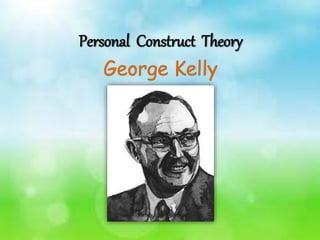
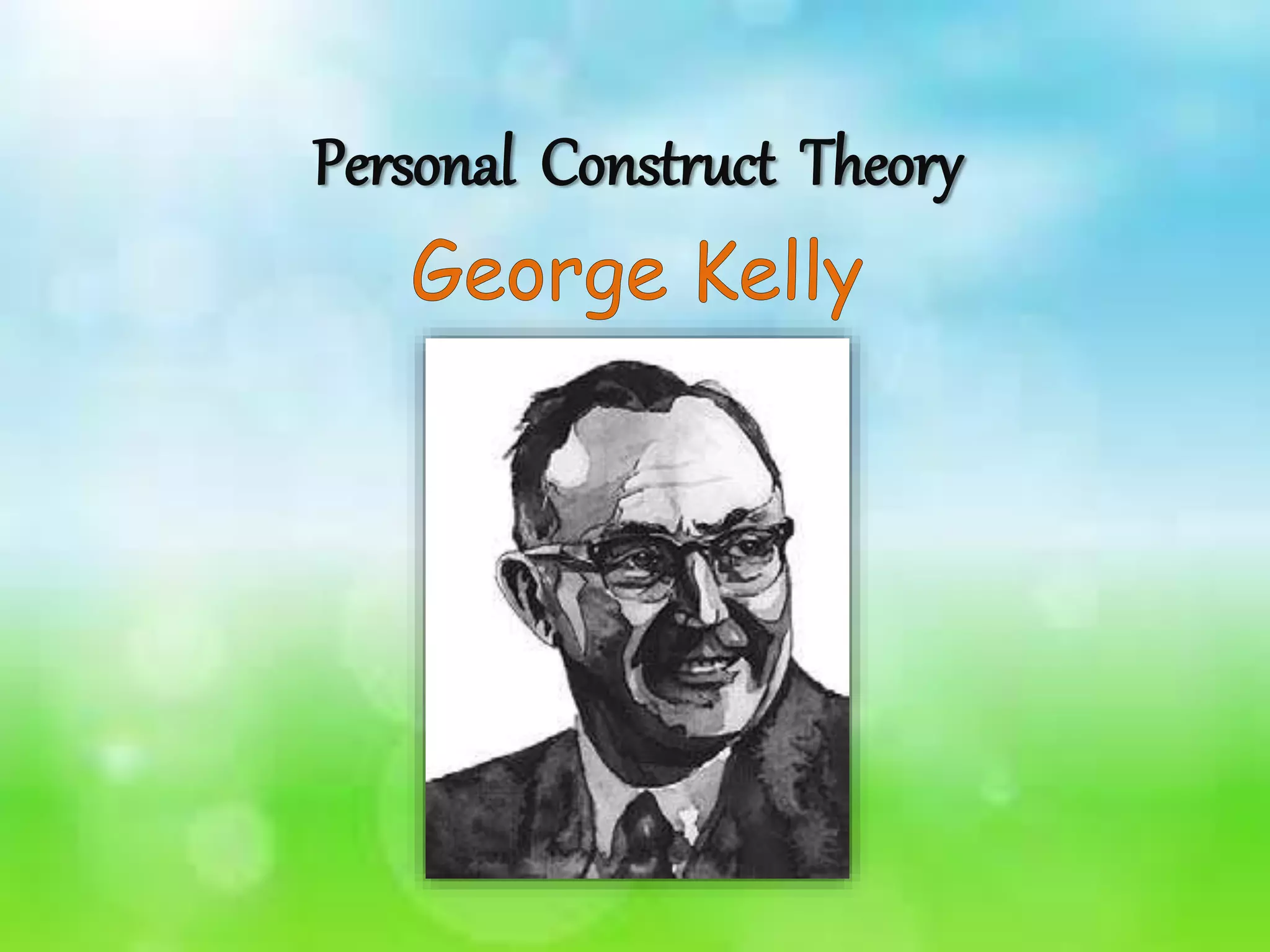
Personal Construct Theory
George Kelly was born
in
Perth, Kansas, USA
on
April 28,1905 His early education
was in one-room
schoolhouse and was
tutored by his parents.
Engineer
Finished college with a degree
in Physics and Mathematics
Social Problems
1929, exchange
scholar at the
University of
Edinburg, Scotland
Enrolled in University of Kansas’ MA program in
educational Sociology and labor relations
1930, degree in
education from
the university
Work closely with Sir Godfrey Thomson
1930, studied Psychology in Iowa State University
Clinical Psychology and Traveling clinics
2 observations:
 accept and usually improves
 way of viewing of situation
World War II – joined navy as Psychologist
With Julian B. Rotter, they developed a
clinical psychology program
Professor of Psychology
and Director of Clinical
Psychology at
Ohio State University
In his 19 years at Ohio State, his theory of
personality was refined and tested
He died on March 6, 1967
o All human beings can develop their own theory
which allow them to anticipate in future events
accurately.
o It is like making decisions and choosing
alternative actions.
o More valid information about the person could
be discovered if the person unravel himself. So,
he devised Role Construct Repertory Test or
Rep Test
Personal Construct
An intellectual hypothesis that we devise and
use to interpret, explain, give meaning or
predict life events.
Constructive Alternatives
We are not controlled by our constructs but are free
to revise or replace them with other alternatives.
“A person’s processes are psychologically
channelized by the ways in which he anticipates in
events”.
Circumspection phase - possible interpretations
that can be labeled cognitive trial and error are
tried
Preemption phase - no. of constructs that
seems especially relevant to the situation are
chosen
Control phase - the choice is made and a course
of action is established.
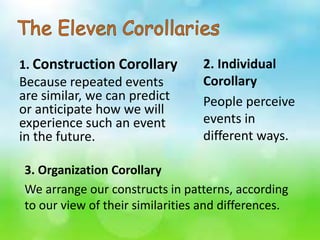
1. Construction Corollary
Because repeated events
are similar, we can predict
or anticipate how we will
experience such an event
in the future.
3. Organization Corollary
We arrange our constructs in patterns, according
to our view of their similarities and differences.
2. Individual
Corollary
People perceive
events in
different ways.
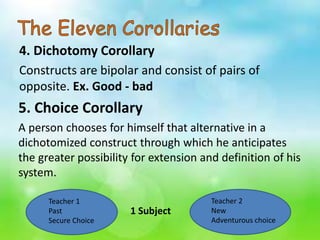
4. Dichotomy Corollary
Constructs are bipolar and consist of pairs of
opposite. Ex. Good - bad
5. Choice Corollary
A person chooses for himself that alternative in a
dichotomized construct through which he anticipates
the greater possibility for extension and definition of his
system.
1 Subject
Teacher 1
Past
Secure Choice
Teacher 2
New
Adventurous choice
6. Range Corollary
A construct is convenient for the
anticipation of a finite range of events only.
7. Experience Corollary
We continually test our constructs against life’s
experiences to make sure they remain useful.
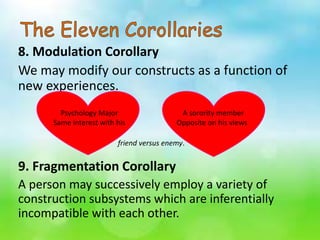
9. Fragmentation Corollary
A person may successively employ a variety of
construction subsystems which are inferentially
incompatible with each other.
8. Modulation Corollary
We may modify our constructs as a function of
new experiences.
friend versus enemy.
Psychology Major
Same interest with his
A sorority member
Opposite on his views
11. Socially Corollary
We try to understand how other people think
and predict what they will do, and we modify
our behavior accordingly.
10. Commonality Corollary
A person may successively employ a variety of
construction subsystems which are inferentially
incompatible with each other
Motivation
Humans are born
motivated and every
person is motivated for no
other reason than that he
or she is alive.
Anxiety
recognition that the events
with which one is confronted
lie outside the range of
convenience of one’s
construct system. WHEN WE
CANNOT COSTRUE AN EVENT,
WE EXPERIENCE ANXIETY.
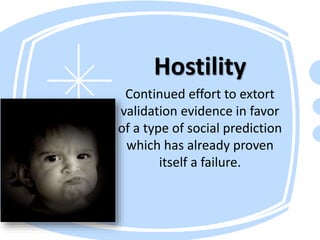
Hostility
Continued effort to extort
validation evidence in favor
of a type of social prediction
which has already proven
itself a failure.
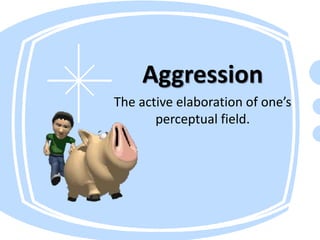
Aggression
The active elaboration of one’s
perceptual field.
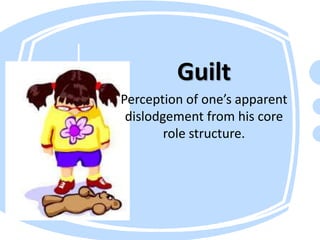
Guilt
Perception of one’s apparent
dislodgement from his core
role structure.
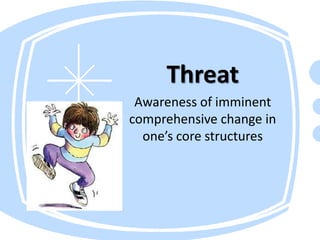
Threat
Awareness of imminent
comprehensive change in
one’s core structures
Fear
Results when a peripheral
element of one’s construct
system is invalidated
The Unconscious
Constructs with low cognitive
awareness could be considered
as unconscious.
Learning
The constant alteration of
one’s construct system with
the goal of increasing its
predictive efficiency. Any
change in in one’s construct
system.
Primary goal of life is to
reduce uncertainty.
We do not seek
reinforcement of
avoidance of pain
instead we seek
validation of our
construct system.
Cognitive –
emphasizes mental
event
Humanistic – gives
importance on
creative power and
determining
personality
END
Prepared by:
Ana Angelica Aldemita
Theories of Personality

George Kelly's Personal Construct Theory

  • 1.
  • 2.
    George Kelly wasborn in Perth, Kansas, USA on April 28,1905 His early education was in one-room schoolhouse and was tutored by his parents.
  • 3.
    Engineer Finished college witha degree in Physics and Mathematics Social Problems
  • 4.
    1929, exchange scholar atthe University of Edinburg, Scotland Enrolled in University of Kansas’ MA program in educational Sociology and labor relations 1930, degree in education from the university Work closely with Sir Godfrey Thomson
  • 5.
    1930, studied Psychologyin Iowa State University Clinical Psychology and Traveling clinics 2 observations:  accept and usually improves  way of viewing of situation World War II – joined navy as Psychologist
  • 6.
    With Julian B.Rotter, they developed a clinical psychology program Professor of Psychology and Director of Clinical Psychology at Ohio State University
  • 7.
    In his 19years at Ohio State, his theory of personality was refined and tested He died on March 6, 1967
  • 8.
    o All humanbeings can develop their own theory which allow them to anticipate in future events accurately. o It is like making decisions and choosing alternative actions. o More valid information about the person could be discovered if the person unravel himself. So, he devised Role Construct Repertory Test or Rep Test
  • 9.
    Personal Construct An intellectualhypothesis that we devise and use to interpret, explain, give meaning or predict life events. Constructive Alternatives We are not controlled by our constructs but are free to revise or replace them with other alternatives. “A person’s processes are psychologically channelized by the ways in which he anticipates in events”.
  • 10.
    Circumspection phase -possible interpretations that can be labeled cognitive trial and error are tried Preemption phase - no. of constructs that seems especially relevant to the situation are chosen Control phase - the choice is made and a course of action is established.
  • 11.
    1. Construction Corollary Becauserepeated events are similar, we can predict or anticipate how we will experience such an event in the future. 3. Organization Corollary We arrange our constructs in patterns, according to our view of their similarities and differences. 2. Individual Corollary People perceive events in different ways.
  • 12.
    4. Dichotomy Corollary Constructsare bipolar and consist of pairs of opposite. Ex. Good - bad 5. Choice Corollary A person chooses for himself that alternative in a dichotomized construct through which he anticipates the greater possibility for extension and definition of his system. 1 Subject Teacher 1 Past Secure Choice Teacher 2 New Adventurous choice
  • 13.
    6. Range Corollary Aconstruct is convenient for the anticipation of a finite range of events only. 7. Experience Corollary We continually test our constructs against life’s experiences to make sure they remain useful.
  • 14.
    9. Fragmentation Corollary Aperson may successively employ a variety of construction subsystems which are inferentially incompatible with each other. 8. Modulation Corollary We may modify our constructs as a function of new experiences. friend versus enemy. Psychology Major Same interest with his A sorority member Opposite on his views
  • 15.
    11. Socially Corollary Wetry to understand how other people think and predict what they will do, and we modify our behavior accordingly. 10. Commonality Corollary A person may successively employ a variety of construction subsystems which are inferentially incompatible with each other
  • 17.
    Motivation Humans are born motivatedand every person is motivated for no other reason than that he or she is alive.
  • 18.
    Anxiety recognition that theevents with which one is confronted lie outside the range of convenience of one’s construct system. WHEN WE CANNOT COSTRUE AN EVENT, WE EXPERIENCE ANXIETY.
  • 19.
    Hostility Continued effort toextort validation evidence in favor of a type of social prediction which has already proven itself a failure.
  • 20.
    Aggression The active elaborationof one’s perceptual field.
  • 21.
    Guilt Perception of one’sapparent dislodgement from his core role structure.
  • 22.
    Threat Awareness of imminent comprehensivechange in one’s core structures
  • 23.
    Fear Results when aperipheral element of one’s construct system is invalidated
  • 24.
    The Unconscious Constructs withlow cognitive awareness could be considered as unconscious.
  • 25.
    Learning The constant alterationof one’s construct system with the goal of increasing its predictive efficiency. Any change in in one’s construct system.
  • 26.
    Primary goal oflife is to reduce uncertainty. We do not seek reinforcement of avoidance of pain instead we seek validation of our construct system. Cognitive – emphasizes mental event Humanistic – gives importance on creative power and determining personality
  • 27.
    END Prepared by: Ana AngelicaAldemita Theories of Personality