‫فلسفې‬ ‫د‬
/
‫نظره‬ ‫له‬ ‫اسالم‬ ‫او‬ ‫ۍ‬‫ژ‬‫سايکالو‬
‫ټمنټ‬‫ر‬‫ډيپا‬ ‫عامې‬ ‫صحت‬‫د‬ ‫پوهنځۍ‬ ‫طب‬‫د‬ ‫ن‬‫پوهنتو‬ ‫کندهار‬ ‫د‬
‫ترتيب‬
:
‫کلیم‬
‫هللا‬
‫دګ‬‫ر‬‫و‬
-2013/Oct
۱۳۹۲
/
‫ان‬‫ز‬‫مي‬
ACCORDING TO
Philosophy/Psychology and Islam!
 Four Humors/Four Temperaments
 Big Five Temperaments/Five Factor Model (FFM)
 Carl-Jung Typology
 Myers Brigg’s Typology
 Type A and Type B
 Morphopsychology
Psychology/Theories
3
• The most ancient (5,000), still echoing in modern psychology (and traditional medicine).
• Hippocrates (460-377BC), Plato's (428-348BC); character and personality
• 4 Elements: Water, Fire, Air, Earth; Four humors: Blood, Bile,BlackBile, Phlegm;
• Four organs: Liver, Spleen, Gall Bladder, Brain and Lungs.
• Blood = Sanguine, Bile = Choleric, BlackBile = Melan Cholic, Phlegmatic
Psycho/Theories/4Humo
4
• Sanguine: Pleasure seeking and Sociable
• Choleric: Ambitious and Leader-like
• Melancholic: Analyticaland Thoughtful
• Phlegmatic: Relaxed and Quiet
Psycho/Theories/4Humo
5
• Is fundamentally sociable, creative, pleasure-seeking;
impulsive, charismatic. They enjoy social gatherings,
making new friends and tend to be boisterous. Sanguines
generally have an almost shameless nature, certain that
what they are doing is right. They however, lack
confidence. Sanguine people are warm-hearted, pleasant,
lively and optimistic.
Psycho/Theo/4Hum/San
6
• Is fundamentally ambitious and leader-like. They have a lot of
aggression, energy, and/or passion, and try to instill that in others.
They are task oriented people and are focused on getting a job
done efficiently; their motto is usually "do it now." They can
dominate people of other temperaments with their strong wills,
especially phlegmatic types, and can become dictatorial or
tyrannical. Many great charismatic military and political figures were
cholerics. However, they can quickly fall into deep depression or
moodiness when failures or setbacks befall them.
Psycho/Theo/4Hum/Cho
7
• Can be highly creative in activities such as poetry, art, and
invention – and are sensitive to others. Because of this sensitivity
and their thoughtfulness they can become preoccupied with the
tragedy and cruelty in the world and are susceptible to depression
and moodiness. Often they are perfectionists. Their desire for
perfection often results in a high degree of personal excellence but
also causes them to be highly conscientious and difficult to relate to
because others often cannot please them.
Psycho/Theo/4Hum/M.C
8
• The phlegmatic temperament is fundamentally relaxed and quiet,
ranging from warmly attentive to lazily sluggish. Phlegmatics tend
to be content with themselves and are kind. Phlegmatics are
consistent, they can be relied upon to be steady and faithful friends.
Phlegmatics prefer to observe and to think on the world around
them while not getting involved. They may try to inspire others to
do the things which they themselves think about doing. They may
be shy and often prefer stability to uncertainty and change. Their
fear of change (and of work) can make them susceptible to
stagnation or laziness, or even stubbornness.
Psycho/Theo/4Hum/Phl
9
• At least four sets of researchers have worked independently for decades
on this problem and have identified generally the same Big Five factors:
Tupes and Cristal were first, followed by Goldberg at the Oregon Research
Institute, Cattell at the University of Illinois, and Costa and McCrae at the
National Institutes of Health. These four sets of researchers used
somewhat different methods in finding the five traits, and thus each set of
five factors has somewhat different names and definitions. However, all
have been found to be highly inter-correlated and factor-analytically
aligned. Psycho/Theories/FFM
10
• Openness
• Conscientiousness
• Extraversion
• Agreeableness
• Neuroticism
• The Big Five has been preferably used rather than other models,
because it is able to account for different traits in personality
without overlapping. During studies, the Big Five personality traits
show consistency in interviews, self-descriptions and observations.
Moreover, this five-factor structure seems to be found across a
wide range of participants of different ages and of different
cultures. Psycho/Theories/FFM
11
• Appreciation for art, emotion, adventure, unusual ideas, curiosity,
and variety of experience. Openness reflects the degree of
intellectual curiosity, creativity and a preference for novelty and
variety a person has.
• A tendency to show self-discipline, act dutifully, and aim for
achievement; planned rather than spontaneous behavior; organized,
and dependable.
12
Psycho/Theories/FFM
• Energy, positive emotions, assertiveness, sociability and the
tendency to seek stimulation in the company of others, and
talkativeness.
• A tendency to be compassionate and cooperative rather than
suspicious and antagonistic towards others. It is also a measure of
ones' trusting and helpful nature, and whether a person is generally
well tempered or not.
13
Psycho/Theories/FFM
• The tendency to experience unpleasant emotions easily, such as
anger, anxiety, depression, or vulnerability. Neuroticism also refers
to the degree of emotional stability and impulse control, and is
sometimes referred by its low pole – "emotional stability".
14
Psycho/Theories/FFM
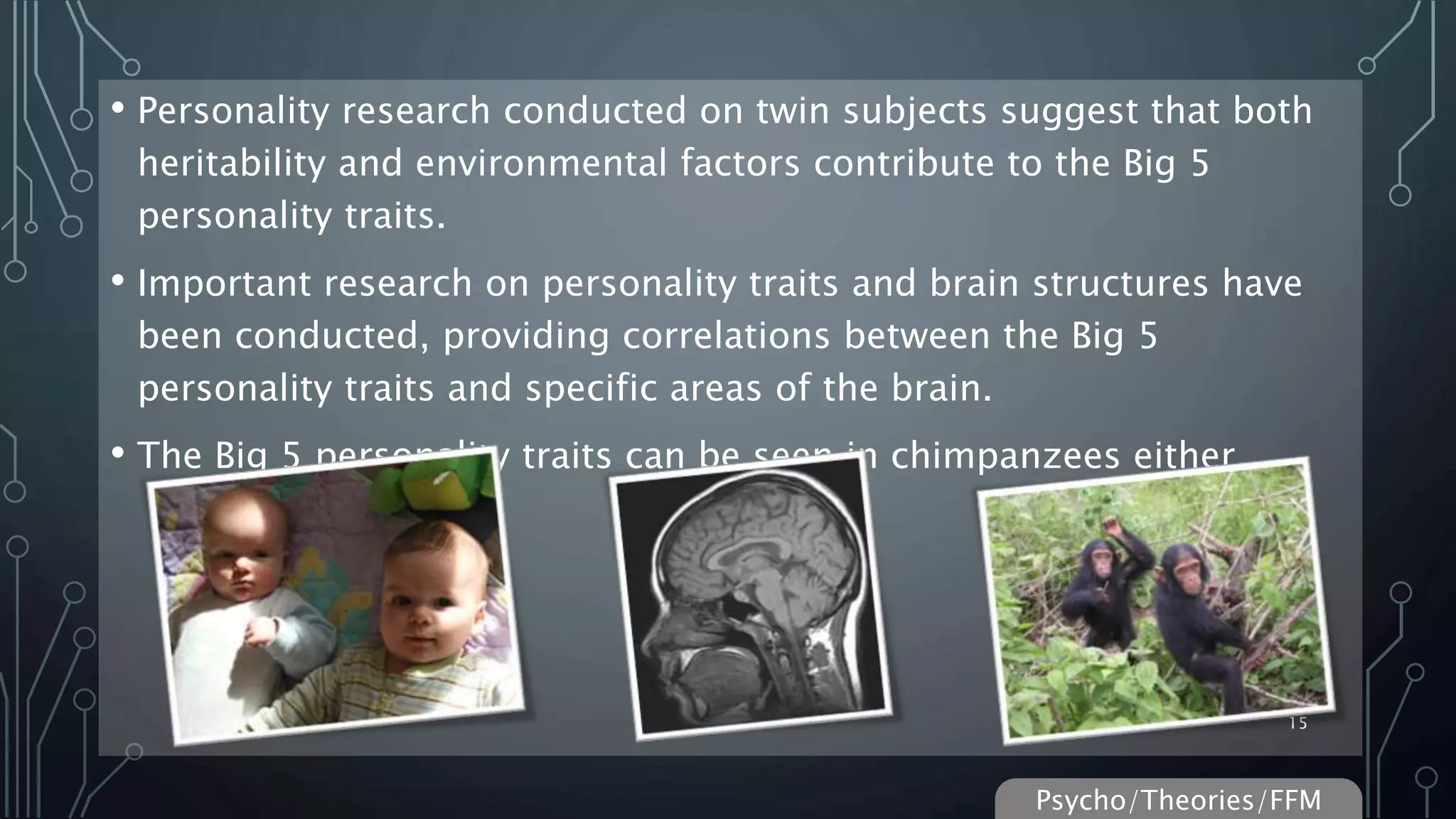
• Personality research conducted on twin subjects suggest that both
heritability and environmental factors contribute to the Big 5
personality traits.
• Important research on personality traits and brain structures have
been conducted, providing correlations between the Big 5
personality traits and specific areas of the brain.
• The Big 5 personality traits can be seen in chimpanzees either.
15
Psycho/Theories/FFM
• Jung's interest in typology grew from his desire to reconcile the theories
of Sigmund Freud and Alfred Adler, and to define how his own perspective
differed from theirs. Jung wrote, “In attempting to answer this question, I
came across the problem of types; for it is one's psychological type which
from the outset determines and limits a person's judgment. Jung became
convinced that acrimony between the Adlerian and Freudian camps was
due to this unrecognized existence of different fundamental psychological
attitudes, which led Jung “to conceive the two controversial theories of
neurosis as manifestations of a type-antagonism.”
Psycho/Theo/Carl-Jung
16
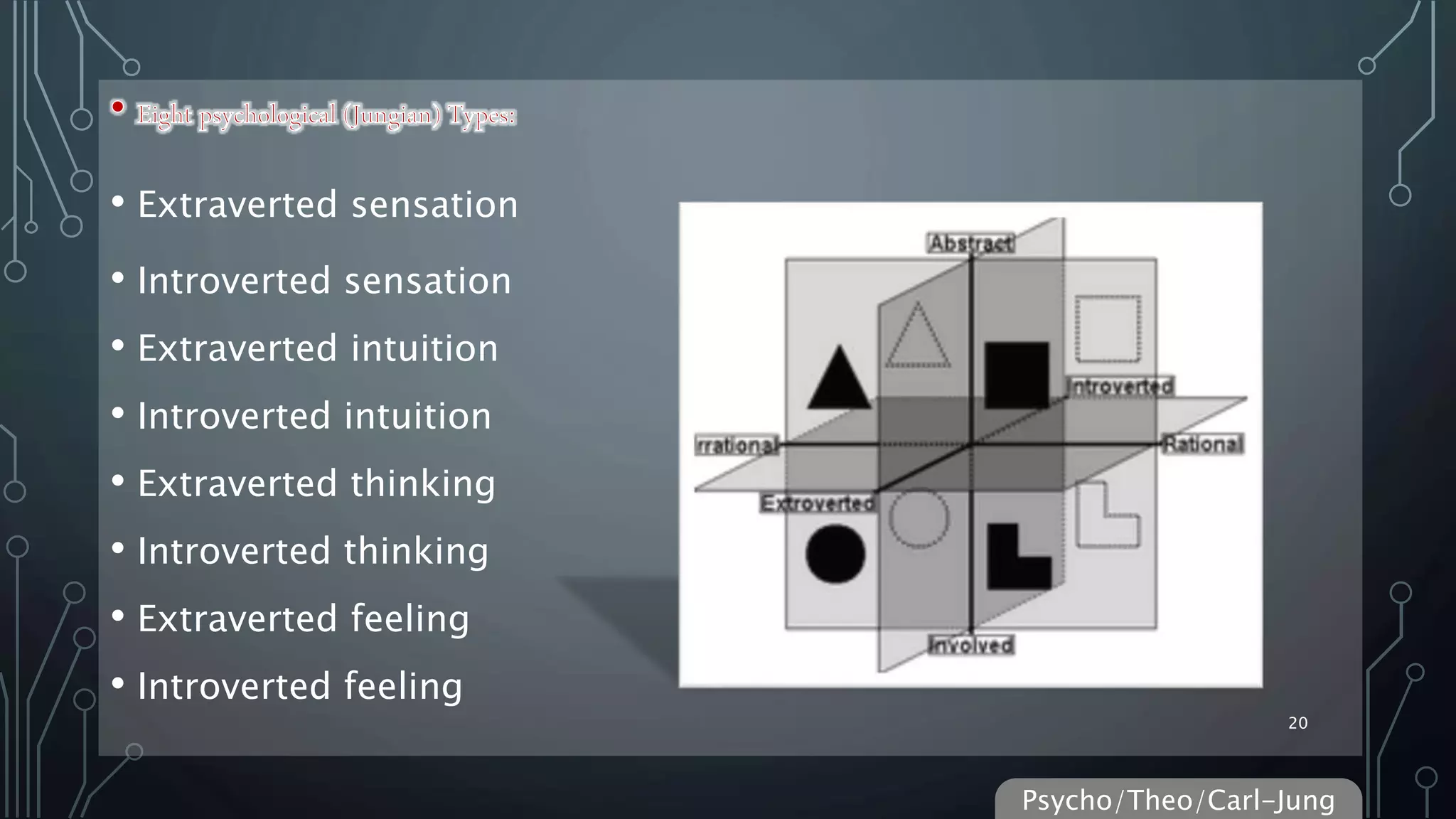
Jung proposed the existence of two dichotomous pairs of cognitive
functions:
• The “Rational” (judging) functions: thinking and feeling
• The “Irrational” (perceiving) functions: sensing and intuition
Jung went on to suggest that these functions are expressed in either
an introverted or extraverted form.
• Sensation —perception by means of the sense organs;
• Intuition —perceiving in unconscious way or perception of
unconscious contents.
• Thinking —function of intellectual cognition; the forming of logical
conclusions;
17
Psycho/Theo/Carl-Jung
Extraversion and Introversion
• Extraverts are action oriented, while introverts are thought oriented.
• Extraverts seek breadth of knowledge and influence, while
introverts seek depth of knowledge and influence.
• Extraverts often prefer more frequent interaction, while introverts
prefer more substantial interaction.
• Extraverts recharge and get their energy from spending time with
people, while introverts recharge and get their energy from
spending time alone.
18
Psycho/Theo/Carl-Jung
• All four functions are used at different times depending on the
circumstances. However, one of the four functions is generally used more
dominantly and proficiently than the other three, in a more conscious and
confident way. According to Jung the dominant function is supported by
two auxiliary functions. (In MBTI publications the first auxiliary is usually
called the auxiliary or secondary function and the second auxiliary
function is usually called the tertiary function.) The fourth and least
conscious function is always the opposite of the dominant function. Jung
called this the "inferior function" and Myers sometimes also called it the
"shadow".
• The four functions operate in conjunction with the attitudes (extraversion
and introversion). Each function is used in either an extraverted or
introverted way. A person whose dominant function is extraverted
intuition, for example, uses intuition very differently from someone whose
dominant function is introverted intuition.
19
Psycho/Theo/Carl-Jung
• Extraverted sensation
• Introverted sensation
• Extraverted intuition
• Introverted intuition
• Extraverted thinking
• Introverted thinking
• Extraverted feeling
• Introverted feeling
20
Psycho/Theo/Carl-Jung
• Divides people into 16 different types, called sociotypes. Most
commonly referred to by their two strongest functions, which are
called the leading function (Jung's dominant) and the creative
function (Jung's auxiliary). The creative function is opposite to the
leading function in extraversion and rationality.
• INTJ (introversion, intuition, thinking, judgment)
Psycho/Theo/Myers
21
22
Psycho/Theo/Myers
23
Psycho/Theo/Myers
• Individual is ambitious, rigidly organized, highly status conscious,
can be sensitive, truthful, impatient, always try to help others, take
on more than they can handle, want other people to get to the
point, proactive, and obsessed with time management. People with
Type A personalities are often high-achieving "workaholics" who
multi-task, push themselves with deadlines, and hate both delays
and ambivalence.
Psycho/Theories/Type
24
• Generally live at a lower stress level and typically work steadily,
enjoying achievement but not becoming stressed when they are not
achieved. When faced with competition, they do not mind losing and
either enjoy the game or back down. They may be creative and
enjoy exploring ideas and concepts. They are often reflective,
thinking about the outer and inner worlds.
• Very often, people with Type A personality find fault with the easy-
going nature and low level of enthusiasm demonstrated by Type B
personalities, and Type B personalities would dislike people with
Type A personalities for their aggressive nature.
Psycho/Theories/Type
25
• Type A personality behavior was first described as a potential risk
factor for heart disease in the 1950s by cardiologists Meyer
Friedman and Ray Rosenman. After an eight and a half year long
study of healthy men between the ages of 35 and 59, Friedman and
Rosenman estimated that Type A behavior doubles the risk of
coronary heart disease in otherwise healthy individuals. The
individuals enrolled in this study were followed well beyond the
original time frame of the study. Subsequent analysis indicated that
although Type A personality is associated with the incidence of
coronary heart disease, it does not seem to be a risk factor for
mortality. This research had a significant effect on the development
of the health psychology field, in which psychologists look at how
Psycho/Theories/Type
26
• In his 1996 book, Type A Behavior: Its Diagnosis and Treatment,
Friedman suggests that Type A behavior is expressed in three major
symptoms: free-floating hostility, which can be triggered by even
minor incidents; time urgency and impatience, which causes
irritation and exasperation usually described as being "short-fused";
and a competitive drive, which causes stress and an achievement-
driven mentality. The first of these symptoms is believed to be
covert and therefore less observable, while the other two are more
overt.
Psycho/Theories/Type
27
• The Fast-paced nature of type A individuals and their stress on
deadlines, work and the like making them highly susceptible to
stress
• The competitive nature of type A personalities making them angry,
tense and pressurized
• Type A behaviors such as fast talking, explosive speech, clenched
fists, restlessness, and hurrying being general indicators of an
underlying unhealthy emotional state
Such traits led to high blood pressure, high cholesterol, and habits
such as smoking, all proven causative factors for cardiac diseases.
Friedman & Rosenman published their theory in their 1974 book
"Type A Behavior and Your Heart," which made the theory of
Psycho/Theories/Type
28
• Research by Redford Williams of Duke University indicates that only
the hostility component, or a high level of expressed anger and
hostility of Type A personality denotes a significant risk factor for
heart disease. Irrespective of the personality type, cynical, resentful,
chronically angry, and mistrustful men remain highly susceptible to
coronary events such as hospitalizations for angina, nonfatal
myocardial infarction, stroke and congestive heart failure.
• The University of Pittsburgh School of Medicine researchers
reinforce the theory of hostility as a causative factor for heart
diseases by using carotid-artery imaging. Each one-point increase
in hostility scores predicted a significantly higher medial thickening.
Psycho/Theories/Type
29
• In 1962 Meyer and Haggerty, did throat culture of a family members
for streptococcus, which were usually asymptomatic +, but stress
was making them prone to disease. (On the other hand, no one
developed the strep illness without exposure to the bacteria.)
• In 2006 Cohen and colleagues have demonstrated that factors such
as self-reported chronic stress and lack of a positive emotional style
predict increased risk of subsequent upper respiratory infection in
experimental exposure to viruses; however, it has been difficult to
identify either behavioral or immunological mediators of such
effects.
• This complexity may be due to multiple causal links—behavioral
links, stress links, biological, situational selection… simultaneously
operating. Psycho/Theories/Type
30
• It is known that in response to stress we produce the hormone
cortisol, which if it remains in the blood system for too long it can
trigger a buildup of fatty deposits in the inner walls of the arteries
going to your heart, eventually leading to heart disease.
• The overly simplistic nature of research, with no scope to assess the
degrees of difference in human personality.
• Unreliability of the methods used to assess type A behavior.
Psycho/Theories/Type
31
• Another 10-year joint research by Italian and Sardinian researchers,
the U.S. National Institute on Aging, and bio-statisticians of the
University of Michigan, while indicating a clear influence of genetic
factors on many traits at once, did not find a connection linking
personality and cardiovascular function.
• On contrary, there is another research result which says it is a major
cause of heart attack, so the Type As should funnel their energy to
positive direction and focus on regular exercise, which will keep
them accommodate to some extent with easy-going personalities.
Psycho/Theories/Type
32
• It is proven that maintaining healthy magnesium levels in the body
plays a strong role in protecting the cardiovascular health of an
individual. An analysis of the literature suggests the possible role of
Mg deficiency in the susceptibility to cardiovascular diseases,
observed among subjects displaying a type A behavior pattern.
Experimental data which support this hypothesis are reviewed. Type
A subjects are more sensitive to stress and produce more
catecholamines than type B subjects. This, in turn, seems to induce
an intracellular Mg loss. In the long run, type A individuals would
develop a state of Mg deficiency, which may promote a greater
sensitivity to stress and, ultimately, lead to the development of
cardiovascular problems.
Psycho/Theories/Type
33
• A method of analyzing human personality/mood/health by interpreting
the shape and features of a person's face.
• Isn’t physiognomy (ancient loosely defined concept of assessing human
character from appearance), nor phrenology (assessing human character
from skull/brain size and shape).
• Not a science, but a 'pseudo-science‘; and widely supported by doctors,
advocates…
• Having similar value and credibility as graphology (the study/analysis of
handwriting). Publicly validated and trusted.
• Named and defined in the 1930s by French psychiatrist Louis Corman
(1901-1995). Psycho/Theo/Morphopsy
34
• Face shape and features (front and side views) are called 'human
facial morphology'. A practitioner/expert in morphopsychology may
be called a 'Morphoanalyst'.
• Corman: essential forces in the human body produce different facial
shapes and forms; Simply True: in smile we crease our eyes, When
we frown we crease our foreheads. The human face displays more
emotions and feelings than we can scientifically describe.
• Corman was influenced by the French doctor Claude Sigaud (1862-
1921), who had earlier identified connective patterns between
human sickness and facial features. Corman built on Sigaud's work,
by which he developed many face/personality correlations, a very
elegant structured model, and a set of rules, based on clinical
observation, which became morphopsychology.
35
Psycho/Theo/Morphopsy
Morphopsychology theory analyses facial shape and features according to:
1. Width and depth of the face - indicating the dominant instinct of
'expansion' (growth) or 'conservation' (preservation)*
2. The 'three levels of the face' ** - indicating the main centers of interest.
3. Skin texture - indicating how the person interacts with his/her
environment.
4. Firmness of the facial features - indicating activity and control.
5. Ratios between sensors (eyes, nose, mouth) and width of the face - to
determine the global behavior.
* The 'expansion-conservation' scale is fundamental within the model.
** The 'three levels of the face' are vertical sections: forehead to
eyes/eyes to nose-base/nose-base to chin.
36
Psycho/Theo/Morphopsy
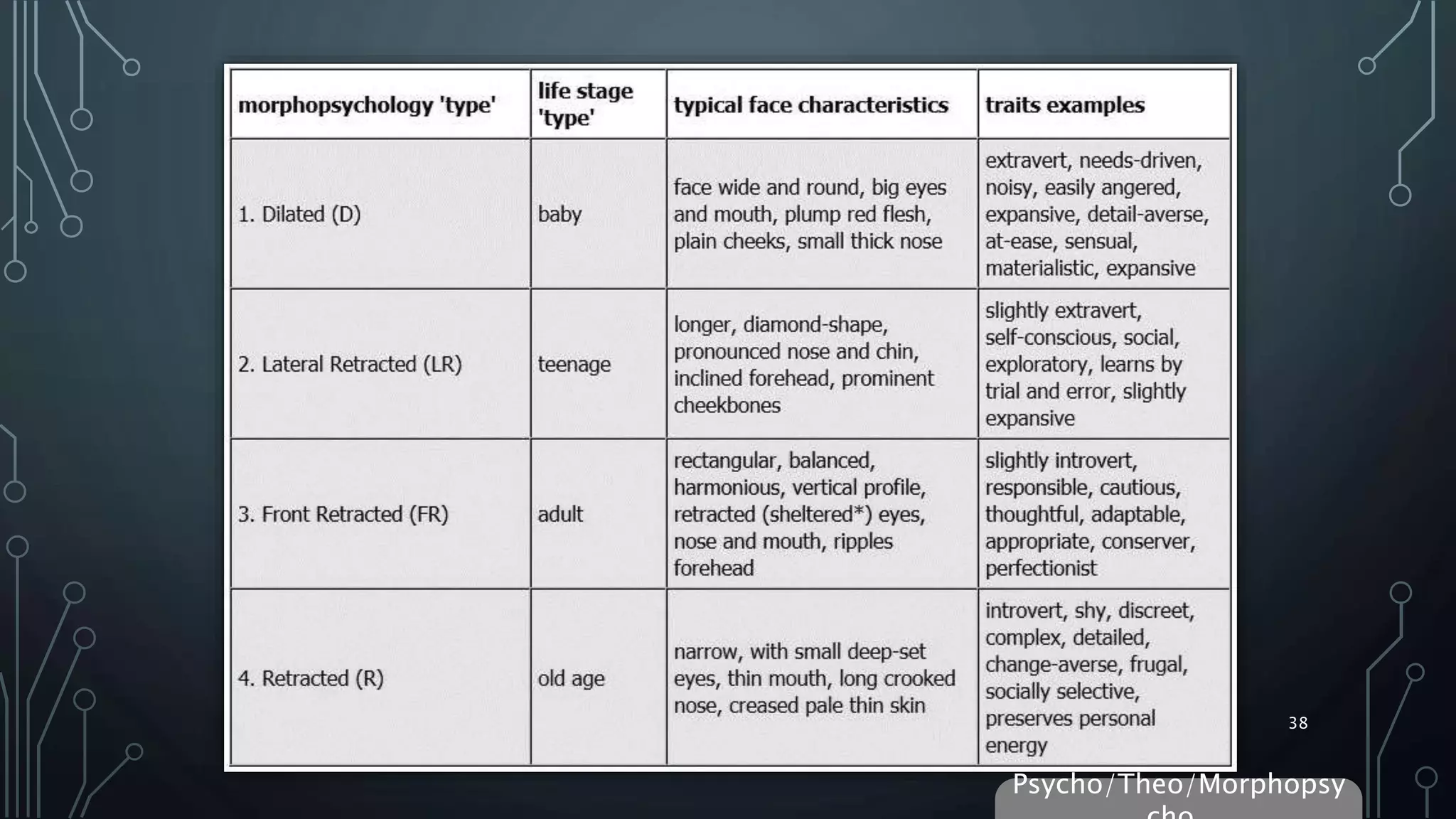
• Assessment of these aspects produces an analysis according to the four
morphopsychology base 'types', for which summary details are provided below:
1. Dilated (D)
2. Lateral Retracted (LR)
3. Front Retracted (FR)
4. Retracted (R)
• These 'types' relate to human development.
• People possess the four types in varying degrees.
• A person's age does not determine his/her dominant types.
• Most of us possess one or two dominant types, although it possible for a person
to possess three types of equal dominance.
• Here are the four basic types in a little more detail:
37
Psycho/Theo/Morphopsy
38
Psycho/Theo/Morphopsy
Advocates and practitioners in morphopsychology use the concept
mostly for:
• Personal development: Reveal or confirm a person's potential - this
relates to fields such as training and development, teambuilding,
counselling, coaching… and self-development.
• Understanding how people function: To gain Insight about a
client/patient - this relates to many and various therapeutic fields,
and also potentially to leadership, management and motivation,
change management, sports management, sales and selling,
negotiation, and coaching, etc.
• In interviewing recruitment and selection: But absolutely not as a
main indicator of suitability for a job, nor as a tool to determine
individual capability, worth, intelligence, honesty, or motive, etc.
39
Psycho/Theo/Morphopsy
• The authors were humans themselves, and the standard was there
own intellect, nourished by 5senses and myths; which means
imperfection, and which is also the main cause of contradictions
between theoreticians, because perfection is a single reality, and
imperfections are infinite.
• They couldn’t describe human and its mission, normal standard for
his thought and action, and finally an Ideal situation; which led to
absence of modification system and loss of ability to distinguish
between wrong and wright.
• So they couldn’t know human as he actually is, and they asserted
about an extremely complex machine without having a look at
manufacturer’s guide catalogue.
40
Psycho/Theo/Morphopsy
َّ
‫الظ‬ َّ
‫ن‬ِ‫إ‬َ‫و‬ َّ
‫ن‬
َّ
‫الظ‬
َّ
‫َّل‬ِ‫إ‬
َ
‫ن‬‫و‬ُ‫ع‬ِ‫ب‬
َّ
‫ت‬َ‫ي‬
ْ
‫ن‬ِ‫إ‬
ْ‫ي‬
َ
‫ش‬ ِ
‫ق‬ َ‫ح‬
ْ
‫ال‬ َ
‫ن‬ِ‫م‬ ‫ي‬ ِ‫ن‬
ْ
‫غ‬ُ‫ي‬
َ
‫َّل‬ َّ
‫ن‬
‫ا‬
ً
‫ئ‬
(
۲۸
)
‫النجم‬
‫شخصيت‬ ‫او‬ ‫اسالم‬
ISLAM AND
PERSONALITY
‫ا‬ ً‫ر‬‫و‬
ُ
‫ك‬
ْ
‫ذ‬ َ‫م‬ ‫ا‬
ً
‫ئ‬ْ‫ي‬
َ
‫ش‬ ْ
‫ن‬
ُ
‫ك‬َ‫ي‬ ْ‫م‬
َ
‫ل‬ ِ‫ر‬ ْ‫ه‬ َّ‫الد‬ َ
‫ن‬ِ‫م‬ ٌ
‫ين‬ ِ
‫ح‬ ِ
‫ان‬ َ
‫س‬
ْ
‫ن‬ِ
ْ
‫اْل‬‫ى‬
َ
‫ل‬َ‫ع‬ ‫ى‬
َ
‫ت‬
َ
‫أ‬ ْ‫ل‬ َ‫ه‬
(
۱
)
‫اَّلنسان‬
• The manufacturer’s guide catalogue about his complex production.
• As perfect as its instructor, meets with both spiritual and physical
requirements.
• Practical, elucidating, fluent, concrete, faultless and free of bias.
• From far beyond the limits of 5senses, conveyed by a trusted
intermediary, free of myths and interpolations.
• Ideal picture, along with complete course of modification and
clarification.
• It has practical solutions for before life, during life, and after life
Islam/Preface
42
• Ancestors: Adam and Eve (rather than Apes)
• Status: The best of all creation, Representative of God (Not an
ordinary animal)
• Residence: Earth, as the sole consumer of its resources.
• Life span: ~100 y, (Fluctuating Nature, in different periods of life)
• P/o Creation: Succeeding the trial of probation to attain Lord’s
hospitality.
• Mission: Peace established by means of submission to Lord’s will.
• Standard: Loyalty and Strive according to the guidelines taught by
messenger (Piety)
Islam/Introduction
43
1. Physical: Bodily Comfort 2. Metaphysical: Spiritual
Satisfaction
• Body is neutral, but influential forces make it go on a side.
• Desires (Fluctuation during different periods of life, goes wrong in
wrong environm.)
• Satanic Whisper (Powerful in isolation, Idleness, youth, ignorance
and carnality)
• Divine Inspiration (Clearly appreciated by means of Piety, Utilized by
means of Ilm) 44
Islam/Introduction
Left Pole: Churlish/Rebellious Right Pole:
Grateful/Virtuous
(on the basis of their distance from the poles)
Grade RelationtoGod Conduct(Label,Proof)
• Secured; Safe Closest to God The best in conduct
(forgiver)
• Blaming; Objector Right-wing The revenger
• Dictator; Commander Left-wing The transgressor
• Rewards are announced for the first and last classes (Mid is kept hidden);
Islam/Personality Types
45
• People can up/down-grade willingly, their truthful decision makes
everything possible.
• They can change their behavior, or at least its way of demonstration so
they can get fit into any sort of suite (Ease, Glad tidings, Anger, Loan,
help, sociality, relations…)
• To overcome the intensity of desires, environment modification/change is
the best solution; (Friendship, Neighborhood, Occupation, Habits…)
• To resist against Satanic whispers, joining a spiritual gathering is vital.
• To experience Divine inspiration, piety and truthfulness is essential
(Forqan, Basharaat) Islam/Soar and Plummet
46
• Marriage: For lawful sexual satisfaction (Fasting as an alternative)
• Relativity; Long Life
• Charity; Bad accidents, bad death
• Friendship; Satanic Whisper
Islam/Soar and Plummet
47
• Repentance:- Cease the process, Remorse, Return the rights, and pledge
not to repeat.
• Immediate Isteghfar, Awwabin Prayer, Juma’ Prayer, Ramazan Fast,
Charity…
• Washout the bad with good; Preach to change the environment caused the
blunder.
• Hajj Congregation
• Learn Qur'an to employ, Teach to become the best, and propagate to
become immortal.
• Construct for social welfare, Innovate for system refabrication.
Islam/First Aid
48
• In emotional situations (Anger, Pleasure), in emergencies (Travel), Sacrifice,
Consult, Relative, Contradiction, Perpetration (Remorse, repent), wealth/poverty,
• 2 criteria for husband (Religion/Piety, Conduct)
• 2 Criteria for Leader (Piety, Proficiency)
• Satisfaction of wife and family.
• Elderly, life and wealth
• Youth, Religiousness/sincerity/bravery/self-control................
Islam/Personality Tests
49
‫وايستم‬ ‫دنياګۍ‬ ‫له‬‫خوب‬ ‫د‬ ‫شپه‬ ‫نيمه‬ ‫تقدير‬‫ه‬‫ز‬
‫ندی‬ ‫خوب‬ ‫تعبير‬ ‫خوب‬ ‫دښکلي‬ ‫ستا‬ ‫ځلميه‬ ‫ويل‬
‫ـپوه‬‫ـ‬‫ـ‬‫ـ‬‫ـ‬‫ـ‬‫ـ‬‫ـ‬‫ـ‬‫ـ‬‫ـ‬‫ـ‬‫ـ‬‫ـ‬‫ـ‬‫ـ‬‫ـ‬‫ټ‬‫و‬ ‫ته‬‫از‬‫و‬‫ـر‬‫ـ‬‫ـ‬‫ـ‬‫ـ‬‫ـ‬‫ـ‬‫ـ‬‫ـ‬‫ـ‬‫ـ‬‫ـ‬‫ـ‬‫ـ‬‫ـ‬‫ـ‬‫ـ‬‫ـ‬‫ـ‬‫ـ‬‫پ‬‫ـان‬‫ـ‬‫ـ‬‫ـ‬‫ـ‬‫ـ‬‫ـ‬‫ـ‬‫ـ‬‫ـ‬‫ـ‬‫ـ‬‫ـ‬‫ـ‬‫ـ‬‫ـ‬‫ـ‬‫ـ‬‫ـ‬‫ـ‬‫ش‬‫کهک‬‫د‬ ‫ر‬‫ز‬‫و‬ ‫ـه‬‫ـ‬‫ـ‬‫ـ‬‫څ‬‫ـا‬‫ـ‬‫ـ‬‫ـ‬‫ـ‬‫ـ‬‫ـ‬‫ـ‬‫ـ‬‫ـ‬‫ـ‬‫ـ‬‫ـ‬‫ـ‬‫ـ‬‫ـ‬‫ـ‬‫ـ‬‫ـ‬‫ـ‬‫پ‬
!
‫ندی‬ ‫يرتوب‬‫ږ‬ ‫سپين‬ ‫جوالنونو‬ ‫د‬ ‫ل‬‫منز‬ ‫ستا‬‫ر‬‫نو‬
...
(
‫کليم‬
)

(Psychology) personality types in english by dr. kalimullah wardak

  • 1.
    ‫فلسفې‬ ‫د‬ / ‫نظره‬ ‫له‬‫اسالم‬ ‫او‬ ‫ۍ‬‫ژ‬‫سايکالو‬ ‫ټمنټ‬‫ر‬‫ډيپا‬ ‫عامې‬ ‫صحت‬‫د‬ ‫پوهنځۍ‬ ‫طب‬‫د‬ ‫ن‬‫پوهنتو‬ ‫کندهار‬ ‫د‬ ‫ترتيب‬ : ‫کلیم‬ ‫هللا‬ ‫دګ‬‫ر‬‫و‬ -2013/Oct ۱۳۹۲ / ‫ان‬‫ز‬‫مي‬
  • 2.
  • 3.
     Four Humors/FourTemperaments  Big Five Temperaments/Five Factor Model (FFM)  Carl-Jung Typology  Myers Brigg’s Typology  Type A and Type B  Morphopsychology Psychology/Theories 3
  • 4.
    • The mostancient (5,000), still echoing in modern psychology (and traditional medicine). • Hippocrates (460-377BC), Plato's (428-348BC); character and personality • 4 Elements: Water, Fire, Air, Earth; Four humors: Blood, Bile,BlackBile, Phlegm; • Four organs: Liver, Spleen, Gall Bladder, Brain and Lungs. • Blood = Sanguine, Bile = Choleric, BlackBile = Melan Cholic, Phlegmatic Psycho/Theories/4Humo 4
  • 5.
    • Sanguine: Pleasureseeking and Sociable • Choleric: Ambitious and Leader-like • Melancholic: Analyticaland Thoughtful • Phlegmatic: Relaxed and Quiet Psycho/Theories/4Humo 5
  • 6.
    • Is fundamentallysociable, creative, pleasure-seeking; impulsive, charismatic. They enjoy social gatherings, making new friends and tend to be boisterous. Sanguines generally have an almost shameless nature, certain that what they are doing is right. They however, lack confidence. Sanguine people are warm-hearted, pleasant, lively and optimistic. Psycho/Theo/4Hum/San 6
  • 7.
    • Is fundamentallyambitious and leader-like. They have a lot of aggression, energy, and/or passion, and try to instill that in others. They are task oriented people and are focused on getting a job done efficiently; their motto is usually "do it now." They can dominate people of other temperaments with their strong wills, especially phlegmatic types, and can become dictatorial or tyrannical. Many great charismatic military and political figures were cholerics. However, they can quickly fall into deep depression or moodiness when failures or setbacks befall them. Psycho/Theo/4Hum/Cho 7
  • 8.
    • Can behighly creative in activities such as poetry, art, and invention – and are sensitive to others. Because of this sensitivity and their thoughtfulness they can become preoccupied with the tragedy and cruelty in the world and are susceptible to depression and moodiness. Often they are perfectionists. Their desire for perfection often results in a high degree of personal excellence but also causes them to be highly conscientious and difficult to relate to because others often cannot please them. Psycho/Theo/4Hum/M.C 8
  • 9.
    • The phlegmatictemperament is fundamentally relaxed and quiet, ranging from warmly attentive to lazily sluggish. Phlegmatics tend to be content with themselves and are kind. Phlegmatics are consistent, they can be relied upon to be steady and faithful friends. Phlegmatics prefer to observe and to think on the world around them while not getting involved. They may try to inspire others to do the things which they themselves think about doing. They may be shy and often prefer stability to uncertainty and change. Their fear of change (and of work) can make them susceptible to stagnation or laziness, or even stubbornness. Psycho/Theo/4Hum/Phl 9
  • 10.
    • At leastfour sets of researchers have worked independently for decades on this problem and have identified generally the same Big Five factors: Tupes and Cristal were first, followed by Goldberg at the Oregon Research Institute, Cattell at the University of Illinois, and Costa and McCrae at the National Institutes of Health. These four sets of researchers used somewhat different methods in finding the five traits, and thus each set of five factors has somewhat different names and definitions. However, all have been found to be highly inter-correlated and factor-analytically aligned. Psycho/Theories/FFM 10
  • 11.
    • Openness • Conscientiousness •Extraversion • Agreeableness • Neuroticism • The Big Five has been preferably used rather than other models, because it is able to account for different traits in personality without overlapping. During studies, the Big Five personality traits show consistency in interviews, self-descriptions and observations. Moreover, this five-factor structure seems to be found across a wide range of participants of different ages and of different cultures. Psycho/Theories/FFM 11
  • 12.
    • Appreciation forart, emotion, adventure, unusual ideas, curiosity, and variety of experience. Openness reflects the degree of intellectual curiosity, creativity and a preference for novelty and variety a person has. • A tendency to show self-discipline, act dutifully, and aim for achievement; planned rather than spontaneous behavior; organized, and dependable. 12 Psycho/Theories/FFM
  • 13.
    • Energy, positiveemotions, assertiveness, sociability and the tendency to seek stimulation in the company of others, and talkativeness. • A tendency to be compassionate and cooperative rather than suspicious and antagonistic towards others. It is also a measure of ones' trusting and helpful nature, and whether a person is generally well tempered or not. 13 Psycho/Theories/FFM
  • 14.
    • The tendencyto experience unpleasant emotions easily, such as anger, anxiety, depression, or vulnerability. Neuroticism also refers to the degree of emotional stability and impulse control, and is sometimes referred by its low pole – "emotional stability". 14 Psycho/Theories/FFM
  • 15.
    • Personality researchconducted on twin subjects suggest that both heritability and environmental factors contribute to the Big 5 personality traits. • Important research on personality traits and brain structures have been conducted, providing correlations between the Big 5 personality traits and specific areas of the brain. • The Big 5 personality traits can be seen in chimpanzees either. 15 Psycho/Theories/FFM
  • 16.
    • Jung's interestin typology grew from his desire to reconcile the theories of Sigmund Freud and Alfred Adler, and to define how his own perspective differed from theirs. Jung wrote, “In attempting to answer this question, I came across the problem of types; for it is one's psychological type which from the outset determines and limits a person's judgment. Jung became convinced that acrimony between the Adlerian and Freudian camps was due to this unrecognized existence of different fundamental psychological attitudes, which led Jung “to conceive the two controversial theories of neurosis as manifestations of a type-antagonism.” Psycho/Theo/Carl-Jung 16
  • 17.
    Jung proposed theexistence of two dichotomous pairs of cognitive functions: • The “Rational” (judging) functions: thinking and feeling • The “Irrational” (perceiving) functions: sensing and intuition Jung went on to suggest that these functions are expressed in either an introverted or extraverted form. • Sensation —perception by means of the sense organs; • Intuition —perceiving in unconscious way or perception of unconscious contents. • Thinking —function of intellectual cognition; the forming of logical conclusions; 17 Psycho/Theo/Carl-Jung
  • 18.
    Extraversion and Introversion •Extraverts are action oriented, while introverts are thought oriented. • Extraverts seek breadth of knowledge and influence, while introverts seek depth of knowledge and influence. • Extraverts often prefer more frequent interaction, while introverts prefer more substantial interaction. • Extraverts recharge and get their energy from spending time with people, while introverts recharge and get their energy from spending time alone. 18 Psycho/Theo/Carl-Jung
  • 19.
    • All fourfunctions are used at different times depending on the circumstances. However, one of the four functions is generally used more dominantly and proficiently than the other three, in a more conscious and confident way. According to Jung the dominant function is supported by two auxiliary functions. (In MBTI publications the first auxiliary is usually called the auxiliary or secondary function and the second auxiliary function is usually called the tertiary function.) The fourth and least conscious function is always the opposite of the dominant function. Jung called this the "inferior function" and Myers sometimes also called it the "shadow". • The four functions operate in conjunction with the attitudes (extraversion and introversion). Each function is used in either an extraverted or introverted way. A person whose dominant function is extraverted intuition, for example, uses intuition very differently from someone whose dominant function is introverted intuition. 19 Psycho/Theo/Carl-Jung
  • 20.
    • Extraverted sensation •Introverted sensation • Extraverted intuition • Introverted intuition • Extraverted thinking • Introverted thinking • Extraverted feeling • Introverted feeling 20 Psycho/Theo/Carl-Jung
  • 21.
    • Divides peopleinto 16 different types, called sociotypes. Most commonly referred to by their two strongest functions, which are called the leading function (Jung's dominant) and the creative function (Jung's auxiliary). The creative function is opposite to the leading function in extraversion and rationality. • INTJ (introversion, intuition, thinking, judgment) Psycho/Theo/Myers 21
  • 22.
  • 23.
  • 24.
    • Individual isambitious, rigidly organized, highly status conscious, can be sensitive, truthful, impatient, always try to help others, take on more than they can handle, want other people to get to the point, proactive, and obsessed with time management. People with Type A personalities are often high-achieving "workaholics" who multi-task, push themselves with deadlines, and hate both delays and ambivalence. Psycho/Theories/Type 24
  • 25.
    • Generally liveat a lower stress level and typically work steadily, enjoying achievement but not becoming stressed when they are not achieved. When faced with competition, they do not mind losing and either enjoy the game or back down. They may be creative and enjoy exploring ideas and concepts. They are often reflective, thinking about the outer and inner worlds. • Very often, people with Type A personality find fault with the easy- going nature and low level of enthusiasm demonstrated by Type B personalities, and Type B personalities would dislike people with Type A personalities for their aggressive nature. Psycho/Theories/Type 25
  • 26.
    • Type Apersonality behavior was first described as a potential risk factor for heart disease in the 1950s by cardiologists Meyer Friedman and Ray Rosenman. After an eight and a half year long study of healthy men between the ages of 35 and 59, Friedman and Rosenman estimated that Type A behavior doubles the risk of coronary heart disease in otherwise healthy individuals. The individuals enrolled in this study were followed well beyond the original time frame of the study. Subsequent analysis indicated that although Type A personality is associated with the incidence of coronary heart disease, it does not seem to be a risk factor for mortality. This research had a significant effect on the development of the health psychology field, in which psychologists look at how Psycho/Theories/Type 26
  • 27.
    • In his1996 book, Type A Behavior: Its Diagnosis and Treatment, Friedman suggests that Type A behavior is expressed in three major symptoms: free-floating hostility, which can be triggered by even minor incidents; time urgency and impatience, which causes irritation and exasperation usually described as being "short-fused"; and a competitive drive, which causes stress and an achievement- driven mentality. The first of these symptoms is believed to be covert and therefore less observable, while the other two are more overt. Psycho/Theories/Type 27
  • 28.
    • The Fast-pacednature of type A individuals and their stress on deadlines, work and the like making them highly susceptible to stress • The competitive nature of type A personalities making them angry, tense and pressurized • Type A behaviors such as fast talking, explosive speech, clenched fists, restlessness, and hurrying being general indicators of an underlying unhealthy emotional state Such traits led to high blood pressure, high cholesterol, and habits such as smoking, all proven causative factors for cardiac diseases. Friedman & Rosenman published their theory in their 1974 book "Type A Behavior and Your Heart," which made the theory of Psycho/Theories/Type 28
  • 29.
    • Research byRedford Williams of Duke University indicates that only the hostility component, or a high level of expressed anger and hostility of Type A personality denotes a significant risk factor for heart disease. Irrespective of the personality type, cynical, resentful, chronically angry, and mistrustful men remain highly susceptible to coronary events such as hospitalizations for angina, nonfatal myocardial infarction, stroke and congestive heart failure. • The University of Pittsburgh School of Medicine researchers reinforce the theory of hostility as a causative factor for heart diseases by using carotid-artery imaging. Each one-point increase in hostility scores predicted a significantly higher medial thickening. Psycho/Theories/Type 29
  • 30.
    • In 1962Meyer and Haggerty, did throat culture of a family members for streptococcus, which were usually asymptomatic +, but stress was making them prone to disease. (On the other hand, no one developed the strep illness without exposure to the bacteria.) • In 2006 Cohen and colleagues have demonstrated that factors such as self-reported chronic stress and lack of a positive emotional style predict increased risk of subsequent upper respiratory infection in experimental exposure to viruses; however, it has been difficult to identify either behavioral or immunological mediators of such effects. • This complexity may be due to multiple causal links—behavioral links, stress links, biological, situational selection… simultaneously operating. Psycho/Theories/Type 30
  • 31.
    • It isknown that in response to stress we produce the hormone cortisol, which if it remains in the blood system for too long it can trigger a buildup of fatty deposits in the inner walls of the arteries going to your heart, eventually leading to heart disease. • The overly simplistic nature of research, with no scope to assess the degrees of difference in human personality. • Unreliability of the methods used to assess type A behavior. Psycho/Theories/Type 31
  • 32.
    • Another 10-yearjoint research by Italian and Sardinian researchers, the U.S. National Institute on Aging, and bio-statisticians of the University of Michigan, while indicating a clear influence of genetic factors on many traits at once, did not find a connection linking personality and cardiovascular function. • On contrary, there is another research result which says it is a major cause of heart attack, so the Type As should funnel their energy to positive direction and focus on regular exercise, which will keep them accommodate to some extent with easy-going personalities. Psycho/Theories/Type 32
  • 33.
    • It isproven that maintaining healthy magnesium levels in the body plays a strong role in protecting the cardiovascular health of an individual. An analysis of the literature suggests the possible role of Mg deficiency in the susceptibility to cardiovascular diseases, observed among subjects displaying a type A behavior pattern. Experimental data which support this hypothesis are reviewed. Type A subjects are more sensitive to stress and produce more catecholamines than type B subjects. This, in turn, seems to induce an intracellular Mg loss. In the long run, type A individuals would develop a state of Mg deficiency, which may promote a greater sensitivity to stress and, ultimately, lead to the development of cardiovascular problems. Psycho/Theories/Type 33
  • 34.
    • A methodof analyzing human personality/mood/health by interpreting the shape and features of a person's face. • Isn’t physiognomy (ancient loosely defined concept of assessing human character from appearance), nor phrenology (assessing human character from skull/brain size and shape). • Not a science, but a 'pseudo-science‘; and widely supported by doctors, advocates… • Having similar value and credibility as graphology (the study/analysis of handwriting). Publicly validated and trusted. • Named and defined in the 1930s by French psychiatrist Louis Corman (1901-1995). Psycho/Theo/Morphopsy 34
  • 35.
    • Face shapeand features (front and side views) are called 'human facial morphology'. A practitioner/expert in morphopsychology may be called a 'Morphoanalyst'. • Corman: essential forces in the human body produce different facial shapes and forms; Simply True: in smile we crease our eyes, When we frown we crease our foreheads. The human face displays more emotions and feelings than we can scientifically describe. • Corman was influenced by the French doctor Claude Sigaud (1862- 1921), who had earlier identified connective patterns between human sickness and facial features. Corman built on Sigaud's work, by which he developed many face/personality correlations, a very elegant structured model, and a set of rules, based on clinical observation, which became morphopsychology. 35 Psycho/Theo/Morphopsy
  • 36.
    Morphopsychology theory analysesfacial shape and features according to: 1. Width and depth of the face - indicating the dominant instinct of 'expansion' (growth) or 'conservation' (preservation)* 2. The 'three levels of the face' ** - indicating the main centers of interest. 3. Skin texture - indicating how the person interacts with his/her environment. 4. Firmness of the facial features - indicating activity and control. 5. Ratios between sensors (eyes, nose, mouth) and width of the face - to determine the global behavior. * The 'expansion-conservation' scale is fundamental within the model. ** The 'three levels of the face' are vertical sections: forehead to eyes/eyes to nose-base/nose-base to chin. 36 Psycho/Theo/Morphopsy
  • 37.
    • Assessment ofthese aspects produces an analysis according to the four morphopsychology base 'types', for which summary details are provided below: 1. Dilated (D) 2. Lateral Retracted (LR) 3. Front Retracted (FR) 4. Retracted (R) • These 'types' relate to human development. • People possess the four types in varying degrees. • A person's age does not determine his/her dominant types. • Most of us possess one or two dominant types, although it possible for a person to possess three types of equal dominance. • Here are the four basic types in a little more detail: 37 Psycho/Theo/Morphopsy
  • 38.
  • 39.
    Advocates and practitionersin morphopsychology use the concept mostly for: • Personal development: Reveal or confirm a person's potential - this relates to fields such as training and development, teambuilding, counselling, coaching… and self-development. • Understanding how people function: To gain Insight about a client/patient - this relates to many and various therapeutic fields, and also potentially to leadership, management and motivation, change management, sports management, sales and selling, negotiation, and coaching, etc. • In interviewing recruitment and selection: But absolutely not as a main indicator of suitability for a job, nor as a tool to determine individual capability, worth, intelligence, honesty, or motive, etc. 39 Psycho/Theo/Morphopsy
  • 40.
    • The authorswere humans themselves, and the standard was there own intellect, nourished by 5senses and myths; which means imperfection, and which is also the main cause of contradictions between theoreticians, because perfection is a single reality, and imperfections are infinite. • They couldn’t describe human and its mission, normal standard for his thought and action, and finally an Ideal situation; which led to absence of modification system and loss of ability to distinguish between wrong and wright. • So they couldn’t know human as he actually is, and they asserted about an extremely complex machine without having a look at manufacturer’s guide catalogue. 40 Psycho/Theo/Morphopsy َّ ‫الظ‬ َّ ‫ن‬ِ‫إ‬َ‫و‬ َّ ‫ن‬ َّ ‫الظ‬ َّ ‫َّل‬ِ‫إ‬ َ ‫ن‬‫و‬ُ‫ع‬ِ‫ب‬ َّ ‫ت‬َ‫ي‬ ْ ‫ن‬ِ‫إ‬ ْ‫ي‬ َ ‫ش‬ ِ ‫ق‬ َ‫ح‬ ْ ‫ال‬ َ ‫ن‬ِ‫م‬ ‫ي‬ ِ‫ن‬ ْ ‫غ‬ُ‫ي‬ َ ‫َّل‬ َّ ‫ن‬ ‫ا‬ ً ‫ئ‬ ( ۲۸ ) ‫النجم‬
  • 41.
    ‫شخصيت‬ ‫او‬ ‫اسالم‬ ISLAMAND PERSONALITY ‫ا‬ ً‫ر‬‫و‬ ُ ‫ك‬ ْ ‫ذ‬ َ‫م‬ ‫ا‬ ً ‫ئ‬ْ‫ي‬ َ ‫ش‬ ْ ‫ن‬ ُ ‫ك‬َ‫ي‬ ْ‫م‬ َ ‫ل‬ ِ‫ر‬ ْ‫ه‬ َّ‫الد‬ َ ‫ن‬ِ‫م‬ ٌ ‫ين‬ ِ ‫ح‬ ِ ‫ان‬ َ ‫س‬ ْ ‫ن‬ِ ْ ‫اْل‬‫ى‬ َ ‫ل‬َ‫ع‬ ‫ى‬ َ ‫ت‬ َ ‫أ‬ ْ‫ل‬ َ‫ه‬ ( ۱ ) ‫اَّلنسان‬
  • 42.
    • The manufacturer’sguide catalogue about his complex production. • As perfect as its instructor, meets with both spiritual and physical requirements. • Practical, elucidating, fluent, concrete, faultless and free of bias. • From far beyond the limits of 5senses, conveyed by a trusted intermediary, free of myths and interpolations. • Ideal picture, along with complete course of modification and clarification. • It has practical solutions for before life, during life, and after life Islam/Preface 42
  • 43.
    • Ancestors: Adamand Eve (rather than Apes) • Status: The best of all creation, Representative of God (Not an ordinary animal) • Residence: Earth, as the sole consumer of its resources. • Life span: ~100 y, (Fluctuating Nature, in different periods of life) • P/o Creation: Succeeding the trial of probation to attain Lord’s hospitality. • Mission: Peace established by means of submission to Lord’s will. • Standard: Loyalty and Strive according to the guidelines taught by messenger (Piety) Islam/Introduction 43
  • 44.
    1. Physical: BodilyComfort 2. Metaphysical: Spiritual Satisfaction • Body is neutral, but influential forces make it go on a side. • Desires (Fluctuation during different periods of life, goes wrong in wrong environm.) • Satanic Whisper (Powerful in isolation, Idleness, youth, ignorance and carnality) • Divine Inspiration (Clearly appreciated by means of Piety, Utilized by means of Ilm) 44 Islam/Introduction
  • 45.
    Left Pole: Churlish/RebelliousRight Pole: Grateful/Virtuous (on the basis of their distance from the poles) Grade RelationtoGod Conduct(Label,Proof) • Secured; Safe Closest to God The best in conduct (forgiver) • Blaming; Objector Right-wing The revenger • Dictator; Commander Left-wing The transgressor • Rewards are announced for the first and last classes (Mid is kept hidden); Islam/Personality Types 45
  • 46.
    • People canup/down-grade willingly, their truthful decision makes everything possible. • They can change their behavior, or at least its way of demonstration so they can get fit into any sort of suite (Ease, Glad tidings, Anger, Loan, help, sociality, relations…) • To overcome the intensity of desires, environment modification/change is the best solution; (Friendship, Neighborhood, Occupation, Habits…) • To resist against Satanic whispers, joining a spiritual gathering is vital. • To experience Divine inspiration, piety and truthfulness is essential (Forqan, Basharaat) Islam/Soar and Plummet 46
  • 47.
    • Marriage: Forlawful sexual satisfaction (Fasting as an alternative) • Relativity; Long Life • Charity; Bad accidents, bad death • Friendship; Satanic Whisper Islam/Soar and Plummet 47
  • 48.
    • Repentance:- Ceasethe process, Remorse, Return the rights, and pledge not to repeat. • Immediate Isteghfar, Awwabin Prayer, Juma’ Prayer, Ramazan Fast, Charity… • Washout the bad with good; Preach to change the environment caused the blunder. • Hajj Congregation • Learn Qur'an to employ, Teach to become the best, and propagate to become immortal. • Construct for social welfare, Innovate for system refabrication. Islam/First Aid 48
  • 49.
    • In emotionalsituations (Anger, Pleasure), in emergencies (Travel), Sacrifice, Consult, Relative, Contradiction, Perpetration (Remorse, repent), wealth/poverty, • 2 criteria for husband (Religion/Piety, Conduct) • 2 Criteria for Leader (Piety, Proficiency) • Satisfaction of wife and family. • Elderly, life and wealth • Youth, Religiousness/sincerity/bravery/self-control................ Islam/Personality Tests 49
  • 50.
    ‫وايستم‬ ‫دنياګۍ‬ ‫له‬‫خوب‬‫د‬ ‫شپه‬ ‫نيمه‬ ‫تقدير‬‫ه‬‫ز‬ ‫ندی‬ ‫خوب‬ ‫تعبير‬ ‫خوب‬ ‫دښکلي‬ ‫ستا‬ ‫ځلميه‬ ‫ويل‬ ‫ـپوه‬‫ـ‬‫ـ‬‫ـ‬‫ـ‬‫ـ‬‫ـ‬‫ـ‬‫ـ‬‫ـ‬‫ـ‬‫ـ‬‫ـ‬‫ـ‬‫ـ‬‫ـ‬‫ـ‬‫ټ‬‫و‬ ‫ته‬‫از‬‫و‬‫ـر‬‫ـ‬‫ـ‬‫ـ‬‫ـ‬‫ـ‬‫ـ‬‫ـ‬‫ـ‬‫ـ‬‫ـ‬‫ـ‬‫ـ‬‫ـ‬‫ـ‬‫ـ‬‫ـ‬‫ـ‬‫ـ‬‫ـ‬‫پ‬‫ـان‬‫ـ‬‫ـ‬‫ـ‬‫ـ‬‫ـ‬‫ـ‬‫ـ‬‫ـ‬‫ـ‬‫ـ‬‫ـ‬‫ـ‬‫ـ‬‫ـ‬‫ـ‬‫ـ‬‫ـ‬‫ـ‬‫ـ‬‫ش‬‫کهک‬‫د‬ ‫ر‬‫ز‬‫و‬ ‫ـه‬‫ـ‬‫ـ‬‫ـ‬‫څ‬‫ـا‬‫ـ‬‫ـ‬‫ـ‬‫ـ‬‫ـ‬‫ـ‬‫ـ‬‫ـ‬‫ـ‬‫ـ‬‫ـ‬‫ـ‬‫ـ‬‫ـ‬‫ـ‬‫ـ‬‫ـ‬‫ـ‬‫ـ‬‫پ‬ ! ‫ندی‬ ‫يرتوب‬‫ږ‬ ‫سپين‬ ‫جوالنونو‬ ‫د‬ ‫ل‬‫منز‬ ‫ستا‬‫ر‬‫نو‬ ... ( ‫کليم‬ )

Editor's Notes

  • #43 لقد ارسلنا الیکم کتابا فیه ذکرکم افلا تعقلون تنزیلا ممن خلق الأرض و السماوات العلی يعلمون ظاهرا من الحیاة الدنیا لقد یسرنا القرآن للذکر فهل من مدکر افلا یتدبرون القرآن.... ولو کان لقول رسول کریم ولو تقول علینا بعض الأقاويل سخر لکم الشمس والقمر دائبين و سخر لکم اللیل و النهار کرمنا بنی آدم و حملناهم فی البر و البحر و رزقناهم من الطیبات و فضلناهم علی کثیر ممن خلقنا تفضیلا الم تروا ان الله سخر لکم ما فی السماوات و ما فی الأرض و اسبغ علیکم نعمه
  • #50 عمر رض اذا خاطب الیکم .... دین، خلق عمر رض... نافع ابن عبدالحارث.... ابن ابزی قَالَ رَسُول اللَّه صَلَّى اللَّه عَلَيْهِ وَسَلَّمَ " أَكْمَل الْمُؤْمِنِينَ إِيمَانًا أَحْسَنهمْ خُلُقًا , وَخِيَاركُمْ خَيْركُمْ لِنِسَائِهِمْ " رَوَاهُ التِّرْمِذِيّ يهرم ابن أدم و يشيب منه اثنان شاب