ECE 520 
Project – Differential Input Differential Output OP­AMP  


by 
  
  
Karthikvel Rathinavel  
Salman Safdar 


In partial fulfillment of the requirements for the course of 
Analog CMOS Integrated Circuits 


Department of Electrical Engineering and Computer Science 
Oregon State University 
Corvallis 
June, 2015 
Project Statement: 
Design a differential input differential output op­amp with capacitive feedback. 
 
Given Specifications: 
Closed Loop Gain  5 
Load Capacitance   2p F 
Settling Time   30nS for 0.01% settling 
Supply Voltage (Vdd)  1.8 V 
HD3 (Closed Loop)  < ­50 dB 
Reference Current Source  100u A 
 
Design Approach 
In our design, we have used a two stage folded cascode differential amplifier. Since we were getting about                                   
43 dB gain from our first stage, we used a second stage amplifier in order to achieve higher gain. But, it                                         
came with expense of not getting required bandwidth and phase margin. In order to compensate our                               
phase, we used Ahuja compensation by using two capacitors as a feedback from our differential outputs.                               
The real challenge was to find the best points and capacitor values to get our desired bandwidth and phase                                     
margin. After many simulations of changing capacitance and Ahuja compensation points, we were able to                             
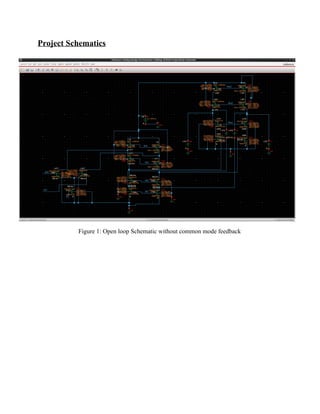
find the excellent bandwidth and phase margin. In figure 1, shows the points in our schematic where we                                   
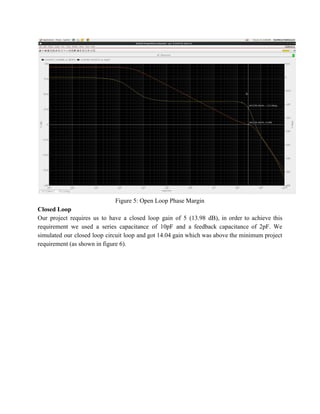
did our compensation and capacitance. We ran the simulation and found the phase margin to be at 67.1                                   
degrees, which keeps the output response stable.   
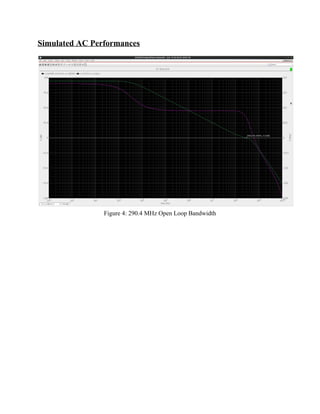
The second stage under open loop operation had a simulated bandwidth of 290.4 MHz and a gain of 94                                     
dB. Device sizes were first fixed according to the ratio of current through the transistors. For example in                                   
figure 1, T1 and T23 carry twice the current of T22. Thus we initially used a channel width which was                                       
twice the channel width of T22. In order to bring all the transistors in saturation we took into account the                                       
square law and accordingly kept changing the bias voltages and device sizes, until we reached the                               
optimum condition where all the MOSFETs were in saturation.  
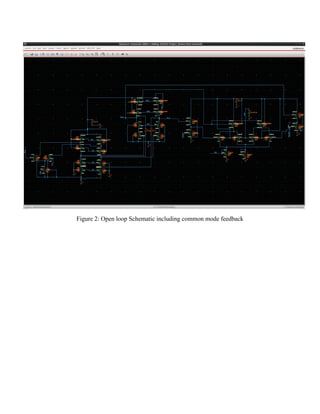
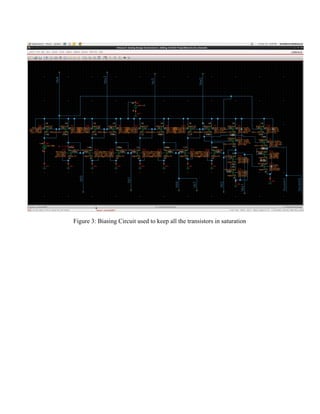
Next we designed our common mode feedback circuit in addition to the bias circuit which consists of                                 
active current mirrors supplied by a single DC voltage of 1.8V and a current source of 100 uA. By                                     
carefully varying the device sizes of the transistors, we got the required DC biasing voltages for all the                                   
transistors, including common mode voltage which was later designed after we performed the closed loop                             
analysis.   


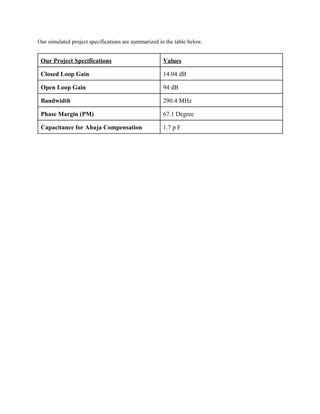
Our simulated project specifications are summarized in the table below. 
  
Our Project Specifications  Values 
Closed Loop Gain  14.04 dB 
Open Loop Gain  94 dB 
Bandwidth  290.4 MHz 
Phase Margin (PM)  67.1 Degree 
Capacitance for Ahuja Compensation  1.7 p F 


Project Schematics 
Figure 1: Open loop Schematic without common mode feedback 
Figure 2: Open loop Schematic including common mode feedback 
 
Figure 3: Biasing Circuit used to keep all the transistors in saturation  


Simulated AC Performances 
 
Figure 4: 290.4 MHz Open Loop Bandwidth  
 
 
Figure 5: Open Loop Phase Margin 
Closed Loop 
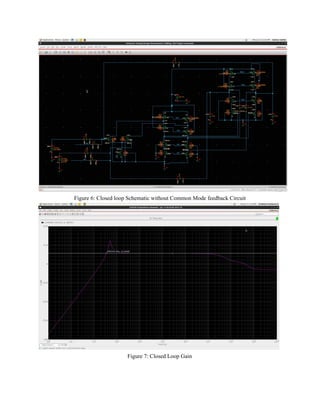
Our project requires us to have a closed loop gain of 5 (13.98 dB), in order to achieve this                                     
requirement we used a series capacitance of 10pF and a feedback capacitance of 2pF. We                             
simulated our closed loop circuit loop and got 14.04 gain which was above the minimum project                               
requirement (as shown in figure 6).  
 
Figure 6: Closed loop Schematic without Common Mode feedback Circuit 
 
Figure 7: Closed Loop Gain  
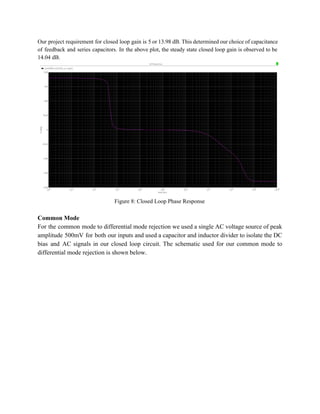
Our project requirement for closed loop gain is 5 or 13.98 dB. This determined our choice of capacitance                                   
of feedback and series capacitors. In the above plot, the steady state closed loop gain is observed to be                                     
14.04 dB. 
 
Figure 8: Closed Loop Phase Response  
 
Common Mode 
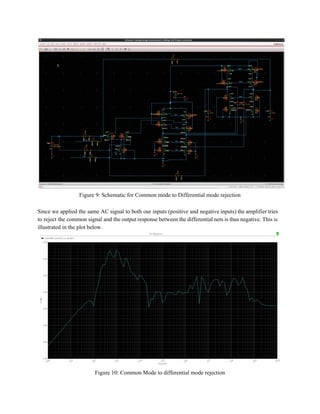
For the common mode to differential mode rejection we used a single AC voltage source of peak                                 
amplitude 500mV for both our inputs and used a capacitor and inductor divider to isolate the DC                                 
bias and AC signals in our closed loop circuit. The schematic used for our common mode to                                 
differential mode rejection is shown below. 
 
Figure 9: Schematic for Common mode to Differential mode rejection 
 
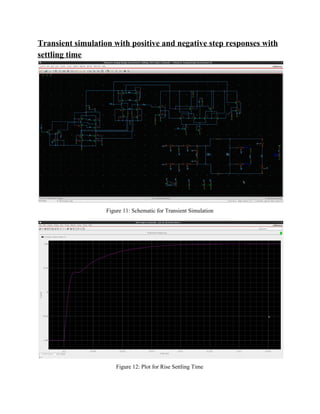
Since we applied the same AC signal to both our inputs (positive and negative inputs) the amplifier tries                                   
to reject the common signal and the output response between the differential nets is thus negative. This is                                   
illustrated in the plot below.  
 
Figure 10: Common Mode to differential mode rejection 
Transient simulation with positive and negative step responses with 
settling time 
 
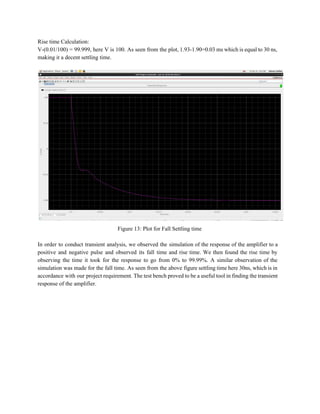
Figure 11: Schematic for Transient Simulation  
 
Figure 12: Plot for Rise Settling Time 
Rise time Calculation:  
V­(0.01/100) = 99.999, here V is 100. As seen from the plot, 1.93­1.90=0.03 ms which is equal to 30 ns,                                       
making it a decent settling time. 
 
 
Figure 13: Plot for Fall Settling time 
 
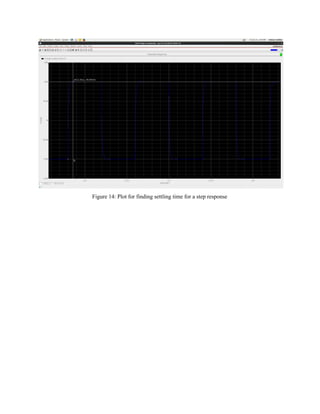
In order to conduct transient analysis, we observed the simulation of the response of the amplifier to a                                   
positive and negative pulse and observed its fall time and rise time. We then found the rise time by                                     
observing the time it took for the response to go from 0% to 99.99%. A similar observation of the                                     
simulation was made for the fall time. As seen from the above figure settling time here 30ns, which is in                                       
accordance with our project requirement. The test bench proved to be a useful tool in finding the transient                                   
response of the amplifier.  
 
Figure 14: Plot for finding settling time for a step response 


Simulation of HD2 and HD3 using transients 
 
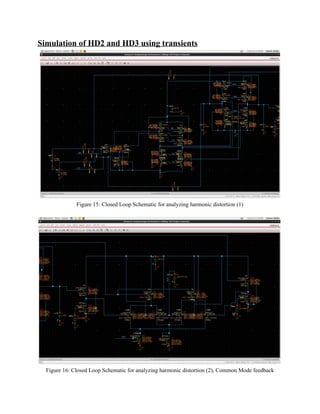
Figure 15: Closed Loop Schematic for analyzing harmonic distortion (1) 
 
 
Figure 16: Closed Loop Schematic for analyzing harmonic distortion (2), Common Mode feedback 
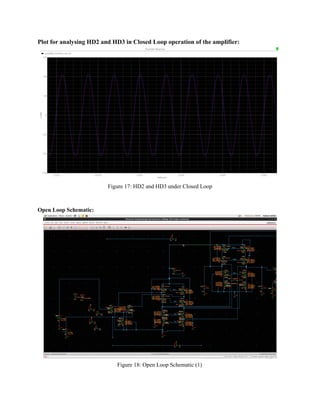
Plot for analysing HD2 and HD3 in Closed Loop operation of the amplifier: 
 
Figure 17: HD2 and HD3 under Closed Loop 
 
 
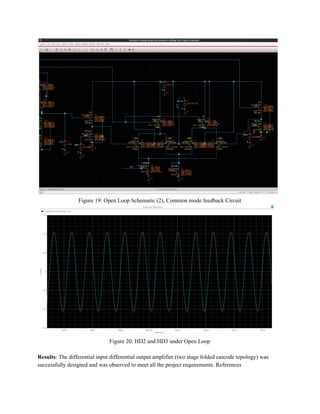
Open Loop Schematic: 
 
Figure 18: Open Loop Schematic (1) 
 
 
Figure 19: Open Loop Schematic (2), Common mode feedback Circuit 
 
Figure 20: HD2 and HD3 under Open Loop  
 
Results​: The differential input differential output amplifier (two stage folded cascode topology) was 
successfully designed and was observed to meet all the project requirements. References 
 

Two stage folded cascode op amp design in Cadence