CMOS Voltage ComparatorCMOS Voltage ComparatorCMOS Voltage Comparator
Ramen DuttaRamen Dutta
Electronics & Electronic CommunicationElectronics & Electronic Communication EnggEngg.,.,
Indian Institute of Technology KharagpurIndian Institute of Technology Kharagpur
Advanced VLSI Design Lab, IIT KharagpurAdvanced VLSI Design Lab, IIT Kharagpur
2Advanced VLSI Design Lab, IIT KGPAdvanced VLSI Design Lab, IIT KGP
Voltage Comparator RequirementVoltage Comparator Requirement
Compares one analog signal (voltage) to another analog voltageCompares one analog signal (voltage) to another analog voltage
or a reference voltage and gives a binary output depending onor a reference voltage and gives a binary output depending on
the comparison.the comparison.
Widely used in Analog to Digital Converter (ADC). Comparator isWidely used in Analog to Digital Converter (ADC). Comparator is
considered as 1considered as 1--bit ADC.bit ADC.
Also used in detection purpose of low swing and high speedAlso used in detection purpose of low swing and high speed
digital bus.digital bus.
-
+Vp
Vn
Vo
Symbol of a comparator
3Advanced VLSI Design Lab, IIT KGPAdvanced VLSI Design Lab, IIT KGP
Vp – Vn
Vo
VOH
VOL
Ideal Voltage Transfer (Gain ~ infinity)
AV = Lim(ΔV 0) {( VOH – VOL )/ ΔV }
Where ΔV is the input voltage change
Comparator Static CharacteristicsComparator Static Characteristics
Static Characteristics :
• Gain
• Output High and Low states
(VOH and VOL)
• Input Resolution
• Offset
• Noise
4Advanced VLSI Design Lab, IIT KGPAdvanced VLSI Design Lab, IIT KGP
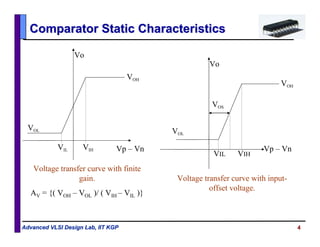
Comparator Static CharacteristicsComparator Static Characteristics
Vp – Vn
Vo
VIHVIL
VOS
VOH
VOL
Voltage transfer curve with input-
offset voltage.
VOL
VOH
Vp – Vn
Vo
VIHVIL
Voltage transfer curve with finite
gain.
AV = {( VOH – VOL )/ ( VIH – VIL )}
5Advanced VLSI Design Lab, IIT KGPAdvanced VLSI Design Lab, IIT KGP
Static CharacteristicsStatic Characteristics
• Offset: There are two types of offset, 1. Systematic offset. 2. Random offset.
Effect of offset can be reduced but can not be totally avoided
• Resolution : It is the input voltage change necessary to make the output swing
to valid binary states.
• Noise: Noise leads to an uncertainty in the transition in the voltage transfer
curve. This uncertainty in the transition region can lead to jitter or phase noise.
• Input Common Mode Range (ICMR): This is the input voltage range where the
comparator function normally (i.e. meets all other required specification).
6Advanced VLSI Design Lab, IIT KGPAdvanced VLSI Design Lab, IIT KGP
t
Vo
VOH
VOL
t
Vi = Vp - Vn
VIH
VIL
tp
mid-point Total Propagation delay time =
( Rising propagation delay time +
Falling propagation delay time) / 2
Dynamic CharacteristicsDynamic Characteristics –– Propagation DelayPropagation Delay
Dynamic Characteristics :
• Propagation Delay
• Slew Rate
7Advanced VLSI Design Lab, IIT KGPAdvanced VLSI Design Lab, IIT KGP
• For a Single Pole System:
Av (s) = Av (0) / ( sτ + 1) Vout (t) = Av (0) [ 1 – exp(-t/τ)] Vin(min)
Vout = ( VOH – VOL ) / 2 at t = tp
Overdrive applied to the input Propagation Delay Time
• For very high input voltage the comparator enters into the large-signal mode
of operation. For this case slew-rate defined by the maximum current available
will define the propagation delay.
i = C (dv/dt) tp = ( VOH – VOL) / 2 * SR
Propagation Delay and Slew RatePropagation Delay and Slew Rate
Therefore if Vin(min) is applied, tp= τ ln(2)=0.693τ
8Advanced VLSI Design Lab, IIT KGPAdvanced VLSI Design Lab, IIT KGP
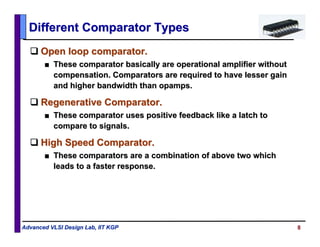
Different Comparator TypesDifferent Comparator Types
Open loop comparator.Open loop comparator.
■■ These comparator basically are operational amplifier withoutThese comparator basically are operational amplifier without
compensation. Comparators are required to have lesser gaincompensation. Comparators are required to have lesser gain
and higher bandwidth thanand higher bandwidth than opampsopamps..
Regenerative Comparator.Regenerative Comparator.
■■ These comparator uses positive feedback like a latch toThese comparator uses positive feedback like a latch to
compare to signals.compare to signals.
High Speed Comparator.High Speed Comparator.
■■ These comparators are a combination of above two whichThese comparators are a combination of above two which
leads to a faster response.leads to a faster response.
9Advanced VLSI Design Lab, IIT KGPAdvanced VLSI Design Lab, IIT KGP
M1 M2Vin+ Vin-
M3 M4
M5
VDD
VSS
Vbias
Vout
Differential Amplifier
Ibias
ac ground
Open Loop Comparator;Open Loop Comparator;
Differential AmplifierDifferential Amplifier
10Advanced VLSI Design Lab, IIT KGPAdvanced VLSI Design Lab, IIT KGP
gm1 * Vin- rds1 1/gm3 gm2 * vin+ rds2 rds4 gm4 * v1
1 2
Note: gm1 = gm2 ; gm3 = gm4
Gain : Av = gm1 ( rds2 || rds4 )
Small Signal Model of Diff. Amp.Small Signal Model of Diff. Amp.
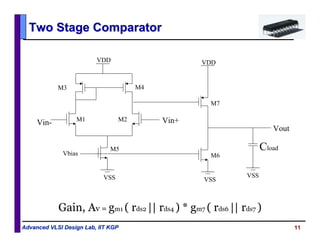
11Advanced VLSI Design Lab, IIT KGPAdvanced VLSI Design Lab, IIT KGP
M1 M2 Vin+
M3 M4
M5
VDD
VSS
Vbias
Vin-
VDD
M6
M7
Vout
VSS
VSS
Cload
Gain, Av = gm1 ( rds2 || rds4 ) * gm7 ( rds6 || rds7 )
Two Stage ComparatorTwo Stage Comparator
12Advanced VLSI Design Lab, IIT KGPAdvanced VLSI Design Lab, IIT KGP
M1
M2
Vin+
M3
M4
M5
VDD
VSS
Vbias
Vin-
VDD
M6
M7
Vout
VSS
VSS
Cload
C1
C2
p1 = -1 / {C1 * (gds2 + gds4)}
p2 = -1 / {C2 * (gds6 + gds7)}
Vout = Av (0) * Vin [ 1 + {p2 * exp(-t*p1)} / (p1 – p2) – {p1 * exp(-t*p2)} / (p1 – p2) ]
Frequency Response of The ComparatorFrequency Response of The Comparator
13Advanced VLSI Design Lab, IIT KGPAdvanced VLSI Design Lab, IIT KGP
t
t
vin
vout
VOH
VOL
Comparator
threshold
Single value of threshold
Response of a Comparator in a NoisyResponse of a Comparator in a Noisy
EnvironmentEnvironment
14Advanced VLSI Design Lab, IIT KGPAdvanced VLSI Design Lab, IIT KGP
Upper
threshold
Lower
threshold
Different trip points for rising and falling Vin
t
t
vin
vout
VOH
VOL
Comparator with Hysteresis in a NoisyComparator with Hysteresis in a Noisy
EnvironmentEnvironment
15Advanced VLSI Design Lab, IIT KGPAdvanced VLSI Design Lab, IIT KGP
Existence of a hysteresis band
* output voltage doesn’t change as long as input is within this band.
* output changes only when the input comes out of the band.
Comparator threshold changes with the state of the output
* One trip point (VTRP+) for VOL
* Another trip point (VTRP -) for VOH
In a hysteresis comparator the output depends both on the present and
the past values of Vin ---------------- dependency on history.
Characteristics of a Comparator withCharacteristics of a Comparator with
HysteresisHysteresis
How to get the hysteresis:
1. External feedback.
2. Internal feedback.
16Advanced VLSI Design Lab, IIT KGPAdvanced VLSI Design Lab, IIT KGP
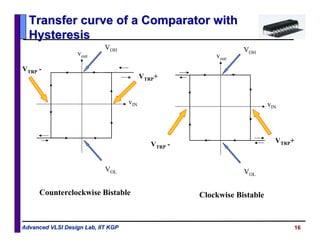
vIN
vout
VTRP+
VTRP -
VOL
VOH
Counterclockwise Bistable
vIN
vout
VTRP+VTRP -
VOL
VOH
Clockwise Bistable
Transfer curve of a Comparator withTransfer curve of a Comparator with
HysteresisHysteresis
17Advanced VLSI Design Lab, IIT KGPAdvanced VLSI Design Lab, IIT KGP
vIN
vout
R1
R2
vIN
vout
R1VOL/R2
VOL
VOH
R1VOH/R2
0
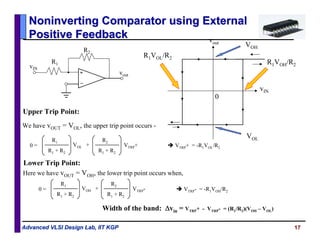
Upper Trip Point:
We have vOUT = VOL, the upper trip point occurs -
R1
R1 + R2
VOL +
R2
R1 + R2
VTRP+0 = VTRP+ = -R1VOL/R2
Lower Trip Point:
Here we have vOUT = VOH, the lower trip point occurs when,
R1
R1 + R2
VOH +
R2
R1 + R2
VTRP-0 = VTRP- = -R1VOH/R2
Width of the band: Δvin = VTRP+ - VTRP- = (R1/R2)(VOH – VOL)
Noninverting Comparator using ExternalNoninverting Comparator using External
Positive FeedbackPositive Feedback
18Advanced VLSI Design Lab, IIT KGPAdvanced VLSI Design Lab, IIT KGP
Width of the band: Δvin = VTRP+ - VTRP- = [R1/(R+R2)](VOH – VOL)
Lower Trip Point:
R1
R1 + R2
VTRP- = VOL
Upper Trip Point:
R1
R1 + R2
VTRP+ = VOH
vIN
vout
VOL
VOH
R1VOL/(R1+R2)
R1VOH/(R1+R2)
vIN vout
R1
R2
Inverting Comparator using ExternalInverting Comparator using External
Positive FeedbackPositive Feedback
19Advanced VLSI Design Lab, IIT KGPAdvanced VLSI Design Lab, IIT KGP
M2
M1
M5
VDD
vi2
vi1
M4M3
Vbias
vo2
M6 M7
A Simple Comparator with an internal positive feedback
Hysteresis using Internal PositiveHysteresis using Internal Positive
FeedbackFeedback
20Advanced VLSI Design Lab, IIT KGPAdvanced VLSI Design Lab, IIT KGP
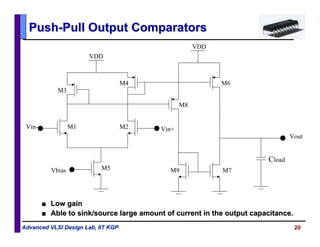
PushPush--Pull Output ComparatorsPull Output Comparators
■■ Low gainLow gain
■■ Able to sink/source large amount of current in the output capaciAble to sink/source large amount of current in the output capacitance.tance.
M1 M2
M3
M4
M5
M6
M7M9
M8
VDD
VDD
Vin+ Vin-
Vout
Cload
Vbias
Vin+Vin-
21Advanced VLSI Design Lab, IIT KGPAdvanced VLSI Design Lab, IIT KGP
Latched ComparatorLatched Comparator
VDD
Vin+ Vin-
Vout+ Vout-
clk clk
M1 M2
M3 M4
M5 M6
M7 M8M9 M10
22Advanced VLSI Design Lab, IIT KGPAdvanced VLSI Design Lab, IIT KGP
Latched ComparatorLatched Comparator -- OperationOperation
VDD
Vin+ Vin-
Vout+ Vout-
M1 M2
M3 M4
M7 M8
Triode Region operation
• When CLK=0
Vout+=Vout-=VDD
• When CLK=1
Vout+ and Vout- gives
valid output
23Advanced VLSI Design Lab, IIT KGPAdvanced VLSI Design Lab, IIT KGP
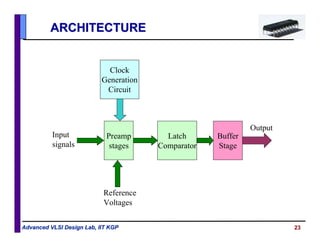
Latch
Comparator
Buffer
Stage
Preamp
stages
Clock
Generation
Circuit
Input
signals
Reference
Voltages
Output
ARCHITECTUREARCHITECTURE
24Advanced VLSI Design Lab, IIT KGPAdvanced VLSI Design Lab, IIT KGP
t
vout
VOL
VOH
VX
Latch
Preamplifier
Use a cascade of linear amplifiers to quickly build up the signal level and
apply this amplified signal level to a latch for quick transition to the full
binary output swing.
Minimization of Propagation DelayMinimization of Propagation Delay
25Advanced VLSI Design Lab, IIT KGPAdvanced VLSI Design Lab, IIT KGP
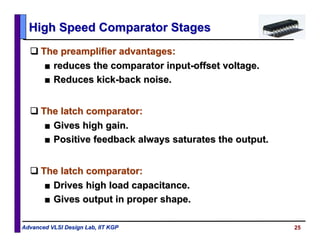
High Speed Comparator StagesHigh Speed Comparator Stages
The preamplifier advantages:The preamplifier advantages:
■■ reduces the comparator inputreduces the comparator input--offset voltage.offset voltage.
■■ Reduces kickReduces kick--back noise.back noise.
The latch comparator:The latch comparator:
■■ Gives high gain.Gives high gain.
■■ Positive feedback always saturates the output.Positive feedback always saturates the output.
The latch comparator:The latch comparator:
■■ Drives high load capacitance.Drives high load capacitance.
■■ Gives output in proper shape.Gives output in proper shape.
26Advanced VLSI Design Lab, IIT KGPAdvanced VLSI Design Lab, IIT KGP
M1 M2 Vin-
M3 M4
M5
VDD
VSS
Vbias
Vin+
VDD
M6
M7
Vout
VSS
VSS
Cload
1
2
I7
I5
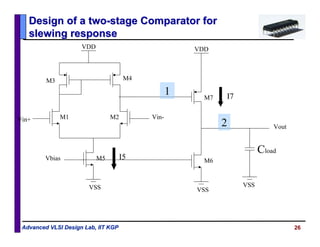
Design of a twoDesign of a two--stage Comparator forstage Comparator for
slewing responseslewing response
27Advanced VLSI Design Lab, IIT KGPAdvanced VLSI Design Lab, IIT KGP
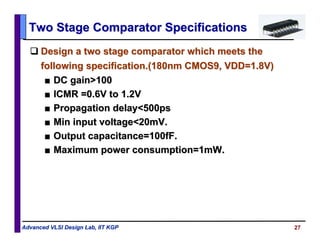
Two Stage Comparator SpecificationsTwo Stage Comparator Specifications
Design a two stage comparator which meets theDesign a two stage comparator which meets the
following specification.(180nm CMOS9, VDD=1.8V)following specification.(180nm CMOS9, VDD=1.8V)
■■ DC gain>100DC gain>100
■■ ICMR =0.6V to 1.2VICMR =0.6V to 1.2V
■■ Propagation delay<500psPropagation delay<500ps
■■ Min input voltage<20mV.Min input voltage<20mV.
■■ Output capacitance=100fF.Output capacitance=100fF.
■■ Maximum power consumption=1mW.Maximum power consumption=1mW.
28Advanced VLSI Design Lab, IIT KGPAdvanced VLSI Design Lab, IIT KGP
Have a Nice Day
Thank You
See you in the lab

Comparator

  • 1.
    CMOS Voltage ComparatorCMOSVoltage ComparatorCMOS Voltage Comparator Ramen DuttaRamen Dutta Electronics & Electronic CommunicationElectronics & Electronic Communication EnggEngg.,., Indian Institute of Technology KharagpurIndian Institute of Technology Kharagpur Advanced VLSI Design Lab, IIT KharagpurAdvanced VLSI Design Lab, IIT Kharagpur
  • 2.
    2Advanced VLSI DesignLab, IIT KGPAdvanced VLSI Design Lab, IIT KGP Voltage Comparator RequirementVoltage Comparator Requirement Compares one analog signal (voltage) to another analog voltageCompares one analog signal (voltage) to another analog voltage or a reference voltage and gives a binary output depending onor a reference voltage and gives a binary output depending on the comparison.the comparison. Widely used in Analog to Digital Converter (ADC). Comparator isWidely used in Analog to Digital Converter (ADC). Comparator is considered as 1considered as 1--bit ADC.bit ADC. Also used in detection purpose of low swing and high speedAlso used in detection purpose of low swing and high speed digital bus.digital bus. - +Vp Vn Vo Symbol of a comparator
  • 3.
    3Advanced VLSI DesignLab, IIT KGPAdvanced VLSI Design Lab, IIT KGP Vp – Vn Vo VOH VOL Ideal Voltage Transfer (Gain ~ infinity) AV = Lim(ΔV 0) {( VOH – VOL )/ ΔV } Where ΔV is the input voltage change Comparator Static CharacteristicsComparator Static Characteristics Static Characteristics : • Gain • Output High and Low states (VOH and VOL) • Input Resolution • Offset • Noise
  • 4.
    4Advanced VLSI DesignLab, IIT KGPAdvanced VLSI Design Lab, IIT KGP Comparator Static CharacteristicsComparator Static Characteristics Vp – Vn Vo VIHVIL VOS VOH VOL Voltage transfer curve with input- offset voltage. VOL VOH Vp – Vn Vo VIHVIL Voltage transfer curve with finite gain. AV = {( VOH – VOL )/ ( VIH – VIL )}
  • 5.
    5Advanced VLSI DesignLab, IIT KGPAdvanced VLSI Design Lab, IIT KGP Static CharacteristicsStatic Characteristics • Offset: There are two types of offset, 1. Systematic offset. 2. Random offset. Effect of offset can be reduced but can not be totally avoided • Resolution : It is the input voltage change necessary to make the output swing to valid binary states. • Noise: Noise leads to an uncertainty in the transition in the voltage transfer curve. This uncertainty in the transition region can lead to jitter or phase noise. • Input Common Mode Range (ICMR): This is the input voltage range where the comparator function normally (i.e. meets all other required specification).
  • 6.
    6Advanced VLSI DesignLab, IIT KGPAdvanced VLSI Design Lab, IIT KGP t Vo VOH VOL t Vi = Vp - Vn VIH VIL tp mid-point Total Propagation delay time = ( Rising propagation delay time + Falling propagation delay time) / 2 Dynamic CharacteristicsDynamic Characteristics –– Propagation DelayPropagation Delay Dynamic Characteristics : • Propagation Delay • Slew Rate
  • 7.
    7Advanced VLSI DesignLab, IIT KGPAdvanced VLSI Design Lab, IIT KGP • For a Single Pole System: Av (s) = Av (0) / ( sτ + 1) Vout (t) = Av (0) [ 1 – exp(-t/τ)] Vin(min) Vout = ( VOH – VOL ) / 2 at t = tp Overdrive applied to the input Propagation Delay Time • For very high input voltage the comparator enters into the large-signal mode of operation. For this case slew-rate defined by the maximum current available will define the propagation delay. i = C (dv/dt) tp = ( VOH – VOL) / 2 * SR Propagation Delay and Slew RatePropagation Delay and Slew Rate Therefore if Vin(min) is applied, tp= τ ln(2)=0.693τ
  • 8.
    8Advanced VLSI DesignLab, IIT KGPAdvanced VLSI Design Lab, IIT KGP Different Comparator TypesDifferent Comparator Types Open loop comparator.Open loop comparator. ■■ These comparator basically are operational amplifier withoutThese comparator basically are operational amplifier without compensation. Comparators are required to have lesser gaincompensation. Comparators are required to have lesser gain and higher bandwidth thanand higher bandwidth than opampsopamps.. Regenerative Comparator.Regenerative Comparator. ■■ These comparator uses positive feedback like a latch toThese comparator uses positive feedback like a latch to compare to signals.compare to signals. High Speed Comparator.High Speed Comparator. ■■ These comparators are a combination of above two whichThese comparators are a combination of above two which leads to a faster response.leads to a faster response.
  • 9.
    9Advanced VLSI DesignLab, IIT KGPAdvanced VLSI Design Lab, IIT KGP M1 M2Vin+ Vin- M3 M4 M5 VDD VSS Vbias Vout Differential Amplifier Ibias ac ground Open Loop Comparator;Open Loop Comparator; Differential AmplifierDifferential Amplifier
  • 10.
    10Advanced VLSI DesignLab, IIT KGPAdvanced VLSI Design Lab, IIT KGP gm1 * Vin- rds1 1/gm3 gm2 * vin+ rds2 rds4 gm4 * v1 1 2 Note: gm1 = gm2 ; gm3 = gm4 Gain : Av = gm1 ( rds2 || rds4 ) Small Signal Model of Diff. Amp.Small Signal Model of Diff. Amp.
  • 11.
    11Advanced VLSI DesignLab, IIT KGPAdvanced VLSI Design Lab, IIT KGP M1 M2 Vin+ M3 M4 M5 VDD VSS Vbias Vin- VDD M6 M7 Vout VSS VSS Cload Gain, Av = gm1 ( rds2 || rds4 ) * gm7 ( rds6 || rds7 ) Two Stage ComparatorTwo Stage Comparator
  • 12.
    12Advanced VLSI DesignLab, IIT KGPAdvanced VLSI Design Lab, IIT KGP M1 M2 Vin+ M3 M4 M5 VDD VSS Vbias Vin- VDD M6 M7 Vout VSS VSS Cload C1 C2 p1 = -1 / {C1 * (gds2 + gds4)} p2 = -1 / {C2 * (gds6 + gds7)} Vout = Av (0) * Vin [ 1 + {p2 * exp(-t*p1)} / (p1 – p2) – {p1 * exp(-t*p2)} / (p1 – p2) ] Frequency Response of The ComparatorFrequency Response of The Comparator
  • 13.
    13Advanced VLSI DesignLab, IIT KGPAdvanced VLSI Design Lab, IIT KGP t t vin vout VOH VOL Comparator threshold Single value of threshold Response of a Comparator in a NoisyResponse of a Comparator in a Noisy EnvironmentEnvironment
  • 14.
    14Advanced VLSI DesignLab, IIT KGPAdvanced VLSI Design Lab, IIT KGP Upper threshold Lower threshold Different trip points for rising and falling Vin t t vin vout VOH VOL Comparator with Hysteresis in a NoisyComparator with Hysteresis in a Noisy EnvironmentEnvironment
  • 15.
    15Advanced VLSI DesignLab, IIT KGPAdvanced VLSI Design Lab, IIT KGP Existence of a hysteresis band * output voltage doesn’t change as long as input is within this band. * output changes only when the input comes out of the band. Comparator threshold changes with the state of the output * One trip point (VTRP+) for VOL * Another trip point (VTRP -) for VOH In a hysteresis comparator the output depends both on the present and the past values of Vin ---------------- dependency on history. Characteristics of a Comparator withCharacteristics of a Comparator with HysteresisHysteresis How to get the hysteresis: 1. External feedback. 2. Internal feedback.
  • 16.
    16Advanced VLSI DesignLab, IIT KGPAdvanced VLSI Design Lab, IIT KGP vIN vout VTRP+ VTRP - VOL VOH Counterclockwise Bistable vIN vout VTRP+VTRP - VOL VOH Clockwise Bistable Transfer curve of a Comparator withTransfer curve of a Comparator with HysteresisHysteresis
  • 17.
    17Advanced VLSI DesignLab, IIT KGPAdvanced VLSI Design Lab, IIT KGP vIN vout R1 R2 vIN vout R1VOL/R2 VOL VOH R1VOH/R2 0 Upper Trip Point: We have vOUT = VOL, the upper trip point occurs - R1 R1 + R2 VOL + R2 R1 + R2 VTRP+0 = VTRP+ = -R1VOL/R2 Lower Trip Point: Here we have vOUT = VOH, the lower trip point occurs when, R1 R1 + R2 VOH + R2 R1 + R2 VTRP-0 = VTRP- = -R1VOH/R2 Width of the band: Δvin = VTRP+ - VTRP- = (R1/R2)(VOH – VOL) Noninverting Comparator using ExternalNoninverting Comparator using External Positive FeedbackPositive Feedback
  • 18.
    18Advanced VLSI DesignLab, IIT KGPAdvanced VLSI Design Lab, IIT KGP Width of the band: Δvin = VTRP+ - VTRP- = [R1/(R+R2)](VOH – VOL) Lower Trip Point: R1 R1 + R2 VTRP- = VOL Upper Trip Point: R1 R1 + R2 VTRP+ = VOH vIN vout VOL VOH R1VOL/(R1+R2) R1VOH/(R1+R2) vIN vout R1 R2 Inverting Comparator using ExternalInverting Comparator using External Positive FeedbackPositive Feedback
  • 19.
    19Advanced VLSI DesignLab, IIT KGPAdvanced VLSI Design Lab, IIT KGP M2 M1 M5 VDD vi2 vi1 M4M3 Vbias vo2 M6 M7 A Simple Comparator with an internal positive feedback Hysteresis using Internal PositiveHysteresis using Internal Positive FeedbackFeedback
  • 20.
    20Advanced VLSI DesignLab, IIT KGPAdvanced VLSI Design Lab, IIT KGP PushPush--Pull Output ComparatorsPull Output Comparators ■■ Low gainLow gain ■■ Able to sink/source large amount of current in the output capaciAble to sink/source large amount of current in the output capacitance.tance. M1 M2 M3 M4 M5 M6 M7M9 M8 VDD VDD Vin+ Vin- Vout Cload Vbias Vin+Vin-
  • 21.
    21Advanced VLSI DesignLab, IIT KGPAdvanced VLSI Design Lab, IIT KGP Latched ComparatorLatched Comparator VDD Vin+ Vin- Vout+ Vout- clk clk M1 M2 M3 M4 M5 M6 M7 M8M9 M10
  • 22.
    22Advanced VLSI DesignLab, IIT KGPAdvanced VLSI Design Lab, IIT KGP Latched ComparatorLatched Comparator -- OperationOperation VDD Vin+ Vin- Vout+ Vout- M1 M2 M3 M4 M7 M8 Triode Region operation • When CLK=0 Vout+=Vout-=VDD • When CLK=1 Vout+ and Vout- gives valid output
  • 23.
    23Advanced VLSI DesignLab, IIT KGPAdvanced VLSI Design Lab, IIT KGP Latch Comparator Buffer Stage Preamp stages Clock Generation Circuit Input signals Reference Voltages Output ARCHITECTUREARCHITECTURE
  • 24.
    24Advanced VLSI DesignLab, IIT KGPAdvanced VLSI Design Lab, IIT KGP t vout VOL VOH VX Latch Preamplifier Use a cascade of linear amplifiers to quickly build up the signal level and apply this amplified signal level to a latch for quick transition to the full binary output swing. Minimization of Propagation DelayMinimization of Propagation Delay
  • 25.
    25Advanced VLSI DesignLab, IIT KGPAdvanced VLSI Design Lab, IIT KGP High Speed Comparator StagesHigh Speed Comparator Stages The preamplifier advantages:The preamplifier advantages: ■■ reduces the comparator inputreduces the comparator input--offset voltage.offset voltage. ■■ Reduces kickReduces kick--back noise.back noise. The latch comparator:The latch comparator: ■■ Gives high gain.Gives high gain. ■■ Positive feedback always saturates the output.Positive feedback always saturates the output. The latch comparator:The latch comparator: ■■ Drives high load capacitance.Drives high load capacitance. ■■ Gives output in proper shape.Gives output in proper shape.
  • 26.
    26Advanced VLSI DesignLab, IIT KGPAdvanced VLSI Design Lab, IIT KGP M1 M2 Vin- M3 M4 M5 VDD VSS Vbias Vin+ VDD M6 M7 Vout VSS VSS Cload 1 2 I7 I5 Design of a twoDesign of a two--stage Comparator forstage Comparator for slewing responseslewing response
  • 27.
    27Advanced VLSI DesignLab, IIT KGPAdvanced VLSI Design Lab, IIT KGP Two Stage Comparator SpecificationsTwo Stage Comparator Specifications Design a two stage comparator which meets theDesign a two stage comparator which meets the following specification.(180nm CMOS9, VDD=1.8V)following specification.(180nm CMOS9, VDD=1.8V) ■■ DC gain>100DC gain>100 ■■ ICMR =0.6V to 1.2VICMR =0.6V to 1.2V ■■ Propagation delay<500psPropagation delay<500ps ■■ Min input voltage<20mV.Min input voltage<20mV. ■■ Output capacitance=100fF.Output capacitance=100fF. ■■ Maximum power consumption=1mW.Maximum power consumption=1mW.
  • 28.
    28Advanced VLSI DesignLab, IIT KGPAdvanced VLSI Design Lab, IIT KGP Have a Nice Day Thank You See you in the lab