INTERNATIONAL JOURNAL OF ELECTRONICS AND
      International Journal of Electronics and Communication Engineering & Technology (IJECET), ISSN
          COMMUNICATION ENGINEERING & TECHNOLOGY (IJECET)
      0976 – 6464(Print), ISSN 0976 – 6472(Online) Volume 3, Issue 3, October- December (2012), © IAEME

ISSN 0976 – 6464(Print)
ISSN 0976 – 6472(Online)
Volume 3, Issue 3, October- December (2012), pp. 147-152
                                                                                  IJECET
© IAEME: www.iaeme.com/ijecet.asp
Journal Impact Factor (2012): 3.5930 (Calculated by GISI)                        ©IAEME
www.jifactor.com


      DESIGN AND SIMULATION OF HIGH SPEED CMOS DIFFERENTIAL
          CURRENT SENSING COMPARATOR IN 0.35µm AND 0.25µm
                          TECHNOLOGIES
                               Dhanisha N. Kapadia1, Priyesh P. Gandhi2
          1
           (E.C.Dept, L.C. Institute of Technology, Bhandu, INDIA,dhally_007@yahoo.co.in)
           2
             (E.C.Dept, L.C. Institute of Technology, Bhandu, INDIA,priyesh.gandhi@lcit.org)

      ABSTRACT

      This paper presents various analysis of different characteristics of Differential current sensing
      comparator along with the buffer stage. Different characteristics of comparator such as propagation
      delay, speed, power dissipation, input common mode range, offset has been carried out in two
      different technologies 0.35um and 0.25um . The supply voltage is kept at 3v, 2.5v for 0.35um and
      0.25um respectively.

      Keywords: ADC, Buffer, Latch comparator, Current sensing comparator.


 I.           INTRODUCTION
       A comparator can be defined as the circuit that compares one analog signal with another
      analog signal or reference signal and gives the output in binary form as either logic’0’ or
      logic’1’ based on the comparison. The application of the comparator lies in ADC, memory
      sensing elements etc. Mostly, it is widely used in analog to digital converters. It is also
      known as 1bit ADC. For designing any comparators various specifications needs to be
      considered such as propagation delay, speed, power dissipation, offset voltage, input
      common mode range. The main advantage of using dynamic latch comparator is the
      reduction of silicon are on the chip by replacing traditional preamplifiers [1][2].Another
      advantage of dynamic latch comparator lies in less power dissipation as compared to
      preamplifiers stage based comparators. This paper is focused on Differential current
      sensing comparator which is a dynamic latch comparator.

II.           DIFFERENTIAL CURRENT SENSING COMPARATOR AND BUFFER STAGE

      2.1 Differential Current Sensing Comparator
      The schematic of the differential current sensing comparator is as shown in fig.1. Whenever
      the Clk signal goes low, the circuit enters in regenerative mode. Transistor M12 is on and M7
      is off. When values of both the outputs Out+ and Out- increases above threshold voltage of
                                                     147
International Journal of Electronics and Communication Engineering & Technology (IJECET), ISSN
0976 – 6464(Print), ISSN 0976 – 6472(Online) Volume 3, Issue 3, October- December (2012), © IAEME

nMOS M5 and M6, both will start conducting which will connect the outputs with comparing
circuit at the input side. It consumes more power because unless and until final state is
reached both the outputs have to drive common mode currents.
   The comparing circuit used at the input side consisting of transistors M1, M2, M3 and M4
are used to transfer the difference of the input voltage into differential currents. During reset
interval, a pass transistor M7 is used to connect both the outputs together


                     Fig. 1. Differential current sensing comparator[3]

2.2 The Buffer Stage


                            Fig.2 The Output Buffer Circuit [4]

The schematic of output buffer circuit used in the comparator is shown in figure 2[4]. The
output buffer stage is also known as post amplifier. This circuit is self biasing differential
amplifier which has differential inputs as Vout+ & Vout- and does not have any slew rate
limitations. It is also useful in giving the output in proper shape.


                                              148
International Journal of Electronics and Communication Engineering & Technology (IJECET), ISSN
   0976 – 6464(Print), ISSN 0976 – 6472(Online) Volume 3, Issue 3, October- December (2012), © IAEME

III.      DESIGNING OF COMPARATOR


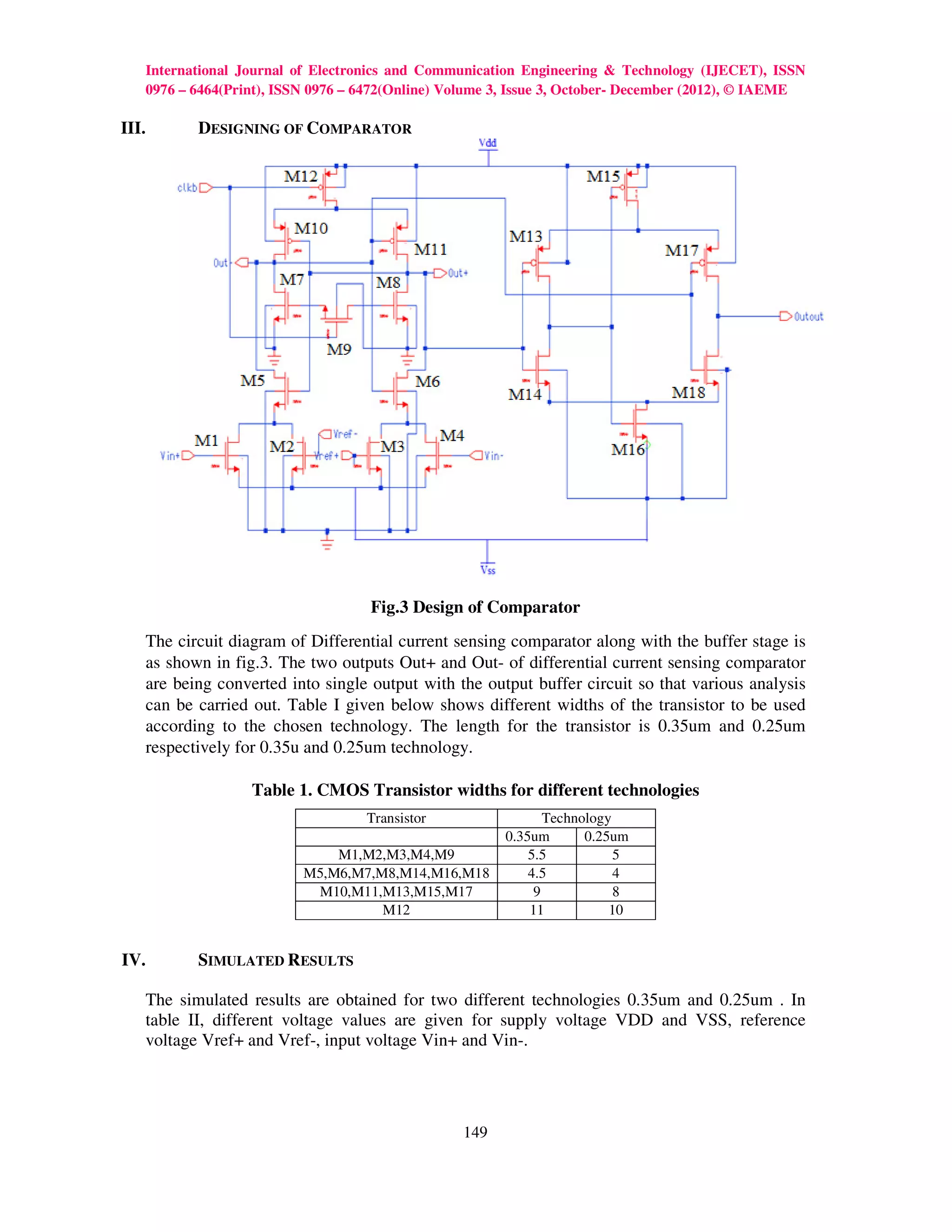
                                    Fig.3 Design of Comparator
   The circuit diagram of Differential current sensing comparator along with the buffer stage is
   as shown in fig.3. The two outputs Out+ and Out- of differential current sensing comparator
   are being converted into single output with the output buffer circuit so that various analysis
   can be carried out. Table I given below shows different widths of the transistor to be used
   according to the chosen technology. The length for the transistor is 0.35um and 0.25um
   respectively for 0.35u and 0.25um technology.

                  Table 1. CMOS Transistor widths for different technologies
                                   Transistor                 Technology
                                                       0.35um       0.25um
                              M1,M2,M3,M4,M9               5.5           5
                          M5,M6,M7,M8,M14,M16,M18          4.5           4
                           M10,M11,M13,M15,M17              9            8
                                    M12                    11           10


IV.       SIMULATED RESULTS

   The simulated results are obtained for two different technologies 0.35um and 0.25um . In
   table II, different voltage values are given for supply voltage VDD and VSS, reference
   voltage Vref+ and Vref-, input voltage Vin+ and Vin-.


                                                 149
International Journal of Electronics and Communication Engineering & Technology (IJECET), ISSN
0976 – 6464(Print), ISSN 0976 – 6472(Online) Volume 3, Issue 3, October- December (2012), © IAEME

               Table2. CMOS Transistor widths for different technologies
                                Voltage             Technology
                               Terminals

                                             0.35um      0.25um

                                  Vdd           3v         2.5v

                                  Vss           -3v        -2.5v

                                  Clkb          -3v        -2.5v

                                 Vin+           3v         2.5v

                                  Vin-          -3v        -2.5v

                                 Vref+         1.5v       1.25v

                                 Vref-         -1.5v       -1.25


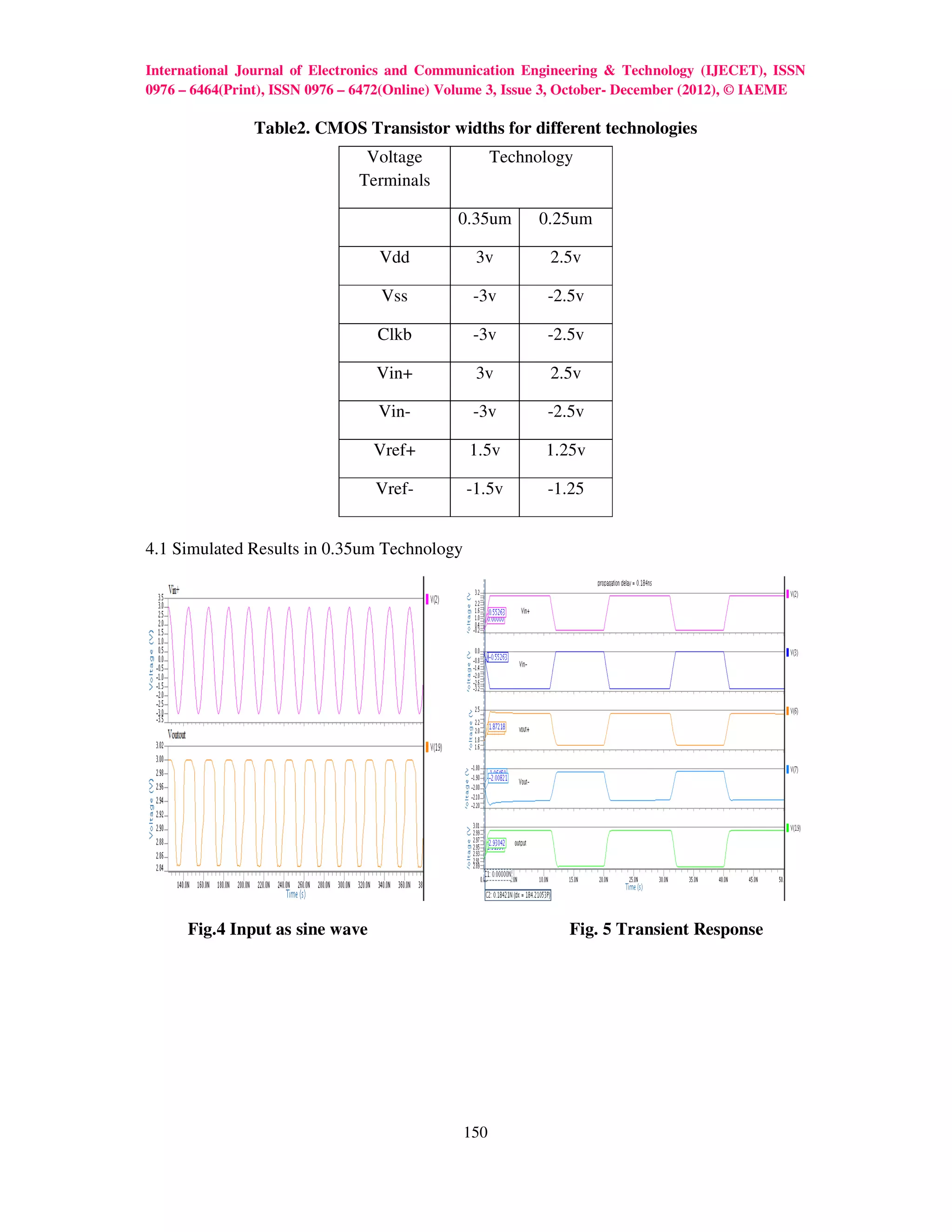
4.1 Simulated Results in 0.35um Technology


      Fig.4 Input as sine wave                                Fig. 5 Transient Response


                                              150
International Journal of Electronics and Communication Engineering & Technology (IJECET), ISSN
0976 – 6464(Print), ISSN 0976 – 6472(Online) Volume 3, Issue 3, October- December (2012), © IAEME


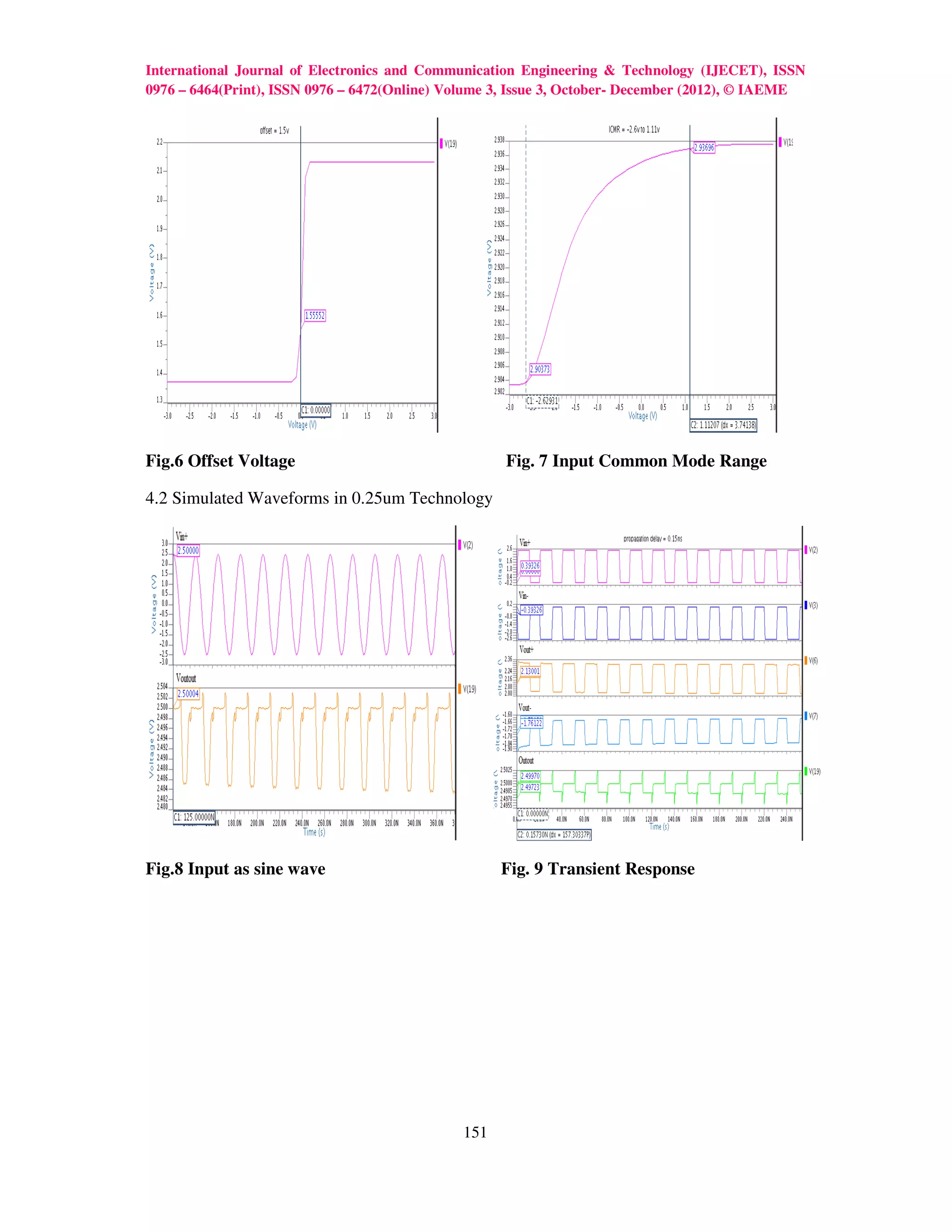
Fig.6 Offset Voltage                                Fig. 7 Input Common Mode Range

4.2 Simulated Waveforms in 0.25um Technology


Fig.8 Input as sine wave                            Fig. 9 Transient Response


                                              151
International Journal of Electronics and Communication Engineering & Technology (IJECET), ISSN
  0976 – 6464(Print), ISSN 0976 – 6472(Online) Volume 3, Issue 3, October- December (2012), © IAEME


  Fig. 10 Offset Voltage                                  Fig. 11 Input Common Mode Range

V.        CONCLUSION
  In this paper, simulated results are presented for the comparator for two different
  technologies, 0.35um and 0.25unm. The summary of the comparison for the Differential
  current sensing comparator in both the technologies is given in the table III.

        TABLE III Different measured parameter values for different Technologies
                                 Parameters                   Technology
                                                        0.35um        0.25um
                            Propagation Delay(ns)        0.184          0.15
                                Speed(GHz)                5.43          6.67
                                  Offset(v)               1.55          1.59
                                  ICMR(v)             -2.6 to 1.11    -2.26 to
                                                                        0.09
                           Power Dissipation(mV)          20.6          12.6


  REFERENCES


  [1] P. Uthaichana and E. Leelarasmee, "Low Power CMOS Dynamic Latch Comparators,"
      IEEE, pp. 605-608, 2003.
  [2] Z. Huang and P. Zhong, "An Adaptive Analog-to-Digital Converter Based on Low-Power
      Dynamic Latch Comparator," IEEE conference, p. 6pp, 2005.
  [3] Christopher J. Lindsley “A Nano-Power Wake-Up Circuit for RF Energy Harvesting
      Wireless Sensor Networks” , M.S. thesis, Dept. Electrical & computer. Eng., Oregon
      State University 2008.
  [4] Priyesh P. Gandhi “Design & Simulation of Low Power High Speed CMOS Comparator
       in Deep Sub-micron Technology”, M.Tech thesis, Dept. of electronics & communication
       Eng. Nirma University, 2010.


                                                    152

Design and simulation of high speed cmos

  • 1.
    INTERNATIONAL JOURNAL OFELECTRONICS AND International Journal of Electronics and Communication Engineering & Technology (IJECET), ISSN COMMUNICATION ENGINEERING & TECHNOLOGY (IJECET) 0976 – 6464(Print), ISSN 0976 – 6472(Online) Volume 3, Issue 3, October- December (2012), © IAEME ISSN 0976 – 6464(Print) ISSN 0976 – 6472(Online) Volume 3, Issue 3, October- December (2012), pp. 147-152 IJECET © IAEME: www.iaeme.com/ijecet.asp Journal Impact Factor (2012): 3.5930 (Calculated by GISI) ©IAEME www.jifactor.com DESIGN AND SIMULATION OF HIGH SPEED CMOS DIFFERENTIAL CURRENT SENSING COMPARATOR IN 0.35µm AND 0.25µm TECHNOLOGIES Dhanisha N. Kapadia1, Priyesh P. Gandhi2 1 (E.C.Dept, L.C. Institute of Technology, Bhandu, INDIA,dhally_007@yahoo.co.in) 2 (E.C.Dept, L.C. Institute of Technology, Bhandu, INDIA,priyesh.gandhi@lcit.org) ABSTRACT This paper presents various analysis of different characteristics of Differential current sensing comparator along with the buffer stage. Different characteristics of comparator such as propagation delay, speed, power dissipation, input common mode range, offset has been carried out in two different technologies 0.35um and 0.25um . The supply voltage is kept at 3v, 2.5v for 0.35um and 0.25um respectively. Keywords: ADC, Buffer, Latch comparator, Current sensing comparator. I. INTRODUCTION A comparator can be defined as the circuit that compares one analog signal with another analog signal or reference signal and gives the output in binary form as either logic’0’ or logic’1’ based on the comparison. The application of the comparator lies in ADC, memory sensing elements etc. Mostly, it is widely used in analog to digital converters. It is also known as 1bit ADC. For designing any comparators various specifications needs to be considered such as propagation delay, speed, power dissipation, offset voltage, input common mode range. The main advantage of using dynamic latch comparator is the reduction of silicon are on the chip by replacing traditional preamplifiers [1][2].Another advantage of dynamic latch comparator lies in less power dissipation as compared to preamplifiers stage based comparators. This paper is focused on Differential current sensing comparator which is a dynamic latch comparator. II. DIFFERENTIAL CURRENT SENSING COMPARATOR AND BUFFER STAGE 2.1 Differential Current Sensing Comparator The schematic of the differential current sensing comparator is as shown in fig.1. Whenever the Clk signal goes low, the circuit enters in regenerative mode. Transistor M12 is on and M7 is off. When values of both the outputs Out+ and Out- increases above threshold voltage of 147
  • 2.
    International Journal ofElectronics and Communication Engineering & Technology (IJECET), ISSN 0976 – 6464(Print), ISSN 0976 – 6472(Online) Volume 3, Issue 3, October- December (2012), © IAEME nMOS M5 and M6, both will start conducting which will connect the outputs with comparing circuit at the input side. It consumes more power because unless and until final state is reached both the outputs have to drive common mode currents. The comparing circuit used at the input side consisting of transistors M1, M2, M3 and M4 are used to transfer the difference of the input voltage into differential currents. During reset interval, a pass transistor M7 is used to connect both the outputs together Fig. 1. Differential current sensing comparator[3] 2.2 The Buffer Stage Fig.2 The Output Buffer Circuit [4] The schematic of output buffer circuit used in the comparator is shown in figure 2[4]. The output buffer stage is also known as post amplifier. This circuit is self biasing differential amplifier which has differential inputs as Vout+ & Vout- and does not have any slew rate limitations. It is also useful in giving the output in proper shape. 148
  • 3.
    International Journal ofElectronics and Communication Engineering & Technology (IJECET), ISSN 0976 – 6464(Print), ISSN 0976 – 6472(Online) Volume 3, Issue 3, October- December (2012), © IAEME III. DESIGNING OF COMPARATOR Fig.3 Design of Comparator The circuit diagram of Differential current sensing comparator along with the buffer stage is as shown in fig.3. The two outputs Out+ and Out- of differential current sensing comparator are being converted into single output with the output buffer circuit so that various analysis can be carried out. Table I given below shows different widths of the transistor to be used according to the chosen technology. The length for the transistor is 0.35um and 0.25um respectively for 0.35u and 0.25um technology. Table 1. CMOS Transistor widths for different technologies Transistor Technology 0.35um 0.25um M1,M2,M3,M4,M9 5.5 5 M5,M6,M7,M8,M14,M16,M18 4.5 4 M10,M11,M13,M15,M17 9 8 M12 11 10 IV. SIMULATED RESULTS The simulated results are obtained for two different technologies 0.35um and 0.25um . In table II, different voltage values are given for supply voltage VDD and VSS, reference voltage Vref+ and Vref-, input voltage Vin+ and Vin-. 149
  • 4.
    International Journal ofElectronics and Communication Engineering & Technology (IJECET), ISSN 0976 – 6464(Print), ISSN 0976 – 6472(Online) Volume 3, Issue 3, October- December (2012), © IAEME Table2. CMOS Transistor widths for different technologies Voltage Technology Terminals 0.35um 0.25um Vdd 3v 2.5v Vss -3v -2.5v Clkb -3v -2.5v Vin+ 3v 2.5v Vin- -3v -2.5v Vref+ 1.5v 1.25v Vref- -1.5v -1.25 4.1 Simulated Results in 0.35um Technology Fig.4 Input as sine wave Fig. 5 Transient Response 150
  • 5.
    International Journal ofElectronics and Communication Engineering & Technology (IJECET), ISSN 0976 – 6464(Print), ISSN 0976 – 6472(Online) Volume 3, Issue 3, October- December (2012), © IAEME Fig.6 Offset Voltage Fig. 7 Input Common Mode Range 4.2 Simulated Waveforms in 0.25um Technology Fig.8 Input as sine wave Fig. 9 Transient Response 151
  • 6.
    International Journal ofElectronics and Communication Engineering & Technology (IJECET), ISSN 0976 – 6464(Print), ISSN 0976 – 6472(Online) Volume 3, Issue 3, October- December (2012), © IAEME Fig. 10 Offset Voltage Fig. 11 Input Common Mode Range V. CONCLUSION In this paper, simulated results are presented for the comparator for two different technologies, 0.35um and 0.25unm. The summary of the comparison for the Differential current sensing comparator in both the technologies is given in the table III. TABLE III Different measured parameter values for different Technologies Parameters Technology 0.35um 0.25um Propagation Delay(ns) 0.184 0.15 Speed(GHz) 5.43 6.67 Offset(v) 1.55 1.59 ICMR(v) -2.6 to 1.11 -2.26 to 0.09 Power Dissipation(mV) 20.6 12.6 REFERENCES [1] P. Uthaichana and E. Leelarasmee, "Low Power CMOS Dynamic Latch Comparators," IEEE, pp. 605-608, 2003. [2] Z. Huang and P. Zhong, "An Adaptive Analog-to-Digital Converter Based on Low-Power Dynamic Latch Comparator," IEEE conference, p. 6pp, 2005. [3] Christopher J. Lindsley “A Nano-Power Wake-Up Circuit for RF Energy Harvesting Wireless Sensor Networks” , M.S. thesis, Dept. Electrical & computer. Eng., Oregon State University 2008. [4] Priyesh P. Gandhi “Design & Simulation of Low Power High Speed CMOS Comparator in Deep Sub-micron Technology”, M.Tech thesis, Dept. of electronics & communication Eng. Nirma University, 2010. 152