Two – Port Networks
Two Port Networks
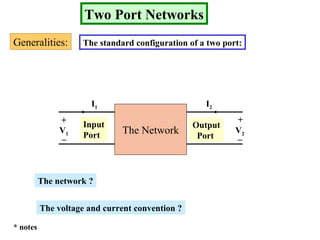
Generalities: The standard configuration of a two port:
The Network
Input
Port
Output
Port
+
_ _
+
V1 V2
I1 I2
The network ?
The voltage and current convention ?
* notes
Two Port Networks
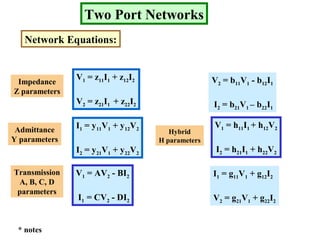
Network Equations:
V1 = z11I1 + z12I2
V2 = z21I1 + z22I2
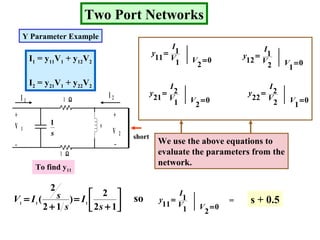
I1 = y11V1 + y12V2
I2 = y21V1 + y22V2
V1 = AV2 - BI2
I1 = CV2 - DI2
V2 = b11V1 - b12I1
I2 = b21V1 – b22I1
V1 = h11I1 + h12V2
I2 = h21I1 + h22V2
I1 = g11V1 + g12I2
V2 = g21V1 + g22I2
Impedance
Z parameters
Admittance
Y parameters
Transmission
A, B, C, D
parameters
Hybrid
H parameters
* notes
Two Port Networks
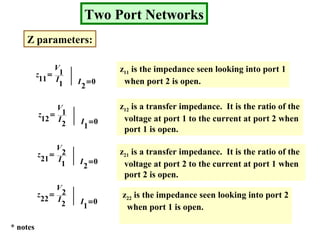
Z parameters:
1
1
11 I
V
z =
0
2
=I
2
1
12 I
V
z =
0
1
=I
1
2
21 I
V
z =
0
2
=I
2
2
22 I
V
z =
0
1
=I
z11 is the impedance seen looking into port 1
when port 2 is open.
z12 is a transfer impedance. It is the ratio of the
voltage at port 1 to the current at port 2 when
port 1 is open.
z21 is a transfer impedance. It is the ratio of the
voltage at port 2 to the current at port 1 when
port 2 is open.
z22 is the impedance seen looking into port 2
when port 1 is open.
* notes
Two Port Networks
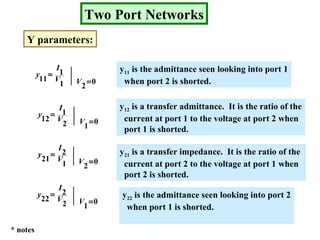
Y parameters:
1
1
11 V
I
y =
0
2
=V
2
1
12 V
I
y =
0
1
=V
1
2
21 V
I
y =
0
2
=V
2
2
22 V
I
y =
0
1
=V
y11 is the admittance seen looking into port 1
when port 2 is shorted.
y12 is a transfer admittance. It is the ratio of the
current at port 1 to the voltage at port 2 when
port 1 is shorted.
y21 is a transfer impedance. It is the ratio of the
current at port 2 to the voltage at port 1 when
port 2 is shorted.
y22 is the admittance seen looking into port 2
when port 1 is shorted.
* notes
Two Port Networks
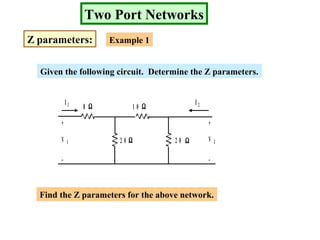
Z parameters: Example 1
Given the following circuit. Determine the Z parameters.
8
2 0 2 0 Ω
ΩΩ
Ω
1 0
+
_
+
_
V 1 V 2
I 1 I 2
Find the Z parameters for the above network.
Two Port Networks
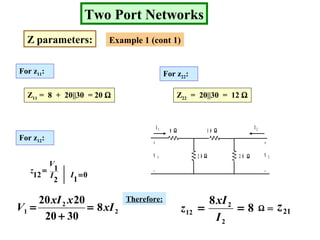
Z parameters: Example 1 (cont 1)
For z11:
Z11 = 8 + 20||30 = 20 Ω
For z22:
For z12:
Z22 = 20||30 = 12 Ω
2
1
12 I
V
z =
0
1
=I
8
2 0 2 0 Ω
ΩΩ
Ω
1 0
+
_
+
_
V 1 V 2
I 1 I 2
2
2
1 8
3020
2020
xI
xxI
V =
+
=
Therefore:
8
8
2
2
12 ==
I
xI
z Ω = 21z
Two Port Networks
Z parameters: Example 1 (cont 2)
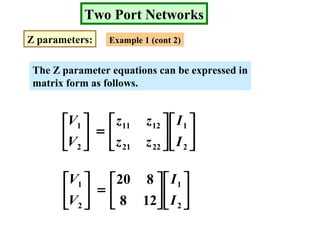
The Z parameter equations can be expressed in
matrix form as follows.












=





2
1
2
1
128
820
I
I
V
V












=





2
1
2221
1211
2
1
I
I
zz
zz
V
V
Two Port Networks
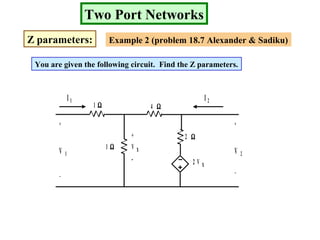
Z parameters: Example 2 (problem 18.7 Alexander & Sadiku)
You are given the following circuit. Find the Z parameters.
1 Ω
1 Ω
4 Ω
2 Ω
2 V x
+
-
V x
+ +
_
_
V 1 V 2
I 1 I 2
Two Port Networks
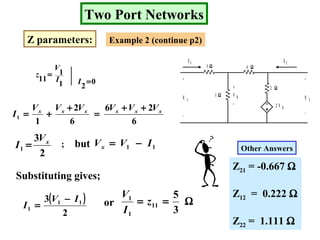
Z parameters: Example 2 (continue p2)
1
1
11 I
V
z =
0
2
=I
1 Ω
1 Ω
4 Ω
2 Ω
2 V x
+
-
V x
+ +
_
_
V 1 V 2
I 1 I 2
6
26
6
2
1
1
xxxxxx VVVVVV
I
++
=
+
+=
2
3
1
xV
I = ; but 11 IVVx −=
Substituting gives;
( )
2
3 11
1
IV
I
−
= or Ω==
3
5
11
1
1
z
I
V
Z21 = -0.667 Ω
Z12 = 0.222 Ω
Z22 = 1.111 Ω
Other Answers
Two Port Networks
Transmission parameters (A,B,C,D):
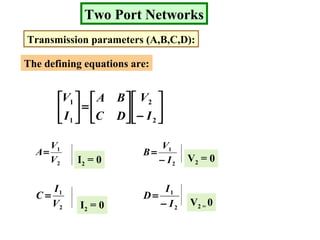
The defining equations are:






−





=





2
2
1
1
I
V
DC
BA
I
V
2
1
V
V
A=
I2 = 0 2
1
I
V
B
−
=
V2 = 0
2
1
V
I
C =
I2 = 0 2
1
I
I
D
−
=
V2 = 0
Two Port Networks
Transmission parameters (A,B,C,D):
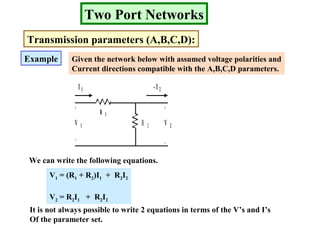
Example Given the network below with assumed voltage polarities and
Current directions compatible with the A,B,C,D parameters.
+
_
+
_
R 1
R 2V 1 V 2
I 1 - I 2
We can write the following equations.
V1 = (R1 + R2)I1 + R2I2
V2 = R2I1 + R2I2
It is not always possible to write 2 equations in terms of the V’s and I’s
Of the parameter set.
1
1R
2
1
R
2
21
R
RR +
Two Port Networks
Transmission parameters (A,B,C,D):
Example (cont.)
V1 = (R1 + R2)I1 + R2I2
V2 = R2I1 + R2I2
From these equations we can directly evaluate the A,B,C,D parameters.
2
1
V
V
A=
I2 = 0 2
1
I
V
B
−
=
V2 = 0
2
1
V
I
C =
I2 = 0 2
1
I
I
D
−
=
V2 = 0
=
=
=
=
Later we will see how to interconnect two of these networks together for a final answer
* notes
Two Port Networks
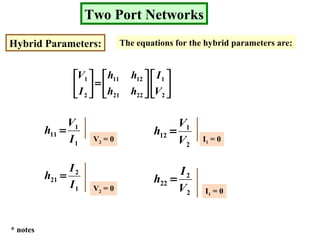
Hybrid Parameters: The equations for the hybrid parameters are:












=





2
1
2221
1211
2
1
V
I
hh
hh
I
V
1
1
11
I
V
h =
V2 = 0
2
1
12
V
V
h =
I1 = 0
1
2
21
I
I
h =
V2 = 0 2
2
22
V
I
h =
I1 = 0
* notes
Two Port Networks
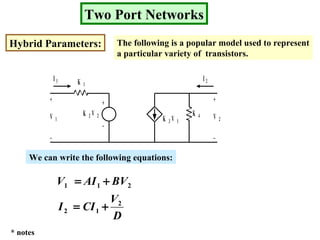
Hybrid Parameters: The following is a popular model used to represent
a particular variety of transistors.
+ +
_ _
V 1 V 2
+
_
K 1
K 4
K 3 V 1
K 2 V 2
I 1 I 2
We can write the following equations:
D
V
CII
BVAIV
2
12
211
+=
+=
* notes
4
1
K
K2
K3
K1
Two Port Networks
Hybrid Parameters:
D
V
CII
BVAIV
2
12
211
+=
+=
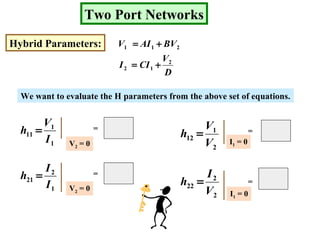
We want to evaluate the H parameters from the above set of equations.
1
1
11
I
V
h =
V2 = 0 2
1
12
V
V
h =
I1 = 0
1
2
21
I
I
h =
V2 = 0
2
2
22
V
I
h =
I1 = 0
=
=
=
=
2
1
R
1
- 1
1R
Two Port Networks
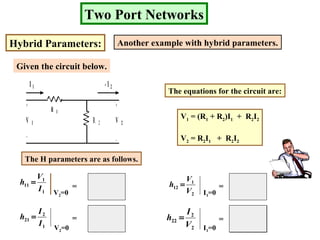
Hybrid Parameters: Another example with hybrid parameters.
Given the circuit below.
+
_
+
_
R 1
R 2V 1 V 2
I 1 - I 2
The equations for the circuit are:
V1 = (R1 + R2)I1 + R2I2
V2 = R2I1 + R2I2
The H parameters are as follows.
1
1
11
I
V
h =
2
1
12
V
V
h =
1
2
21
I
I
h =
2
2
22
V
I
h =
V2=0
V2=0
I1=0
I1=0
=
=
=
=
Two Port Networks
Modifying the two port network:
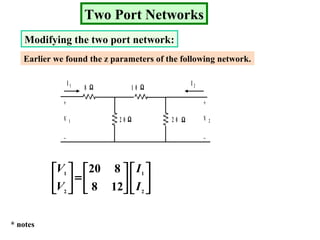
Earlier we found the z parameters of the following network.
8
2 0 2 0 Ω
ΩΩ
Ω
1 0
+
_
+
_
V 1 V 2
I 1 I 2












=





2
1
2
1
128
820
I
I
V
V
* notes
Two Port Networks
Modifying the two port network:
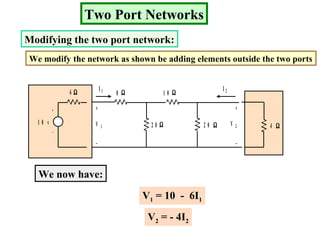
We modify the network as shown be adding elements outside the two ports
8
2 0 2 0 Ω
ΩΩ
Ω
1 0
+
_
+
_
V 1 V 2
I 1 I 2
+
_
1 0 v
6 Ω
4 Ω
We now have:
V1 = 10 - 6I1
V2 = - 4I2
Two Port Networks
Modifying the two port network:
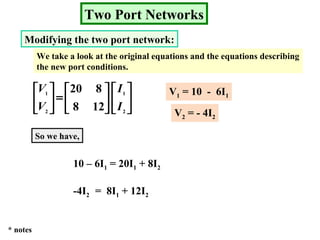
We take a look at the original equations and the equations describing
the new port conditions.












=





2
1
2
1
128
820
I
I
V
V V1 = 10 - 6I1
V2 = - 4I2
So we have,
10 – 6I1 = 20I1 + 8I2
-4I2 = 8I1 + 12I2
* notes
-0.2273
0.4545
0
10
168
826
Two Port Networks
Modifying the two port network:
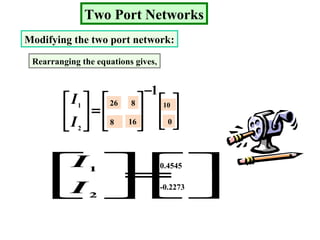
Rearranging the equations gives,






=





2
1
I
I










=





−1
2
1
I
I
Two Port Networks
Y Parameters and Beyond:
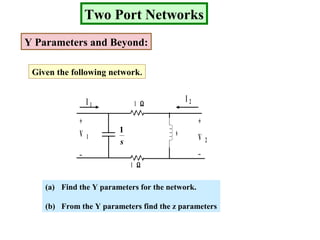
Given the following network.
+
_
+
_
V 1 V 2
I 1
I 2
s
1
1 Ω
1 Ω
s
(a) Find the Y parameters for the network.
(b) From the Y parameters find the z parameters
Two Port Networks
1
1
11 V
I
y =
0
2
=V
2
1
12 V
I
y =
0
1
=V
1
2
21 V
I
y =
0
2
=V 2
2
22 V
I
y =
0
1
=V
I1 = y11V1 + y12V2
I2 = y21V1 + y22V2
+
_
+
_
V 1
V 2
I 1
I 2
s
1
1 Ω
1 Ω
s
To find y11




+
=
+
=
12
2
)
12
2
( 111
s
I
s
sIV so = s + 0.5
1
1
11 V
I
y =
0
2
=V
We use the above equations to
evaluate the parameters from the
network.
Y Parameter Example
short
Two Port Networks
Y Parameter Example
1
2
21 V
I
y =
0
2
=V +
_
+
_
V 1
V 2
I 1
s
1
1 Ω
1 Ω
s
I 2
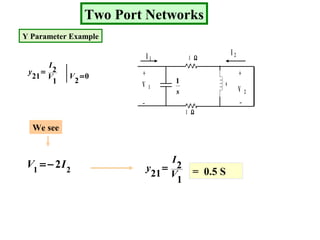
21
2IV −=
We see
= 0.5 S
1
2
21 V
I
y =
Two Port Networks
Y Parameter Example
+
_
+
_
V 1 V 2
I 1
s
1
1 Ω
1 Ω
s
I 2
2
1
12 V
I
y =
0
1
=V
2
1
12 V
I
y =
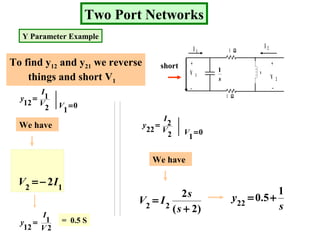
12
2IV −=
We have
= 0.5 S
short
2
2
22 V
I
y =
0
1
=V
We have
)2(
2
22 +
=
s
s
IV
s
y
1
5.022
+=
To find y12 and y21 we reverse
things and short V1
Two Port Networks
Y Parameter Example
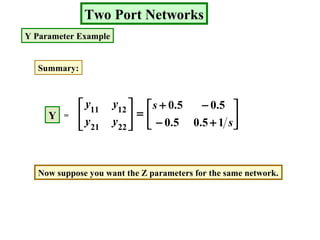
Summary:
Y = 





+−
−+
=





s
s
yy
yy
15.05.0
5.05.0
2221
1211
Now suppose you want the Z parameters for the same network.
Two Port Networks
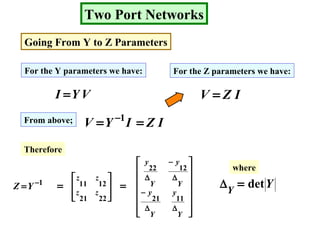
Going From Y to Z Parameters
For the Y parameters we have:
VYI =
For the Z parameters we have:
IZV =
From above; IZIYV == −1






















=
∆∆
−
∆
−
∆
−
==
Y
y
Y
y
Y
y
Y
y
zz
zz
YZ
1121
1222
2221
12111 YY
det=∆
Therefore
where
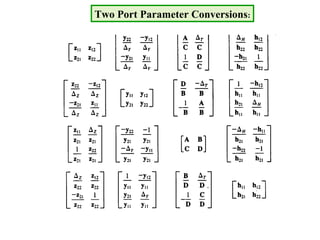
Two Port Parameter Conversions:
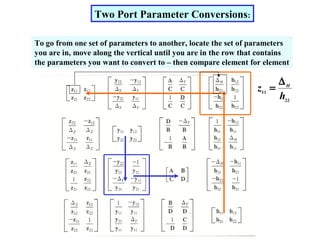
To go from one set of parameters to another, locate the set of parameters
you are in, move along the vertical until you are in the row that contains
the parameters you want to convert to – then compare element for element
22
11
h
z H
∆
=
Interconnection Of Two Port Networks
Three ways that two ports are interconnected:
* Parallel
* Series
* Cascade
[ ] [ ] [ ]ba
yyy +=
[ ] [ ] [ ]ba
zzz +=
[ ] [ ] [ ]ba
TTT =
ya
yb
za
zb
Ta Tb
parametersY
parametersZ
parametersABCD
Interconnection Of Two Port Networks
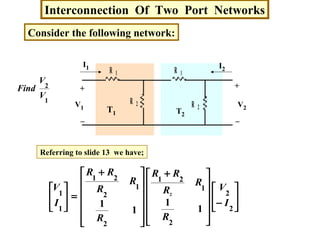
Consider the following network:
R 1
R 2
R 1
R 2T1 T2
Referring to slide 13 we have;
+
_
+
_
V1 V2
I1 I2
1
2
V
V
Find






−











 +













 +
=





2
2
2
1
21
2
1
2
21
1
1
1
1
1
1
2
I
V
R
R
R
RR
R
R
R
RR
I
V






−











 +













 +
=





2
2
2
1
21
2
1
2
21
1
1
1
1
1
1
2
I
V
R
R
R
RR
R
R
R
RR
I
V
Interconnection Of Two Port Networks
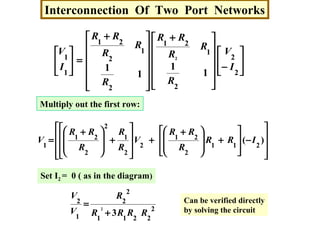
Multiply out the first row:










−








+







 +
+








+







 +
= )( 211
2
21
2
2
1
2
2
21
1
IRR
R
RR
V
R
R
R
RR
V
Set I2 = 0 ( as in the diagram)
2
2211
2
2
1
2
3
2
RRRR
R
V
V
+
= Can be verified directly
by solving the circuit
Two port networks

Two port networks

  • 1.
    Two – PortNetworks
  • 2.
    Two Port Networks Generalities:The standard configuration of a two port: The Network Input Port Output Port + _ _ + V1 V2 I1 I2 The network ? The voltage and current convention ? * notes
  • 3.
    Two Port Networks NetworkEquations: V1 = z11I1 + z12I2 V2 = z21I1 + z22I2 I1 = y11V1 + y12V2 I2 = y21V1 + y22V2 V1 = AV2 - BI2 I1 = CV2 - DI2 V2 = b11V1 - b12I1 I2 = b21V1 – b22I1 V1 = h11I1 + h12V2 I2 = h21I1 + h22V2 I1 = g11V1 + g12I2 V2 = g21V1 + g22I2 Impedance Z parameters Admittance Y parameters Transmission A, B, C, D parameters Hybrid H parameters * notes
  • 4.
    Two Port Networks Zparameters: 1 1 11 I V z = 0 2 =I 2 1 12 I V z = 0 1 =I 1 2 21 I V z = 0 2 =I 2 2 22 I V z = 0 1 =I z11 is the impedance seen looking into port 1 when port 2 is open. z12 is a transfer impedance. It is the ratio of the voltage at port 1 to the current at port 2 when port 1 is open. z21 is a transfer impedance. It is the ratio of the voltage at port 2 to the current at port 1 when port 2 is open. z22 is the impedance seen looking into port 2 when port 1 is open. * notes
  • 5.
    Two Port Networks Yparameters: 1 1 11 V I y = 0 2 =V 2 1 12 V I y = 0 1 =V 1 2 21 V I y = 0 2 =V 2 2 22 V I y = 0 1 =V y11 is the admittance seen looking into port 1 when port 2 is shorted. y12 is a transfer admittance. It is the ratio of the current at port 1 to the voltage at port 2 when port 1 is shorted. y21 is a transfer impedance. It is the ratio of the current at port 2 to the voltage at port 1 when port 2 is shorted. y22 is the admittance seen looking into port 2 when port 1 is shorted. * notes
  • 6.
    Two Port Networks Zparameters: Example 1 Given the following circuit. Determine the Z parameters. 8 2 0 2 0 Ω ΩΩ Ω 1 0 + _ + _ V 1 V 2 I 1 I 2 Find the Z parameters for the above network.
  • 7.
    Two Port Networks Zparameters: Example 1 (cont 1) For z11: Z11 = 8 + 20||30 = 20 Ω For z22: For z12: Z22 = 20||30 = 12 Ω 2 1 12 I V z = 0 1 =I 8 2 0 2 0 Ω ΩΩ Ω 1 0 + _ + _ V 1 V 2 I 1 I 2 2 2 1 8 3020 2020 xI xxI V = + = Therefore: 8 8 2 2 12 == I xI z Ω = 21z
  • 8.
    Two Port Networks Zparameters: Example 1 (cont 2) The Z parameter equations can be expressed in matrix form as follows.             =      2 1 2 1 128 820 I I V V             =      2 1 2221 1211 2 1 I I zz zz V V
  • 9.
    Two Port Networks Zparameters: Example 2 (problem 18.7 Alexander & Sadiku) You are given the following circuit. Find the Z parameters. 1 Ω 1 Ω 4 Ω 2 Ω 2 V x + - V x + + _ _ V 1 V 2 I 1 I 2
  • 10.
    Two Port Networks Zparameters: Example 2 (continue p2) 1 1 11 I V z = 0 2 =I 1 Ω 1 Ω 4 Ω 2 Ω 2 V x + - V x + + _ _ V 1 V 2 I 1 I 2 6 26 6 2 1 1 xxxxxx VVVVVV I ++ = + += 2 3 1 xV I = ; but 11 IVVx −= Substituting gives; ( ) 2 3 11 1 IV I − = or Ω== 3 5 11 1 1 z I V Z21 = -0.667 Ω Z12 = 0.222 Ω Z22 = 1.111 Ω Other Answers
  • 11.
    Two Port Networks Transmissionparameters (A,B,C,D): The defining equations are:       −      =      2 2 1 1 I V DC BA I V 2 1 V V A= I2 = 0 2 1 I V B − = V2 = 0 2 1 V I C = I2 = 0 2 1 I I D − = V2 = 0
  • 12.
    Two Port Networks Transmissionparameters (A,B,C,D): Example Given the network below with assumed voltage polarities and Current directions compatible with the A,B,C,D parameters. + _ + _ R 1 R 2V 1 V 2 I 1 - I 2 We can write the following equations. V1 = (R1 + R2)I1 + R2I2 V2 = R2I1 + R2I2 It is not always possible to write 2 equations in terms of the V’s and I’s Of the parameter set.
  • 13.
    1 1R 2 1 R 2 21 R RR + Two PortNetworks Transmission parameters (A,B,C,D): Example (cont.) V1 = (R1 + R2)I1 + R2I2 V2 = R2I1 + R2I2 From these equations we can directly evaluate the A,B,C,D parameters. 2 1 V V A= I2 = 0 2 1 I V B − = V2 = 0 2 1 V I C = I2 = 0 2 1 I I D − = V2 = 0 = = = = Later we will see how to interconnect two of these networks together for a final answer * notes
  • 14.
    Two Port Networks HybridParameters: The equations for the hybrid parameters are:             =      2 1 2221 1211 2 1 V I hh hh I V 1 1 11 I V h = V2 = 0 2 1 12 V V h = I1 = 0 1 2 21 I I h = V2 = 0 2 2 22 V I h = I1 = 0 * notes
  • 15.
    Two Port Networks HybridParameters: The following is a popular model used to represent a particular variety of transistors. + + _ _ V 1 V 2 + _ K 1 K 4 K 3 V 1 K 2 V 2 I 1 I 2 We can write the following equations: D V CII BVAIV 2 12 211 += += * notes
  • 16.
    4 1 K K2 K3 K1 Two Port Networks HybridParameters: D V CII BVAIV 2 12 211 += += We want to evaluate the H parameters from the above set of equations. 1 1 11 I V h = V2 = 0 2 1 12 V V h = I1 = 0 1 2 21 I I h = V2 = 0 2 2 22 V I h = I1 = 0 = = = =
  • 17.
    2 1 R 1 - 1 1R Two PortNetworks Hybrid Parameters: Another example with hybrid parameters. Given the circuit below. + _ + _ R 1 R 2V 1 V 2 I 1 - I 2 The equations for the circuit are: V1 = (R1 + R2)I1 + R2I2 V2 = R2I1 + R2I2 The H parameters are as follows. 1 1 11 I V h = 2 1 12 V V h = 1 2 21 I I h = 2 2 22 V I h = V2=0 V2=0 I1=0 I1=0 = = = =
  • 18.
    Two Port Networks Modifyingthe two port network: Earlier we found the z parameters of the following network. 8 2 0 2 0 Ω ΩΩ Ω 1 0 + _ + _ V 1 V 2 I 1 I 2             =      2 1 2 1 128 820 I I V V * notes
  • 19.
    Two Port Networks Modifyingthe two port network: We modify the network as shown be adding elements outside the two ports 8 2 0 2 0 Ω ΩΩ Ω 1 0 + _ + _ V 1 V 2 I 1 I 2 + _ 1 0 v 6 Ω 4 Ω We now have: V1 = 10 - 6I1 V2 = - 4I2
  • 20.
    Two Port Networks Modifyingthe two port network: We take a look at the original equations and the equations describing the new port conditions.             =      2 1 2 1 128 820 I I V V V1 = 10 - 6I1 V2 = - 4I2 So we have, 10 – 6I1 = 20I1 + 8I2 -4I2 = 8I1 + 12I2 * notes
  • 21.
    -0.2273 0.4545 0 10 168 826 Two Port Networks Modifyingthe two port network: Rearranging the equations gives,       =      2 1 I I           =      −1 2 1 I I
  • 22.
    Two Port Networks YParameters and Beyond: Given the following network. + _ + _ V 1 V 2 I 1 I 2 s 1 1 Ω 1 Ω s (a) Find the Y parameters for the network. (b) From the Y parameters find the z parameters
  • 23.
    Two Port Networks 1 1 11V I y = 0 2 =V 2 1 12 V I y = 0 1 =V 1 2 21 V I y = 0 2 =V 2 2 22 V I y = 0 1 =V I1 = y11V1 + y12V2 I2 = y21V1 + y22V2 + _ + _ V 1 V 2 I 1 I 2 s 1 1 Ω 1 Ω s To find y11     + = + = 12 2 ) 12 2 ( 111 s I s sIV so = s + 0.5 1 1 11 V I y = 0 2 =V We use the above equations to evaluate the parameters from the network. Y Parameter Example short
  • 24.
    Two Port Networks YParameter Example 1 2 21 V I y = 0 2 =V + _ + _ V 1 V 2 I 1 s 1 1 Ω 1 Ω s I 2 21 2IV −= We see = 0.5 S 1 2 21 V I y =
  • 25.
    Two Port Networks YParameter Example + _ + _ V 1 V 2 I 1 s 1 1 Ω 1 Ω s I 2 2 1 12 V I y = 0 1 =V 2 1 12 V I y = 12 2IV −= We have = 0.5 S short 2 2 22 V I y = 0 1 =V We have )2( 2 22 + = s s IV s y 1 5.022 += To find y12 and y21 we reverse things and short V1
  • 26.
    Two Port Networks YParameter Example Summary: Y =       +− −+ =      s s yy yy 15.05.0 5.05.0 2221 1211 Now suppose you want the Z parameters for the same network.
  • 27.
    Two Port Networks GoingFrom Y to Z Parameters For the Y parameters we have: VYI = For the Z parameters we have: IZV = From above; IZIYV == −1                       = ∆∆ − ∆ − ∆ − == Y y Y y Y y Y y zz zz YZ 1121 1222 2221 12111 YY det=∆ Therefore where
  • 28.
    Two Port ParameterConversions:
  • 29.
    Two Port ParameterConversions: To go from one set of parameters to another, locate the set of parameters you are in, move along the vertical until you are in the row that contains the parameters you want to convert to – then compare element for element 22 11 h z H ∆ =
  • 30.
    Interconnection Of TwoPort Networks Three ways that two ports are interconnected: * Parallel * Series * Cascade [ ] [ ] [ ]ba yyy += [ ] [ ] [ ]ba zzz += [ ] [ ] [ ]ba TTT = ya yb za zb Ta Tb parametersY parametersZ parametersABCD
  • 31.
    Interconnection Of TwoPort Networks Consider the following network: R 1 R 2 R 1 R 2T1 T2 Referring to slide 13 we have; + _ + _ V1 V2 I1 I2 1 2 V V Find       −             +               + =      2 2 2 1 21 2 1 2 21 1 1 1 1 1 1 2 I V R R R RR R R R RR I V
  • 32.
          −             +               + =      2 2 2 1 21 2 1 2 21 1 1 1 1 1 1 2 I V R R R RR R R R RR I V InterconnectionOf Two Port Networks Multiply out the first row:           −         +         + +         +         + = )( 211 2 21 2 2 1 2 2 21 1 IRR R RR V R R R RR V Set I2 = 0 ( as in the diagram) 2 2211 2 2 1 2 3 2 RRRR R V V + = Can be verified directly by solving the circuit

Editor's Notes

  • #3 The two port network configuration shown with this slide is practically used universally in all text books. The same goes for the voltage and current assumed polarity and direction at the input and output ports. I think this is done because of how we define parameters with respect the voltages and currents at the input and out ports. With respect to the network, it may be configured with passive R, L, C, op-amps, transformers, dependent sources but not independent sources.
  • #4 The equations in light orange are the ones we will consider here. The other equations are also presented and consider in Nilsson & Riedel, 6th ed. The parameters are defined in terms of open and short circuit conditions of the two ports. This will be illustrated and some examples presented.
  • #6 Similar to input and output impedance, y11 and y22 are determined by looking into the input and output ports with the opposite ports short circuited. When we look for y12 and y21 we adhere to the above equations with respect to shorting the output terminals. If the circuit is not passive, we need to be careful and do exactly as the equations tell us to do.
  • #14 The answers to the above are underneath the gray boxes. The A,B,C,D parameters are best used when we want to cascade two networks together such as follows
  • #15 The H parameters are used almost solely in electronics. These parameters are used in the equivalent circuit Of a transistor. As you will see, the H parameter equations directly set-up so as to describe the device in terms Of the hij parameters which are given by the manufacturer. You will use this material in junior electronics.
  • #16 In this example we consider a very popular model of a transistor. We first assign some identifier, such as K1, K2, K3, K4, to the model. Next we write the equations at the input port and output port. In this case they are extremely simple to write. Then it turns out that we can use these equations to directly identify what will be called the H parameters. Note that one of the parameters is a voltage gain, one is a current gain, one is an resistance and one is a conductance. You will go into a fair amount of detail on this model later in the curriculum
  • #19 Equations from two port networks are not considered to be the end of the problem. We will practically always add components to the input and output. When we do this we must start with the two port parameter, in a certain form, and modify the equations to incorporate the changes at the two ports. For example, we may place a voltage source in series with a resistor at the input port and maybe a load resistor at the output port. The example here illustrates how to handle this problem.
  • #21 Remember that we are trying to solve for I1 and I2 after changing the port conditions. This involves doing some algebra but at a low level. We recombine terms and arrange the original equation in matrix form and we can easily take the inverse to find the solution or else we can use simultaneous equations with our hand calculators.