Two Port Network Parameters and
Functions
ALLPPT.com _ Free PowerPoint Templates, Diagrams and Charts
Contents
•Terminal characteristics of network,
•Z, Y, h, ABCD Parameters;
•Reciprocity and Symmetry conditions,
•Applications of the parameters.
•Application of Laplace Transforms to circuit analysis,
•network functions for one port and two port networks,
•poles and zeros of network functions and network
stability.
Need of two port Networks
•it is easy to analyze any electrical network, if it is
represented with an equivalent model, which gives the
relation between input and output variables.
Two Port Networks
•For this, we can use two port network
representations.
•As the name suggests, two port networks
contain two ports.
•Among which, one port is used as an input
port and the other port is used as an output
port.
•The first and second ports are called as port1 a
nd port2 respectively.
One Port Networks
•One port network is a two terminal electrical
network in which, current enters through one
terminal and leaves through another terminal.
•Resistors, inductors and capacitors are the
examples of one port network because each
one has two terminals.
One Port Networks
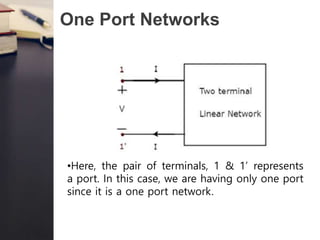
•Here, the pair of terminals, 1 & 1’ represents
a port. In this case, we are having only one port
since it is a one port network.
Two Port Networks
•two port network is a pair of two terminal
electrical network in which, current enters
through one terminal and leaves through
another terminal of each port.
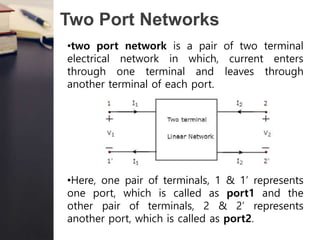
•Here, one pair of terminals, 1 & 1’ represents
one port, which is called as port1 and the
other pair of terminals, 2 & 2’ represents
another port, which is called as port2.
Two Port Networks
•There are four variables V1, V2, I1 and I2 in a
two port network as shown in the figure.
•Out of which, we can choose two variables as
independent and another two variables as
dependent.
•So equations which we get, represent the
dependent variables in terms of independent
variables.
•The coefficients of independent variables are
called as parameters.
•So, each pair of equations will give a set of
four parameters.
Two Port Network Parameters
Z parameters
Y parameters
h Parameters
ABCD Parameters
Z parameters
The Z-parameters are also known as open
circuit impedance parameters.
Here the voltages V1 and V2 are expressed in
terms of I1 and I2
Z parameters
•We will get the following set of two equations
by considering the variables V1 & V2 as
dependent and I1 & I2 as independent.
•The coefficients of independent variables, I1 an
d I2 are called as Z parameters.
Z parameters
The individual Z parameters for a given network can be defined by
setting each of the port currents equal to zero.
Case 1
Case 2
Z parameters
Z parameters
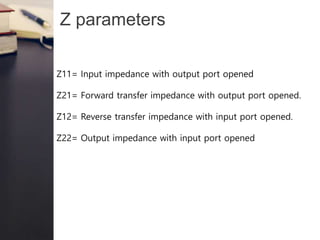
Z11= Input impedance with output port opened
Z21= Forward transfer impedance with output port opened.
Z12= Reverse transfer impedance with input port opened.
Z22= Output impedance with input port opened
Z parameters
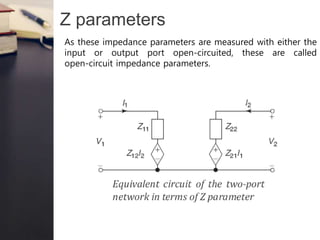
As these impedance parameters are measured with either the
input or output port open-circuited, these are called
open-circuit impedance parameters.
Transmission Parameters
The transmission parameters or chain parameters or ABCD
parameters serve to relate the voltage and current at the
input port to voltage and current at the output port.
Transmission Parameters
Hybrid Parameters (h-parameters)
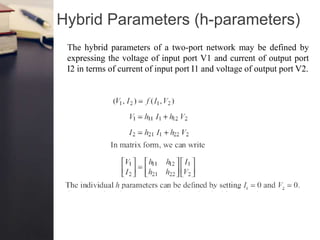
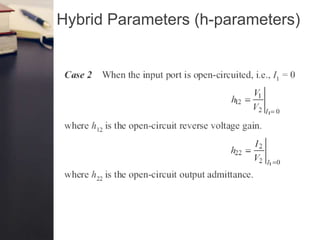
The hybrid parameters of a two-port network may be defined by
expressing the voltage of input port V1 and current of output port
I2 in terms of current of input port I1 and voltage of output port V2.
Hybrid Parameters (h-parameters)

Network Functions.pptx

  • 1.
    Two Port NetworkParameters and Functions ALLPPT.com _ Free PowerPoint Templates, Diagrams and Charts
  • 2.
    Contents •Terminal characteristics ofnetwork, •Z, Y, h, ABCD Parameters; •Reciprocity and Symmetry conditions, •Applications of the parameters. •Application of Laplace Transforms to circuit analysis, •network functions for one port and two port networks, •poles and zeros of network functions and network stability.
  • 3.
    Need of twoport Networks •it is easy to analyze any electrical network, if it is represented with an equivalent model, which gives the relation between input and output variables.
  • 4.
    Two Port Networks •Forthis, we can use two port network representations. •As the name suggests, two port networks contain two ports. •Among which, one port is used as an input port and the other port is used as an output port. •The first and second ports are called as port1 a nd port2 respectively.
  • 5.
    One Port Networks •Oneport network is a two terminal electrical network in which, current enters through one terminal and leaves through another terminal. •Resistors, inductors and capacitors are the examples of one port network because each one has two terminals.
  • 6.
    One Port Networks •Here,the pair of terminals, 1 & 1’ represents a port. In this case, we are having only one port since it is a one port network.
  • 7.
    Two Port Networks •twoport network is a pair of two terminal electrical network in which, current enters through one terminal and leaves through another terminal of each port. •Here, one pair of terminals, 1 & 1’ represents one port, which is called as port1 and the other pair of terminals, 2 & 2’ represents another port, which is called as port2.
  • 8.
    Two Port Networks •Thereare four variables V1, V2, I1 and I2 in a two port network as shown in the figure. •Out of which, we can choose two variables as independent and another two variables as dependent. •So equations which we get, represent the dependent variables in terms of independent variables. •The coefficients of independent variables are called as parameters. •So, each pair of equations will give a set of four parameters.
  • 9.
    Two Port NetworkParameters Z parameters Y parameters h Parameters ABCD Parameters
  • 10.
    Z parameters The Z-parametersare also known as open circuit impedance parameters. Here the voltages V1 and V2 are expressed in terms of I1 and I2
  • 11.
    Z parameters •We willget the following set of two equations by considering the variables V1 & V2 as dependent and I1 & I2 as independent. •The coefficients of independent variables, I1 an d I2 are called as Z parameters.
  • 12.
    Z parameters The individualZ parameters for a given network can be defined by setting each of the port currents equal to zero.
  • 13.
  • 14.
  • 15.
  • 16.
    Z parameters Z11= Inputimpedance with output port opened Z21= Forward transfer impedance with output port opened. Z12= Reverse transfer impedance with input port opened. Z22= Output impedance with input port opened
  • 17.
    Z parameters As theseimpedance parameters are measured with either the input or output port open-circuited, these are called open-circuit impedance parameters.
  • 18.
    Transmission Parameters The transmissionparameters or chain parameters or ABCD parameters serve to relate the voltage and current at the input port to voltage and current at the output port.
  • 19.
  • 20.
  • 21.
    Hybrid Parameters (h-parameters) Thehybrid parameters of a two-port network may be defined by expressing the voltage of input port V1 and current of output port I2 in terms of current of input port I1 and voltage of output port V2.
  • 22.
  • 23.