© PHI Learning Private Limited
Network Analysis and Synthesis
A. ANAND KUMAR
Advisor to
Dean Academics and Dean Quality
K.L. University
Green Fields, Vaddeswaram
Guntur District
Andhra Pradesh
© PHI Learning Private Limited
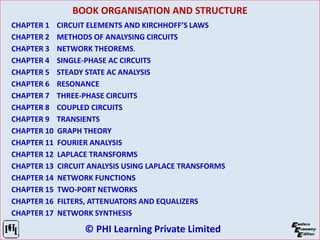
BOOK ORGANISATION AND STRUCTURE
CHAPTER 1 CIRCUIT ELEMENTS AND KIRCHHOFF’S LAWS
CHAPTER 2 METHODS OF ANALYSING CIRCUITS
CHAPTER 3 NETWORK THEOREMS.
CHAPTER 4 SINGLE-PHASE AC CIRCUITS
CHAPTER 5 STEADY STATE AC ANALYSIS
CHAPTER 6 RESONANCE
CHAPTER 7 THREE-PHASE CIRCUITS
CHAPTER 8 COUPLED CIRCUITS
CHAPTER 9 TRANSIENTS
CHAPTER 10 GRAPH THEORY
CHAPTER 11 FOURIER ANALYSIS
CHAPTER 12 LAPLACE TRANSFORMS
CHAPTER 13 CIRCUIT ANALYSIS USING LAPLACE TRANSFORMS
CHAPTER 14 NETWORK FUNCTIONS
CHAPTER 15 TWO-PORT NETWORKS
CHAPTER 16 FILTERS, ATTENUATORS AND EQUALIZERS
CHAPTER 17 NETWORK SYNTHESIS
© PHI Learning Private Limited
Chapter 1
Circuit Elements and
Kirchhoff’s Laws
© PHI Learning Private Limited
VOLTAGE
• Potential difference in electrical terminology is known as
voltage.
V = W/Q or v = dw/dq
• It is denoted by either V or v.
• The unit of voltage is volt.
1 volt = 1 joule/coulomb
© PHI Learning Private Limited
CURRENT
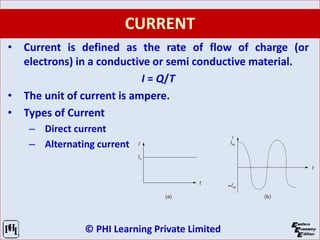
• Current is defined as the rate of flow of charge (or
electrons) in a conductive or semi conductive material.
I = Q/T
• The unit of current is ampere.
• Types of Current
– Direct current
– Alternating current
© PHI Learning Private Limited
RESISTANCE
• Resistance opposes the flow of current.
R = r(l/a)
where r is a constant of proportionality, known as resistivity
of the material. The unit of resistivity r is W-m.
• The unit of resistance is ohm (W).
• I = V/R or i = v/R
© PHI Learning Private Limited
CONDUCTANCE AND CONDUCTIVITY
• Conductance is defined as the reciprocal of resistance.
G = 1/R
• The unit of conductance is siemens.
• s = 1/r is called the conductivity or specific conductance
of a conductor.
© PHI Learning Private Limited
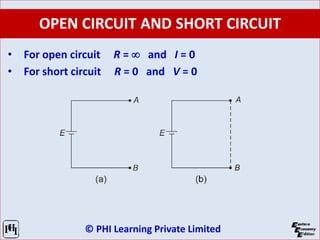
OPEN CIRCUIT AND SHORT CIRCUIT
• For open circuit R =  and I = 0
• For short circuit R = 0 and V = 0
© PHI Learning Private Limited
OHM’s LAW
• Ohm’s law states that the current flowing through a
conductor is directly proportional to the potential
difference between its two ends
• From Ohm’s law, V  I
i.e.,
V = IR
© PHI Learning Private Limited
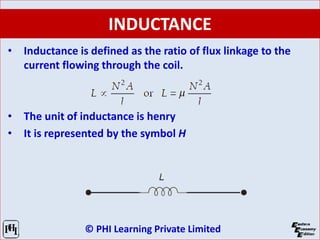
INDUCTANCE
• Inductance is defined as the ratio of flux linkage to the
current flowing through the coil.
• The unit of inductance is henry
• It is represented by the symbol H
© PHI Learning Private Limited
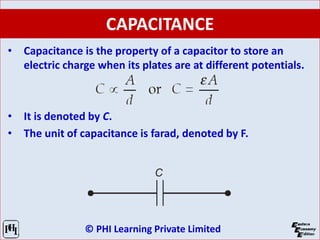
CAPACITANCE
• Capacitance is the property of a capacitor to store an
electric charge when its plates are at different potentials.
• It is denoted by C.
• The unit of capacitance is farad, denoted by F.
© PHI Learning Private Limited
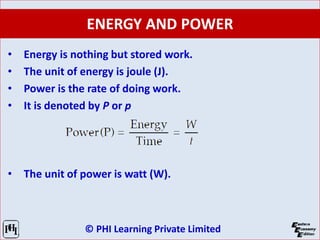
ENERGY AND POWER
• Energy is nothing but stored work.
• The unit of energy is joule (J).
• Power is the rate of doing work.
• It is denoted by P or p
• The unit of power is watt (W).
© PHI Learning Private Limited
NETWORK ELEMENTS
• Active and Passive Elements
• Bilateral or unilateral elements
• Linear or Nonlinear Elements
• Lumped or Distributed Elements
© PHI Learning Private Limited
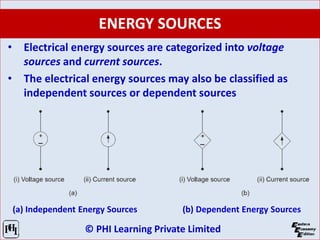
ENERGY SOURCES
• Electrical energy sources are categorized into voltage
sources and current sources.
• The electrical energy sources may also be classified as
independent sources or dependent sources
(a) Independent Energy Sources (b) Dependent Energy Sources
© PHI Learning Private Limited
ENERGY SOURCES
Independent Sources
• Voltage source: An ideal voltage source is a two-terminal network element
• Current source: An ideal current source is a two-terminal network element
Dependent Sources
• Voltage Controlled Voltage Source (VCVS): A voltage controlled voltage
source is a four- terminal network component
• Current Controlled Voltage Source (CCVS): A current controlled voltage
source is a four-terminal network component
• Voltage Controlled Current Source (VCCS): A voltage controlled current
source is a four-terminal network component
• Current Controlled Current Source (CCCS): A current controlled current
source is a four- terminal network component
© PHI Learning Private Limited
KIRCHHOFF’S VOLTAGE LAW (KVL)
• The algebraic sum of all branch voltages around any closed
path in a circuit is always zero at all instants of time.
© PHI Learning Private Limited
SERIES CONNECTION OF RESISTORS
In series combination:
• The current is same through all the resistors.
• The voltage across each resistor is different (assuming
each resistor to be of a different value).
© PHI Learning Private Limited
POWER IN A SERIES CIRCUIT
The total power supplied by the source in a series
resistive circuit is equal to the sum of the powers in
each resistor in series, i.e.,
Ps = P1 + P2 + P3 + . . . + Pm
© PHI Learning Private Limited
KIRCHHOFF’S CURRENT LAW
• The algebraic sum of all the currents meeting at a node
(junction point) in an electric circuit at any instant is equal
to zero.
© PHI Learning Private Limited
PARALLEL CONNECTION OF RESISTORS
• In a parallel circuit, same voltage is applied across each
resistor, but the current through each is different (if the
resistors are of different values).
© PHI Learning Private Limited
POWER IN A PARALLEL CIRCUIT
• Total power supplied by the source in any parallel
resistive circuit is equal to the sum of the powers in each
resistor in parallel, i.e.,
Ps = P1 + P2 + P3 + . . . + Pm
© PHI Learning Private Limited
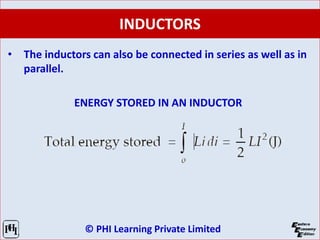
INDUCTORS
• The inductors can also be connected in series as well as in
parallel.
ENERGY STORED IN AN INDUCTOR
© PHI Learning Private Limited
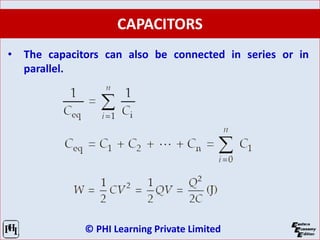
CAPACITORS
• The capacitors can also be connected in series or in
parallel.
WANT TO READ MORE?
Get Your Copy Today from:
www.phindia.com
E-book at 30% OFF
P-book at 20% OFF
• Address: "Rimjhim House", 111,
Patparganj Industrial Estate,
Delhi - 110 092
• Phone Number: (011) 43031100
• E-mail IDs:
General Manager (Sales) – balamurugan@phindia.com
Editorial Department – shivani.editorial@phindia.com
Manager Acquisitions – malaya@phindia.com
• Website:
www.phindia.com
• Connect with us:
CONTACT US

Network Analysis and Synthesis

  • 1.
    © PHI LearningPrivate Limited
  • 2.
    © PHI LearningPrivate Limited Network Analysis and Synthesis A. ANAND KUMAR Advisor to Dean Academics and Dean Quality K.L. University Green Fields, Vaddeswaram Guntur District Andhra Pradesh © PHI Learning Private Limited
  • 3.
    © PHI LearningPrivate Limited BOOK ORGANISATION AND STRUCTURE CHAPTER 1 CIRCUIT ELEMENTS AND KIRCHHOFF’S LAWS CHAPTER 2 METHODS OF ANALYSING CIRCUITS CHAPTER 3 NETWORK THEOREMS. CHAPTER 4 SINGLE-PHASE AC CIRCUITS CHAPTER 5 STEADY STATE AC ANALYSIS CHAPTER 6 RESONANCE CHAPTER 7 THREE-PHASE CIRCUITS CHAPTER 8 COUPLED CIRCUITS CHAPTER 9 TRANSIENTS CHAPTER 10 GRAPH THEORY CHAPTER 11 FOURIER ANALYSIS CHAPTER 12 LAPLACE TRANSFORMS CHAPTER 13 CIRCUIT ANALYSIS USING LAPLACE TRANSFORMS CHAPTER 14 NETWORK FUNCTIONS CHAPTER 15 TWO-PORT NETWORKS CHAPTER 16 FILTERS, ATTENUATORS AND EQUALIZERS CHAPTER 17 NETWORK SYNTHESIS
  • 4.
    © PHI LearningPrivate Limited Chapter 1 Circuit Elements and Kirchhoff’s Laws
  • 5.
    © PHI LearningPrivate Limited VOLTAGE • Potential difference in electrical terminology is known as voltage. V = W/Q or v = dw/dq • It is denoted by either V or v. • The unit of voltage is volt. 1 volt = 1 joule/coulomb
  • 6.
    © PHI LearningPrivate Limited CURRENT • Current is defined as the rate of flow of charge (or electrons) in a conductive or semi conductive material. I = Q/T • The unit of current is ampere. • Types of Current – Direct current – Alternating current
  • 7.
    © PHI LearningPrivate Limited RESISTANCE • Resistance opposes the flow of current. R = r(l/a) where r is a constant of proportionality, known as resistivity of the material. The unit of resistivity r is W-m. • The unit of resistance is ohm (W). • I = V/R or i = v/R
  • 8.
    © PHI LearningPrivate Limited CONDUCTANCE AND CONDUCTIVITY • Conductance is defined as the reciprocal of resistance. G = 1/R • The unit of conductance is siemens. • s = 1/r is called the conductivity or specific conductance of a conductor.
  • 9.
    © PHI LearningPrivate Limited OPEN CIRCUIT AND SHORT CIRCUIT • For open circuit R =  and I = 0 • For short circuit R = 0 and V = 0
  • 10.
    © PHI LearningPrivate Limited OHM’s LAW • Ohm’s law states that the current flowing through a conductor is directly proportional to the potential difference between its two ends • From Ohm’s law, V  I i.e., V = IR
  • 11.
    © PHI LearningPrivate Limited INDUCTANCE • Inductance is defined as the ratio of flux linkage to the current flowing through the coil. • The unit of inductance is henry • It is represented by the symbol H
  • 12.
    © PHI LearningPrivate Limited CAPACITANCE • Capacitance is the property of a capacitor to store an electric charge when its plates are at different potentials. • It is denoted by C. • The unit of capacitance is farad, denoted by F.
  • 13.
    © PHI LearningPrivate Limited ENERGY AND POWER • Energy is nothing but stored work. • The unit of energy is joule (J). • Power is the rate of doing work. • It is denoted by P or p • The unit of power is watt (W).
  • 14.
    © PHI LearningPrivate Limited NETWORK ELEMENTS • Active and Passive Elements • Bilateral or unilateral elements • Linear or Nonlinear Elements • Lumped or Distributed Elements
  • 15.
    © PHI LearningPrivate Limited ENERGY SOURCES • Electrical energy sources are categorized into voltage sources and current sources. • The electrical energy sources may also be classified as independent sources or dependent sources (a) Independent Energy Sources (b) Dependent Energy Sources
  • 16.
    © PHI LearningPrivate Limited ENERGY SOURCES Independent Sources • Voltage source: An ideal voltage source is a two-terminal network element • Current source: An ideal current source is a two-terminal network element Dependent Sources • Voltage Controlled Voltage Source (VCVS): A voltage controlled voltage source is a four- terminal network component • Current Controlled Voltage Source (CCVS): A current controlled voltage source is a four-terminal network component • Voltage Controlled Current Source (VCCS): A voltage controlled current source is a four-terminal network component • Current Controlled Current Source (CCCS): A current controlled current source is a four- terminal network component
  • 17.
    © PHI LearningPrivate Limited KIRCHHOFF’S VOLTAGE LAW (KVL) • The algebraic sum of all branch voltages around any closed path in a circuit is always zero at all instants of time.
  • 18.
    © PHI LearningPrivate Limited SERIES CONNECTION OF RESISTORS In series combination: • The current is same through all the resistors. • The voltage across each resistor is different (assuming each resistor to be of a different value).
  • 19.
    © PHI LearningPrivate Limited POWER IN A SERIES CIRCUIT The total power supplied by the source in a series resistive circuit is equal to the sum of the powers in each resistor in series, i.e., Ps = P1 + P2 + P3 + . . . + Pm
  • 20.
    © PHI LearningPrivate Limited KIRCHHOFF’S CURRENT LAW • The algebraic sum of all the currents meeting at a node (junction point) in an electric circuit at any instant is equal to zero.
  • 21.
    © PHI LearningPrivate Limited PARALLEL CONNECTION OF RESISTORS • In a parallel circuit, same voltage is applied across each resistor, but the current through each is different (if the resistors are of different values).
  • 22.
    © PHI LearningPrivate Limited POWER IN A PARALLEL CIRCUIT • Total power supplied by the source in any parallel resistive circuit is equal to the sum of the powers in each resistor in parallel, i.e., Ps = P1 + P2 + P3 + . . . + Pm
  • 23.
    © PHI LearningPrivate Limited INDUCTORS • The inductors can also be connected in series as well as in parallel. ENERGY STORED IN AN INDUCTOR
  • 24.
    © PHI LearningPrivate Limited CAPACITORS • The capacitors can also be connected in series or in parallel.
  • 25.
    WANT TO READMORE? Get Your Copy Today from: www.phindia.com E-book at 30% OFF P-book at 20% OFF
  • 26.
    • Address: "RimjhimHouse", 111, Patparganj Industrial Estate, Delhi - 110 092 • Phone Number: (011) 43031100 • E-mail IDs: General Manager (Sales) – balamurugan@phindia.com Editorial Department – shivani.editorial@phindia.com Manager Acquisitions – malaya@phindia.com • Website: www.phindia.com • Connect with us: CONTACT US