ELECTRICAL
ENGINEERING
by - Mohammed Waris Senan
Mohammed Waris Senan 2
MAGNETIC MATERIALS
&
B-H CURVE
Content
Magnetic Dipole and Dipole Moment
Magnetic Materials and their properties
Magnetic Domain (Domain Theory)
B-H Curve or Hysteresis Loop
Hysteresis Loss
Mohammed Waris Senan 3
Mohammed Waris Senan 4
Magnetic Dipole Moment
+
e
NS
S N
S
DIPOLE
Dipole Moment, M = NIA
Direction of Dipole Moment is from S-Pole to N-Pole
Every substance has Magnetic Dipole Moment
Mohammed Waris Senan 5
Magnetic Materials
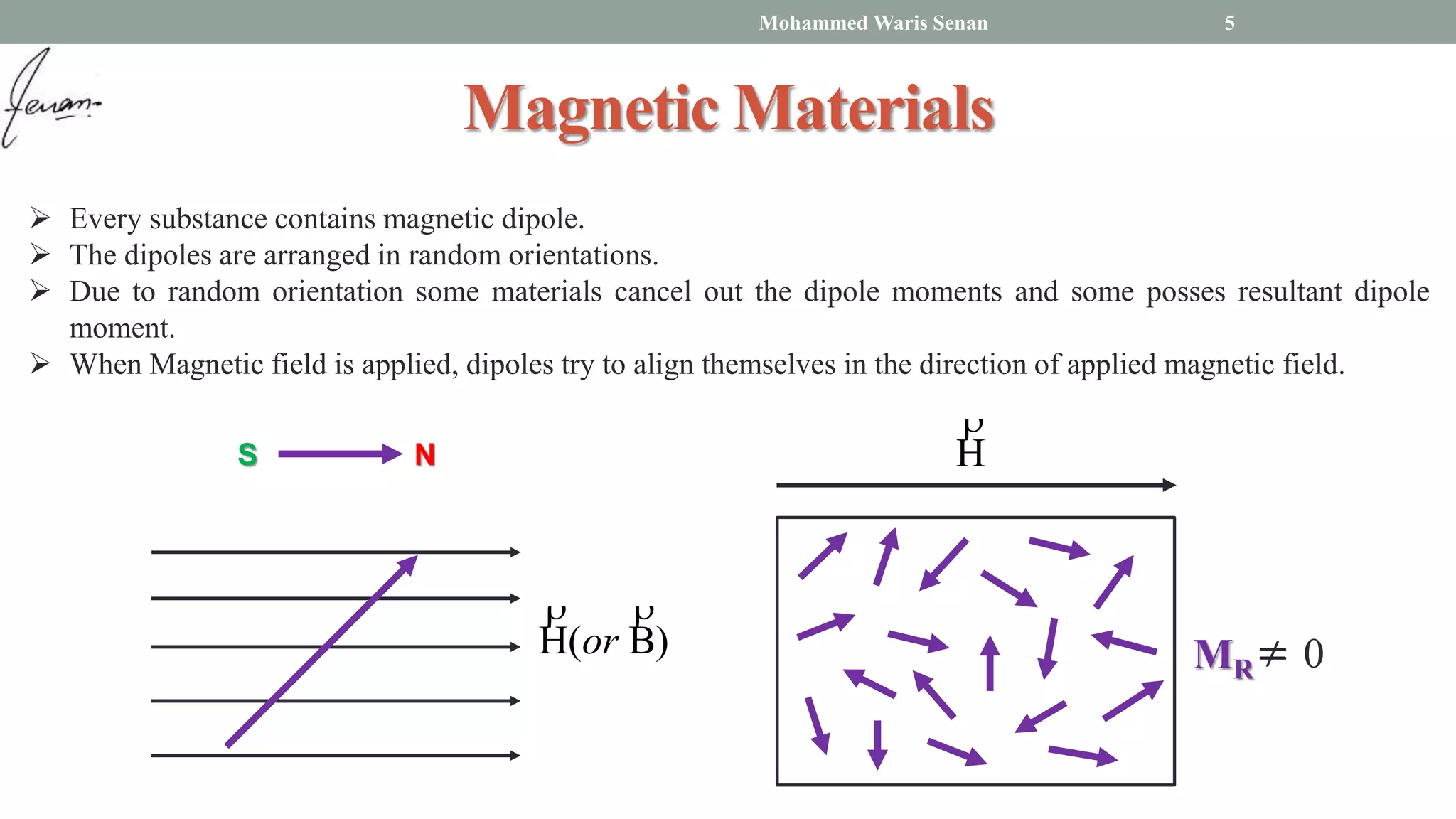
 Every substance contains magnetic dipole.
 The dipoles are arranged in random orientations.
 Due to random orientation some materials cancel out the dipole moments and some posses resultant dipole
moment.
 When Magnetic field is applied, dipoles try to align themselves in the direction of applied magnetic field.
NS
)B(H

or
H

MR= 0≠
Mohammed Waris Senan 6
Magnetic Materials contd..
 Paramagnetic Materials
 Gets weakly magnetise in the direction of applied magnetic field i.e. weakly attracted by the magnet.
 Examples: Aluminium, Manganese, Platinum etc.
 Diamagnetic Materials
 Gets weakly magnetise in opposite direction of applied magnetic field i.e. weakly repelled by the magnet.
 Examples: Copper, Phosphorous, Antimony etc.
 Ferromagnetic Materials
 Gets strongly magnetise in the direction of applied magnetic field i.e. strongly attracted by the magnet.
 Examples: Iron, Nickel, Cobalt & their alloys.
 Antiferromagnetic Materials
 Gets strongly magnetise in the opposite direction of applied magnetic field i.e. strongly repelled by the
magnet.
 Examples: Chromium, Nickel Oxide (NiO), Chromium Oxide (Cr2O3) etc.
 Ferrimagnetic Materials
 Very similar to Ferromagnetic materials but Gets not that strongly magnetise in the direction of applied
magnetic field as a Ferromagnetic material
 Examples: Ferrites like barium ferrite, magnetite etc.
Mohammed Waris Senan 7
Magnetic Domain
H

MR= 0≠
Magnetic
Domain
 Magnetic Domain:
Group of dipoles arranged in a particular direction
 Spontaneous Magnetization (Msp):
Resultant dipole moment present when no external
magnetic field is applied.
 Magnetic Susceptibility (χm):
Quantitative measure of the extent to which a material may
be magnetized in relation to a given applied magnetic field.
Mathematically, χm=
𝑀𝑎𝑔𝑛𝑒𝑡𝑖𝑧𝑎𝑡𝑖𝑜𝑛 (𝑀)
𝑀𝑎𝑔𝑛𝑒𝑡𝑖𝑐 𝐹𝑖𝑒𝑙𝑑 𝑆𝑡𝑟𝑒𝑛𝑔𝑡ℎ (𝐻)
Mohammed Waris Senan 8
B-H Curve
abe
NS
a b
i
l
Ni
H  iH 
A

B B 
Mohammed Waris Senan 9
B-H Curve contd..
i
t
)( B
)( iH 
Im
- Im
- Im Im
Retentivity (Br)
Coercivity (Hc)
Mohammed Waris Senan 10
B-H Curve contd..
)( B
)( iH 
- Im Im
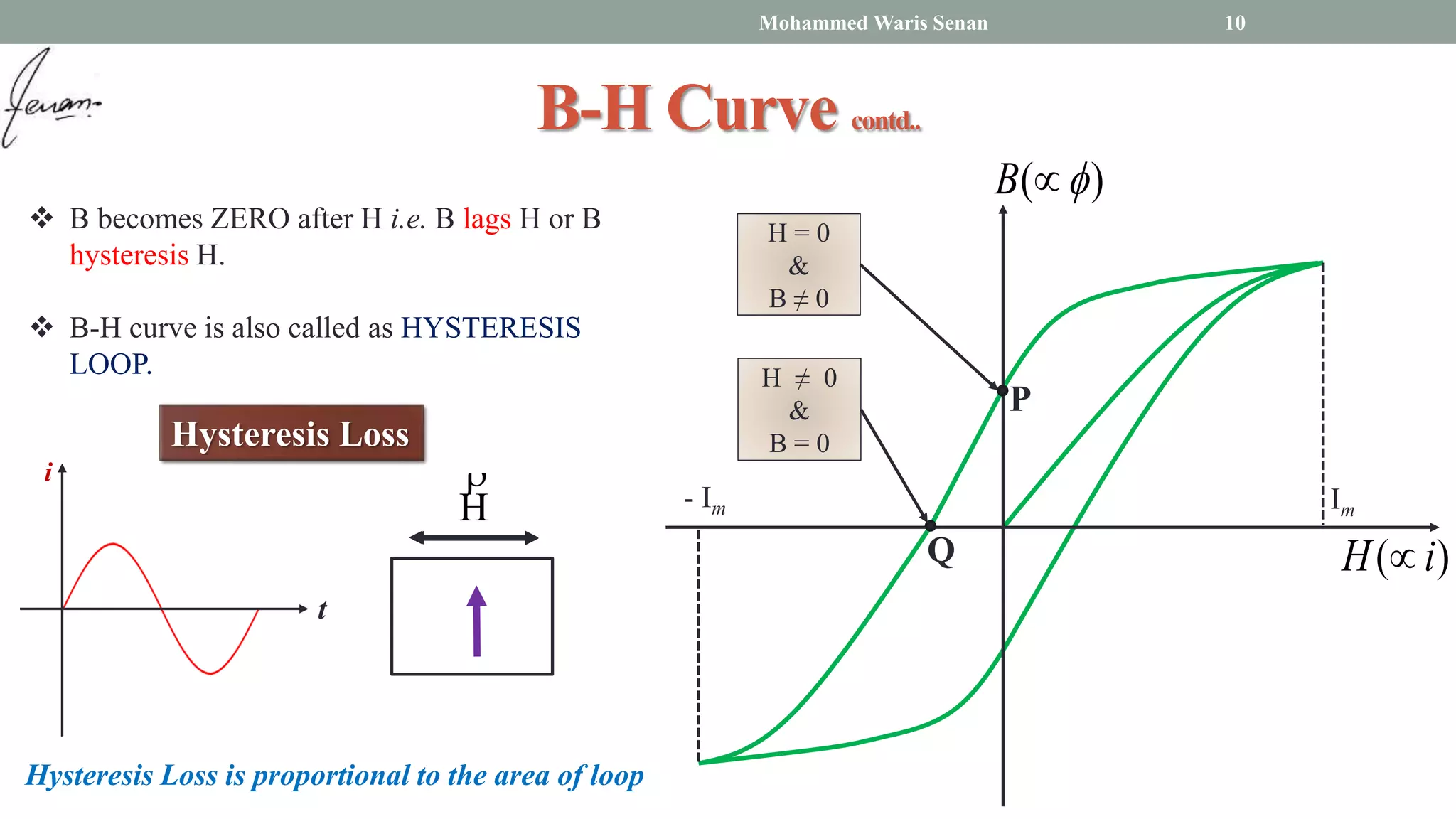
H = 0
&
B ≠ 0
H ≠ 0
&
B = 0
 B becomes ZERO after H i.e. B lags H or B
hysteresis H.
 B-H curve is also called as HYSTERESIS
LOOP.
H
i
t
Hysteresis Loss
Hysteresis Loss is proportional to the area of loop
P
Q

Magnetic materials & B-H Curve

  • 1.
  • 2.
    Mohammed Waris Senan2 MAGNETIC MATERIALS & B-H CURVE
  • 3.
    Content Magnetic Dipole andDipole Moment Magnetic Materials and their properties Magnetic Domain (Domain Theory) B-H Curve or Hysteresis Loop Hysteresis Loss Mohammed Waris Senan 3
  • 4.
    Mohammed Waris Senan4 Magnetic Dipole Moment + e NS S N S DIPOLE Dipole Moment, M = NIA Direction of Dipole Moment is from S-Pole to N-Pole Every substance has Magnetic Dipole Moment
  • 5.
    Mohammed Waris Senan5 Magnetic Materials  Every substance contains magnetic dipole.  The dipoles are arranged in random orientations.  Due to random orientation some materials cancel out the dipole moments and some posses resultant dipole moment.  When Magnetic field is applied, dipoles try to align themselves in the direction of applied magnetic field. NS )B(H  or H  MR= 0≠
  • 6.
    Mohammed Waris Senan6 Magnetic Materials contd..  Paramagnetic Materials  Gets weakly magnetise in the direction of applied magnetic field i.e. weakly attracted by the magnet.  Examples: Aluminium, Manganese, Platinum etc.  Diamagnetic Materials  Gets weakly magnetise in opposite direction of applied magnetic field i.e. weakly repelled by the magnet.  Examples: Copper, Phosphorous, Antimony etc.  Ferromagnetic Materials  Gets strongly magnetise in the direction of applied magnetic field i.e. strongly attracted by the magnet.  Examples: Iron, Nickel, Cobalt & their alloys.  Antiferromagnetic Materials  Gets strongly magnetise in the opposite direction of applied magnetic field i.e. strongly repelled by the magnet.  Examples: Chromium, Nickel Oxide (NiO), Chromium Oxide (Cr2O3) etc.  Ferrimagnetic Materials  Very similar to Ferromagnetic materials but Gets not that strongly magnetise in the direction of applied magnetic field as a Ferromagnetic material  Examples: Ferrites like barium ferrite, magnetite etc.
  • 7.
    Mohammed Waris Senan7 Magnetic Domain H  MR= 0≠ Magnetic Domain  Magnetic Domain: Group of dipoles arranged in a particular direction  Spontaneous Magnetization (Msp): Resultant dipole moment present when no external magnetic field is applied.  Magnetic Susceptibility (χm): Quantitative measure of the extent to which a material may be magnetized in relation to a given applied magnetic field. Mathematically, χm= 𝑀𝑎𝑔𝑛𝑒𝑡𝑖𝑧𝑎𝑡𝑖𝑜𝑛 (𝑀) 𝑀𝑎𝑔𝑛𝑒𝑡𝑖𝑐 𝐹𝑖𝑒𝑙𝑑 𝑆𝑡𝑟𝑒𝑛𝑔𝑡ℎ (𝐻)
  • 8.
    Mohammed Waris Senan8 B-H Curve abe NS a b i l Ni H  iH  A  B B 
  • 9.
    Mohammed Waris Senan9 B-H Curve contd.. i t )( B )( iH  Im - Im - Im Im Retentivity (Br) Coercivity (Hc)
  • 10.
    Mohammed Waris Senan10 B-H Curve contd.. )( B )( iH  - Im Im H = 0 & B ≠ 0 H ≠ 0 & B = 0  B becomes ZERO after H i.e. B lags H or B hysteresis H.  B-H curve is also called as HYSTERESIS LOOP. H i t Hysteresis Loss Hysteresis Loss is proportional to the area of loop P Q