1
TWO PORTTWO PORT
NETWORKSNETWORKS
2
SUB - TOPICSSUB - TOPICS
Z – PARAMETER
Y – PARAMETER
T (ABCD) – PARAMETER
TERMINATED TWO PORT NETWORKS
3
OBJECTIVESOBJECTIVES
• TO UNDERSTAND ABOUT TWO – PORT
NETWORKS AND ITS FUNTIONS.
• TO UNDERSTAND THE DIFFERENT
BETWEEN Z – PARAMETER, Y –
PARAMETER, T – PARAMETER AND
TERMINATED TWO PORT NETWORKS.
• TO INVERTIGATE AND ANALYSIS THE
BEHAVIOUR OF TWO – PORT NETWORKS.
4
TWO – PORT NETWORKSTWO – PORT NETWORKS
• A pair of terminals through which a
current may enter or leave a network is
known as a port.
• Two terminal devices or elements (such as
resistors, capacitors, and inductors)
results in one – port network.
• Most of the circuits we have dealt with so
far are two – terminal or one – port
circuits.
5
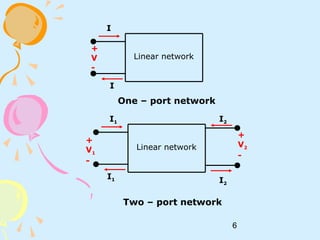
• A two – port network is an electrical
network with two separate ports for
input and output.
• It has two terminal pairs acting as
access points. The current entering
one terminal of a pair leaves the
other terminal in the pair.
6
Linear network
+
V
-
I
I
One – port network
Linear network
+
V1
-
I1
I1 I2
I2
+
V2
-
Two – port network
7
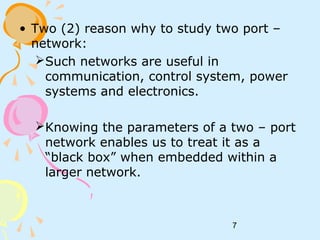
• Two (2) reason why to study two port –
network:
Such networks are useful in
communication, control system, power
systems and electronics.
Knowing the parameters of a two – port
network enables us to treat it as a
“black box” when embedded within a
larger network.
8
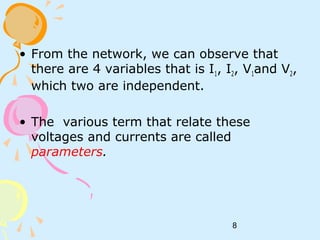
• From the network, we can observe that
there are 4 variables that is I1, I2, V1and V2,
which two are independent.
• The various term that relate these
voltages and currents are called
parameters.
9
Z – PARAMETERZ – PARAMETER
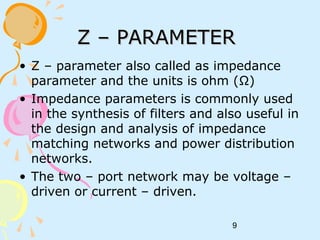
• Z – parameter also called as impedance
parameter and the units is ohm (Ω)
• Impedance parameters is commonly used
in the synthesis of filters and also useful in
the design and analysis of impedance
matching networks and power distribution
networks.
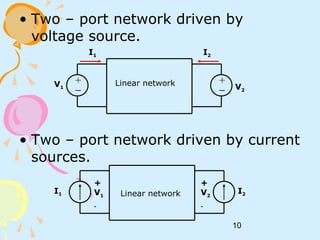
• The two – port network may be voltage –
driven or current – driven.
10
• Two – port network driven by
voltage source.
• Two – port network driven by current
sources.
Linear network
I1 I2
+
−
+
−
V1 V2
I1 I2
+
V1
-
Linear network
+
V2
-
11
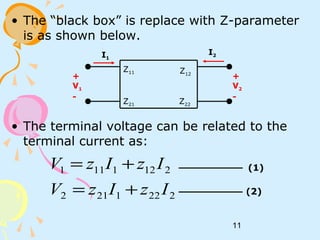
• The “black box” is replace with Z-parameter
is as shown below.
• The terminal voltage can be related to the
terminal current as:
+
V1
-
I1
I2
+
V2
-
Z11
Z21
Z12
Z22
2221212
2121111
IzIzV
IzIzV
+=
+= (1)
(2)
12
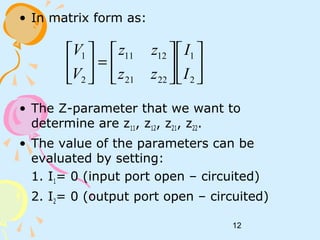
• In matrix form as:
• The Z-parameter that we want to
determine are z11, z12, z21, z22.
• The value of the parameters can be
evaluated by setting:
1. I1= 0 (input port open – circuited)
2. I2= 0 (output port open – circuited)












=





2
1
2221
1211
2
1
I
I
zz
zz
V
V
13
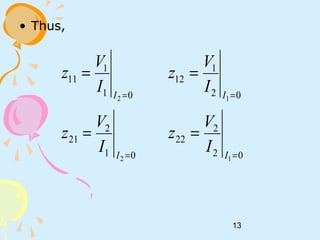
• Thus,
01
2
21
01
1
11
2
2
=
=
=
=
I
I
I
V
z
I
V
z
02
2
22
02
1
12
1
1
=
=
=
=
I
I
I
V
z
I
V
z
14
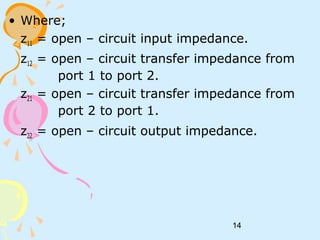
• Where;
z11 = open – circuit input impedance.
z12 = open – circuit transfer impedance from
port 1 to port 2.
z21 = open – circuit transfer impedance from
port 2 to port 1.
z22 = open – circuit output impedance.
15
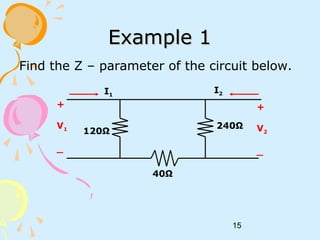
Example 1Example 1
Find the Z – parameter of the circuit below.
40Ω
240Ω
120Ω
+
V1
_
+
V2
_
I1
I2
16
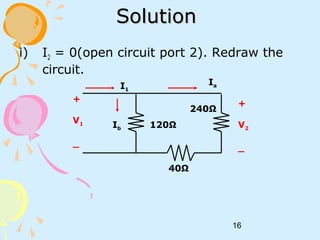
SolutionSolution
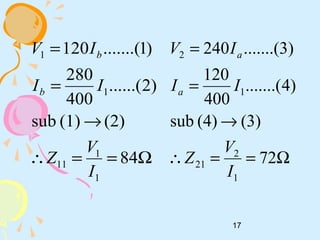
i) I2 = 0(open circuit port 2). Redraw the
circuit.
40Ω
240Ω
120Ω
+
V1
_
+
V2
_
I1
Ia
Ib
17
Ω==∴
→
=
=
84
(2)(1)sub
)2......(
400
280
)1.......(120
1
1
11
1
1
I
V
Z
II
IV
b
b
Ω==∴
→
=
=
72
(3)(4)sub
)4.......(
400
120
.......(3)240
1
2
21
1
2
I
V
Z
II
IV
a
a
18
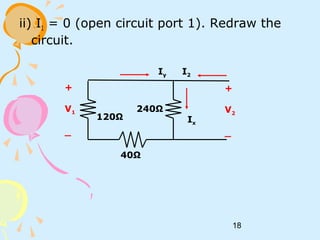
ii) I1 = 0 (open circuit port 1). Redraw the
circuit.
40Ω
240Ω
120Ω
+
V1
_
+
V2
_
Iy I2
Ix
19
Ω==∴
→
=
=
96Z
(2)(1)sub
)2.......(
400
160
)1.......(240
2
2
22
2
2
I
V
II
IV
x
x
Ω==∴
→
=
=
72
(3)(4)sub
)4.......(
400
240
)3.......(120
2
1
12
2
1
I
V
Z
II
IV
y
y
[ ] 





=
9672
7284
Z
In matrix form:
20
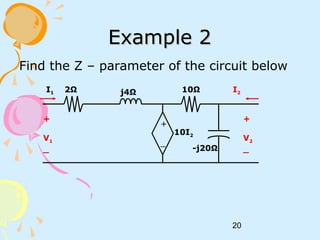
Example 2Example 2
Find the Z – parameter of the circuit below
+
_
+
V1
_
+
V2
_-j20Ω
10Ωj4Ω2Ω
10I2
I2I1
21
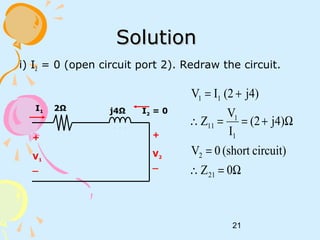
SolutionSolution
i) I2 = 0 (open circuit port 2). Redraw the circuit.
Ω=∴
=
Ω+==∴
+=
0Z
circuit)(short0V
j4)(2
I
V
Z
j4)(2IV
21
2
1
1
11
11
+
V1
_
j4Ω2ΩI1
+
V2
_
I2 = 0
22
ii) I1 = 0 (open circuit port 1). Redraw the circuit.
Ω==∴






+=
+
−
=
Ω==∴
=
j8)-(16
I
V
Z
10
1
20
j
V2I
10
10I-V
j20
V
I
10
I
V
Z
10IV
2
2
22
22
222
2
2
1
12
21
[ ] 




 +
=
j8)-(1610
0j4)(2
Z
form;matrixIn
+
_
+
V1
_
+
V2
_-j20Ω
10Ω
10I2
I2I1 = 0
23
Y - PARAMETERY - PARAMETER
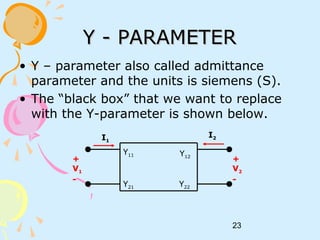
• Y – parameter also called admittance
parameter and the units is siemens (S).
• The “black box” that we want to replace
with the Y-parameter is shown below.
+
V1
-
I1
I2
+
V2
-
Y11
Y21
Y12
Y22
24
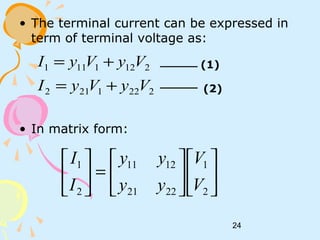
• The terminal current can be expressed in
term of terminal voltage as:
• In matrix form:
2221212
2121111
VyVyI
VyVyI
+=
+= (1)
(2)












=





2
1
2221
1211
2
1
V
V
yy
yy
I
I
25
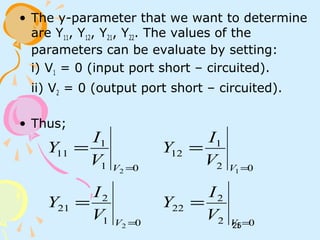
• The y-parameter that we want to determine
are Y11, Y12, Y21, Y22. The values of the
parameters can be evaluate by setting:
i) V1 = 0 (input port short – circuited).
ii) V2 = 0 (output port short – circuited).
• Thus;
01
2
21
01
1
11
2
2
=
=
=
=
V
V
V
I
Y
V
I
Y
02
2
22
02
1
12
1
1
=
=
=
=
V
V
V
I
Y
V
I
Y
26
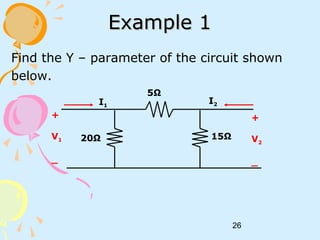
Example 1Example 1
Find the Y – parameter of the circuit shown
below.
5Ω
15Ω20Ω
+
V1
_
+
V2
_
I1
I2
27
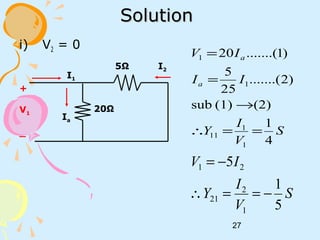
SolutionSolution
i) V2 = 0
5Ω
20Ω
+
V1
_
I1
I2
Ia
S
V
I
Y
II
IV
a
a
4
1
(2)(1)sub
)2.......(
25
5
)1.......(20
1
1
11
1
1
==∴
→
=
=
S
V
I
Y
IV
5
1
5
1
2
21
21
−==∴
−=
28
ii) V1 = 0
In matrix form;
5Ω
15Ω
+
V2
_
I1
I2
Ix
S
V
I
Y
II
IV
x
x
15
4
(4)(3)sub
)4.......(
25
5
)3.......(15
2
2
22
2
2
==∴
→
=
=
S
V
I
Y
IV
5
1
5
2
1
12
12
−==∴
−=
[ ] SY










−
−
=
15
4
5
1
5
1
4
1
29
Example 2 (circuit withExample 2 (circuit with
dependent source)dependent source)
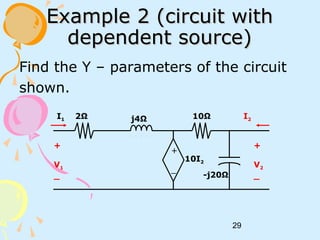
Find the Y – parameters of the circuit
shown.
+
_
+
V1
_
+
V2
_-j20Ω
10Ωj4Ω2Ω
10I2
I2I1
30
SolutionSolution
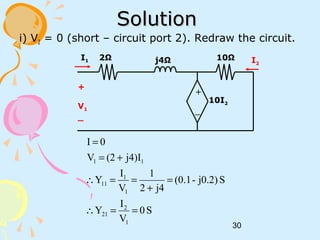
i) V2 = 0 (short – circuit port 2). Redraw the circuit.
+
_
+
V1
_
10Ωj4Ω2Ω
10I2
I2
I1
S0
V
I
Y
Sj0.2)-(0.1
j42
1
V
I
Y
j4)I(2V
0I
1
2
21
1
1
11
11
==∴
=
+
==∴
+=
=
31
ii) V1 = 0 (short – circuit port 1). Redraw the circuit.
)2.......(
j20-
1
10
1
V2I
10
10I-V
j20-
V
I
)........(1
j42
10I-
I
22
222
2
2
1






+=
+=
+
=
+
_
+
V2
_-j20Ω
10Ωj4Ω2Ω
10I2
I2I1
[ ] S
j0.0250.050
j0.0751.0j0.20.1
Y
form;matrixIn
Sj0.075)(-0.1
V
I
Y
(1)(2)sub
Sj0.025)(0.05
V
I
Y
2
1
12
2
2
22






+
+−+
=∴
+==
→
+==∴
32
T (ABCD) PARAMETERT (ABCD) PARAMETER
• T – parameter or ABCD – parameter is a
another set of parameters relates the
variables at the input port to those at the
output port.
• T – parameter also called transmission
parameters because this parameter are
useful in the analysis of transmission lines
because they express sending – end
variables (V1 and I1) in terms of the
receiving – end variables (V2 and -I2).
33
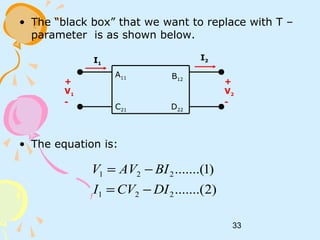
• The “black box” that we want to replace with T –
parameter is as shown below.
• The equation is:
+
V1
-
I1
I2
+
V2
-
A11
C21
B12
D22
)2.......(
)1.......(
221
221
DICVI
BIAVV
−=
−=
34
• In matrix form is:
• The T – parameter that we want
determine are A, B, C and D where A and
D are dimensionless, B is in ohm (Ω) and
C is in siemens (S).
• The values can be evaluated by setting
i) I2 = 0 (input port open – circuit)
ii) V2 = 0 (output port short circuit)






−





=





2
2
1
1
I
V
DC
BA
I
V
35
• Thus;
• In term of the transmission parameter, a
network is reciprocal if;
02
1
02
1
2
2
=
=
=
=
I
I
V
I
C
V
V
A
02
1
02
1
2
2
=
=
=
=
V
V
I
I
D
I
V
B
1BC-AD =
36
ExampleExample
Find the ABCD – parameter of the circuit
shown below.
2Ω
10Ω
+
V2
_
I1 I2
+
V1
_
4Ω
37
SolutionSolution
i) I2 = 0,
2Ω
10Ω
+
V2
_
I1
+
V1
_
2.1
5
6
10
2
2
1.0
10
2
1
22
2
1
211
2
1
12
==∴
=+





=
+=
==∴
=
V
V
A
VV
V
V
VIV
S
V
I
C
IV
38
ii) V2 = 0,
( )
Ω=−=∴
+





−=
+=
++=
=−=∴
−=
8.6
10
10
14
12
1012
102
4.1
14
10
2
1
221
211
2111
2
1
12
I
V
B
IIV
IIV
IIIV
I
I
D
II
2Ω
10Ω
I1 I2
+
V1
_
4Ω
I1 + I2
[ ] 





=
4.11.0
8.62.1
T
39
TERMINATED TWO – PORTTERMINATED TWO – PORT
NETWORKSNETWORKS
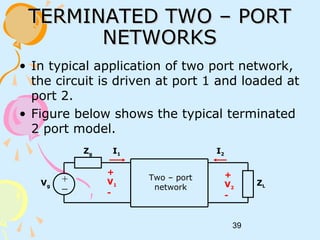
• In typical application of two port network,
the circuit is driven at port 1 and loaded at
port 2.
• Figure below shows the typical terminated
2 port model.
+
V1
-
I1 I2
+
V2
-
+
−
Zg
ZLVg
Two – port
network
40
• Zg represents the internal impedance of
the source and Vg is the internal voltage of
the source and ZL is the load impedance.
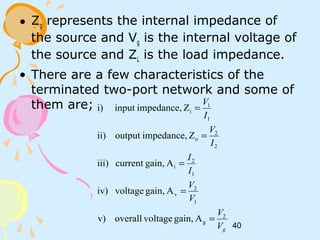
• There are a few characteristics of the
terminated two-port network and some of
them are;
gV
V
V
V
I
I
I
V
I
V
2
g
1
2
v
1
2
i
2
2
o
1
1
i
Again,voltageoverallv)
Again,voltageiv)
Again,currentiii)
Zimpedance,outputii)
Zimpedance,inputi)
=
=
=
=
=
41
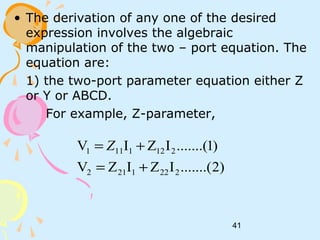
• The derivation of any one of the desired
expression involves the algebraic
manipulation of the two – port equation. The
equation are:
1) the two-port parameter equation either Z
or Y or ABCD.
For example, Z-parameter,
)2.......(IZIZV
)1.......(IZIV
2221212
2121111
+=
+= Z
42
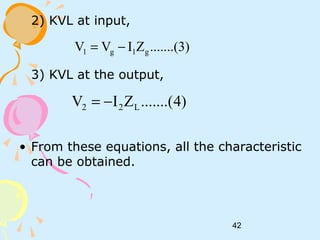
2) KVL at input,
3) KVL at the output,
• From these equations, all the characteristic
can be obtained.
.......(3)ZIVV g1g1 −=
)4.......(ZIV L22 −=
43
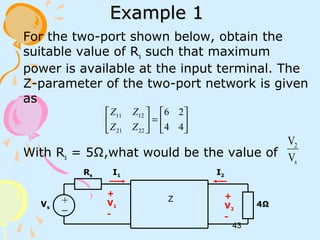
Example 1Example 1
For the two-port shown below, obtain the
suitable value of Rs such that maximum
power is available at the input terminal. The
Z-parameter of the two-port network is given
as
With Rs = 5Ω,what would be the value of






=





44
26
2221
1211
ZZ
ZZ
s
2
V
V
+
V1
-
I1 I2
+
V2
-
+
−
Rs
4ΩVs
Z
44
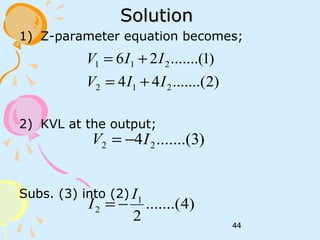
SolutionSolution
1) Z-parameter equation becomes;
2) KVL at the output;
Subs. (3) into (2)
)2.......(44
)1.......(26
212
211
IIV
IIV
+=
+=
)3.......(4 22 IV −=
)4.......(
2
1
2
I
I −=
45
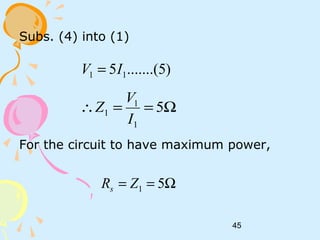
Subs. (4) into (1)
For the circuit to have maximum power,
)5.......(5 11 IV =
Ω==∴ 5
1
1
1
I
V
Z
Ω== 51ZRs
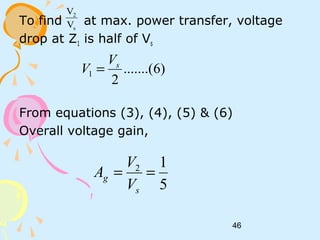
46
To find at max. power transfer, voltage
drop at Z1 is half of Vs
From equations (3), (4), (5) & (6)
Overall voltage gain,
s
2
V
V
)6.......(
2
1
sV
V =
5
12
==
s
g
V
V
A
47
Example 2Example 2
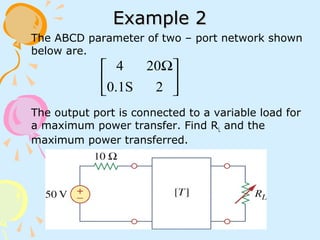
The ABCD parameter of two – port network shown
below are.
The output port is connected to a variable load for
a maximum power transfer. Find RL and the
maximum power transferred.





 Ω
20.1S
204
48
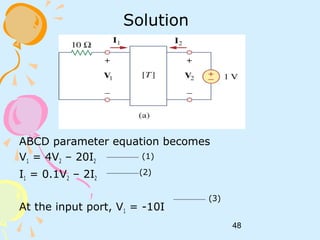
ABCD parameter equation becomes
V1 = 4V2 – 20I2
I1 = 0.1V2 – 2I2
At the input port, V1 = -10I
(1)
(2)
(3)
Solution
49
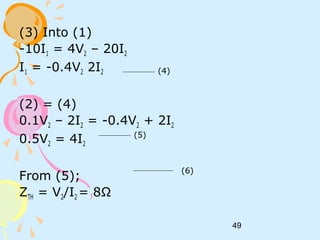
(3) Into (1)
-10I1 = 4V2 – 20I2
I1 = -0.4V2 2I2
(2) = (4)
0.1V2 – 2I2 = -0.4V2 + 2I2
0.5V2 = 4I2
From (5);
ZTH = V2/I2 = 8Ω
(4)
(5)
(6)
50
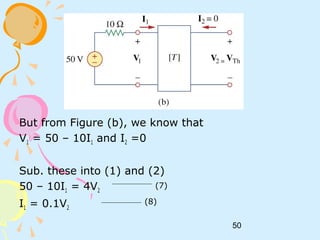
But from Figure (b), we know that
V1 = 50 – 10I1 and I2 =0
Sub. these into (1) and (2)
50 – 10I1 = 4V2
I1 = 0.1V2
(8)
(7)
51
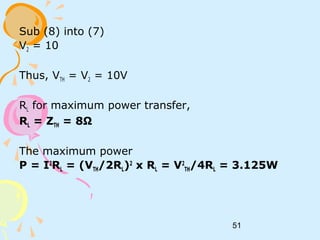
Sub (8) into (7)
V2 = 10
Thus, VTH = V2 = 10V
RL for maximum power transfer,
RL = ZTH = 8Ω
The maximum power
P = I2
RL = (VTH/2RL)2
x RL = V2
TH/4RL = 3.125W

2portnetwork-150303092056-conversion-gate01

  • 1.
  • 2.
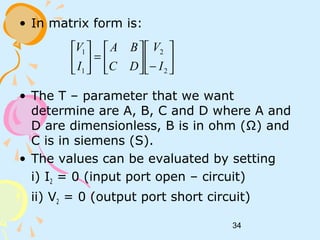
    2 SUB - TOPICSSUB- TOPICS Z – PARAMETER Y – PARAMETER T (ABCD) – PARAMETER TERMINATED TWO PORT NETWORKS
  • 3.
    3 OBJECTIVESOBJECTIVES • TO UNDERSTANDABOUT TWO – PORT NETWORKS AND ITS FUNTIONS. • TO UNDERSTAND THE DIFFERENT BETWEEN Z – PARAMETER, Y – PARAMETER, T – PARAMETER AND TERMINATED TWO PORT NETWORKS. • TO INVERTIGATE AND ANALYSIS THE BEHAVIOUR OF TWO – PORT NETWORKS.
  • 4.
    4 TWO – PORTNETWORKSTWO – PORT NETWORKS • A pair of terminals through which a current may enter or leave a network is known as a port. • Two terminal devices or elements (such as resistors, capacitors, and inductors) results in one – port network. • Most of the circuits we have dealt with so far are two – terminal or one – port circuits.
  • 5.
    5 • A two– port network is an electrical network with two separate ports for input and output. • It has two terminal pairs acting as access points. The current entering one terminal of a pair leaves the other terminal in the pair.
  • 6.
    6 Linear network + V - I I One –port network Linear network + V1 - I1 I1 I2 I2 + V2 - Two – port network
  • 7.
    7 • Two (2)reason why to study two port – network: Such networks are useful in communication, control system, power systems and electronics. Knowing the parameters of a two – port network enables us to treat it as a “black box” when embedded within a larger network.
  • 8.
    8 • From thenetwork, we can observe that there are 4 variables that is I1, I2, V1and V2, which two are independent. • The various term that relate these voltages and currents are called parameters.
  • 9.
    9 Z – PARAMETERZ– PARAMETER • Z – parameter also called as impedance parameter and the units is ohm (Ω) • Impedance parameters is commonly used in the synthesis of filters and also useful in the design and analysis of impedance matching networks and power distribution networks. • The two – port network may be voltage – driven or current – driven.
  • 10.
    10 • Two –port network driven by voltage source. • Two – port network driven by current sources. Linear network I1 I2 + − + − V1 V2 I1 I2 + V1 - Linear network + V2 -
  • 11.
    11 • The “blackbox” is replace with Z-parameter is as shown below. • The terminal voltage can be related to the terminal current as: + V1 - I1 I2 + V2 - Z11 Z21 Z12 Z22 2221212 2121111 IzIzV IzIzV += += (1) (2)
  • 12.
    12 • In matrixform as: • The Z-parameter that we want to determine are z11, z12, z21, z22. • The value of the parameters can be evaluated by setting: 1. I1= 0 (input port open – circuited) 2. I2= 0 (output port open – circuited)             =      2 1 2221 1211 2 1 I I zz zz V V
  • 13.
  • 14.
    14 • Where; z11 =open – circuit input impedance. z12 = open – circuit transfer impedance from port 1 to port 2. z21 = open – circuit transfer impedance from port 2 to port 1. z22 = open – circuit output impedance.
  • 15.
    15 Example 1Example 1 Findthe Z – parameter of the circuit below. 40Ω 240Ω 120Ω + V1 _ + V2 _ I1 I2
  • 16.
    16 SolutionSolution i) I2 =0(open circuit port 2). Redraw the circuit. 40Ω 240Ω 120Ω + V1 _ + V2 _ I1 Ia Ib
  • 17.
  • 18.
    18 ii) I1 =0 (open circuit port 1). Redraw the circuit. 40Ω 240Ω 120Ω + V1 _ + V2 _ Iy I2 Ix
  • 19.
  • 20.
    20 Example 2Example 2 Findthe Z – parameter of the circuit below + _ + V1 _ + V2 _-j20Ω 10Ωj4Ω2Ω 10I2 I2I1
  • 21.
    21 SolutionSolution i) I2 =0 (open circuit port 2). Redraw the circuit. Ω=∴ = Ω+==∴ += 0Z circuit)(short0V j4)(2 I V Z j4)(2IV 21 2 1 1 11 11 + V1 _ j4Ω2ΩI1 + V2 _ I2 = 0
  • 22.
    22 ii) I1 =0 (open circuit port 1). Redraw the circuit. Ω==∴       += + − = Ω==∴ = j8)-(16 I V Z 10 1 20 j V2I 10 10I-V j20 V I 10 I V Z 10IV 2 2 22 22 222 2 2 1 12 21 [ ]       + = j8)-(1610 0j4)(2 Z form;matrixIn + _ + V1 _ + V2 _-j20Ω 10Ω 10I2 I2I1 = 0
  • 23.
    23 Y - PARAMETERY- PARAMETER • Y – parameter also called admittance parameter and the units is siemens (S). • The “black box” that we want to replace with the Y-parameter is shown below. + V1 - I1 I2 + V2 - Y11 Y21 Y12 Y22
  • 24.
    24 • The terminalcurrent can be expressed in term of terminal voltage as: • In matrix form: 2221212 2121111 VyVyI VyVyI += += (1) (2)             =      2 1 2221 1211 2 1 V V yy yy I I
  • 25.
    25 • The y-parameterthat we want to determine are Y11, Y12, Y21, Y22. The values of the parameters can be evaluate by setting: i) V1 = 0 (input port short – circuited). ii) V2 = 0 (output port short – circuited). • Thus; 01 2 21 01 1 11 2 2 = = = = V V V I Y V I Y 02 2 22 02 1 12 1 1 = = = = V V V I Y V I Y
  • 26.
    26 Example 1Example 1 Findthe Y – parameter of the circuit shown below. 5Ω 15Ω20Ω + V1 _ + V2 _ I1 I2
  • 27.
    27 SolutionSolution i) V2 =0 5Ω 20Ω + V1 _ I1 I2 Ia S V I Y II IV a a 4 1 (2)(1)sub )2.......( 25 5 )1.......(20 1 1 11 1 1 ==∴ → = = S V I Y IV 5 1 5 1 2 21 21 −==∴ −=
  • 28.
    28 ii) V1 =0 In matrix form; 5Ω 15Ω + V2 _ I1 I2 Ix S V I Y II IV x x 15 4 (4)(3)sub )4.......( 25 5 )3.......(15 2 2 22 2 2 ==∴ → = = S V I Y IV 5 1 5 2 1 12 12 −==∴ −= [ ] SY           − − = 15 4 5 1 5 1 4 1
  • 29.
    29 Example 2 (circuitwithExample 2 (circuit with dependent source)dependent source) Find the Y – parameters of the circuit shown. + _ + V1 _ + V2 _-j20Ω 10Ωj4Ω2Ω 10I2 I2I1
  • 30.
    30 SolutionSolution i) V2 =0 (short – circuit port 2). Redraw the circuit. + _ + V1 _ 10Ωj4Ω2Ω 10I2 I2 I1 S0 V I Y Sj0.2)-(0.1 j42 1 V I Y j4)I(2V 0I 1 2 21 1 1 11 11 ==∴ = + ==∴ += =
  • 31.
    31 ii) V1 =0 (short – circuit port 1). Redraw the circuit. )2.......( j20- 1 10 1 V2I 10 10I-V j20- V I )........(1 j42 10I- I 22 222 2 2 1       += += + = + _ + V2 _-j20Ω 10Ωj4Ω2Ω 10I2 I2I1 [ ] S j0.0250.050 j0.0751.0j0.20.1 Y form;matrixIn Sj0.075)(-0.1 V I Y (1)(2)sub Sj0.025)(0.05 V I Y 2 1 12 2 2 22       + +−+ =∴ +== → +==∴
  • 32.
    32 T (ABCD) PARAMETERT(ABCD) PARAMETER • T – parameter or ABCD – parameter is a another set of parameters relates the variables at the input port to those at the output port. • T – parameter also called transmission parameters because this parameter are useful in the analysis of transmission lines because they express sending – end variables (V1 and I1) in terms of the receiving – end variables (V2 and -I2).
  • 33.
    33 • The “blackbox” that we want to replace with T – parameter is as shown below. • The equation is: + V1 - I1 I2 + V2 - A11 C21 B12 D22 )2.......( )1.......( 221 221 DICVI BIAVV −= −=
  • 34.
    34 • In matrixform is: • The T – parameter that we want determine are A, B, C and D where A and D are dimensionless, B is in ohm (Ω) and C is in siemens (S). • The values can be evaluated by setting i) I2 = 0 (input port open – circuit) ii) V2 = 0 (output port short circuit)       −      =      2 2 1 1 I V DC BA I V
  • 35.
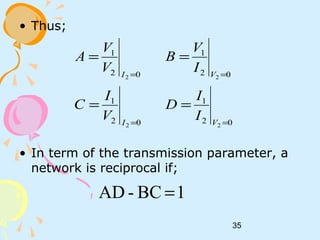
    35 • Thus; • Interm of the transmission parameter, a network is reciprocal if; 02 1 02 1 2 2 = = = = I I V I C V V A 02 1 02 1 2 2 = = = = V V I I D I V B 1BC-AD =
  • 36.
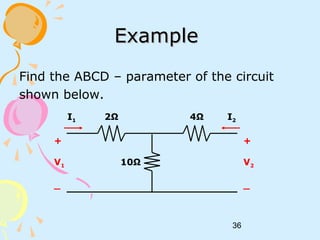
    36 ExampleExample Find the ABCD– parameter of the circuit shown below. 2Ω 10Ω + V2 _ I1 I2 + V1 _ 4Ω
  • 37.
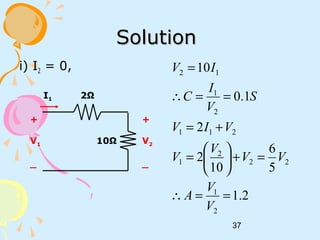
    37 SolutionSolution i) I2 =0, 2Ω 10Ω + V2 _ I1 + V1 _ 2.1 5 6 10 2 2 1.0 10 2 1 22 2 1 211 2 1 12 ==∴ =+      = += ==∴ = V V A VV V V VIV S V I C IV
  • 38.
    38 ii) V2 =0, ( ) Ω=−=∴ +      −= += ++= =−=∴ −= 8.6 10 10 14 12 1012 102 4.1 14 10 2 1 221 211 2111 2 1 12 I V B IIV IIV IIIV I I D II 2Ω 10Ω I1 I2 + V1 _ 4Ω I1 + I2 [ ]       = 4.11.0 8.62.1 T
  • 39.
    39 TERMINATED TWO –PORTTERMINATED TWO – PORT NETWORKSNETWORKS • In typical application of two port network, the circuit is driven at port 1 and loaded at port 2. • Figure below shows the typical terminated 2 port model. + V1 - I1 I2 + V2 - + − Zg ZLVg Two – port network
  • 40.
    40 • Zg representsthe internal impedance of the source and Vg is the internal voltage of the source and ZL is the load impedance. • There are a few characteristics of the terminated two-port network and some of them are; gV V V V I I I V I V 2 g 1 2 v 1 2 i 2 2 o 1 1 i Again,voltageoverallv) Again,voltageiv) Again,currentiii) Zimpedance,outputii) Zimpedance,inputi) = = = = =
  • 41.
    41 • The derivationof any one of the desired expression involves the algebraic manipulation of the two – port equation. The equation are: 1) the two-port parameter equation either Z or Y or ABCD. For example, Z-parameter, )2.......(IZIZV )1.......(IZIV 2221212 2121111 += += Z
  • 42.
    42 2) KVL atinput, 3) KVL at the output, • From these equations, all the characteristic can be obtained. .......(3)ZIVV g1g1 −= )4.......(ZIV L22 −=
  • 43.
    43 Example 1Example 1 Forthe two-port shown below, obtain the suitable value of Rs such that maximum power is available at the input terminal. The Z-parameter of the two-port network is given as With Rs = 5Ω,what would be the value of       =      44 26 2221 1211 ZZ ZZ s 2 V V + V1 - I1 I2 + V2 - + − Rs 4ΩVs Z
  • 44.
    44 SolutionSolution 1) Z-parameter equationbecomes; 2) KVL at the output; Subs. (3) into (2) )2.......(44 )1.......(26 212 211 IIV IIV += += )3.......(4 22 IV −= )4.......( 2 1 2 I I −=
  • 45.
    45 Subs. (4) into(1) For the circuit to have maximum power, )5.......(5 11 IV = Ω==∴ 5 1 1 1 I V Z Ω== 51ZRs
  • 46.
    46 To find atmax. power transfer, voltage drop at Z1 is half of Vs From equations (3), (4), (5) & (6) Overall voltage gain, s 2 V V )6.......( 2 1 sV V = 5 12 == s g V V A
  • 47.
    47 Example 2Example 2 TheABCD parameter of two – port network shown below are. The output port is connected to a variable load for a maximum power transfer. Find RL and the maximum power transferred.       Ω 20.1S 204
  • 48.
    48 ABCD parameter equationbecomes V1 = 4V2 – 20I2 I1 = 0.1V2 – 2I2 At the input port, V1 = -10I (1) (2) (3) Solution
  • 49.
    49 (3) Into (1) -10I1= 4V2 – 20I2 I1 = -0.4V2 2I2 (2) = (4) 0.1V2 – 2I2 = -0.4V2 + 2I2 0.5V2 = 4I2 From (5); ZTH = V2/I2 = 8Ω (4) (5) (6)
  • 50.
    50 But from Figure(b), we know that V1 = 50 – 10I1 and I2 =0 Sub. these into (1) and (2) 50 – 10I1 = 4V2 I1 = 0.1V2 (8) (7)
  • 51.
    51 Sub (8) into(7) V2 = 10 Thus, VTH = V2 = 10V RL for maximum power transfer, RL = ZTH = 8Ω The maximum power P = I2 RL = (VTH/2RL)2 x RL = V2 TH/4RL = 3.125W