Synthesis of one-port networks
with two kind of elements
Contents
 Network Function
 Hurwitz Polynomial
 Positive Real function
 Properties of L-C immittance functions
 Properties
 Examples of immittance and non-immittance
functions
 Synthesis of L-C driving-point immittance
 Synthesis of L-C circuit
 Examples of synthesis
Network Functions
As the name suggests, in theory of network synthesis we are going to study
about the synthesis of various networks which consists of both the active
(Energy source) and passive elements (resistor, inductors and capacitors).
what is a network function?
In the frequency domain, network functions are defined as the
quotient obtained by dividing the phasor corresponding to the
circuit output by the phasor corresponding to the circuit input.
In simple words, network functions are the ratio of output phasor
to the input phasor when phasors exists in frequency domain.
 The degree of the numerator of F(s) should not exceed the degree of
denominator by more than unity. In other words (m - n) should be less than or
equal to one.
 F(s) should not have multiple poles on the jω-axis or the y-axis of the pole-
zero plot.
 F(s) should not have poles on the right half of the s-plane.
Network Functions
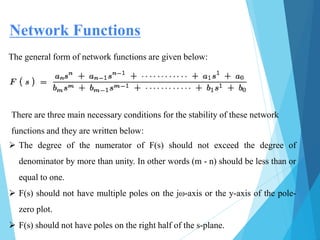
The general form of network functions are given below:
There are three main necessary conditions for the stability of these network
functions and they are written below:
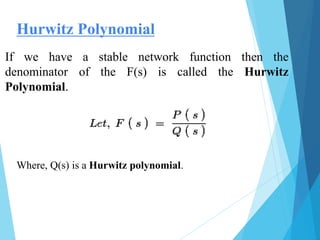
If we have a stable network function then the
denominator of the F(s) is called the Hurwitz
Polynomial.
Hurwitz Polynomial
Where, Q(s) is a Hurwitz polynomial.
 For all real values of s value of the function P(s) should be real.
 The real part of every root should be either zero or negative.
 Let us consider the coefficients of denominator of F(s) is bn, b(n-1),
b(n-2). . . . b0. Here it should be noted that bn, b(n-1), b0 must be
positive and bn and b(n-1) should not be equal to zero
simultaneously.
Properties of Hurwitz Polynomials
 The continued fraction expansion of Even/Odd or Odd/Even part of
the Hurwitz polynomial should give all positive quotient terms.
 In case of purely even or purely odd polynomial, we must do continued
fraction with the derivative of the purely even or purely odd polynomial and
rest of the procedure is same as mentioned in the point number (4).
From the above discussion we conclude one very simple result,
If all the coefficients of the quadratic polynomial are real and positive then
that quadratic polynomial is always a Hurwitz polynomial.
 F(s) should give real values for all real values of s.
 P(s) should be a Hurwitz polynomial.
 If we substitute s = jω then on separating the real and imaginary parts, the real
part of the function should be greater than or equal to zero, means it should be
non negative. This most important condition and we will frequently use this
condition in order to find out the whether the function is positive real or not.
 On substituting s = jω, F(s) should posses simple poles and the residues should
be real and positive.
Positive Real Functions
Any function which is in the form of F(s) will be called as a positive real
function if fulfill these four important conditions:
 The numerator and denominator of F(s) should be Hurwitz polynomials.
 The degree of the numerator of F(s) should not exceed the degree of
denominator by more than unity. In other words (m-n) should be less than or
equal to one.
 If F(s) is positive real function then reciprocal of F(s) should also be positive
real function.
 Remember the summation of two or more positive real function is also a
positive real function but in case of the difference it may or may not be positive
real function.
Properties of Positive Real Function
Property 1. L-C immittance function
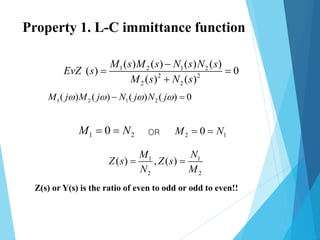
 1. ZLC (s) or YLC (s) is the ratio of odd to even or even to odd
polynomials.
 Consider the impedance Z(s) of passive one-port network.
(M is even N is odd)
As we know, when the input current is I, the average power dissipated by one-
port network is zero:
Average Power = = 0
(for pure reactive network)
1 1
2 2
( ) ( )
( )
( ) ( )
M s N s
Z s
M s N s



21
Re[ ( )]
2
Z j I
1 2 1 2( ) ( ) ( ) ( ) 0M j M j N j N j    
1 2 1 2
2 2
2 2
( ) ( ) ( ) ( )
( ) 0
( ) ( )
M s M s N s N s
EvZ s
M s N s

 

1 20M N  2 10M N OR
1 1
2 2
( ) , ( )
M N
Z s Z s
N M
 
Z(s) or Y(s) is the ratio of even to odd or odd to even!!
Property 1. L-C immittance function
Property 2. L-C immittance function
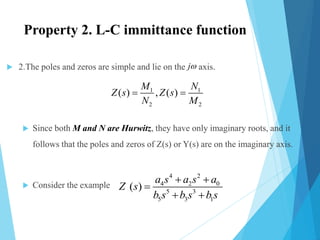
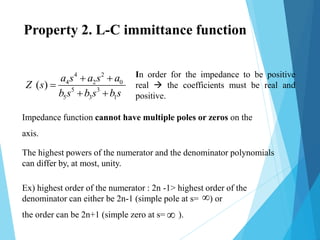
 2.The poles and zeros are simple and lie on the axis.
 Since both M and N are Hurwitz, they have only imaginary roots, and it
follows that the poles and zeros of Z(s) or Y(s) are on the imaginary axis.
 Consider the example
j
1 1
2 2
( ) , ( )
M N
Z s Z s
N M
 
4 2
4 2 0
5 3
5 3 1
( )
a s a s a
Z s
b s b s b s
 

 
Ex) highest order of the numerator : 2n -1> highest order of the
denominator can either be 2n-1 (simple pole at s= ) or
the order can be 2n+1 (simple zero at s= ).
Impedance function cannot have multiple poles or zeros on the
axis.
In order for the impedance to be positive
real  the coefficients must be real and
positive.
4 2
4 2 0
5 3
5 3 1
( )
a s a s a
Z s
b s b s b s
 

 


The highest powers of the numerator and the denominator polynomials
can differ by, at most, unity.
Property 2. L-C immittance function
Property 3. L-C immittance function
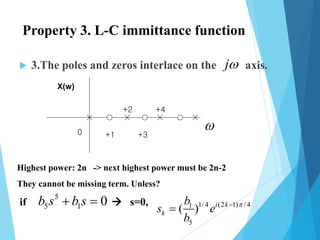
 3.The poles and zeros interlace on the axis.j
0 +1
+2
+3
+4
X(w)
Highest power: 2n -> next highest power must be 2n-2
They cannot be missing term. Unless?
if  s=0,
5
5 1 0b s b s  1/4 (2 1) /41
5
( ) i k
k
b
s e
b


2 2 2 2 2 2
1 3
2 2 2 2 2 2
2 4
( )( )...( )...
( )
( )( )...( )...
i
j
K s s s
Z s
s s s s
  
  
  

  
0 2 4
2 2 2 2
2 4
2 2
( ) ...
K K s K s
Z s K s
s s s      
 
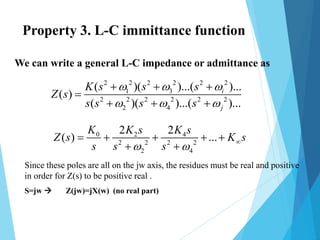
We can write a general L-C impedance or admittance as
Since these poles are all on the jw axis, the residues must be real and positive
in order for Z(s) to be positive real .
S=jw  Z(jw)=jX(w) (no real part)
Property 3. L-C immittance function
2 2
0 2 2
2 2 2
2
( )( )
...
( )
K KdX
K
d
 
   

   

( )
0
dX
d



2 2
3
2 2 2 2
2 4
( )
( )
( )( )
Ks s
Z s
s s

 


 
2 2
3
2 2 2 2
2 4
( )
( )
( )( )
K
jX j
  

   
 
 
   
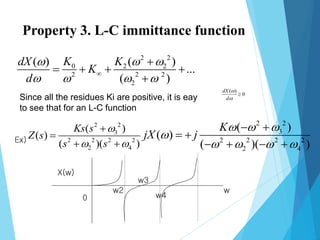
Since all the residues Ki are positive, it is eay
to see that for an L-C function
Ex)
w
X(w)
0
w2
w3
w4
Property 3. L-C immittance function
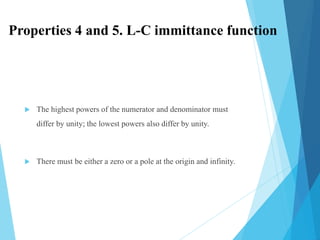
Properties 4 and 5. L-C immittance function
 The highest powers of the numerator and denominator must
differ by unity; the lowest powers also differ by unity.
 There must be either a zero or a pole at the origin and infinity.
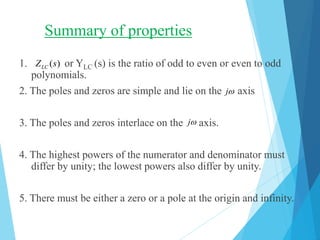
Summary of properties
1. or YLC (s) is the ratio of odd to even or even to odd
polynomials.
2. The poles and zeros are simple and lie on the axis
3. The poles and zeros interlace on the axis.
4. The highest powers of the numerator and denominator must
differ by unity; the lowest powers also differ by unity.
5. There must be either a zero or a pole at the origin and infinity.
( )LCZ s
j
j
Examples
2
2 2
( 4)
( )
( 1)( 3)
Ks s
Z s
s s


 
5 3
4 2
4 5
( )
3 6
s s s
Z s
s s
 


2 2
2 2
( 1)( 9)
( )
( 2)( 10)
K s s
Z s
s s
 

 
2 2
2
2( 1)( 9)
( )
( 4)
s s
Z s
s s
 


Synthesis of L-C Driving point immittances
 L-C immittance is a positive real function with
poles and zeros on the axis only.
 The synthesis is accomplished directly from the partial
fraction .
 F(s) is impedance -> then the term :
capacitor of 1/K farads
the K(infinite)s is an inductance of K(infinite) henrys.
0 2 4
2 2 2 2
2 4
2 2
( ) ...
K K s K s
Z s K s
s s s      
 
0 /K s
j
Is a parallel tank capacitance and inductance.
,
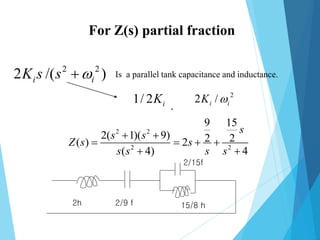
For Z(s) partial fraction
2 2
2 /( )i iK s s 
2
2 /i iK 1/ 2 iK
2 2
2 2
9 15
2( 1)( 9) 2 2( ) 2
( 4) 4
s
s s
Z s s
s s s s
 
   
 
2/15f
2/9 f2h 15/8 h
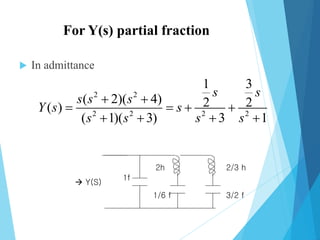
For Y(s) partial fraction
 In admittance
2 2
2 2 2 2
1 3
( 2)( 4) 2 2( )
( 1)( 3) 3 1
s s
s s s
Y s s
s s s s
 
   
   
 Y(S)
1f
3/2 f
2/3 h2h
1/6 f
Another methodology
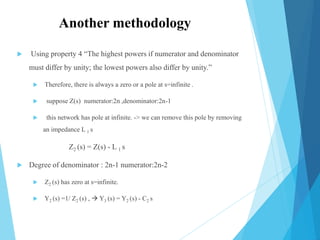
 Using property 4 “The highest powers if numerator and denominator
must differ by unity; the lowest powers also differ by unity.”
 Therefore, there is always a zero or a pole at s=infinite .
 suppose Z(s) numerator:2n ,denominator:2n-1
 this network has pole at infinite. -> we can remove this pole by removing
an impedance L 1 s
Z2 (s) = Z(s) - L 1 s
 Degree of denominator : 2n-1 numerator:2n-2
 Z2 (s) has zero at s=infinite.
 Y2 (s) =1/ Z2 (s) ,  Y3 (s) = Y2 (s) - C2 s
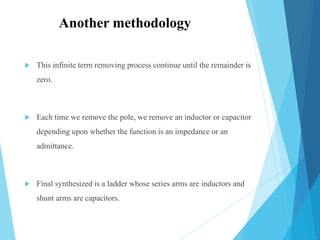
 This infinite term removing process continue until the remainder is
zero.
 Each time we remove the pole, we remove an inductor or capacitor
depending upon whether the function is an impedance or an
admittance.
 Final synthesized is a ladder whose series arms are inductors and
shunt arms are capacitors.
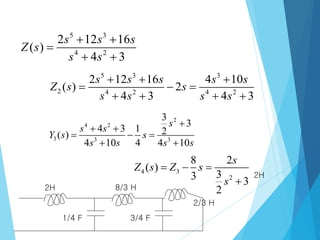
Another methodology
5 3
4 2
2 12 16
( )
4 3
s s s
Z s
s s
 

 
5 3 3
2 4 2 4 2
2 12 16 4 10
( ) 2
4 3 4 3
s s s s s
Z s s
s s s s
  
  
   
2
4 2
3 3 3
3
3
4 3 1 2( )
4 10 4 4 10
s
s s
Y s s
s s s s

 
  
 
4 3
2
8 2
( )
33 3
2
s
Z s Z s
s
  

2H
2H
1/4 F 3/4 F
2/3 H
8/3 H
 This circuit (Ladder) called as Cauer because Cauer discovered the
continues fraction method.
 Without going into the proof of the statement m in can be said that both
the Foster and Cauer form gice the minimum number of elements for a
specified L-C network.
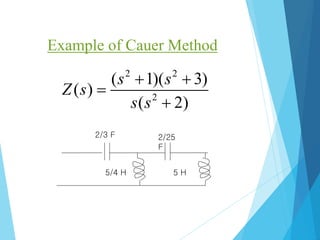
CAUER Form
Example of Cauer Method
2 2
2
( 1)( 3)
( )
( 2)
s s
Z s
s s
 


5/4 H 5 H
2/25
F
2/3 F

Network synthesis

  • 1.
    Synthesis of one-portnetworks with two kind of elements
  • 2.
    Contents  Network Function Hurwitz Polynomial  Positive Real function  Properties of L-C immittance functions  Properties  Examples of immittance and non-immittance functions  Synthesis of L-C driving-point immittance  Synthesis of L-C circuit  Examples of synthesis
  • 3.
    Network Functions As thename suggests, in theory of network synthesis we are going to study about the synthesis of various networks which consists of both the active (Energy source) and passive elements (resistor, inductors and capacitors). what is a network function? In the frequency domain, network functions are defined as the quotient obtained by dividing the phasor corresponding to the circuit output by the phasor corresponding to the circuit input. In simple words, network functions are the ratio of output phasor to the input phasor when phasors exists in frequency domain.
  • 4.
     The degreeof the numerator of F(s) should not exceed the degree of denominator by more than unity. In other words (m - n) should be less than or equal to one.  F(s) should not have multiple poles on the jω-axis or the y-axis of the pole- zero plot.  F(s) should not have poles on the right half of the s-plane. Network Functions The general form of network functions are given below: There are three main necessary conditions for the stability of these network functions and they are written below:
  • 5.
    If we havea stable network function then the denominator of the F(s) is called the Hurwitz Polynomial. Hurwitz Polynomial Where, Q(s) is a Hurwitz polynomial.
  • 6.
     For allreal values of s value of the function P(s) should be real.  The real part of every root should be either zero or negative.  Let us consider the coefficients of denominator of F(s) is bn, b(n-1), b(n-2). . . . b0. Here it should be noted that bn, b(n-1), b0 must be positive and bn and b(n-1) should not be equal to zero simultaneously. Properties of Hurwitz Polynomials
  • 7.
    Properties of HurwitzPolynomials  The continued fraction expansion of Even/Odd or Odd/Even part of the Hurwitz polynomial should give all positive quotient terms.  In case of purely even or purely odd polynomial, we must do continued fraction with the derivative of the purely even or purely odd polynomial and rest of the procedure is same as mentioned in the point number (4). From the above discussion we conclude one very simple result, If all the coefficients of the quadratic polynomial are real and positive then that quadratic polynomial is always a Hurwitz polynomial.
  • 8.
     F(s) shouldgive real values for all real values of s.  P(s) should be a Hurwitz polynomial.  If we substitute s = jω then on separating the real and imaginary parts, the real part of the function should be greater than or equal to zero, means it should be non negative. This most important condition and we will frequently use this condition in order to find out the whether the function is positive real or not.  On substituting s = jω, F(s) should posses simple poles and the residues should be real and positive. Positive Real Functions Any function which is in the form of F(s) will be called as a positive real function if fulfill these four important conditions:
  • 9.
     The numeratorand denominator of F(s) should be Hurwitz polynomials.  The degree of the numerator of F(s) should not exceed the degree of denominator by more than unity. In other words (m-n) should be less than or equal to one.  If F(s) is positive real function then reciprocal of F(s) should also be positive real function.  Remember the summation of two or more positive real function is also a positive real function but in case of the difference it may or may not be positive real function. Properties of Positive Real Function
  • 10.
    Property 1. L-Cimmittance function  1. ZLC (s) or YLC (s) is the ratio of odd to even or even to odd polynomials.  Consider the impedance Z(s) of passive one-port network. (M is even N is odd) As we know, when the input current is I, the average power dissipated by one- port network is zero: Average Power = = 0 (for pure reactive network) 1 1 2 2 ( ) ( ) ( ) ( ) ( ) M s N s Z s M s N s    21 Re[ ( )] 2 Z j I
  • 11.
    1 2 12( ) ( ) ( ) ( ) 0M j M j N j N j     1 2 1 2 2 2 2 2 ( ) ( ) ( ) ( ) ( ) 0 ( ) ( ) M s M s N s N s EvZ s M s N s     1 20M N  2 10M N OR 1 1 2 2 ( ) , ( ) M N Z s Z s N M   Z(s) or Y(s) is the ratio of even to odd or odd to even!! Property 1. L-C immittance function
  • 12.
    Property 2. L-Cimmittance function  2.The poles and zeros are simple and lie on the axis.  Since both M and N are Hurwitz, they have only imaginary roots, and it follows that the poles and zeros of Z(s) or Y(s) are on the imaginary axis.  Consider the example j 1 1 2 2 ( ) , ( ) M N Z s Z s N M   4 2 4 2 0 5 3 5 3 1 ( ) a s a s a Z s b s b s b s     
  • 13.
    Ex) highest orderof the numerator : 2n -1> highest order of the denominator can either be 2n-1 (simple pole at s= ) or the order can be 2n+1 (simple zero at s= ). Impedance function cannot have multiple poles or zeros on the axis. In order for the impedance to be positive real  the coefficients must be real and positive. 4 2 4 2 0 5 3 5 3 1 ( ) a s a s a Z s b s b s b s        The highest powers of the numerator and the denominator polynomials can differ by, at most, unity. Property 2. L-C immittance function
  • 14.
    Property 3. L-Cimmittance function  3.The poles and zeros interlace on the axis.j 0 +1 +2 +3 +4 X(w) Highest power: 2n -> next highest power must be 2n-2 They cannot be missing term. Unless? if  s=0, 5 5 1 0b s b s  1/4 (2 1) /41 5 ( ) i k k b s e b  
  • 15.
    2 2 22 2 2 1 3 2 2 2 2 2 2 2 4 ( )( )...( )... ( ) ( )( )...( )... i j K s s s Z s s s s s              0 2 4 2 2 2 2 2 4 2 2 ( ) ... K K s K s Z s K s s s s         We can write a general L-C impedance or admittance as Since these poles are all on the jw axis, the residues must be real and positive in order for Z(s) to be positive real . S=jw  Z(jw)=jX(w) (no real part) Property 3. L-C immittance function
  • 16.
    2 2 0 22 2 2 2 2 ( )( ) ... ( ) K KdX K d             ( ) 0 dX d    2 2 3 2 2 2 2 2 4 ( ) ( ) ( )( ) Ks s Z s s s        2 2 3 2 2 2 2 2 4 ( ) ( ) ( )( ) K jX j                 Since all the residues Ki are positive, it is eay to see that for an L-C function Ex) w X(w) 0 w2 w3 w4 Property 3. L-C immittance function
  • 17.
    Properties 4 and5. L-C immittance function  The highest powers of the numerator and denominator must differ by unity; the lowest powers also differ by unity.  There must be either a zero or a pole at the origin and infinity.
  • 18.
    Summary of properties 1.or YLC (s) is the ratio of odd to even or even to odd polynomials. 2. The poles and zeros are simple and lie on the axis 3. The poles and zeros interlace on the axis. 4. The highest powers of the numerator and denominator must differ by unity; the lowest powers also differ by unity. 5. There must be either a zero or a pole at the origin and infinity. ( )LCZ s j j
  • 19.
    Examples 2 2 2 ( 4) () ( 1)( 3) Ks s Z s s s     5 3 4 2 4 5 ( ) 3 6 s s s Z s s s     2 2 2 2 ( 1)( 9) ( ) ( 2)( 10) K s s Z s s s      2 2 2 2( 1)( 9) ( ) ( 4) s s Z s s s    
  • 20.
    Synthesis of L-CDriving point immittances  L-C immittance is a positive real function with poles and zeros on the axis only.  The synthesis is accomplished directly from the partial fraction .  F(s) is impedance -> then the term : capacitor of 1/K farads the K(infinite)s is an inductance of K(infinite) henrys. 0 2 4 2 2 2 2 2 4 2 2 ( ) ... K K s K s Z s K s s s s         0 /K s j
  • 21.
    Is a paralleltank capacitance and inductance. , For Z(s) partial fraction 2 2 2 /( )i iK s s  2 2 /i iK 1/ 2 iK 2 2 2 2 9 15 2( 1)( 9) 2 2( ) 2 ( 4) 4 s s s Z s s s s s s         2/15f 2/9 f2h 15/8 h
  • 22.
    For Y(s) partialfraction  In admittance 2 2 2 2 2 2 1 3 ( 2)( 4) 2 2( ) ( 1)( 3) 3 1 s s s s s Y s s s s s s            Y(S) 1f 3/2 f 2/3 h2h 1/6 f
  • 23.
    Another methodology  Usingproperty 4 “The highest powers if numerator and denominator must differ by unity; the lowest powers also differ by unity.”  Therefore, there is always a zero or a pole at s=infinite .  suppose Z(s) numerator:2n ,denominator:2n-1  this network has pole at infinite. -> we can remove this pole by removing an impedance L 1 s Z2 (s) = Z(s) - L 1 s  Degree of denominator : 2n-1 numerator:2n-2  Z2 (s) has zero at s=infinite.  Y2 (s) =1/ Z2 (s) ,  Y3 (s) = Y2 (s) - C2 s
  • 24.
     This infiniteterm removing process continue until the remainder is zero.  Each time we remove the pole, we remove an inductor or capacitor depending upon whether the function is an impedance or an admittance.  Final synthesized is a ladder whose series arms are inductors and shunt arms are capacitors. Another methodology
  • 25.
    5 3 4 2 212 16 ( ) 4 3 s s s Z s s s      5 3 3 2 4 2 4 2 2 12 16 4 10 ( ) 2 4 3 4 3 s s s s s Z s s s s s s           2 4 2 3 3 3 3 3 4 3 1 2( ) 4 10 4 4 10 s s s Y s s s s s s         4 3 2 8 2 ( ) 33 3 2 s Z s Z s s     2H 2H 1/4 F 3/4 F 2/3 H 8/3 H
  • 26.
     This circuit(Ladder) called as Cauer because Cauer discovered the continues fraction method.  Without going into the proof of the statement m in can be said that both the Foster and Cauer form gice the minimum number of elements for a specified L-C network. CAUER Form
  • 27.
    Example of CauerMethod 2 2 2 ( 1)( 3) ( ) ( 2) s s Z s s s     5/4 H 5 H 2/25 F 2/3 F