Concept of complex Frequency
Definition:
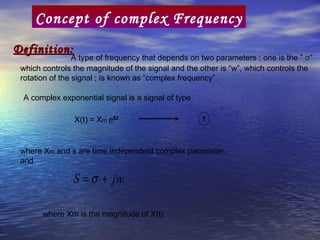
                 A type of frequency that depends on two parameters ; one is the ” σ”
 which controls the magnitude of the signal and the other is “w”, which controls the
 rotation of the signal ; is known as “complex frequency”.

 A complex exponential signal is a signal of type

                                                     1


 where Xm and s are time independent complex parameter.
 and

                S = σ + jw

       where Xm is the magnitude of X(t)
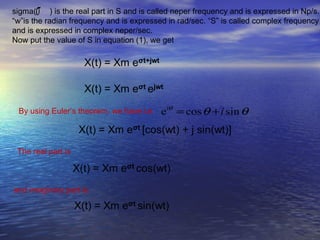
sigma(σ     ) is the real part in S and is called neper frequency and is expressed in Np/s.
“w”is the radian frequency and is expressed in rad/sec. “S” is called complex frequency
and is expressed in complex neper/sec.
Now put the value of S in equation (1), we get


 By using Euler’s theorem. we have i.e      eiθ = cos θ + i sin θ


 The real part is


and imaginary part is
The physical interpretation of complex frequency appearing in the exponential form
will be studied easily by considering a number of special cases for the different value
of S.


  Case no 1:
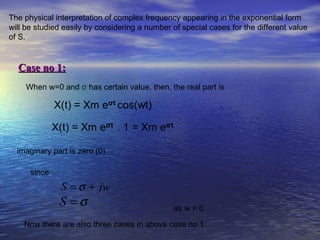
     When w=0 and σ has certain value, then, the real part is


  imaginary part is zero (0)

      since
               S = σ + jw
              S =σ                             as w = 0

    Now there are also three cases in above case no 1
σ
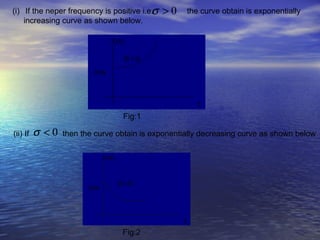
(i) If the neper frequency is positive i.e.   >0   the curve obtain is exponentially
    increasing curve as shown below.


                                 Fig:1

(ii) If   σ <0   then the curve obtain is exponentially decreasing curve as shown below


                                 Fig:2
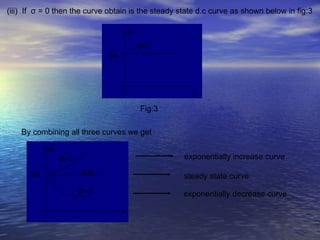
(iii) If σ = 0 then the curve obtain is the steady state d.c curve as shown below in fig:3


                                       Fig:3

    By combining all three curves we get


                                                    exponentially increase curve

                                                    steady state curve

                                                    exponentially decrease curve
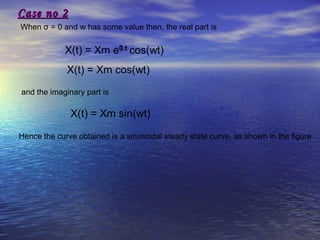
Case no 2
When σ = 0 and w has some value then, the real part is


and the imaginary part is


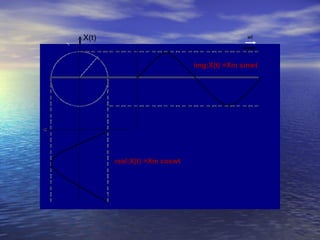
Hence the curve obtained is a sinusoidal steady state curve, as shown in the figure
X(t)                                        wt

                                                 wt

                             img:X(t) =Xm sinwt


       real:X(t) =Xm coswt
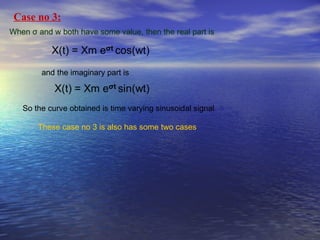
Case no 3:
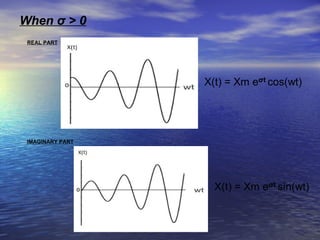
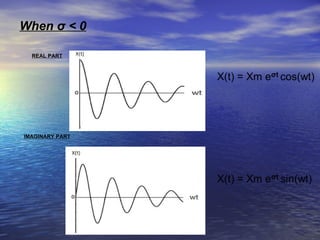
When σ and w both have some value, then the real part is


        and the imaginary part is


   So the curve obtained is time varying sinusoidal signal

       These case no 3 is also has some two cases
When σ > 0
 REAL PART


 IMAGINARY PART
When σ < 0

  REAL PART


IMAGINARY PART
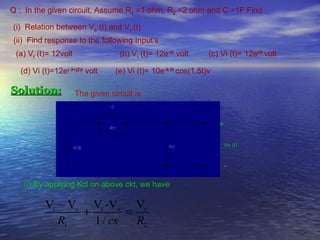
Q : In the given circuit, Assume R1 =1 ohm, R2 =2 ohm and C =1F Find

(i) Relation between Vo (t) and Vi (t)
(ii) Find response to the following Input’s
 (a) Vi (t)= 12volt                (b) Vi (t)= 12e-3t volt      (c) Vi (t)= 12ei2t volt

  (d) Vi (t)=12e(-3+j2)t volt     (e) Vi (t)= 10e-0.5t cos(1.5t)v

Solution:             The given circuit is


                                                                    +

                                                                        Vo (t)


                                                                        -

   (i) By applying Kcl on above ckt, we have

          Vi − Vo Vi -Vo Vo
                 +        =
             R1    1 / cs   R2
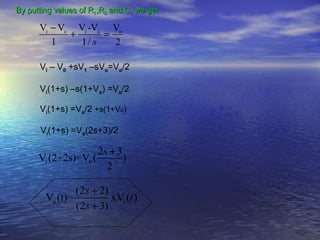
By putting values of R1,R2 and C, we get

      Vi − Vo Vi -Vo Vo
             +      =
         1     1/ s   2

      Vi – V0 +sV1 –sVo=Vo/2

      Vi(1+s) –s(1+Vo) =Vo/2

      Vi(1+s) =Vo/2 +s(1+Vo)

      Vi(1+s) =Vo(2s+3)/2

                     2s + 3
      Vi (2+2s)=V0 (        )
                       2

                  (2 s + 2)
        Vo (t)=             xVi (t )
                  (2 s + 3)
(ii) Response to the following Input is given below:
 (a) Vi (t)= 12volts


                     2(0) + 2
            Vo (t)=[          ]x12
                     2(0) + 3

            Vo (t)=8 volt
 (b) Vi (t) =12e-3t

                       2(−3) + 2
            Vo (t)=[             ]x12e −3t
                       2(−3) + 3
            Vo (t)=16e −3t
 (c) Vi (t) =12ej2t volt
                      2(2 j ) + 2
             Vo (t)=[             ]12e j 2t
                      2(2 j ) + 3
4 j + 2 4 j −3
       Vo (t)=[        x       ]x12e j 2t
                4 j +3 4 j −3


(d) Vi (t) =12e(-3+j2)t volt

                   2(−3 + j 2) + 2
        Vo (t)=[                   ]x12e ( −3+ j 2)t
                   2(−3 + j 2) + 3

        Vo (t)=13.57<8.130o e( −3+ j 2)t

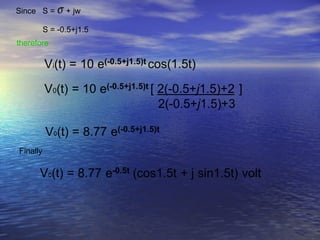
(e) Vi (t) =10e-0.5t cos(1.5t+30)

      Since the given response voltage is of only real part & we know that


      and we have given

       Vi =10,          σ      =-0.5, w =1.5,
Since S = σ + jw

          S = -0.5+j1.5
therefore


Finally
Concept of-complex-frequency

Concept of-complex-frequency

  • 2.
    Concept of complexFrequency Definition: A type of frequency that depends on two parameters ; one is the ” σ” which controls the magnitude of the signal and the other is “w”, which controls the rotation of the signal ; is known as “complex frequency”. A complex exponential signal is a signal of type 1 where Xm and s are time independent complex parameter. and S = σ + jw where Xm is the magnitude of X(t)
  • 3.
    sigma(σ ) is the real part in S and is called neper frequency and is expressed in Np/s. “w”is the radian frequency and is expressed in rad/sec. “S” is called complex frequency and is expressed in complex neper/sec. Now put the value of S in equation (1), we get By using Euler’s theorem. we have i.e eiθ = cos θ + i sin θ The real part is and imaginary part is
  • 4.
    The physical interpretationof complex frequency appearing in the exponential form will be studied easily by considering a number of special cases for the different value of S. Case no 1: When w=0 and σ has certain value, then, the real part is imaginary part is zero (0) since S = σ + jw S =σ as w = 0 Now there are also three cases in above case no 1
  • 5.
    σ (i) If theneper frequency is positive i.e. >0 the curve obtain is exponentially increasing curve as shown below. Fig:1 (ii) If σ <0 then the curve obtain is exponentially decreasing curve as shown below Fig:2
  • 6.
    (iii) If σ= 0 then the curve obtain is the steady state d.c curve as shown below in fig:3 Fig:3 By combining all three curves we get exponentially increase curve steady state curve exponentially decrease curve
  • 7.
    Case no 2 Whenσ = 0 and w has some value then, the real part is and the imaginary part is Hence the curve obtained is a sinusoidal steady state curve, as shown in the figure
  • 8.
    X(t) wt wt img:X(t) =Xm sinwt real:X(t) =Xm coswt
  • 9.
    Case no 3: Whenσ and w both have some value, then the real part is and the imaginary part is So the curve obtained is time varying sinusoidal signal These case no 3 is also has some two cases
  • 10.
    When σ >0 REAL PART IMAGINARY PART
  • 11.
    When σ <0 REAL PART IMAGINARY PART
  • 12.
    Q : Inthe given circuit, Assume R1 =1 ohm, R2 =2 ohm and C =1F Find (i) Relation between Vo (t) and Vi (t) (ii) Find response to the following Input’s (a) Vi (t)= 12volt (b) Vi (t)= 12e-3t volt (c) Vi (t)= 12ei2t volt (d) Vi (t)=12e(-3+j2)t volt (e) Vi (t)= 10e-0.5t cos(1.5t)v Solution: The given circuit is + Vo (t) - (i) By applying Kcl on above ckt, we have Vi − Vo Vi -Vo Vo + = R1 1 / cs R2
  • 13.
    By putting valuesof R1,R2 and C, we get Vi − Vo Vi -Vo Vo + = 1 1/ s 2 Vi – V0 +sV1 –sVo=Vo/2 Vi(1+s) –s(1+Vo) =Vo/2 Vi(1+s) =Vo/2 +s(1+Vo) Vi(1+s) =Vo(2s+3)/2 2s + 3 Vi (2+2s)=V0 ( ) 2 (2 s + 2) Vo (t)= xVi (t ) (2 s + 3)
  • 14.
    (ii) Response tothe following Input is given below: (a) Vi (t)= 12volts 2(0) + 2 Vo (t)=[ ]x12 2(0) + 3 Vo (t)=8 volt (b) Vi (t) =12e-3t 2(−3) + 2 Vo (t)=[ ]x12e −3t 2(−3) + 3 Vo (t)=16e −3t (c) Vi (t) =12ej2t volt 2(2 j ) + 2 Vo (t)=[ ]12e j 2t 2(2 j ) + 3
  • 15.
    4 j +2 4 j −3 Vo (t)=[ x ]x12e j 2t 4 j +3 4 j −3 (d) Vi (t) =12e(-3+j2)t volt 2(−3 + j 2) + 2 Vo (t)=[ ]x12e ( −3+ j 2)t 2(−3 + j 2) + 3 Vo (t)=13.57<8.130o e( −3+ j 2)t (e) Vi (t) =10e-0.5t cos(1.5t+30) Since the given response voltage is of only real part & we know that and we have given Vi =10, σ =-0.5, w =1.5,
  • 16.
    Since S =σ + jw S = -0.5+j1.5 therefore Finally