Dr. Inayat Ullah
PGT Paediatrics
 Definition
 Statistics
 Etiology
 Epidemiology
 Transmission
 Pathogenesis
 Extra pulmonary TB
 TB is an infectious, systemic chronic
granuomatous disease caused by
Mycobacterium tuberculosis (M) TB.
 It is an aerobic non-spore forming Acid Fast
Bacilli (AFB)
 Two other species Mycobacterium Bovis and
M.A fricanum rarely causes TB in humans
 New case: if child has never taken treatment
for TB or has taken ATT for less than 4 weeks.
 Relapse: If a child declared cured, or
treatment completed in the past, again has
clinical, radiological or bacteriological
evidence of TB.
 Transferred in: A child who is referred from
another TB register fro completion of
treatment
 Treatment failure: if a child on appropriate
treatment has clinical, radiological or
bacteriological evidence of active TB 2 or
more months after start of treatment.
 Return after default: if a child returns to
treatment after interrupting treatment for 2 or
more months.
 Others: A child who do not meet the above
criteria, such a child known to have taken ATT
for more than 4 months outside program.
 Tuberculosis (TB) is a top infectious disease
killer worldwide.
 In 2014, 9.6 million people fell ill with TB and 1.5
million died from the disease.
 Over 95% of TB deaths occur in low- and middle-
income countries, and it is among the top 5
causes of death for women aged 15 to 44.
 In 2014, an estimated 1 million children became
ill with TB and 140 000 children died of TB.
 TB is a leading killer of HIV-positive people: in
2015, 1 in 3HIV deaths was due to TB.
 Globally in 2014, an estimated 480 000 people
developed multidrug-resistant TB
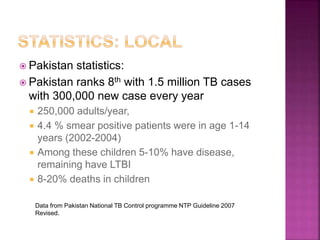
 Pakistan statistics:
 Pakistan ranks 8th with 1.5 million TB cases
with 300,000 new case every year
 250,000 adults/year,
 4.4 % smear positive patients were in age 1-14
years (2002-2004)
 Among these children 5-10% have disease,
remaining have LTBI
 8-20% deaths in children
Data from Pakistan National TB Control programme NTP Guideline 2007
Revised.
 Mycobacterium Tuberculosis complex
 M. Tuberculosis
 M. Bovis
 M. Africanum
 M. Microti
 M. Canetti
 M. Tuberculosis is the most important cause
of tuberculosis disease in humans
 Discovered by Robert Koch in 1882
 Non spore forming, non motile, pleomorphic
 Weakly gram positive, curved rods 2-4 µm
long
 Appear beaded or clumped in stained
specimens or culture media
 Obligate aerobes that grow in Loewenstein-
Jensen culture media
 Grow at 37-41ºC
 Acid fastness: capacity to form stable mycolate
complexes with arylmethane dyes (crystal violet,
carbolfuchsin etc). Once stained, they resist
decolouration with ethanol and hydrochloric or other
acids
 Lipid rich cell wall resistant to bactericidal actions
of antibody or complement
 Growth on solid media (Loewenstein Jensen):
slow, 3-6 weeks, additional 4 weeks for drug
susceptibility
 Growth on liquid media (BACTEC): 1-3 weeks,
additional 3-5 days for drug susceptibility
 Nucleic acid amplification (NAA) tests: can
detect M. tuberculosis within hours eg PCR
 By airborne mucus droplet nuclei, 1-5 µm in
diameter containing M. tuberculosis
 Rarely occurs by direct contact
 High chances of transmission in the following:
 Positive acid fast smear of sputum
 Extensive upper lobe infiltrate or cavity
 Copious production of thin sputum and severe &
forceful cough
 Environmental factors like poor air circulation
 Low chances of transmission in children:
 Most adults within 2 weeks after beginning
adequate chemotherapy becomes non-infectious
 Young children (sparse tubercle bacilli in
endobronchial secretions of children and lack of
tussive force of cough)
 Children are considered infectious when they are
having cavitatory lesion or draining TB wound
which can aerosoliz.
 However adults accompanying TB children
should have screening done because upto 15 %
of them had TB.
 M. bovis and M. africanum – airborne
transmission
 M. bovis penetrates the GI mucosa, lymphatic
tissue of oropharynx
 Human infection is low due to pasteurization
of milk in developed countries
A. Inhalation of bacilli
B. Containment in a
granuloma
C. Breakdown of the
granuloma in less
immunocompetent
individuals
 Inhalation of M. tuberculosis leads to one of
the three possible outcomes:
 Immediate clearance of the organism
 Latent tuberculosis infection (LTBI)
 Primary infection (onset of active disease)
 Time between initial infection & clinically
apparent disease:
 Disseminated & meningeal TB – 2-6 months
 Endobronchial TB & lymph node involvement – 3-
9 months
 Lesions of bones & joints – several years
 Renal lesions – decades
 Extrapulmonary manifestations develop in 25-
35% of children with TB, and 10% of
immunocompetent adults
Tubercle bacilli invade alveoli
Majority killed by activated macrophages
Some retained in inactivated macrophages
Infected macrophages produce cytokines and
chemokines
Attract other phagocytic cells (monocytes, more
macrophages, neutrophils etc)
Eventually form a nodular granulomatous structure
called the tubercle
Bacilli enter draining lymph nodes. This tuberculous lesion expansion into lung
parenchyma & LN involvement is called GHON COMPLEX
Source: Pakistan National TB Control programme NTP Guideline 2007
Revised.
 Cell mediated immunity develops 2-12 weeks
after infection along with tissue
hypersensitivity
 The pathologic events depend on the balance
among:
 Mycobacterial antigen load
 Cell mediated immunity (enhances intracellular
killing)
 Tissue hypersensitivity (enhances extracellular
killing)
 In absence of treatment
 Death in 80% of cases
 Remaining cases develop chronic disease
(repeated episodes characterized by fibrotic
changes)
 Complete spontaneous eradication is rare
CONTACT
NO INFECTION
INFECTION
NO DISEASE
DISEASE
EARLY DISEASE
LATE DISEASE
Cell-mediated
immunity
Defenses
(5%)
(5%)
(90%)
CONTACT
NO INFECTION
NO DISEASE
DISEASE
EARLY DISEASE
LATE DISEASE
Defenses
(5%)
(5%)
(90%)
INFECTION
cell-mediated
immunity
PPD positive
 Dormant bacteria seeded at the time of
primary infection
 Reactivation of tubercle bacilli (usually
endogenous regrowth of bacilli persisting in
partially encapsulated lesions)
 Localized lesion
 Little regional lymph node involvement and
less caseation
 Typically occurs at the lung apices
 Disseminated disease is unusual in
immunocompetent individuals
 Rare in children
 Common among adolescents and young
adults
 Risk of dissemination is high in:
 HIV infected persons
 Immunocompetent persons in highly endemic
areas
 TB in a pregnant woman has increased risk of
following in the neonate:
 Prematurity
 Fetal growth retardation
 Low birth weight
 Perinatal mortality
 Congenital TB is rare because TB of female
genital tract results in infertility
 Source:
 Primary infection in mother, transmitted through
placenta (umbilical vein) just before or during
delivery
 Tubercle bacilli first reach liver
 Periportal lymph node involvement
 Main fetal circulation → infect many organs
 Congenital TB can also be caused by
ingestion or aspiration of infected amniotic
fluid
 Most common cause of TB at birth is
postnatal airborne transmission of disease
Disseminated TB pneumonia
 Generalized dissemination through bloodstream
 caseous focus ruptures into blood vessel
 growth of tubercle within the blood vessel
 may be acute, occult or chronic, liver lung nad bone
marrow are uusually seeded.
 Uniformly fatal if not treated
 Rare
 Usually occurs in the first 4 months after primary
infection
 Occures in vulnerable hosts those with malnutrition
or immunodefeciency.
MILIARY Disease
 Millet seed appearance
on X-ray
 Mantoux positive?
 Most children still have
active primary complex
when miliary disease
strikes
 Most develop meningitis
SITES % Avg. Age
lymphatics 67 5y
meninges 13 3y
pleura 6 16y
miliary 5 1y
skeletal 4 5y
other 5
Clin Chest Med 1989, Am. Rev. Resp. Dis, 1990
 Dreadful complication of TB
 High morbidity and mortality
 Should be treated at tertiary care facility.
 Common form of extrapumonary TB after
lymphadenitis
 Commoner below 5 yr greatest risk 20% in
<12months.
 Involes basal meninges, cerebral cortex and
choroid plexus.
 Spread of MTB is hematogenous
 Children have classically insidious
presentation but neonate had fulminant
course.
 Fever headache, malaise, irittability vomiting,
weight loss, and neck stiffness are clue to
diagnosis
 40% of cases ocur within 3 months of
estimated onset of TB
 rarely < 1 month
 90% with TB menningitis PPD positive
 94% of these have positive CXR’s
 average duration from meningitis diagnosis to
death (untreated) 19.5 days
 Most common of all extra pulmonary TB
 Presentation is solitary or multiple painless
matted lymph nodes that do not respond to
oral antibiotics.
 Systemic signs and symptoms may or may
not be present.
 LN biopsy or FNAC is required for diagnosis
 Differential include; lymphoma, fungal
infection, and bacterial infection
 Insidious onset with diverse signs and
symptoms
 Diagnosis is difficult and delayed and
therefore leads to high morbidity and mortality.
 Should be treated at tertiary care level.
 As many as 60% undergo laparatomy for
diagnosis and reliief of obstruction
Tuberculosis
Tuberculosis

Tuberculosis

  • 1.
  • 2.
     Definition  Statistics Etiology  Epidemiology  Transmission  Pathogenesis  Extra pulmonary TB
  • 3.
     TB isan infectious, systemic chronic granuomatous disease caused by Mycobacterium tuberculosis (M) TB.  It is an aerobic non-spore forming Acid Fast Bacilli (AFB)  Two other species Mycobacterium Bovis and M.A fricanum rarely causes TB in humans
  • 4.
     New case:if child has never taken treatment for TB or has taken ATT for less than 4 weeks.  Relapse: If a child declared cured, or treatment completed in the past, again has clinical, radiological or bacteriological evidence of TB.  Transferred in: A child who is referred from another TB register fro completion of treatment
  • 5.
     Treatment failure:if a child on appropriate treatment has clinical, radiological or bacteriological evidence of active TB 2 or more months after start of treatment.  Return after default: if a child returns to treatment after interrupting treatment for 2 or more months.  Others: A child who do not meet the above criteria, such a child known to have taken ATT for more than 4 months outside program.
  • 6.
     Tuberculosis (TB)is a top infectious disease killer worldwide.  In 2014, 9.6 million people fell ill with TB and 1.5 million died from the disease.  Over 95% of TB deaths occur in low- and middle- income countries, and it is among the top 5 causes of death for women aged 15 to 44.  In 2014, an estimated 1 million children became ill with TB and 140 000 children died of TB.  TB is a leading killer of HIV-positive people: in 2015, 1 in 3HIV deaths was due to TB.  Globally in 2014, an estimated 480 000 people developed multidrug-resistant TB
  • 7.
     Pakistan statistics: Pakistan ranks 8th with 1.5 million TB cases with 300,000 new case every year  250,000 adults/year,  4.4 % smear positive patients were in age 1-14 years (2002-2004)  Among these children 5-10% have disease, remaining have LTBI  8-20% deaths in children Data from Pakistan National TB Control programme NTP Guideline 2007 Revised.
  • 9.
     Mycobacterium Tuberculosiscomplex  M. Tuberculosis  M. Bovis  M. Africanum  M. Microti  M. Canetti  M. Tuberculosis is the most important cause of tuberculosis disease in humans
  • 10.
     Discovered byRobert Koch in 1882  Non spore forming, non motile, pleomorphic  Weakly gram positive, curved rods 2-4 µm long  Appear beaded or clumped in stained specimens or culture media  Obligate aerobes that grow in Loewenstein- Jensen culture media  Grow at 37-41ºC
  • 12.
     Acid fastness:capacity to form stable mycolate complexes with arylmethane dyes (crystal violet, carbolfuchsin etc). Once stained, they resist decolouration with ethanol and hydrochloric or other acids  Lipid rich cell wall resistant to bactericidal actions of antibody or complement  Growth on solid media (Loewenstein Jensen): slow, 3-6 weeks, additional 4 weeks for drug susceptibility  Growth on liquid media (BACTEC): 1-3 weeks, additional 3-5 days for drug susceptibility
  • 14.
     Nucleic acidamplification (NAA) tests: can detect M. tuberculosis within hours eg PCR
  • 16.
     By airbornemucus droplet nuclei, 1-5 µm in diameter containing M. tuberculosis  Rarely occurs by direct contact  High chances of transmission in the following:  Positive acid fast smear of sputum  Extensive upper lobe infiltrate or cavity  Copious production of thin sputum and severe & forceful cough  Environmental factors like poor air circulation
  • 17.
     Low chancesof transmission in children:  Most adults within 2 weeks after beginning adequate chemotherapy becomes non-infectious  Young children (sparse tubercle bacilli in endobronchial secretions of children and lack of tussive force of cough)  Children are considered infectious when they are having cavitatory lesion or draining TB wound which can aerosoliz.  However adults accompanying TB children should have screening done because upto 15 % of them had TB.
  • 18.
     M. bovisand M. africanum – airborne transmission  M. bovis penetrates the GI mucosa, lymphatic tissue of oropharynx  Human infection is low due to pasteurization of milk in developed countries
  • 20.
    A. Inhalation ofbacilli B. Containment in a granuloma C. Breakdown of the granuloma in less immunocompetent individuals
  • 21.
     Inhalation ofM. tuberculosis leads to one of the three possible outcomes:  Immediate clearance of the organism  Latent tuberculosis infection (LTBI)  Primary infection (onset of active disease)
  • 22.
     Time betweeninitial infection & clinically apparent disease:  Disseminated & meningeal TB – 2-6 months  Endobronchial TB & lymph node involvement – 3- 9 months  Lesions of bones & joints – several years  Renal lesions – decades  Extrapulmonary manifestations develop in 25- 35% of children with TB, and 10% of immunocompetent adults
  • 23.
    Tubercle bacilli invadealveoli Majority killed by activated macrophages Some retained in inactivated macrophages Infected macrophages produce cytokines and chemokines Attract other phagocytic cells (monocytes, more macrophages, neutrophils etc) Eventually form a nodular granulomatous structure called the tubercle Bacilli enter draining lymph nodes. This tuberculous lesion expansion into lung parenchyma & LN involvement is called GHON COMPLEX
  • 24.
    Source: Pakistan NationalTB Control programme NTP Guideline 2007 Revised.
  • 25.
     Cell mediatedimmunity develops 2-12 weeks after infection along with tissue hypersensitivity  The pathologic events depend on the balance among:  Mycobacterial antigen load  Cell mediated immunity (enhances intracellular killing)  Tissue hypersensitivity (enhances extracellular killing)
  • 26.
     In absenceof treatment  Death in 80% of cases  Remaining cases develop chronic disease (repeated episodes characterized by fibrotic changes)  Complete spontaneous eradication is rare
  • 27.
    CONTACT NO INFECTION INFECTION NO DISEASE DISEASE EARLYDISEASE LATE DISEASE Cell-mediated immunity Defenses (5%) (5%) (90%)
  • 28.
    CONTACT NO INFECTION NO DISEASE DISEASE EARLYDISEASE LATE DISEASE Defenses (5%) (5%) (90%) INFECTION cell-mediated immunity PPD positive
  • 29.
     Dormant bacteriaseeded at the time of primary infection  Reactivation of tubercle bacilli (usually endogenous regrowth of bacilli persisting in partially encapsulated lesions)  Localized lesion  Little regional lymph node involvement and less caseation  Typically occurs at the lung apices  Disseminated disease is unusual in immunocompetent individuals
  • 30.
     Rare inchildren  Common among adolescents and young adults  Risk of dissemination is high in:  HIV infected persons  Immunocompetent persons in highly endemic areas
  • 31.
     TB ina pregnant woman has increased risk of following in the neonate:  Prematurity  Fetal growth retardation  Low birth weight  Perinatal mortality  Congenital TB is rare because TB of female genital tract results in infertility
  • 32.
     Source:  Primaryinfection in mother, transmitted through placenta (umbilical vein) just before or during delivery  Tubercle bacilli first reach liver  Periportal lymph node involvement  Main fetal circulation → infect many organs  Congenital TB can also be caused by ingestion or aspiration of infected amniotic fluid  Most common cause of TB at birth is postnatal airborne transmission of disease
  • 33.
  • 34.
     Generalized disseminationthrough bloodstream  caseous focus ruptures into blood vessel  growth of tubercle within the blood vessel  may be acute, occult or chronic, liver lung nad bone marrow are uusually seeded.  Uniformly fatal if not treated  Rare  Usually occurs in the first 4 months after primary infection  Occures in vulnerable hosts those with malnutrition or immunodefeciency.
  • 35.
    MILIARY Disease  Milletseed appearance on X-ray  Mantoux positive?  Most children still have active primary complex when miliary disease strikes  Most develop meningitis
  • 36.
    SITES % Avg.Age lymphatics 67 5y meninges 13 3y pleura 6 16y miliary 5 1y skeletal 4 5y other 5 Clin Chest Med 1989, Am. Rev. Resp. Dis, 1990
  • 37.
     Dreadful complicationof TB  High morbidity and mortality  Should be treated at tertiary care facility.  Common form of extrapumonary TB after lymphadenitis  Commoner below 5 yr greatest risk 20% in <12months.  Involes basal meninges, cerebral cortex and choroid plexus.
  • 38.
     Spread ofMTB is hematogenous  Children have classically insidious presentation but neonate had fulminant course.  Fever headache, malaise, irittability vomiting, weight loss, and neck stiffness are clue to diagnosis
  • 39.
     40% ofcases ocur within 3 months of estimated onset of TB  rarely < 1 month  90% with TB menningitis PPD positive  94% of these have positive CXR’s  average duration from meningitis diagnosis to death (untreated) 19.5 days
  • 40.
     Most commonof all extra pulmonary TB  Presentation is solitary or multiple painless matted lymph nodes that do not respond to oral antibiotics.  Systemic signs and symptoms may or may not be present.  LN biopsy or FNAC is required for diagnosis  Differential include; lymphoma, fungal infection, and bacterial infection
  • 41.
     Insidious onsetwith diverse signs and symptoms  Diagnosis is difficult and delayed and therefore leads to high morbidity and mortality.  Should be treated at tertiary care level.  As many as 60% undergo laparatomy for diagnosis and reliief of obstruction