By
Abhinav Sawhney
M. Pharmacy (Pharmacology)
Amity Institute of Pharmacy
Amity University Noida.
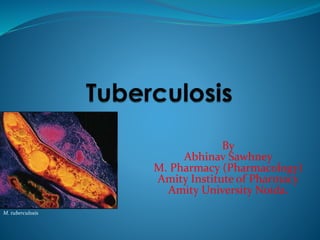
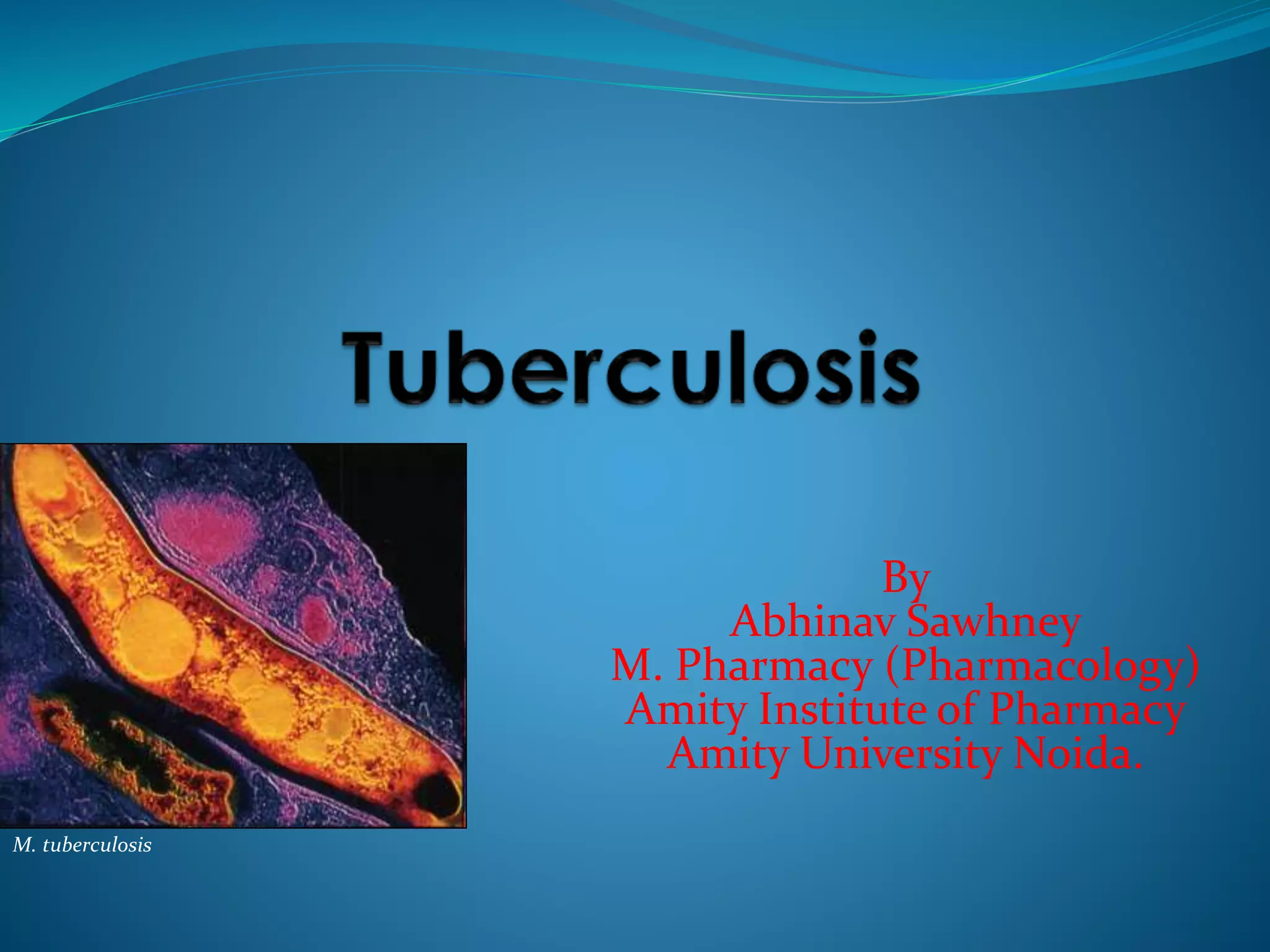
M. tuberculosis
TB Transmission
What is TB?
TB is a disease caused by infection with a bacteria
called Mycobacterium tuberculosis.
How Are TB Germs Spread?
TB Transmission
How can you catch TB?
TB is spread through tiny drops
sprayed into the air when an
infected person coughs, sneezes,
or speaks, or another person
breathes the air into their lungs
containing the TB bacteria.
How Are TB Germs Spread?
 TB germs are passed through the air when a person
who is sick with TB disease coughs, sings, sneezes, or
laughs
 To become infected with TB germs, a person usually
needs to share air space with someone sick with TB
disease (e.g., live, work, or play together)
 The amount of time, the environment, and how sick
the person is all contribute to whether or not you get
infected
 In most cases, your body is able to fight off the germs
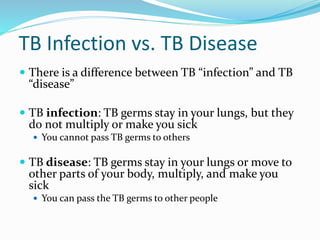
TB Infection vs. TB Disease
 There is a difference between TB “infection” and TB
“disease”
 TB infection: TB germs stay in your lungs, but they
do not multiply or make you sick
 You cannot pass TB germs to others
 TB disease: TB germs stay in your lungs or move to
other parts of your body, multiply, and make you
sick
 You can pass the TB germs to other people
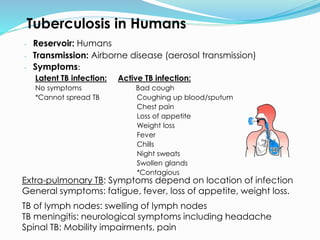
Tuberculosis in Humans
- Reservoir: Humans
- Transmission: Airborne disease (aerosol transmission)
- Symptoms:
Latent TB infection: Active TB infection:
No symptoms Bad cough
*Cannot spread TB Coughing up blood/sputum
Chest pain
Loss of appetite
Weight loss
Fever
Chills
Night sweats
Swollen glands
*Contagious
Extra-pulmonary TB: Symptoms depend on location of infection
General symptoms: fatigue, fever, loss of appetite, weight loss.
TB of lymph nodes: swelling of lymph nodes
TB meningitis: neurological symptoms including headache
Spinal TB: Mobility impairments, pain
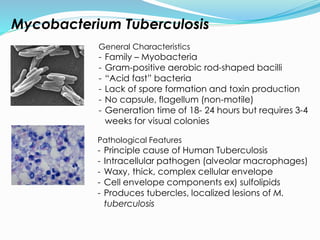
Mycobacterium Tuberculosis
General Characteristics
- Family – Myobacteria
- Gram-positive aerobic rod-shaped bacilli
- “Acid fast” bacteria
- Lack of spore formation and toxin production
- No capsule, flagellum (non-motile)
- Generation time of 18- 24 hours but requires 3-4
weeks for visual colonies
Pathological Features
- Principle cause of Human Tuberculosis
- Intracellular pathogen (alveolar macrophages)
- Waxy, thick, complex cellular envelope
- Cell envelope components ex) sulfolipids
- Produces tubercles, localized lesions of M.
tuberculosis
SEM of M. tuberculosis
M. Tuberculosis
(stained in purple)
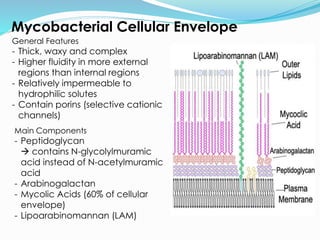
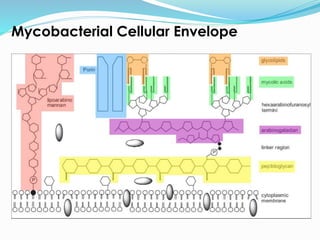
Mycobacterial Cellular Envelope
General Features
- Thick, waxy and complex
- Higher fluidity in more external
regions than internal regions
- Relatively impermeable to
hydrophilic solutes
- Contain porins (selective cationic
channels)
Main Components
- Peptidoglycan
 contains N-glycolylmuramic
acid instead of N-acetylmuramic
acid
- Arabinogalactan
- Mycolic Acids (60% of cellular
envelope)
- Lipoarabinomannan (LAM)
Mycobacterial Cellular Envelope
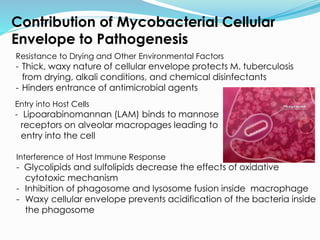
Contribution of Mycobacterial Cellular
Envelope to Pathogenesis
Resistance to Drying and Other Environmental Factors
- Thick, waxy nature of cellular envelope protects M. tuberculosis
from drying, alkali conditions, and chemical disinfectants
- Hinders entrance of antimicrobial agents
Entry into Host Cells
- Lipoarabinomannan (LAM) binds to mannose
receptors on alveolar macropages leading to
entry into the cell
Interference of Host Immune Response
- Glycolipids and sulfolipids decrease the effects of oxidative
cytotoxic mechanism
- Inhibition of phagosome and lysosome fusion inside macrophage
- Waxy cellular envelope prevents acidification of the bacteria inside
the phagosome
Factors Affecting Pathogenicity
Active Infection
- Only individuals with an active infection
can transmit the disease
Transmission
- Aerosolized droplets need to be <10μm in
order to evade the ciliated epithelium of
the lung to establish infection in the
terminal alveoli
Growth & Structure
- Only require a very few number of
bacteria to establish an infection (1-10
bacteria)
- Slow generation time
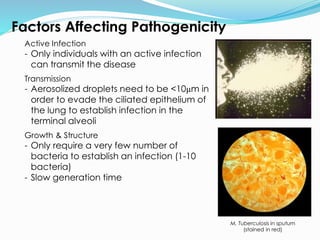
M. Tuberculosis in sputum
(stained in red)
Common Symptoms of TB Disease
 Cough (2-3 weeks or more)
 Coughing up blood
 Chest pains
 Fever
 Night sweats
 Feeling weak and tired
 Losing weight without trying
 Decreased or no appetite
 If you have TB outside the lungs, you may have
other symptoms
Diagnosis of Latent & Active TB
Tools for Diagnosing TB Infection
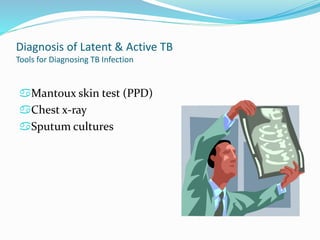
Mantoux skin test (PPD)
Chest x-ray
Sputum cultures
Diagnosis for Latent & Active TB
Tools for Diagnosing TB Infection
Mantoux Skin Test(PPD)
Mantoux tuberculin skin test (PPD) is a skin
test for identifying exposure to the TB
bacteria, Mycobacterium tuberculosis
(latent infection)
The Mantoux test is recommended because
it provides the most consistent and reliable
result.
The Mantoux test is read 48-72 hours after
administration. Induration or “knot-like”
swelling at the test site is significant and the
reaction is measured in millimeter units.
Redness at the test site is not measured.
Diagnosis for Latent & Active TB
Tools for Diagnosing TB Infection
Sputum
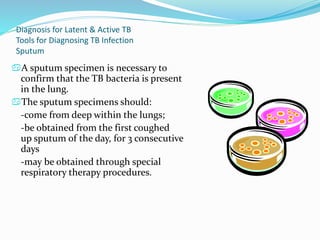
A sputum specimen is necessary to
confirm that the TB bacteria is present
in the lung.
The sputum specimens should:
-come from deep within the lungs;
-be obtained from the first coughed
up sputum of the day, for 3 consecutive
days
-may be obtained through special
respiratory therapy procedures.
Treatment for TB Disease
 TB disease is treated with medicine to kill the TB germs
 Usually, the treatment will last for 6-9 months
 TB disease can be cured if the medicine is taken as
prescribed, even after you no longer feel sick
Treatment
Antibacterial chemotherapy:
- Combination of first and second line drugs for the
first 2 months which could include:
- Isoniazid
- Rifampicin
- Pyrazinamide
- Streptomycin or Ethambutol
- Next 4 months, combination of:
- Isoniazid
- Rifampicin
- Early resistance to isoniazid: other first-line drugs
such as ethambutol, streptomycin, pyrazinamide and
fluoroquinolones can be added to drug arsenal
(treatment period also extended).
- These drugs are relatively effective in killing the bacteria,
however, they also produce a wide variety of side effects.
Treatment
First line drugs:
- Bactericidal agents: kill active bacteria, important in the early
stages of infection.
Second line drugs:
- Bacteriostatic: hinder bacterial growth.
- Strengthen treatment in the case of resistant bacteria.
- Less efficient and generally more toxic than first line drugs.
Inappropriate chemotherapy:
- Monotherapy (single drug treatment)
- Decreased treatment period
- Low absorption of drugs
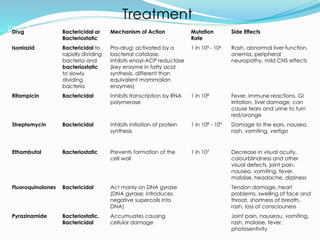
Drug Bactericidal or
Bacteriostatic
Mechanism of Action Mutation
Rate
Side Effects
Isoniazid Bactericidal to
rapidly dividing
bacteria and
bacteriostatic
to slowly
dividing
bacteria
Pro-drug: activated by a
bacterial catalase.
Inhibits enoyl-ACP reductase
(key enzyme in fatty acid
synthesis, different than
equivalent mammalian
enzymes)
1 in 105 - 106 Rash, abnormal liver function,
anemia, peripheral
neuropathy, mild CNS effects
Rifampicin Bactericidal Inhibits transcription by RNA
polymerase
1 in 108 Fever, immune reactions, GI
irritation, liver damage, can
cause tears and urine to turn
red/orange
Streptomycin Bactericidal Inhibits initiation of protein
synthesis
1 in 108 - 109 Damage to the ears, nausea,
rash, vomiting, vertigo
Ethambutol Bacteriostatic Prevents formation of the
cell wall
1 in 107 Decrease in visual acuity,
colourblindness and other
visual defects, joint pain,
nausea, vomiting, fever,
malaise, headache, dizziness
Fluoroquinolones Bactericidal Act manly on DNA gyrase
(DNA gyrase: introduces
negative supercoils into
DNA)
Tendon damage, heart
problems, swelling of face and
throat, shortness of breath,
rash, loss of consciouness
Pyrazinamide Bacteriostatic,
Bactericidal
Accumuates causing
cellular damage
Joint pain, nauseau, vomiting,
rash, malaise, fever,
photosentivity
Treatment
Drug Resistance and Tuberculosis
- M. tuberculosis: naturally resistant to
certain antibiotics due to presence of:
- Drug-modifying enzymes
- Drug-efflux systems
- Hydrophobic cell wall
- Mycobacteria undergo natural mutations
which can lead to development of drug
resistance.
- TB is treated by administration of
combination chemotherapy:
decreases probability of development
of drug resistance.
- Development of increasingly resistant
strains mainly due to: Patient non-
compliance
MDR and XDR Tuberculosis
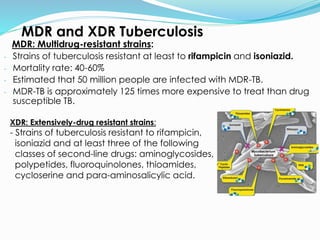
MDR: Multidrug-resistant strains:
- Strains of tuberculosis resistant at least to rifampicin and isoniazid.
- Mortality rate: 40-60%
- Estimated that 50 million people are infected with MDR-TB.
- MDR-TB is approximately 125 times more expensive to treat than drug
susceptible TB.
XDR: Extensively-drug resistant strains:
- Strains of tuberculosis resistant to rifampicin,
isoniazid and at least three of the following
classes of second-line drugs: aminoglycosides,
polypetides, fluoroquinolones, thioamides,
cycloserine and para-aminosalicylic acid.
MDR and XDR Tuberculosis
- Emergence due to lack of patient compliance during TB
treatment and inappropriate administration of TB drugs.
- Results in more aggressive forms of TB.
- Drug resistance does not increase infectiousness.
- MDR and XDR-TB: uncommon in developing nations lacking TB
drugs (high drug-susceptible TB rates)
- MDR and XDR-TB rates are higher in developed nations with
access to anti-TB drugs.
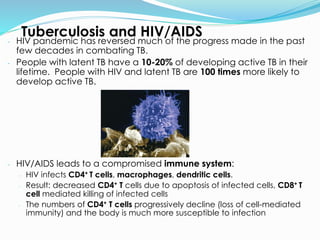
- HIV pandemic has reversed much of the progress made in the past
few decades in combating TB.
- People with latent TB have a 10-20% of developing active TB in their
lifetime. People with HIV and latent TB are 100 times more likely to
develop active TB.
- HIV/AIDS leads to a compromised immune system:
- HIV infects CD4+ T cells, macrophages, dendritic cells.
- Result: decreased CD4+ T cells due to apoptosis of infected cells, CD8+ T
cell mediated killing of infected cells
- The numbers of CD4+ T cells progressively decline (loss of cell-mediated
immunity) and the body is much more susceptible to infection
Tuberculosis and HIV/AIDS
T cell
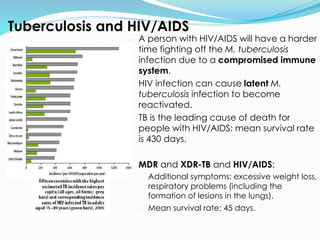
- A person with HIV/AIDS will have a harder
time fighting off the M. tuberculosis
infection due to a compromised immune
system.
- HIV infection can cause latent M.
tuberculosis infection to become
reactivated.
- TB is the leading cause of death for
people with HIV/AIDS: mean survival rate
is 430 days.
- MDR and XDR-TB and HIV/AIDS:
- Additional symptoms: excessive weight loss,
respiratory problems (including the
formation of lesions in the lungs).
- Mean survival rate: 45 days.
Tuberculosis and HIV/AIDS
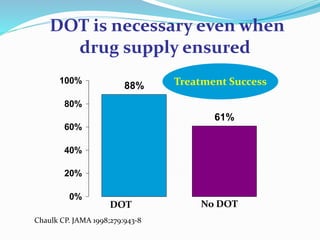
Directly Observed Treatment
 Why? Many patients don’t take medicines regularly,
even if excellent health education provided
 Who? All patients... impossible to predict which
patient will take medicine (1/3 not adherent)
 What? Observer watches and helps patient swallow
tablets
 Where? Anywhere! (home, clinic, work, school, etc)
 Who does it? HCW, community liaisons, teachers,
Direct observation ensures treatment for entire course
with the right drugs, in the right doses, at the right
intervals
DOT is necessary even when
drug supply ensured
88%
61%
0%
20%
40%
60%
80%
100%
Chaulk CP. JAMA 1998;279:943-8
Treatment Success
DOT No DOT

Tuberculosis

  • 1.
    By Abhinav Sawhney M. Pharmacy(Pharmacology) Amity Institute of Pharmacy Amity University Noida. M. tuberculosis
  • 2.
    TB Transmission What isTB? TB is a disease caused by infection with a bacteria called Mycobacterium tuberculosis.
  • 3.
    How Are TBGerms Spread?
  • 4.
    TB Transmission How canyou catch TB? TB is spread through tiny drops sprayed into the air when an infected person coughs, sneezes, or speaks, or another person breathes the air into their lungs containing the TB bacteria.
  • 5.
    How Are TBGerms Spread?  TB germs are passed through the air when a person who is sick with TB disease coughs, sings, sneezes, or laughs  To become infected with TB germs, a person usually needs to share air space with someone sick with TB disease (e.g., live, work, or play together)  The amount of time, the environment, and how sick the person is all contribute to whether or not you get infected  In most cases, your body is able to fight off the germs
  • 6.
    TB Infection vs.TB Disease  There is a difference between TB “infection” and TB “disease”  TB infection: TB germs stay in your lungs, but they do not multiply or make you sick  You cannot pass TB germs to others  TB disease: TB germs stay in your lungs or move to other parts of your body, multiply, and make you sick  You can pass the TB germs to other people
  • 7.
    Tuberculosis in Humans -Reservoir: Humans - Transmission: Airborne disease (aerosol transmission) - Symptoms: Latent TB infection: Active TB infection: No symptoms Bad cough *Cannot spread TB Coughing up blood/sputum Chest pain Loss of appetite Weight loss Fever Chills Night sweats Swollen glands *Contagious Extra-pulmonary TB: Symptoms depend on location of infection General symptoms: fatigue, fever, loss of appetite, weight loss. TB of lymph nodes: swelling of lymph nodes TB meningitis: neurological symptoms including headache Spinal TB: Mobility impairments, pain
  • 8.
    Mycobacterium Tuberculosis General Characteristics -Family – Myobacteria - Gram-positive aerobic rod-shaped bacilli - “Acid fast” bacteria - Lack of spore formation and toxin production - No capsule, flagellum (non-motile) - Generation time of 18- 24 hours but requires 3-4 weeks for visual colonies Pathological Features - Principle cause of Human Tuberculosis - Intracellular pathogen (alveolar macrophages) - Waxy, thick, complex cellular envelope - Cell envelope components ex) sulfolipids - Produces tubercles, localized lesions of M. tuberculosis SEM of M. tuberculosis M. Tuberculosis (stained in purple)
  • 9.
    Mycobacterial Cellular Envelope GeneralFeatures - Thick, waxy and complex - Higher fluidity in more external regions than internal regions - Relatively impermeable to hydrophilic solutes - Contain porins (selective cationic channels) Main Components - Peptidoglycan  contains N-glycolylmuramic acid instead of N-acetylmuramic acid - Arabinogalactan - Mycolic Acids (60% of cellular envelope) - Lipoarabinomannan (LAM)
  • 10.
  • 11.
    Contribution of MycobacterialCellular Envelope to Pathogenesis Resistance to Drying and Other Environmental Factors - Thick, waxy nature of cellular envelope protects M. tuberculosis from drying, alkali conditions, and chemical disinfectants - Hinders entrance of antimicrobial agents Entry into Host Cells - Lipoarabinomannan (LAM) binds to mannose receptors on alveolar macropages leading to entry into the cell Interference of Host Immune Response - Glycolipids and sulfolipids decrease the effects of oxidative cytotoxic mechanism - Inhibition of phagosome and lysosome fusion inside macrophage - Waxy cellular envelope prevents acidification of the bacteria inside the phagosome
  • 12.
    Factors Affecting Pathogenicity ActiveInfection - Only individuals with an active infection can transmit the disease Transmission - Aerosolized droplets need to be <10μm in order to evade the ciliated epithelium of the lung to establish infection in the terminal alveoli Growth & Structure - Only require a very few number of bacteria to establish an infection (1-10 bacteria) - Slow generation time M. Tuberculosis in sputum (stained in red)
  • 13.
    Common Symptoms ofTB Disease  Cough (2-3 weeks or more)  Coughing up blood  Chest pains  Fever  Night sweats  Feeling weak and tired  Losing weight without trying  Decreased or no appetite  If you have TB outside the lungs, you may have other symptoms
  • 14.
    Diagnosis of Latent& Active TB Tools for Diagnosing TB Infection Mantoux skin test (PPD) Chest x-ray Sputum cultures
  • 15.
    Diagnosis for Latent& Active TB Tools for Diagnosing TB Infection Mantoux Skin Test(PPD) Mantoux tuberculin skin test (PPD) is a skin test for identifying exposure to the TB bacteria, Mycobacterium tuberculosis (latent infection) The Mantoux test is recommended because it provides the most consistent and reliable result. The Mantoux test is read 48-72 hours after administration. Induration or “knot-like” swelling at the test site is significant and the reaction is measured in millimeter units. Redness at the test site is not measured.
  • 16.
    Diagnosis for Latent& Active TB Tools for Diagnosing TB Infection Sputum A sputum specimen is necessary to confirm that the TB bacteria is present in the lung. The sputum specimens should: -come from deep within the lungs; -be obtained from the first coughed up sputum of the day, for 3 consecutive days -may be obtained through special respiratory therapy procedures.
  • 17.
    Treatment for TBDisease  TB disease is treated with medicine to kill the TB germs  Usually, the treatment will last for 6-9 months  TB disease can be cured if the medicine is taken as prescribed, even after you no longer feel sick
  • 18.
    Treatment Antibacterial chemotherapy: - Combinationof first and second line drugs for the first 2 months which could include: - Isoniazid - Rifampicin - Pyrazinamide - Streptomycin or Ethambutol - Next 4 months, combination of: - Isoniazid - Rifampicin - Early resistance to isoniazid: other first-line drugs such as ethambutol, streptomycin, pyrazinamide and fluoroquinolones can be added to drug arsenal (treatment period also extended). - These drugs are relatively effective in killing the bacteria, however, they also produce a wide variety of side effects.
  • 19.
    Treatment First line drugs: -Bactericidal agents: kill active bacteria, important in the early stages of infection. Second line drugs: - Bacteriostatic: hinder bacterial growth. - Strengthen treatment in the case of resistant bacteria. - Less efficient and generally more toxic than first line drugs. Inappropriate chemotherapy: - Monotherapy (single drug treatment) - Decreased treatment period - Low absorption of drugs
  • 20.
    Drug Bactericidal or Bacteriostatic Mechanismof Action Mutation Rate Side Effects Isoniazid Bactericidal to rapidly dividing bacteria and bacteriostatic to slowly dividing bacteria Pro-drug: activated by a bacterial catalase. Inhibits enoyl-ACP reductase (key enzyme in fatty acid synthesis, different than equivalent mammalian enzymes) 1 in 105 - 106 Rash, abnormal liver function, anemia, peripheral neuropathy, mild CNS effects Rifampicin Bactericidal Inhibits transcription by RNA polymerase 1 in 108 Fever, immune reactions, GI irritation, liver damage, can cause tears and urine to turn red/orange Streptomycin Bactericidal Inhibits initiation of protein synthesis 1 in 108 - 109 Damage to the ears, nausea, rash, vomiting, vertigo Ethambutol Bacteriostatic Prevents formation of the cell wall 1 in 107 Decrease in visual acuity, colourblindness and other visual defects, joint pain, nausea, vomiting, fever, malaise, headache, dizziness Fluoroquinolones Bactericidal Act manly on DNA gyrase (DNA gyrase: introduces negative supercoils into DNA) Tendon damage, heart problems, swelling of face and throat, shortness of breath, rash, loss of consciouness Pyrazinamide Bacteriostatic, Bactericidal Accumuates causing cellular damage Joint pain, nauseau, vomiting, rash, malaise, fever, photosentivity Treatment
  • 21.
    Drug Resistance andTuberculosis - M. tuberculosis: naturally resistant to certain antibiotics due to presence of: - Drug-modifying enzymes - Drug-efflux systems - Hydrophobic cell wall - Mycobacteria undergo natural mutations which can lead to development of drug resistance. - TB is treated by administration of combination chemotherapy: decreases probability of development of drug resistance. - Development of increasingly resistant strains mainly due to: Patient non- compliance
  • 22.
    MDR and XDRTuberculosis MDR: Multidrug-resistant strains: - Strains of tuberculosis resistant at least to rifampicin and isoniazid. - Mortality rate: 40-60% - Estimated that 50 million people are infected with MDR-TB. - MDR-TB is approximately 125 times more expensive to treat than drug susceptible TB. XDR: Extensively-drug resistant strains: - Strains of tuberculosis resistant to rifampicin, isoniazid and at least three of the following classes of second-line drugs: aminoglycosides, polypetides, fluoroquinolones, thioamides, cycloserine and para-aminosalicylic acid.
  • 23.
    MDR and XDRTuberculosis - Emergence due to lack of patient compliance during TB treatment and inappropriate administration of TB drugs. - Results in more aggressive forms of TB. - Drug resistance does not increase infectiousness. - MDR and XDR-TB: uncommon in developing nations lacking TB drugs (high drug-susceptible TB rates) - MDR and XDR-TB rates are higher in developed nations with access to anti-TB drugs.
  • 24.
    - HIV pandemichas reversed much of the progress made in the past few decades in combating TB. - People with latent TB have a 10-20% of developing active TB in their lifetime. People with HIV and latent TB are 100 times more likely to develop active TB. - HIV/AIDS leads to a compromised immune system: - HIV infects CD4+ T cells, macrophages, dendritic cells. - Result: decreased CD4+ T cells due to apoptosis of infected cells, CD8+ T cell mediated killing of infected cells - The numbers of CD4+ T cells progressively decline (loss of cell-mediated immunity) and the body is much more susceptible to infection Tuberculosis and HIV/AIDS T cell
  • 25.
    - A personwith HIV/AIDS will have a harder time fighting off the M. tuberculosis infection due to a compromised immune system. - HIV infection can cause latent M. tuberculosis infection to become reactivated. - TB is the leading cause of death for people with HIV/AIDS: mean survival rate is 430 days. - MDR and XDR-TB and HIV/AIDS: - Additional symptoms: excessive weight loss, respiratory problems (including the formation of lesions in the lungs). - Mean survival rate: 45 days. Tuberculosis and HIV/AIDS
  • 26.
    Directly Observed Treatment Why? Many patients don’t take medicines regularly, even if excellent health education provided  Who? All patients... impossible to predict which patient will take medicine (1/3 not adherent)  What? Observer watches and helps patient swallow tablets  Where? Anywhere! (home, clinic, work, school, etc)  Who does it? HCW, community liaisons, teachers, Direct observation ensures treatment for entire course with the right drugs, in the right doses, at the right intervals
  • 27.
    DOT is necessaryeven when drug supply ensured 88% 61% 0% 20% 40% 60% 80% 100% Chaulk CP. JAMA 1998;279:943-8 Treatment Success DOT No DOT