TOUCH SCREEN
By
XXXXXX
(12XXX)
ECE
Guide:
XXXXXXXXXXXXX
Associate Professor
ABSTRACT
 A touch screen is an electronic visual display that can detect the presence
and location of a touch within the display area. The term generally refers
to touch or contact to the display of the device by a finger or hand. The
ability to interact physically with what is shown on a display (a form of
“direct manipulation”) typically indicates the presence of a touch screen.
 It has two main attributes:
1.It enables one to interact with what is displayed directly on the screen,
where it is displayed, rather than indirectly with a mouse or touchpad.
2. It lets one do so without requiring any intermediate device, again, such
as a stylus that needs to be held in the hand.
INTRODUCTION
WHAT IS TOUCH SCREEN?
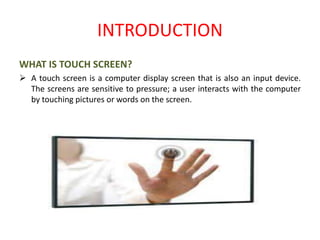
 A touch screen is a computer display screen that is also an input device.
The screens are sensitive to pressure; a user interacts with the computer
by touching pictures or words on the screen.
DEFINITION:
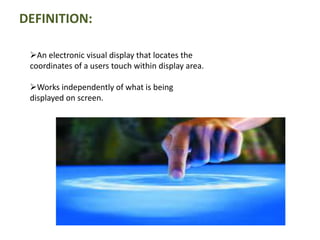
An electronic visual display that locates the
coordinates of a users touch within display area.
Works independently of what is being
displayed on screen.
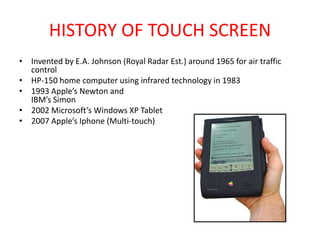
HISTORY OF TOUCH SCREEN
• Invented by E.A. Johnson (Royal Radar Est.) around 1965 for air traffic
control
• HP-150 home computer using infrared technology in 1983
• 1993 Apple’s Newton and
IBM’s Simon
• 2002 Microsoft’s Windows XP Tablet
• 2007 Apple’s Iphone (Multi-touch)
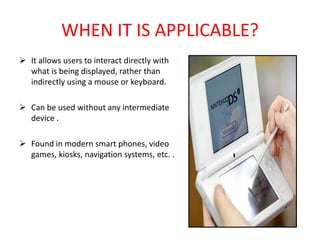
WHEN IT IS APPLICABLE?
 It allows users to interact directly with
what is being displayed, rather than
indirectly using a mouse or keyboard.
 Can be used without any intermediate
device .
 Found in modern smart phones, video
games, kiosks, navigation systems, etc. .
TOUCH SCREEN TECHNOLOGY
 Four different technologies used to make
touch screens today:
• Resistive
• Capacitive
• Surface Acoustic Wave (SAW)
• Infrared LED or Optical
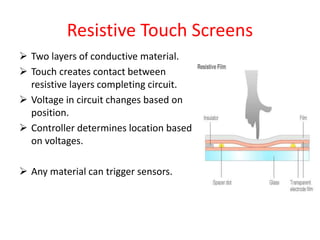
Resistive Touch Screens
 Two layers of conductive material.
 Touch creates contact between
resistive layers completing circuit.
 Voltage in circuit changes based on
position.
 Controller determines location based
on voltages.
 Any material can trigger sensors.
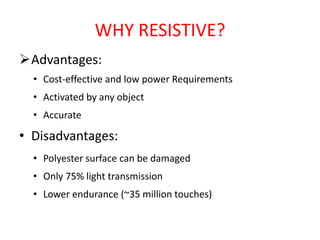
WHY RESISTIVE?
Advantages:
• Cost-effective and low power Requirements
• Activated by any object
• Accurate
• Disadvantages:
• Polyester surface can be damaged
• Only 75% light transmission
• Lower endurance (~35 million touches)
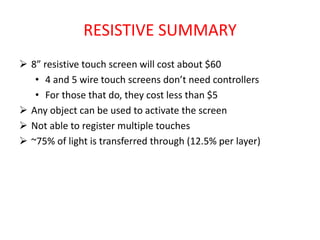
RESISTIVE SUMMARY
 8” resistive touch screen will cost about $60
• 4 and 5 wire touch screens don’t need controllers
• For those that do, they cost less than $5
 Any object can be used to activate the screen
 Not able to register multiple touches
 ~75% of light is transferred through (12.5% per layer)
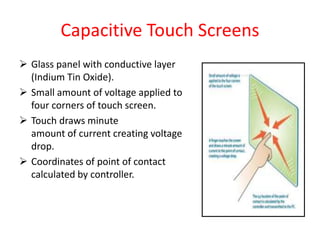
Capacitive Touch Screens
 Glass panel with conductive layer
(Indium Tin Oxide).
 Small amount of voltage applied to
four corners of touch screen.
 Touch draws minute
amount of current creating voltage
drop.
 Coordinates of point of contact
calculated by controller.
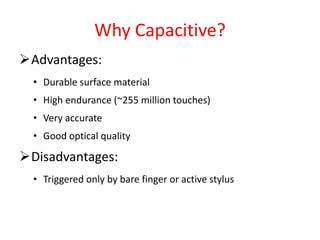
Why Capacitive?
Advantages:
• Durable surface material
• High endurance (~255 million touches)
• Very accurate
• Good optical quality
Disadvantages:
• Triggered only by bare finger or active stylus
CAPACITIVE SUMMARY
 8” capacitive touch screen costs about $100
• Controllers can be bought for less than $5
 Only conductive objects can be used to activate
 Able to register multiple touches
 ~88% of light is transferred through
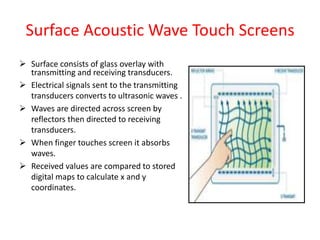
Surface Acoustic Wave Touch Screens
 Surface consists of glass overlay with
transmitting and receiving transducers.
 Electrical signals sent to the transmitting
transducers converts to ultrasonic waves .
 Waves are directed across screen by
reflectors then directed to receiving
transducers.
 When finger touches screen it absorbs
waves.
 Received values are compared to stored
digital maps to calculate x and y
coordinates.
Why SAW?
Advantages:
• Best optical quality
• High surface durability and seal
• Activated by multiple sources
Disadvantages:
• Expensive
• Contaminates on screen can cause false-touches
SURFACE ACOUSTIC WAVE SUMMARY
 We were not able to find prices for individual screens.
 Any object can be used to activate the screen.
 Able to register multiple touches.
 ~100% of light is transferred through.
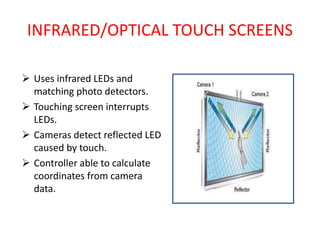
INFRARED/OPTICAL TOUCH SCREENS
 Uses infrared LEDs and
matching photo detectors.
 Touching screen interrupts
LEDs.
 Cameras detect reflected LED
caused by touch.
 Controller able to calculate
coordinates from camera
data.
Why Infrared/Optical
Touch Screens
Advantages:
• High optical clarity
• Durable surface
• Supports multi-touch
• Can scale to large sizes
Disadvantages:
• Expensive
• Cameras can get out of alignment
INFRARED/OPTICAL SUMMARY
 8” infrared touch screen costs about $16.
 Any object can be used to activate the screen.
 Able to register multiple touches.
 ~100% of light is transferred through.
ADVANTAGES
 Touch screen devices have limited buttons that will possibly
break after 3 – 4 years.
 Touch screen devices usually have more simple user interfaces
Ex. IPod Apps.
 Having less or not buttons means that you can put more effort
into having a big screen.
 For people new or uncomfortable with normal desktops,
touch screens are easy to use helping more people get used
to using computers.
DISADVANTAGES
 The screens will get very dirty.
 They usually cost more than ordinary devices.
 In direct sunlight it is much less efficient and most of the time
very difficult to read the screen.
 The screen has to be big enough to be able to touch the
buttons without missing.
REFERENCES
1. http://topnews.net.nz/category/companies/nintendo?page=7
2. http://www.planarembedded.com/technology/touch/
3. http://computer.howstuffworks.com/question716.htm
4. http://www.tvielectronics.com/Touch_Screen.html
CONCLUSION
 Though the touch screen technology contains
limitations, it’s
User friendly
Fast
Accurate
Easy to operate
 It has been widely accepted and a little modification can
replace the mouse and keyboard completely in near future.
TOUCH SCREEN BY SAIKIRAN PANJALA

TOUCH SCREEN BY SAIKIRAN PANJALA

  • 1.
  • 2.
    ABSTRACT  A touchscreen is an electronic visual display that can detect the presence and location of a touch within the display area. The term generally refers to touch or contact to the display of the device by a finger or hand. The ability to interact physically with what is shown on a display (a form of “direct manipulation”) typically indicates the presence of a touch screen.  It has two main attributes: 1.It enables one to interact with what is displayed directly on the screen, where it is displayed, rather than indirectly with a mouse or touchpad. 2. It lets one do so without requiring any intermediate device, again, such as a stylus that needs to be held in the hand.
  • 3.
    INTRODUCTION WHAT IS TOUCHSCREEN?  A touch screen is a computer display screen that is also an input device. The screens are sensitive to pressure; a user interacts with the computer by touching pictures or words on the screen.
  • 4.
    DEFINITION: An electronic visualdisplay that locates the coordinates of a users touch within display area. Works independently of what is being displayed on screen.
  • 5.
    HISTORY OF TOUCHSCREEN • Invented by E.A. Johnson (Royal Radar Est.) around 1965 for air traffic control • HP-150 home computer using infrared technology in 1983 • 1993 Apple’s Newton and IBM’s Simon • 2002 Microsoft’s Windows XP Tablet • 2007 Apple’s Iphone (Multi-touch)
  • 6.
    WHEN IT ISAPPLICABLE?  It allows users to interact directly with what is being displayed, rather than indirectly using a mouse or keyboard.  Can be used without any intermediate device .  Found in modern smart phones, video games, kiosks, navigation systems, etc. .
  • 7.
    TOUCH SCREEN TECHNOLOGY Four different technologies used to make touch screens today: • Resistive • Capacitive • Surface Acoustic Wave (SAW) • Infrared LED or Optical
  • 8.
    Resistive Touch Screens Two layers of conductive material.  Touch creates contact between resistive layers completing circuit.  Voltage in circuit changes based on position.  Controller determines location based on voltages.  Any material can trigger sensors.
  • 9.
    WHY RESISTIVE? Advantages: • Cost-effectiveand low power Requirements • Activated by any object • Accurate • Disadvantages: • Polyester surface can be damaged • Only 75% light transmission • Lower endurance (~35 million touches)
  • 10.
    RESISTIVE SUMMARY  8”resistive touch screen will cost about $60 • 4 and 5 wire touch screens don’t need controllers • For those that do, they cost less than $5  Any object can be used to activate the screen  Not able to register multiple touches  ~75% of light is transferred through (12.5% per layer)
  • 11.
    Capacitive Touch Screens Glass panel with conductive layer (Indium Tin Oxide).  Small amount of voltage applied to four corners of touch screen.  Touch draws minute amount of current creating voltage drop.  Coordinates of point of contact calculated by controller.
  • 12.
    Why Capacitive? Advantages: • Durablesurface material • High endurance (~255 million touches) • Very accurate • Good optical quality Disadvantages: • Triggered only by bare finger or active stylus
  • 13.
    CAPACITIVE SUMMARY  8”capacitive touch screen costs about $100 • Controllers can be bought for less than $5  Only conductive objects can be used to activate  Able to register multiple touches  ~88% of light is transferred through
  • 14.
    Surface Acoustic WaveTouch Screens  Surface consists of glass overlay with transmitting and receiving transducers.  Electrical signals sent to the transmitting transducers converts to ultrasonic waves .  Waves are directed across screen by reflectors then directed to receiving transducers.  When finger touches screen it absorbs waves.  Received values are compared to stored digital maps to calculate x and y coordinates.
  • 15.
    Why SAW? Advantages: • Bestoptical quality • High surface durability and seal • Activated by multiple sources Disadvantages: • Expensive • Contaminates on screen can cause false-touches
  • 16.
    SURFACE ACOUSTIC WAVESUMMARY  We were not able to find prices for individual screens.  Any object can be used to activate the screen.  Able to register multiple touches.  ~100% of light is transferred through.
  • 17.
    INFRARED/OPTICAL TOUCH SCREENS Uses infrared LEDs and matching photo detectors.  Touching screen interrupts LEDs.  Cameras detect reflected LED caused by touch.  Controller able to calculate coordinates from camera data.
  • 18.
    Why Infrared/Optical Touch Screens Advantages: •High optical clarity • Durable surface • Supports multi-touch • Can scale to large sizes Disadvantages: • Expensive • Cameras can get out of alignment
  • 19.
    INFRARED/OPTICAL SUMMARY  8”infrared touch screen costs about $16.  Any object can be used to activate the screen.  Able to register multiple touches.  ~100% of light is transferred through.
  • 20.
    ADVANTAGES  Touch screendevices have limited buttons that will possibly break after 3 – 4 years.  Touch screen devices usually have more simple user interfaces Ex. IPod Apps.  Having less or not buttons means that you can put more effort into having a big screen.  For people new or uncomfortable with normal desktops, touch screens are easy to use helping more people get used to using computers.
  • 21.
    DISADVANTAGES  The screenswill get very dirty.  They usually cost more than ordinary devices.  In direct sunlight it is much less efficient and most of the time very difficult to read the screen.  The screen has to be big enough to be able to touch the buttons without missing.
  • 22.
    REFERENCES 1. http://topnews.net.nz/category/companies/nintendo?page=7 2. http://www.planarembedded.com/technology/touch/ 3.http://computer.howstuffworks.com/question716.htm 4. http://www.tvielectronics.com/Touch_Screen.html
  • 23.
    CONCLUSION  Though thetouch screen technology contains limitations, it’s User friendly Fast Accurate Easy to operate  It has been widely accepted and a little modification can replace the mouse and keyboard completely in near future.