FIREWALLS
Presenting by
######
12df@@@@@@
Under the guidance of
@@@@@@@@@@
The increasing complexity of networks , and the
need to make them more open due to growing emphasis and
attractiveness of the Internet as a medium for business
transactions, mean that networks are becoming more and
more exposed to attacks. The search is on for mechanisms
and techniques for the protection of internal networks from
such attack. One of the protective mechanisms under serious
consideration is the firewall.
A Firewall protects a network by guarding the points of
entry to it. Firewalls are becoming more sophisticated by the
day, and new features are constantly being added, so that, in
spite of the criticism made of them and developmental trends
threatening them, they are still a powerful protective
mechanism.
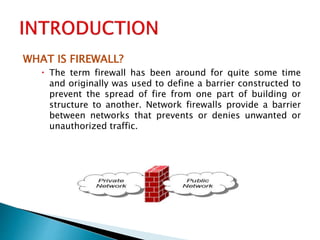
WHAT IS FIREWALL?
 The term firewall has been around for quite some time
and originally was used to define a barrier constructed to
prevent the spread of fire from one part of building or
structure to another. Network firewalls provide a barrier
between networks that prevents or denies unwanted or
unauthorized traffic.
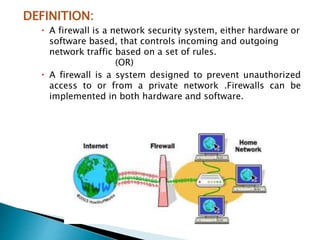
DEFINITION:
 A firewall is a network security system, either hardware or
software based, that controls incoming and outgoing
network traffic based on a set of rules.
(OR)
 A firewall is a system designed to prevent unauthorized
access to or from a private network .Firewalls can be
implemented in both hardware and software.
 NirZuk says he developed the technology used in all firewalls
today .David Pensak claims to have built the first
commercially successful firewall.
 Firewall technology emerged in the late 1980s when the
Internet was a fairly new technology in terms of its global use
and connectivity. The original idea was formed in response to
a number of major internet security problems, which occurred
in the late 1980s.
FIRST GENERATION:
The first paper published on firewall was in 1988,when
Jeff Mogul from Digital Equipment Corporation(DEC)
developed filter systems known as packet filter firewalls.
SECOND GENERATION:
From 1980-1990 two colleagues from AT&T Company,
developed the second generation of firewalls known as circuit
level firewalls.
THIRD GENERATION:
Publications by Gene Spafford of Purdue University, Bill
Cheswick at AT&T Laboratories described a third generation
firewall, also known as proxy based firewall.
Subsequent generations:
In 1992,Bob Braden and Annette DeSchon at the
University of Southern California(USC) were developing their
own fourth generation packet filter firewall system.
In 1994 an Israeli company called Check Point Software
Technologies built this into readily available software known
as FireWall-1.
Cisco, one of the largest internet security companies in
the world released their PIX “Private Internet Exchange”
product to the public in 1997.
Positive effects:
User authentication.
Firewalls can be configured to require user authentication.
This allows network administrators to control, track specific
user activity.
Auditing and logging.
By configuring a firewall to log and audit activity,
information may be kept and analyzed at a later date.
 Anti-Spoofing -Detecting when the source of the network
traffic is being “spoofed” , i.e., when an individual attempting
to access a blocked service alters the source address in the
message so that the traffic is allowed.
 Network Address Translation(NAT) – Changing the network
addresses of devices on any side of the firewall to hide their
true addresses from devices on other sides . There are two
ways NAT is performed.
1) One-to-One : where each true address is translated to a
unique translated address.
2) Many-to-One : where all true addresses are translated to a
single address, usually that of the firewall.
 Virtual Private Networks
VPNs are communications sessions traversing public
networks that have been made virtually private through
the use of encryption technology. VPN sessions are defined
by creating a firewall rule that requires encryption for any
session that meets specific criteria.
Negative Effects:
Although firewall provide many benefits, negative effects
may also be experienced.
 Traffic bottlenecks . By forcing all the network traffic to pass
through the firewall , there is a greater chance that the
network will become congested.
 Single point of failure . In most configurations where firewalls
are the only link between networks, if they are not configured
correctly or are unavailable , no traffic will be allowed
through.
 Increased management responsibilities. A firewall often adds
to network management responsibilities and makes network
troubleshooting more complex.
 Firewalls types can be categorized depending on:
- The function or methodologies the firewall use
- Whether the communication is being done between a
single node and the network or between two
networks.
- Whether the communication state is being tracked at
the firewall or not.
By the Firewalls methodology :
 Packet Filtering
 Stateful Packet Inspection
 Application Gateways/Proxies
 Circuit Level Gateway
A packet filtering firewall does exactly what its name implies
-- it filters packets.
As each packet passes through the firewall, it is examined
and information contained in the header is compared to a
pre-configured set of rules or filters. An allow or deny
decision is made based on the results of the comparison.
Each packet is examined individually without regard to other
packets that are part of the same connection.
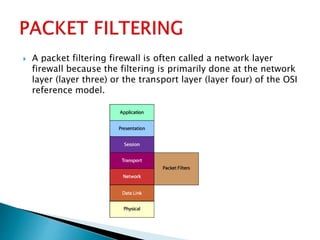
 A packet filtering firewall is often called a network layer
firewall because the filtering is primarily done at the network
layer (layer three) or the transport layer (layer four) of the OSI
reference model.
Strengths :
 Packet filtering firewalls are typically less expensive. Many
hardware devices and software packages have packet filtering
features included as part of their standard package.
Weaknesses:
 Defining rules and filters on a packet filtering firewall can be
a complex task.
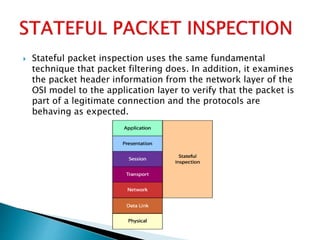
 Stateful packet inspection uses the same fundamental
technique that packet filtering does. In addition, it examines
the packet header information from the network layer of the
OSI model to the application layer to verify that the packet is
part of a legitimate connection and the protocols are
behaving as expected.
Strengths :
 More secure than basic packet filtering firewalls. Because
stateful packet inspection digs deeper into the packet header
information to determine the connection state between
endpoints.
 Usually it have some logging capabilities. Logging can help
identify and track the different types of traffic that pass
though the firewall.
Weaknesses
 Like packet filtering, stateful packet inspection does not
break the client/server model and therefore allows a direct
connection to be made between the two endpoints
 Rules and filters in this packet screening method can become
complex, hard to manage and difficult to test.
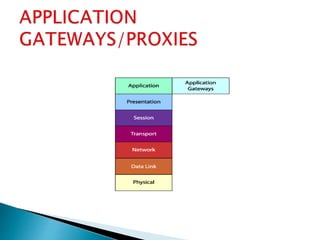
 This type of firewall operates at the application level of the
OSI model. For source and destination endpoints to be able to
communicate with each other, a proxy service must be
implemented for each application protocol.
 The gateways/proxies are carefully designed to be reliable
and secure because they are the only connection point
between the two networks.
Strengths
 Application gateways/proxies do not allow a direct
connection to be made between endpoints. They actually
break the client/server model.
 Allow the network administrator to have more control over
traffic passing through the firewall. They can permit or deny
specific applications or specific features of an application.
Weaknesses
 The most significant weakness is the impact they can have on
performance.
 Typically require additional client configuration. Clients on
the network may require specialized software or configuration
changes to be able to connect to the application
gateway/proxy.
 Unlike a packet filtering firewall, a circuit-level gateway does
not examine individual packets. Instead, circuit-level
gateways monitor TCP or UDP sessions.
 Once a session has been established, it leaves the port open
to allow all other packets belonging to that session to pass.
The port is closed when the session is terminated.
 Circuit-level gateways operate at the transport layer (layer 4)
of the OSI model.
2. With regard to the scope of filtered communications that done
between a single node and the network, or between two or
more networks there exist :
◦ Personal Firewalls, a software application which normally
filters traffic entering or leaving a single computer.
◦ Network Firewalls, normally running on a dedicated
network device or computer positioned on the boundary of
two or more networks.
3. Finally, Types depending on whether the firewalls keeps
track of the state of network connections or treats each
packet in isolation, two additional categories of firewalls
exist:
◦ Stateful firewall
◦ Stateless firewall
Stateful firewall
keeps track of the state of network connections (such as
TCP streams) traveling across it . Stateful firewall is able to
hold in memory significant attributes of each connection,
from start to finish. These attributes, which are collectively
known as the state of the connection, may include such
details as the IP addresses and ports involved in the
connection and the sequence numbers of the packets
traversing the connection.
Stateless firewall
Treats each network frame (Packet) in isolation. Such a
firewall has no way of knowing if any given packet is part of
an existing connection, is trying to establish a new
connection, or is just a rogue packet.
The classic example is the File Transfer Protocol,
because by design it opens new connections to random
ports.
 Don’t make the mistake of thinking that no one will attack
your network, because with the rise in automated attack
tools, your network is as much at risk as every other network
on the Internet.
 The need for firewalls has led to their ubiquity. Nearly every
organization connected to the Internet has installed some
sort of firewall.
 When choosing and implementing a firewall solution, make a
decision based on the organization's needs, security policy,
technical analysis, and financial resources. Solutions available
today utilize different types of equipment, network
configurations, and software.
THANK YOU

FIREWALLS BY SAIKIRAN PANJALA

  • 1.
  • 2.
    The increasing complexityof networks , and the need to make them more open due to growing emphasis and attractiveness of the Internet as a medium for business transactions, mean that networks are becoming more and more exposed to attacks. The search is on for mechanisms and techniques for the protection of internal networks from such attack. One of the protective mechanisms under serious consideration is the firewall. A Firewall protects a network by guarding the points of entry to it. Firewalls are becoming more sophisticated by the day, and new features are constantly being added, so that, in spite of the criticism made of them and developmental trends threatening them, they are still a powerful protective mechanism.
  • 3.
    WHAT IS FIREWALL? The term firewall has been around for quite some time and originally was used to define a barrier constructed to prevent the spread of fire from one part of building or structure to another. Network firewalls provide a barrier between networks that prevents or denies unwanted or unauthorized traffic.
  • 4.
    DEFINITION:  A firewallis a network security system, either hardware or software based, that controls incoming and outgoing network traffic based on a set of rules. (OR)  A firewall is a system designed to prevent unauthorized access to or from a private network .Firewalls can be implemented in both hardware and software.
  • 5.
     NirZuk sayshe developed the technology used in all firewalls today .David Pensak claims to have built the first commercially successful firewall.  Firewall technology emerged in the late 1980s when the Internet was a fairly new technology in terms of its global use and connectivity. The original idea was formed in response to a number of major internet security problems, which occurred in the late 1980s.
  • 6.
    FIRST GENERATION: The firstpaper published on firewall was in 1988,when Jeff Mogul from Digital Equipment Corporation(DEC) developed filter systems known as packet filter firewalls. SECOND GENERATION: From 1980-1990 two colleagues from AT&T Company, developed the second generation of firewalls known as circuit level firewalls. THIRD GENERATION: Publications by Gene Spafford of Purdue University, Bill Cheswick at AT&T Laboratories described a third generation firewall, also known as proxy based firewall.
  • 7.
    Subsequent generations: In 1992,BobBraden and Annette DeSchon at the University of Southern California(USC) were developing their own fourth generation packet filter firewall system. In 1994 an Israeli company called Check Point Software Technologies built this into readily available software known as FireWall-1. Cisco, one of the largest internet security companies in the world released their PIX “Private Internet Exchange” product to the public in 1997.
  • 8.
    Positive effects: User authentication. Firewallscan be configured to require user authentication. This allows network administrators to control, track specific user activity. Auditing and logging. By configuring a firewall to log and audit activity, information may be kept and analyzed at a later date.
  • 9.
     Anti-Spoofing -Detectingwhen the source of the network traffic is being “spoofed” , i.e., when an individual attempting to access a blocked service alters the source address in the message so that the traffic is allowed.  Network Address Translation(NAT) – Changing the network addresses of devices on any side of the firewall to hide their true addresses from devices on other sides . There are two ways NAT is performed. 1) One-to-One : where each true address is translated to a unique translated address. 2) Many-to-One : where all true addresses are translated to a single address, usually that of the firewall.
  • 10.
     Virtual PrivateNetworks VPNs are communications sessions traversing public networks that have been made virtually private through the use of encryption technology. VPN sessions are defined by creating a firewall rule that requires encryption for any session that meets specific criteria.
  • 11.
    Negative Effects: Although firewallprovide many benefits, negative effects may also be experienced.  Traffic bottlenecks . By forcing all the network traffic to pass through the firewall , there is a greater chance that the network will become congested.  Single point of failure . In most configurations where firewalls are the only link between networks, if they are not configured correctly or are unavailable , no traffic will be allowed through.
  • 12.
     Increased managementresponsibilities. A firewall often adds to network management responsibilities and makes network troubleshooting more complex.
  • 13.
     Firewalls typescan be categorized depending on: - The function or methodologies the firewall use - Whether the communication is being done between a single node and the network or between two networks. - Whether the communication state is being tracked at the firewall or not.
  • 14.
    By the Firewallsmethodology :  Packet Filtering  Stateful Packet Inspection  Application Gateways/Proxies  Circuit Level Gateway
  • 15.
    A packet filteringfirewall does exactly what its name implies -- it filters packets. As each packet passes through the firewall, it is examined and information contained in the header is compared to a pre-configured set of rules or filters. An allow or deny decision is made based on the results of the comparison. Each packet is examined individually without regard to other packets that are part of the same connection.
  • 16.
     A packetfiltering firewall is often called a network layer firewall because the filtering is primarily done at the network layer (layer three) or the transport layer (layer four) of the OSI reference model.
  • 17.
    Strengths :  Packetfiltering firewalls are typically less expensive. Many hardware devices and software packages have packet filtering features included as part of their standard package. Weaknesses:  Defining rules and filters on a packet filtering firewall can be a complex task.
  • 18.
     Stateful packetinspection uses the same fundamental technique that packet filtering does. In addition, it examines the packet header information from the network layer of the OSI model to the application layer to verify that the packet is part of a legitimate connection and the protocols are behaving as expected.
  • 19.
    Strengths :  Moresecure than basic packet filtering firewalls. Because stateful packet inspection digs deeper into the packet header information to determine the connection state between endpoints.  Usually it have some logging capabilities. Logging can help identify and track the different types of traffic that pass though the firewall.
  • 20.
    Weaknesses  Like packetfiltering, stateful packet inspection does not break the client/server model and therefore allows a direct connection to be made between the two endpoints  Rules and filters in this packet screening method can become complex, hard to manage and difficult to test.
  • 21.
     This typeof firewall operates at the application level of the OSI model. For source and destination endpoints to be able to communicate with each other, a proxy service must be implemented for each application protocol.  The gateways/proxies are carefully designed to be reliable and secure because they are the only connection point between the two networks.
  • 23.
    Strengths  Application gateways/proxiesdo not allow a direct connection to be made between endpoints. They actually break the client/server model.  Allow the network administrator to have more control over traffic passing through the firewall. They can permit or deny specific applications or specific features of an application.
  • 24.
    Weaknesses  The mostsignificant weakness is the impact they can have on performance.  Typically require additional client configuration. Clients on the network may require specialized software or configuration changes to be able to connect to the application gateway/proxy.
  • 25.
     Unlike apacket filtering firewall, a circuit-level gateway does not examine individual packets. Instead, circuit-level gateways monitor TCP or UDP sessions.  Once a session has been established, it leaves the port open to allow all other packets belonging to that session to pass. The port is closed when the session is terminated.  Circuit-level gateways operate at the transport layer (layer 4) of the OSI model.
  • 26.
    2. With regardto the scope of filtered communications that done between a single node and the network, or between two or more networks there exist : ◦ Personal Firewalls, a software application which normally filters traffic entering or leaving a single computer. ◦ Network Firewalls, normally running on a dedicated network device or computer positioned on the boundary of two or more networks.
  • 27.
    3. Finally, Typesdepending on whether the firewalls keeps track of the state of network connections or treats each packet in isolation, two additional categories of firewalls exist: ◦ Stateful firewall ◦ Stateless firewall
  • 28.
    Stateful firewall keeps trackof the state of network connections (such as TCP streams) traveling across it . Stateful firewall is able to hold in memory significant attributes of each connection, from start to finish. These attributes, which are collectively known as the state of the connection, may include such details as the IP addresses and ports involved in the connection and the sequence numbers of the packets traversing the connection. Stateless firewall Treats each network frame (Packet) in isolation. Such a firewall has no way of knowing if any given packet is part of an existing connection, is trying to establish a new connection, or is just a rogue packet. The classic example is the File Transfer Protocol, because by design it opens new connections to random ports.
  • 29.
     Don’t makethe mistake of thinking that no one will attack your network, because with the rise in automated attack tools, your network is as much at risk as every other network on the Internet.  The need for firewalls has led to their ubiquity. Nearly every organization connected to the Internet has installed some sort of firewall.  When choosing and implementing a firewall solution, make a decision based on the organization's needs, security policy, technical analysis, and financial resources. Solutions available today utilize different types of equipment, network configurations, and software.
  • 30.