MIMO(A SHORT DISSCUSSION)
            PRESENTED BY-PRITAM MOHANTY
                   REGD.NO-0901304189
   GUIDED BY-Mr. Shakti Narayana Mishra(lect. In ECE dept.)


  DEPT.-ELECTRONICS AND COMMUNICATION ENGINEERING
GANDHI INSTITUTE OF TECHNOLOGY AND MANAGEMENT
                  BHUBANESWAR
CONTENTS
 Motivations for the development of MIMO
  systems
 MIMO Antenna Configuration
 Design Criterion for MIMO Systems (Diversity )
 MIMO-OFDM
 Conclusions
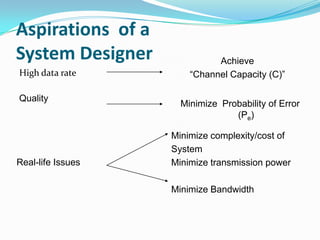
Aspirations of a
System Designer              Achieve
High data rate         “Channel Capacity (C)”

Quality
                     Minimize Probability of Error
                                 (Pe)

                   Minimize complexity/cost of
                   System
Real-life Issues   Minimize transmission power

                   Minimize Bandwidth
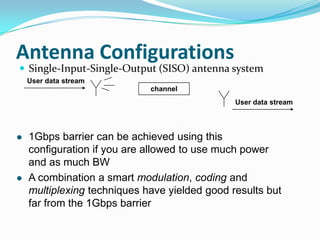
Antenna Configurations
 Single-Input-Single-Output (SISO) antenna system
    User data stream
                             channel
                                               User data stream


   1Gbps barrier can be achieved using this
    configuration if you are allowed to use much power
    and as much BW
   A combination a smart modulation, coding and
    multiplexing techniques have yielded good results but
    far from the 1Gbps barrier
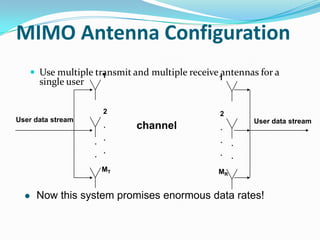
MIMO Antenna Configuration
    Use multiple transmit and multiple receive antennas for a
                    1                          1
      single user

                        2                      2
User data stream                                        User data stream
                        .    channel            .
                        .                       .
                    .                               .
                        .                       .
                    .                               .
                        MT                     MR


     Now this system promises enormous data rates!
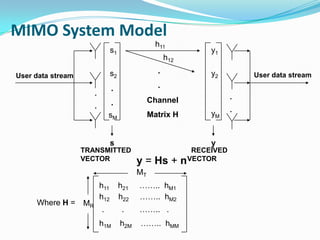
MIMO System Model
                                                  h11
                                s1                                 y1
                                                      h12

                                s2                .                y2         User data stream
User data stream
                                .                 .
                      .                                                   .
                                .               Channel
                      .                                                   .
                              sM                Matrix H           yM


                                s                                  y
                   TRANSMITTED                                 RECEIVED
                   VECTOR                  y = Hs +         n VECTOR
                                           MT
                          h11        h21   …….. hM1
                          h12        h22   …….. hM2
     Where H = MR
                          .           .    …….. .
                          h1M        h2M   …….. hMM
Capacity of MIMO Channels

 We assume M RX and N TX antennas. The capacity
  in bits/sec/Hz of a MIMO channel under an
  average transmitter power constraint is given by

       C = log 2 [det(IM + p/N H H*) b/s/Hz]
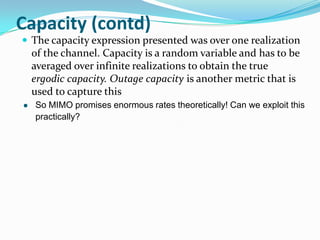
Capacity (contd)
 The capacity expression presented was over one realization
    of the channel. Capacity is a random variable and has to be
    averaged over infinite realizations to obtain the true
    ergodic capacity. Outage capacity is another metric that is
    used to capture this
   So MIMO promises enormous rates theoretically! Can we exploit this
    practically?
DIVERSITY:
 Reliable reception is achieved when multiple
  independently-faded replicas of the data symbol
  can be obtained at the receiver end.
 The maximal diversity gain dmax is the total
  number of independent signal paths that exist
  between the transmitter and receiver
 The higher my diversity gain, the lower my Pe
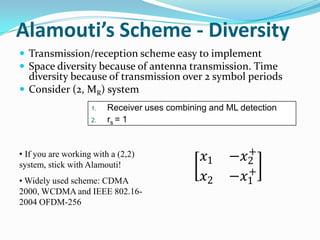
Alamouti’s Scheme - Diversity
 Transmission/reception scheme easy to implement
 Space diversity because of antenna transmission. Time
  diversity because of transmission over 2 symbol periods
 Consider (2, MR) system
                    1.   Receiver uses combining and ML detection
                    2.   rs = 1


                                                       +
• If you are working with a (2,2)
system, stick with Alamouti!
                                               𝑥1    −𝑥2
                                                       +
• Widely used scheme: CDMA                     𝑥2    −𝑥1
2000, WCDMA and IEEE 802.16-
2004 OFDM-256
Orthogonal Frequency Division
Multiplexing(OFDM)
 It is a special kind of FDM
 The spacing between carriers are such that they are
  orthogonal to one another
 Therefore no need of guard band between carriers.


                                                        11
MIMO-OFDM
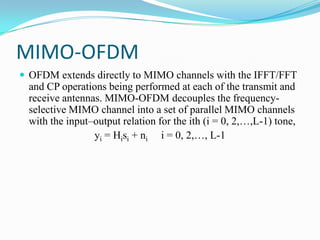
 OFDM extends directly to MIMO channels with the IFFT/FFT
  and CP operations being performed at each of the transmit and
  receive antennas. MIMO-OFDM decouples the frequency-
  selective MIMO channel into a set of parallel MIMO channels
  with the input–output relation for the ith (i = 0, 2,…,L-1) tone,
                 yi = Hisi + ni i = 0, 2,…, L-1
Conclusions
 MIMO Systems are getting us closer to the 1Gbps
  landmark
 At the same time, they provide reliable
  communications
 Different architectures available for use
 Developing efficient network protocols for a
  MIMO PHY layer is an area of open research
References
(1) “Layered Space-Time Architecture for
    Wireless Communication in a Fading
     Environment When using Multi-Element
    Antennas”, G.J.Foschini, Bell Labs Tech
    Journal, 1996
(2) “An Overview of MIMO Communications – A
    Key to Gigabit Wireless”, A.J Paulraj,
     Gore, Nabar and Bolcskei, IEEE Trans
    Comm, 2003
(3) “Improving Fairness and Throughput of Ad
    Hoc Networks Using Multiple
    Antennas”, Park, Choi and
    Nettles, submitted Mobicom 2004
THANK YOU

MIMO.ppt (2) 2

  • 1.
    MIMO(A SHORT DISSCUSSION) PRESENTED BY-PRITAM MOHANTY REGD.NO-0901304189 GUIDED BY-Mr. Shakti Narayana Mishra(lect. In ECE dept.) DEPT.-ELECTRONICS AND COMMUNICATION ENGINEERING GANDHI INSTITUTE OF TECHNOLOGY AND MANAGEMENT BHUBANESWAR
  • 2.
    CONTENTS  Motivations forthe development of MIMO systems  MIMO Antenna Configuration  Design Criterion for MIMO Systems (Diversity )  MIMO-OFDM  Conclusions
  • 3.
    Aspirations of a SystemDesigner Achieve High data rate “Channel Capacity (C)” Quality Minimize Probability of Error (Pe) Minimize complexity/cost of System Real-life Issues Minimize transmission power Minimize Bandwidth
  • 4.
    Antenna Configurations  Single-Input-Single-Output(SISO) antenna system User data stream channel User data stream  1Gbps barrier can be achieved using this configuration if you are allowed to use much power and as much BW  A combination a smart modulation, coding and multiplexing techniques have yielded good results but far from the 1Gbps barrier
  • 5.
    MIMO Antenna Configuration  Use multiple transmit and multiple receive antennas for a 1 1 single user 2 2 User data stream User data stream . channel . . . . . . . . . MT MR  Now this system promises enormous data rates!
  • 6.
    MIMO System Model h11 s1 y1 h12 s2 . y2 User data stream User data stream . . . . . Channel . . sM Matrix H yM s y TRANSMITTED RECEIVED VECTOR y = Hs + n VECTOR MT h11 h21 …….. hM1 h12 h22 …….. hM2 Where H = MR . . …….. . h1M h2M …….. hMM
  • 7.
    Capacity of MIMOChannels  We assume M RX and N TX antennas. The capacity in bits/sec/Hz of a MIMO channel under an average transmitter power constraint is given by C = log 2 [det(IM + p/N H H*) b/s/Hz]
  • 8.
    Capacity (contd)  Thecapacity expression presented was over one realization of the channel. Capacity is a random variable and has to be averaged over infinite realizations to obtain the true ergodic capacity. Outage capacity is another metric that is used to capture this  So MIMO promises enormous rates theoretically! Can we exploit this practically?
  • 9.
    DIVERSITY:  Reliable receptionis achieved when multiple independently-faded replicas of the data symbol can be obtained at the receiver end.  The maximal diversity gain dmax is the total number of independent signal paths that exist between the transmitter and receiver  The higher my diversity gain, the lower my Pe
  • 10.
    Alamouti’s Scheme -Diversity  Transmission/reception scheme easy to implement  Space diversity because of antenna transmission. Time diversity because of transmission over 2 symbol periods  Consider (2, MR) system 1. Receiver uses combining and ML detection 2. rs = 1 + • If you are working with a (2,2) system, stick with Alamouti! 𝑥1 −𝑥2 + • Widely used scheme: CDMA 𝑥2 −𝑥1 2000, WCDMA and IEEE 802.16- 2004 OFDM-256
  • 11.
    Orthogonal Frequency Division Multiplexing(OFDM) It is a special kind of FDM  The spacing between carriers are such that they are orthogonal to one another  Therefore no need of guard band between carriers. 11
  • 12.
    MIMO-OFDM  OFDM extendsdirectly to MIMO channels with the IFFT/FFT and CP operations being performed at each of the transmit and receive antennas. MIMO-OFDM decouples the frequency- selective MIMO channel into a set of parallel MIMO channels with the input–output relation for the ith (i = 0, 2,…,L-1) tone, yi = Hisi + ni i = 0, 2,…, L-1
  • 13.
    Conclusions  MIMO Systemsare getting us closer to the 1Gbps landmark  At the same time, they provide reliable communications  Different architectures available for use  Developing efficient network protocols for a MIMO PHY layer is an area of open research
  • 14.
    References (1) “Layered Space-TimeArchitecture for Wireless Communication in a Fading Environment When using Multi-Element Antennas”, G.J.Foschini, Bell Labs Tech Journal, 1996 (2) “An Overview of MIMO Communications – A Key to Gigabit Wireless”, A.J Paulraj, Gore, Nabar and Bolcskei, IEEE Trans Comm, 2003 (3) “Improving Fairness and Throughput of Ad Hoc Networks Using Multiple Antennas”, Park, Choi and Nettles, submitted Mobicom 2004
  • 15.