P R E S E N T E D B Y
# # # # # # # # # #
1 2 3 3 3 3 3 3 3 3 3
U N D E R T H E G U I D E N C E O F
@ @ @ @ @ @ @ @ @ @ @
DEVELOPMENT OF
INTERNET
ABSTRACT
This paper traces the growth of the Internet
and knowledge networks in the world, with an
explanation of the implications of the Internet
for the developing world. Starting with a brief
history of the development of the Internet, the
paper describes the phenomenal growth of
Internet networks and how the uses made of the
Internet have evolved tremendously in the last
fifteen years.
What Is the Internet?
 A network of networks, joining many government,
university and private computers together and
providing an infrastructure for the use of E-mail,
bulletin boards, file archives, hypertext documents,
databases and other computational resources
 The vast collection of computer networks which form
and act as a single huge network for transport of data
.
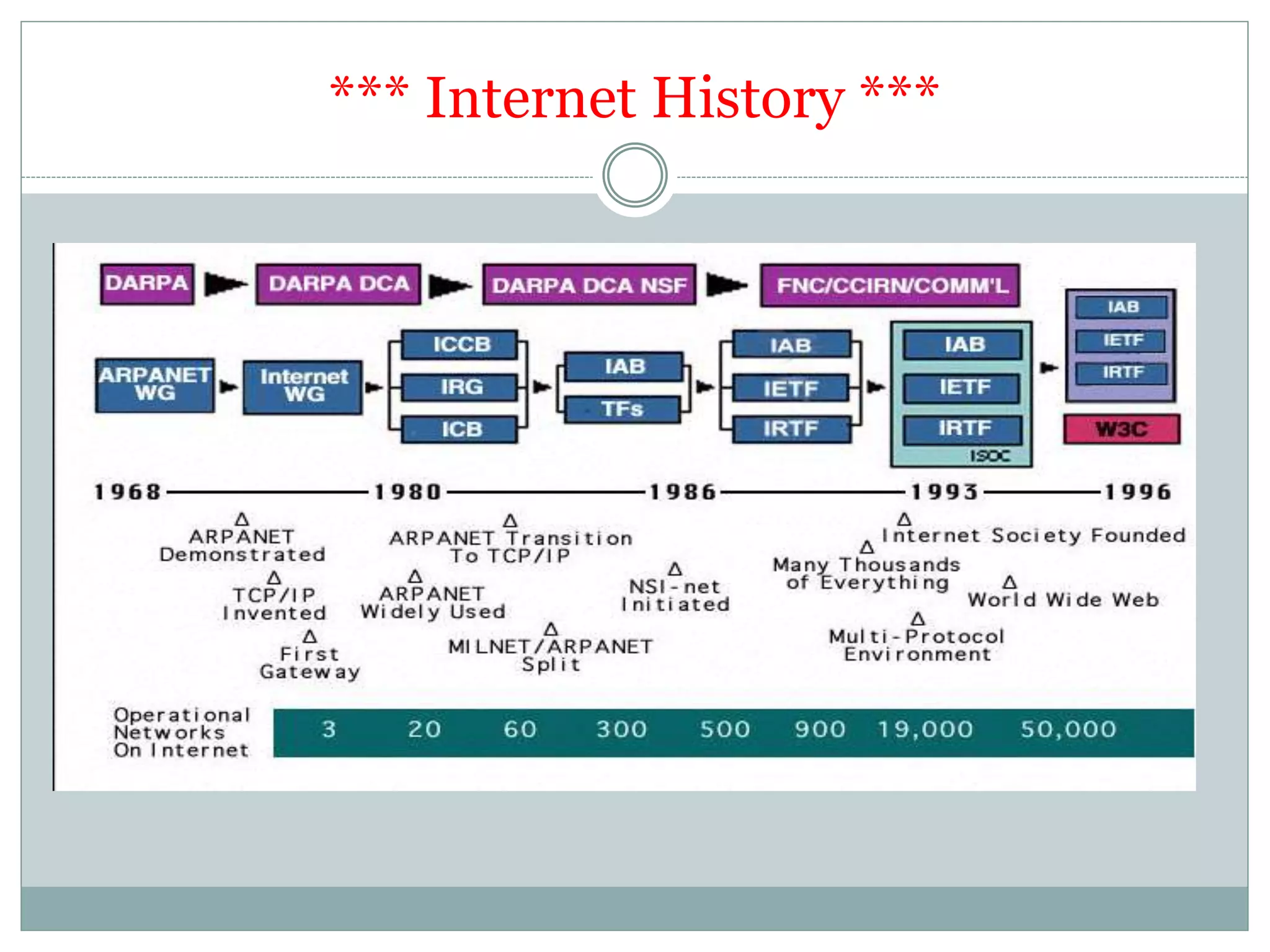
Brief History of the Internet
 1968 - DARPA (Defense Advanced Research Projects Agency) contracts
with BBN (Bolt, Beranek & Newman) to create ARPAnet
 1970 - First five nodes:
 UCLA
 Stanford
 UC Santa Barbara
 U of Utah, and
 BBN
 1974 - TCP specification by Vint Cerf
 1984 – On January 1, the Internet with its 1000 hosts
converts en masse to using TCP/IP for its messaging
*** Internet History ***
The Creation of the Internet
 The creation of the Internet solved the following challenges:
 Basically inventing digital networking as we know it
 Survivability of an infrastructure to send / receive high-speed
electronic messages
 Reliability of computer messaging
The development of the Internet of data networking.
Early Steps: 1960-1970
 Approximately 15 years after the first computers became
operational, researchers began to realize that an interconnected
network of computers could provide services that transcended the
capabilities of a single system.
 At this time, computers were becoming increasingly powerful, and a
number of scientists were beginning to consider applications that went
far beyond simple numerical calculation. and computers would become
sufficiently powerful to cooperate with humans in solving scientific and
technical problems.
 Early networking research concentrated on packet switching, a
technique of breaking up a conversation into small, independent units,
each of which carries the address of its destination and is routed
through the network independently.
What do we mean by Internet
Development?
Internet development is about people. Shared
knowledge and collaborative relationships are key
drivers of successful Internet growth, not technology
alone.
The Internet Society works to foster growth and
access to technology by bringing information,
training, and partnerships to people and
communities across the globe.
Smart development
 1. Human Infrastructure
 2. Technical infrastructure
 3. Governance Infrastructure
Human Infrastructure
 Trained, educated and engaged people who create,
sustain, and maintain networks at a local and regional
level.
 People who connect with each other and form “trusted
human networks” that build content and innovate
around the world.
 This is what allows the Internet to grow and become a
platform for economic and community development.
Technical infrastructure
 The networks, computers, protocols (“standards”),
Internet exchange points, and other technology that
the Internet runs “on”, and through which the
unconnected become connected.
Where innovation drives technology and economic
growth.
Governance Infrastructure
 The frameworks, guidelines and rules that promote
Internet use, innovation and expansion are critical to
allow the Internet to fulfill potential as a channel for
human expression .
 This can be as simple as committed and organized people
who manage an IXP, to robust stakeholder commitment
to building out the Internet and discussing
Aims of smart development
 Smart Development aims to strengthen this idea.
 It represents a positive, inclusive, and proven alternative
to policies that can stifle innovation and network
development.
 It offers an apolitical, non-interventionist method of
building Internet connectivity of the a world of results.
The Development is possible by:
 Participating in conferences and technical
workshops
Supporting local and regional Internet
Organizations
 Producing research and publications
 Funding grants for Internet Experts in developing
countries.
Conclusion
 The Internet (and World Wide Web) was have today was
created by some very bright, talented people who either
had vision, or were inspired by other talented people’s
visions.
 Though their ideas were not always popular, they
pressed ahead.
 Their perseverance and hard work brought us to where
we are today.
 There is a lot to be learned by studying these people,
their early work and keeping in mind what they had to
work with.
 Today, we owe a great deal for the wired world we enjoy,
to the hard work of these people.
Thank you

DEVELOPMENT OF INTERNET BY SAIKIRAN PANJALA

  • 1.
    P R ES E N T E D B Y # # # # # # # # # # 1 2 3 3 3 3 3 3 3 3 3 U N D E R T H E G U I D E N C E O F @ @ @ @ @ @ @ @ @ @ @ DEVELOPMENT OF INTERNET
  • 2.
    ABSTRACT This paper tracesthe growth of the Internet and knowledge networks in the world, with an explanation of the implications of the Internet for the developing world. Starting with a brief history of the development of the Internet, the paper describes the phenomenal growth of Internet networks and how the uses made of the Internet have evolved tremendously in the last fifteen years.
  • 3.
    What Is theInternet?  A network of networks, joining many government, university and private computers together and providing an infrastructure for the use of E-mail, bulletin boards, file archives, hypertext documents, databases and other computational resources  The vast collection of computer networks which form and act as a single huge network for transport of data .
  • 4.
    Brief History ofthe Internet  1968 - DARPA (Defense Advanced Research Projects Agency) contracts with BBN (Bolt, Beranek & Newman) to create ARPAnet  1970 - First five nodes:  UCLA  Stanford  UC Santa Barbara  U of Utah, and  BBN  1974 - TCP specification by Vint Cerf  1984 – On January 1, the Internet with its 1000 hosts converts en masse to using TCP/IP for its messaging
  • 5.
  • 6.
    The Creation ofthe Internet  The creation of the Internet solved the following challenges:  Basically inventing digital networking as we know it  Survivability of an infrastructure to send / receive high-speed electronic messages  Reliability of computer messaging
  • 7.
    The development ofthe Internet of data networking.
  • 8.
    Early Steps: 1960-1970 Approximately 15 years after the first computers became operational, researchers began to realize that an interconnected network of computers could provide services that transcended the capabilities of a single system.  At this time, computers were becoming increasingly powerful, and a number of scientists were beginning to consider applications that went far beyond simple numerical calculation. and computers would become sufficiently powerful to cooperate with humans in solving scientific and technical problems.  Early networking research concentrated on packet switching, a technique of breaking up a conversation into small, independent units, each of which carries the address of its destination and is routed through the network independently.
  • 9.
    What do wemean by Internet Development? Internet development is about people. Shared knowledge and collaborative relationships are key drivers of successful Internet growth, not technology alone. The Internet Society works to foster growth and access to technology by bringing information, training, and partnerships to people and communities across the globe.
  • 10.
    Smart development  1.Human Infrastructure  2. Technical infrastructure  3. Governance Infrastructure
  • 11.
    Human Infrastructure  Trained,educated and engaged people who create, sustain, and maintain networks at a local and regional level.  People who connect with each other and form “trusted human networks” that build content and innovate around the world.  This is what allows the Internet to grow and become a platform for economic and community development.
  • 12.
    Technical infrastructure  Thenetworks, computers, protocols (“standards”), Internet exchange points, and other technology that the Internet runs “on”, and through which the unconnected become connected. Where innovation drives technology and economic growth.
  • 13.
    Governance Infrastructure  Theframeworks, guidelines and rules that promote Internet use, innovation and expansion are critical to allow the Internet to fulfill potential as a channel for human expression .  This can be as simple as committed and organized people who manage an IXP, to robust stakeholder commitment to building out the Internet and discussing
  • 14.
    Aims of smartdevelopment  Smart Development aims to strengthen this idea.  It represents a positive, inclusive, and proven alternative to policies that can stifle innovation and network development.  It offers an apolitical, non-interventionist method of building Internet connectivity of the a world of results.
  • 15.
    The Development ispossible by:  Participating in conferences and technical workshops Supporting local and regional Internet Organizations  Producing research and publications  Funding grants for Internet Experts in developing countries.
  • 16.
    Conclusion  The Internet(and World Wide Web) was have today was created by some very bright, talented people who either had vision, or were inspired by other talented people’s visions.  Though their ideas were not always popular, they pressed ahead.  Their perseverance and hard work brought us to where we are today.  There is a lot to be learned by studying these people, their early work and keeping in mind what they had to work with.  Today, we owe a great deal for the wired world we enjoy, to the hard work of these people.
  • 17.