VIRTUAL PRIVATE
NETWORKS
Presenting by
@@@@@@@@
121222222222
Under the guidance of
###########
ABSTRACT
Virtual private network(VPN) is a rapidly growing
technology which plays a great role in wireless LAN(WLAN)
by providing secure data transmission. The purpose of VPN
is to provide safe and secure communication by creating
virtual tunnels between pair of hosts, once tunnel is
created data transfer can take place.
INTRODUCTION
A VPN is a private network that uses a public
infrastructure(usually the Internet)to connect remote sites
or users .The VPN as the name suggests uses “virtual”
connections routed through the Internet from the
business’s private network to the remote site or remote
employee .It is a new technology which can be applied to
LAN as well as to WLAN.A VPN maintains privacy of data
through security procedures and tunneling protocols .In
effect, data is encrypted at sender side and forwarded via
tunnel which is then decrypted at receiver side.
TYPES OF VPN
 Remote-Access VPN
 Site-to-Site VPN (Intranet-based)
 Site-to-Site VPN (Extranet-based)
REMOTE-ACCESS VPN
 A remote access VPN is for home or travelling users who
need to access their central LAN from a remote location.
 They dial their ISP and connect over the internet to the
LAN.
 This is made possible by installing a client software
program on the remote user’s laptop or PC that deals with
the encryption and decryption of the VPN traffic between
itself and the VPN gateway on the central LAN.
SITE-TO-SITE VPN
 Intranet-based - If a company has one or more remote
locations that they wish to join in a single private network,
they can create an intranet VPN to connect LAN to LAN.
 Extranet-based - When a company has a close
relationship with another company (for example, a partner,
supplier or customer), they can build an extranet VPN that
connects LAN to LAN, and that allows all of the various
companies to work in a shared environment.
ALL 3 TYPES OF VPN
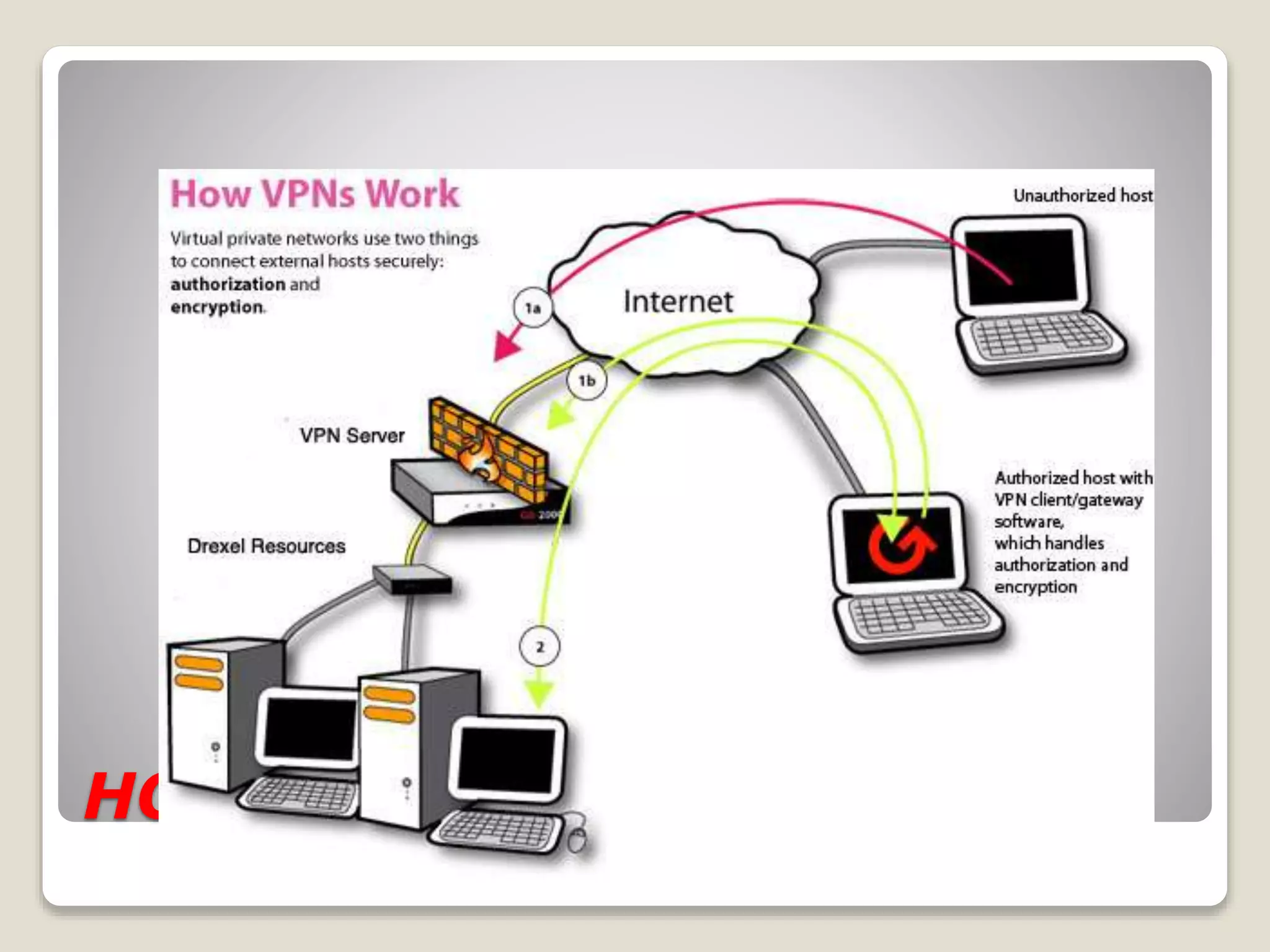
HOW VPN WORKS
PROTOCOLS USED IN VPN
 PPTP - Point-to-point tunneling protocol
 L2Tp – Layers to Tunneling Protocol
 IPSec - Internet protocol security
 SSL – is not used as much as the ones above.
 Encryption
VPN SECURITY: FIREWALL
A well-designed VPN uses several methods for keeping your
connection and data secure:
 Firewalls
 Encryption
 IPSec
 AAA Server
 You can set firewalls to restrict the number of open ports,
what type of packets are passed through and which
protocols are allowed through.
VPN ADVANTAGES
 Multiple telephone lines and banks of modems at the
central site are not required.
 A reduction in the overall telecommunication infrastructure
– as the ISP provides the bulk of the network.
 Reduced cost of management, maintenance of equipment
and technical support.
 Simplifies network topology by eliminating modem pools
and a private network infrastructure.
 VPN functionality is already present in some IT equipment.
VPN DISADVANTAGES
 If the ISP or Internet connection is down, so is the VPN.
 The central site must have a permanent internet
connection so that remote clients and other sites can
connect at anytime.
 VPNs may provide each user with less bandwidth than a
dedicated line solution.
 Existing firewalls, proxies, routers and hubs may not
support VPN transmissions.
VPN FEATURES
 Security – tunneling support between sites with at least
128bit encryption of the data.
 Scalability – extra users and bandwidth can be added
easily to adapt to new requirements.
 Services – quality of service features, including
bandwidth, management and traffic shaping, are important
to avoid congestion.
 Management – reports on user activity, management of
user policies and monitoring of the VPN as a whole.
CONCLUSION
 As we have gone through all possible details we conclude
that VPN is the best option for the corporate networking.
 As many companies need to have access to Internet and
hence security is also the main concern.
 VPN provides best possible combination of security and
private network capabilities with adequate cost –saving to
the companies who are presently working with leased lines.
VIRTUAL PRIVATE NETWORKS BY SAIKIRAN PANJALA

VIRTUAL PRIVATE NETWORKS BY SAIKIRAN PANJALA

  • 1.
  • 2.
    ABSTRACT Virtual private network(VPN)is a rapidly growing technology which plays a great role in wireless LAN(WLAN) by providing secure data transmission. The purpose of VPN is to provide safe and secure communication by creating virtual tunnels between pair of hosts, once tunnel is created data transfer can take place.
  • 3.
    INTRODUCTION A VPN isa private network that uses a public infrastructure(usually the Internet)to connect remote sites or users .The VPN as the name suggests uses “virtual” connections routed through the Internet from the business’s private network to the remote site or remote employee .It is a new technology which can be applied to LAN as well as to WLAN.A VPN maintains privacy of data through security procedures and tunneling protocols .In effect, data is encrypted at sender side and forwarded via tunnel which is then decrypted at receiver side.
  • 4.
    TYPES OF VPN Remote-Access VPN  Site-to-Site VPN (Intranet-based)  Site-to-Site VPN (Extranet-based)
  • 5.
    REMOTE-ACCESS VPN  Aremote access VPN is for home or travelling users who need to access their central LAN from a remote location.  They dial their ISP and connect over the internet to the LAN.  This is made possible by installing a client software program on the remote user’s laptop or PC that deals with the encryption and decryption of the VPN traffic between itself and the VPN gateway on the central LAN.
  • 6.
    SITE-TO-SITE VPN  Intranet-based- If a company has one or more remote locations that they wish to join in a single private network, they can create an intranet VPN to connect LAN to LAN.  Extranet-based - When a company has a close relationship with another company (for example, a partner, supplier or customer), they can build an extranet VPN that connects LAN to LAN, and that allows all of the various companies to work in a shared environment.
  • 7.
  • 8.
  • 9.
    PROTOCOLS USED INVPN  PPTP - Point-to-point tunneling protocol  L2Tp – Layers to Tunneling Protocol  IPSec - Internet protocol security  SSL – is not used as much as the ones above.  Encryption
  • 10.
    VPN SECURITY: FIREWALL Awell-designed VPN uses several methods for keeping your connection and data secure:  Firewalls  Encryption  IPSec  AAA Server  You can set firewalls to restrict the number of open ports, what type of packets are passed through and which protocols are allowed through.
  • 11.
    VPN ADVANTAGES  Multipletelephone lines and banks of modems at the central site are not required.  A reduction in the overall telecommunication infrastructure – as the ISP provides the bulk of the network.  Reduced cost of management, maintenance of equipment and technical support.  Simplifies network topology by eliminating modem pools and a private network infrastructure.  VPN functionality is already present in some IT equipment.
  • 12.
    VPN DISADVANTAGES  Ifthe ISP or Internet connection is down, so is the VPN.  The central site must have a permanent internet connection so that remote clients and other sites can connect at anytime.  VPNs may provide each user with less bandwidth than a dedicated line solution.  Existing firewalls, proxies, routers and hubs may not support VPN transmissions.
  • 13.
    VPN FEATURES  Security– tunneling support between sites with at least 128bit encryption of the data.  Scalability – extra users and bandwidth can be added easily to adapt to new requirements.  Services – quality of service features, including bandwidth, management and traffic shaping, are important to avoid congestion.  Management – reports on user activity, management of user policies and monitoring of the VPN as a whole.
  • 14.
    CONCLUSION  As wehave gone through all possible details we conclude that VPN is the best option for the corporate networking.  As many companies need to have access to Internet and hence security is also the main concern.  VPN provides best possible combination of security and private network capabilities with adequate cost –saving to the companies who are presently working with leased lines.