Digital Audio Broadcasting
Presenting By
#######
12dhhhh
Under the guidance of
@@@@@@@@@
2
Digital audio broadcasting is a technique which gives listeners
interference free reception of high quality sound, easy to use radio, and the
potential for wider listening choice through many additional station and
services. Current analogue FM radio broadcasting systems in VHF band cannot
satisfy demands of future ,such as excellent sound quality, large number of
stations and small portable receivers and no quality impairment due to
multipath propagation. Digital audio technology has set technical quality
standards, which are far beyond those available to radio broadcasting
transmitted over the analog. DAB has the potential to make radio .


Digital audio broadcasting, DAB, is the most
fundamental advancement in radio technology since
that introduction of FM stereo radio.
It gives listeners interference — free reception of CD
quality sound, easy to use radios, and the potential for
wider listening choice through many additional stations
and services.
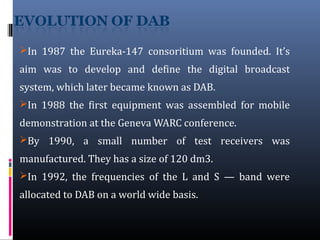
In 1987 the Eureka-147 consoritium was founded. It’s
aim was to develop and define the digital broadcast
system, which later became known as DAB.
In 1988 the first equipment was assembled for mobile
demonstration at the Geneva WARC conference.
By 1990, a small number of test receivers was
manufactured. They has a size of 120 dm3.
In 1992, the frequencies of the L and S — band were
allocated to DAB on a world wide basis.
The digital representation of audio data offers many
advantages.
•High noise immunity
•Stability
•Reproducibility
•Allows the efficient implementation of many audio
processing functions (i.e. mixing, filtering, equalization)
though the digital computer.
 The MPEG (Motion Picture Experts Group) audio
compression algorithm is an International
Standardization Organization (ISO) standard for high
fidelity audio compression.
 The high performance of this compression algorithm is
due to the exploitation of auditory masking.
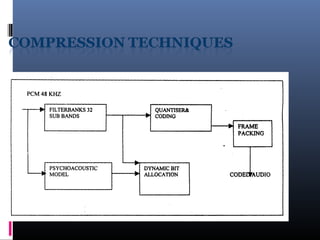
The input audio stream passes through a filter bank that
divides the input into multiple sub-bands.
The input audio stream simultaneously passed through a
pyscho acoustic model that determines the signal –to mask
ratio of each sub-band
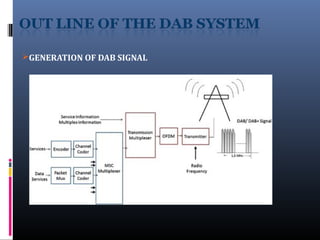
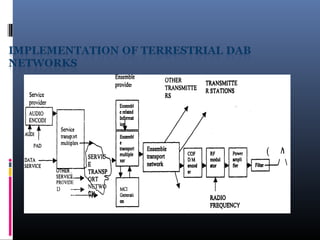
GENERATION OF DAB SIGNAL
PROGRAMME ASSOCIATED DATA
INDEPENDENT DATA SERVICES
CONDITIONAL ACCESS
SERVICE INFORMATION
Besides terrestrial transmission the DAB system is
suitable for satellite as well as for hybrid/mixed
terrestrial/satellite broadcasting , using a simple omni-
directional receiving antenna.
Satellites will receive the data generated by uplink
stations ,amplify this data and send it back through special
spot beams not only to fixed, but also to mobile and portable
receivers, complementary terrestrial transmitters may be
necessary, e.g. in big cities with high-rise buildings.
Better quality audio can be obtained.
Error correction is a part of the digital system.
Multipath interference which is the main problem of analog
FM is reduced or almost avoided.
Significant data casting capacity.
Additional data services.
The figure below shows a conceptual DAB receiver.
The DAB ensemble(multiplex) is selected in the
analogue tuner , the digitized output of which is fed to
the OFDM demodulator and channel decoder to
eliminate transmission errors.
Reception Quality: The reception quality on DAB can be poor
even for people who live well within the coverage area.
Signal Delay: Delays in the receiver due to digital processing add
to the overall delay perceived by the listener.As DAB is at a
relatively early stage of deployment, DAB coverage is poor in
nearly all countries in comparison to the high population coverage
provided by FM.
More and more countries across the world are switching on to
DAB.
Any how DAB is going to be the Sound of the future. It is in the
path of the growth and development.
 It is going to replace the present methods, even through it
may take time. As a successor of DAB , DTV hams started
broadcasting in the UK, the USA etc.
Thank You

Digital Audio Broadcasting By SAIKIRAN PANJALA

  • 1.
    Digital Audio Broadcasting PresentingBy ####### 12dhhhh Under the guidance of @@@@@@@@@
  • 2.
    2 Digital audio broadcastingis a technique which gives listeners interference free reception of high quality sound, easy to use radio, and the potential for wider listening choice through many additional station and services. Current analogue FM radio broadcasting systems in VHF band cannot satisfy demands of future ,such as excellent sound quality, large number of stations and small portable receivers and no quality impairment due to multipath propagation. Digital audio technology has set technical quality standards, which are far beyond those available to radio broadcasting transmitted over the analog. DAB has the potential to make radio .                                                          
  • 3.
    Digital audio broadcasting,DAB, is the most fundamental advancement in radio technology since that introduction of FM stereo radio. It gives listeners interference — free reception of CD quality sound, easy to use radios, and the potential for wider listening choice through many additional stations and services.
  • 4.
    In 1987 theEureka-147 consoritium was founded. It’s aim was to develop and define the digital broadcast system, which later became known as DAB. In 1988 the first equipment was assembled for mobile demonstration at the Geneva WARC conference. By 1990, a small number of test receivers was manufactured. They has a size of 120 dm3. In 1992, the frequencies of the L and S — band were allocated to DAB on a world wide basis.
  • 5.
    The digital representationof audio data offers many advantages. •High noise immunity •Stability •Reproducibility •Allows the efficient implementation of many audio processing functions (i.e. mixing, filtering, equalization) though the digital computer.
  • 6.
     The MPEG(Motion Picture Experts Group) audio compression algorithm is an International Standardization Organization (ISO) standard for high fidelity audio compression.  The high performance of this compression algorithm is due to the exploitation of auditory masking.
  • 8.
    The input audiostream passes through a filter bank that divides the input into multiple sub-bands. The input audio stream simultaneously passed through a pyscho acoustic model that determines the signal –to mask ratio of each sub-band
  • 9.
  • 11.
    PROGRAMME ASSOCIATED DATA INDEPENDENTDATA SERVICES CONDITIONAL ACCESS SERVICE INFORMATION
  • 13.
    Besides terrestrial transmissionthe DAB system is suitable for satellite as well as for hybrid/mixed terrestrial/satellite broadcasting , using a simple omni- directional receiving antenna. Satellites will receive the data generated by uplink stations ,amplify this data and send it back through special spot beams not only to fixed, but also to mobile and portable receivers, complementary terrestrial transmitters may be necessary, e.g. in big cities with high-rise buildings.
  • 14.
    Better quality audiocan be obtained. Error correction is a part of the digital system. Multipath interference which is the main problem of analog FM is reduced or almost avoided. Significant data casting capacity. Additional data services.
  • 15.
    The figure belowshows a conceptual DAB receiver. The DAB ensemble(multiplex) is selected in the analogue tuner , the digitized output of which is fed to the OFDM demodulator and channel decoder to eliminate transmission errors.
  • 16.
    Reception Quality: Thereception quality on DAB can be poor even for people who live well within the coverage area. Signal Delay: Delays in the receiver due to digital processing add to the overall delay perceived by the listener.As DAB is at a relatively early stage of deployment, DAB coverage is poor in nearly all countries in comparison to the high population coverage provided by FM.
  • 17.
    More and morecountries across the world are switching on to DAB. Any how DAB is going to be the Sound of the future. It is in the path of the growth and development.  It is going to replace the present methods, even through it may take time. As a successor of DAB , DTV hams started broadcasting in the UK, the USA etc.
  • 18.