LATEST TRENDS IN
ANDROID TECHNOLOGY
Presenting By
#########
12addddd
Under the guidance of
@@@@@@@@@@
PRESENTATION OUT LINES
 ABSTRACT
 INTRODUCTION
 OPEN HANDSET ALLIANCE(OHA)
 FEATURES OF ANDROID
 OSWHICHARE MOSTLY USED
 VERSIONS OF ANDROID
 ADVANTAGES
 LIMITATIONS
 CONCLUSION
 REFERENCE
ABSTRACT
Android is a software stack for mobile devices that include an
operating system, middleware and key applications. Android is a
software platform and operating system for mobile devices based on the
Linux operating system and developed by Google and the Open Handset
Alliance. The unveiling of the Android platform on 5 November 2007 was
announced with the founding of the Open Handset Alliance, a
consortium of 34 hardware, software and telecom companies devoted to
advancing open standard for mobile devices. When released in 2008,
most of the Android platform will be made available under the Apache
free-software and open-source license. The versions in Android are in the
alphabetical order .They are Astro (Alpha), Beta, Cupcake, Donut, Éclair,
Froyo, Ginger Bread, Honey Comb, Ice cream sandwich, Jelly Bean,
Kitkat, Lollipop and now the latest version is Marshmallow.
INTRODUCTION
 WHAT IS ANDROID ?
 A Software platform and operating system for
mobile.
 Based on the Linux kernel.
 Android was found back in 2003.
 It was developed in Palo Alto, California.
 Android was developed by the Andy Rubin, Rich
Miner, Nick Sears and Chris White.
 Android was purchased by the GOOGLE in
August 2005, for 50 million $.
OPEN HANDSET ALLIANCE(OHA)
 What is OHA ?
 It is a consortium of
several companies.
 This group of companies
are allowed to use source
code of Android and
develop applications.
 Reasons for Nokia not to
develop Android Mobiles
is Nokia is not part of
OHA.
FEATURES OF ANDROID
 Android supports wireless communication
using:
3G Networks
4G Networks
802.11 WI-FI Networks
Bluetooth Connectivity
 Android is a multi-process system, in which
each application runs in its own process.
FEATURES OF ANDROID
 Interface that is better than the previous
touch screen mobiles.
 User gets millions of applications that user
can not get in any other mobile operating
system.
 Android supports advanced audio/video/
media formats such as MPEG-4,MP3, and
AAC, JPEG, PNG, GIF.
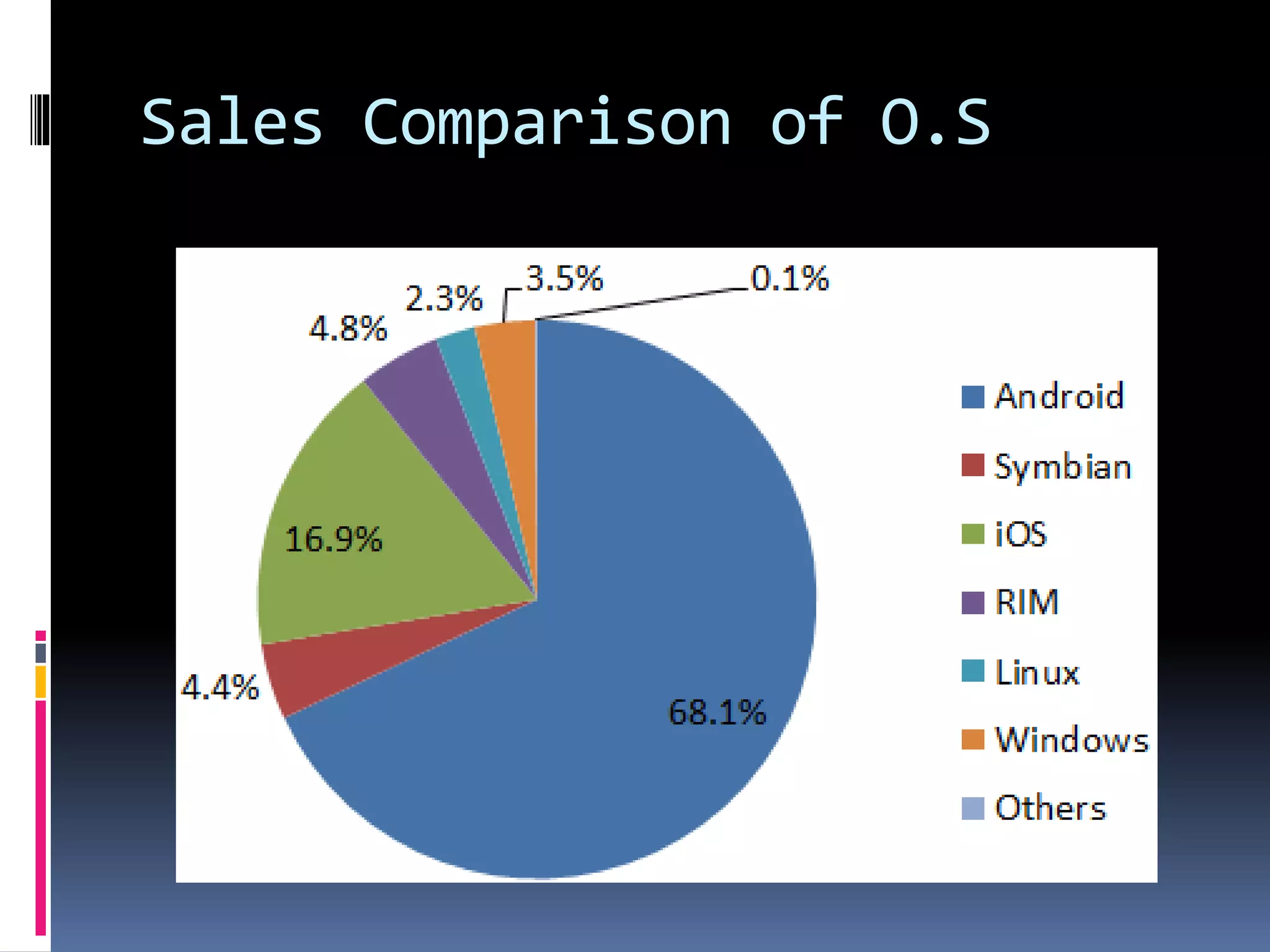
O.S WHICH ARE MOSTLY USED
 Other then Android there are several other
mobile operating system which is used.
 Symbian, iOS, windows are one of the mostly
used mobile operating systems.
Sales Comparison of O.S
VERSIONS OF ANDROID
 NOTE :The versions Astro (Alpha) and Beta were
not publicly named
 Android Astro(Alpha)
 First version of android.
 Released on September 23, 2008.
 Wi-Fi and Bluetooth support.
 Quite slow in operating.
 copy and paste feature in the web browser is not
present.
 Android Beta
 Released on February 9, 2009.
 The focus of Android beta is
testing incorporating usability.
 Android beta will generally have
many more problems on speed
and performance.
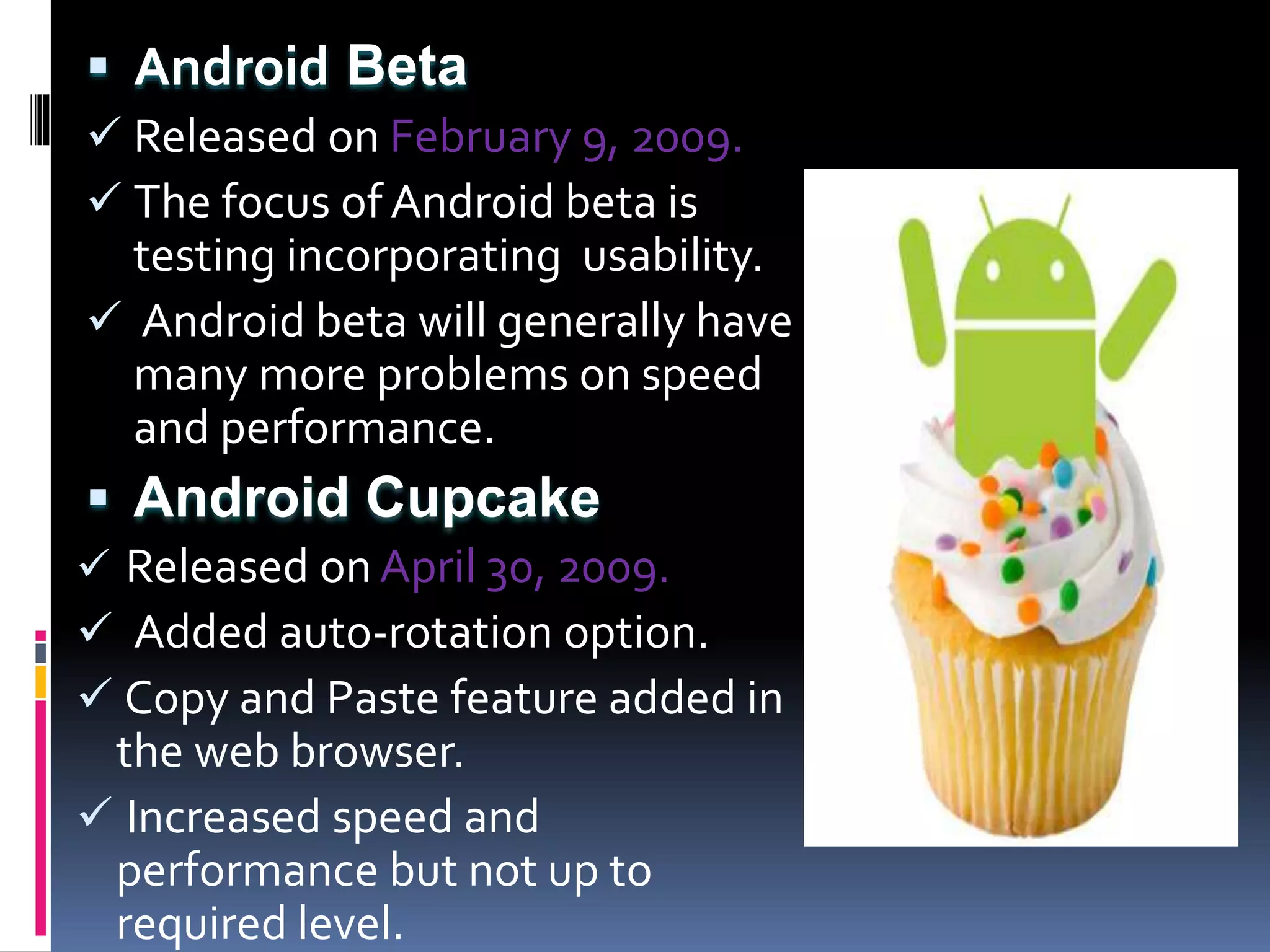
 Android Cupcake
 Released on April 30, 2009.
 Added auto-rotation option.
 Copy and Paste feature added in
the web browser.
 Increased speed and
performance but not up to
required level.
 Android Donut
 Released on September 15, 2009.
 Voice search and Search box were added.
 Faster OS boot times and fast web browsing
experience.
 Typing is quite slower.
• Android Éclair
 Released on October 26, 2009.
 Bluetooth 2.1 support.
 Improved typing speed on virtual
keyboard, with smarter
dictionary.
 no Adobe flash media support
 Android Froyo
 Released on May 20, 2010.
 Support for Adobe Flash 10.1
 Improved Application launcher with better
browser
 No internet calling.
 Android Gingerbread
 Released on December 6, 2010.
 Updated User Interface with high efficiency and speed
 Internet calling
 One touch word selection and copy/paste.
 New keyboard for faster word input.
 More successful version of Android than previous
versions.
 not supports multi-core processors.
 Android Honeycomb
 Released on February 22, 2011.
 Support for multi-core processors
 Ability to encrypt all user data.
 This version of android is only available for tablets.
 Android Ice Cream Sandwich
 Released on November 14, 2011.
 Virtual button in the UI.
 A new typeface family for the UI, Roboto.
 Ability to shut down apps that are using data in the
background.
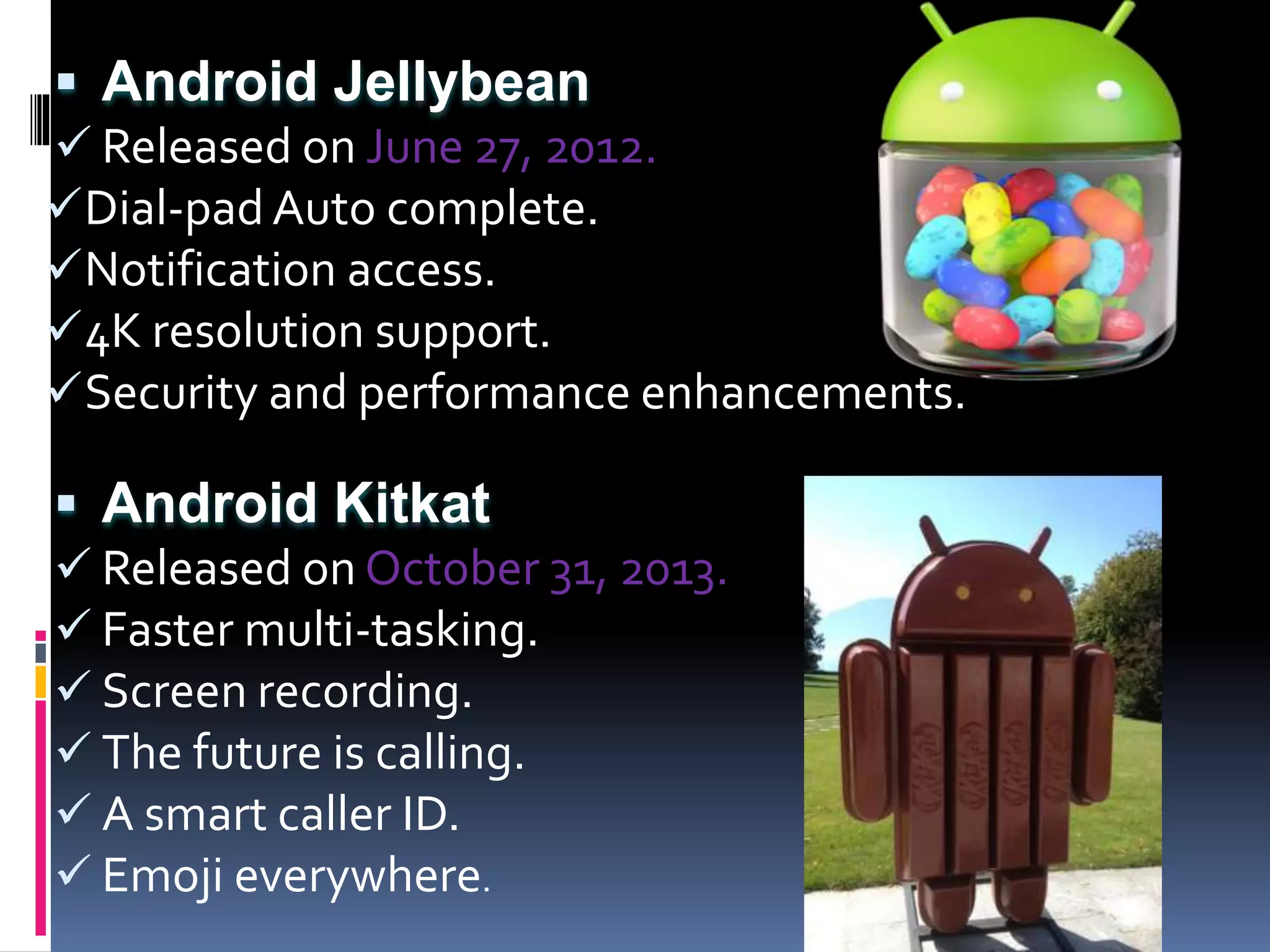
 Android Jellybean
 Released on June 27, 2012.
Dial-pad Auto complete.
Notification access.
4K resolution support.
Security and performance enhancements.
 Android Kitkat
 Released on October 31, 2013.
 Faster multi-tasking.
 Screen recording.
 The future is calling.
 A smart caller ID.
 Emoji everywhere.
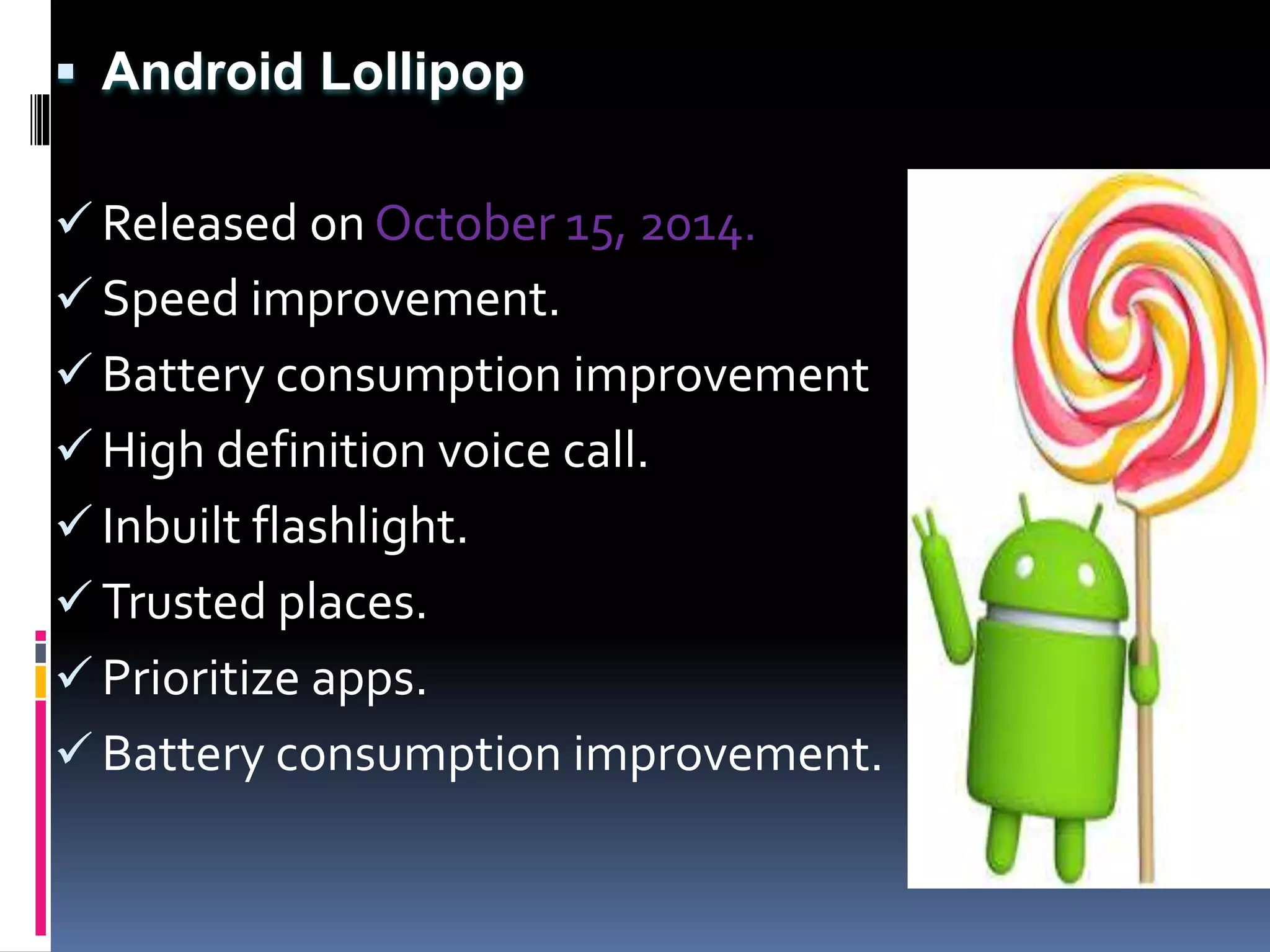
 Android Lollipop
 Released on October 15, 2014.
 Speed improvement.
 Battery consumption improvement
 High definition voice call.
 Inbuilt flashlight.
 Trusted places.
 Prioritize apps.
 Battery consumption improvement.
 Android Marshmallow
 Latest version of android.
 Released on October 5, 2015.
 Fingerprint authentication support.
 Better battery life.
ADVANTAGES
 Android can run multiple apps at the same time.
 Android gives you better notifications compare to
iphone, because iphone has some trouble with
notifications.
 Android is hardware independent.
 Android lets you install custom ROMs
 Android has a better application market.
LIMITATIONS
 Making source code available to everyone inevitably
invites the attention of hackers.
 Android operating system uses more amount of
battery as compared to normal mobile phones.
 As there are so many user sometimes it becomes
difficult to connect all the users.
 As we call Android is world of applications we
continuously need to connected with the internet
which is not possible for all the users.
CONCLUSION
 Android is now stepping up in next level of
mobile internet.
 Google may launch another version of
android that starts N because Google is
launching all the android versions in the
alphabetical order.
 There are chances of Android may become
the widely used operating system in world.
REFERENCES
 http://www.openhandsetalliance.com/androi
d_overview.html
 http://www.android.com
THANK YOU

LATEST TRENDS IN ANDROID TECHNOLOGY BY SAIKIRAN PANJALA

  • 1.
    LATEST TRENDS IN ANDROIDTECHNOLOGY Presenting By ######### 12addddd Under the guidance of @@@@@@@@@@
  • 2.
    PRESENTATION OUT LINES ABSTRACT  INTRODUCTION  OPEN HANDSET ALLIANCE(OHA)  FEATURES OF ANDROID  OSWHICHARE MOSTLY USED  VERSIONS OF ANDROID  ADVANTAGES  LIMITATIONS  CONCLUSION  REFERENCE
  • 3.
    ABSTRACT Android is asoftware stack for mobile devices that include an operating system, middleware and key applications. Android is a software platform and operating system for mobile devices based on the Linux operating system and developed by Google and the Open Handset Alliance. The unveiling of the Android platform on 5 November 2007 was announced with the founding of the Open Handset Alliance, a consortium of 34 hardware, software and telecom companies devoted to advancing open standard for mobile devices. When released in 2008, most of the Android platform will be made available under the Apache free-software and open-source license. The versions in Android are in the alphabetical order .They are Astro (Alpha), Beta, Cupcake, Donut, Éclair, Froyo, Ginger Bread, Honey Comb, Ice cream sandwich, Jelly Bean, Kitkat, Lollipop and now the latest version is Marshmallow.
  • 4.
    INTRODUCTION  WHAT ISANDROID ?  A Software platform and operating system for mobile.  Based on the Linux kernel.  Android was found back in 2003.  It was developed in Palo Alto, California.  Android was developed by the Andy Rubin, Rich Miner, Nick Sears and Chris White.  Android was purchased by the GOOGLE in August 2005, for 50 million $.
  • 5.
    OPEN HANDSET ALLIANCE(OHA) What is OHA ?  It is a consortium of several companies.  This group of companies are allowed to use source code of Android and develop applications.  Reasons for Nokia not to develop Android Mobiles is Nokia is not part of OHA.
  • 6.
    FEATURES OF ANDROID Android supports wireless communication using: 3G Networks 4G Networks 802.11 WI-FI Networks Bluetooth Connectivity  Android is a multi-process system, in which each application runs in its own process.
  • 7.
    FEATURES OF ANDROID Interface that is better than the previous touch screen mobiles.  User gets millions of applications that user can not get in any other mobile operating system.  Android supports advanced audio/video/ media formats such as MPEG-4,MP3, and AAC, JPEG, PNG, GIF.
  • 8.
    O.S WHICH AREMOSTLY USED  Other then Android there are several other mobile operating system which is used.  Symbian, iOS, windows are one of the mostly used mobile operating systems.
  • 9.
  • 10.
    VERSIONS OF ANDROID NOTE :The versions Astro (Alpha) and Beta were not publicly named  Android Astro(Alpha)  First version of android.  Released on September 23, 2008.  Wi-Fi and Bluetooth support.  Quite slow in operating.  copy and paste feature in the web browser is not present.
  • 11.
     Android Beta Released on February 9, 2009.  The focus of Android beta is testing incorporating usability.  Android beta will generally have many more problems on speed and performance.  Android Cupcake  Released on April 30, 2009.  Added auto-rotation option.  Copy and Paste feature added in the web browser.  Increased speed and performance but not up to required level.
  • 12.
     Android Donut Released on September 15, 2009.  Voice search and Search box were added.  Faster OS boot times and fast web browsing experience.  Typing is quite slower. • Android Éclair  Released on October 26, 2009.  Bluetooth 2.1 support.  Improved typing speed on virtual keyboard, with smarter dictionary.  no Adobe flash media support
  • 13.
     Android Froyo Released on May 20, 2010.  Support for Adobe Flash 10.1  Improved Application launcher with better browser  No internet calling.
  • 14.
     Android Gingerbread Released on December 6, 2010.  Updated User Interface with high efficiency and speed  Internet calling  One touch word selection and copy/paste.  New keyboard for faster word input.  More successful version of Android than previous versions.  not supports multi-core processors.
  • 15.
     Android Honeycomb Released on February 22, 2011.  Support for multi-core processors  Ability to encrypt all user data.  This version of android is only available for tablets.  Android Ice Cream Sandwich  Released on November 14, 2011.  Virtual button in the UI.  A new typeface family for the UI, Roboto.  Ability to shut down apps that are using data in the background.
  • 16.
     Android Jellybean Released on June 27, 2012. Dial-pad Auto complete. Notification access. 4K resolution support. Security and performance enhancements.  Android Kitkat  Released on October 31, 2013.  Faster multi-tasking.  Screen recording.  The future is calling.  A smart caller ID.  Emoji everywhere.
  • 17.
     Android Lollipop Released on October 15, 2014.  Speed improvement.  Battery consumption improvement  High definition voice call.  Inbuilt flashlight.  Trusted places.  Prioritize apps.  Battery consumption improvement.
  • 18.
     Android Marshmallow Latest version of android.  Released on October 5, 2015.  Fingerprint authentication support.  Better battery life.
  • 19.
    ADVANTAGES  Android canrun multiple apps at the same time.  Android gives you better notifications compare to iphone, because iphone has some trouble with notifications.  Android is hardware independent.  Android lets you install custom ROMs  Android has a better application market.
  • 20.
    LIMITATIONS  Making sourcecode available to everyone inevitably invites the attention of hackers.  Android operating system uses more amount of battery as compared to normal mobile phones.  As there are so many user sometimes it becomes difficult to connect all the users.  As we call Android is world of applications we continuously need to connected with the internet which is not possible for all the users.
  • 21.
    CONCLUSION  Android isnow stepping up in next level of mobile internet.  Google may launch another version of android that starts N because Google is launching all the android versions in the alphabetical order.  There are chances of Android may become the widely used operating system in world.
  • 22.
  • 23.