A quantum computer is a machine that
performs calculations based on the laws of
quantum mechanics, which is the behavior of
particles at the sub-atomic level. A quantum
computer can efficiently simulate any realistic
model of computation. In a quantum computer,
one "qubit" - quantum bit - could be both 0 and
1 at the same time. So with three qubits of data,
a quantum computer could store all eight
combinations of 0 and 1 simultaneously. That
means a three-qubit quantum computer could
calculate eight times faster than a three-bit
digital computer. If we built this quantum
computer it would revoltionize human society.
 Civilization has advanced as people discovered
new ways of exploiting various physical resources such
as materials, forces and energies. The history of
computer technology has involved a sequence of
changes of physical realization - from gears to relays to
valves to transistors to integrated circuits and so on.
Today's advanced lithographic techniques can squeeze
fraction of micron wide logic gates and wires onto the
surface of silicon chips.
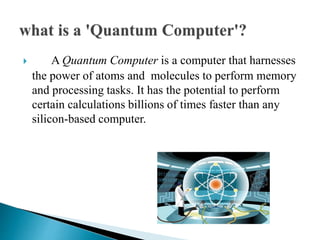
 A Quantum Computer is a computer that harnesses
the power of atoms and molecules to perform memory
and processing tasks. It has the potential to perform
certain calculations billions of times faster than any
silicon-based computer.
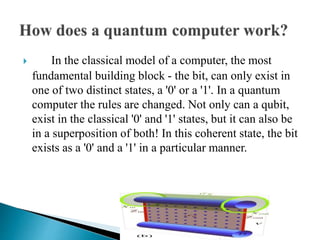
 In the classical model of a computer, the most
fundamental building block - the bit, can only exist in
one of two distinct states, a '0' or a '1'. In a quantum
computer the rules are changed. Not only can a qubit,
exist in the classical '0' and '1' states, but it can also be
in a superposition of both! In this coherent state, the bit
exists as a '0' and a '1' in a particular manner.
ANALYSIS
 Quantum computers are advantageous in the way
they encode a bit, the fundamental unit of information.
A number - 0 or 1, specifies the state of a bit in a
classical digital computer. An n-bit binary word in a
typical computer is accordingly described by a string of
n zeros and ones. A qubit might be represented by an
atom in one of two different states, which can also be
denoted as 0 or 1.
 The current challenge is not to build a full quantum
computer right away but rather to move from the
experiments in which we merely observe quantum
phenomena to experiments in which we can control
these phenomena. This is a first step towards quantum
logic gates and simple quantum networks.
 Quantum computers could one day replace silicon
chips, just like the transistor once replaced the
vacuum tube. But for now, the technology required to
develop such a quantum computer is beyond our
reach. Most research in quantum computing is still
very theoretical. The most advanced quantum
computers have not gone beyond manipulating more
than 7 qubits, meaning that they are still at the "1 +
1" stage. However, the potential remains that
quantum computers one day could perform, quickly
and easily, calculations that are incredibly time-
consuming on conventional computers
 Consider first a classical computer that operates on a three-bit register.
The state of the computer at any time is a probability distribution over the 23 =
8 different three-bit strings 000, 001, 010, 011, 100, 101, 110, 111. If it is a
deterministic computer, then it is in exactly one of these states with probability
1.
 However, if it is a probabilistic computer, then there is a possibility of it
being in any one of a number of different states. We can describe this
probabilistic state by eight nonnegative numbers a,b,c,d,e,f,g,h.
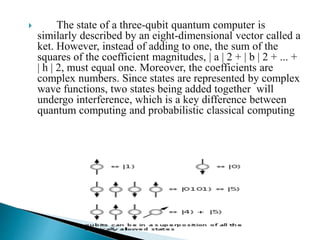
 The state of a three-qubit quantum computer is
similarly described by an eight-dimensional vector called a
ket. However, instead of adding to one, the sum of the
squares of the coefficient magnitudes, | a | 2 + | b | 2 + ... +
| h | 2, must equal one. Moreover, the coefficients are
complex numbers. Since states are represented by complex
wave functions, two states being added together will
undergo interference, which is a key difference between
quantum computing and probabilistic classical computing
 While a classical three-bit state and a quantum three-qubit state are both eight-
dimensional vectors, they are manipulated quite differently for classical or
quantum computation. For computing in either case, the system must be
initialized, for example into the all-zeros string, , corresponding to the vector
(1,0,0,0,0,0,0,0). In classical randomized computation, the system evolves
according to the application of stochastic matrices, which preserve
 that the probabilities add up to one.
 Integer factorization is believed to be computationally infeasible with an
ordinary computer for large integers if they are the product of few prime
numbers.By comparison, a quantum computer could efficiently solve this problem
using Shor's algorithm to find its factors. This ability would allow a quantum
computer to decrypt many of the cryptographic systems in use today, in the sense
that there would be a polynomial time algorithm for solving the problem. In
particular, most of the popular public key ciphers are based on the difficulty of
factoring integers, including forms of
 RSA. These are used to protect secure Web pages,
 Encrypted email, and many other types of data.
There are a number of quantum computing candidates
among those:
Superconductor-based quantum computers
Trapped ion quantum computer
Optical lattices
Topological quantum computer
 The class of problems that can be efficiently solved by quantum
computers is called BQP, for "bounded error, quantum,
polynomial time".Quantum computers only run probabilistic
algorithms, so BQP on quantum computers is the counterpart of
BPP on classical computers.It is defined solvable with a
polynomial-time algorithm, whose probability of error is
bounded away from one half.A quantum computer is said to
"solve" a problem if, for every instance,its answer will be right
with high probability.If that solution runs in polynomial
time,then that problem is in BQP.
 Quantum Cryptography
 Quantum Communication
 Artificial Intelligence
Although the future of quantum computing looks promising, we
have only just taken our first steps to actually realizing a quantum
computer.There are many hurdles,which need to be overcome before
we can begin to appreciate the benefits they may deliver.
Researchers around the world are racing to be the first to achieve a
practical system, a task,which some scientists think, is futile.
REFERENCES
http://www.aps.org/units/gqi/newsletters/index.cfm
http://quantum.fis.ucm.es/
http://scienceblogs.com/pontiff/
http://www.scottaaronson.com/blog/
A Technical Seminar on Quantum Computers By SAIKIRAN PANJALA

A Technical Seminar on Quantum Computers By SAIKIRAN PANJALA

  • 2.
    A quantum computeris a machine that performs calculations based on the laws of quantum mechanics, which is the behavior of particles at the sub-atomic level. A quantum computer can efficiently simulate any realistic model of computation. In a quantum computer, one "qubit" - quantum bit - could be both 0 and 1 at the same time. So with three qubits of data, a quantum computer could store all eight combinations of 0 and 1 simultaneously. That means a three-qubit quantum computer could calculate eight times faster than a three-bit digital computer. If we built this quantum computer it would revoltionize human society.
  • 3.
     Civilization hasadvanced as people discovered new ways of exploiting various physical resources such as materials, forces and energies. The history of computer technology has involved a sequence of changes of physical realization - from gears to relays to valves to transistors to integrated circuits and so on. Today's advanced lithographic techniques can squeeze fraction of micron wide logic gates and wires onto the surface of silicon chips.
  • 4.
     A QuantumComputer is a computer that harnesses the power of atoms and molecules to perform memory and processing tasks. It has the potential to perform certain calculations billions of times faster than any silicon-based computer.
  • 5.
     In theclassical model of a computer, the most fundamental building block - the bit, can only exist in one of two distinct states, a '0' or a '1'. In a quantum computer the rules are changed. Not only can a qubit, exist in the classical '0' and '1' states, but it can also be in a superposition of both! In this coherent state, the bit exists as a '0' and a '1' in a particular manner.
  • 6.
    ANALYSIS  Quantum computersare advantageous in the way they encode a bit, the fundamental unit of information. A number - 0 or 1, specifies the state of a bit in a classical digital computer. An n-bit binary word in a typical computer is accordingly described by a string of n zeros and ones. A qubit might be represented by an atom in one of two different states, which can also be denoted as 0 or 1.
  • 7.
     The currentchallenge is not to build a full quantum computer right away but rather to move from the experiments in which we merely observe quantum phenomena to experiments in which we can control these phenomena. This is a first step towards quantum logic gates and simple quantum networks.
  • 8.
     Quantum computerscould one day replace silicon chips, just like the transistor once replaced the vacuum tube. But for now, the technology required to develop such a quantum computer is beyond our reach. Most research in quantum computing is still very theoretical. The most advanced quantum computers have not gone beyond manipulating more than 7 qubits, meaning that they are still at the "1 + 1" stage. However, the potential remains that quantum computers one day could perform, quickly and easily, calculations that are incredibly time- consuming on conventional computers
  • 9.
     Consider firsta classical computer that operates on a three-bit register. The state of the computer at any time is a probability distribution over the 23 = 8 different three-bit strings 000, 001, 010, 011, 100, 101, 110, 111. If it is a deterministic computer, then it is in exactly one of these states with probability 1.  However, if it is a probabilistic computer, then there is a possibility of it being in any one of a number of different states. We can describe this probabilistic state by eight nonnegative numbers a,b,c,d,e,f,g,h.
  • 10.
     The stateof a three-qubit quantum computer is similarly described by an eight-dimensional vector called a ket. However, instead of adding to one, the sum of the squares of the coefficient magnitudes, | a | 2 + | b | 2 + ... + | h | 2, must equal one. Moreover, the coefficients are complex numbers. Since states are represented by complex wave functions, two states being added together will undergo interference, which is a key difference between quantum computing and probabilistic classical computing
  • 11.
     While aclassical three-bit state and a quantum three-qubit state are both eight- dimensional vectors, they are manipulated quite differently for classical or quantum computation. For computing in either case, the system must be initialized, for example into the all-zeros string, , corresponding to the vector (1,0,0,0,0,0,0,0). In classical randomized computation, the system evolves according to the application of stochastic matrices, which preserve  that the probabilities add up to one.
  • 12.
     Integer factorizationis believed to be computationally infeasible with an ordinary computer for large integers if they are the product of few prime numbers.By comparison, a quantum computer could efficiently solve this problem using Shor's algorithm to find its factors. This ability would allow a quantum computer to decrypt many of the cryptographic systems in use today, in the sense that there would be a polynomial time algorithm for solving the problem. In particular, most of the popular public key ciphers are based on the difficulty of factoring integers, including forms of  RSA. These are used to protect secure Web pages,  Encrypted email, and many other types of data.
  • 13.
    There are anumber of quantum computing candidates among those: Superconductor-based quantum computers Trapped ion quantum computer Optical lattices Topological quantum computer
  • 14.
     The classof problems that can be efficiently solved by quantum computers is called BQP, for "bounded error, quantum, polynomial time".Quantum computers only run probabilistic algorithms, so BQP on quantum computers is the counterpart of BPP on classical computers.It is defined solvable with a polynomial-time algorithm, whose probability of error is bounded away from one half.A quantum computer is said to "solve" a problem if, for every instance,its answer will be right with high probability.If that solution runs in polynomial time,then that problem is in BQP.
  • 15.
     Quantum Cryptography Quantum Communication  Artificial Intelligence
  • 16.
    Although the futureof quantum computing looks promising, we have only just taken our first steps to actually realizing a quantum computer.There are many hurdles,which need to be overcome before we can begin to appreciate the benefits they may deliver. Researchers around the world are racing to be the first to achieve a practical system, a task,which some scientists think, is futile.
  • 17.