
Unit 4
notes:
DNA Structure
(1) What is DNA?
• DNA = DeoxyriboNucleic Acid
• Stores genetic instructions for producing
proteins.
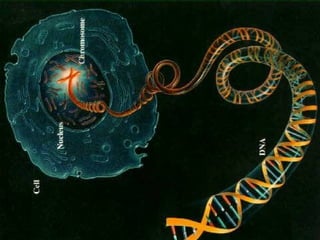
• Stored in the Nucleus of Eukaryotes.
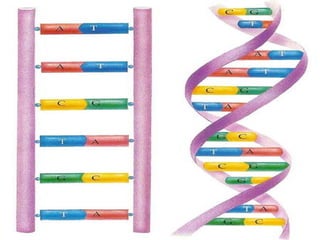
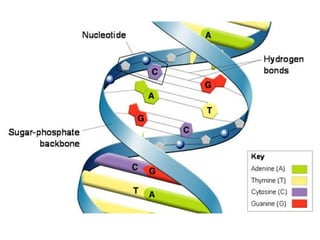
(2) Overall DNA Structure
• Double stranded
• Helix
• Outside / Backbones Made Of:
– Alternating Phosphates and Sugars
• Inside / Steps Made of:
– Nitrogenous Bases
(Yes You Need To Draw This…)
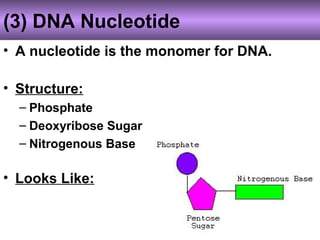
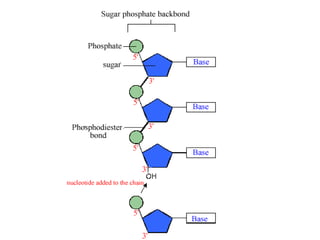
(3) DNA Nucleotide
• A nucleotide is the monomer for DNA.
• Structure:
– Phosphate
– Deoxyribose Sugar
– Nitrogenous Base
• Looks Like:
(4) Nitrogenous Bases
• The sequence of these bases ARE your genetic
code/instructions.
• 4 Types of Bases:
– A = Adenine
– T = Thymine
– G = Guanine
– C = Cytosine
• A’s and T’s bond together.
• G’s and C’s bond together.
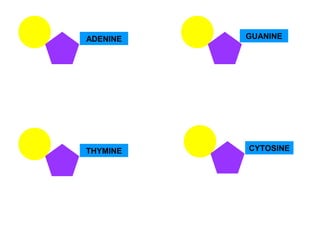
ADENINE
THYMINE
GUANINE
CYTOSINE
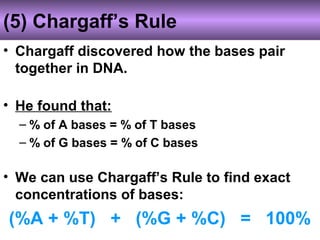
(5) Chargaff’s Rule
• Chargaff discovered how the bases pair
together in DNA.
• He found that:
– % of A bases = % of T bases
– % of G bases = % of C bases
• We can use Chargaff’s Rule to find exact
concentrations of bases:
(%A + %T) + (%G + %C) = 100%
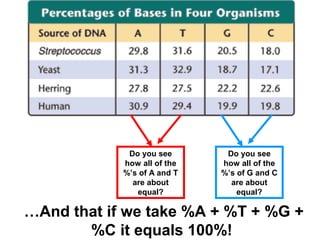
Do you see
how all of the
%’s of A and T
are about
equal?
Do you see
how all of the
%’s of G and C
are about
equal?
…And that if we take %A + %T + %G +
%C it equals 100%!
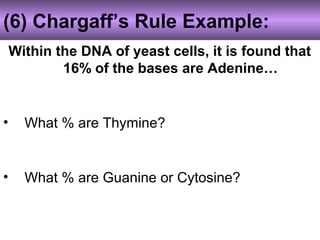
(6) Chargaff’s Rule Example:
Within the DNA of yeast cells, it is found that
16% of the bases are Adenine…
• What % are Thymine?
• What % are Guanine or Cytosine?
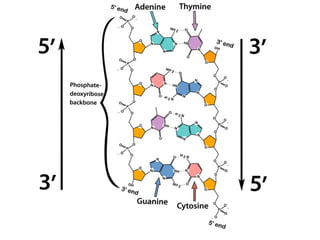
(7) Anti-Parallel Strands:
• Anti-Parallel refers to the two strands in
DNA being positioned in opposite
directions.
• The strands are upside down mirror images
of one another!
Ths general biology unit 4 heredity dna structure and function notes

Ths general biology unit 4 heredity dna structure and function notes

  • 1.
  • 2.
    (1) What isDNA? • DNA = DeoxyriboNucleic Acid • Stores genetic instructions for producing proteins. • Stored in the Nucleus of Eukaryotes.
  • 4.
    (2) Overall DNAStructure • Double stranded • Helix • Outside / Backbones Made Of: – Alternating Phosphates and Sugars • Inside / Steps Made of: – Nitrogenous Bases
  • 6.
    (Yes You NeedTo Draw This…)
  • 7.
    (3) DNA Nucleotide •A nucleotide is the monomer for DNA. • Structure: – Phosphate – Deoxyribose Sugar – Nitrogenous Base • Looks Like:
  • 8.
    (4) Nitrogenous Bases •The sequence of these bases ARE your genetic code/instructions. • 4 Types of Bases: – A = Adenine – T = Thymine – G = Guanine – C = Cytosine • A’s and T’s bond together. • G’s and C’s bond together.
  • 9.
  • 11.
    (5) Chargaff’s Rule •Chargaff discovered how the bases pair together in DNA. • He found that: – % of A bases = % of T bases – % of G bases = % of C bases • We can use Chargaff’s Rule to find exact concentrations of bases: (%A + %T) + (%G + %C) = 100%
  • 12.
    Do you see howall of the %’s of A and T are about equal? Do you see how all of the %’s of G and C are about equal? …And that if we take %A + %T + %G + %C it equals 100%!
  • 13.
    (6) Chargaff’s RuleExample: Within the DNA of yeast cells, it is found that 16% of the bases are Adenine… • What % are Thymine? • What % are Guanine or Cytosine?
  • 14.
    (7) Anti-Parallel Strands: •Anti-Parallel refers to the two strands in DNA being positioned in opposite directions. • The strands are upside down mirror images of one another!