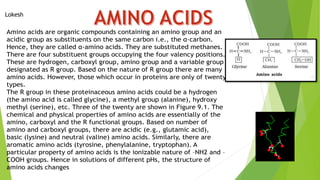

Lokesh
Lokesh 
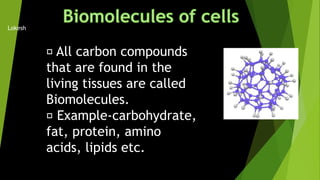
All carbon compounds 
that are found in the 
living tissues are called 
Biomolecules. 
Example-carbohydrate, 
fat, protein, amino 
acids, lipids etc.
Lokesh 
Picture Page Layout 
Your picture caption can go here. Picture 
from PresenterMedia.com 
Lokesh
Lokesh 
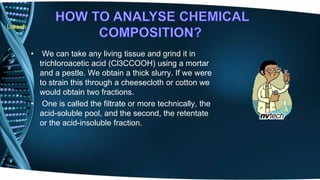
• We can take any living tissue and grind it in 
trichloroacetic acid (Cl3CCOOH) using a mortar 
and a pestle. We obtain a thick slurry. If we were 
to strain this through a cheesecloth or cotton we 
would obtain two fractions. 
• One is called the filtrate or more technically, the 
acid-soluble pool, and the second, the retentate 
or the acid-insoluble fraction.
Lokesh 
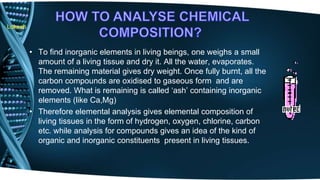
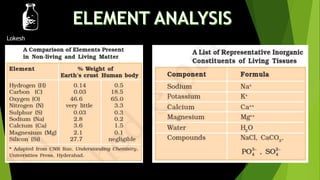
• To find inorganic elements in living beings, one weighs a small 
amount of a living tissue and dry it. All the water, evaporates. 
The remaining material gives dry weight. Once fully burnt, all the 
carbon compounds are oxidised to gaseous form and are 
removed. What is remaining is called ‘ash’ containing inorganic 
elements (like Ca,Mg) 
• Therefore elemental analysis gives elemental composition of 
living tissues in the form of hydrogen, oxygen, chlorine, carbon 
etc. while analysis for compounds gives an idea of the kind of 
organic and inorganic constituents present in living tissues.
Lokesh
Lokesh 
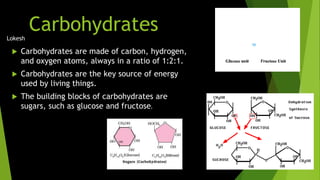
Carbohydrates 
 Carbohydrates are made of carbon, hydrogen, 
and oxygen atoms, always in a ratio of 1:2:1. 
 Carbohydrates are the key source of energy 
used by living things. 
 The building blocks of carbohydrates are 
sugars, such as glucose and fructose.
Lokesh
Lokesh 
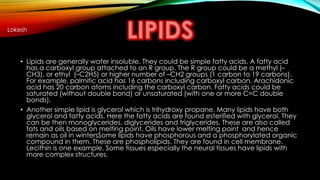
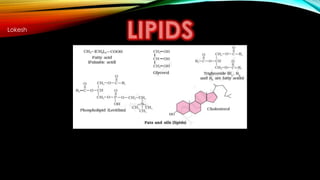
• Lipids are generally water insoluble. They could be simple fatty acids. A fatty acid 
has a carboxyl group attached to an R group. The R group could be a methyl (– 
CH3), or ethyl (–C2H5) or higher number of –CH2 groups (1 carbon to 19 carbons). 
For example, palmitic acid has 16 carbons including carboxyl carbon. Arachidonic 
acid has 20 carbon atoms including the carboxyl carbon. Fatty acids could be 
saturated (without double bond) or unsaturated (with one or more C=C double 
bonds). 
• Another simple lipid is glycerol which is trihydroxy propane. Many lipids have both 
glycerol and fatty acids. Here the fatty acids are found esterified with glycerol. They 
can be then monoglycerides, diglycerides and triglycerides. These are also called 
fats and oils based on melting point. Oils have lower melting point and hence 
remain as oil in wintersSome lipids have phosphorous and a phosphorylated organic 
compound in them. These are phospholipids. They are found in cell membrane. 
Lecithin is one example. Some tissues especially the neural tissues have lipids with 
more complex structures.
Lokesh
Lokesh 
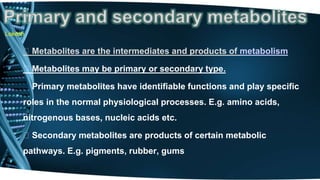
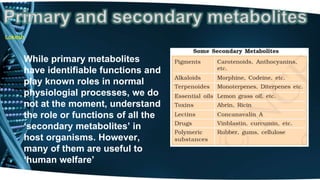
Metabolites are the intermediates and products of metabolism 
Metabolites may be primary or secondary type. 
Primary metabolites have identifiable functions and play specific 
roles in the normal physiological processes. E.g. amino acids, 
nitrogenous bases, nucleic acids etc. 
Secondary metabolites are products of certain metabolic 
pathways. E.g. pigments, rubber, gums
Lokesh 
While primary metabolites 
have identifiable functions and 
play known roles in normal 
physiologial processes, we do 
not at the moment, understand 
the role or functions of all the 
‘secondary metabolites’ in 
host organisms. However, 
many of them are useful to 
‘human welfare’
Lokesh 
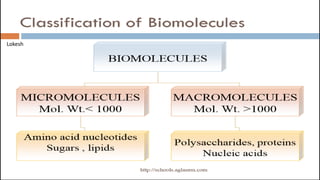
• The acid insoluble fraction, has only four types of organic compounds i.e., 
proteins, nucleic acids, polysaccharides and lipids. These classes of 
compounds with the exception of lipids, have molecular weights in the 
range of ten thousand daltons and above. For this very reason, 
biomolecules, i.e., chemical compounds found in living organisms are of two 
types. One, those which have molecular weights less than one thousand 
dalton and are usually referred to as micromolecules or simply biomolecules 
while those which are found in the acid insoluble fraction are called 
macromolecules or biomacromolecules.
Lokesh 
Proteins 
• Proteins are building blocks of structures called amino acids. 
Proteins are what your DNA codes to make (we will talk about 
this in great detail in a month or so). 
• A peptide bond forms between amino acids by dehydration 
synthesis. 
• Proteins are heteropolymers containing strings of amino acids. 
• There are 3 structures 
• 1)primary structure 
• 2)Secondary structure 
• 3)Teritary structure 
• Some proteins are an assembly of polypeptide or subunits.
Lokesh 
• Proteins are heteropolymers containing 
strings of amino acids. 
• There are 3 structures 
• 1)primary structure 
• 2)Secondary structure 
• 3)Tertiary structure 
• 4)Quaternary structure 
• Some proteins are an assembly of 
polypeptide or subunits.
Lokesh 
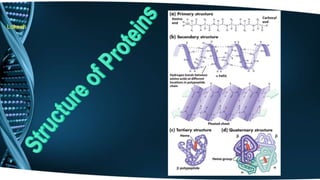
• The sequence of amino acids i.e., the positional information in a protein – which is 
the first amino acid, which is second, and so on – is called the primary structure of 
a protein. A protein is imagined as a line, the left end represented by the first amino 
acid and the right end represented by the last amino acid. The first amino acid is 
also called as N-terminal and the last one is called the C-terminal amino acid. The 
protein thread is folded in the form of a helix (similar to a revolving staircase). 
• In proteins, only right handed helices are observed structure. Other regions of the 
protein thread are folded into other forms in what is called the secondary structure 
.In addition, the long protein chain is also folded upon itself like a hollow woolen 
ball, giving rise to the tertiary structure .. Some proteins are an assembly of more 
than one polypeptide or subunits The manner in which these individual folded 
polypeptides or subunits are arranged with respect to each other (e.g. linear string 
of spheres, spheres arranged one upon each other in the form of a cube or plate 
etc.) is the architecture of a protein otherwise called the quaternary structure of a 
protein.
Lokesh
Lokesh 
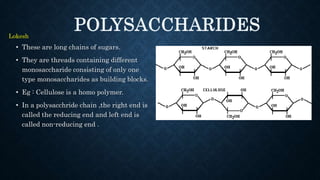
• These are long chains of sugars. 
• They are threads containing different 
monosaccharide consisting of only one 
type monosaccharides as building blocks. 
• Eg : Cellulose is a homo polymer. 
• In a polysacchride chain ,the right end is 
called the reducing end and left end is 
called non-reducing end .
Lokesh 
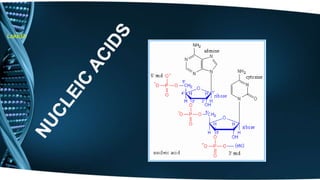
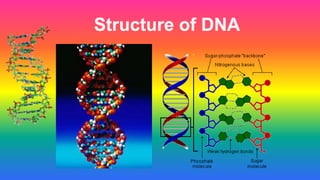
• They other type of macromolecule that one would find in the 
acid insoluble fraction of any living tissue is the nucleic acid. 
• These are polynucleotides. 
• For nucleic acids ,the building blocks is a nucleotide. 
• These contain 3 chemically distinct components. 
• 1)Heterocyclic 
• 2)Monosacchride 
• 3)phosphoric acid or phosphate 
• . A nucleic acid containing deoxyribose is called 
deoxyribonucleic acid (DNA) while that which contains ribose 
is called ribonucleic acid (RNA)
Lokesh
Lokesh 
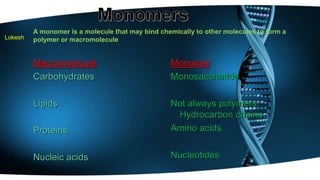
A monomer is a molecule that may bind chemically to other molecules to form a 
polymer or macromolecule 
Macromolecule 
Carbohydrates 
Lipids 
Proteins 
Nucleic acids 
Monomer 
Monosaccharide 
Not always polymers; 
Hydrocarbon chains 
Amino acids 
Nucleotides
Lokesh 
• In a polypeptide or a protein, amino acids are linked by 
a peptide bond which is formed when the carboxyl 
group of one amino acid reacts with the amino group of 
next amino acid with the elimination of water moiety(the 
process is called dehydration). 
• In a polysaccharide the individual monosaccharides are 
linked by glycosidic bond.
Lokesh 
Cell contain thousands of organic compounds. These compounds or biomolecules 
are present in certain concentrations .Biomolecules are constantly being changed 
into some other biomolecules and also made from some other biomolecules. This 
breaking and making is through chemical reactions constantly occuring in living 
organisms. Together all these chemical reactions are called metabolism. Each of 
the metabolic reactions results in the transformation of biomolecules. Example: 
removal of CO2 from amino acids making an amino acid into an amine, metabolites 
are converted into each other in a series of linked reactions called metabolic 
pathways.. These pathways are either linear or circular. These pathways criss- cross 
each other, i.e., there are traffic junctions. Flow of metabolites through metabolic 
pathway has a definite rate and direction like automobile traffic. This metabolite 
flow is called the dynamic state of body constituents. What is most important is 
that this interlinked metabolic traffic is very smooth and without a single reported 
mishap for healthy conditions. There is no uncatalysed metabolic conversion in 
living systems. Even CO2 dissolving in water, a physical process, is a catalysed 
reaction in living systems. The catalysts which hasten the rate of a given metabolic 
conversation are also proteins. These proteins with catalytic power are named 
enzymes.
Lokesh 
Metabolic pathways can lead to more complex 
structure from a simpler structure or lead to a 
simpler structure from a complex structure. 
The former structure are called biosynthetic 
pathways or anabolic pathways. 
The latter constitute degradation and hence are 
called catabolic pathways. 
The most important form of energy in a living 
system is the bond energy in a chemical called 
adenosine triphosphate (ATP)
Lokesh 
• Thousands of chemical compounds in a living organism, otherwise called 
metabolites, or biomolecules, are present at concentrations characteristic of each 
of them. For example, the blood concentration of glucose in a normal healthy 
individual is 4.5-5.0 mM, while that of hormones would be nanograms/ mL. 
• The most important fact of biological systems is that all living organisms exist in 
a steady-state characterised by concentrations of each of these biomolecules. 
These biomolecules are in a metabolic flux. 
• Any chemical or physical process moves spontaneously to equilibrium. The 
steady state is a non-equilibrium state. One should remember from physics that 
systems at equilibrium cannot perform work. As living organisms work 
continuously, they cannot afford to reach equilibrium. Hence the living state is a 
non-equilibrium steady-state to be able to perform work; living process is a 
constant effort to prevent falling into equilibrium. This is achieved by energy 
input. 
• Metabolism provides a mechanism for the production of energy. Hence the living 
state and metabolism are synonymous. Without metabolism there cannot be a 
living state.
Lokesh

Biomolecules

  • 1.
  • 2.
    Lokesh All carboncompounds that are found in the living tissues are called Biomolecules. Example-carbohydrate, fat, protein, amino acids, lipids etc.
  • 3.
    Lokesh Picture PageLayout Your picture caption can go here. Picture from PresenterMedia.com Lokesh
  • 4.
    Lokesh • Wecan take any living tissue and grind it in trichloroacetic acid (Cl3CCOOH) using a mortar and a pestle. We obtain a thick slurry. If we were to strain this through a cheesecloth or cotton we would obtain two fractions. • One is called the filtrate or more technically, the acid-soluble pool, and the second, the retentate or the acid-insoluble fraction.
  • 5.
    Lokesh • Tofind inorganic elements in living beings, one weighs a small amount of a living tissue and dry it. All the water, evaporates. The remaining material gives dry weight. Once fully burnt, all the carbon compounds are oxidised to gaseous form and are removed. What is remaining is called ‘ash’ containing inorganic elements (like Ca,Mg) • Therefore elemental analysis gives elemental composition of living tissues in the form of hydrogen, oxygen, chlorine, carbon etc. while analysis for compounds gives an idea of the kind of organic and inorganic constituents present in living tissues.
  • 6.
  • 7.
    Lokesh Carbohydrates Carbohydrates are made of carbon, hydrogen, and oxygen atoms, always in a ratio of 1:2:1.  Carbohydrates are the key source of energy used by living things.  The building blocks of carbohydrates are sugars, such as glucose and fructose.
  • 8.
  • 9.
    Lokesh • Lipidsare generally water insoluble. They could be simple fatty acids. A fatty acid has a carboxyl group attached to an R group. The R group could be a methyl (– CH3), or ethyl (–C2H5) or higher number of –CH2 groups (1 carbon to 19 carbons). For example, palmitic acid has 16 carbons including carboxyl carbon. Arachidonic acid has 20 carbon atoms including the carboxyl carbon. Fatty acids could be saturated (without double bond) or unsaturated (with one or more C=C double bonds). • Another simple lipid is glycerol which is trihydroxy propane. Many lipids have both glycerol and fatty acids. Here the fatty acids are found esterified with glycerol. They can be then monoglycerides, diglycerides and triglycerides. These are also called fats and oils based on melting point. Oils have lower melting point and hence remain as oil in wintersSome lipids have phosphorous and a phosphorylated organic compound in them. These are phospholipids. They are found in cell membrane. Lecithin is one example. Some tissues especially the neural tissues have lipids with more complex structures.
  • 10.
  • 11.
    Lokesh Metabolites arethe intermediates and products of metabolism Metabolites may be primary or secondary type. Primary metabolites have identifiable functions and play specific roles in the normal physiological processes. E.g. amino acids, nitrogenous bases, nucleic acids etc. Secondary metabolites are products of certain metabolic pathways. E.g. pigments, rubber, gums
  • 12.
    Lokesh While primarymetabolites have identifiable functions and play known roles in normal physiologial processes, we do not at the moment, understand the role or functions of all the ‘secondary metabolites’ in host organisms. However, many of them are useful to ‘human welfare’
  • 13.
    Lokesh • Theacid insoluble fraction, has only four types of organic compounds i.e., proteins, nucleic acids, polysaccharides and lipids. These classes of compounds with the exception of lipids, have molecular weights in the range of ten thousand daltons and above. For this very reason, biomolecules, i.e., chemical compounds found in living organisms are of two types. One, those which have molecular weights less than one thousand dalton and are usually referred to as micromolecules or simply biomolecules while those which are found in the acid insoluble fraction are called macromolecules or biomacromolecules.
  • 14.
    Lokesh Proteins •Proteins are building blocks of structures called amino acids. Proteins are what your DNA codes to make (we will talk about this in great detail in a month or so). • A peptide bond forms between amino acids by dehydration synthesis. • Proteins are heteropolymers containing strings of amino acids. • There are 3 structures • 1)primary structure • 2)Secondary structure • 3)Teritary structure • Some proteins are an assembly of polypeptide or subunits.
  • 15.
    Lokesh • Proteinsare heteropolymers containing strings of amino acids. • There are 3 structures • 1)primary structure • 2)Secondary structure • 3)Tertiary structure • 4)Quaternary structure • Some proteins are an assembly of polypeptide or subunits.
  • 16.
    Lokesh • Thesequence of amino acids i.e., the positional information in a protein – which is the first amino acid, which is second, and so on – is called the primary structure of a protein. A protein is imagined as a line, the left end represented by the first amino acid and the right end represented by the last amino acid. The first amino acid is also called as N-terminal and the last one is called the C-terminal amino acid. The protein thread is folded in the form of a helix (similar to a revolving staircase). • In proteins, only right handed helices are observed structure. Other regions of the protein thread are folded into other forms in what is called the secondary structure .In addition, the long protein chain is also folded upon itself like a hollow woolen ball, giving rise to the tertiary structure .. Some proteins are an assembly of more than one polypeptide or subunits The manner in which these individual folded polypeptides or subunits are arranged with respect to each other (e.g. linear string of spheres, spheres arranged one upon each other in the form of a cube or plate etc.) is the architecture of a protein otherwise called the quaternary structure of a protein.
  • 17.
  • 18.
    Lokesh • Theseare long chains of sugars. • They are threads containing different monosaccharide consisting of only one type monosaccharides as building blocks. • Eg : Cellulose is a homo polymer. • In a polysacchride chain ,the right end is called the reducing end and left end is called non-reducing end .
  • 19.
    Lokesh • Theyother type of macromolecule that one would find in the acid insoluble fraction of any living tissue is the nucleic acid. • These are polynucleotides. • For nucleic acids ,the building blocks is a nucleotide. • These contain 3 chemically distinct components. • 1)Heterocyclic • 2)Monosacchride • 3)phosphoric acid or phosphate • . A nucleic acid containing deoxyribose is called deoxyribonucleic acid (DNA) while that which contains ribose is called ribonucleic acid (RNA)
  • 20.
  • 21.
    Lokesh A monomeris a molecule that may bind chemically to other molecules to form a polymer or macromolecule Macromolecule Carbohydrates Lipids Proteins Nucleic acids Monomer Monosaccharide Not always polymers; Hydrocarbon chains Amino acids Nucleotides
  • 22.
    Lokesh • Ina polypeptide or a protein, amino acids are linked by a peptide bond which is formed when the carboxyl group of one amino acid reacts with the amino group of next amino acid with the elimination of water moiety(the process is called dehydration). • In a polysaccharide the individual monosaccharides are linked by glycosidic bond.
  • 24.
    Lokesh Cell containthousands of organic compounds. These compounds or biomolecules are present in certain concentrations .Biomolecules are constantly being changed into some other biomolecules and also made from some other biomolecules. This breaking and making is through chemical reactions constantly occuring in living organisms. Together all these chemical reactions are called metabolism. Each of the metabolic reactions results in the transformation of biomolecules. Example: removal of CO2 from amino acids making an amino acid into an amine, metabolites are converted into each other in a series of linked reactions called metabolic pathways.. These pathways are either linear or circular. These pathways criss- cross each other, i.e., there are traffic junctions. Flow of metabolites through metabolic pathway has a definite rate and direction like automobile traffic. This metabolite flow is called the dynamic state of body constituents. What is most important is that this interlinked metabolic traffic is very smooth and without a single reported mishap for healthy conditions. There is no uncatalysed metabolic conversion in living systems. Even CO2 dissolving in water, a physical process, is a catalysed reaction in living systems. The catalysts which hasten the rate of a given metabolic conversation are also proteins. These proteins with catalytic power are named enzymes.
  • 25.
    Lokesh Metabolic pathwayscan lead to more complex structure from a simpler structure or lead to a simpler structure from a complex structure. The former structure are called biosynthetic pathways or anabolic pathways. The latter constitute degradation and hence are called catabolic pathways. The most important form of energy in a living system is the bond energy in a chemical called adenosine triphosphate (ATP)
  • 26.
    Lokesh • Thousandsof chemical compounds in a living organism, otherwise called metabolites, or biomolecules, are present at concentrations characteristic of each of them. For example, the blood concentration of glucose in a normal healthy individual is 4.5-5.0 mM, while that of hormones would be nanograms/ mL. • The most important fact of biological systems is that all living organisms exist in a steady-state characterised by concentrations of each of these biomolecules. These biomolecules are in a metabolic flux. • Any chemical or physical process moves spontaneously to equilibrium. The steady state is a non-equilibrium state. One should remember from physics that systems at equilibrium cannot perform work. As living organisms work continuously, they cannot afford to reach equilibrium. Hence the living state is a non-equilibrium steady-state to be able to perform work; living process is a constant effort to prevent falling into equilibrium. This is achieved by energy input. • Metabolism provides a mechanism for the production of energy. Hence the living state and metabolism are synonymous. Without metabolism there cannot be a living state.
  • 27.